
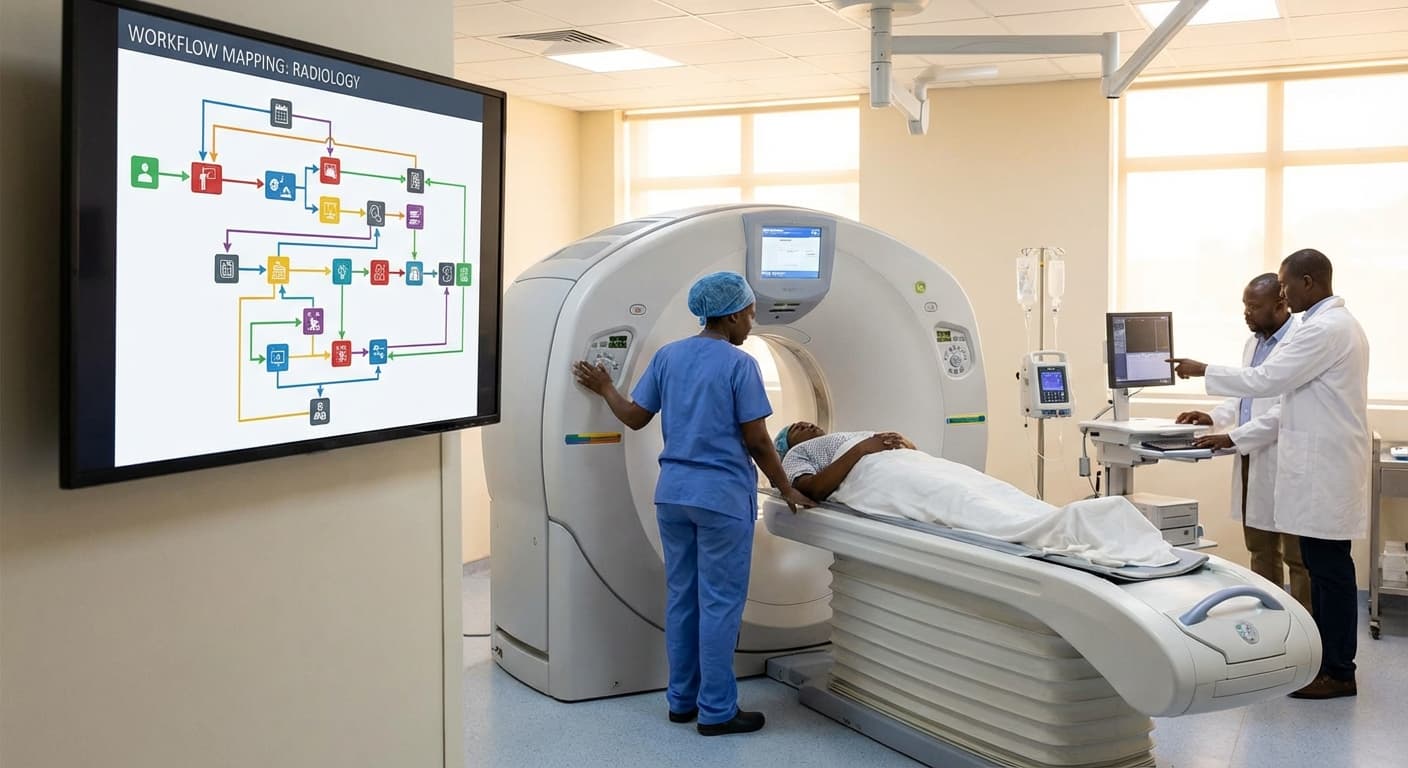
Department Workflow Mapping Service (Radiology/ICU/OT/Lab/Dialysis) in Sudan
Engineering Excellence & Technical Support
Department Workflow Mapping Service (Radiology/ICU/OT/Lab/Dialysis) High-standard technical execution following OEM protocols and local regulatory frameworks.
Streamlined Patient Flow from Admission to Discharge (Radiology)
Visualize and optimize the entire patient journey through the Radiology department, from initial request and scheduling to image acquisition, interpretation, and final report delivery. Identify bottlenecks and reduce turnaround times, ensuring faster diagnosis and treatment initiation for Sudanese patients.
Critical Care Pathway Optimization (ICU)
Map the intricate workflows within the Intensive Care Unit, detailing patient monitoring, intervention sequences, and interdisciplinary team communication. Enhance critical care delivery in Sudan by standardizing protocols and ensuring rapid response to life-threatening conditions.
Surgical Procedure Lifecycle Management (OT)
Deconstruct the entire surgical process from pre-operative assessment and scheduling to intra-operative management and post-operative care. Improve efficiency and patient safety in Operating Theatres across Sudan by mapping resource allocation and team coordination for various surgical specialties.
What Is Department Workflow Mapping Service (Radiology/icu/ot/lab/dialysis) In Sudan?
Department Workflow Mapping Service, particularly within specialized healthcare departments like Radiology, Intensive Care Units (ICU), Operating Theatres (OT), Laboratories, and Dialysis centers in Sudan, refers to a systematic process of analyzing, documenting, and visualizing the sequence of tasks, activities, information flows, and decision points involved in the operational processes of these departments. The primary objective is to identify inefficiencies, bottlenecks, redundancies, and areas for improvement in order to optimize resource utilization, enhance patient care delivery, and ensure regulatory compliance. This service is crucial for understanding the current state of operations (as-is) and designing an improved future state (to-be) that is more efficient, effective, and patient-centric within the Sudanese healthcare context.
| Department | Who Needs It | Typical Use Cases |
|---|---|---|
| Radiology | Hospital Administrators, Radiology Department Heads, Radiologists, Radiographers, IT Departments | Optimizing patient scheduling and throughput for imaging procedures; Streamlining image acquisition, interpretation, and reporting workflows; Improving PACS (Picture Archiving and Communication System) integration and data flow; Enhancing workflow for interventional radiology procedures; Identifying opportunities for automation in image analysis. |
| Intensive Care Unit (ICU) | Hospital Administrators, ICU Department Heads, Intensivists, Critical Care Nurses, Allied Health Professionals, IT Departments | Improving patient admission and transfer processes; Streamlining multidisciplinary team rounds and communication; Optimizing medication administration workflows; Enhancing patient monitoring and data recording processes; Reducing response times for critical events; Improving bed management and patient flow. |
| Operating Theatre (OT) | Hospital Administrators, Surgical Department Heads, Anesthesiologists, Surgeons, Perioperative Nurses, Sterilization Staff, IT Departments | Optimizing surgical case scheduling and room utilization; Streamlining patient preparation and handover to OT; Improving instrument and equipment management and sterilization workflows; Enhancing communication between surgical teams, anesthesia, and nursing staff; Reducing surgical delays and cancellations; Optimizing post-operative patient recovery and transfer. |
| Laboratory | Hospital Administrators, Laboratory Directors, Pathologists, Medical Laboratory Technicians, Phlebotomists, IT Departments | Improving sample collection, accessioning, and tracking; Streamlining analytical testing workflows for various departments (e.g., chemistry, hematology, microbiology); Optimizing result reporting and delivery; Enhancing quality control and assurance processes; Improving inventory management for reagents and consumables; Facilitating LIS (Laboratory Information System) integration and data accuracy. |
| Dialysis | Hospital Administrators, Nephrology Department Heads, Nephrologists, Dialysis Nurses, Biomedical Engineers, IT Departments | Optimizing patient scheduling for dialysis sessions; Streamlining patient preparation, treatment, and post-treatment procedures; Improving medication management for dialysis patients; Enhancing equipment maintenance and calibration workflows; Optimizing staff allocation and workload distribution; Improving communication with other departments for patient care continuity. |
Key Components of Department Workflow Mapping Service
- Process Identification and Scope Definition: Clearly defining the boundaries and specific processes to be mapped within each department (e.g., patient admission to discharge in ICU, sample processing in the lab, scheduling and execution of surgical procedures in OT).
- Data Collection and Analysis: Employing various techniques such as interviews with staff (clinicians, technicians, administrators), direct observation of activities, review of existing documentation (protocols, SOPs), and analysis of performance metrics to gather comprehensive data.
- Workflow Diagramming: Creating visual representations of workflows using standardized notation (e.g., Business Process Model and Notation - BPMN) to depict the sequence of activities, roles involved, decision points, and information exchange.
- Bottleneck and Inefficiency Identification: Systematically analyzing the mapped workflows to pinpoint areas of delay, resource underutilization, communication breakdowns, excessive manual interventions, and non-value-adding steps.
- Performance Measurement and Benchmarking: Establishing baseline performance metrics for key processes and, where feasible, benchmarking against industry best practices or national/regional standards.
- Redesign and Optimization Recommendations: Developing actionable recommendations for process improvement, including technology adoption, staff training, policy changes, and restructuring of roles and responsibilities.
- Implementation Planning and Support: Assisting in the development of phased implementation plans for the proposed improvements and providing guidance during the transition.
- Continuous Monitoring and Improvement Framework: Establishing mechanisms for ongoing monitoring of departmental workflows and fostering a culture of continuous improvement.
Who Needs Department Workflow Mapping Service (Radiology/icu/ot/lab/dialysis) In Sudan?
In Sudan's evolving healthcare landscape, the demand for efficient and streamlined operations within critical hospital departments is paramount. Department Workflow Mapping Services offer a crucial solution to identify bottlenecks, optimize resource allocation, and improve patient care delivery in high-intensity areas. These services are particularly vital for departments facing challenges such as high patient volumes, complex interdependencies, and the need for rapid decision-making.
| Department | Description of Need | Target Customers (within the department) | Specific Challenges Addressed |
|---|---|---|---|
| Radiology | Mapping the end-to-end process from patient referral to image acquisition, interpretation, reporting, and results dissemination. | Radiologists, Radiographers, Technicians, Department Heads, IT Support Staff | Long waiting times for imaging, inefficient reporting turnaround, equipment utilization, patient scheduling, image archiving and retrieval. |
| ICU (Intensive Care Unit) | Analyzing patient admission, treatment, monitoring, discharge, and inter-departmental communication pathways. | Intensivists, Critical Care Nurses, Respiratory Therapists, Pharmacists, Unit Managers | Patient handover protocols, medication management, ventilator management, resource allocation (beds, equipment), communication between shifts, infection control. |
| OT (Operating Theatre) | Mapping the surgical journey from pre-operative assessment to post-operative recovery, including scheduling, sterilization, and staff coordination. | Surgeons, Anesthesiologists, Surgical Nurses, Scrub Nurses, Anesthetic Technicians, Theatre Managers | Operating room scheduling efficiency, instrument and supply management, patient safety during surgery, staff rostering, equipment availability and maintenance. |
| Laboratory | Streamlining the process of sample collection, transportation, testing, quality control, and result reporting. | Pathologists, Laboratory Technicians, Phlebotomists, Lab Managers, IT Personnel | Sample integrity and tracking, turnaround times for test results, reagent and consumable management, equipment calibration and maintenance, reporting accuracy. |
| Dialysis | Analyzing the patient journey from referral and scheduling to treatment delivery, post-treatment care, and data management. | Nephrologists, Dialysis Nurses, Dialysis Technicians, Unit Coordinators, Biomedical Engineers | Patient scheduling and session management, equipment maintenance and sterilization, medication administration, infection control, water purification systems, data recording and reporting. |
Who Needs Department Workflow Mapping Service in Sudan?
- Hospitals and healthcare facilities seeking to enhance operational efficiency.
- Departments experiencing patient flow delays or backlogs.
- Institutions aiming to reduce errors and improve patient safety.
- Organizations looking to optimize resource utilization (staff, equipment, supplies).
- Facilities undergoing digital transformation or implementing new technologies.
- Government health ministries and regulatory bodies focused on improving healthcare standards.
Department Workflow Mapping Service (Radiology/icu/ot/lab/dialysis) Process In Sudan
This document outlines the typical workflow for engaging the Department Workflow Mapping Service for various specialized departments in Sudan, including Radiology, Intensive Care Unit (ICU), Operating Theatre (OT), Laboratory, and Dialysis. The service aims to analyze, document, and optimize existing operational processes within these critical hospital units. The workflow begins with an initial inquiry from a healthcare facility and culminates in the delivery of a comprehensive workflow map and recommendations.
| Stage | Description | Key Activities | Responsible Parties | Deliverables/Outputs |
|---|---|---|---|---|
| Inquiry & Initial Consultation | The healthcare facility expresses interest in the workflow mapping service. This stage involves understanding their high-level needs and determining if the service is a good fit. | Contacting the service provider, initial discussion of requirements, understanding departmental challenges. | Healthcare Facility Management/Department Heads, Service Provider Representative | Initial understanding of needs, scheduling of follow-up meetings. |
| Scope Definition & Needs Assessment | A more in-depth discussion to clearly define the specific department(s) to be mapped, the objectives of the mapping, and the desired outcomes. | Detailed needs assessment meetings, identifying specific pain points, defining the boundaries of the workflow to be mapped (e.g., patient journey, equipment management, staff allocation). | Healthcare Facility Stakeholders (Management, Department Heads, Key Staff), Service Provider Consultants | Agreed-upon scope of work, project objectives, key performance indicators (KPIs) for improvement, service agreement/proposal. |
| Data Collection & Analysis | Gathering comprehensive information about the current operational processes, systems, roles, and resources within the targeted department. | Observation of daily operations, interviews with staff at all levels, review of existing SOPs and documentation, system audits (e.g., EMR, lab information systems), data analysis (e.g., patient wait times, turnaround times, resource utilization). | Service Provider Consultants, Department Staff, IT Department (if applicable) | Raw data, interview notes, observation logs, preliminary analysis findings. |
| Workflow Mapping & Documentation | Translating the collected data into visual representations of the current workflows, clearly illustrating the sequence of steps, decision points, and involved parties. | Developing process flow diagrams (e.g., using BPMN or similar notation), documenting roles and responsibilities, identifying system interactions, creating data flow diagrams. | Service Provider Consultants | Draft workflow maps, documented process descriptions, initial identification of bottlenecks and inefficiencies. |
| Review & Validation | Presenting the draft workflow maps and findings to the relevant stakeholders for verification and feedback. | Presentation of draft maps to department heads and key staff, soliciting feedback and ensuring accuracy, validating data and assumptions. | Service Provider Consultants, Healthcare Facility Stakeholders | Validated workflow maps, confirmed process descriptions, agreement on identified issues. |
| Recommendation Development | Based on the validated workflow maps and identified inefficiencies, developing actionable recommendations for improvement. | Brainstorming improvement strategies, benchmarking against best practices, proposing process re-engineering, suggesting technology upgrades or changes in resource allocation. | Service Provider Consultants, input from Healthcare Facility Stakeholders | List of prioritized recommendations, potential benefits of each recommendation, estimated resources required. |
| Final Report & Presentation | Compiling all findings, validated workflow maps, and recommendations into a comprehensive report and presenting it to the facility's management and relevant departments. | Writing the final report, developing presentation materials, conducting a formal presentation and Q&A session. | Service Provider Consultants, Healthcare Facility Management | Final workflow mapping report, executive summary, presentation slides, official sign-off. |
| Implementation Support (Optional) | Providing assistance to the healthcare facility in implementing the recommended changes. | Project management for implementation, training staff on new processes, monitoring progress, providing ongoing consultation. | Service Provider Consultants (if contracted), Healthcare Facility Implementation Team | Successful implementation of recommendations, improved operational efficiency, measurable impact on KPIs. |
Workflow Stages
- Inquiry & Initial Consultation
- Scope Definition & Needs Assessment
- Data Collection & Analysis
- Workflow Mapping & Documentation
- Review & Validation
- Recommendation Development
- Final Report & Presentation
- Implementation Support (Optional)
Department Workflow Mapping Service (Radiology/icu/ot/lab/dialysis) Cost In Sudan
The cost of departmental workflow mapping services for specialized units like Radiology, Intensive Care Unit (ICU), Operating Theatre (OT), Laboratory, and Dialysis in Sudan can vary significantly based on several factors. These services are crucial for optimizing efficiency, patient safety, and resource utilization within these high-stakes environments. Understanding the pricing structure involves considering the scope of work, the expertise of the service provider, the complexity of the department, and the duration of the engagement. Typically, these services involve detailed analysis of existing processes, identification of bottlenecks, development of standardized operating procedures (SOPs), and implementation of recommendations. The price is generally quoted as a project-based fee rather than an hourly rate due to the comprehensive nature of the work.
| Department Type | Estimated Cost Range (SDG) | Typical Scope Focus |
|---|---|---|
| Radiology | 150,000 - 400,000 | Patient registration, imaging scheduling, procedure workflow, reporting, equipment utilization, image archiving, inter-departmental referrals. |
| Intensive Care Unit (ICU) | 200,000 - 500,000 | Patient admission/transfer, monitoring protocols, medication administration, ventilator management, infection control, communication among care teams, discharge planning. |
| Operating Theatre (OT) | 250,000 - 600,000 | Pre-operative patient preparation, surgical scheduling, instrument sterilization, scrub nurse workflow, anesthesia procedures, post-operative care transition, room turnover. |
| Laboratory | 120,000 - 350,000 | Sample collection and handling, test request processing, analytical procedures, quality control, result reporting, inventory management, specimen storage. |
| Dialysis | 180,000 - 450,000 | Patient scheduling, pre-dialysis assessment, dialysis treatment procedures, fluid management, medication administration, post-dialysis monitoring, machine maintenance, infection control. |
Key Pricing Factors for Workflow Mapping Services in Sudan
- Scope of Services: The depth of analysis required. Does it cover only the core processes, or also ancillary services, patient flow from admission to discharge, and inter-departmental communication?
- Departmental Size and Complexity: Larger departments with multiple sub-specialties or complex equipment (e.g., a large radiology department with MRI, CT, X-ray, ultrasound, or an OT with multiple suites) will naturally incur higher costs.
- Provider Expertise and Reputation: Consulting firms or individuals with a proven track record in healthcare workflow optimization, particularly within the Sudanese context, will command higher fees.
- Duration of Engagement: The time required for data collection, analysis, report generation, and implementation support. Longer projects will be more expensive.
- Level of Detail in Deliverables: The requirement for highly detailed SOPs, comprehensive training materials, or custom software integration will impact the cost.
- Travel and Accommodation (if applicable): If the consultants are based in a different city or region within Sudan, these costs will be factored in.
- Data Collection Methods: The use of advanced data analytics tools, direct observation, interviews, and surveys all contribute to the overall effort and cost.
- Number of Stakeholders Involved: The more individuals and teams that need to be consulted and trained, the greater the logistical effort and thus cost.
Affordable Department Workflow Mapping Service (Radiology/icu/ot/lab/dialysis) Options
Our Affordable Department Workflow Mapping Service is designed to streamline operations, identify bottlenecks, and implement cost-saving strategies across critical hospital departments including Radiology, Intensive Care Units (ICU), Operating Theatres (OT), Laboratories, and Dialysis Centers. We provide clear visualizations of your current processes, enabling data-driven improvements that enhance efficiency, reduce waste, and improve patient care outcomes. Our service focuses on delivering tangible value through optimized workflows, leading to significant cost savings and improved resource utilization.
| Value Bundle | Included Services | Target Department(s) | Estimated Cost Range (USD) | Key Cost-Saving Strategies Addressed |
|---|---|---|---|---|
| Essential Workflow Mapping | Initial process assessment, flowchart creation, bottleneck identification, basic recommendation report. | Radiology, Lab, Dialysis | $3,000 - $7,000 | Reduced redundant tasks, optimized equipment scheduling, improved sample turnaround time. |
| Comprehensive Department Optimization | Detailed process mapping, root cause analysis, stakeholder interviews, advanced bottleneck resolution, optimization plan with phased implementation guidance. | ICU, OT | $7,000 - $15,000 | Improved patient flow, optimized staff deployment, reduced procedure delays, enhanced resource sharing. |
| Integrated Departmental Synergy | Cross-departmental workflow mapping, inter-departmental dependency analysis, communication protocol development, integrated process improvement plan. | Radiology & ICU, OT & Lab, etc. | $12,000 - $25,000+ | Reduced inter-departmental delays, streamlined patient transitions, improved information sharing, reduced duplicate testing/imaging. |
| Advanced Data Analytics & Automation Integration | All comprehensive services plus data collection strategy, performance metric definition, identification of automation opportunities (e.g., EHR integration, robotic process automation), ROI analysis for automation. | All Departments | $20,000 - $50,000+ | Significant reduction in manual tasks, improved data accuracy, enhanced predictive capabilities, optimized supply chain management. |
Key Benefits of Workflow Mapping
- Identify and eliminate redundant steps or tasks.
- Reduce wait times and improve patient throughput.
- Optimize staff allocation and utilization.
- Enhance communication and collaboration between departments.
- Minimize errors and rework.
- Improve inventory management and reduce waste.
- Ensure compliance with regulatory standards.
- Drive continuous process improvement.
Verified Providers In Sudan
Navigating the healthcare landscape in Sudan requires trust and reliability. Verified providers are crucial for ensuring quality care, and Franance Health stands out as a leader in this regard. Their rigorous credentialing process and commitment to patient well-being make them the preferred choice for many.
| Credentialing Aspect | Franance Health's Approach | Benefit to Patients |
|---|---|---|
| Professional Licensure Verification | Thorough checks of all medical licenses and certifications. | Ensures providers meet all regulatory and professional standards. |
| Experience and Expertise Assessment | Review of professional history, specialized training, and peer references. | Guarantees access to experienced specialists for diverse medical needs. |
| Background Checks | Comprehensive screening to ensure patient safety and ethical conduct. | Provides peace of mind and a secure healthcare environment. |
| Continuous Professional Development | Encourages and tracks ongoing education and training for providers. | Keeps patients informed about the latest medical advancements and treatments. |
| Patient Feedback and Performance Monitoring | Regular collection and analysis of patient satisfaction and outcome data. | Drives continuous improvement and ensures high service standards. |
Why Franance Health is the Top Choice for Verified Providers in Sudan:
- Unwavering commitment to patient safety and quality of care.
- Extensive network of highly qualified and vetted healthcare professionals.
- Transparent and ethical operational practices.
- Focus on accessibility and affordability of essential health services.
- Utilizing advanced technologies for efficient healthcare delivery.
Scope Of Work For Department Workflow Mapping Service (Radiology/icu/ot/lab/dialysis)
This Scope of Work (SOW) outlines the services to be provided for the comprehensive mapping of departmental workflows within key hospital areas. The objective is to analyze, document, and standardize existing processes to identify inefficiencies, redundancies, and areas for improvement, ultimately leading to enhanced operational efficiency, patient safety, and resource utilization. The service will encompass Radiology, Intensive Care Unit (ICU), Operating Theater (OT), Laboratory (Lab), and Dialysis departments.
| Department | Workflow Mapping Scope | Key Process Areas to Document |
|---|---|---|
| Radiology | From patient scheduling and arrival to image acquisition, interpretation, reporting, and archival. Includes pre-procedure preparation, post-procedure follow-up, and equipment maintenance workflows. | Patient registration and check-in, Modality scheduling (X-ray, CT, MRI, Ultrasound, PET), Image acquisition protocols, Contrast administration procedures, Radiologist interpretation and dictation, Report generation and distribution, Image archival and retrieval, Quality control checks, Patient preparation and post-procedure instructions. |
| Intensive Care Unit (ICU) | Encompasses patient admission, monitoring, treatment delivery, multidisciplinary rounds, transfer out, and discharge. Includes critical care interventions, medication management, and communication protocols. | Patient admission and initial assessment, Vital signs monitoring and documentation, Ventilator management protocols, Medication administration and reconciliation, Fluid and electrolyte management, Nutritional support, Pain management and sedation, Multidisciplinary team rounds, Infection control procedures, Patient handover and transfer, Discharge planning and execution. |
| Operating Theater (OT) | Covers pre-operative patient preparation, intra-operative procedures, anesthesia management, surgical team coordination, post-operative recovery, and sterile processing. | Patient pre-operative assessment and preparation, Anesthesia induction and maintenance, Surgical procedure steps and documentation, Instrument and equipment management, Sterilization and reprocessing of surgical instruments, Operating room setup and turnover, Post-anesthesia care unit (PACU) management, Surgical team communication and coordination, Waste management and disposal. |
| Laboratory (Lab) | From sample collection and accessioning to testing, quality control, result reporting, and sample disposal. Includes pre-analytical, analytical, and post-analytical phases. | Patient identification and sample collection, Sample accessioning and labeling, Sample transportation and storage, Specimen preparation and processing, Test methodology and execution, Quality control (QC) and quality assurance (QA) procedures, Result validation and verification, Report generation and distribution, Instrument maintenance and calibration, Biohazard waste management. |
| Dialysis | Includes patient assessment, dialysis prescription, treatment delivery, monitoring, and post-treatment care. Covers both hemodialysis and peritoneal dialysis if applicable. | Patient pre-treatment assessment and vital signs, Dialysis prescription and scheduling, Vascular access preparation, Dialysis treatment initiation and monitoring, Fluid management and ultrafiltration, Medication administration during dialysis, Post-treatment assessment and monitoring, Dialysis machine setup and disinfection, Patient education and self-care, Waste management and disposal. |
Key Objectives
- To accurately document current state workflows for each specified department.
- To identify bottlenecks, inefficiencies, and areas of risk within existing processes.
- To propose optimized future state workflows incorporating best practices and technological advancements.
- To develop standardized process documentation for each department.
- To facilitate knowledge transfer and build internal capacity for ongoing workflow management.
Service Level Agreement For Department Workflow Mapping Service (Radiology/icu/ot/lab/dialysis)
This Service Level Agreement (SLA) outlines the performance standards and support commitments for the Department Workflow Mapping Service. This service is designed to document, analyze, and optimize workflows within key hospital departments, including Radiology, Intensive Care Unit (ICU), Operating Theatre (OT), Laboratory, and Dialysis. The SLA defines response times for critical issues and guarantees a minimum uptime for the workflow mapping platform and associated support.
| Service Component | Response Time Target (Business Hours) | Resolution Time Target (Business Hours) | Uptime Guarantee |
|---|---|---|---|
| Core Workflow Mapping Platform (Access & Functionality) | 1 Hour (Critical Issue), 4 Business Hours (Non-Critical Issue) | 4 Business Hours (Critical Issue), 8 Business Hours (Non-Critical Issue) | 99.5% |
| Workflow Data Input & Retrieval | 2 Business Hours | 6 Business Hours | 99.5% |
| Workflow Analysis & Reporting Tools | 4 Business Hours | 8 Business Hours | 99.0% |
| Technical Support (Phone/Email/Ticketing System) | 1 Business Hour (Acknowledgement) | N/A (Resolution varies based on issue complexity) | N/A |
| Scheduled Maintenance (Notification required 48 hours in advance) | N/A | N/A | N/A (Downtime for scheduled maintenance is excluded from uptime calculations) |
Applicability
- Radiology Department Workflow Mapping Service
- Intensive Care Unit (ICU) Workflow Mapping Service
- Operating Theatre (OT) Workflow Mapping Service
- Laboratory Department Workflow Mapping Service
- Dialysis Department Workflow Mapping Service
Frequently Asked Questions

Ready when you are
Let's scope your Department Workflow Mapping Service (Radiology/ICU/OT/Lab/Dialysis) in Sudan project in Sudan.

Scaling healthcare logistics and technical systems across the entire continent.