
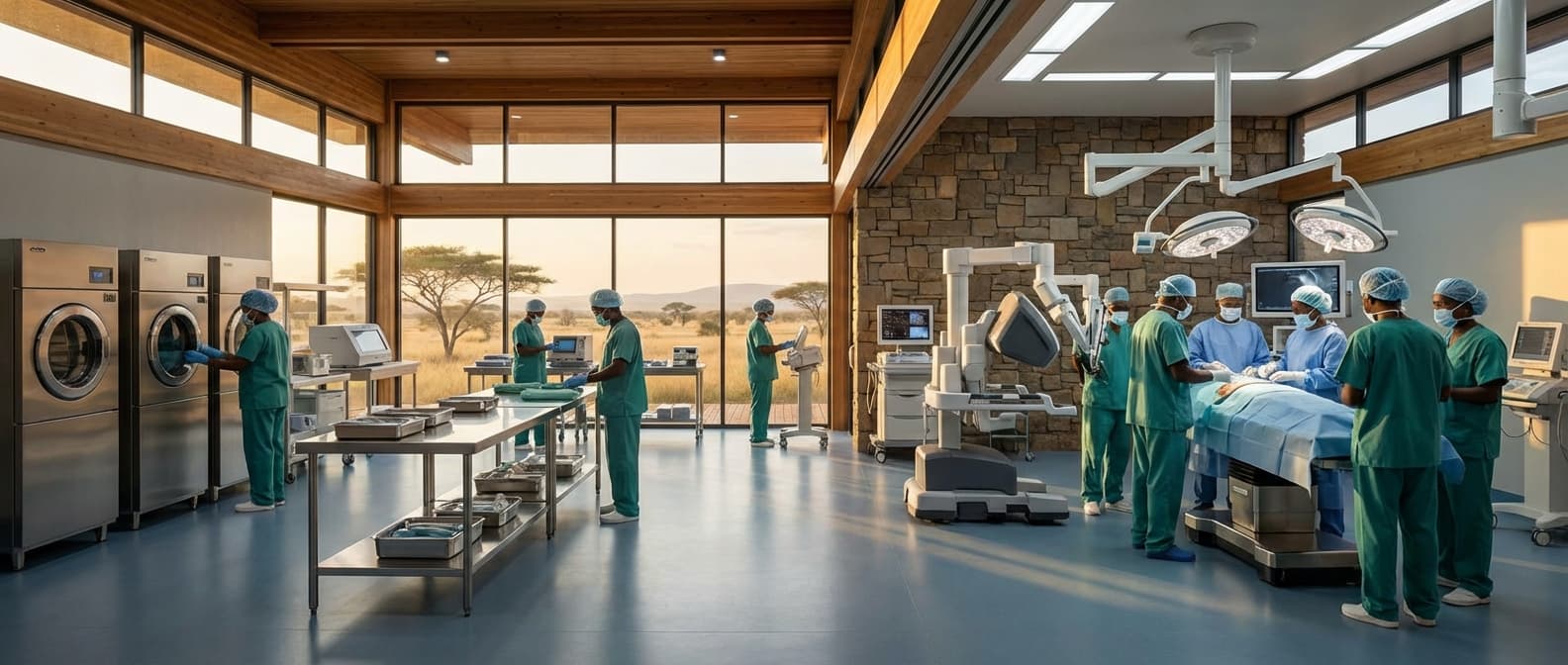
Operating Theatre Turnkey Build in Sudan
Engineering Excellence & Technical Support
Complete OR design, equipment integration and commissioning High-standard technical execution following OEM protocols and local regulatory frameworks.
Accelerated Project Delivery
Our streamlined turnkey approach ensures rapid construction and outfitting of state-of-the-art operating theatres in Sudan, minimizing project timelines and enabling swift deployment of critical medical facilities.
Integrated Medical-Grade Systems
We provide comprehensive installation of all essential medical-grade systems, including HVAC, medical gases, electrical power, lighting, and sterile environments, ensuring a fully operational and compliant operating theatre from day one.
Localized Expertise & Global Standards
Leveraging deep understanding of Sudanese logistical and regulatory landscapes, we deliver turnkey solutions that adhere to international healthcare construction standards, ensuring safety, efficacy, and long-term sustainability.
What Is Operating Theatre Turnkey Build In Sudan?
An Operating Theatre Turnkey Build in Sudan refers to a comprehensive service that delivers a fully functional, state-of-the-art operating theatre (OT) from initial design through to final handover. This approach consolidates all aspects of the project, including architectural design, construction, medical equipment procurement and installation, specialized MEP (Mechanical, Electrical, and Plumbing) systems, and regulatory compliance, under a single contractual agreement with a specialized provider. The 'turnkey' nature signifies that the client receives a ready-to-operate facility with minimal direct involvement in the minutiae of construction and integration. This is particularly relevant in regions like Sudan where local expertise in advanced healthcare infrastructure development may be limited, or where the client (typically a hospital or healthcare institution) wishes to outsource the complexities to ensure timely completion and adherence to international standards.
| Stakeholder Category | Primary Needs/Drivers | Typical Use Cases |
|---|---|---|
| Public Hospitals (e.g., Ministry of Health facilities) | Upgrading outdated infrastructure, expanding capacity, improving infection control, accessing advanced surgical capabilities, adherence to national health mandates. | Replacement of an aging OT suite; construction of new specialized surgical centers (e.g., cardiac, neurosurgery); expansion of general surgery capacity. |
| Private Hospitals & Clinics | Enhancing service offerings, attracting specialized surgeons, improving patient outcomes, achieving international accreditation, competitive differentiation, maximizing ROI. | Establishment of a new hospital with modern OT facilities; expansion of a multi-specialty surgical department; integration of minimally invasive surgery suites. |
| Non-Governmental Organizations (NGOs) & Humanitarian Aid Organizations | Rapid deployment of essential surgical services in underserved or post-conflict areas, disaster relief, provision of specialized medical missions. | Setting up temporary or semi-permanent surgical units in emergency response scenarios; establishing surgical capacity for specific health campaigns (e.g., fistula repair, trauma care). |
| Research & Teaching Institutions | Creating advanced training environments, facilitating surgical research, implementing innovative surgical techniques, attracting top medical talent. | Development of a dedicated surgical training OT; integration of advanced imaging and robotic surgery platforms for research and education. |
Service Components of an Operating Theatre Turnkey Build in Sudan:
- Feasibility Studies & Site Assessment: Evaluating the proposed location, assessing structural integrity, and determining spatial requirements.
- Architectural & Engineering Design: Developing detailed blueprints for the OT suite, including layout, workflows, infection control principles, and aesthetic considerations.
- Civil Construction & Renovation: Executing the physical build or modification of the operating theatre space, adhering to strict hygiene and safety regulations.
- Specialized MEP Systems Integration: Installation of critical systems such as laminar airflow, HVAC (with HEPA filtration and positive pressure), medical gas pipelines (oxygen, medical air, vacuum), emergency power backup, advanced lighting systems (surgical lights, ambient lighting), and nurse call systems.
- Medical Equipment Procurement & Installation: Sourcing, purchasing, and integrating a full range of surgical equipment, including anesthesia machines, ventilators, surgical tables, electrosurgical units, patient monitors, and sterilization equipment.
- Information Technology (IT) Integration: Setting up IT infrastructure for electronic health records (EHR), PACS (Picture Archiving and Communication Systems), and telemedicine capabilities, if required.
- Sterilization & Waste Management Systems: Implementing appropriate systems for instrument sterilization and biohazard waste disposal.
- Regulatory Compliance & Certification: Ensuring adherence to national (Sudanese) and international healthcare standards (e.g., Joint Commission International - JCI) and obtaining necessary permits and certifications.
- Commissioning & Training: Thorough testing of all systems and equipment, followed by comprehensive training for clinical and technical staff on operation and maintenance.
- Post-Handover Support: Provision of warranty, maintenance services, and ongoing technical support.
Who Needs Operating Theatre Turnkey Build In Sudan?
Operating theatre turnkey builds in Sudan are essential for healthcare facilities seeking to establish or upgrade their surgical capabilities to international standards. These comprehensive solutions provide everything from initial design and construction to the installation of state-of-the-art medical equipment, ensuring a fully functional and compliant operating theatre. The demand for such services is driven by the need for enhanced patient care, reduced infection rates, improved surgical outcomes, and the capacity to perform complex procedures.
| Customer Segment | Typical Departments Requiring Turnkey Build | Key Needs/Drivers |
|---|---|---|
| Major Public Hospitals | General Surgery, Orthopedics, Obstetrics & Gynecology, Urology, Neurosurgery, Cardiovascular Surgery, Emergency Surgery, Pediatric Surgery | High patient volume, need for standardized infection control, ability to handle diverse surgical specialties, outdated existing infrastructure. |
| Private Hospitals & Clinics | Plastic Surgery, Ophthalmology, Dentistry (complex procedures), IVF (surgical aspects), Fertility Treatments, Elective Surgery (various specialties) | Attracting high-paying clientele, offering specialized cosmetic or elective procedures, competitive advantage through advanced technology, premium patient experience. |
| Teaching Hospitals & Medical Universities | All surgical specialties, research & development surgical suites, simulation labs with integrated surgical environments | Training future surgeons to international standards, facilitating medical research, providing cutting-edge diagnostic and treatment capabilities for complex cases. |
| Missions & Humanitarian Organizations | Emergency Surgery, Trauma Surgery, Obstetrics & Gynecology (maternal health focus), General Surgery (essential services) | Rapid deployment capabilities, remote area suitability, cost-effectiveness with high impact, ability to provide life-saving procedures in challenging environments. |
| Government Health Projects | Regional referral hospitals, rural health centers with surgical capacity, specialized national institutes (e.g., cancer centers) | Improving national healthcare access, addressing regional disparities, standardizing healthcare delivery, capacity building for the healthcare workforce. |
Target Customers and Departments for Operating Theatre Turnkey Builds in Sudan
- Hospitals (Public & Private): The primary beneficiaries, requiring modern surgical infrastructure to meet growing healthcare demands.
- Specialized Surgical Centers: Facilities focusing on specific surgical disciplines.
- Missions and NGOs: Organizations providing healthcare services in underserved regions or during crises.
- Government Health Ministries: For public healthcare system upgrades and the establishment of new facilities.
- Military Hospitals: Requiring robust and adaptable surgical units for combat or general medical needs.
Operating Theatre Turnkey Build Process In Sudan
This document outlines the typical workflow for an Operating Theatre (OT) turnkey build process in Sudan, from the initial client inquiry to the final execution and handover. A turnkey solution signifies a comprehensive service where the contractor manages all aspects of the project, delivering a fully functional operating theatre ready for use.
| Stage | Description | Key Activities | Typical Duration (Sudan Context) | Key Considerations (Sudan Context) |
|---|---|---|---|---|
| Inquiry & Initial Consultation | The client (hospital, clinic, government agency) expresses interest and provides initial project requirements. | Understanding client needs, budget, and timeline. Preliminary discussion of scope of work. Site visit potential. | 1-2 Weeks | Cultural nuances in business dealings. Language barriers. Establishing trust. |
| Site Assessment & Feasibility Study | A thorough evaluation of the proposed construction site and the project's viability. | Site surveys (geotechnical, topographical). Utility availability assessment (power, water, waste). Regulatory compliance check. Risk assessment. | 2-4 Weeks | Infrastructure reliability (power outages, water scarcity). Land ownership and permits. Local building codes and standards. |
| Conceptual Design & Proposal Development | Developing an initial design concept and a detailed proposal outlining the project scope, timeline, and cost. | Space planning. Preliminary architectural drawings. Equipment list generation. Cost estimation. Project schedule outline. Risk mitigation strategies. | 3-6 Weeks | Availability of local design expertise. Cost fluctuations of materials and labor. Understanding of international healthcare standards vs. local capabilities. |
| Detailed Design & Engineering | Translating the conceptual design into detailed architectural, structural, MEP, and specialized system designs. | Finalizing architectural layouts. Structural engineering calculations. MEP system design (HVAC, medical gases, electrical, plumbing). Designing specialized systems (laminar flow, radiation shielding, etc.). Obtaining necessary approvals. | 6-12 Weeks | Access to specialized engineering software and expertise. Coordination with local authorities for permits. Importation of specialized design components. |
| Procurement & Supply Chain Management | Sourcing and acquiring all necessary materials, equipment, and components. | Identifying suppliers (local and international). Negotiating contracts. Managing logistics and customs clearance. Inventory management. Quality control. | 8-16 Weeks (Ongoing) | Import/export regulations and duties. Shipping delays and costs. Availability of specific building materials and medical equipment. Local vs. international sourcing balance. |
| Construction & Civil Works | The physical construction of the operating theatre space. | Site preparation. Foundation work. Building shell construction. Interior finishing (walls, floors, ceilings). Installation of doors and windows. | 12-24 Weeks | Skilled labor availability and quality. Weather conditions. Security of the construction site. Dust and noise control. |
| MEP & Specialized Systems Installation | Installing mechanical, electrical, plumbing, and specialized medical systems. | HVAC system installation (including HEPA filters). Medical gas pipeline installation. Electrical wiring and lighting systems. Plumbing and drainage. Nurse call systems. Communication systems. Radiation shielding. | 10-20 Weeks | Specialized technicians for medical gases and HVAC. Strict adherence to safety and quality standards. Power redundancy and backup systems. |
| Medical Equipment Integration | Installing and connecting all medical equipment within the operating theatre. | Placing and mounting surgical lights, anesthesia machines, patient monitors, surgical tables, imaging equipment, etc. Connecting power and medical gas outlets. Integrating IT systems. | 4-8 Weeks | Compatibility of equipment with existing infrastructure. Availability of qualified technicians for installation and calibration. Manufacturer support availability. |
| Testing, Commissioning & Validation | Thorough testing of all systems and equipment to ensure they function correctly and meet required standards. | Functional testing of MEP systems. Air quality testing (particle count, differential pressure). Medical gas system leak testing. Equipment performance testing. Final inspection and snagging. | 3-6 Weeks | Availability of calibrated testing equipment. Qualified personnel for validation. Regulatory body approvals and certifications. |
| Training & Handover | Training hospital staff on the operation and maintenance of the new operating theatre and its equipment. Formal handover of the project. | User manuals provision. Practical training sessions for clinical and technical staff. Warranty information. As-built drawings and documentation. | 1-2 Weeks | Language of training materials. Availability of hospital staff for training. Post-training support needs. |
| Post-Handover Support & Maintenance | Providing ongoing support and maintenance services after the project completion. | Warranty support. Scheduled maintenance. Troubleshooting and repairs. Spare parts management. | Ongoing | Establishing reliable maintenance contracts. Availability of spare parts locally. Long-term service agreements. |
Operating Theatre Turnkey Build Process in Sudan: Workflow
- Inquiry & Initial Consultation
- Site Assessment & Feasibility Study
- Conceptual Design & Proposal Development
- Detailed Design & Engineering
- Procurement & Supply Chain Management
- Construction & Civil Works
- MEP (Mechanical, Electrical, Plumbing) & Specialized Systems Installation
- Medical Equipment Integration
- Testing, Commissioning & Validation
- Training & Handover
- Post-Handover Support & Maintenance
Operating Theatre Turnkey Build Cost In Sudan
Establishing a fully operational operating theatre (OT) in Sudan, often referred to as a turnkey build, involves a comprehensive process from initial design to final commissioning. The cost for such a project can fluctuate significantly due to a variety of factors, making it challenging to provide a single definitive price. These factors range from the size and complexity of the OT, the quality of materials and equipment chosen, the contractor's expertise, regulatory compliance, and the prevailing economic conditions in Sudan, including inflation and currency exchange rates. Understanding these elements is crucial for accurate budgeting and successful project execution.
| Category | Estimated Cost Range (SDG) | Notes |
|---|---|---|
| Basic, Small Operating Theatre (approx. 30-50 sqm) | 100,000,000 - 300,000,000 | Includes essential equipment, basic finishes, standard HVAC. May be suitable for simpler procedures or as an upgrade to an existing facility. |
| Standard, Medium Operating Theatre (approx. 50-80 sqm) | 300,000,000 - 800,000,000 | Good quality materials, advanced medical equipment (e.g., modern anesthesia machine, surgical lights), robust HVAC and medical gas systems. |
| Advanced/Specialized Operating Theatre (approx. 80+ sqm) | 800,000,000 - 2,000,000,000+ | High-end finishes, state-of-the-art medical equipment (e.g., integrated OT systems, advanced imaging), hybrid OR capabilities, comprehensive medical gas systems, advanced infection control measures. |
| Medical Equipment (Percentage of Total Project Cost) | 40% - 65% | Highly variable depending on the type and quantity of specialized surgical and diagnostic equipment. |
| Construction & Finishes (Percentage of Total Project Cost) | 25% - 40% | Includes structural work, interior finishing, flooring, walls, ceilings, and specialized hygiene requirements. |
| HVAC & Medical Gas Systems (Percentage of Total Project Cost) | 10% - 20% | Crucial for infection control and patient safety. Costs increase with advanced filtration and multiple gas lines. |
| Architectural, Engineering & Consultancy Fees (Percentage of Total Project Cost) | 5% - 10% | Essential for proper design, planning, and project oversight. |
Key Pricing Factors for Operating Theatre Turnkey Builds in Sudan
- Scope of Works: The overall size of the operating theatre suite (number of OT rooms, pre-op, post-op, sterile supply units, etc.), the complexity of the design (e.g., specialized surgical areas, hybrid ORs), and the required infrastructure (ventilation, power, plumbing) heavily influence costs.
- Quality of Materials and Finishes: The choice of flooring, wall finishes, ceiling materials, lighting fixtures, and doors impacts the budget. High-grade, anti-microbial, and durable materials typically command higher prices.
- Medical Equipment: This is often the most significant cost component. It includes surgical tables, anesthesia machines, surgical lights, patient monitors, electro-surgical units, sterilization equipment, imaging devices (e.g., C-arms), and specialized surgical instruments. The brand, model, and newness (new vs. refurbished) of equipment are critical determinants.
- HVAC and Medical Gas Systems: Sophisticated air handling units (AHUs) with HEPA filtration for sterile environments and reliable medical gas pipelines (oxygen, medical air, vacuum) are essential and contribute substantially to the cost.
- Electrical and Plumbing Infrastructure: Robust electrical systems with backup generators and uninterrupted power supplies (UPS) are vital. Similarly, specialized plumbing for medical waste management and sterile water supply adds to the expense.
- Architectural and Engineering Design: The fees for qualified architects and engineers to design the OT to international standards and local regulations are a necessary upfront investment.
- Contractor's Fees and Overhead: The chosen construction company's experience, reputation, project management capabilities, and profit margins will be factored into the overall cost.
- Regulatory Compliance and Approvals: Obtaining necessary permits, licenses, and ensuring compliance with Ministry of Health regulations and international healthcare standards can incur fees and require specialized expertise.
- Logistics and Transportation: Importing specialized equipment and materials into Sudan can involve significant shipping, customs duties, and local transportation costs, especially for remote locations.
- Contingency: It is prudent to include a contingency fund (typically 10-20%) to account for unforeseen issues, design changes, or price escalations during the project.
- Inflation and Currency Fluctuations: Sudan has experienced periods of high inflation and volatile currency exchange rates. These economic factors directly impact the cost of imported materials and equipment, as well as local labor and services.
Affordable Operating Theatre Turnkey Build Options
Establishing a fully functional operating theatre is a significant undertaking, often associated with high costs. However, by understanding value bundles and implementing strategic cost-saving measures, healthcare facilities can achieve their goals within budget. This guide explores affordable operating theatre turnkey build options, focusing on what constitutes value and how to optimize expenditure.
| Value Bundle Type | Description | Cost-Saving Strategies Applicable | Typical Use Case |
|---|---|---|---|
| Basic Essentials Package | Includes foundational equipment and infrastructure for standard surgical procedures. Focuses on core functionality and compliance. | Focus on essential medical gas systems, basic lighting, standard operating table, anesthesia machine, and essential surgical instruments. Opt for reliable but not necessarily top-of-the-line brands. | New clinics, smaller surgical centers, or facilities with limited procedural scope. |
| Standard Functionality Bundle | Expands on the basic package with enhanced features for a wider range of procedures. Includes improved imaging capabilities and more specialized equipment. | Consider package deals for integrated anesthesia and ventilation systems. Explore 'bundle' discounts on imaging equipment (e.g., C-arm). Choose multi-functional equipment where possible. | Medium-sized hospitals, specialized surgical units, or facilities performing a moderate variety of surgeries. |
| Advanced Procedure Ready Bundle | Designed for complex surgeries requiring advanced technology, integrated navigation, high-definition imaging, and specialized monitoring. | Prioritize modular design for future upgrades. Leverage long-term service agreements for advanced equipment to manage maintenance costs. Investigate leasing options for high-cost items. | Tertiary care hospitals, centers of excellence, or facilities performing highly specialized and complex procedures. |
| Refurbished & Certified Pre-Owned Option | Utilizes professionally refurbished and certified pre-owned medical equipment and potentially modular theatre components. Significantly reduces upfront capital expenditure. | Thoroughly vet refurbishment companies and their warranties. Consider this for non-critical or less frequently used equipment first. Negotiate bulk discounts on multiple refurbished items. | Budget-conscious facilities, educational institutions, or departments needing to expand capacity without a large capital outlay. |
Key Considerations for Affordable Turnkey Operating Theatres
- Defining Scope and Requirements:
- Understanding different 'turnkey' levels of service.
- Prioritizing essential equipment and features.
- Researching and selecting reputable, cost-effective suppliers.
- Considering modular or prefabricated construction where applicable.
- Exploring refurbished or certified pre-owned equipment options.
- Negotiating effectively with contractors and suppliers.
- Phased implementation to manage cash flow.
Verified Providers In Sudan
Ensuring access to quality healthcare in Sudan is paramount, and identifying verified providers is a crucial step. Franance Health stands out as a leading credentialing body, rigorously vetting healthcare professionals and facilities to guarantee a high standard of care. Their comprehensive verification process instills confidence in patients seeking reliable medical services.
| Credentialing Aspect | Franance Health's Approach | Benefit to Patients |
|---|---|---|
| Professional Qualifications | Verification of degrees, licenses, and certifications. | Ensures providers possess the necessary expertise and training. |
| Clinical Experience | Scrutiny of practice history and professional references. | Confirms practical application of knowledge and skills. |
| Facility Standards | Assessment of infrastructure, equipment, and hygiene protocols. | Guarantees a safe and well-equipped environment for treatment. |
| Ethical Compliance | Review of adherence to medical ethics and best practices. | Promotes responsible and trustworthy healthcare delivery. |
| Continuing Education | Confirmation of engagement in ongoing professional development. | Ensures providers stay updated with the latest medical advancements. |
Why Franance Health Credentials Represent the Best Choice:
- Uncompromising commitment to patient safety and quality of care.
- Rigorous vetting of medical professionals' qualifications and experience.
- Thorough inspection of healthcare facilities for compliance with international standards.
- Independent and unbiased evaluation process.
- Enhanced trust and confidence for patients seeking medical services.
- Promotion of ethical practices and professional conduct within the Sudanese healthcare sector.
Scope Of Work For Operating Theatre Turnkey Build
This Scope of Work (SOW) outlines the requirements for the turnkey construction and commissioning of a state-of-the-art Operating Theatre (OT). It details the technical deliverables and standard specifications to ensure a fully functional, safe, and compliant OT environment, ready for immediate use. The project encompasses all phases from design and procurement to installation, testing, validation, and handover.
| Category | Technical Deliverable | Standard Specifications / Requirements | Verification Method |
|---|---|---|---|
| Structural & Architectural | OT Room Construction | Seamless, coved flooring (e.g., anti-microbial vinyl/epoxy). Seamless, coved walls and ceiling. Lead shielding for X-ray protection (if required). Wall and ceiling materials to be non-porous, cleanable, and fire-retardant (e.g., HPL panels, specialty paint). Recessed, flush-mounted lighting and equipment. Integrated service panels for gases, power, and data. Anti-static properties for flooring and wall finishes. Adequate soundproofing. | Visual Inspection, Material Certification, Performance Testing (e.g., lead equivalence test). |
| HVAC & Environmental Control | Air Handling Unit (AHU) and Filtration | Positive pressure differential relative to adjacent areas (e.g., +15 Pa). HEPA filtration for supply air (minimum MERV 17 / ISO Class 5 environment). Temperature and humidity control (e.g., 20-24°C, 40-60% RH). Adequate air changes per hour (e.g., 20-25 ACPH). Laminar flow capabilities (if specified). Redundant AHU systems for critical areas. | Performance Testing (temperature, humidity, pressure differential, air flow), Air Particle Count Testing, Filter Integrity Testing. |
| Electrical & Power | Power Distribution and Backup | Isolated medical power systems with ground fault interruption (GFI). UPS backup for critical equipment (e.g., anesthesia machines, monitors). Emergency generator backup for essential services. Color-coded outlets for medical gases and power. Adequate lighting levels (e.g., 1000-2000 lux for general, higher for surgical field). Integrated medical gas outlets (N2O, O2, Air, Vacuum) meeting international standards (e.g., DIN, BS, NIST). Emergency shut-off valves accessible. | Electrical Safety Testing, UPS/Generator Load Testing, Lighting Level Measurement, Medical Gas Outlet Functionality Test. |
| Medical Gas Systems | Medical Gas Supply and Distribution | Medical grade gases (Oxygen, Nitrous Oxide, Medical Air, Vacuum, etc.) as per relevant standards. Pressure regulation and monitoring systems. Alarm systems for pressure deviations. Color-coded piping and labeling. Leak testing of the entire system. | Pressure Testing, Leak Detection, Gas Purity Analysis, Flow Rate Verification. |
| Lighting | Surgical & General Lighting | High-quality, shadowless surgical lights with adjustable intensity and color temperature. Ambient lighting with dimming capabilities. Emergency lighting. | Illuminance measurements, color rendering index (CRI) assessment, functional testing of articulation and controls. |
| Equipment Integration | Ceiling Pendants & Booms | Configurable medical supply units (ceiling pendants/booms) for integrated gas, power, and data. Ergonomic design and easy maneuverability. Load-bearing capacity as per specifications. | Functional testing, load testing, integration with medical gas and electrical systems. |
| Infection Control | Antimicrobial Surfaces & Fixtures | Use of antimicrobial materials for surfaces and high-touch areas. Easy-to-clean fixtures and equipment. Handwashing stations with touchless operation (if required). | Material certification, visual inspection for ease of cleaning. |
| Safety & Compliance | Fire Safety Systems | Fire detection and alarm systems. Sprinkler systems (if applicable and code compliant). Fire-rated doors and partitions. | Inspection and testing by certified fire safety professionals, compliance with local building codes. |
| Communication & Data | Integrated Communication Systems | Nurse call system. Data ports for PACS, EMR, and other hospital systems. Intercom system (if required). | Functional testing of call systems, data connectivity tests. |
| Documentation & Handover | As-Built Drawings & Manuals | Complete set of as-built drawings for all systems. Operation and maintenance manuals for all installed equipment and systems. Training materials. | Review and approval of documentation by client. |
Key Project Stages and Activities
- Design and Planning
- Procurement and Supply Chain Management
- Construction and Installation
- Testing, Commissioning, and Validation
- Training and Handover
- Post-Handover Support and Warranty
Service Level Agreement For Operating Theatre Turnkey Build
This Service Level Agreement (SLA) outlines the guaranteed response times and uptime for the Operating Theatre Turnkey Build project. It establishes the expected service levels to ensure timely project completion, minimal disruptions, and optimal operational readiness.
| Service Area | Metric | Guaranteed Level | Measurement Period | Remedy for Breach |
|---|---|---|---|---|
| Project Management & Technical Support | Response Time for Critical Issues (e.g., significant structural delays, critical system failure during commissioning) | 1 Business Hour Acknowledgement, 4 Business Hours Initial Action Plan | Throughout the Build and Commissioning Phase | Project extension with no penalty, expedited resource allocation, compensation for demonstrable financial loss directly attributable to delay. |
| Project Management & Technical Support | Response Time for Standard Issues (e.g., design clarifications, material queries, minor scheduling adjustments) | 8 Business Hours Acknowledgement, 24 Business Hours Initial Response/Action | Throughout the Build and Commissioning Phase | Formal written apology, prioritized resolution in subsequent planning cycles, minor fee rebate for repeated failures. |
| Construction & Installation Readiness | Uptime Guarantee (Pre-Operational Testing & Commissioning) | 98% Availability of the constructed space and essential infrastructure (power, HVAC, medical gases) | During the defined testing and commissioning window | Extension of testing period at no additional cost, compensation for rescheduled testing due to unavailability. |
| Operational Readiness | Uptime Guarantee (Post-Handover - Initial Operational Period) | 99.5% Availability of core operating theatre systems (excluding planned maintenance and scheduled downtime) | First 3 months post-handover | Service credits equivalent to 5% of monthly operational support fees for each 0.1% downtime exceeding the guarantee. |
Key Performance Indicators (KPIs) and Guarantees
- Response Time for Critical Issues: Time taken by the project team to acknowledge and begin addressing critical issues impacting project timelines or safety.
- Response Time for Standard Issues: Time taken by the project team to acknowledge and begin addressing non-critical issues or queries.
- Uptime Guarantee (Pre-Operational Testing): Refers to the availability of the constructed space and installed infrastructure for testing and commissioning purposes, ensuring readiness for handover.
- Uptime Guarantee (Post-Handover - Initial Operational Period): Refers to the guaranteed availability of the fully operational theatre after handover, excluding planned maintenance or client-induced downtime.
Frequently Asked Questions

Ready when you are
Let's scope your Operating Theatre Turnkey Build in Sudan project in Sudan.

Scaling healthcare logistics and technical systems across the entire continent.