
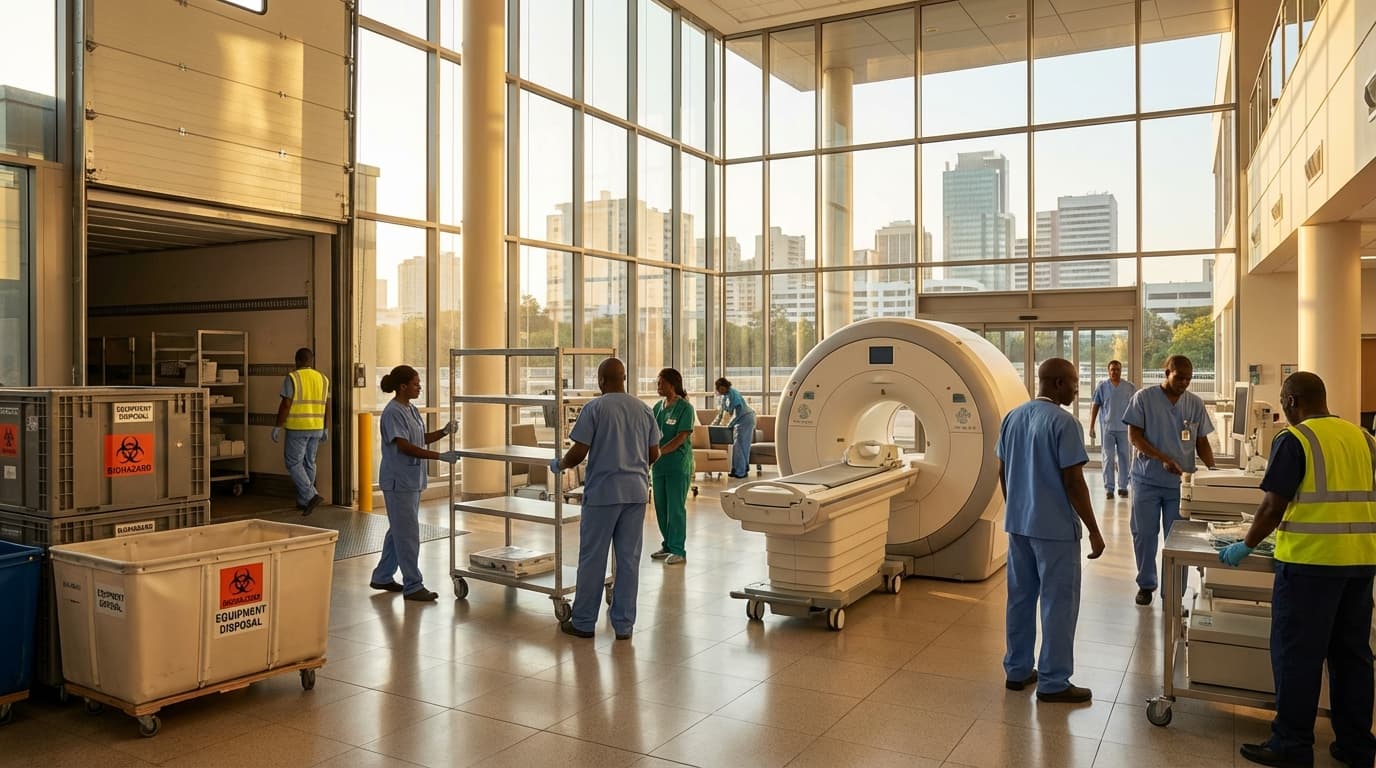
Decommissioning Service for Medical Devices in South Sudan
Engineering Excellence & Technical Support
Decommissioning Service for Medical Devices High-standard technical execution following OEM protocols and local regulatory frameworks.
Safe & Compliant Decommissioning
Ensuring all medical devices are retired following international safety standards and local regulations, preventing any environmental or health hazards during removal and disposal.
Data Security & Privacy
Implementing robust data sanitization protocols to securely erase all sensitive patient and operational data from medical devices before disposal, safeguarding privacy and confidentiality.
Environmentally Responsible Disposal
Utilizing eco-friendly disposal methods and partnering with certified recycling facilities to minimize the environmental impact, including responsible handling of hazardous materials.
What Is Decommissioning Service For Medical Devices In South Sudan?
Decommissioning service for medical devices in South Sudan refers to the systematic and documented process of retiring a medical device from active clinical use. This involves ensuring that the device is no longer capable of functioning as intended, its data is appropriately managed, and it is disposed of in a manner that complies with relevant regulations and environmental standards. This service is critical for maintaining patient safety, protecting sensitive health information, and preventing unauthorized or unsafe reuse of equipment.
| Stakeholder/Entity | Reason for Needing Decommissioning Service | Typical Use Cases |
|---|---|---|
| Hospitals and Clinics (Public & Private) | End-of-life equipment, equipment with irreparable damage, outdated technology, relocation of facilities, compliance with safety standards. | Retiring old X-ray machines, decommissioning expired diagnostic equipment, disposing of broken surgical instruments, removing obsolete laboratory analyzers. |
| Non-Governmental Organizations (NGOs) involved in healthcare delivery | Project completion, transition of services, equipment surplus, adherence to donor requirements, responsible asset management. | Decommissioning equipment upon closure of a temporary health post, retiring donated devices no longer supported, disposal of used medical supplies and consumables with integrated electronics. |
| Medical Device Manufacturers and Suppliers (operating or having supplied in South Sudan) | End-of-warranty equipment, product recalls, management of returned or damaged devices, ensuring responsible product lifecycle management. | Receiving and decommissioning faulty devices returned under warranty, managing inventory of devices awaiting disposal after obsolescence, handling equipment returned due to product defects. |
| Government Health Authorities (Ministry of Health) | Ensuring public safety, managing national medical equipment inventory, enforcing disposal regulations, preventing the circulation of unsafe or uncertified devices. | Overseeing the decommissioning of equipment from closed government facilities, developing and enforcing national disposal protocols, managing the disposal of seized or confiscated medical devices. |
| Healthcare Training Institutions | Disposal of outdated or damaged training equipment, managing surplus assets. | Decommissioning anatomical models with electronic components that are no longer functional, retiring expired simulation mannequins. |
Key Components of Medical Device Decommissioning in South Sudan:
- Data Sanitization/Destruction: Securely erasing or physically destroying any stored patient health information (PHI) or device-specific operational data to prevent unauthorized access or breaches.
- Functional Disablement: Rendering the device inoperable through physical modification, component removal, or software incapacitation to prevent its subsequent use.
- Inventory Management Update: Removing the device from all relevant asset registries, maintenance logs, and usage records.
- Environmental Disposal: Managing the end-of-life disposition of the device and its components in accordance with national and international environmental guidelines, especially for hazardous materials.
- Certification and Documentation: Providing a formal certificate of decommissioning and maintaining detailed records of the entire process for audit and compliance purposes.
- Regulatory Compliance: Adhering to any directives or regulations set forth by the Ministry of Health or other relevant South Sudanese authorities regarding medical device disposal.
Who Needs Decommissioning Service For Medical Devices In South Sudan?
Decommissioning of medical devices in South Sudan is a critical service for ensuring responsible end-of-life management, data security, and regulatory compliance. This process is essential for healthcare facilities that are upgrading equipment, closing down operations, or dealing with damaged or obsolete medical technology. Effective decommissioning prevents the misuse of sensitive patient data, mitigates environmental hazards from disposed medical equipment, and ensures that facilities adhere to national and international health and safety standards.
| Customer Type | Key Departments Involved | Specific Needs for Decommissioning |
|---|---|---|
| Government Healthcare Institutions | Biomedical Engineering Department, IT Department, Procurement Department, Facility Management, Records Management | Secure data erasure from imaging devices (MRI, CT scanners), sterilizers, and patient monitoring systems; environmentally sound disposal of hazardous materials; asset tracking and inventory management. |
| NGOs & Humanitarian Organizations | Logistics Department, Program Management, Medical Director, Finance Department | Compliance with donor requirements for asset disposal; data security for patient records; safe handling of potentially contaminated equipment; efficient removal of equipment from remote or temporary sites. |
| Private Healthcare Providers | Chief Medical Officer, IT Security Officer, Operations Manager, Facilities Manager | Protecting proprietary patient information; ensuring compliance with local health regulations; maintaining reputation by adhering to ethical disposal practices; managing costs associated with obsolete equipment. |
| International Organizations & UN Agencies | Procurement Unit, Health Program Managers, Asset Management Team | Adherence to international standards for medical waste management; transparent and auditable disposal processes; ensuring no dual-use or prohibited technology remains in circulation; supporting local capacity building where possible. |
| Research and Training Institutions | Laboratory Manager, IT Department, Department Heads, Safety Officer | Irreversible data sanitization of research-related medical devices; safe disposal of biohazardous materials integrated with equipment; compliance with institutional research ethics and safety protocols. |
| Closed or Relocating Facilities | Administrator, Facilities Manager, IT Department, Legal Counsel | Complete and documented decommissioning of all medical assets; data destruction to prevent future liability; efficient and cost-effective removal of all equipment; ensuring premises are cleared according to lease agreements or sale terms. |
Target Customers and Departments for Medical Device Decommissioning Services in South Sudan
- {"title":"Government Healthcare Institutions","description":"Public hospitals, clinics, and health centers operated by the Ministry of Health and other government bodies."}
- {"title":"Non-Governmental Organizations (NGOs) & Humanitarian Organizations","description":"Organizations providing healthcare services in South Sudan, often with donor-funded equipment that requires proper end-of-life disposal."}
- {"title":"Private Healthcare Providers","description":"Private hospitals, diagnostic centers, and specialized clinics."}
- {"title":"International Organizations & UN Agencies","description":"Agencies like WHO, UNICEF, UNFPA, and others involved in healthcare delivery and infrastructure development."}
- {"title":"Research and Training Institutions","description":"Medical schools and research facilities that utilize and dispose of medical equipment."}
- {"title":"Closed or Relocating Facilities","description":"Any healthcare facility that is ceasing operations, merging, or relocating."}
Decommissioning Service For Medical Devices Process In South Sudan
This document outlines the standard workflow for decommissioning medical devices in South Sudan, ensuring responsible and safe removal from service. The process is designed to be transparent, compliant with relevant regulations, and environmentally sound.
| Step | Description | Key Activities | Responsible Party | Deliverables/Outcomes |
|---|---|---|---|---|
| The process begins when a healthcare facility or entity identifies a need to decommission medical devices. Initial contact is made to inquire about decommissioning services. | Receive inquiry, gather preliminary information on the type and quantity of devices, understand the client's requirements and urgency. | Client (Healthcare Facility), Decommissioning Service Provider | Confirmation of service availability, preliminary understanding of scope. |
| A thorough assessment of the devices requiring decommissioning is conducted at the client's site. | Physical inspection of devices, confirmation of make, model, serial numbers, and current condition. Identification of any hazards or special handling requirements. Verification of ownership. | Decommissioning Service Provider, Client Representative | Detailed inventory of devices, assessment report, identification of any regulatory compliance issues. |
| Based on the assessment, a detailed proposal and quotation are provided to the client. | Prepare a comprehensive quotation including service fees, disposal costs, and any potential charges. Negotiate terms and conditions. Formalize the agreement through a signed contract. | Decommissioning Service Provider, Client | Formal quotation, signed service agreement/contract. |
| Once the agreement is in place, a detailed plan for the decommissioning process is developed and scheduled. | Develop a project plan, including timelines, resource allocation (personnel, equipment), and logistics. Coordinate with the client for the most suitable date and time for execution, minimizing disruption to operations. | Decommissioning Service Provider | Project plan, agreed-upon schedule. |
| The actual process of decommissioning the medical devices takes place on-site or at a designated facility. | Safe disconnection of devices, removal of hazardous materials (e.g., mercury, refrigerants) if applicable, data sanitization or secure destruction of data storage, disassembly or preparation for transport. Adherence to safety protocols. | Decommissioning Service Provider | Decommissioned devices, safely handled and prepared for disposal. |
| Proper handling and disposal of decommissioned devices and associated waste according to environmental regulations. | Categorization of waste (e.g., recyclable, hazardous, general waste). Transportation to authorized disposal or recycling facilities. Ensuring environmentally sound and compliant disposal methods. | Decommissioning Service Provider, Authorized Waste Management Partners | Records of disposal, certificates of destruction (if applicable). |
| Comprehensive documentation of the entire decommissioning process is compiled and provided to the client. | Prepare a final report detailing the devices decommissioned, methods used, dates, disposal routes, and any relevant certifications. Issue a certificate of decommissioning. | Decommissioning Service Provider | Decommissioning report, certificate of decommissioning. |
| A final review and confirmation of the completed service. | Address any client queries or concerns. Ensure all contractual obligations have been met. Obtain client feedback for continuous improvement. | Decommissioning Service Provider, Client | Client satisfaction, feedback for service enhancement. |
Decommissioning Service for Medical Devices Workflow in South Sudan
- Inquiry and Initial Assessment
- Site Visit and Device Identification
- Quotation and Agreement
- Planning and Scheduling
- Execution of Decommissioning
- Waste Management and Disposal
- Documentation and Certification
- Post-Decommissioning Follow-up
Decommissioning Service For Medical Devices Cost In South Sudan
Decommissioning medical devices in South Sudan involves a range of costs influenced by several key factors. The process typically includes safe removal, secure storage, data sanitization (for devices with data storage capabilities), and environmentally responsible disposal or recycling. The pricing is highly dynamic and subject to local economic conditions, availability of specialized services, and the complexity of the devices themselves. It's crucial to obtain detailed quotes from licensed and reputable service providers to ensure compliance with regulations and to avoid potential environmental or data security liabilities. The ongoing instability and logistical challenges in South Sudan can also contribute to higher operational costs for decommissioning services.
| Device Category (Example) | Estimated Cost Range (SSP) | Notes |
|---|---|---|
| Small Diagnostic Equipment (e.g., digital thermometers, pulse oximeters) | 5,000 - 20,000 | Includes basic sanitization and eco-friendly disposal. |
| Medium Imaging/Laboratory Equipment (e.g., X-ray machines, basic ultrasound, centrifuges) | 50,000 - 250,000 | May include partial dismantling, data sanitization, and specialized transport for heavier components. |
| Large/Complex Medical Systems (e.g., MRI, CT scanners, large surgical lasers) | 300,000 - 1,500,000+ | Involves highly specialized dismantling, secure data destruction, heavy lifting, complex logistics, and often international regulatory considerations for component disposal. |
| General Hospital Furniture/Non-Electronic Equipment (e.g., beds, trolleys) | 2,000 - 10,000 per item | Cost depends on quantity, condition, and disposal method (recycling or landfill). |
Key Pricing Factors for Medical Device Decommissioning in South Sudan
- Type and Size of Medical Device: Larger and more complex devices (e.g., MRI machines, CT scanners, large surgical equipment) will incur higher costs due to specialized handling, transportation, and disposal requirements.
- Number of Devices: Bulk decommissioning projects may offer economies of scale, potentially reducing the per-device cost, but the overall project cost will be higher.
- Condition and Functionality: Devices that are functional or require more intricate dismantling will command higher prices than those that are simple and clearly destined for scrap.
- Data Security Requirements: Devices with data storage capabilities (e.g., imaging equipment, patient monitoring systems) will require certified data sanitization or destruction, adding to the cost.
- Transportation and Logistics: The distance from the decommissioning site to the disposal/recycling facility, road conditions, and the need for specialized transport (e.g., heavy lifting equipment) significantly impact costs.
- Environmental Disposal/Recycling Method: Disposal methods vary in cost. Environmentally sound practices, such as regulated landfilling for hazardous components or certified recycling, are generally more expensive than basic disposal.
- Regulatory Compliance and Permitting: Costs associated with obtaining necessary permits, adhering to local environmental regulations, and ensuring proper documentation for disposal can add to the overall expense.
- Service Provider Expertise and Certification: Reputable decommissioning companies with trained personnel, specialized equipment, and relevant certifications will typically charge more for their services.
- Geographic Location within South Sudan: Accessibility and infrastructure vary greatly across regions. Decommissioning in remote or hard-to-reach areas will likely incur higher logistical costs.
- Emergency or Urgent Services: Expedited decommissioning services, if required, will usually come with a premium.
Affordable Decommissioning Service For Medical Devices Options
Decommissioning medical devices is a critical but often overlooked aspect of healthcare facility management. It involves the safe and compliant removal of equipment from service, including data sanitization, proper disposal, and environmental considerations. For facilities seeking affordable solutions, understanding value bundles and implementing cost-saving strategies is paramount. This service ensures compliance with data privacy regulations (like HIPAA), protects patient information, prevents unauthorized reuse, and promotes environmental responsibility by facilitating recycling and responsible disposal of hazardous materials.
| Value Bundle Tier | Included Services | Target Audience | Potential Cost Savings |
|---|---|---|---|
| Basic Decommissioning | Physical removal, basic data wiping (e.g., factory reset), transportation to disposal site. | Low-risk devices, facilities with minimal data security concerns. | Lower upfront cost due to limited services. |
| Standard Decommissioning | Physical removal, secure data sanitization (e.g., DoD 5220.22-M compliant wiping), chain of custody documentation, basic recycling. | Most common medical devices, facilities requiring moderate data security and compliance. | Balanced cost-effectiveness, covers essential compliance needs. |
| Premium/Comprehensive Decommissioning | Physical removal, advanced data erasure (e.g., physical destruction for highly sensitive data), specialized recycling, environmental disposal, certification of destruction, asset tracking and reporting. | High-risk devices (imaging, surgical), facilities with stringent data security and regulatory requirements. | Higher initial cost but mitigates significant risks and potential fines, often includes value recovery through refurbishment/resale. |
| Customized Bundles | Tailored to specific facility needs, equipment inventory, and compliance mandates. Can be a mix of services from different tiers. | Facilities with unique or mixed equipment portfolios, specific project timelines. | Optimized cost based on precise service requirements. |
Understanding Value Bundles and Cost-Saving Strategies
- {"title":"Value Bundles Explained","description":"Value bundles are service packages designed to offer comprehensive decommissioning solutions at a bundled price, often providing better overall value than individual service components. These bundles typically include a range of services tailored to different needs and equipment types."}
- {"title":"Common Decommissioning Service Components within Bundles","description":"These services can be mixed and matched or included as part of a tiered offering:"}
- {"title":"Cost-Saving Strategies","description":"Beyond opting for bundles, several strategic approaches can significantly reduce decommissioning costs:"}
Verified Providers In South Sudan
In the challenging landscape of healthcare in South Sudan, identifying and engaging with verified providers is paramount for ensuring quality and reliable medical services. This document highlights the importance of verified providers and presents Franance Health as a leading choice due to its robust credentials and commitment to excellence. Choosing a verified provider like Franance Health offers peace of mind, guarantees adherence to international standards, and ensures access to skilled professionals and modern medical practices.
| Credential/Aspect | Franance Health's Commitment | Why it Matters for Patients |
|---|---|---|
| Accreditation & Licensing | Fully licensed by South Sudanese Ministry of Health and relevant international bodies. Adheres to stringent operational and clinical protocols. | Ensures Franance Health operates legally and meets national healthcare standards, guaranteeing legitimate and regulated services. |
| Staff Qualifications | Employs highly qualified, certified, and experienced medical professionals (doctors, nurses, specialists) with continuous professional development. | Patients receive care from competent individuals who are up-to-date with the latest medical knowledge and techniques. |
| Quality Assurance | Implements rigorous internal quality control measures and participates in external quality assessments. Regular audits and reviews are conducted. | Guarantees consistent delivery of high-quality healthcare services, minimizing errors and maximizing patient outcomes. |
| Infrastructure & Equipment | Maintains modern, well-equipped facilities with up-to-date medical technology and adheres to strict hygiene and safety standards. | Access to advanced diagnostic and treatment tools, leading to more accurate diagnoses and effective therapies in a safe environment. |
| Ethical Practices & Patient Rights | Upholds the highest ethical standards in patient care, ensuring confidentiality, informed consent, and respectful treatment. Dedicated patient advocacy programs. | Patients can trust that their privacy is protected, they are treated with dignity, and their rights are respected throughout their healthcare journey. |
| Partnerships & Collaborations | Collaborates with reputable international health organizations and local community stakeholders to enhance service delivery and reach. | Leverages global expertise and local insights to provide comprehensive and accessible healthcare solutions tailored to South Sudan's needs. |
Why Verified Providers Matter in South Sudan
- Ensures adherence to quality standards and best practices.
- Provides access to qualified and licensed medical professionals.
- Guarantees the authenticity and safety of medical supplies and equipment.
- Reduces the risk of fraud, malpractice, and substandard care.
- Facilitates accountability and transparency in healthcare delivery.
- Promotes patient safety and well-being.
Scope Of Work For Decommissioning Service For Medical Devices
This Scope of Work (SOW) outlines the requirements for the decommissioning of medical devices. It defines the technical deliverables, standard specifications, and procedures to ensure safe, secure, and environmentally responsible removal of equipment from service. This SOW applies to all medical devices identified for decommissioning.
| Section | Description | Standard Specifications / Requirements |
|---|---|---|
| 1.0 Scope Definition | Detailed description of the devices to be decommissioned, including make, model, serial number, and location. | Comprehensive inventory list of all devices, including asset tags, current operational status, and any unique identifiers. |
| 2.0 Decommissioning Planning | Development of a detailed decommissioning plan addressing safety, data security, environmental impact, and regulatory compliance. | Plan must include risk assessment, resource allocation, scheduling, and communication protocols. Adherence to manufacturer's recommended decommissioning procedures where applicable. |
| 3.0 Data Security and Privacy | Secure erasure or destruction of all patient data, personal information, and proprietary system data from devices. | Compliance with HIPAA, GDPR, and other relevant data privacy regulations. Utilization of certified data wiping methods (e.g., DoD 5220.22-M) or physical destruction of storage media. Documentation of data sanitization process with certificates of destruction. |
| 4.0 Device Dismantling and Removal | Safe and careful dismantling and removal of devices from their installed locations, ensuring minimal disruption to ongoing operations. | Trained and certified personnel. Use of appropriate tools and protective equipment. Isolation of power and essential services prior to dismantling. Containment of any hazardous materials (e.g., mercury, batteries). |
| 5.0 Hazardous Material Management | Identification, segregation, and proper disposal of any hazardous materials present in the devices. | Compliance with local, regional, and national environmental regulations for hazardous waste disposal. Proper labeling and manifest tracking of hazardous materials. |
| 6.0 Environmental Disposal / Recycling | Environmentally responsible disposal or recycling of decommissioned devices and their components. | Preference for certified e-waste recyclers. Compliance with WEEE directive or equivalent regulations. Documentation of recycling and disposal certificates, including material breakdown. |
| 7.0 Asset Management and Inventory Update | Accurate updating of asset management systems to reflect the removal of devices from service. | Decommissioning reports detailing device status change, disposal method, and final disposition. Reconciliation with original asset inventory. |
| 8.0 Documentation and Reporting | Comprehensive documentation of all decommissioning activities, including plans, procedures, logs, and final reports. | Final decommissioning report to include: inventory of decommissioned devices, data sanitization certificates, hazardous material manifests, recycling/disposal certificates, and a summary of activities. Report to be submitted to designated stakeholders. |
| 9.0 Regulatory Compliance | Ensuring all decommissioning activities comply with relevant healthcare, safety, environmental, and data privacy regulations. | Adherence to FDA regulations (e.g., 21 CFR Part 820), ISO 13485 (if applicable), and any other governing body requirements. Maintenance of auditable records for a specified period. |
| 10.0 Training and Certification | Personnel involved in decommissioning must possess appropriate training and certifications. | Proof of certification for data sanitization, hazardous material handling, and medical device handling. Evidence of relevant safety training (e.g., OSHA). |
Key Stakeholders
- Healthcare Facility Management
- Biomedical Engineering Department
- IT Department (for networked devices)
- Environmental Health & Safety (EHS)
- Vendor/Service Provider
- Regulatory Compliance Officer
Service Level Agreement For Decommissioning Service For Medical Devices
This Service Level Agreement (SLA) outlines the response times and uptime guarantees for the Decommissioning Service for Medical Devices provided by [Your Company Name] (hereinafter referred to as "Provider") to [Client Company Name] (hereinafter referred to as "Client"). This SLA is an addendum to the Master Service Agreement between the parties.
| Service Component | Response Time (Business Hours) | Uptime Guarantee |
|---|---|---|
| Initial Acknowledgment of Decommissioning Request (Critical Devices) | [Specify Time, e.g., 2 Business Hours] | N/A |
| Initial Acknowledgment of Decommissioning Request (Standard Devices) | [Specify Time, e.g., 4 Business Hours] | N/A |
| Initiation of On-site Decommissioning (Critical Devices) | [Specify Time, e.g., 8 Business Hours from Acknowledgment] | N/A |
| Initiation of On-site Decommissioning (Standard Devices) | [Specify Time, e.g., 24 Business Hours from Acknowledgment] | N/A |
| Availability of Decommissioning Process Personnel | 99.5% during Scheduled Decommissioning Activities | 99.5% during Scheduled Decommissioning Activities |
| Availability of Data Erasure/Destruction Verification System | 99.9% during Scheduled Decommissioning Activities | 99.9% during Scheduled Decommissioning Activities |
| Availability of Reporting and Documentation Portal | 99.8% during Scheduled Decommissioning Activities | 99.8% during Scheduled Decommissioning Activities |
Definitions
- Decommissioning Request: A formal request submitted by the Client to initiate the decommissioning process for a specific medical device or group of devices.
- Downtime: Any period during which the decommissioning service for a critical component or the overall process is unavailable to the Client, excluding scheduled maintenance.
- Scheduled Maintenance: Pre-planned periods during which the decommissioning service may be unavailable for updates, upgrades, or maintenance. The Client will be notified at least [Number] business days in advance.
- Critical Device: A medical device whose decommissioning is essential for regulatory compliance, data security, or operational continuity, as designated by the Client.
- Standard Device: A medical device whose decommissioning is important but does not fall under the "Critical Device" designation.
- Business Hours: [Specify Business Hours, e.g., Monday to Friday, 9:00 AM to 5:00 PM Local Time, excluding public holidays].
Frequently Asked Questions

Ready when you are
Let's scope your Decommissioning Service for Medical Devices in South Sudan project in South Sudan.

Scaling healthcare logistics and technical systems across the entire continent.