
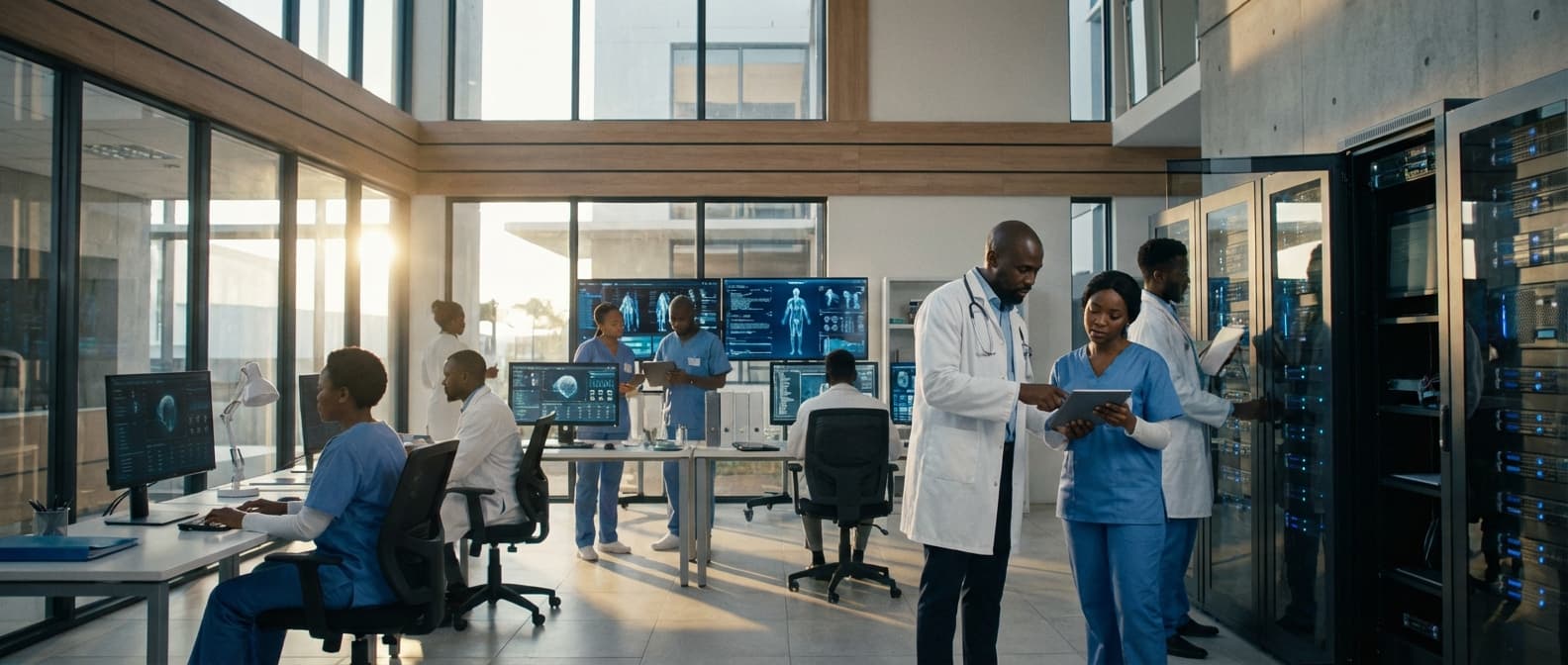
Tele-Radiology in South Sudan
Engineering Excellence & Technical Support
24/7 access to certified radiologists providing rapid, accurate remote interpretation of diagnostic imaging studies. High-standard technical execution following OEM protocols and local regulatory frameworks.
Bridging Geographic Divides
Tele-radiology connects remote healthcare facilities in South Sudan to specialized radiologists, overcoming vast distances and limited local expertise. This ensures timely and accurate diagnoses for patients in underserved regions.
Enhanced Diagnostic Accuracy
Leveraging advanced imaging technologies and expert remote interpretation, tele-radiology elevates diagnostic precision for a wide range of medical conditions, leading to better treatment planning and improved patient outcomes.
Capacity Building & Training
Tele-radiology platforms facilitate remote training and mentorship for local healthcare professionals, building sustainable diagnostic capacity within South Sudan's medical community and empowering on-site teams.
What Is Tele-radiology In South Sudan?
Tele-radiology, in the context of South Sudan, refers to the remote transmission and interpretation of medical imaging studies, such as X-rays, CT scans, and MRIs, to radiologists located outside of the immediate clinical setting. This service is crucial for overcoming geographical barriers and addressing the severe shortage of specialist radiologists within the country. It involves the secure digital transfer of image data from imaging equipment at a healthcare facility in South Sudan to a teleradiology service provider, where qualified radiologists perform the interpretation and generate diagnostic reports. These reports are then transmitted back to the referring clinician for patient management. The demand for tele-radiology is driven by the disparity between the need for advanced diagnostic imaging services and the limited availability of trained personnel and infrastructure in South Sudan.
| Who Needs Tele-Radiology in South Sudan? | Typical Use Cases |
|---|---|
| Patients in Remote and Underserved Areas: Access to specialist interpretation is severely limited outside major urban centers. | Emergency Department Imaging: Timely interpretation of critical findings for trauma, stroke, or acute abdominal conditions. |
| Healthcare Facilities with Limited Radiologist Staff: Overcoming the chronic shortage of radiologists and reducing diagnostic delays. | Diagnostic Imaging for Common Conditions: Interpretation of chest X-rays for pneumonia or tuberculosis, abdominal X-rays for bowel obstruction. |
| Specialty Clinics (e.g., Oncology, Neurology): Requiring expert interpretation of advanced imaging (CT, MRI) for diagnosis, staging, and treatment monitoring. | Orthopedic Imaging: Evaluation of fractures, dislocations, and other musculoskeletal injuries. |
| Public Health Programs: Facilitating the diagnosis and management of communicable diseases (e.g., tuberculosis screening via chest X-rays). | Pediatric Imaging: Interpretation of imaging studies for congenital abnormalities or pediatric illnesses. |
| Training and Education: Providing remote expert consultation and feedback for local medical professionals. | Follow-up Imaging: Monitoring treatment response and disease progression through serial imaging studies. |
Key Components and Stakeholders of Tele-Radiology in South Sudan
- Image Acquisition: Deployment and maintenance of digital imaging equipment (CR, DR, CT, MRI) at healthcare facilities.
- Data Transmission: Secure and reliable digital infrastructure for transmitting DICOM (Digital Imaging and Communications in Medicine) images and associated patient data. This includes internet connectivity, VPNs, or dedicated secure networks.
- Teleradiology Platform: Software solutions for image viewing, storage (PACS - Picture Archiving and Communication System), workflow management, and reporting.
- Radiologist Network: A pool of qualified and credentialed radiologists (potentially international) capable of interpreting diverse imaging modalities.
- Referring Clinicians: Physicians and healthcare professionals at the point of care who order imaging studies and utilize the diagnostic reports for patient diagnosis and treatment planning.
- Healthcare Facilities: Hospitals, clinics, and diagnostic centers in South Sudan equipped with imaging capabilities.
- Service Providers: Organizations offering tele-radiology services, including technology infrastructure, radiologist staffing, and quality assurance.
Who Needs Tele-radiology In South Sudan?
Tele-radiology, the practice of interpreting medical images remotely, is a critical solution for addressing the significant disparities in radiology services experienced by South Sudan. The country faces severe shortages of trained radiologists, advanced imaging equipment, and reliable infrastructure, particularly in rural and underserved areas. Tele-radiology can bridge these gaps by connecting local healthcare facilities with a global network of radiologists, enabling timely and accurate diagnoses, improving patient outcomes, and strengthening the overall healthcare system.
| Target Customer/Department | Specific Needs Addressed by Tele-Radiology | Key Benefits | Examples of Imaging Modalities |
|---|---|---|---|
| Rural Health Clinics | Lack of on-site radiologists, limited access to diagnostic imaging expertise, delayed diagnoses for critical conditions. | Faster diagnosis, improved patient referral decisions, reduced travel burden for patients, increased access to specialist interpretation. | X-ray |
| District Hospitals | Shortage of radiologists, limited subspecialty expertise (e.g., pediatric radiology, neuroradiology), overwhelmed existing staff. | Expanded diagnostic capabilities, access to subspecialty opinions, reduced workload for local clinicians, improved training opportunities for local technicians. | X-ray, Ultrasound, CT scans (if available) |
| Central Referral Hospitals | High patient volume, potential for radiologist burnout, need for expert second opinions, difficulties in accessing niche subspecialists. | Improved diagnostic accuracy, timely interpretation of complex cases, access to global expertise, enhanced capacity to manage increased patient loads. | X-ray, Ultrasound, CT scans, MRI scans (if available) |
| Maternal and Child Health Centers | Need for specialized interpretation of obstetric and pediatric imaging, limited access to experienced pediatric radiologists. | Improved prenatal care, early detection of congenital abnormalities, better management of pediatric emergencies, enhanced maternal health outcomes. | Ultrasound (obstetric and pediatric), X-ray (pediatric) |
| Trauma and Emergency Departments | Urgent need for rapid interpretation of imaging in life-threatening situations, limited availability of on-call radiologists. | Faster trauma assessment, immediate decision-making for surgical interventions, reduced mortality and morbidity from injuries. | X-ray, CT scans |
| Infectious Disease Units (e.g., TB, HIV) | Need for accurate interpretation of chest X-rays for diagnosis and monitoring of conditions like tuberculosis, specialized imaging for HIV-related complications. | Improved diagnosis and management of infectious diseases, better monitoring of treatment effectiveness, reduced transmission rates. | X-ray (especially chest X-ray), Ultrasound |
| NGO and Mission Hospitals | Often operate in resource-limited settings, rely on external expertise, aim to provide comprehensive care to vulnerable populations. | Cost-effective access to advanced diagnostic services, enhanced service delivery in remote areas, improved capacity to respond to health crises. | Various, depending on available equipment |
| Military and Humanitarian Aid Deployments | Need for rapid and reliable diagnostic imaging in challenging environments, often with limited infrastructure and personnel. | Critical support for deployed medical teams, timely diagnosis and treatment of injuries and illnesses in conflict or disaster zones, efficient management of medical resources. | Portable X-ray, Ultrasound |
Target Customers and Departments for Tele-Radiology in South Sudan
- Healthcare Facilities in Remote and Underserved Areas
- Central Hospitals and Referral Centers
- Missions and Non-Governmental Organization (NGO) Clinics
- Military and Humanitarian Aid Organizations
Tele-radiology Process In South Sudan
Tele-radiology in South Sudan aims to bridge the gap in diagnostic imaging access by connecting remote healthcare facilities with experienced radiologists. The process typically involves several key stages, from the initial patient referral to the final report delivery and patient management. This workflow is designed to be efficient and effective, leveraging available technology and human resources to provide crucial diagnostic services where they are most needed.
| Stage | Description | Key Participants | Technology/Tools |
|---|---|---|---|
| Inquiry & Referral | Patient identified for imaging; clinician initiates request. | Referring Clinician, Patient | Patient Referral Form |
| Image Acquisition | Radiological scan performed at the remote site. | Radiology Technician/Nurse | X-ray Machine, CT Scanner, MRI Scanner, DICOM Camera |
| Image Transmission | Images and data sent to the tele-radiology hub. | Radiology Technician/Nurse, IT Support | Internet, Satellite Link, Secure VPN, Encrypted Drives |
| Teleradiology Hub Management | Case received, verified, and assigned to a radiologist. | Case Manager/Administrator | PACS, Workflow Management Software |
| Radiologist Interpretation | Remote analysis of images and generation of a report. | Radiologist | Workstation, PACS Viewer, Dictation Software |
| Report Review & QA | Ensuring accuracy and quality of the diagnostic report. | Senior Radiologist, Radiologist | Peer Review System, QA Protocols |
| Report Transmission & Delivery | Finalized report sent back to the referring facility. | Teleradiology Hub Administrator | PACS, Secure Email, Online Portal |
| Clinical Integration & Management | Report used for patient diagnosis and treatment planning. | Referring Clinician, Patient | Electronic Health Records (if available), Clinical Decision Making |
| Feedback & Follow-up | Gathering input for service improvement. | Referring Facility, Teleradiology Team | Feedback Forms, Regular Meetings |
Tele-Radiology Workflow in South Sudan
- Inquiry & Referral: A healthcare facility in a remote area identifies a patient requiring radiological imaging (X-ray, CT, MRI). The referring clinician initiates the process by filling out a patient referral form, including clinical history, suspected diagnosis, and specific imaging requests.
- Image Acquisition: At the remote facility, a trained technician or nurse performs the required radiological scan using available equipment. Modern PACS (Picture Archiving and Communication System) or DICOM-compliant viewers are crucial for efficient image capture and storage.
- Image Transmission: Acquired images, along with the referral form and relevant patient data, are securely transmitted to the central tele-radiology hub. This transmission can occur via internet (if available and reliable), dedicated satellite links, or even secure offline transfer methods like encrypted USB drives if connectivity is a major challenge.
- Teleradiology Hub Management: The tele-radiology hub receives the case. A case manager or administrator verifies the completeness of the data and assigns the case to an available radiologist based on expertise, workload, and sub-specialty.
- Radiologist Interpretation: The assigned radiologist accesses the images and associated clinical information remotely. They perform a thorough interpretation of the images and dictate or type a comprehensive diagnostic report.
- Report Review & Quality Assurance: The dictated/typed report often undergoes a review process by a senior radiologist or a peer review system to ensure accuracy and quality. This step is critical for maintaining high diagnostic standards.
- Report Transmission & Delivery: The finalized report is securely transmitted back to the referring healthcare facility. This can be done electronically through the PACS, email, or a secure online portal.
- Clinical Integration & Patient Management: The referring clinician receives the report and integrates the findings into the patient's overall care plan. This may lead to further investigations, treatment initiation, or follow-up imaging.
- Feedback & Follow-up: The referring facility may provide feedback on the turnaround time, report clarity, and impact on patient management. This feedback loop is essential for continuous improvement of the tele-radiology service.
Tele-radiology Cost In South Sudan
Tele-radiology, the interpretation of medical images remotely, holds significant potential to improve diagnostic access in underserved regions like South Sudan. However, its cost in South Sudan is not standardized and is influenced by a complex interplay of factors. Due to the nascent stage of widespread tele-radiology implementation and varying infrastructure capabilities, precise, universally applicable pricing ranges are difficult to establish. Instead, we discuss the key drivers of cost and provide estimated ranges, acknowledging that these are subject to significant fluctuation based on specific circumstances and provider.
| Service Type/Component | Estimated Range (South Sudanese Pound - SSP) | Notes |
|---|---|---|
| Per X-ray Interpretation (Routine) | 15,000 - 40,000 SSP | Highly dependent on connectivity, provider, and volume. May be higher for STAT reads. |
| Per CT Scan Interpretation (Routine) | 30,000 - 75,000 SSP | CT scans are more complex; cost reflects this. Volume discounts applicable. |
| Per Ultrasound Interpretation (Routine) | 20,000 - 50,000 SSP | Varies based on scan type (e.g., obstetric vs. abdominal) and complexity. |
| Basic Tele-Radiology Platform Setup (Annual Subscription) | 5,000,000 - 20,000,000+ SSP | Covers software, basic connectivity solutions, and initial support. Excludes imaging hardware. |
| Dedicated Bandwidth/Satellite Link (Monthly) | 2,000,000 - 10,000,000+ SSP | Highly variable based on provider, location, and required uptime. |
| Radiologist Training (Per Session/Individual) | 1,000,000 - 5,000,000+ SSP | Depends on duration, trainer expertise, and scope of training (technical vs. clinical). |
| PACS System Implementation (One-time Fee) | 10,000,000 - 50,000,000+ SSP | Includes software, installation, and initial configuration. Can be a significant upfront investment. |
Key Factors Influencing Tele-Radiology Costs in South Sudan:
- Technology & Infrastructure: This is a primary driver. The availability and reliability of internet connectivity (bandwidth, latency, stability) are crucial. Costs increase significantly if dedicated satellite links or more robust internet solutions are required. Furthermore, the cost of imaging equipment (X-ray machines, CT scanners, ultrasound machines), PACS (Picture Archiving and Communication System) software, and secure data transmission platforms are all factored in. Investment in local IT support and maintenance is also essential.
- Radiologist Expertise & Availability: The scarcity of qualified radiologists within South Sudan drives up costs. Foreign-based radiologists are often contracted, and their fees are influenced by their specialization, experience, and the time zone differences. On-demand services may be more expensive than pre-arranged contracts.
- Volume of Scans: Like any service, the cost per scan can decrease with higher volumes. Larger hospitals or regional health networks negotiating bulk service agreements will likely achieve lower per-unit costs.
- Service Model: Different tele-radiology providers offer various service models. This can range from basic image interpretation to comprehensive solutions including PACS implementation, training, and ongoing technical support. More integrated solutions will naturally have higher upfront and recurring costs.
- Service Level Agreements (SLAs): The required turnaround time for image interpretation (e.g., STAT reads versus routine reads) significantly impacts pricing. Faster turnaround times demand more immediate radiologist availability and potentially higher fees.
- Geographic Location within South Sudan: Remote locations with extremely limited infrastructure will incur higher costs for setting up and maintaining the necessary technology and for transporting any required equipment or personnel.
- Currency Volatility: South Sudan Pound (SSP) is subject to significant volatility, which can impact the cost of imported technology and services paid for in foreign currency. This needs to be factored into long-term budget planning.
- Training & Capacity Building: While not a direct per-scan cost, the investment in training local technicians and healthcare professionals to operate imaging equipment and utilize tele-radiology platforms is a crucial component of sustainable implementation and adds to the overall expenditure.
- Operational Overhead: This includes administrative costs, licensing fees, insurance, and any local operational presence the tele-radiology provider might maintain.
Affordable Tele-radiology Options
Tele-radiology offers a cost-effective solution for healthcare providers by leveraging remote radiologists to interpret medical images. This not only expands access to specialized expertise but can also significantly reduce overhead costs associated with in-house radiology departments. Value bundles and strategic cost-saving measures are key to maximizing the financial benefits of tele-radiology.
| Value Bundle Component | Description | Cost-Saving Benefit |
|---|---|---|
| Basic Interpretation Package | Includes standard interpretation of X-rays, CT scans, and MRIs for routine cases. | Provides essential diagnostic services at a predictable per-study cost, eliminating fixed staffing expenses. |
| Subspecialty On-Demand | Access to subspecialist radiologists (e.g., neuroradiology, pediatric radiology) for complex cases as needed. | Avoids the high cost of employing full-time subspecialists, offering targeted expertise only when required. |
| Critical & STAT Reads | Guaranteed rapid turnaround times for urgent and life-threatening findings. | Minimizes delays in critical care decisions, potentially reducing adverse outcomes and associated costs. |
| Quality Assurance & Reporting | Includes comprehensive reporting, peer review, and quality metrics tracking. | Ensures high-quality interpretations, reducing the risk of misdiagnosis and subsequent treatment costs. |
| Teleradiology Platform Access | Access to a secure, HIPAA-compliant platform for image transmission and report delivery. | Eliminates the need for internal IT investment in specialized radiology software and infrastructure. |
Key Cost-Saving Strategies
- Flexible Staffing Models: Contract with tele-radiology providers for on-demand or overflow coverage, rather than maintaining a full-time in-house team.
- Volume-Based Pricing: Negotiate rates that decrease with higher image volumes, incentivizing increased utilization.
- Subspecialty Access: Avoid the expense of hiring multiple subspecialty radiologists by accessing them remotely through a tele-radiology service.
- Reduced Infrastructure Costs: Eliminate the need for dedicated radiology suites, expensive imaging equipment maintenance, and associated staffing for on-site interpretation.
- Improved Turnaround Times: Faster report turnaround can lead to quicker patient diagnoses and treatment, potentially reducing hospital length of stay and associated costs.
- 24/7 Coverage: Ensure round-the-clock interpretation without the high cost of overnight or holiday staff.
- Technology Integration: Choose providers with seamless integration into existing PACS (Picture Archiving and Communication System) and EMR (Electronic Medical Record) systems to minimize IT burden.
Verified Providers In South Sudan
In South Sudan, navigating the healthcare landscape can be challenging. Ensuring you are engaging with verified and reputable healthcare providers is paramount for receiving quality care and peace of mind. Franance Health stands out as a leading organization committed to upholding the highest standards in healthcare delivery. Their stringent credentialing process and dedication to patient well-being make them an exemplary choice for individuals and organizations seeking reliable medical services.
| Provider Type | Franance Health Verification Includes | Benefits of Choosing Franance Health Affiliated Providers |
|---|---|---|
| Physicians | Medical license, board certification, educational qualifications, professional references, criminal background check | Access to qualified doctors with proven expertise, assurance of ethical practice, up-to-date medical knowledge |
| Nurses | Nursing license, relevant certifications, practical experience assessment, background check | Competent and compassionate nursing care, adherence to safety protocols, dedicated patient support |
| Specialists (e.g., Surgeons, Pediatricians, Gynecologists) | All physician verification criteria plus specialized training and fellowship completion | Expert diagnosis and treatment for specific medical conditions, access to advanced medical procedures |
| Ancillary Staff (e.g., Lab Technicians, Pharmacists) | Professional certifications, relevant training, practical skills evaluation | Accurate diagnostic testing, reliable medication dispensing, essential support services |
| Healthcare Facilities | Licensing, accreditation, safety standards compliance, equipment verification | Access to well-equipped and safe medical facilities, adherence to hygiene and infection control measures |
Why Franance Health is the Best Choice for Verified Providers in South Sudan:
- Rigorous Credentialing Process: Franance Health employs a multi-faceted approach to verify the qualifications, licenses, and professional backgrounds of all their affiliated healthcare providers. This ensures that every practitioner meets established benchmarks for competence and ethical practice.
- Commitment to Quality Care: Beyond basic verification, Franance Health actively promotes a culture of continuous improvement and excellence in patient care. They monitor provider performance and patient feedback to maintain superior service delivery.
- Network of Skilled Professionals: Franance Health has cultivated a comprehensive network of highly skilled and experienced medical professionals across various specializations. This allows them to offer a wide range of services to meet diverse healthcare needs.
- Patient-Centric Approach: The organization prioritizes the needs and comfort of patients. They focus on clear communication, accessibility, and ensuring a positive healthcare experience from consultation to recovery.
- Adherence to International Standards: Franance Health aligns its operations with recognized international healthcare standards, ensuring that services provided in South Sudan are comparable to those offered globally.
- Trust and Reliability: By consistently delivering on its promises and maintaining a high level of transparency, Franance Health has built a strong reputation for trust and reliability within South Sudan's healthcare sector.
Scope Of Work For Tele-radiology
This Scope of Work (SOW) outlines the requirements for a Tele-Radiology service, focusing on technical deliverables and standard specifications. The aim is to establish a framework for a reliable, efficient, and secure remote radiology interpretation service.
| Parameter | Specification/Requirement | Notes |
|---|---|---|
| DICOM Conformance Statement | Provider must supply a comprehensive DICOM Conformance Statement. | Details the DICOM services the platform supports. |
| Security Protocols | TLS 1.2+ for data in transit; AES-256 encryption for data at rest. | Ensures data confidentiality and integrity. |
| Viewer Performance | Load time for a typical CT/MRI study < 15 seconds. | Ensures efficient radiologist workflow. |
| Audit Trail Granularity | Logs user, date/time, action, and study identifier. | Crucial for compliance and accountability. |
| HL7/FHIR Integration | Support for ADT, ORU, RDE messages. | Facilitates seamless workflow with EMR/RIS. |
| Disaster Recovery RTO/RPO | Recovery Time Objective (RTO) < 4 hours; Recovery Point Objective (RPO) < 1 hour. | Minimizes data loss and service interruption. |
Key Technical Deliverables and Standard Specifications
- Image Acquisition & Transmission:
- PACS/RIS Integration: Seamless integration with existing Picture Archiving and Communication System (PACS) and Radiology Information System (RIS) at originating sites. Protocols for data exchange (e.g., DICOM, HL7) must be clearly defined.
- Data Encryption: All transmitted imaging data (DICOM) must be encrypted using industry-standard protocols (e.g., TLS 1.2 or higher) to ensure confidentiality and integrity during transit.
- Bandwidth Requirements: Minimum and recommended bandwidth specifications for image transmission from originating sites to the tele-radiology provider's platform, considering image resolution and modality.
- Image Quality Standards: Adherence to DICOM standards for image acquisition and display. Radiologists must be provided with images of sufficient quality for accurate interpretation, with configurable resolution and zoom capabilities.
- Data Compression: Support for lossless and, where appropriate, lossy compression algorithms (e.g., JPEG2000) for efficient transmission, with clearly defined acceptable compression ratios and their impact on image quality.
- Tele-Radiology Platform:
- Viewer Software: Web-based or installable viewer with advanced imaging tools (e.g., windowing/leveling, measurements, MPR, 3D reconstruction). The viewer must be cross-platform compatible (Windows, macOS, potentially web browsers).
- Report Generation: Robust reporting module supporting structured reporting templates, integration with NLP tools for automated report generation, and secure electronic signature capabilities for radiologists.
- Audit Trails: Comprehensive audit trails for all actions performed on the platform, including image access, interpretation, report creation, and modifications, ensuring compliance with regulatory requirements.
- Worklist Management: Efficient worklist management system for assigning and prioritizing studies based on urgency, modality, and radiologist expertise. Real-time status updates for all studies.
- Security & Access Control: Multi-factor authentication (MFA), role-based access control (RBAC), and granular permissions to ensure data security and compliance with HIPAA/GDPR. Secure login procedures and session management.
- High Availability & Disaster Recovery: Redundant infrastructure and robust disaster recovery plan to ensure continuous service availability and minimal downtime.
- Scalability: The platform must be scalable to accommodate increasing volumes of studies and user growth.
- Interoperability: Ability to integrate with other healthcare IT systems (e.g., EMR/EHR) via standard interfaces (HL7, FHIR).
- Radiologist Workstation Standards:
- Monitor Specifications: High-resolution, calibrated medical-grade monitors (e.g., 3MP or 5MP) with appropriate luminance and contrast ratios for accurate diagnostic interpretation.
- Workstation Hardware: Minimum hardware specifications (CPU, RAM, GPU) for smooth operation of the viewer software and efficient image loading.
- Network Connectivity: Reliable and secure internet connectivity with sufficient bandwidth at radiologist locations.
- Ergonomics: Consideration for ergonomic setup of the radiologist's workspace.
- Data Storage & Archiving:
- DICOM Storage: Secure storage of all interpreted studies and reports in compliance with regulatory retention periods.
- Data Backup: Regular and verified data backups to prevent data loss.
- Data Retrieval: Efficient mechanisms for retrieving archived studies and reports.
- Service Level Agreements (SLAs):
- Turnaround Times (TAT): Clearly defined TATs for different study types and urgency levels (e.g., STAT, routine).
- Availability: Guaranteed uptime for the tele-radiology platform and services.
- Response Times: Defined response times for technical support and issue resolution.
- Compliance & Regulatory:
- HIPAA/GDPR Compliance: Strict adherence to relevant data privacy and security regulations.
- Accreditation: Requirements for any necessary accreditations for the tele-radiology provider.
- Licensing: Compliance with all radiologist licensing requirements in the jurisdictions where services are provided.
Service Level Agreement For Tele-radiology
This Service Level Agreement (SLA) outlines the performance standards, response times, and uptime guarantees for the Tele-Radiology services provided by [Your Company Name] to [Client Name]. This SLA is an addendum to the Master Service Agreement (MSA) between the parties.
| Service Component | Performance Metric | Guaranteed Level | Measurement Period |
|---|---|---|---|
| Report Availability - Critical Studies | Turnaround Time (TAT) | Within [Number] minutes of study receipt | 24x7x365 |
| Report Availability - Routine Studies | Turnaround Time (TAT) | Within [Number] hours of study receipt | 24x7x365 |
| System Uptime | Availability | 99.9% Uptime | Monthly |
| Customer Support Availability | Access to Support | 24x7x365 | N/A |
| Data Transmission Reliability | Successful Image Upload | 99.95% successful transmission | Monthly |
Key Definitions
- Reportable Image: Any image that requires interpretation by a qualified radiologist.
- Turnaround Time (TAT): The time elapsed from the successful receipt of a Reportable Image by [Your Company Name]'s PACS system to the availability of the preliminary or final report in the Client's designated system.
- Uptime: The percentage of time that the Tele-Radiology service is available and functional, excluding Scheduled Maintenance.
- Scheduled Maintenance: Pre-announced periods of planned downtime for system upgrades, patches, or other necessary maintenance. Notice will be provided at least [Number] business days in advance.
- Emergency Maintenance: Unplanned downtime required to address critical system failures or security vulnerabilities. [Your Company Name] will make reasonable efforts to provide notice as soon as practicable.
- Critical Study: A study designated by the Client or the interpreting radiologist as requiring immediate attention due to its potentially life-threatening nature (e.g., intracranial hemorrhage, pulmonary embolism, acute aortic dissection).
- Routine Study: Any study that is not classified as a Critical Study.
Frequently Asked Questions

Ready when you are
Let's scope your Tele-Radiology in South Sudan project in South Sudan.

Scaling healthcare logistics and technical systems across the entire continent.