
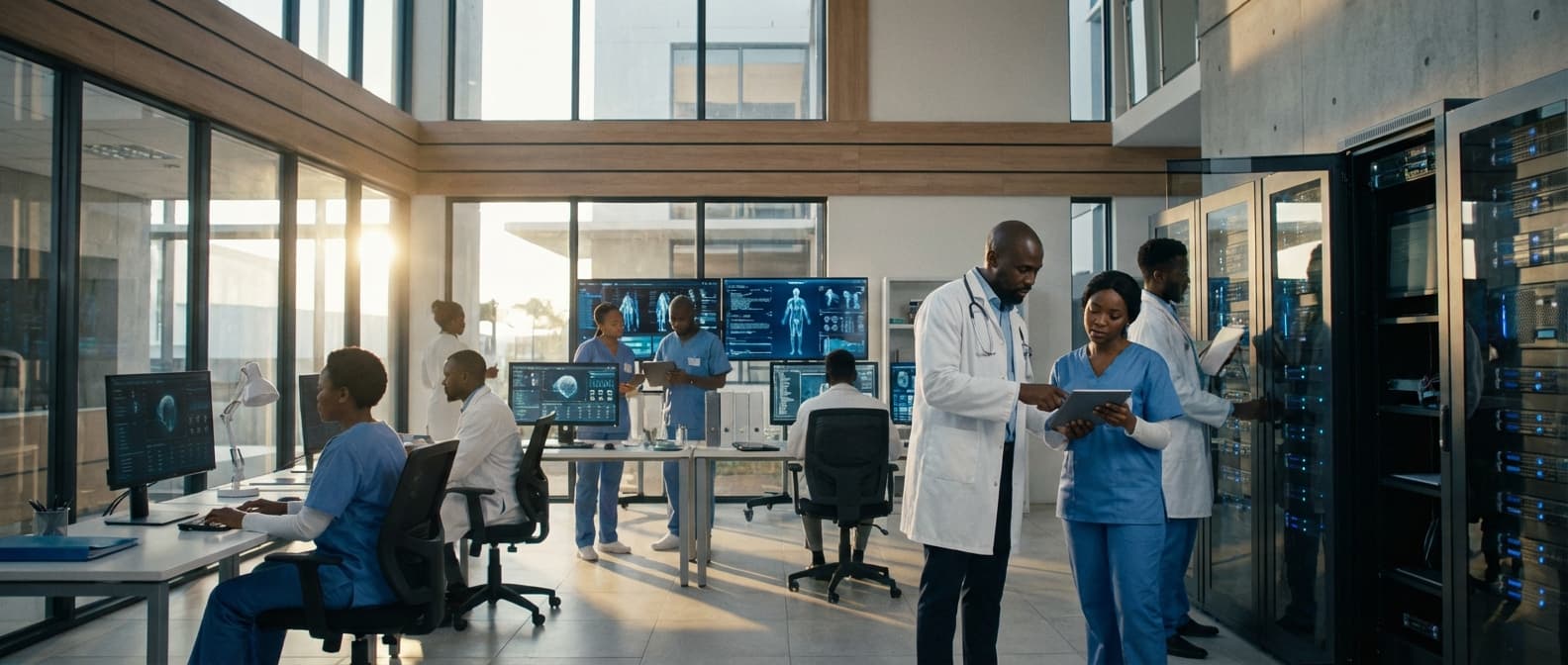
Medical IT Consultation in South Sudan
Engineering Excellence & Technical Support
Strategic technology consulting to optimize healthcare operations, streamline workflows, and integrate cutting-edge medical information systems. High-standard technical execution following OEM protocols and local regulatory frameworks.
Digital Health Record Implementation
Successfully deployed cloud-based Electronic Health Record (EHR) systems in three rural health clinics, improving data accuracy, accessibility, and patient care continuity across remote South Sudanese communities.
Telemedicine Infrastructure Development
Established robust, satellite-internet enabled telemedicine hubs in Juba and Wau, facilitating remote consultations with specialized physicians and significantly reducing the need for costly patient evacuations.
Cybersecurity Enhancement for Health Data
Implemented comprehensive cybersecurity protocols, including data encryption and secure access controls, safeguarding sensitive patient information against evolving threats and ensuring compliance with international health data privacy standards.
What Is Medical It Consultation In South Sudan?
Medical IT Consultation in South Sudan refers to the provision of expert advice, planning, and implementation services related to information technology within the healthcare sector. This specialized field focuses on leveraging technology to improve the efficiency, accuracy, accessibility, and security of healthcare delivery, administration, and research in the South Sudanese context. It addresses the unique challenges and opportunities present in a developing nation, including limited infrastructure, diverse technological literacy levels, and resource constraints.
| Who Needs Medical IT Consultation? | Typical Use Cases |
|---|---|
| Government Health Ministries and Agencies: For national health information system development, policy formulation, and large-scale public health initiatives. | Implementing national EHR systems for improved patient data tracking and public health surveillance. Developing digital immunization registries. Establishing nationwide telemedicine networks for remote consultations and specialist access. |
| Hospitals and Healthcare Facilities (Public and Private): To optimize clinical workflows, enhance patient care, and improve administrative efficiency. | Digitizing patient records to reduce errors and improve data retrieval. Implementing PACS for radiology image management and remote viewing. Deploying laboratory information systems for efficient sample tracking and result reporting. Setting up patient appointment and scheduling systems. |
| Non-Governmental Organizations (NGOs) and International Aid Organizations: For establishing and managing health programs in remote or underserved areas. | Deploying mobile health (mHealth) solutions for data collection in field settings. Implementing cloud-based HIMS for managing patient data across multiple project sites. Setting up communication infrastructure for coordination and reporting in emergency health responses. |
| Research Institutions and Universities: To facilitate data management, analysis, and collaboration for health research. | Developing secure databases for clinical trial data. Implementing data analytics tools for epidemiological studies. Facilitating secure data sharing platforms for collaborative research. |
| Individual Healthcare Providers (in select cases): To adopt basic digital tools for practice management. | Implementing simple practice management software for billing and patient scheduling. |
Key Components of Medical IT Consultation in South Sudan
- Needs Assessment and Gap Analysis: Evaluating existing IT infrastructure, workflows, and human capacity to identify critical areas for improvement and technological integration.
- Strategic Planning and Roadmapping: Developing long-term IT strategies aligned with organizational goals, including technology acquisition, deployment, and maintenance plans.
- System Design and Architecture: Designing robust and scalable IT systems, including Electronic Health Records (EHRs), Picture Archiving and Communication Systems (PACS), laboratory information systems (LIS), and telemedicine platforms.
- Infrastructure Development and Management: Advising on and overseeing the implementation of essential IT infrastructure such as networks, servers, data storage, cybersecurity measures, and power solutions.
- Software Selection and Implementation: Recommending and facilitating the adoption of appropriate health information management systems (HIMS) and other healthcare-specific software, ensuring interoperability.
- Data Management and Analytics: Establishing protocols for data collection, storage, security, and analysis to support evidence-based decision-making, public health surveillance, and research.
- Training and Capacity Building: Developing and delivering training programs for healthcare professionals and IT staff on the effective use and maintenance of implemented technologies.
- Policy and Governance Development: Assisting in the formulation of IT policies, data privacy regulations, and cybersecurity frameworks compliant with local and international standards.
- Remote Support and Maintenance: Providing ongoing technical support, troubleshooting, and system maintenance, often leveraging remote access capabilities.
- Interoperability and Integration: Ensuring seamless data exchange between different healthcare systems and facilities, overcoming data silos.
Who Needs Medical It Consultation In South Sudan?
Medical IT consultation is crucial for healthcare organizations in South Sudan to overcome the unique challenges of developing and maintaining robust, reliable, and secure IT systems in a complex operating environment. This includes navigating infrastructure limitations, ensuring data privacy and security, and optimizing resource allocation for improved patient care and operational efficiency. The demand for specialized IT expertise spans various sectors within the healthcare landscape.
| Customer Type | Key IT Needs | Impact on Healthcare Delivery |
|---|---|---|
| Government Health Ministries | National HIS/EHR, Public Health Data Analytics, Cybersecurity | Improved national health planning, disease surveillance, and policy enforcement. |
| Public Hospitals & Clinics | EHRs, Network Infrastructure, Telemedicine, Patient Management Systems | Enhanced patient care quality, reduced errors, faster service delivery, and better record management. |
| NGOs & International Organizations | mHealth, Data Management, Secure Communication, Donor Reporting | Expanded reach of healthcare services, efficient data collection for program impact, and accountability. |
| Private Healthcare Providers | Modern HIS/EHR, Patient Portals, Cybersecurity | Improved patient experience, operational efficiency, and enhanced data security. |
| Medical Training Institutions | LMS, Digital Libraries, Research Data Management | Better medical education and research outcomes, producing skilled healthcare professionals. |
| Pharmacies & Supply Chain | Inventory Management, Supply Chain Tracking, E-procurement | Ensured availability of essential medicines, reduced waste, and improved drug security. |
Target Customers and Departments for Medical IT Consultation in South Sudan
- {"title":"Government Health Ministries and Agencies","description":"These entities are responsible for national health strategies, policy development, and the oversight of public healthcare infrastructure. They require consultation to implement nationwide health information systems (HIS), manage electronic health records (EHRs), enhance data analytics for public health surveillance, and ensure cybersecurity across government health facilities. Departments benefiting include Planning & Policy, Public Health Surveillance, Health Information Management, and Procurement."}
- {"title":"Public Hospitals and Clinics","description":"From large referral hospitals to primary healthcare centers, these facilities often struggle with outdated or non-existent IT infrastructure. Consultation is needed for network upgrades, EHR implementation and training, medical equipment integration, telemedicine solutions, and optimizing patient management systems to reduce wait times and improve record-keeping. Key departments include Administration, Clinical Departments (e.g., Surgery, Pediatrics, Internal Medicine), Pharmacy, Laboratory, Radiology, and Patient Records."}
- {"title":"Non-Governmental Organizations (NGOs) and International Health Organizations","description":"Many NGOs play a vital role in delivering healthcare services in remote or underserved areas of South Sudan. They need IT support for managing project-specific data, implementing mobile health (mHealth) solutions for data collection and patient outreach, establishing secure communication channels, and ensuring data integrity for reporting to donors. Departments involved include Program Management, Monitoring & Evaluation (M&E), Field Operations, and IT/Technical Support."}
- {"title":"Private Healthcare Providers and Clinics","description":"While a smaller sector, private healthcare providers are increasingly seeking to modernize their operations to offer competitive and efficient services. Consultation can assist them in implementing modern HIS/EHRs, patient portals, appointment scheduling systems, and robust cybersecurity measures to protect sensitive patient data and build trust. Departments include Management, Billing & Finance, and Clinical Services."}
- {"title":"Medical Training and Educational Institutions","description":"Universities and colleges offering medical and health sciences programs require IT infrastructure for educational purposes, research, and administrative functions. Consultation can help in developing learning management systems (LMS), providing access to digital libraries, supporting research data management, and ensuring robust IT support for faculty and students. Departments include Academic Affairs, IT Services, Research Departments, and Administration."}
- {"title":"Pharmacies and Medical Supply Chain Management","description":"Ensuring the availability and proper management of essential medicines is critical. IT consultation can assist in implementing inventory management systems, supply chain tracking software, and e-procurement platforms to improve efficiency, reduce stockouts, and prevent counterfeit drugs. Departments include Procurement, Logistics, Inventory Management, and Pharmacy Operations."}
Medical It Consultation Process In South Sudan
The Medical IT Consultation Process in South Sudan outlines the systematic approach taken by IT service providers to address the technology needs of healthcare organizations within the country. This workflow ensures that all stages, from initial contact to the successful implementation and ongoing support of IT solutions, are managed efficiently and effectively, considering the unique challenges and opportunities present in South Sudan's healthcare sector. The process is designed to be adaptable, recognizing the diverse technological maturity and resource availability of different medical facilities.
| Stage | Description | Key Activities | Deliverables | Considerations for South Sudan |
|---|---|---|---|---|
| Initial Inquiry & Needs Assessment | The client (healthcare facility) expresses interest in IT services or solutions. The consultation begins with understanding their current IT infrastructure, pain points, and future goals. | Initial meeting, stakeholder interviews, site visit (if feasible), review of existing IT assets, documentation of current challenges. | Needs assessment report, list of identified IT gaps and opportunities. | Limited existing infrastructure, potential for leapfrogging to modern solutions, reliance on satellite connectivity, understanding local technical expertise availability. |
| Proposal Development & Contract Negotiation | Based on the needs assessment, a tailored IT solution is proposed. This stage involves defining the scope of work, timelines, costs, and service level agreements. | Developing a detailed proposal, cost estimation, defining project milestones, legal review, contract signing. | Formal project proposal, detailed budget, signed contract/Memorandum of Understanding (MoU). | Cost-effectiveness, phased implementation options, understanding donor funding cycles, clear contractual terms for remote support. |
| System Design & Planning | A comprehensive plan is developed for the chosen IT solution, including hardware, software, network infrastructure, and security measures. | System architecture design, software selection/customization, network topology planning, data migration strategy, security protocols definition, implementation roadmap. | System design documentation, technical specifications, project implementation plan, security policy. | Adapting solutions for low-bandwidth environments, considering offline capabilities, ensuring data privacy and security in a sensitive sector, integrating with existing (if any) legacy systems. |
| Procurement & Deployment | The necessary hardware, software, and licenses are acquired, and the IT system is installed and configured. | Hardware and software procurement, installation of devices, network setup, software configuration, initial data migration. | Installed and configured IT systems, functional hardware and software. | Logistics and customs clearance for imported equipment, local sourcing where possible, robust installation procedures to minimize on-site intervention needs, potential for pre-configuration. |
| Training & User Adoption | End-users and IT staff are trained on how to effectively use and manage the new IT systems. | Developing training materials, conducting training sessions (on-site/remote), providing user manuals, assessing user proficiency. | Trained staff, user manuals, training feedback reports. | Culturally sensitive training methods, addressing varying literacy levels, train-the-trainer models for sustainability, provision of simplified user guides. |
| Go-Live & Monitoring | The new IT system is officially launched, and its performance is closely monitored to identify and resolve any immediate issues. | System launch, real-time performance monitoring, troubleshooting initial glitches, user support during the initial phase. | Operational IT system, initial performance reports, resolved critical issues. | Phased rollout to minimize disruption, robust helpdesk support during the critical go-live period, understanding common user errors. |
| Post-Implementation Support & Optimization | Ongoing maintenance, technical support, and system optimization are provided to ensure continued efficiency and to adapt to evolving needs. | Regular system maintenance, troubleshooting, software updates, performance tuning, user feedback collection, system upgrades, ongoing training. | Ongoing support services, system performance reports, updated documentation, future improvement recommendations. | Long-term support agreements, remote monitoring and management capabilities, proactive maintenance schedules, planning for future upgrades and scalability. |
Key Stages of the Medical IT Consultation Process
- Initial Inquiry & Needs Assessment
- Proposal Development & Contract Negotiation
- System Design & Planning
- Procurement & Deployment
- Training & User Adoption
- Go-Live & Monitoring
- Post-Implementation Support & Optimization
Medical It Consultation Cost In South Sudan
Medical IT consultation costs in South Sudan are highly variable, influenced by several key factors. Unlike developed economies with established IT service markets, South Sudan's IT landscape is still maturing, leading to a wider price range and often project-specific quotations. The demand for specialized medical IT expertise is growing, but the supply of qualified professionals and robust IT infrastructure can be limited, impacting pricing. Understanding these drivers is crucial for organizations seeking IT consulting services in the healthcare sector.
| Service Type/Complexity | Estimated Range (South Sudanese Pounds - SSP) | Notes |
|---|---|---|
| Initial IT Assessment & Recommendations (Short-term, basic analysis) | 500,000 - 1,500,000 SSP | Covers a few days of on-site or remote work, basic infrastructure review, and preliminary advice. |
| EHR/HIS System Planning & Vendor Selection | 1,000,000 - 3,000,000 SSP | Involves detailed needs assessment, vendor research, RFP development, and selection guidance. Can be longer duration. |
| Telemedicine Platform Strategy & Setup | 800,000 - 2,500,000 SSP | Focuses on platform selection, technical requirements, network considerations, and initial setup guidance. |
| Cybersecurity Audit & Policy Development for Healthcare Data | 700,000 - 2,000,000 SSP | Assessing current security posture, identifying vulnerabilities, and developing data protection policies. |
| Network Infrastructure Design & Upgrade Consultation | 600,000 - 1,800,000 SSP | Consultation on improving connectivity, bandwidth, and network reliability for medical facilities. |
| Comprehensive IT Strategy & Roadmap Development (Long-term) | 1,500,000 - 5,000,000+ SSP | In-depth strategic planning, multi-year IT roadmap, and ongoing advisory. Highly project-dependent. |
| Specialized Medical Imaging IT Consultation | 900,000 - 3,000,000 SSP | Focuses on Picture Archiving and Communication Systems (PACS) and other medical imaging IT infrastructure. |
| Project Management & Implementation Support (per month) | 400,000 - 1,000,000+ SSP | Ongoing support for IT projects, often with a focus on local capacity building. |
| International Consultant (Daily Rate + Expenses) | USD 500 - 1,500+ per day (plus travel, accommodation, per diem) | When local expertise is limited, international consultants are engaged, significantly increasing overall cost due to travel and international rates. |
Factors Influencing Medical IT Consultation Costs in South Sudan
- Scope and Complexity of the Project: Larger, more intricate projects requiring extensive analysis, system design, and implementation naturally incur higher costs. This includes areas like Electronic Health Records (EHR) system implementation, telemedicine platform setup, cybersecurity audits for healthcare data, or network infrastructure upgrades for hospitals.
- Duration of the Consultation: The length of time required for the consultant to engage with the client, conduct assessments, develop strategies, and provide ongoing support directly translates to cost. Short-term advisory services will be less expensive than long-term project management or system integration.
- Consultant's Expertise and Experience: Highly specialized medical IT consultants with proven track records and experience in similar healthcare environments in South Sudan or comparable regions will command higher fees. This includes knowledge of local regulations, health system challenges, and existing infrastructure.
- Type of Service Required: Different services have different pricing structures. This could range from a one-time assessment and report, to ongoing strategic planning, to hands-on implementation and training. Software procurement and configuration, data migration, and IT security planning are examples of distinct service types.
- Geographic Location within South Sudan: While Juba, as the capital, generally has a higher concentration of skilled IT professionals and potentially higher operational costs for consultants, remote areas might involve additional travel and logistical expenses, which can be factored into the overall cost.
- Demand and Availability: The current demand for medical IT consultants in South Sudan, coupled with the availability of qualified individuals, can influence pricing. High demand and limited supply will likely drive costs upwards.
- Specific Technology Stack: If the consultation involves working with specific, complex, or proprietary medical IT systems (e.g., advanced HIS/EMR platforms, specialized medical imaging software), the consultant's familiarity and expertise with these technologies will be a pricing factor.
- Travel and Accommodation: For consultants traveling from outside the immediate area or from international locations, travel expenses (flights, local transport) and accommodation costs will be significant components of the overall fee.
Affordable Medical It Consultation Options
Navigating the complexities of Medical IT can be daunting and expensive for healthcare organizations. This guide explores affordable medical IT consultation options, focusing on value bundles and cost-saving strategies to ensure your practice receives the expertise it needs without breaking the bank. We'll cover how to leverage flexible service models, understand tiered pricing, and implement smart procurement practices.
| Cost-Saving Strategy | Description | Potential Benefits |
|---|---|---|
| Value Bundling | Purchasing a package of services (e.g., cybersecurity assessment + EHR optimization + cloud migration planning) from a single provider at a reduced overall cost. | Significant cost reduction compared to individual service purchases, streamlined communication, integrated solutions. |
| Tiered Service Levels | Engaging consultants at different service levels (e.g., basic advice, in-depth analysis, full implementation support) based on budget and urgency. | Flexibility to manage costs, paying only for the level of expertise and support required. |
| Retainer Agreements (Flexible) | Establishing a recurring monthly fee for a set number of hours or access to specific expertise, offering proactive support and reduced hourly rates. | Predictable IT costs, ongoing strategic guidance, faster response times for minor issues. |
| Project-Based Consultation | Hiring consultants for specific, well-defined projects with a fixed scope and budget. | Ideal for targeted needs, clear cost control, and measurable outcomes. |
| Remote & Virtual Support | Utilizing consultants who can provide expertise and support remotely, reducing travel costs and on-site time. | Lower consultation fees, increased accessibility to a wider pool of experts. |
| Phased Implementations | Breaking down large IT projects into smaller, manageable phases, allowing for staggered investments and evaluation of each stage. | Easier budget management, reduced risk, ability to adapt based on early results. |
| Vendor Negotiation & RFPs | Thoroughly researching and comparing multiple vendor proposals (Request for Proposals - RFPs) and negotiating terms. | Securing competitive pricing, ensuring best value for money. |
Key Components of Affordable Medical IT Consultation
- Understanding Your Needs: A thorough assessment of your current IT infrastructure, pain points, and future goals is crucial for selecting the right consultation services.
- Value Bundles: Services packaged together often provide a more cost-effective solution than purchasing individual consultations.
- On-Demand vs. Retainer: Differentiating between the need for immediate, project-based support and ongoing advisory services.
- Vendor Specialization: Focusing on consultants with specific expertise in healthcare IT can lead to more efficient and impactful solutions.
- Clear Scope of Work: Defining project deliverables, timelines, and success metrics upfront minimizes unexpected costs and scope creep.
- Leveraging Technology: Utilizing remote support tools and cloud-based solutions can reduce on-site consultation time and costs.
Verified Providers In South Sudan
In South Sudan, access to reliable and qualified healthcare providers is paramount for the well-being of its citizens. Verified providers, those who have undergone rigorous credentialing and are recognized for their expertise and adherence to ethical standards, offer a critical layer of assurance. Franance Health stands out as a leading organization committed to ensuring the highest quality of care through its stringent verification processes. This dedication to credentialing not only safeguards patients but also elevates the standard of healthcare services available in the region, making Franance Health a trusted partner in health.
| Provider Aspect | Franance Health's Verification Process | Why it Matters for Patients |
|---|---|---|
| Licensing and Registration | Franance Health meticulously cross-references all medical licenses with relevant South Sudanese and international regulatory bodies. | Guarantees that practitioners are legally qualified and authorized to practice, ensuring adherence to established medical protocols. |
| Educational Attainment | We independently verify the authenticity and accreditation of all educational certificates and degrees presented by our providers. | Confirms that healthcare professionals have received a sound and recognized foundational education in their respective fields. |
| Clinical Experience | Franance Health employs a multi-faceted approach to assess clinical experience, including reference checks and review of past performance where possible. | Ensures that providers possess practical skills and a track record of successful patient care, vital for effective treatment. |
| Ethical Conduct | All Franance Health providers undergo background checks for disciplinary actions and attest to adherence to a comprehensive ethical code. | Builds trust and confidence by assuring patients of respectful, confidential, and professional treatment free from bias. |
| Specialized Expertise | For specialists, Franance Health confirms relevant board certifications and advanced training, validating their specific competencies. | Ensures patients receive care from highly qualified individuals who have proven expertise in their chosen medical discipline. |
| Commitment to Quality | Franance Health's rigorous credentialing process is designed to identify and onboard only the most competent and ethical healthcare professionals. | Provides patients with the peace of mind that they are receiving care from providers who meet the highest industry standards, contributing to better health outcomes. |
Key Credentials of Verified Providers like Franance Health
- Professional Licensing and Registration: Ensuring all practitioners possess valid, up-to-date licenses from recognized national and international bodies.
- Educational Background Verification: Confirming the authenticity of degrees, diplomas, and specialized training from accredited institutions.
- Experience and Competency Assessment: Evaluating practical experience through peer reviews, case studies, and performance evaluations.
- Adherence to Ethical Standards: Commitment to a strict code of conduct, patient confidentiality, and non-discrimination.
- Continuous Professional Development (CPD): Mandating ongoing training and education to keep pace with advancements in medical knowledge and practice.
- Clean Disciplinary Record: Thorough background checks to ensure no history of malpractice, negligence, or ethical violations.
- Specialty Certifications: Verifying qualifications for specialized medical fields, ensuring expertise in specific areas of care.
Scope Of Work For Medical It Consultation
This Scope of Work (SOW) outlines the objectives, deliverables, and specifications for a Medical IT Consultation engagement. The primary goal is to assess, advise on, and potentially implement solutions to enhance the efficiency, security, and compliance of [Client Name]'s medical IT infrastructure. This consultation will focus on current systems, future needs, and best practices within the healthcare industry.
| Deliverable | Description | Standard Specifications/Acceptance Criteria | Timeline (Weeks) |
|---|---|---|---|
| Initial IT Infrastructure Assessment Report | Comprehensive analysis of current IT assets, including network topology, hardware inventory, software licenses, and user access controls. | Report includes system diagrams, asset lists, and initial risk assessment. Acceptance based on completeness and accuracy of information presented. | 2 |
| Security & Compliance Audit Findings | Detailed review of IT security measures and adherence to relevant healthcare regulations (HIPAA, HITECH). Identifies gaps and non-compliance areas. | Report outlines identified vulnerabilities, compliance gaps, and a prioritized list of remediation actions. Acceptance based on clear identification of risks and actionable recommendations. | 3 |
| Technology Recommendations & Solution Design | Proposed solutions for hardware upgrades, software adoption, cloud migration, EHR/EMR optimization, telehealth integration, and cybersecurity enhancements. | Includes vendor evaluations (if applicable), cost-benefit analysis, and proposed implementation plans. Acceptance based on feasibility, cost-effectiveness, and alignment with client needs. | 4 |
| Strategic IT Roadmap | A multi-year plan outlining IT initiatives, project timelines, resource allocation, and budget considerations to achieve strategic objectives. | Roadmap is clear, actionable, and aligns with the client's business growth and evolving healthcare landscape. Acceptance based on strategic alignment and clear implementation phases. | 5 |
| Implementation Support (Optional) | Assistance with the planning, procurement, and deployment of recommended IT solutions. | Scope and deliverables to be defined in a separate SOW addendum if engaged. Acceptance criteria will be project-specific. | TBD |
| Final Consultation Summary & Presentation | A comprehensive overview of findings, recommendations, and the strategic roadmap, presented to key stakeholders. | Presentation is clear, concise, and addresses all key aspects of the consultation. Acceptance based on stakeholder understanding and buy-in. | 6 |
Key Objectives of the Medical IT Consultation
- Assess the current state of the client's IT infrastructure, including hardware, software, network, and data management systems.
- Identify critical pain points, inefficiencies, and potential security vulnerabilities within the existing IT environment.
- Evaluate the client's compliance with relevant healthcare regulations (e.g., HIPAA, HITECH).
- Provide expert recommendations for technology upgrades, software solutions, and process improvements.
- Develop a strategic IT roadmap aligned with the client's short-term and long-term business goals.
- Ensure recommendations prioritize patient data security, privacy, and accessibility.
- Facilitate seamless integration of new technologies with existing systems.
Service Level Agreement For Medical It Consultation
This Service Level Agreement (SLA) outlines the agreed-upon response times and uptime guarantees for Medical IT Consultation services provided by [Your Company Name] to [Client Name]. This SLA is an addendum to the Master Services Agreement (MSA) dated [Date of MSA].
| Incident Priority | Initial Response Time | Resolution Target Time | Uptime Guarantee (Monthly) |
|---|---|---|---|
| Critical Incident | 15 Minutes | 4 Hours | 99.9% |
| High Priority Incident | 1 Hour | 8 Business Hours | 99.5% |
| Medium Priority Incident | 4 Business Hours | 24 Business Hours | 99.0% |
| Low Priority Incident | 8 Business Hours | 72 Business Hours | N/A (Best Effort) |
| Scheduled Maintenance | N/A (Advance Notice Required) | As per agreed schedule | N/A |
Service Level Objectives (SLOs)
- Critical Incident: An incident that renders a core clinical system unusable, significantly impacts patient care, or causes a complete loss of critical data. Examples include: Electronic Health Record (EHR) system outage, inability to access patient medical images, or a major network failure affecting multiple clinical departments.
- High Priority Incident: An incident that severely degrades the performance of a critical clinical system, impacts a significant number of users, or causes a minor loss of non-critical data. Examples include: Slow performance of the EHR system impacting multiple users, inability to access a specific non-critical application, or intermittent network connectivity issues in a department.
- Medium Priority Incident: An incident that impacts a single user or a small group of users, causes minor degradation of system performance, or affects non-critical systems. Examples include: A single workstation issue, a printer malfunction, or an issue with a departmental administrative application.
- Low Priority Incident: A general inquiry, a request for information, a minor bug report that does not significantly impact functionality, or a feature enhancement request. Examples include: How-to questions, minor cosmetic issues in software, or requests for reporting enhancements.
- Scheduled Maintenance: Planned downtime for system upgrades, patches, or hardware maintenance. This will be communicated with advance notice.
Frequently Asked Questions

Ready when you are
Let's scope your Medical IT Consultation in South Sudan project in South Sudan.

Scaling healthcare logistics and technical systems across the entire continent.