
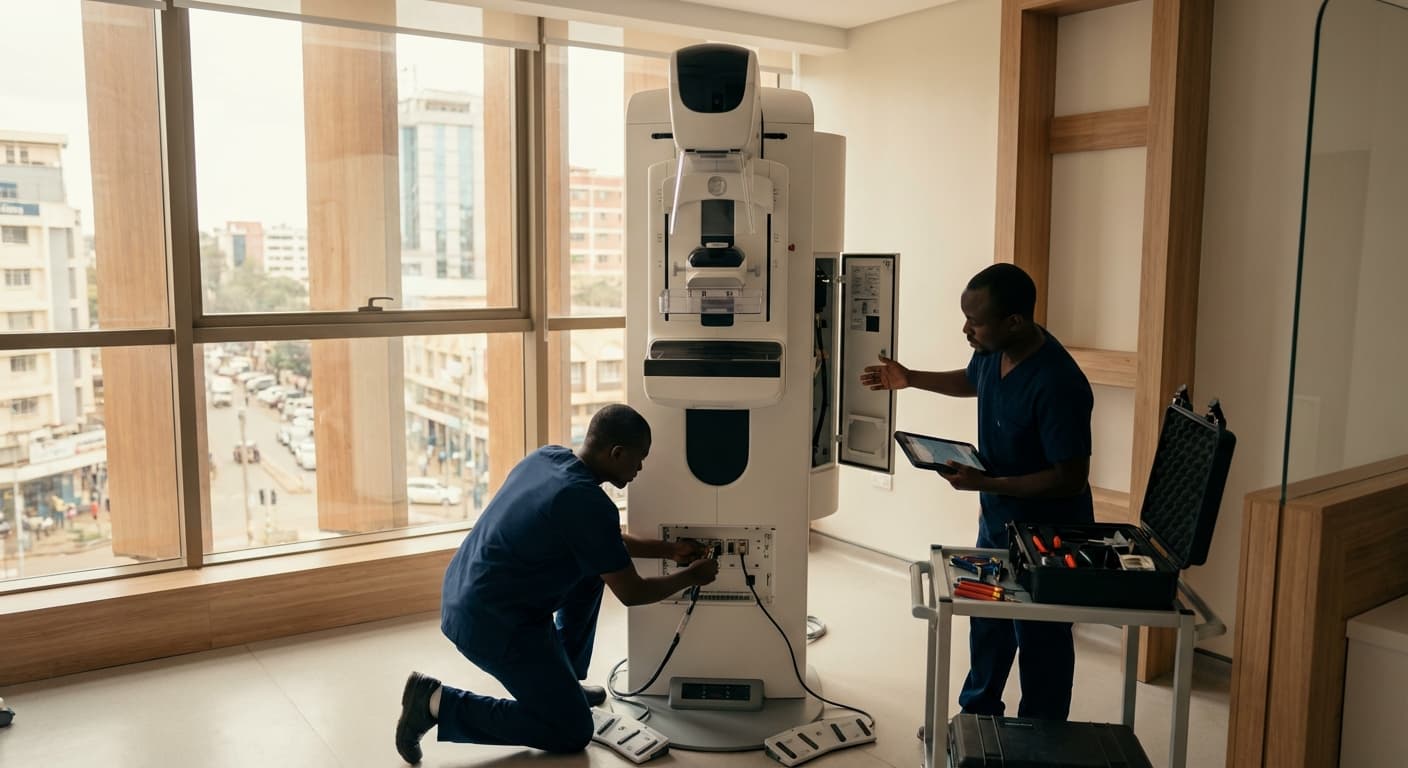
Mammography Installation Service in South Sudan
Engineering Excellence & Technical Support
Mammography Installation Service High-standard technical execution following OEM protocols and local regulatory frameworks.
Rapid Deployment & Commissioning
Leveraging our experienced field teams and streamlined logistical processes, we ensure rapid deployment and efficient commissioning of advanced mammography systems across South Sudan, minimizing downtime and maximizing diagnostic availability.
Robust Infrastructure Integration
We provide comprehensive site assessment and installation services, including power, networking, and environmental controls, to ensure seamless integration of mammography units with existing healthcare infrastructure, guaranteeing optimal performance and reliability in challenging conditions.
Certified Training & Ongoing Support
Our expert technicians deliver certified, hands-on training for local medical personnel, alongside a robust post-installation support framework and readily available spare parts, ensuring sustained operational excellence and patient safety for mammography services throughout South Sudan.
What Is Mammography Installation Service In South Sudan?
Mammography Installation Service in South Sudan refers to the comprehensive process of setting up, calibrating, and commissioning mammography equipment within healthcare facilities in South Sudan. This service ensures that the medical imaging technology is functional, safe, and capable of producing diagnostic-quality images for breast cancer screening and diagnosis. The installation encompasses the physical placement of the equipment, integration with existing hospital infrastructure (e.g., power, networking), and the establishment of necessary software and hardware configurations. This is a critical service for any facility aiming to offer advanced diagnostic imaging capabilities for breast health.
| Who Needs Mammography Installation Service? | Typical Use Cases | |||
|---|---|---|---|---|
| Hospitals and Medical Centers: Both public and private facilities looking to establish or upgrade their radiology departments with mammography capabilities. | Breast Cancer Screening Programs: Facilities participating in national or regional breast cancer screening initiatives. | Diagnostic Imaging Clinics: Specialized clinics offering a range of imaging services, including mammography. | Non-Governmental Organizations (NGOs) and International Aid Agencies: Organizations involved in improving healthcare infrastructure and services in South Sudan, often focusing on maternal and child health or non-communicable diseases. | Government Health Ministries/Departments: Responsible for overseeing and equipping public health facilities to provide essential diagnostic services. |
| Early Detection of Breast Cancer: Enabling routine screening mammograms for asymptomatic women to identify potential malignancies at an early, treatable stage. | Diagnostic Mammography: Utilizing mammography to investigate suspicious lumps, pain, or other abnormalities detected during clinical examination or self-examination. | Follow-up of Abnormal Findings: Performing diagnostic mammography to further evaluate suspicious areas identified on screening mammograms or other imaging modalities. | Monitoring Patients with a History of Breast Cancer: Occasionally used in follow-up protocols, though other imaging techniques are more common. | Research and Training: For academic medical centers or research institutions conducting studies related to breast imaging or training future radiologists and technologists. |
Key Components of Mammography Installation Service:
- Site Preparation: Assessing and preparing the physical space to meet the specific requirements of mammography equipment, including radiation shielding, ventilation, and electrical load.
- Equipment Delivery and Unpacking: Safe transportation and careful unpacking of the mammography unit and its accessories.
- Physical Installation and Assembly: Positioning, bolting, and connecting all components of the mammography system according to manufacturer specifications.
- Electrical and Network Integration: Connecting the unit to the facility's power supply, ensuring proper grounding, and integrating it with PACS (Picture Archiving and Communication System) or other relevant IT infrastructure.
- Software Configuration and Installation: Installing and configuring the operating system, imaging software, and any associated diagnostic tools.
- Calibration and Quality Assurance (QA): Performing precise calibration of X-ray beam parameters, image processing algorithms, and other critical settings to ensure accurate and reliable image acquisition.
- Initial Testing and Performance Verification: Conducting a series of tests to confirm that all components are functioning as intended and that the system meets diagnostic imaging standards.
- Training: Providing comprehensive training to radiographers, technologists, and relevant biomedical engineering staff on the operation, maintenance, and basic troubleshooting of the mammography equipment.
- Documentation: Supplying all necessary manuals, warranty information, and installation certificates.
Who Needs Mammography Installation Service In South Sudan?
Mammography installation services are crucial for establishing and maintaining vital diagnostic capabilities in South Sudan's healthcare system. These services ensure that medical facilities are equipped with the necessary technology to perform mammograms, a critical tool for early breast cancer detection. This is particularly important in a region where access to advanced medical screening can be limited.
| Customer Type | Relevant Departments/Units | Key Needs/Reasons for Installation |
|---|---|---|
| Public Hospitals (National and Regional) | Radiology Department, Oncology Department, Women's Health Unit | Establishing baseline diagnostic infrastructure, improving access to screening for the general population, fulfilling national health mandates. |
| Private Hospitals and Clinics | Radiology Department, Diagnostic Imaging Center, Women's Health Services | Offering comprehensive diagnostic services, attracting patients seeking advanced care, competitive advantage in the private healthcare market. |
| Non-Governmental Organization (NGO) Healthcare Facilities | Mobile Clinics (if equipped), Specialized Cancer Screening Centers, General Hospitals | Providing essential screening services in underserved areas, supporting public health initiatives, focusing on specific health challenges within their mandate. |
| Maternal and Child Health Centers (with advanced diagnostic capabilities) | Radiology Unit, Women's Health Clinic | Expanding service offerings beyond primary maternal and child care to include preventative cancer screening, holistic women's health. |
| University Teaching Hospitals and Medical Training Institutions | Radiology Department, Pathology Department, Medical Education Unit | Training future radiologists and healthcare professionals, conducting research, providing advanced patient care and diagnostic services. |
Target Customers and Departments for Mammography Installation Service in South Sudan
- Public Hospitals (National and Regional)
- Private Hospitals and Clinics
- Non-Governmental Organization (NGO) Healthcare Facilities
- Maternal and Child Health Centers with advanced diagnostic capabilities
- University Teaching Hospitals and Medical Training Institutions
Mammography Installation Service Process In South Sudan
This document outlines the comprehensive workflow for a mammography installation service process in South Sudan. It covers all stages from the initial inquiry to the final execution and handover, ensuring a structured and efficient deployment of critical medical equipment.
| Phase | Step | Description | Key Stakeholders | Deliverables/Outcomes |
|---|---|---|---|---|
| Phase 1: Inquiry and Initial Assessment | 1.1 Client Inquiry | Receipt of formal request or expression of interest for mammography installation services from a healthcare facility or organization in South Sudan. | Client (Healthcare Facility/Ministry of Health), Service Provider | Initial contact established, understanding of client's needs. |
| 1.2 Needs Assessment Call/Meeting | Discussion to understand the specific mammography system requirements, intended use, existing infrastructure, and budget considerations. | Client, Service Provider Technical/Sales Team | Detailed requirements documented, preliminary solution conceptualized. | |
| 1.3 Proposal Development | Creation of a tailored proposal outlining the scope of work, equipment options, service timeline, pricing, and terms and conditions. | Service Provider | Formal proposal submitted to the client. | |
| Phase 2: Site Survey and Planning | 2.1 Site Visit Scheduling | Arrangement of a visit to the intended installation site(s) in South Sudan. | Client, Service Provider | Confirmed site visit date and time. |
| 2.2 On-site Survey | Detailed assessment of the installation location, including power supply, ventilation, room dimensions, structural integrity, security, and accessibility for equipment delivery. | Service Provider Technical Team, Client Representative | Comprehensive site survey report detailing infrastructure requirements and potential challenges. | |
| 2.3 Technical Design & Planning | Development of detailed installation plans, including room layout, power and cabling requirements, radiation shielding (if applicable), and environmental controls. | Service Provider Engineering Team | Approved technical drawings and installation plan. | |
| Phase 3: Procurement and Logistics | 3.1 Equipment Procurement | Ordering of the selected mammography system and any necessary accessories from the manufacturer or authorized distributor. | Service Provider Procurement Department | Confirmation of equipment order and estimated delivery date. |
| 3.2 Logistics and Transportation | Planning and execution of the safe and secure transportation of the equipment from the point of origin to the installation site in South Sudan, considering local infrastructure and customs clearance. | Service Provider Logistics Team, Shipping Company, Customs Authorities | Equipment cleared customs and delivered to the site or a staging area. | |
| Phase 4: Pre-Installation Preparations | 4.1 Site Preparation | Ensuring the installation site meets all the requirements identified in the site survey, including any necessary civil works, electrical upgrades, or environmental modifications. | Client, Service Provider (as per agreement) | Installation space prepared and compliant with specifications. |
| 4.2 Team Mobilization | Deployment of the installation team to the site, including engineers, technicians, and project managers. | Service Provider Project Management | Installation team on-site and ready. | |
| Phase 5: Installation and Configuration | 5.1 Equipment Unpacking and Inspection | Careful unpacking of the mammography system and all components, followed by a thorough visual inspection for any shipping damage. | Service Provider Installation Team | Equipment unpacked and initial condition verified. |
| 5.2 Physical Installation | Assembly and setup of the mammography unit according to the manufacturer's specifications and the approved installation plan. | Service Provider Installation Team | Mammography system physically installed in its designated location. | |
| 5.3 Electrical and Network Connections | Connecting the mammography system to the power supply, grounding, and any required network infrastructure for PACS integration (if applicable). | Service Provider Installation Team, IT Support (if applicable) | All necessary electrical and network connections completed. | |
| 5.4 Software Installation and Configuration | Installation and configuration of the system software, including user interface, imaging parameters, and integration with existing hospital IT systems. | Service Provider Installation Team, Software Specialists | System software installed and configured. | |
| Phase 6: Testing and Calibration | 6.1 System Self-Tests | Running internal diagnostic tests to ensure all components are functioning correctly. | Service Provider Installation Team | Initial system health check passed. |
| 6.2 Performance Testing | Conducting tests to verify image quality, radiation output, and overall system performance against manufacturer specifications. | Service Provider Installation Team, Quality Control Personnel | System performance validated. | |
| 6.3 Calibration | Precise calibration of the mammography unit to ensure accurate measurements and optimal image acquisition. | Service Provider Calibration Specialist | System calibrated for accurate operation. | |
| 6.4 Acceptance Testing (Client Sign-off) | Joint testing by the service provider and client to confirm the system meets all agreed-upon specifications and is ready for use. | Service Provider, Client Representatives (Radiologists, Technicians) | Formal client acceptance of the installed system. | |
| Phase 7: Training and Handover | 7.1 Operator Training | Comprehensive training for radiographers and technicians on the operation, basic troubleshooting, and daily maintenance of the mammography system. | Service Provider Application Specialist, Client Radiographers/Technicians | Operators trained and competent in system usage. |
| 7.2 Administrator/IT Training | Training for relevant IT staff on system administration, network integration, and basic IT support. | Service Provider IT Specialist, Client IT Staff | IT personnel trained on system management. | |
| 7.3 Documentation Handover | Provision of all relevant user manuals, service manuals, warranty information, and installation reports to the client. | Service Provider Project Manager | Complete documentation package provided. | |
| 7.4 Final Handover | Official transfer of responsibility for the installed system to the client, marking the completion of the installation phase. | Service Provider Project Manager, Client Representative | System officially handed over to the client. | |
| Phase 8: Post-Installation Support and Maintenance | 8.1 Warranty Period | Provision of warranty support as per the contract, covering defects in materials and workmanship. | Service Provider Technical Support | System covered by warranty. |
| 8.2 Preventive Maintenance | Scheduled maintenance visits to ensure the system's optimal performance and longevity, as per the service agreement. | Service Provider Field Service Engineers | Regular maintenance performed. | |
| 8.3 Corrective Maintenance/Breakdown Support | Rapid response to any system malfunctions or breakdowns, including troubleshooting and repair services. | Service Provider Technical Support, Field Service Engineers | System operational after repairs. | |
| 8.4 Spare Parts Management | Ensuring the availability of critical spare parts to minimize downtime. | Service Provider Logistics & Service Department | Spare parts inventory managed. |
Mammography Installation Service Workflow in South Sudan
- Phase 1: Inquiry and Initial Assessment
- Phase 2: Site Survey and Planning
- Phase 3: Procurement and Logistics
- Phase 4: Pre-Installation Preparations
- Phase 5: Installation and Configuration
- Phase 6: Testing and Calibration
- Phase 7: Training and Handover
- Phase 8: Post-Installation Support and Maintenance
Mammography Installation Service Cost In South Sudan
Installing mammography equipment in South Sudan involves a range of costs influenced by several key factors. These factors contribute to the overall investment required for a functional mammography service, impacting both initial setup and ongoing operational expenses. Understanding these elements is crucial for healthcare facilities and government bodies planning for such essential medical infrastructure.
| Service/Component | Estimated Cost Range (South Sudanese Pounds - SSP) | Notes |
|---|---|---|
| New Digital Mammography Machine (Mid-Range) | SSP 150,000,000 - SSP 300,000,000+ | Excludes shipping, installation, and site prep. Prices can vary greatly by brand and features. |
| Refurbished Digital Mammography Machine | SSP 70,000,000 - SSP 150,000,000 | Condition and warranty are key factors. May require more frequent maintenance. |
| Ancillary Equipment (PACS, viewing stations) | SSP 30,000,000 - SSP 80,000,000 | Depends on the complexity and scale of the system. |
| Site Preparation (Shielding, Electrical, HVAC) | SSP 20,000,000 - SSP 60,000,000 | Highly dependent on existing infrastructure and required modifications. |
| Shipping, Customs, and Logistics (Imported) | SSP 40,000,000 - SSP 100,000,000+ | Can be a significant portion of the total cost, especially for landlocked regions. |
| Professional Installation and Calibration | SSP 15,000,000 - SSP 40,000,000 | Includes fees for specialized technicians. |
| Initial Operator and Technician Training | SSP 10,000,000 - SSP 25,000,000 | Covers training for multiple personnel and modalities. |
| Annual Maintenance and Service Contract (Post-Warranty) | SSP 15,000,000 - SSP 40,000,000 (per year) | Essential for long-term operational efficiency. Varies by service level agreement. |
| Total Estimated Installation Cost (excluding ongoing maintenance) | SSP 250,000,000 - SSP 600,000,000+ | This is a broad estimate. A detailed quotation is required for precise budgeting. |
Key Pricing Factors for Mammography Installation in South Sudan
- Type and Brand of Mammography Machine: High-end, advanced digital mammography systems (like 3D tomosynthesis) are significantly more expensive than basic analog or older digital models. Brand reputation and technological features play a major role.
- New vs. Refurbished Equipment: New machines come with the latest technology and full warranties but at a premium price. Refurbished units can offer substantial cost savings but may have shorter lifespans and potentially higher maintenance needs.
- Ancillary Equipment and Software: Beyond the mammography unit itself, costs include image processing software, PACS (Picture Archiving and Communication System) for digital storage, and potentially dedicated viewing stations. Training for staff on new software also adds to the expense.
- Installation Complexity and Site Preparation: This encompasses electrical work (ensuring adequate power supply and grounding), radiation shielding for the installation room (lead lining), HVAC systems for temperature and humidity control, and potential structural modifications to accommodate the equipment's weight and size.
- Shipping and Logistics: Importing specialized medical equipment into South Sudan can incur substantial costs due to transportation, customs duties, taxes, and potential delays. This is a significant consideration for landlocked countries.
- Professional Installation and Calibration Services: Qualified technicians are required to assemble, install, and calibrate the mammography unit to ensure optimal performance and safety. These specialized services command professional fees.
- Training and Skill Development: Comprehensive training for radiologists, radiographers, and maintenance personnel is essential for effective operation and troubleshooting. This includes both initial training and ongoing professional development.
- Maintenance and Service Contracts: Post-installation, ongoing maintenance and service agreements are crucial for ensuring the longevity and reliability of the equipment. These contracts often involve annual fees.
- Local Infrastructure and Availability of Technicians: The availability of skilled local technicians for installation and maintenance can influence costs. If specialized external expertise is required, travel and accommodation expenses will be added.
- Currency Exchange Rates and Inflation: As South Sudan's economy can be volatile, fluctuations in currency exchange rates and inflation can significantly impact the final cost of imported equipment and services.
Affordable Mammography Installation Service Options
Installing a mammography unit is a significant investment for any healthcare facility. Beyond the purchase price of the equipment itself, there are crucial installation services that ensure its proper functioning, safety, and compliance with regulatory standards. Understanding these services and exploring cost-saving strategies can help facilities manage their budgets effectively while ensuring high-quality patient care.
Value Bundles: Many mammography equipment manufacturers and specialized installation service providers offer 'value bundles.' These packages typically combine several essential installation components into a single, often discounted, price. This approach simplifies the procurement process and can lead to significant cost savings compared to purchasing each service à la carte. Common inclusions in these bundles can range from basic site preparation and equipment delivery to advanced services like shielding verification, quality control (QC) testing, and staff training.
| Cost-Saving Strategy | Description | Potential Benefits |
|---|---|---|
| Bundle Purchasing | Opting for pre-packaged installation services from the manufacturer or a dedicated provider that includes multiple components. | Reduced overall cost, simplified procurement, streamlined project management. |
| Phased Installation | Breaking down the installation into stages, allowing for payment and execution over time. This can be beneficial for budgeting. | Improved cash flow management, flexibility in project timelines. |
| Negotiate Service Agreements | Actively negotiate pricing for installation services, especially when purchasing multiple units or as part of a larger equipment acquisition. | Potential for discounts, customized service level agreements. |
| Leverage Internal Expertise | If the facility has qualified in-house biomedical engineers or physicists, they may be able to perform certain QC or calibration tasks under supervision, reducing external service costs. | Reduced external labor costs, enhanced internal capabilities. |
| Source Competitively | Obtain quotes from multiple specialized installation service providers, not just the equipment manufacturer. Compare their offerings and pricing thoroughly. | Competitive pricing, access to diverse service expertise. |
| Early Planning and Site Preparation | Thoroughly plan and prepare the installation site well in advance to avoid costly delays, rework, or specialized last-minute modifications. | Minimized delays, reduced risk of unforeseen expenses, smoother installation process. |
| Consider Refurbished Equipment with Installation Packages | For facilities with tighter budgets, purchasing certified refurbished mammography equipment that includes installation services can be a cost-effective option. | Lower upfront equipment cost, often bundled with essential installation services. |
Key Components of Mammography Installation Services:
- Site Assessment and Preparation: Evaluating the intended installation space for structural integrity, power requirements, ventilation, and radiation shielding needs.
- Equipment Delivery and Rigging: Safely transporting the heavy mammography unit to the installation site and maneuvering it into position.
- Electrical and Network Cabling: Connecting the unit to the facility's power grid and IT network for data transfer and PACS integration.
- Radiation Shielding (if required): Installing lead lining or other shielding materials to protect personnel and the public from radiation exposure, adhering to local and national regulations.
- Initial System Setup and Calibration: Configuring the mammography unit's software and hardware, ensuring all components are functioning optimally.
- Quality Assurance (QA) and Quality Control (QC) Testing: Performing a series of tests to verify image quality, dose accuracy, and adherence to regulatory standards (e.g., MQSA in the US).
- System Integration: Connecting the mammography unit with Picture Archiving and Communication Systems (PACS), Radiology Information Systems (RIS), and other relevant hospital infrastructure.
- Staff Training: Providing comprehensive training to radiographers, technologists, and physicists on the operation, maintenance, and QC procedures for the new mammography unit.
- Post-Installation Support: Offering ongoing technical assistance and troubleshooting after the unit is operational.
Verified Providers In South Sudan
In South Sudan, access to reliable and qualified healthcare providers is paramount. Franance Health stands out as a leading organization committed to delivering exceptional medical services. Their rigorous credentialing process ensures that all their affiliated healthcare professionals meet the highest standards of expertise, ethics, and patient care. Choosing a verified provider like those under the Franance Health umbrella offers peace of mind, knowing you are receiving care from competent and trustworthy individuals. This dedication to quality assurance is what makes Franance Health the best choice for your healthcare needs in South Sudan.
| Provider Type | Key Credentials Verified by Franance Health | Benefits of Choosing Franance Health |
|---|---|---|
| Doctors (GPs & Specialists) | Medical Degree (MBBS/MD or equivalent), Postgraduate Specialization Certification, Valid Medical License, Peer Reviews, Continuous Professional Development (CPD) | Accurate diagnosis, effective treatment plans, access to specialized care, up-to-date medical knowledge |
| Nurses (RNs, ENs, Midwives) | Nursing Diploma/Degree, Professional Nursing License, Specialty Certifications (e.g., midwifery, critical care), Experience in various healthcare settings | Compassionate care, skilled patient monitoring, effective wound care, safe childbirth assistance |
| Paramedics & Emergency Medical Technicians (EMTs) | Paramedic/EMT Certification, Advanced Life Support (ALS) or Basic Life Support (BLS) certifications, Emergency response training, Valid Driver's License | Timely and efficient emergency response, stabilization of critically ill/injured patients, safe patient transport |
| Pharmacists | Pharmacy Degree, Professional Pharmacy License, Knowledge of drug interactions and dispensing regulations | Safe and accurate medication dispensing, patient counseling on medication use, drug interaction checks |
| Therapists (Physio, Occupational) | Degree in relevant therapy field, Professional Registration, Specialization certifications, Clinical experience | Restoration of mobility and function, pain management, rehabilitation after injury or illness |
Why Franance Health Providers are the Best Choice:
- Rigorous Credentialing: Franance Health employs a stringent vetting process for all its healthcare professionals, ensuring they possess the necessary qualifications, experience, and ethical standing.
- Commitment to Excellence: Their providers are dedicated to delivering high-quality, patient-centered care, prioritizing well-being and positive health outcomes.
- Trust and Reliability: By choosing a Franance Health verified provider, you are assured of receiving care from individuals who have been thoroughly assessed and approved, building a foundation of trust.
- Access to Expertise: Franance Health networks with a diverse range of medical specialists, offering access to a broad spectrum of healthcare services and expertise.
- Patient-Centric Approach: The focus is always on the patient's needs, with an emphasis on clear communication, informed consent, and respectful treatment.
Scope Of Work For Mammography Installation Service
This Scope of Work (SOW) outlines the requirements for the comprehensive installation of a new mammography unit at [Hospital/Clinic Name]. The service encompasses the delivery, uncrating, positioning, connection, calibration, testing, and commissioning of the mammography system. It also includes the necessary site preparation coordination and post-installation support. The objective is to ensure the mammography unit is fully operational, compliant with all relevant regulations and standards, and integrated seamlessly into the existing medical imaging infrastructure.
| Item | Description | Standard Specification/Requirement | Compliance Evidence |
|---|---|---|---|
| Mammography Unit | Brand and Model: [Specify Mammography Unit Brand and Model] | Manufacturer's latest certified model. Compliance with FDA, CE, IEC, and local regulatory body requirements. | Manufacturer's Certificate of Conformity, Serial Number Tag, Installation Checklist |
| X-ray Generator | High-frequency, multi-pulse generator. | Output stability within +/- 5%. kVp, mA, and time accuracy within +/- 5%. Grid-controlled. Automatic exposure control (AEC) capability. | Generator test report, AEC calibration report |
| X-ray Tube | Dual-focus rotating anode tube (e.g., Rhodium/Molybdenum targets). | Focus spot size as per manufacturer's specifications. Integrated filtration as per regulatory requirements. | Tube specification sheet, Filtration verification report |
| Image Receptor | Digital Detector (DR) with appropriate pixel pitch and matrix size. (e.g., Cesium Iodide - CsI, or equivalent). | Spatial resolution: Minimum 3.5 lp/mm. Detective Quantum Efficiency (DQE) as per manufacturer's specifications and industry best practices. Image uniformity and noise characteristics meeting DICOM standards. | Detector specifications, DQE measurement report, Image quality assessment report |
| Compression System | Motorized, automated compression with adjustable speed and force. | Maximum compression force: 20 daN (or as per regulatory standards). Consistent and uniform compression application. Emergency release mechanism. | Compression force calibration report, User manual verification |
| Workstation and Console | High-resolution diagnostic monitor(s) (minimum 5MP for mammography). Ergonomic control console. | Monitor compliance with DICOM Part 14 and AAPM TG18 standards. Touchscreen or intuitive controls. Integrated acquisition software with advanced image processing. | Monitor calibration report, Software version verification, User interface demonstration |
| Radiation Shielding | Integrated shielding and room design considerations. | Dose levels at occupied areas compliant with ALARA principles and local radiation safety regulations. Lead shielding as required for walls, doors, and windows. | Radiation survey report post-installation, Room shielding design specifications |
| PACS/RIS Integration | DICOM conformance for image acquisition, storage, and retrieval. | Seamless integration with existing PACS and RIS. HL7 integration for patient demographics and study information. Modality Worklist (MWL) support. | DICOM conformance statement, Integration test report, RIS/PACS verification |
| Power Requirements | Stable power supply with UPS backup. | Voltage: [Specify required voltage, e.g., 208-240V]. Frequency: 50/60 Hz. Power consumption as per manufacturer's specifications. UPS capacity sufficient for full system operation and safe shutdown. | Electrical contractor's sign-off, UPS test report |
| Environmental Conditions | Suitable operating environment. | Temperature: 15-30°C. Humidity: 30-60% RH (non-condensing). Adequate ventilation and air conditioning. | Site assessment report, HVAC verification |
| Safety Features | Emergency stop buttons, interlocks, and warning lights. | All safety features functional and tested. Compliance with medical device safety standards. | Safety feature test report, Pre-installation safety checklist |
| Calibration and QA | Initial calibration and quality assurance setup. | All system parameters calibrated according to manufacturer's recommendations and regulatory standards. Initial QA phantom studies performed and documented. | Calibration certificates, Initial QA reports, Phantom images |
| Training | Operator and technologist training. | Comprehensive training on system operation, image acquisition, processing, quality control, and basic troubleshooting. Training delivered by certified instructors. Training documentation provided. | Training agenda, Attendance register, Training feedback forms |
| Documentation | Complete set of user and service manuals. | Provided in hardcopy and/or electronic format. Includes installation, operation, maintenance, troubleshooting, and safety information. | Manuals provided, Checklist of provided documents |
Technical Deliverables
- Site Assessment and Preparation Plan
- Delivery and Uncrating Report
- System Installation and Cabling Documentation
- Calibration and Performance Verification Reports
- Acceptance Testing Protocols and Results
- User Training Materials and Attendance Records
- System Configuration and DICOM/PACS Integration Report
- Warranty and Service Agreement Documentation
- Final Commissioning Report
- Post-Installation Support Plan
Service Level Agreement For Mammography Installation Service
This Service Level Agreement (SLA) outlines the response times and uptime guarantees for the Mammography Installation Service provided by [Your Company Name] to [Client Company Name]. This agreement is effective as of [Start Date] and will remain in effect until [End Date].
| Service Level | Description | Target Response Time | Uptime Guarantee |
|---|---|---|---|
| Critical Issue (Equipment Failure) | Complete loss of functionality preventing any diagnostic imaging. | 1 Hour (initial acknowledgment), 4 Business Hours (initiation of on-site/remote troubleshooting) | 99.5% |
| Major Issue (Partial Functionality Loss) | Significant reduction in functionality impacting workflow or specific imaging capabilities. | 2 Business Hours (initial acknowledgment), 8 Business Hours (initiation of on-site/remote troubleshooting) | 99.0% |
| Minor Issue (Performance Degradation/Non-critical error) | Issues affecting performance, minor error messages, or non-critical feature malfunctions. | 4 Business Hours (initial acknowledgment), 2 Business Days (initiation of remote troubleshooting) | 98.0% |
Key Service Components
- Installation Service: Includes the physical installation of the mammography equipment at the client's designated facility, connection to necessary power and network infrastructure, and initial system configuration.
- Response Time: Refers to the time taken by [Your Company Name] to acknowledge and begin addressing a reported issue.
- Uptime Guarantee: Refers to the guaranteed operational availability of the installed mammography equipment.
Frequently Asked Questions

Ready when you are
Let's scope your Mammography Installation Service in South Sudan project in South Sudan.

Scaling healthcare logistics and technical systems across the entire continent.