
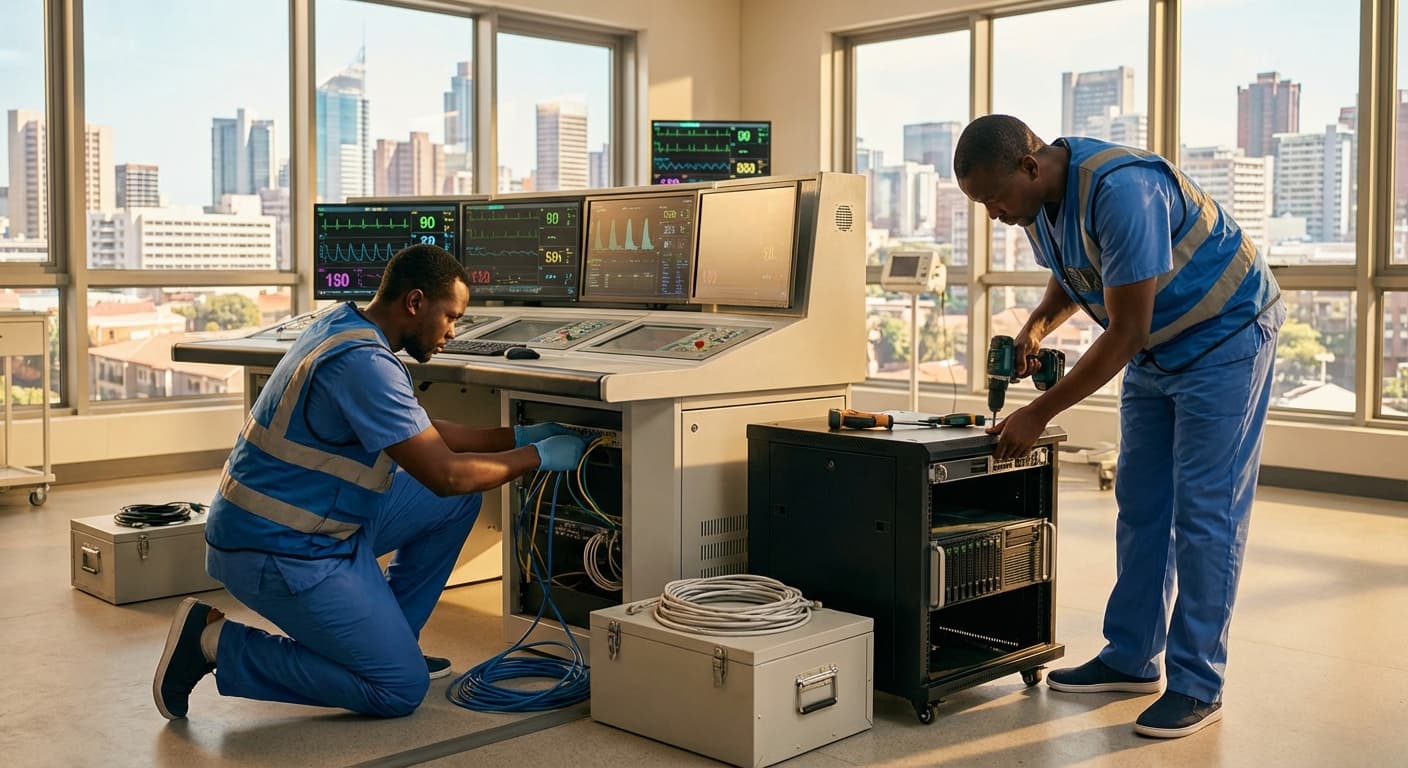
ICU Central Monitoring Station Installation Service in South Sudan
Engineering Excellence & Technical Support
ICU Central Monitoring Station Installation Service High-standard technical execution following OEM protocols and local regulatory frameworks.
Robust Network Infrastructure
Ensuring a resilient and high-bandwidth network backbone, we deploy redundant cabling, advanced switching, and secure Wi-Fi solutions to guarantee uninterrupted data flow from patient monitors to the central station, even in challenging environments.
Uninterrupted Power Systems
Critical to patient care, our installations integrate robust Uninterruptible Power Supplies (UPS) and backup generators, meticulously configured to provide seamless and sustained power to all monitoring equipment and central workstations during grid outages.
Secure Data Management & Access
Implementing enterprise-grade encryption and granular access controls, we safeguard sensitive patient data at rest and in transit, ensuring HIPAA compliance and providing authorized personnel with secure, remote access to vital patient information.
What Is Icu Central Monitoring Station Installation Service In South Sudan?
ICU Central Monitoring Station Installation Service in South Sudan refers to the comprehensive process of setting up and commissioning a centralized system designed to remotely monitor vital physiological parameters of patients admitted to Intensive Care Units (ICUs). This service ensures continuous surveillance, data aggregation, and alarm management from a dedicated station, enabling a more efficient and proactive approach to critical care management within healthcare facilities in South Sudan. It involves the integration of advanced medical devices, network infrastructure, and specialized software to facilitate real-time patient data visualization and analysis.
| Service Component | Description | Target Beneficiary (South Sudan Context) | Typical Use Case |
|---|---|---|---|
| System Design and Planning | Architectural assessment, device placement, power, and redundancy planning. | Hospitals with new or expanding ICUs, facilities with outdated monitoring systems. | Ensuring optimal coverage and reliability in a newly established ICU ward or upgrading a legacy system in a major referral hospital. |
| Hardware Procurement and Installation | Sourcing and setting up bedside monitors, central consoles, servers, and networking gear. | Hospitals requiring essential critical care equipment, especially those receiving international aid or funding for medical infrastructure. | Equipping a multi-bed ICU in a regional hospital with the latest generation of patient monitoring technology. |
| Software Configuration and Integration | Installing and configuring monitoring software, connecting devices, setting up alarms and data logging. | Healthcare facilities aiming to improve clinical decision-making and patient management through data-driven insights. | Implementing a system that provides real-time trend data for hypothermia management in neonates or sepsis monitoring in adult ICUs. |
| Network Infrastructure Setup | Designing and implementing a secure and reliable data network for real-time transmission. | Larger hospitals or those with multiple ICU units needing centralized oversight and data access. | Establishing a secure network that allows remote access for specialist physicians to review patient data from a different location within the hospital or even remotely (if permitted). |
| Power and Backup Systems | Installing UPS and generator integration for uninterrupted operation. | All healthcare facilities in South Sudan, given the prevalent challenges with stable power supply. | Ensuring continuous monitoring of critically ill patients during unexpected power outages, preventing patient decompensation and adverse events. |
| Calibration and Testing | Verifying the accuracy and functionality of all installed components. | Any healthcare institution prioritizing patient safety and diagnostic accuracy. | Performing rigorous pre-launch testing to confirm that alarm parameters are correctly set and trigger appropriately for various physiological derangements. |
| User Training and Support | Educating clinical and technical staff on system operation and maintenance. | Hospitals with newly trained staff or those transitioning to new technologies. | Providing comprehensive training to ICU nurses on interpreting complex waveform data and managing alarm fatigue, and to biomedical technicians on routine maintenance. |
Key Components of ICU Central Monitoring Station Installation Service:
- System Design and Planning: Architectural assessment of the ICU, determining optimal placement of monitoring devices, central station, and network cabling. Includes power supply considerations, environmental controls (temperature, humidity), and redundancy planning.
- Hardware Procurement and Installation: Sourcing and physically installing bedside patient monitors (measuring ECG, SpO2, NIBP, respiration, temperature, invasive pressures, etc.), central monitoring consoles, servers, workstations, and necessary networking equipment (switches, routers, firewalls).
- Software Configuration and Integration: Installation and configuration of specialized ICU monitoring software, establishing secure network connections between bedside monitors and the central station. This includes setting up patient profiles, alarm thresholds, data logging, and trending capabilities. Integration with existing hospital information systems (HIS) or electronic health records (EHR) may be included.
- Network Infrastructure Setup: Designing and implementing a robust and secure network infrastructure to support the real-time transmission of large volumes of patient data. This encompasses cabling, IP addressing, subnetting, and ensuring compliance with data security and privacy regulations.
- Power and Backup Systems: Installation of reliable power solutions, including Uninterruptible Power Supplies (UPS) and potentially backup generators, to ensure continuous operation of the monitoring system during power outages, a critical concern in many regions of South Sudan.
- Calibration and Testing: Rigorous testing and calibration of all installed equipment and software to ensure accuracy, reliability, and adherence to medical device standards. This includes simulated patient scenarios to validate alarm functionality and data integrity.
- User Training and Support: Comprehensive training for ICU staff (nurses, physicians, biomedical engineers) on the operation, maintenance, and troubleshooting of the central monitoring system. Provision of ongoing technical support and maintenance contracts.
- Compliance and Documentation: Ensuring the installation meets relevant international and local healthcare standards and regulations. Comprehensive documentation of the system design, installation process, and operational procedures.
Who Needs Icu Central Monitoring Station Installation Service In South Sudan?
ICU Central Monitoring Station installation services are critical for healthcare facilities in South Sudan aiming to enhance patient care, improve diagnostic capabilities, and optimize resource allocation within their Intensive Care Units (ICUs). These services are essential for any hospital or clinic that is either establishing a new ICU or upgrading its existing infrastructure to meet modern medical standards. The installation ensures that vital patient data from multiple ICU beds is collected, displayed, and analyzed in a centralized location, enabling medical teams to respond swiftly to critical changes in patient conditions.
| Target Customer Type | Specific Departments/Users | Key Needs & Benefits |
|---|---|---|
| Government Hospitals | Ministry of Health, Hospital Administration, ICU Department, Nursing Staff, Medical Doctors | Standardization of care, improved patient outcomes, efficient staff utilization, data for public health reporting, capacity building. |
| Missionary/NGO Hospitals | Hospital Management, Clinical Directors, ICU Ward Manager, Critical Care Physicians, Nurses | Delivering high-quality care with limited resources, enhanced patient safety, remote support capabilities, training for local staff, disaster preparedness. |
| Private Hospitals | Hospital Owners, Chief Medical Officers, ICU Unit Heads, Cardiologists, Anesthesiologists, Critical Care Specialists | Competitive advantage, advanced diagnostic tools, patient comfort and safety, data for research and quality improvement, attracting specialized medical talent. |
| Tertiary Care Centers / Referral Hospitals | ICU Directors, Senior Consultants (Cardiology, Neurology, Pulmonology, Surgery), Intensivists, Charge Nurses | Managing complex cases, real-time trend analysis, early detection of deterioration, seamless transfer of critical information, integration with Picture Archiving and Communication Systems (PACS). |
| Larger District Hospitals (with established ICUs) | Hospital Administrator, Head of Medicine, ICU Nurse Manager, Resident Doctors, Senior Nurses | Improving the level of critical care provided, reducing patient mortality, better staff coordination, foundational for advanced medical services. |
Target Customers and Departments for ICU Central Monitoring Station Installation Service in South Sudan
- Government Hospitals
- Missionary/NGO Hospitals
- Private Hospitals
- Tertiary Care Centers
- Referral Hospitals
- Larger District Hospitals
- Maternity and Children's Hospitals (with ICUs)
- Specialized Cardiac or Surgical Centers (with ICUs)
Icu Central Monitoring Station Installation Service Process In South Sudan
This document outlines the detailed workflow for the ICU Central Monitoring Station Installation Service Process in South Sudan, from the initial customer inquiry to the final execution and handover. The process is designed to ensure a systematic, efficient, and compliant installation, taking into account the unique logistical and environmental challenges present in South Sudan.
| Stage | Description | Key Activities | Responsible Party | Deliverables/Outcomes | Considerations for South Sudan |
|---|---|---|---|---|---|
| Initial contact from a client seeking ICU Central Monitoring Station installation services. |
| Client, Sales/Technical Team | Understanding of client needs, preliminary project scope. |
|
| Detailed evaluation of the installation site to determine feasibility and plan the project. |
| Technical Team, Client Facilities Management | Detailed site survey report, technical specifications, refined project plan. |
|
| Development and approval of a formal proposal, quotation, and contractual agreement. |
| Sales/Commercial Team, Client Procurement | Approved quotation, signed service contract. |
|
| Acquisition of all necessary equipment, materials, and transportation to the site. |
| Procurement Department, Logistics Team | All required equipment and materials at the designated staging area or site. |
|
| Ensuring the installation site is ready for the equipment and technicians. |
| Client Facilities Management, Installation Team | Ready and safe installation environment. |
|
| The physical installation and setup of the central monitoring station hardware and software. |
| Installation Team | Installed and powered-on central monitoring station hardware and software. |
|
| Verifying that the installed system functions correctly and meets all performance requirements. |
| Installation Team, Quality Assurance | Fully functional and calibrated ICU Central Monitoring Station. |
|
| Providing training to end-users and officially handing over the installed system. |
| Technical Team, Client End-Users | Trained personnel, complete system documentation, signed acceptance certificate. |
|
| Ongoing support, maintenance, and troubleshooting after the system is operational. |
| Support Team, Technical Team | Operational and well-maintained system, ongoing client satisfaction. |
|
Key Stages of the ICU Central Monitoring Station Installation Service Process
- Inquiry & Consultation
- Site Assessment & Planning
- Quotation & Contract Finalization
- Procurement & Logistics
- Pre-Installation & Site Preparation
- Installation & Configuration
- Testing & Commissioning
- Training & Handover
- Post-Installation Support
Icu Central Monitoring Station Installation Service Cost In South Sudan
Installing an ICU Central Monitoring Station (CMS) in South Sudan is a complex undertaking with costs that can vary significantly due to several factors. The price range is influenced by the scale of the project, the specific technology chosen, the required infrastructure upgrades, and the service provider's expertise. It's crucial for healthcare facilities to conduct thorough due diligence and obtain detailed quotes from multiple reputable vendors to ensure they are receiving value for their investment in this critical medical technology.
| Cost Component | Estimated Range (South Sudanese Pounds - SSP) | Notes |
|---|---|---|
| Basic Patient Monitors (per bed) | 5,000,000 - 15,000,000 | Covers standard vital signs monitoring (ECG, NIBP, SpO2, Respiration). Higher end for more advanced parameters. |
| Central Monitoring Station Software & Server | 20,000,000 - 50,000,000 | Includes software licenses, server hardware (if needed), and initial configuration. |
| Installation & Cabling (per ICU bed) | 1,000,000 - 3,000,000 | Includes network cabling, power, and initial setup. Varies with ICU layout complexity. |
| Biomedical Engineering & IT Technician Labor (per day) | 300,000 - 700,000 | Reflects specialized skills. Can be higher for expatriate technicians. |
| Training for Clinical Staff (per session/group) | 5,000,000 - 10,000,000 | Comprehensive training is crucial. |
| Project Management & Consulting | Negotiable, often a percentage of total project cost (e.g., 5-10%) | Ensures smooth execution. |
| Contingency (for unforeseen issues) | 10-15% of total project cost | Recommended for complex installations. |
| Total Estimated Installation Cost (for a typical 5-10 bed ICU) | 100,000,000 - 300,000,000+ SSP | This is a broad estimate. Highly dependent on the specific requirements and vendor. |
Key Pricing Factors for ICU Central Monitoring Station Installation in South Sudan:
- Scope of the Installation: The number of ICU beds requiring monitoring, the complexity of the monitoring equipment (e.g., basic vital signs vs. advanced hemodynamic monitoring), and the need for integration with existing hospital information systems will directly impact the cost.
- Equipment Costs: This is a primary driver. The brand, model, features, and quantity of patient monitors, central station software, and associated accessories (cables, sensors, etc.) will dictate a significant portion of the budget.
- Infrastructure Requirements: This includes the need for new or upgraded electrical wiring, network cabling (for data transmission), dedicated server space (if applicable), and potentially modifications to the physical layout of the ICU.
- Installation and Labor Costs: The complexity of the installation, the duration of the project, and the rates charged by skilled biomedical engineers and IT technicians in South Sudan will contribute to the overall expense. Travel and accommodation for specialized technicians (if not locally available) can also be a factor.
- Software Licensing and Integration: Costs associated with the central monitoring software, including initial licenses, ongoing support, and integration with electronic health records (EHR) or other hospital systems, need to be considered.
- Training: Comprehensive training for clinical staff on operating the CMS and troubleshooting common issues is essential and usually included in the service package or as a separate cost.
- Project Management: Professional project management services to oversee the entire installation process, ensuring timely completion and adherence to specifications, will add to the cost.
- Warranty and Maintenance Agreements: While not strictly installation costs, long-term service and maintenance contracts are vital for ensuring the longevity and functionality of the CMS and should be factored into the total cost of ownership.
- Customization and Special Requirements: Any unique customization needs, specific network security protocols, or integration with specialized medical devices not typically included in standard packages will increase the price.
- Geographic Location within South Sudan: While major urban centers might have more readily available technical expertise, remote locations could incur higher logistical costs for equipment delivery and personnel deployment.
Affordable Icu Central Monitoring Station Installation Service Options
Setting up an ICU central monitoring station is a crucial investment for any healthcare facility, ensuring continuous patient oversight and timely interventions. However, the costs associated with installation can be substantial. This guide explores affordable service options, focusing on value bundles and effective cost-saving strategies to help you make informed decisions without compromising on quality or patient care.
| Value Bundle Component | Description | Cost-Saving Benefit |
|---|---|---|
| **Basic Monitoring Package | Includes essential patient monitoring parameters (ECG, SpO2, NIBP, respiration) and a central station display. Often bundled with a limited number of workstations. | Lower upfront cost, ideal for facilities with basic monitoring needs or limited budgets. Reduces the need for individual bedside monitor purchases. |
| **Advanced Integration Bundle | Combines standard monitoring with EMR/EHR integration, advanced alarm management, and potentially remote viewing capabilities. May include network infrastructure setup. | Streamlines data entry, reduces manual errors, and improves clinical workflow efficiency. Can save time and labor costs in the long run. Reduces redundant data entry. |
| **Full-Service Installation Package | Encompasses hardware, software, installation, configuration, site assessment, cabling, initial training, and post-installation support. Often offered by a single vendor. | Simplifies the procurement and installation process by having one point of contact. Can lead to bundled discounts and reduced project management overhead. Minimizes the risk of compatibility issues. |
| **Managed Services & Software Updates | Ongoing support contracts that include regular software updates, remote diagnostics, and preventative maintenance. May also cover future hardware upgrades. | Reduces the risk of unexpected maintenance costs and system downtime. Ensures the system remains up-to-date with the latest features and security patches, extending its lifespan. |
Key Considerations for Affordable ICU Central Monitoring Station Installation
- Understanding Your Needs: Accurately assess the number of ICU beds, required monitoring parameters (ECG, SpO2, NIBP, respiration, etc.), and desired advanced features (e.g., EMR integration, remote access).
- Scalability: Choose a system that can grow with your facility, avoiding costly upgrades or replacements in the near future.
- Vendor Reputation & Support: Prioritize vendors with a proven track record, excellent customer support, and comprehensive training programs.
- Integration Capabilities: Ensure the system can seamlessly integrate with existing hospital infrastructure, such as EMR/EHR systems, for streamlined data management and improved workflow.
- Future-Proofing: Opt for technologies that are likely to remain relevant and supported for an extended period.
Verified Providers In South Sudan
In South Sudan's complex healthcare landscape, identifying verified and trustworthy providers is paramount. Franance Health stands out as a leading organization, distinguishing itself through a rigorous commitment to quality, ethical practices, and verifiable credentials. Their dedication to patient well-being and adherence to international standards makes them the optimal choice for essential health services in the region.
| Aspect | Franance Health's Commitment | Benefit to Patients |
|---|---|---|
| Credentialing Process | Strict verification of all medical professionals' qualifications and licenses. | Ensures access to competent and legitimate healthcare providers. |
| Quality Assurance | Adherence to international healthcare standards and best practices. | Delivers safe, effective, and high-quality medical care. |
| Professional Development | Continuous training and upskilling for all staff. | Keeps medical teams updated on the latest medical advancements and techniques. |
| Patient Safety | Implementation of robust patient safety protocols and infection control measures. | Minimizes risks and ensures a secure treatment environment. |
| Accessibility | Strategic placement of facilities and mobile outreach programs. | Improves access to healthcare services for a wider population, especially in underserved areas. |
Why Franance Health is the Best Choice in South Sudan:
- Rigorous Verification & Accreditation: Franance Health undergoes stringent verification processes, ensuring all their medical professionals and facilities meet established national and international healthcare standards. This commitment to accreditation provides a crucial layer of trust for patients.
- Experienced & Qualified Professionals: The organization employs a team of highly skilled and experienced doctors, nurses, and support staff. Their credentials are meticulously checked, guaranteeing that patients receive care from competent and compassionate individuals.
- Comprehensive Service Offering: Franance Health provides a wide spectrum of medical services, from primary care and specialized treatments to public health initiatives and emergency response. This comprehensive approach ensures continuity of care and addresses diverse health needs.
- Commitment to Ethical Practices: Transparency, patient confidentiality, and ethical medical conduct are core tenets of Franance Health's operations. This unwavering commitment fosters a safe and respectful healthcare environment.
- Community-Centric Approach: Franance Health actively engages with communities, understanding local health challenges and tailoring their services accordingly. This makes them highly responsive and relevant to the specific needs of South Sudan.
- Investment in Modern Infrastructure: The organization prioritizes investing in up-to-date medical equipment and facilities, enabling them to deliver advanced diagnostic and treatment options.
Scope Of Work For Icu Central Monitoring Station Installation Service
This Scope of Work (SOW) outlines the requirements for the installation of an Intensive Care Unit (ICU) Central Monitoring Station (CMS) service. The project encompasses the complete setup, configuration, testing, and commissioning of the CMS, ensuring seamless integration with existing and new ICU patient monitoring devices. The objective is to provide a robust and reliable system for real-time patient data visualization, alarming, and trending, enhancing clinical decision-making and patient care within the ICU.
| Deliverable | Description | Standard Specifications | Acceptance Criteria |
|---|---|---|---|
| Central Monitoring Station Hardware Installation | Physical installation of the CMS server(s), workstations, large display screens, and associated network infrastructure within the designated ICU control room. | All hardware to be installed in accordance with manufacturer guidelines and site-specific environmental requirements (e.g., temperature, humidity, power). Secure mounting of all equipment. | Successful physical installation of all hardware components, verified by site inspection and checklist completion. |
| Central Monitoring Station Software Configuration & Deployment | Installation, configuration, and deployment of the CMS software, including operating system, monitoring application, database, and any middleware. | Software to be installed on designated servers and workstations. Configuration to include user accounts, access permissions, network settings, and initial system parameters. Adherence to cybersecurity best practices. | Successful installation and initial configuration of all CMS software components. Verified by system startup and basic functionality checks. |
| Patient Monitoring Device Integration | Establishing network connectivity and configuring the CMS to receive data from all designated ICU patient monitoring devices (e.g., ventilators, ECG monitors, NIBP, SpO2, temperature probes). | Support for standard medical device communication protocols (e.g., HL7, IEEE 11073, proprietary vendor protocols). Secure and reliable data transmission. Each device to be mapped correctly within the CMS. | All specified patient monitoring devices successfully integrated and transmitting data to the CMS. Verified by displaying real-time data from each device on the CMS workstations. |
| Alarm Management Configuration | Configuration of alarm parameters, priorities, and notification rules for all connected patient monitoring devices within the CMS. | Customizable alarm limits and thresholds. Support for audible and visual alarms. Integration with hospital-wide alarm notification systems (if applicable). | All critical alarms configured and tested. Verified by simulating alarm conditions and confirming appropriate alerts on the CMS and any integrated notification systems. |
| Data Archiving & Trending | Configuration of data archiving and trending capabilities for patient monitoring data. | Sufficient storage capacity for historical data. Configurable data retention policies. User-friendly interface for data retrieval and trending analysis. | Successful archiving of historical patient data for the specified retention period. Verified by retrieving and displaying historical trends for selected parameters. |
| System Testing & Validation | Comprehensive testing and validation of the entire CMS, including functionality, performance, reliability, and security. | Unit testing, integration testing, system testing, and user acceptance testing (UAT). Performance testing to ensure response times and data throughput. Security vulnerability assessment. | Successful completion of all defined test cases and UAT with sign-off from hospital stakeholders. |
| User Training | Provision of comprehensive training to designated hospital IT and clinical staff on the operation, maintenance, troubleshooting, and administration of the CMS. | Training materials provided in electronic and/or hard copy format. Training sessions conducted by qualified instructors. Practical hands-on exercises included. | Completion of training sessions with attendance records and feedback forms. Competency assessment of trainees (optional). |
| Documentation | Delivery of all relevant system documentation, including installation guides, configuration manuals, user manuals, and troubleshooting guides. | Documentation to be comprehensive, accurate, and up-to-date. Provided in electronic format (PDF) and/or hard copy as agreed. | Delivery of all specified documentation in the agreed format and completeness. |
| Post-Installation Support | Provision of post-installation support for a defined period to address any issues or bugs identified after go-live. | Defined service level agreement (SLA) for response and resolution times. Remote and/or on-site support as required. | Successful resolution of all critical issues within the agreed SLA. System stability and satisfactory performance during the support period. |
Key Objectives
- To successfully install and configure the ICU Central Monitoring Station hardware and software.
- To establish reliable network connectivity between the CMS and all connected patient monitoring devices.
- To ensure accurate and timely display of patient vital signs and alarm data.
- To integrate the CMS with the Hospital Information System (HIS) or Electronic Medical Record (EMR) system as specified.
- To provide comprehensive training to hospital IT and clinical staff on the operation and maintenance of the CMS.
- To perform thorough testing and validation to guarantee system functionality and performance.
Service Level Agreement For Icu Central Monitoring Station Installation Service
This Service Level Agreement (SLA) outlines the guaranteed response times and uptime for the installation and initial setup of the ICU Central Monitoring Station (CMS) service provided by [Your Company Name] to [Client Name]. This SLA is an addendum to the Master Service Agreement (MSA) dated [MSA Date].
| Service Component | Uptime Guarantee | Response Time (Business Hours) | Response Time (Emergency Support Hours) | Resolution Target |
|---|---|---|---|---|
| CMS Core Functionality (Patient Data Display & Alarms) | 99.9% (during the first 30 days post-installation) | 1 hour for Critical System Failure | 2 hours for Critical System Failure | 4 business hours for Critical System Failure |
| CMS Data Integrity & Connectivity | 99.5% (during the first 30 days post-installation) | 2 hours for Major System Malfunction | 4 hours for Major System Malfunction | 8 business hours for Major System Malfunction |
| CMS User Interface & Secondary Features | N/A (Focus on core functionality during initial support period) | 4 business hours for Minor System Issue | 8 business hours for Minor System Issue | 12 business hours for Minor System Issue |
| Installation Completion | N/A (Focus on service availability post-installation) | On-site presence within 2 business days of scheduled start date | N/A | Completion within 5 business days of on-site start, barring unforeseen site-specific issues |
Definitions
- Installation Service: The physical setup, configuration, and initial testing of the ICU Central Monitoring Station hardware and software at the Client's premises.
- Central Monitoring Station (CMS): The integrated system designed to receive, display, and manage patient monitoring data from multiple ICU beds.
- Critical System Failure: A complete loss of CMS functionality preventing the real-time monitoring of patient vital signs from any connected ICU bed.
- Major System Malfunction: A significant degradation of CMS functionality affecting the monitoring of a substantial portion of connected ICU beds, or rendering critical features (e.g., alarm management) unreliable.
- Minor System Issue: A non-critical problem that does not impede core patient monitoring but may affect secondary features or user interface elements.
- Business Hours: Monday to Friday, 9:00 AM to 5:00 PM [Client's Time Zone], excluding public holidays recognized in [Client's Location].
- Emergency Support Hours: Outside of Business Hours, including nights, weekends, and public holidays.
Frequently Asked Questions

Ready when you are
Let's scope your ICU Central Monitoring Station Installation Service in South Sudan project in South Sudan.

Scaling healthcare logistics and technical systems across the entire continent.