
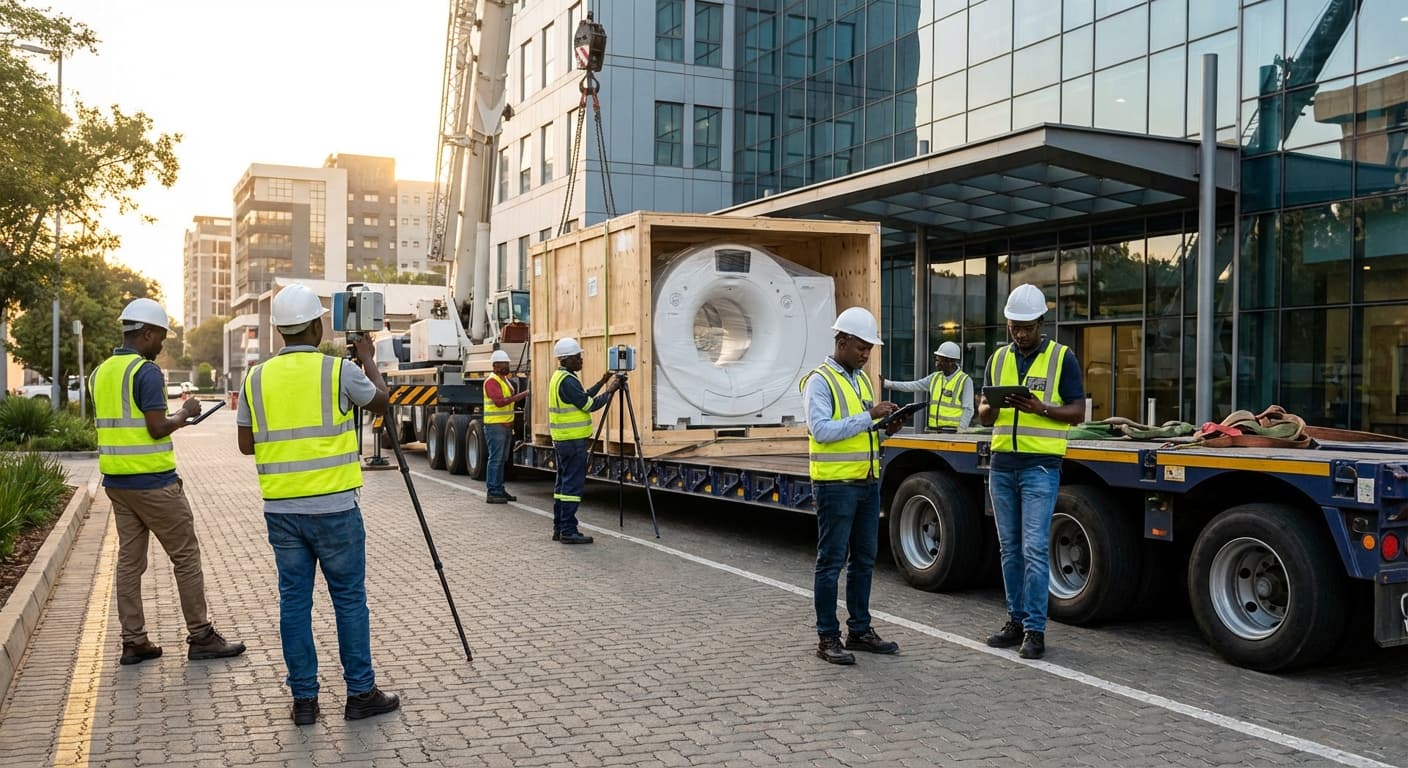
Route Survey & Rigging Plan Service for Heavy Medical Equipment in South Sudan
Engineering Excellence & Technical Support
Route Survey & Rigging Plan Service for Heavy Medical Equipment High-standard technical execution following OEM protocols and local regulatory frameworks.
Optimized Route Assessment & Clearance
Utilizing advanced surveying techniques (GPS, LiDAR, drone imagery) to meticulously map and analyze all potential transport routes. This includes identifying and mitigating critical obstacles such as low clearances, narrow passages, unpaved roads, unstable terrain, and community infrastructure, ensuring a safe and efficient path for heavy medical equipment delivery across South Sudan's challenging landscape.
Tailored Rigging & Lifting Solutions
Designing and implementing bespoke rigging and lifting plans specifically for the sensitive and often oversized nature of medical equipment. Our expertise covers load calculations, selection of appropriate lifting gear (cranes, gantries, specialized dollies), anchorage points, and precise maneuver strategies to prevent any damage or stress during transit, loading, and unloading operations in diverse environmental conditions.
Risk Mitigation & Safety Protocols
Proactive identification and mitigation of all potential risks associated with the transport of high-value medical equipment. This encompasses comprehensive site-specific risk assessments, development of emergency response plans, implementation of stringent safety protocols for personnel and equipment, and adherence to international best practices for heavy lifting and logistical operations in a complex operational environment.
What Is Route Survey & Rigging Plan Service For Heavy Medical Equipment In South Sudan?
Route Survey & Rigging Plan Service for Heavy Medical Equipment in South Sudan is a specialized engineering and logistics undertaking focused on the secure, efficient, and compliant transportation and installation of large-scale, high-value medical apparatus within the unique operational environment of South Sudan. This service necessitates meticulous planning, on-site assessment, and detailed procedural documentation to mitigate risks associated with infrastructure limitations, security concerns, and environmental factors inherent to the region. The objective is to ensure the integrity of the equipment from its point of arrival to its final operational placement, thereby safeguarding the investment and enabling timely healthcare service delivery.
| Who Needs This Service? | Typical Use Cases | ||||
|---|---|---|---|---|---|
| Hospitals and Healthcare Facilities: Public, private, and non-governmental organization (NGO)-operated healthcare institutions requiring the installation of new or replacement large-scale medical equipment. | Government Ministries of Health: National and regional health authorities responsible for procuring and deploying critical medical infrastructure. | International Aid Organizations and NGOs: Organizations involved in humanitarian medical aid and development projects in South Sudan. | Equipment Manufacturers and Suppliers: Companies delivering and installing complex medical devices to clients in the region. | Project Management Firms: Entities overseeing the development or upgrade of healthcare infrastructure. | |
| Installation of MRI Scanners and CT Scanners: These are large, heavy, and sensitive diagnostic imaging devices requiring precise placement and specialized lifting. | Deployment of Linear Accelerators for Radiotherapy: High-mass equipment with stringent installation and safety protocols. | Installation of Large-Scale Laboratory Analyzers and Sterilizers: Often bulky and requiring careful integration with building services. | Transportation and Setup of Modular Operating Theatres or Diagnostic Units: Prefabricated structures that need to be transported and assembled on-site. | Relocation of Existing Heavy Medical Equipment: Moving large apparatus within or between healthcare facilities. | Delivery of Specialized Medical Equipment to Remote or Underserved Areas: Navigating challenging logistical and infrastructural conditions. |
Key Components of Route Survey & Rigging Plan Service:
- Route Reconnaissance and Assessment: Detailed evaluation of all potential transportation pathways, including road conditions, bridge capacities, turning radii, overhead clearances, and potential obstructions. Identification and mitigation of security risks along the proposed route.
- Load Bearing Capacity Analysis: Assessment of the weight and dimensions of the medical equipment and analysis of their compatibility with existing infrastructure (e.g., port facilities, road surfaces, building entry points).
- Rigging and Lifting Plan Development: Creation of comprehensive plans for the lifting, maneuvering, and positioning of the equipment. This includes selection of appropriate lifting gear (cranes, hoists), rigging configurations, and stabilization techniques.
- Site Survey and Preparation: On-site inspection of the installation location to assess access, structural integrity of floors and walls, power and utility availability, and any necessary site modifications.
- Transportation and Logistics Management: Coordination of specialized transport vehicles, escort services (if required for security or traffic management), and adherence to any applicable customs and import regulations.
- Risk Assessment and Mitigation Strategies: Proactive identification of potential hazards (e.g., weather, terrain, equipment failure, security incidents) and development of contingency plans.
- Documentation and Permitting: Generation of detailed technical reports, schematics, method statements, and acquisition of any necessary permits or approvals from relevant authorities.
- Supervision and Execution: On-site management and oversight of all rigging, transportation, and installation activities by qualified personnel.
Who Needs Route Survey & Rigging Plan Service For Heavy Medical Equipment In South Sudan?
South Sudan's healthcare sector, while growing, faces significant logistical challenges when it comes to the installation and deployment of heavy medical equipment. This is where specialized Route Survey & Rigging Plan services become indispensable. These services ensure that complex, oversized, or exceptionally heavy medical machinery can be safely and efficiently transported, maneuvered, and installed within existing or new healthcare facilities, often in demanding environments with limited infrastructure.
| Target Customer | Relevant Departments/Functions | Specific Needs |
|---|---|---|
| Hospitals and Healthcare Institutions | Procurement, Engineering/Maintenance, Facilities Management, Biomedical Engineering | Safe and timely installation of new equipment; minimizing disruption during upgrades; ensuring structural integrity of the building to support heavy machinery. |
| Medical Equipment Suppliers/Manufacturers | Logistics, Project Management, Technical Services, Sales Support | Ensuring successful product delivery and installation as per contractual obligations; mitigating risks during transit and on-site operations; protecting valuable assets. |
| Government Health Ministries/Agencies | Planning & Infrastructure, Procurement, Public Health Programs | Efficient deployment of public health resources; ensuring national healthcare infrastructure is equipped with functional and safely installed medical technology. |
| NGOs and Humanitarian Aid Organizations | Program Management, Logistics, Operations, Health Coordinators | Delivering critical medical equipment to remote areas; ensuring rapid deployment for emergency response or established health programs; maximizing the impact of aid investments. |
| Construction and Engineering Firms | Project Management, Site Engineering, Structural Design, Installation Teams | Integrating heavy equipment into building plans; ensuring accessibility and structural support; coordinating with equipment specialists for seamless installation. |
| Logistics and Freight Forwarding Companies | Operations, Project Cargo, Customs Clearance, Final Mile Delivery | Providing end-to-end logistics solutions; ensuring safe handling and transport of sensitive medical equipment; outsourcing specialized rigging and installation expertise. |
| Research Institutions/Universities | Administration, Procurement, Facilities Management, Department Heads (Medical/Scientific) | Setting up advanced research capabilities; ensuring proper installation of specialized scientific and medical equipment for training and experimentation. |
Who Needs Route Survey & Rigging Plan Service for Heavy Medical Equipment in South Sudan?
- Hospitals and Healthcare Institutions: Both public and private facilities requiring the installation of advanced diagnostic imaging machines (MRI, CT scanners), large surgical equipment, radiotherapy units, or other bulky medical devices.
- Medical Equipment Suppliers and Manufacturers: Companies that import and deliver heavy medical equipment to South Sudan, needing to ensure their products reach their final destination safely and are installed correctly.
- Government Health Ministries and Agencies: Responsible for equipping public hospitals and health centers, especially for large-scale health initiatives or the establishment of new medical facilities.
- Non-Governmental Organizations (NGOs) and Humanitarian Aid Organizations: Actively involved in providing healthcare services and infrastructure in South Sudan, often bringing in specialized medical equipment for clinics and hospitals in remote or underserved areas.
- Construction and Engineering Firms: Involved in building or renovating healthcare facilities where heavy medical equipment will be integrated into the design and construction process.
- Logistics and Freight Forwarding Companies: Handling the transportation of medical equipment into South Sudan, requiring expert partners for the final mile delivery and installation phase.
- Research Institutions and Universities: Establishing or upgrading medical training and research facilities that require the installation of specialized, heavy equipment.
Route Survey & Rigging Plan Service For Heavy Medical Equipment Process In South Sudan
This document outlines the comprehensive workflow for our Route Survey & Rigging Plan Service, specifically tailored for the intricate process of handling and transporting heavy medical equipment in South Sudan. Our service is designed to ensure the safe, efficient, and compliant movement of critical medical assets, navigating the unique logistical challenges of the region. The workflow encompasses the entire journey from the initial client inquiry to the successful execution of the rigging and transportation plan.
| Stage | Description | Key Activities | Deliverables | Timeline (Indicative) |
|---|---|---|---|---|
| The process begins with a client expressing their need for route survey and rigging plan services for heavy medical equipment in South Sudan. | Receive and review client request, understand equipment specifications (weight, dimensions, fragility), identify destination and origin points, discuss budget and timeline constraints. | Initial understanding of project scope, preliminary risk identification. | 1-2 business days |
| A thorough assessment of the proposed routes and landing/staging areas to identify potential obstacles and constraints. | On-site reconnaissance of origin, destination, and intermediate points. Detailed inspection of roads, bridges, culverts, terrain, and access points. GPS mapping of routes. Identification of any required road modifications or infrastructure assessments (e.g., port facilities, airstrips). | Detailed Route Survey Report including maps, photographic evidence, and identified challenges. Preliminary assessment of required transport vehicles. | 3-7 business days (depending on route complexity) |
| Identifying and evaluating all potential risks associated with the movement of the equipment and developing strategies to mitigate them. | Analyze findings from route survey, potential security risks, weather impacts, equipment handling risks, customs & border considerations, and environmental factors. Develop detailed mitigation plans for each identified risk. | Comprehensive Risk Assessment Report with detailed mitigation strategies. | 2-3 business days |
| Creation of a detailed, step-by-step plan for the safe lifting, securing, and loading/unloading of the heavy medical equipment. | Develop lifting procedures, select appropriate rigging gear (cranes, slings, shackles, etc.), calculate load capacities, plan lashing and securing methods, design temporary support structures if needed, create lifting and rigging schematics. | Detailed Rigging Plan including schematics, equipment lists, load calculations, and safety procedures. | 5-10 business days (depending on equipment complexity) |
| Presenting the developed plans to the client for their review, feedback, and formal approval. | Share Route Survey Report, Risk Assessment Report, and Rigging Plan with the client. Conduct review meetings to address any queries and incorporate feedback. Obtain written sign-off on all plans. | Approved Route Survey Report, Risk Assessment Report, and Rigging Plan. | 2-4 business days |
| Mobilizing resources, obtaining necessary permits, and conducting pre-operation checks. | Procure and inspect all required rigging equipment and transportation vehicles. Secure necessary permits and permissions (local authorities, customs). Brief and train on-site teams. Conduct pre-job safety meetings. | Readiness confirmation for execution, permits secured, teams briefed. | 3-7 business days (depending on permit requirements) |
| The actual implementation of the rigging and transportation plan according to the approved documents. | Supervise and execute lifting and rigging operations. Oversee transportation of equipment along the surveyed route. Ensure adherence to all safety protocols and operational procedures. Coordinate with local stakeholders. | Successful and safe movement of medical equipment. | Variable (depending on scope and route length) |
| Documenting the execution of the service and formally closing out the project. | Prepare a detailed execution report outlining the operations performed, any deviations from the plan, incident reports (if any), and lessons learned. Conduct a final project review with the client. Final invoicing and project closure. | Execution Report, lessons learned, project closure documentation. | 2-3 business days |
Workflow Stages
- Inquiry & Initial Consultation
- Site Assessment & Route Survey
- Risk Assessment & Mitigation Planning
- Rigging Plan Development
- Client Review & Approval
- Pre-Execution Preparation
- On-Site Execution
- Post-Execution Reporting & Closeout
Route Survey & Rigging Plan Service For Heavy Medical Equipment Cost In South Sudan
Providing a detailed route survey and rigging plan service for heavy medical equipment in South Sudan is a complex undertaking with significant logistical and safety considerations. The cost is highly variable, influenced by a multitude of factors unique to the operating environment. These factors include the specific nature and weight of the medical equipment, the accessibility and condition of the transport route, the required level of precision and safety protocols, the duration of the service, and the prevailing economic conditions in South Sudan. Given the challenging infrastructure, security concerns, and potential for unforeseen circumstances, these services are typically priced on a case-by-case basis.
| Service Component | Estimated Cost Range (SSP - South Sudanese Pound) | Notes |
|---|---|---|
| Initial Route Survey (per km or per site) | 50,000 - 200,000+ | Varies based on terrain complexity, accessibility, and required detail. |
| Detailed Rigging Plan Development | 150,000 - 500,000+ | Dependent on equipment size, weight, and complexity of rigging operations. |
| On-site Rigging Supervision (per day) | 75,000 - 250,000+ | Includes experienced supervisor; cost increases with team size and expertise. |
| Specialized Rigging Crew (per person, per day) | 30,000 - 80,000+ | Reflects skill level, certifications, and hazard pay. |
| Rental of Basic Rigging Equipment (e.g., dollies, chains) | 50,000 - 150,000+ (per day/rental) | Excludes heavy machinery. |
| Rental of Heavy Lifting Equipment (e.g., cranes, forklifts) | 200,000 - 1,000,000+ (per day/rental) | Highly dependent on capacity and operational requirements. |
| Security Escort (per day/trip) | 75,000 - 300,000+ | Essential in many regions; cost varies based on threat level and escort team size. |
| Permit Acquisition Assistance | 25,000 - 100,000+ | Administrative fees and potential facilitation costs. |
| Contingency/Mobilization Fees | 10% - 25% of total project cost | To cover unforeseen circumstances and initial setup. |
| Full Service Package (Example: Survey, Plan, Rigging for a large MRI machine) | 5,000,000 - 20,000,000+ SSP | A broad estimate; a detailed quote is essential. |
Key Pricing Factors for Route Survey & Rigging Plan Services in South Sudan:
- Equipment Specifications: The weight, dimensions, fragility, and specific handling requirements of the medical equipment are paramount. Heavier, larger, or more sensitive items necessitate more robust planning and specialized rigging equipment, increasing costs.
- Route Complexity and Distance: The length and terrain of the transport route are critical. Surveys of remote or underdeveloped areas, routes with poor road conditions, river crossings, or areas prone to flooding will incur higher costs due to increased survey time, potential for specialized transport, and risk mitigation.
- Accessibility and Infrastructure: The availability of suitable access points at both the origin and destination (e.g., doorways, loading docks, stable ground for cranes) significantly impacts rigging complexity. Lack of existing infrastructure often requires temporary solutions, adding to the expense.
- Safety and Security Requirements: South Sudan's security environment necessitates comprehensive risk assessments and security protocols. This may include armed escorts, secure staging areas, and specialized training for personnel, all of which contribute to the overall cost.
- Permitting and Authorizations: Obtaining necessary permits from local authorities, customs, and any relevant governing bodies can be a time-consuming and costly process, especially for international or inter-state movement of goods.
- Survey and Planning Duration: The time required for detailed route mapping, obstacle identification, load bearing capacity assessments, and the development of a comprehensive rigging plan will directly influence the service cost.
- Rigging Equipment and Personnel: The type and quantity of specialized rigging equipment (cranes, forklifts, specialized dollies, lifting beams) and the number and expertise of the rigging crew required will be a major cost driver. Highly skilled and certified personnel are essential for safety and efficiency.
- Contingency Planning: Due to the inherent unpredictability of operations in South Sudan, a robust contingency plan is vital. This often includes buffer time and resources for unforeseen delays or issues, which is factored into the pricing.
- Insurance: Comprehensive insurance coverage for the equipment and the rigging operation is a necessary expense and will be included in the overall cost.
- Local Economic Conditions and Currency Fluctuations: The prevailing exchange rates, inflation, and the general cost of labor and materials in South Sudan will significantly influence the local currency pricing. USD is often used as a benchmark, and conversion rates will apply.
Affordable Route Survey & Rigging Plan Service For Heavy Medical Equipment Options
Navigating the complexities of transporting and installing heavy medical equipment requires a specialized route survey and rigging plan. Our service ensures a safe, efficient, and cost-effective process, minimizing risks and downtime. We understand the unique challenges associated with medical machinery, from precise calibration requirements to the need for sterile environments. Our expert team conducts thorough site assessments, identifies potential obstacles, and develops detailed rigging strategies. We also offer value bundles and cost-saving strategies to make this essential service accessible for a wider range of healthcare providers and institutions.
| Value Bundle | Includes | Key Benefits | Cost-Saving Strategy |
|---|---|---|---|
| Basic Package | Route Survey (single location), Basic Rigging Plan (standard equipment) | Essential planning for straightforward installations, quick turnaround. | Ideal for less complex moves, reduces upfront investment for simpler needs. |
| Standard Package | Route Survey (multiple locations), Detailed Rigging Plan (moderate complexity), Initial Risk Assessment | Comprehensive planning for common scenarios, enhanced safety focus. | Bundled services offer a discount compared to individual components, predictable budgeting. |
| Premium Package | In-depth Route Survey (complex environments/multiple sites), Advanced Rigging Plan (specialized equipment), Full Risk Assessment & Mitigation, On-site Supervision (initial phase) | Maximized safety and efficiency for high-value, complex, or multi-stage projects. | Proactive risk mitigation prevents costly delays and damage, potential for volume discounts on multiple projects. |
| Custom Solutions | Tailored to specific client needs, can include specialized consultations, permit acquisition assistance, etc. | Flexibility to address unique challenges and requirements. | Pay only for what you need, avoids unnecessary costs associated with pre-defined packages. |
Key Components of Our Affordable Route Survey & Rigging Plan Service
- Comprehensive Route Assessment: Detailed analysis of transportation pathways, considering structural integrity, weight limits, and accessibility.
- On-Site Rigging Survey: Expert evaluation of the installation location, including floor load capacities, ceiling heights, and access points.
- Customized Rigging Plan: Development of detailed schematics and procedures for lifting, moving, and securing equipment.
- Risk Mitigation Strategies: Proactive identification and planning to address potential hazards and challenges.
- Logistics Coordination: Seamless integration with your existing logistics and operational schedules.
- Compliance and Safety Assurance: Adherence to all relevant industry regulations and safety standards.
Verified Providers In South Sudan
In South Sudan's burgeoning healthcare landscape, identifying trustworthy and competent healthcare providers is paramount. Franance Health stands out as a beacon of reliability, offering a comprehensive suite of services backed by verified credentials and a commitment to excellence. This commitment ensures that patients receive not only quality medical care but also the peace of mind that comes from engaging with a reputable and accredited organization.
| Credential Type | Franance Health's Verification Standard | Benefit to Patients |
|---|---|---|
| Medical Licenses & Certifications | Confirmed validity with relevant medical boards and professional bodies. | Ensures providers are legally authorized and possess the required expertise. |
| Professional Experience | Thorough review of past performance, references, and specialized training. | Guarantees that patients are treated by experienced and competent medical professionals. |
| Accreditation of Facilities | Verification of healthcare facilities against established quality and safety benchmarks. | Ensures a safe, clean, and well-equipped environment for medical procedures and consultations. |
| Continuing Medical Education (CME) | Emphasis on providers actively participating in ongoing professional development. | Confirms that providers stay updated with the latest medical advancements and best practices. |
| Ethical Conduct & Patient Rights | Adherence to a strict code of ethics and patient advocacy policies. | Promotes trust, respect, and a patient-centered approach to care. |
Why Franance Health is the Best Choice for Verified Healthcare in South Sudan:
- Rigorous Verification Processes: Franance Health meticulously vets all its affiliated healthcare professionals and facilities, ensuring they meet stringent international and local standards for practice and patient care. This includes verifying medical licenses, certifications, and adherence to ethical guidelines.
- Experienced and Qualified Professionals: The network comprises highly skilled doctors, nurses, specialists, and allied health professionals with extensive experience in various medical fields. Many have international training and a deep understanding of the unique health challenges faced in South Sudan.
- Comprehensive Service Offering: From primary care and diagnostics to specialized treatments and emergency services, Franance Health provides a broad spectrum of healthcare solutions, catering to diverse patient needs.
- Commitment to Patient Safety and Quality: Patient well-being is at the forefront of Franance Health's operations. They champion best practices in infection control, patient safety protocols, and continuous quality improvement initiatives.
- Accessibility and Affordability: While maintaining high standards, Franance Health strives to make quality healthcare accessible and as affordable as possible to the South Sudanese population, often through partnerships and innovative service delivery models.
- Ethical and Transparent Practices: Transparency in billing, treatment plans, and patient rights is a cornerstone of Franance Health's philosophy. Patients can expect clear communication and ethical conduct from all their providers.
- Technological Integration: Where feasible, Franance Health embraces technology to enhance service delivery, from appointment scheduling and record keeping to telehealth consultations, improving efficiency and patient experience.
Scope Of Work For Route Survey & Rigging Plan Service For Heavy Medical Equipment
This Scope of Work (SOW) outlines the services required for a comprehensive Route Survey and Rigging Plan for the transportation and installation of heavy medical equipment. The objective is to ensure safe, efficient, and damage-free movement of sensitive and high-value assets from their point of receipt to their final installation location within a facility. This document details the technical deliverables and standard specifications that will govern the execution of these services.
| Section | Description | Key Activities | Deliverables |
|---|---|---|---|
| Comprehensive evaluation of the entire transportation path from the receiving dock to the final installation site. |
|
|
| Creation of a detailed, step-by-step plan for the safe lifting, moving, and positioning of the heavy medical equipment. |
|
|
| The tangible outputs of the services provided. |
| All deliverables will be provided in electronic format (PDF) and, upon request, in hard copy. The specific format and required detail level will be confirmed during the project initiation meeting. |
| Adherence to relevant industry standards, safety regulations, and client-specific requirements. |
|
|
| Clear definition of duties for all parties involved. |
| A RACI (Responsible, Accountable, Consulted, Informed) matrix will be developed if deemed necessary for complex projects. |
| Ensuring effective communication, progress tracking, and documentation throughout the project. |
|
|
Scope of Work Details
- Route Survey & Assessment
- Rigging Plan Development
- Technical Deliverables
- Standard Specifications & Compliance
- Roles & Responsibilities
- Project Management & Reporting
Service Level Agreement For Route Survey & Rigging Plan Service For Heavy Medical Equipment
This Service Level Agreement (SLA) outlines the response times and uptime guarantees for the Route Survey & Rigging Plan Service for Heavy Medical Equipment provided by [Your Company Name] to [Client Company Name]. This agreement is effective as of [Start Date] and will remain in effect until [End Date].
| Service Metric | Target Performance | Measurement Period | Client Notification |
|---|---|---|---|
| Initial Request Acknowledgement | Within 4 business hours of submission | Per request | Automated email confirmation with reference number. |
| Initial Survey/Plan Assessment & Scheduling | Within 2 business days of acknowledgement | Per request | Email with proposed timeline and any required client input. |
| Service Uptime Guarantee | 99.5% | Monthly | Monthly performance report. Notification of unplanned downtime exceeding 1 hour within 2 business hours of detection. |
| Critical Issue Resolution (e.g., inaccessible survey site preventing progress) | Within 8 business hours of identification | Per critical issue | Direct communication (phone/email) and follow-up status updates every 4 business hours. |
| Progress Updates for Active Projects | At least once per week | Per active project | Email or scheduled call as agreed per project. |
Key Service Metrics
- Service Availability: The Route Survey & Rigging Plan Service is considered available when the client can submit requests and receive timely acknowledgements and progress updates. System maintenance is excluded from scheduled downtime.
- Response Time: The time taken to acknowledge a submitted request and provide initial feedback or scheduling information.
- Uptime Guarantee: The percentage of time the service is operational and accessible to the client, excluding scheduled maintenance.
- Resolution Time (for critical issues): The time taken to address and resolve critical issues that prevent the progression of the survey or planning process.
- Reporting: Regular reports on service performance against the agreed-upon metrics.
Frequently Asked Questions

Ready when you are
Let's scope your Route Survey & Rigging Plan Service for Heavy Medical Equipment in South Sudan project in South Sudan.

Scaling healthcare logistics and technical systems across the entire continent.