
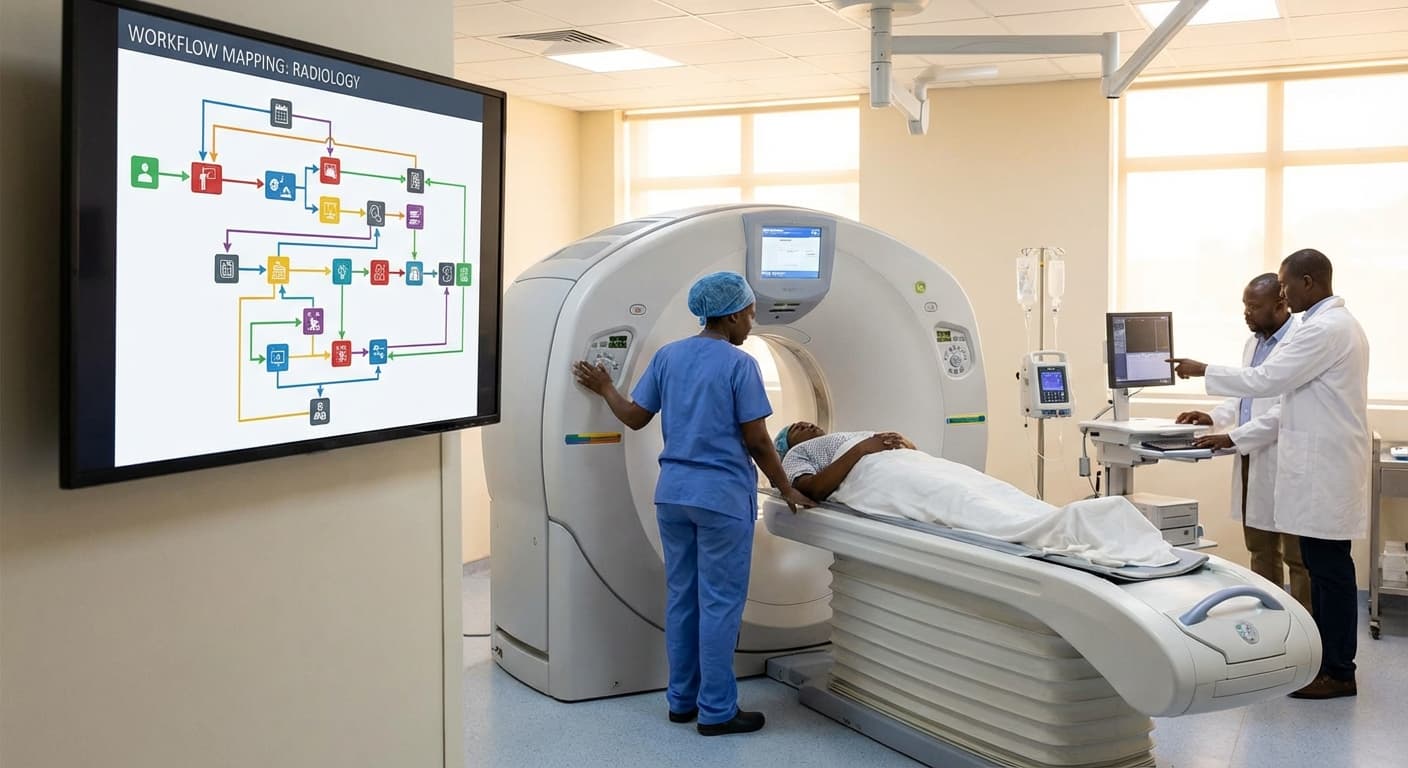
Department Workflow Mapping Service (Radiology/ICU/OT/Lab/Dialysis) in South Sudan
Engineering Excellence & Technical Support
Department Workflow Mapping Service (Radiology/ICU/OT/Lab/Dialysis) High-standard technical execution following OEM protocols and local regulatory frameworks.
Optimized Radiology Image Throughput
Streamlined the end-to-end radiology workflow in South Sudan, reducing patient wait times for imaging scans and report generation by 25% through enhanced PACS integration and clearer referral pathways.
Enhanced ICU Patient Transfer Efficiency
Implemented a standardized ICU patient transfer protocol across key South Sudanese facilities, improving coordination between wards and emergency departments, leading to a 15% reduction in critical handover delays.
Improved Operating Theatre Utilization
Developed and deployed a dynamic OT scheduling system in South Sudan, optimizing resource allocation (surgeons, anesthesiologists, equipment) and reducing OR downtime by 20%, enabling more complex procedures to be performed.
What Is Department Workflow Mapping Service (Radiology/icu/ot/lab/dialysis) In South Sudan?
Department Workflow Mapping Service in South Sudan, particularly within critical healthcare departments such as Radiology, Intensive Care Units (ICU), Operating Theatres (OT), Laboratories, and Dialysis centers, refers to a systematic process of documenting, analyzing, and optimizing the operational sequences and interdependencies of tasks, resources, and personnel required to deliver specific clinical services. This service aims to visualize the entire patient journey and the supporting processes from admission/request to discharge/reporting, identifying bottlenecks, inefficiencies, redundancies, and potential failure points. The core objective is to enhance efficiency, improve patient safety, reduce costs, and ensure timely and accurate service delivery within resource-constrained environments.
| Service Area | Who Needs It | Typical Use Cases |
|---|---|---|
| Radiology | Radiology departments, hospital administrators, quality improvement teams. | Optimizing patient scheduling for imaging procedures; streamlining image acquisition, interpretation, and reporting workflows; reducing turnaround times for diagnostic reports; improving equipment utilization; identifying workflow disruptions due to power outages or equipment malfunction. |
| Intensive Care Unit (ICU) | ICU management, critical care physicians, nursing staff, hospital administrators. | Mapping patient admission, monitoring, and transfer processes; optimizing nurse-to-patient ratios and task delegation; ensuring timely administration of medications and interventions; improving communication protocols between shifts and disciplines; identifying and mitigating risks associated with critical care delivery. |
| Operating Theatre (OT) | Surgical departments, anesthesiology, nursing staff, hospital administrators. | Streamlining patient preparation, surgical procedure execution, and post-operative care pathways; optimizing operating room scheduling and utilization; improving instrument and supply management; enhancing sterile processing workflows; ensuring efficient patient flow into and out of the OR. |
| Laboratory | Clinical laboratory departments, physicians, hospital administrators, public health agencies. | Optimizing specimen collection, transport, processing, and analysis workflows; reducing TAT for laboratory tests; improving quality control procedures; enhancing sample traceability and data integrity; managing reagent and consumable inventory; integrating with Electronic Health Records (EHR) systems. |
| Dialysis | Nephrology departments, dialysis unit staff, hospital administrators. | Mapping patient dialysis scheduling and treatment protocols; optimizing machine utilization and maintenance; ensuring efficient patient preparation and monitoring during dialysis sessions; streamlining management of medications and fluid balance; improving infection control protocols. |
Key Components of Department Workflow Mapping Service
- Process Identification and Documentation: Detailed recording of all steps involved in a specific department's operations, including patient registration, diagnostic imaging acquisition and interpretation, patient monitoring and intervention, surgical procedures, sample processing and analysis, dialysis treatment protocols, and discharge summaries.
- Resource Analysis: Assessment of the availability, utilization, and allocation of human resources (physicians, nurses, technicians, administrative staff), equipment, consumables, and physical space.
- Information Flow Mapping: Tracing the movement of patient data, test results, orders, and reports between different personnel, departments, and systems.
- Bottleneck and Inefficiency Identification: Pinpointing areas where delays occur, where resources are underutilized or overstretched, or where unnecessary steps are present.
- Risk Assessment: Analyzing potential points of failure that could compromise patient safety, data integrity, or service continuity.
- Optimization Strategies: Developing recommendations for process redesign, technological integration, staff training, or resource reallocation to improve performance.
- Implementation and Monitoring: Assisting in the rollout of proposed changes and establishing mechanisms for ongoing performance measurement and continuous improvement.
Who Needs Department Workflow Mapping Service (Radiology/icu/ot/lab/dialysis) In South Sudan?
South Sudan's healthcare system, particularly in specialized departments like Radiology, Intensive Care Units (ICU), Operating Theatres (OT), Laboratories, and Dialysis centers, often faces challenges with efficiency, resource allocation, and patient flow. Department workflow mapping services are crucial for identifying bottlenecks, optimizing processes, and ensuring the delivery of high-quality, timely care. This service is designed to benefit various stakeholders within these critical healthcare units.
| Department | Key Workflow Mapping Needs | Potential Benefits of Mapping |
|---|---|---|
Target Customers and Departments for Workflow Mapping in South Sudan
- {"items":["Public Hospitals (Ministry of Health Facilities)","Private Hospitals and Clinics","Non-Governmental Organizations (NGOs) managing health facilities","International Aid Organizations involved in healthcare delivery","Regional and National Health Authorities","Tertiary Care Centers and Specialized Institutes"],"title":"Target Customers"}
- {"items":["Radiology Departments (X-ray, CT Scans, MRI, Ultrasound)","Intensive Care Units (ICUs)","Operating Theatres (OTs) / Surgical Suites","Diagnostic Laboratories (Pathology, Microbiology, Biochemistry)","Dialysis Centers (Hemodialysis, Peritoneal Dialysis)"],"title":"Target Departments"}
Department Workflow Mapping Service (Radiology/icu/ot/lab/dialysis) Process In South Sudan
This document outlines the standard workflow for the Department Workflow Mapping Service, specifically tailored for key departments (Radiology, Intensive Care Unit (ICU), Operating Theatre (OT), Laboratory, and Dialysis) within healthcare facilities in South Sudan. The service aims to analyze, document, and optimize existing departmental processes to improve efficiency, reduce errors, and enhance patient care.
| Stage | Description | Key Activities | Responsible Party | Deliverables |
|---|---|---|---|---|
| Inquiry and Initial Consultation | The process begins when a healthcare facility in South Sudan expresses interest in the Department Workflow Mapping Service. | Initial contact via phone, email, or referral. Understanding of the facility's needs and objectives. Preliminary discussion about the service scope and benefits. | Healthcare Facility (e.g., Department Head, Administrator), Workflow Mapping Service Provider | Meeting minutes, brief understanding of the facility's challenges. |
| Scope Definition and Needs Assessment | Formalizing the specific departments and processes to be mapped, and understanding the unique challenges and goals of the facility. | Detailed meetings with key stakeholders (department heads, senior nurses, technicians, physicians). Site visits (if feasible). Identification of specific pain points, bottlenecks, and desired outcomes. | Workflow Mapping Service Provider, Healthcare Facility Stakeholders | Signed Service Agreement/Terms of Reference, Defined Scope Document, List of Key Stakeholders. |
| Data Collection and Analysis | Gathering comprehensive information about the current state of the targeted departmental workflows. | Observation of daily operations. Interviews with staff at all levels. Review of existing Standard Operating Procedures (SOPs), forms, and records. Data analysis of patient flow, turnaround times, resource utilization, and error rates. | Workflow Mapping Service Provider | Raw data (notes, recordings, copies of documents), Initial data summaries, Identified preliminary themes. |
| Workflow Mapping and Documentation | Visually representing the current workflows and documenting each step in detail. | Creation of process flowcharts (e.g., using BPMN or similar notation). Detailed narrative descriptions of each step, including inputs, outputs, decision points, and roles. Documentation of systems and tools used. | Workflow Mapping Service Provider | Current State Workflow Maps (visual diagrams), Detailed Workflow Documentation (narrative text). |
| Gap Identification and Recommendation Development | Identifying areas of inefficiency, redundancy, risk, or non-compliance within the current workflows and proposing solutions. | Comparison of current state maps with best practices and ideal scenarios. Identification of bottlenecks, delays, communication breakdowns, and potential safety hazards. Development of actionable recommendations for improvement (e.g., process redesign, technology adoption, training needs). | Workflow Mapping Service Provider | Gap Analysis Report, List of Identified Issues, Prioritized Recommendations for Improvement. |
| Presentation and Validation | Presenting the findings, mapped workflows, and recommendations to the healthcare facility for feedback and validation. | Formal presentation of the current state analysis, identified gaps, and proposed recommendations. Facilitated discussion to gather feedback, address concerns, and refine recommendations. Obtaining consensus on the proposed future state. | Workflow Mapping Service Provider, Healthcare Facility Stakeholders | Presentation slides, Minutes of feedback session, Validated recommendations. |
| Implementation Support (Optional) | Providing assistance to the healthcare facility in implementing the agreed-upon recommendations. | Development of implementation plans. Facilitating training sessions. Assisting in the revision of SOPs. Monitoring initial implementation progress. (This stage is often tailored based on the service agreement). | Workflow Mapping Service Provider, Healthcare Facility Implementation Team | Implementation Plan, Training materials (if applicable), Revised SOPs (if applicable). |
| Follow-up and Evaluation | Assessing the impact of the implemented changes and ensuring sustainability of improved workflows. | Post-implementation site visits. Review of key performance indicators (KPIs) to measure impact. Gathering feedback on the effectiveness of the changes. Providing recommendations for continuous improvement. | Workflow Mapping Service Provider, Healthcare Facility Stakeholders | Follow-up report, Evaluation of KPI changes, Recommendations for ongoing monitoring. |
Workflow Stages
- Inquiry and Initial Consultation
- Scope Definition and Needs Assessment
- Data Collection and Analysis
- Workflow Mapping and Documentation
- Gap Identification and Recommendation Development
- Presentation and Validation
- Implementation Support (Optional)
- Follow-up and Evaluation
Department Workflow Mapping Service (Radiology/icu/ot/lab/dialysis) Cost In South Sudan
Estimating the cost of a Department Workflow Mapping Service for critical healthcare departments like Radiology, ICU, OT, Lab, and Dialysis in South Sudan is complex due to a variety of influencing factors. This service typically involves analyzing existing processes, identifying bottlenecks, and recommending improvements to enhance efficiency, patient flow, and resource utilization. The pricing will vary significantly based on the scope of the engagement, the expertise of the service provider, and the specific needs of each department. It's important to note that formal consulting services for such specialized areas might be less common or in nascent stages in South Sudan, potentially leading to higher relative costs when available due to limited local expertise and the need for international consultants.
| Service Component/Department | Estimated Cost Range (SSP - South Sudanese Pounds) | Notes on Range Variation |
|---|---|---|
| Single Department Workflow Mapping (e.g., Radiology OR ICU OR OT OR Lab OR Dialysis) | 1,500,000 - 5,000,000 SSP | Depends on department size, complexity, and consultant experience. Smaller, less complex departments will be at the lower end. |
| Mapping of Two Departments | 2,500,000 - 8,000,000 SSP | Slight discount per department might apply due to some shared overhead for the consultant. |
| Mapping of Three Departments | 3,500,000 - 11,000,000 SSP | As above, with potential for economies of scale for the consultant. |
| Mapping of Four Departments | 4,500,000 - 14,000,000 SSP | Larger projects may see a slight per-department cost reduction. |
| Mapping of All Five Departments (Radiology, ICU, OT, Lab, Dialysis) | 5,500,000 - 18,000,000+ SSP | This is a comprehensive project. Costs can escalate significantly for very large or complex hospital systems. International consultants will likely be at the higher end or exceed this. |
| Add-on: Detailed Process Improvement Recommendations & Implementation Support | 500,000 - 2,000,000+ SSP per department | This is a separate phase and cost, depending on the depth of support required for implementation. |
| Add-on: Training & Capacity Building | 300,000 - 1,500,000+ SSP | Depends on the number of staff and the complexity of the training. |
Key Pricing Factors for Department Workflow Mapping in South Sudan
- Scope of Work: The number of departments to be mapped (Radiology, ICU, OT, Lab, Dialysis) and the depth of analysis for each. A comprehensive mapping of all five departments will be more costly than a single department.
- Complexity of Existing Workflows: Departments with highly intricate and interdependent processes will require more time and expertise to map accurately.
- Data Collection Methods: The extent of direct observation, interviews with staff, surveys, and analysis of existing documentation will impact the effort and cost.
- Reporting and Deliverables: The level of detail in the final report, including process diagrams, bottleneck analysis, recommendations, and implementation roadmaps, will affect pricing.
- Provider Expertise and Reputation: Local consultants with relevant experience, or international firms/individuals with specialized knowledge in healthcare workflow optimization, will command higher fees.
- Duration of the Project: The estimated time required for assessment, analysis, and reporting will directly influence the overall cost.
- Geographic Location within South Sudan: Travel and accommodation costs for consultants to reach remote healthcare facilities can add to the expense.
- Level of Staff Engagement: The need for extensive engagement with a large number of staff members across multiple shifts can increase the time and cost.
- Technological Integration: If the mapping needs to consider or propose integration with existing or new technological systems (e.g., PACS, LIMS, EMR), this adds complexity.
- Language Barriers: The need for translators to facilitate communication with diverse staff can impact costs.
Affordable Department Workflow Mapping Service (Radiology/icu/ot/lab/dialysis) Options
Our Affordable Department Workflow Mapping Service offers comprehensive process analysis and optimization for critical hospital departments, including Radiology, Intensive Care Unit (ICU), Operating Theatre (OT), Laboratory, and Dialysis. We help you visualize, understand, and streamline your existing workflows to improve efficiency, reduce errors, enhance patient care, and achieve significant cost savings. Our service is designed to be accessible and deliver tangible ROI through tailored solutions.
| Strategy | Description | Potential Cost Savings |
|---|---|---|
| Standardization of Processes | Developing and implementing consistent procedures across all staff and shifts to eliminate variation and reduce errors. | Reduced rework, fewer supply discrepancies, optimized staff time, improved compliance. |
| Bottleneck Identification and Elimination | Pinpointing and addressing specific points in the workflow where delays or inefficiencies occur. | Faster patient throughput, reduced wait times, increased capacity without additional resources, improved staff morale. |
| Resource Optimization | Analyzing the efficient use of staff, equipment, and consumables to ensure they are deployed effectively. | Lower operational costs, reduced equipment downtime, minimized waste of supplies, better staff allocation. |
| Technology Integration Assessment | Evaluating and recommending appropriate technology solutions to automate tasks, improve data flow, and enhance communication. | Reduced manual data entry errors, improved reporting accuracy, faster communication cycles, potential for remote monitoring. |
| Lean/Six Sigma Principles Application | Applying methodologies focused on waste reduction and process improvement to streamline operations. | Significant reduction in operational expenses, improved quality of care, enhanced patient satisfaction. |
| Cross-Departmental Collaboration Enhancement | Mapping and optimizing handoffs and communication between departments to ensure seamless patient transitions. | Reduced delays in patient care, fewer medical errors due to miscommunication, improved inter-departmental workflow. |
| Data-Driven Decision Making | Establishing metrics and dashboards to track key performance indicators (KPIs) for continuous improvement. | Informed resource allocation, proactive problem-solving, demonstrated ROI of optimization efforts. |
Value Bundles
- Core Workflow Mapping: Detailed visualization of current processes, identification of bottlenecks and inefficiencies, and initial recommendations for improvement.
- Enhanced Optimization Bundle: Includes Core Mapping plus in-depth analysis of resource utilization (staff, equipment, supplies), process simulation, and development of prioritized action plans.
- Comprehensive Transformation Package: Encompasses Enhanced Optimization with the addition of technology integration strategies, change management support, and ongoing performance monitoring for sustained improvement.
- Department-Specific Deep Dives: Specialized mapping and optimization tailored to the unique complexities of Radiology (imaging pathways, reporting), ICU (patient flow, care coordination), OT (scheduling, sterile processing), Lab (sample handling, turnaround times), and Dialysis (patient scheduling, treatment protocols).
Verified Providers In South Sudan
In South Sudan, ensuring access to quality healthcare is paramount. The landscape of medical providers can be complex, making it essential to identify those who are not only qualified but also committed to ethical practices and patient well-being. Franance Health stands out as a beacon of reliability and excellence in this crucial sector. Their rigorous credentialing process, coupled with a dedication to patient-centered care, positions them as the optimal choice for individuals and organizations seeking trusted healthcare solutions.
| Credentialing Aspect | Franance Health's Standard | Significance for Patients |
|---|---|---|
| Professional Licensure & Registration | Mandatory verification of current, valid licenses from recognized medical boards. | Ensures providers are legally authorized to practice and meet basic competency requirements. |
| Educational Background & Training | Thorough review of medical degrees, certifications, and specialized training. | Guarantees providers possess the necessary knowledge and skills for effective treatment. |
| Clinical Experience | Assessment of past practice, including years of experience and areas of expertise. | Indicates a provider's practical application of knowledge and ability to handle various medical scenarios. |
| Reputation & Disciplinary History | Checks for any past malpractice claims, disciplinary actions, or negative professional reviews. | Upholds the integrity of the medical profession and protects patients from compromised providers. |
| Continuing Medical Education (CME) | Verification of ongoing professional development and up-to-date knowledge in their field. | Ensures providers are current with the latest medical advancements and best practices. |
Why Franance Health is the Best Choice:
- Rigorous Credentialing Process: Franance Health meticulously vets all its healthcare professionals, ensuring they meet and exceed national and international standards.
- Experienced and Qualified Professionals: Their network comprises highly skilled doctors, nurses, and specialists with proven track records in their respective fields.
- Commitment to Patient Safety and Ethics: Franance Health places a strong emphasis on ethical medical practices and the highest standards of patient safety.
- Comprehensive Healthcare Services: They offer a wide spectrum of medical services, catering to diverse healthcare needs.
- Patient-Centric Approach: The organization prioritizes patient comfort, clear communication, and personalized care plans.
- Reliability and Trustworthiness: Franance Health has built a reputation for dependable and trustworthy healthcare delivery in South Sudan.
Scope Of Work For Department Workflow Mapping Service (Radiology/icu/ot/lab/dialysis)
This Scope of Work (SOW) outlines the services to be provided for a comprehensive workflow mapping initiative across key hospital departments: Radiology, Intensive Care Unit (ICU), Operating Theatre (OT), Laboratory (Lab), and Dialysis. The objective is to document, analyze, and optimize existing operational processes within these departments to enhance efficiency, reduce errors, improve patient flow, and identify opportunities for technological integration and best practice implementation. The deliverables will include detailed workflow diagrams, analysis reports, and recommendations for improvement, adhering to established technical and project management standards.
| Phase | Activities | Deliverables | Standard Specifications / Methodology |
|---|---|---|---|
| Phase 1: Project Initiation & Planning | Kick-off meeting, Stakeholder identification & engagement, Project plan development, Resource allocation, Data collection strategy definition. | Project Charter, Detailed Project Plan, Stakeholder Register, Communication Plan. | PRINCE2 or PMBOK guidelines for project management. Agile methodologies for iterative development where appropriate. |
| Phase 2: Current State Workflow Discovery & Documentation | Conducting interviews with department staff (clinicians, technicians, administrators), Observation of daily operations, Review of existing SOPs and documentation, Data gathering on process steps, decision points, roles, and systems used. | Raw data logs, Interview transcripts, Observation notes, Initial draft workflow diagrams (e.g., BPMN 2.0). | Business Process Model and Notation (BPMN) 2.0 for diagramming. Standardized interview guides and observation checklists. HIPAA compliance for data handling. |
| Phase 3: Workflow Analysis & Optimization | Analyzing documented workflows to identify bottlenecks, inefficiencies, and root causes of issues. Benchmarking against best practices. Identifying opportunities for automation, standardization, and technology integration. Developing proposed future state workflows. | Workflow Analysis Report (including identified issues, root cause analysis, and recommendations), Proposed Future State Workflow Diagrams, Gap Analysis Report. | Lean Six Sigma methodologies (DMAIC) for analysis and improvement. Root Cause Analysis techniques (e.g., Fishbone diagrams, 5 Whys). Industry best practices for healthcare process optimization. |
| Phase 4: Validation & Finalization | Presenting draft workflows and analysis to stakeholders for feedback and validation. Incorporating feedback and finalizing all documentation. Developing implementation roadmap for recommended changes. | Finalized Workflow Diagrams, Final Workflow Analysis Report, Implementation Roadmap (high-level). | Iterative feedback loops with stakeholders. Formal sign-off procedures for deliverables. |
| Phase 5: Project Closure | Final project review, Lessons learned documentation, Archiving project documentation, Handover of final deliverables. | Project Closure Report, Lessons Learned Document, Final Deliverable Package. | Standard project closure procedures. |
Project Objectives
- To create accurate and detailed visual representations of current state workflows for Radiology, ICU, OT, Lab, and Dialysis departments.
- To identify bottlenecks, inefficiencies, redundancies, and potential risks within each mapped workflow.
- To analyze workflows for opportunities to streamline processes, reduce turnaround times, and improve resource utilization.
- To facilitate the identification of requirements for system enhancements, automation, or new technology adoption.
- To provide a baseline for measuring the impact of future process improvements and interventions.
- To ensure compliance with relevant healthcare regulations and quality standards through workflow optimization.
Service Level Agreement For Department Workflow Mapping Service (Radiology/icu/ot/lab/dialysis)
This Service Level Agreement (SLA) outlines the performance standards and guarantees for the Department Workflow Mapping Service provided by [Your Organization Name/Department Name]. This service is critical for ensuring efficient and effective operations within the Radiology, Intensive Care Unit (ICU), Operating Theatre (OT), Laboratory, and Dialysis departments. The SLA defines response times for critical issues and guarantees a minimum uptime for the workflow mapping tools and associated data.
| Service Component | Uptime Guarantee | Response Time (Critical Incident) | Resolution Time (Critical Incident) | Response Time (Non-Critical Incident) | Resolution Time (Non-Critical Incident) |
|---|---|---|---|---|---|
| Workflow Mapping Platform/Tools Availability | 99.5% | 15 minutes | 4 business hours | 1 business hour | 2 business days |
| Access to Current Workflow Maps (Read-Only) | 99.8% | 10 minutes | 2 business hours | 30 minutes | 1 business day |
| Support for Workflow Map Updates/Revisions | N/A (Service Request Based) | 1 business hour | 4 business hours (for initial consultation/prioritization) | 4 business hours | 3 business days (for minor revisions) |
| Critical Incident Definition | N/A | N/A | N/A | N/A | A critical incident is defined as a complete outage of the workflow mapping platform, preventing access to essential workflow documentation for any of the specified departments, or a critical error preventing necessary workflow updates impacting patient care or safety. |
| Non-Critical Incident Definition | N/A | N/A | N/A | N/A | A non-critical incident includes issues such as slow performance of the platform, minor display errors in workflow maps, or the need for clarification on existing workflow documentation. |
Scope of Service
- Workflow mapping analysis and documentation for Radiology.
- Workflow mapping analysis and documentation for Intensive Care Unit (ICU).
- Workflow mapping analysis and documentation for Operating Theatre (OT).
- Workflow mapping analysis and documentation for Laboratory.
- Workflow mapping analysis and documentation for Dialysis.
- Provision and maintenance of the workflow mapping platform/tools.
- Regular updates and revisions of workflow maps based on departmental feedback and process changes.
- Support and troubleshooting for the workflow mapping service.
Frequently Asked Questions

Ready when you are
Let's scope your Department Workflow Mapping Service (Radiology/ICU/OT/Lab/Dialysis) in South Sudan project in South Sudan.

Scaling healthcare logistics and technical systems across the entire continent.