
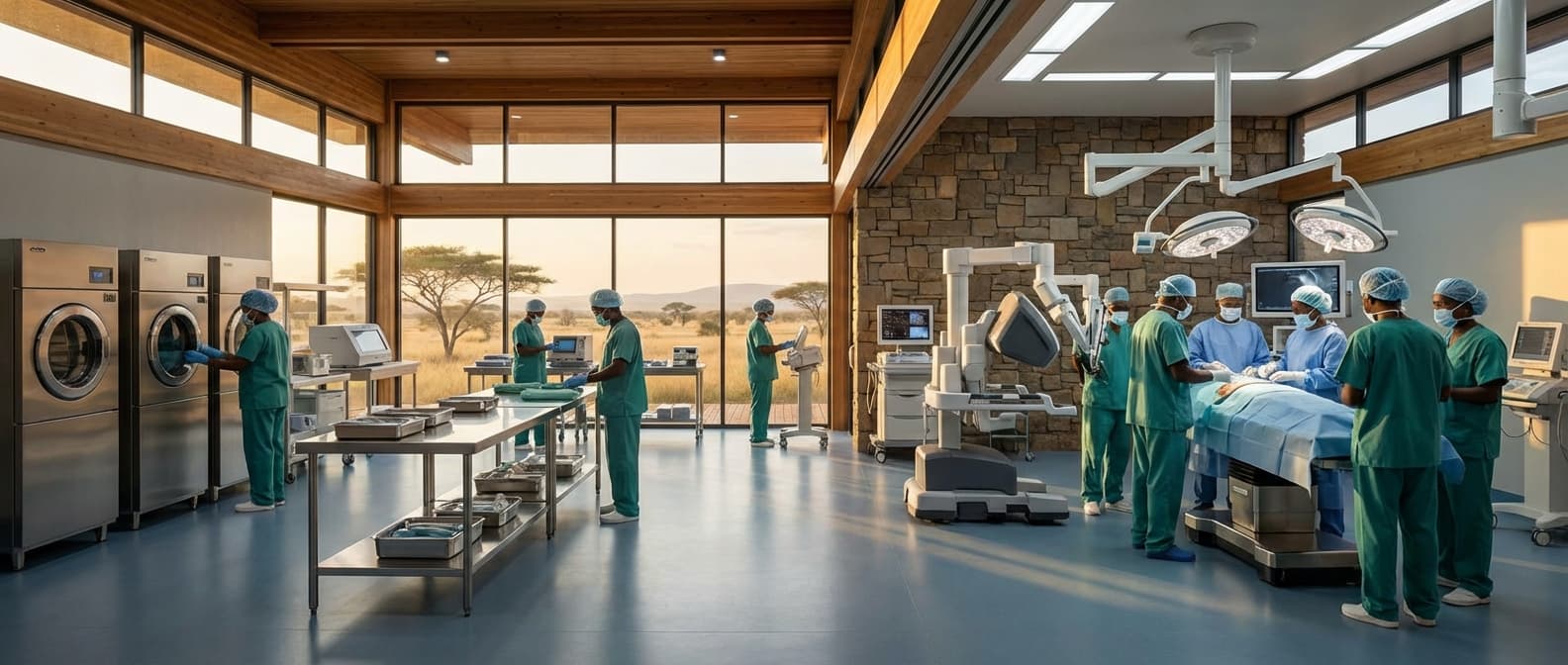
Operating Theatre Turnkey Build in South Sudan
Engineering Excellence & Technical Support
Complete OR design, equipment integration and commissioning High-standard technical execution following OEM protocols and local regulatory frameworks.
Advanced Sterilization & Infection Control Systems
Implementation of state-of-the-art HEPA filtration, laminar airflow, and integrated sterilization units to maintain the highest standards of sterility and minimize healthcare-associated infections, crucial for patient safety in a challenging environment.
Integrated Medical Gas & Power Redundancy
Robust installation of medical gas pipelines (oxygen, medical air, vacuum) with redundant backup systems, coupled with a reliable, multi-source power solution (generator, solar, grid tie-in) ensuring uninterrupted operation of critical life-support equipment.
Durable, Biocompatible Construction Materials
Selection and application of non-porous, antimicrobial, and easily decontaminable building materials designed to withstand harsh environmental conditions, frequent cleaning protocols, and potential biohazards, guaranteeing long-term operational integrity and patient comfort.
What Is Operating Theatre Turnkey Build In South Sudan?
An Operating Theatre Turnkey Build in South Sudan refers to a comprehensive service that encompasses the complete design, construction, equipping, and commissioning of a functional operating theatre suite, delivered as a ready-to-use facility. This 'turnkey' approach streamlines the entire project lifecycle, minimizing the burden on the client and ensuring a high-quality, compliant medical environment. It integrates all necessary architectural, engineering, mechanical, electrical, plumbing, medical gas, HVAC, sterilization, and specialized theatre equipment into a unified solution.
| Who Needs It? | Typical Use Cases | ||||
|---|---|---|---|---|---|
| Government Healthcare Facilities: Public hospitals and clinics requiring upgrades or new construction to improve surgical capacity and standards. | Non-Governmental Organizations (NGOs) & Humanitarian Organizations: Aid organizations establishing or expanding medical services in remote or conflict-affected areas where existing infrastructure is insufficient. | Private Healthcare Providers: New or existing private hospitals and clinics seeking to offer advanced surgical services and meet international quality benchmarks. | Mission Hospitals & Religious Organizations: Healthcare facilities operated by faith-based organizations providing medical care to underserved populations. | International Aid & Development Agencies: Organizations funding healthcare infrastructure projects in South Sudan. | |
| Emergency & Trauma Surgery: Establishing facilities capable of handling immediate life-saving surgical interventions. | General Surgery: Providing access to basic and intermediate surgical procedures for common ailments. | Maternal and Child Health Surgery: Creating dedicated spaces for obstetric and gynecological surgeries, including C-sections. | Specialized Surgical Units: Development of theatres for ophthalmology, orthopedics, or other specific surgical disciplines depending on community needs. | Capacity Building Initiatives: Equipping hospitals to support training programs for local surgeons and medical personnel. | Disaster Relief & Public Health Crises: Rapid deployment of surgical capabilities in response to outbreaks or natural disasters. |
Key Components of an Operating Theatre Turnkey Build:
- Architectural Design & Planning: Site assessment, detailed architectural drawings, space planning adhering to international and local healthcare standards (e.g., infection control, patient flow, safety).
- Civil Construction & Infrastructure: Building shell construction, foundation, structural integrity, internal partitioning, finishes (seamless, anti-bacterial surfaces), and all associated civil works.
- Mechanical, Electrical, and Plumbing (MEP): Robust and redundant power supply (including backup generators), specialized medical gas systems (oxygen, medical air, vacuum), efficient HVAC systems with HEPA filtration for positive pressure environments, and water management systems (including sterilization and waste disposal).
- Specialized Operating Theatre Equipment: Supply and installation of surgical lights, operating tables, anesthesia machines, patient monitoring systems, electrosurgical units, endoscopic equipment, sterilization units (autoclaves), surgical instrument sets, and cabinetry.
- Integration & Commissioning: Interconnecting all systems, rigorous testing of all equipment and infrastructure, functional validation, and handover of a fully operational theatre suite.
- Training & Handover: Comprehensive training for medical and technical staff on the operation and maintenance of the installed systems and equipment.
- Documentation & Compliance: Provision of all necessary certifications, operational manuals, and compliance documentation with relevant health and safety regulations.
Who Needs Operating Theatre Turnkey Build In South Sudan?
Operating Theatre Turnkey Builds in South Sudan are crucial for enhancing healthcare infrastructure and delivering specialized surgical care. These comprehensive solutions, encompassing design, construction, fit-out, and equipping of operating rooms, address a critical need for modern and functional surgical facilities in a region facing significant healthcare challenges. The demand stems from the imperative to improve patient outcomes, reduce the burden of preventable surgical conditions, and build a more resilient healthcare system capable of handling complex medical emergencies and elective procedures.
| Department/Facility | Key Needs Addressed by Turnkey Builds | Examples of Services Offered |
|---|---|---|
| Public Hospitals (Ministry of Health) | Upgrading dilapidated facilities, establishing new surgical capacity, ensuring sterile environments, providing essential equipment for life-saving surgeries, training local staff. | Emergency surgery, trauma care, general surgery, obstetrics and gynecology surgery, basic orthopedics. |
| NGO-Run Hospitals/Clinics | Establishing surgical capabilities in underserved areas, providing specialized surgical services for specific populations (e.g., women, children), ensuring compliance with international standards, enabling rapid deployment of medical services. | Maternal and child health surgeries, reconstructive surgery, fistula repair, humanitarian surgical interventions. |
| Mission Hospitals | Modernizing existing surgical suites, expanding capacity to meet growing community needs, integrating advanced medical technology, providing a safe and sterile environment for complex procedures. | General surgery, ophthalmology, urology, minor orthopedic procedures. |
| Private Hospitals | Establishing state-of-the-art surgical facilities to attract specialized medical talent, offering advanced surgical procedures, meeting the demands of a growing middle class seeking private healthcare. | Cardiovascular surgery, advanced laparoscopy, neurosurgery, advanced orthopedic surgery, cosmetic surgery. |
| Reconstruction/Development Projects | Incorporating modern surgical infrastructure into newly built or renovated healthcare complexes, ensuring sustainability and long-term operational efficiency, facilitating the transfer of medical knowledge and skills. | Comprehensive surgical services aligned with the project's overall healthcare goals. |
Target Customers for Operating Theatre Turnkey Builds in South Sudan
- Government Ministry of Health and Public Hospitals
- Non-Governmental Organizations (NGOs) and International Aid Agencies
- Mission Hospitals and Faith-Based Healthcare Providers
- Private Healthcare Providers and For-Profit Hospitals
- Reconstruction and Development Projects with Healthcare Components
Operating Theatre Turnkey Build Process In South Sudan
Building an operating theatre in South Sudan is a complex process requiring meticulous planning, adherence to international standards, and robust logistical management due to the challenging environment. The workflow from initial inquiry to the final handover involves several distinct phases, each with specific activities and considerations. This process prioritizes functionality, safety, and sustainability within the unique context of South Sudan.
| Phase | Key Activities | Key Considerations & Challenges (South Sudan Context) | Deliverables/Outcomes |
|---|---|---|---|
| 1. Inquiry & Initial Consultation | • Client (e.g., Ministry of Health, NGO, private entity) expresses interest. • Initial discussions regarding project scope, budget, and objectives. • Preliminary site assessment (if possible) or discussion of available location. | • Understanding client's specific medical needs and intended use of the theatre. • Establishing trust and clear communication channels. • Initial identification of potential funding sources. | • Project brief and preliminary scope document. • Agreement on next steps. |
| 2. Needs Assessment & Feasibility Study | • Detailed site survey (geotechnical, environmental, access, utilities). • Comprehensive medical equipment and technology requirements assessment. • Regulatory compliance review (local building codes, healthcare standards). • Risk assessment (security, environmental, logistical). • Development of a preliminary budget and timeline. | • Limited infrastructure (power, water, internet) requiring robust backup systems. • Security concerns and access limitations to remote areas. • Availability of skilled local labor and materials. • Importation regulations and customs clearance challenges. • Potential for malaria, other endemic diseases affecting workforce. | • Detailed feasibility report. • Site assessment report. • Preliminary equipment list. • Draft budget and project timeline. • Risk mitigation plan. |
| 3. Design & Engineering | • Architectural design incorporating international standards (e.g., WHO guidelines for infection control, airflow, acoustics). • Mechanical, Electrical, and Plumbing (MEP) design for specialized systems (HVAC with HEPA filters, medical gases, sterile water). • Structural engineering for building integrity. • Integration of medical equipment into the design. • Development of detailed construction drawings and specifications. | • Ensuring adherence to strict sterile environments and infection control protocols. • Designing for extreme heat and potential dust ingress. • Planning for reliable and redundant power and water supply. • Incorporating local materials where feasible without compromising standards. • Engaging specialized consultants for medical gas and cleanroom technology. | • Final architectural, structural, and MEP drawings. • Detailed specifications for all building elements and systems. • Bill of Quantities (BOQ). • Approved design documents. |
| 4. Procurement & Logistics | • Sourcing and procurement of all construction materials and specialized medical equipment. • Establishing supply chains for materials and equipment. • Managing transportation and customs clearance. • Warehousing and site storage solutions. • Recruitment and mobilization of skilled construction workforce. | • Long lead times for specialized equipment and imported materials. • Navigating complex customs procedures and potential corruption. • Inefficient transportation networks and high freight costs. • Security risks during transit and on-site storage. • Ensuring quality control of procured materials. | • Procurement contracts. • Import permits and customs declarations. • Logistics plan. • Secured warehousing. • Mobilized workforce. |
| 5. Construction & Installation | • Site preparation and foundation work. • Structural erection. • Installation of MEP systems (HVAC, electrical, plumbing, medical gases). • Interior finishing (wall cladding, flooring, ceiling systems). • Installation of medical equipment. • Landscaping and external works. | • Implementing stringent quality control and supervision. • Adapting to unforeseen site conditions. • Managing potential security incidents. • Ensuring adherence to work safety standards in a challenging environment. • Coordinating between different trades and equipment suppliers. • Implementing infection control measures during construction. | • Completed building structure. • Installed and functional MEP systems. • Finished interior spaces. • Installed medical equipment. • Completed external works. |
| 6. Commissioning & Validation | • Testing and balancing of HVAC systems (air changes, pressure differentials, filtration efficiency). • Testing of electrical systems (power quality, backup generators). • Testing of water and medical gas systems. • Verification of all installed medical equipment functionality. • Performance testing against design specifications. • Environmental monitoring and validation (e.g., air quality). • Final inspections by regulatory bodies and client. | • Ensuring systems perform to sterile environment standards. • Verifying reliability of backup systems. • Identifying and rectifying any system defects. • Documenting all test results rigorously. | • Commissioning reports for all systems. • Validation certificates. • Test and balance reports. • Equipment performance reports. • Certificate of Occupancy/Completion. |
| 7. Training & Handover | • Training of hospital staff on the operation and maintenance of all installed systems and medical equipment. • Provision of comprehensive operation and maintenance manuals. • Formal handover of the completed facility to the client. • Final project documentation compilation. | • Ensuring adequate understanding and competence of local staff. • Language barriers may require translation services. • Need for ongoing support beyond initial training. | • Trained staff. • Comprehensive O&M manuals. • Project completion documentation. • Formal handover certificate. |
| 8. Post-Handover Support | • Warranty period management. • Scheduled preventative maintenance. • Troubleshooting and repair services. • Supply of spare parts. • Potential for ongoing training or system upgrades. | • Establishing a reliable and responsive support network. • Ensuring availability of spare parts. • Long-term sustainability of the facility. | • Operational and well-maintained operating theatre. • Ongoing client satisfaction. |
Operating Theatre Turnkey Build Process in South Sudan: Workflow Breakdown
- Phase 1: Inquiry & Initial Consultation
- Phase 2: Needs Assessment & Feasibility Study
- Phase 3: Design & Engineering
- Phase 4: Procurement & Logistics
- Phase 5: Construction & Installation
- Phase 6: Commissioning & Validation
- Phase 7: Training & Handover
- Phase 8: Post-Handover Support
Operating Theatre Turnkey Build Cost In South Sudan
Building an operating theatre in South Sudan presents a complex cost landscape, heavily influenced by numerous factors unique to the country's infrastructure, supply chains, and economic conditions. Turnkey solutions, encompassing design, construction, equipment procurement, and installation, require careful budgeting. Pricing can vary significantly based on location (urban vs. remote), the scale and complexity of the facility, the quality of materials and equipment specified, and the prevailing security situation. Fluctuations in the South Sudanese Pound (SSP) and the availability of imported goods further contribute to the volatility of costs.
| Category | Estimated Range (SSP) | Notes |
|---|---|---|
| Basic Small Operating Theatre (e.g., for a clinic, limited equipment) | 150,000,000 - 350,000,000 | Assumes basic infrastructure, essential equipment only, potentially using some locally sourced materials where feasible. |
| Standard Operating Theatre (e.g., for a hospital, moderate equipment) | 350,000,000 - 700,000,000 | Includes more robust construction, advanced HVAC, standard medical gases, a wider range of surgical equipment, and reliable power backup. |
| Advanced/Specialized Operating Theatre (e.g., for a larger hospital, high-end equipment, multiple ORs) | 700,000,000 - 1,500,000,000+ | Involves state-of-the-art equipment, sophisticated medical systems, specialized flooring and lighting, and comprehensive backup systems. Costs can escalate significantly for highly specialized needs. |
| Logistics & Transportation (per container/shipment, highly variable) | 5,000,000 - 30,000,000+ | Dependent on origin, destination, mode of transport, and security clearance. This can be a substantial hidden cost. |
| Specialized Medical Equipment (per major item, e.g., anesthesia machine, surgical lights) | 10,000,000 - 100,000,000+ | Varies drastically by brand, model, and functionality. Import duties and taxes will apply. |
Key Pricing Factors for Operating Theatre Turnkey Builds in South Sudan:
- Site Preparation & Infrastructure: Clearing land, foundation work, ensuring access to essential utilities (water, electricity, waste disposal), and potentially constructing new access roads. Remote locations will incur significantly higher logistical costs.
- Construction Materials: Costs of cement, steel, bricks, roofing, flooring (specialized anti-bacterial and anti-static flooring is crucial), and interior finishes. Import duties and transportation expenses heavily impact these prices.
- Specialized Operating Theatre Systems: This includes HVAC (medical-grade air filtration and temperature control), medical gas systems (oxygen, medical air, vacuum), lighting (surgical lighting fixtures), and power backup systems (generators, UPS).
- Medical Equipment: A major cost driver. This encompasses surgical tables, anesthetic machines, patient monitors, sterilization equipment (autoclaves), surgical instruments, imaging equipment (X-ray, ultrasound), and other specialized devices. The quality and brand of equipment will dictate the price.
- Labor Costs: Skilled and unskilled labor rates, often higher in South Sudan due to a limited skilled workforce and the need for expatriate specialists for certain tasks.
- Logistics & Transportation: Moving materials, equipment, and personnel to the site, especially in a country with developing infrastructure. This can involve road, air, or even river transport, each with its own cost implications.
- Design & Engineering Fees: Costs associated with architectural and engineering services for specialized operating theatre design.
- Permits & Approvals: Local regulatory fees and potential administrative costs for obtaining necessary permits.
- Contingency: Essential due to the inherent uncertainties in South Sudan, including security risks, unexpected logistical challenges, and currency fluctuations.
- Project Management: Overhead and fees for managing the entire turnkey project, including coordination with various suppliers and contractors.
Affordable Operating Theatre Turnkey Build Options
Building an operating theatre is a significant investment. Fortunately, "affordable operating theatre turnkey build options" are becoming increasingly accessible. These options focus on providing comprehensive solutions at a predictable cost, often through pre-designed modules or phased approaches. Value bundles are key to these affordability strategies, bundling essential components and services together to achieve economies of scale and streamline the procurement and construction process. This not only reduces the overall price but also minimizes potential cost overruns due to unforeseen issues during a piecemeal build.
| Cost-Saving Strategy | Explanation | Benefit |
|---|---|---|
| Bulk Purchasing | Procuring multiple components and services from a single provider or through a large tender process. | Leverages economies of scale, leading to discounted pricing on equipment, materials, and labor. |
| Standardization & Off-the-Shelf Components | Utilizing pre-designed layouts and readily available medical equipment and building materials. | Reduces custom engineering and manufacturing costs. Faster procurement and installation. |
| Prefabrication & Modular Construction | Manufacturing key theatre components or entire modules in a controlled factory environment. | Minimizes on-site labor, reduces weather delays, and improves quality control, leading to faster project completion and lower overall costs. |
| Lean Project Management | Implementing efficient project management methodologies to minimize waste in time, resources, and effort. | Streamlines workflows, reduces rework, and improves communication, resulting in cost savings and timely delivery. |
| Phased Investment | Breaking down the project into distinct, achievable stages with separate budgets. | Allows for more manageable cash flow and the ability to adapt to changing needs or funding availability. |
| Negotiated Long-Term Partnerships | Establishing ongoing relationships with key suppliers and contractors for future projects or expansions. | Can lead to preferential pricing, dedicated support, and more predictable costs over time. |
Key Value Bundles in Affordable Turnkey Operating Theatre Builds
- Modular Theatre Units: Pre-fabricated, self-contained operating rooms that can be quickly installed and commissioned, significantly reducing on-site construction time and labor costs. These often include integrated HVAC, lighting, and medical gas systems.
- Standardized Design Packages: Pre-engineered and validated designs for common operating theatre configurations. This reduces the need for extensive custom design work, saving on architectural and engineering fees.
- Integrated Equipment & Fit-out: Bundling the core surgical equipment (e.g., surgical lights, tables, booms) with the theatre's interior fit-out (walls, flooring, ceilings) ensures compatibility and often allows for bulk purchasing discounts.
- Phased Development Plans: Breaking down the project into manageable phases, allowing for staggered investment and the ability to scale the facility as demand grows. This can be more financially feasible than a large upfront capital outlay.
- All-Inclusive Service Contracts: Bundling installation, commissioning, training, and initial maintenance services into a single package provides cost certainty and avoids separate service provider negotiations.
Verified Providers In South Sudan
In South Sudan, ensuring access to reliable and qualified healthcare is paramount. When seeking medical services, it's crucial to identify providers who have undergone rigorous verification and meet high professional standards. Franance Health stands out as a leader in this regard, offering a network of credentials that assure patients of receiving exceptional care. This document outlines why Franance Health's verified providers are the best choice for your health needs in South Sudan.
| Credential Type | Verification Standard | Patient Benefit |
|---|---|---|
| Medical Licenses & Certifications | Validation with relevant national and international medical boards. | Ensures practitioners are legally qualified and possess foundational medical knowledge. |
| Professional Experience & Specialization | Review of work history, peer references, and documented surgical/procedural experience. | Guarantees access to experienced doctors with proven expertise in specific medical areas. |
| Ethical Conduct & Disciplinary History | Background checks and review of any past disciplinary actions or ethical breaches. | Protects patients from malpractice and ensures a safe, trustworthy healthcare environment. |
| Continuing Medical Education (CME) | Verification of participation in accredited CME programs and workshops. | Confirms that providers are up-to-date with the latest medical research, technologies, and treatment protocols. |
| Facility Standards (where applicable) | Assessment of clinic and hospital infrastructure, equipment, and hygiene protocols. | Ensures that the medical environment is safe, clean, and equipped to provide effective care. |
Key Credentials and Benefits of Choosing Franance Health Verified Providers
- Rigorous Vetting Process: Franance Health employs a comprehensive vetting system that scrutinizes the qualifications, licenses, and professional history of every healthcare provider in their network. This ensures that only the most competent and ethical practitioners are included.
- Adherence to International Standards: Verified providers are committed to upholding international best practices in healthcare delivery, patient safety, and ethical conduct. This means you can expect a quality of care comparable to global standards.
- Specialized Expertise: Franance Health’s network includes specialists across a wide range of medical disciplines. Their verification process confirms the specific expertise and experience of each practitioner, allowing you to find the right doctor for your condition.
- Commitment to Patient Well-being: Beyond technical skills, Franance Health prioritizes providers who demonstrate a strong commitment to patient-centered care, empathy, and clear communication. This fosters trust and a positive patient experience.
- Continuous Professional Development: Verified providers are encouraged and often required to participate in ongoing training and education to stay abreast of the latest medical advancements and techniques, guaranteeing you access to up-to-date treatments.
- Transparency and Accountability: Franance Health maintains a transparent system where patients can be confident in the credentials of their chosen provider. This accountability framework ensures that providers are held to a high standard of performance.
Scope Of Work For Operating Theatre Turnkey Build
This document outlines the Scope of Work (SOW) for a turnkey Operating Theatre (OT) build. It details the technical deliverables and standard specifications required for the successful completion of the project, ensuring a safe, efficient, and compliant healthcare environment. The scope encompasses design, procurement, construction, installation, commissioning, and handover of fully functional operating theatres.
| Category | Standard Specification | Key Requirements |
|---|---|---|
| Room Layout & Dimensions | ISO 7396-1, ASHRAE 170 | Adequate space for equipment, patient, and staff; clear circulation paths; non-porous, easy-to-clean surfaces |
| Air Quality & Ventilation | ISO 14644-1 (Class 7 or 8), ASHRAE 170 | HEPA filtration; positive pressure for sterile areas; controlled air changes per hour; temperature and humidity control |
| Medical Gas Pipeline System (MGPS) | ISO 7396-1, HTM 02-01 | Nitrous oxide, medical air, vacuum, oxygen; alarm systems; color-coded pipelines; medical gas outlets |
| Electrical Systems | IEC 60364-7-710, NFPA 99 | Isolated power systems; backup generators; UPS for critical equipment; emergency lighting; appropriate grounding |
| Lighting | IES RP-25, Local Building Codes | Surgical shadowless lights; ambient lighting; color rendering index (CRI) >90; adjustable intensity and color temperature |
| Infection Control | HTM 01-01, Local Regulations | Seamless, non-porous surfaces; rounded corners; easily disinfectable materials; waste management systems |
| Materials & Finishes | ASTM, Local Building Codes | Durable, non-absorbent, antimicrobial, and easily cleanable materials for walls, floors, and ceilings |
| Acoustics | ISO 717-1, Local Building Codes | Sound insulation to minimize distractions and maintain privacy |
| Safety Features | NFPA 101, Local Fire Codes | Fire suppression systems, emergency exits, clear signage, slip-resistant flooring |
Key Technical Deliverables
- Detailed Architectural & Engineering Designs (including layouts, schematics, and BIM models)
- Medical Gas Pipeline System (MGPS) Design and Installation
- HVAC System Design and Installation (including HEPA filtration, laminar flow, and pressure differentials)
- Electrical System Design and Installation (including backup power, UPS, and lighting)
- Low Voltage Systems Installation (including nurse call, data, audio-visual, and security systems)
- Infection Control Measures Integration
- Sterilization and Waste Management Systems
- Specialized OT Equipment Integration (e.g., surgical lights, booms, tables, imaging equipment)
- Final Commissioning and Performance Testing Reports
- As-Built Drawings and Documentation
- User Manuals and Training Materials
Service Level Agreement For Operating Theatre Turnkey Build
This Service Level Agreement (SLA) outlines the response times and uptime guarantees for the turnkey build of operating theatres. It serves as a commitment from the service provider to the client regarding the operational availability and support for the delivered operating theatre infrastructure.
| Service Component | Severity Level | Response Time Guarantee | Resolution Time Guarantee | Uptime Guarantee |
|---|---|---|---|---|
| Structural Integrity (Walls, Floors, Ceilings) | Critical (Compromised safety or hygiene) | 1 hour | 4 hours | 99.9% |
| HVAC and Air Filtration System | Critical (Breach of sterile field requirements) | 30 minutes | 2 hours | 99.95% |
| Medical Gas Supply and Alarm Systems | Critical (Interruption of essential gas supply) | 15 minutes | 1 hour | 99.99% |
| Lighting Systems (Main & Emergency) | Critical (Complete loss of lighting) | 30 minutes | 2 hours | 99.9% |
| Integrated A/V and Control Systems | Major (Significant functional impairment) | 1 hour | 4 hours | 99.5% |
| Plumbing and Drainage Systems | Major (Leakage or blockage impacting use) | 1 hour | 4 hours | 99.5% |
| Electrical Power Supply (Main & Backup) | Critical (Complete power outage) | 15 minutes | 1 hour | 99.99% |
| General Building Fabric & Finishes | Minor (Cosmetic or non-critical functional issue) | 4 business hours | 24 business hours | N/A (covered under standard warranty) |
Key Performance Indicators (KPIs)
- Response Time: The time taken by the service provider to acknowledge and begin addressing a reported issue.
- Resolution Time: The time taken by the service provider to fully resolve a reported issue and restore normal operating theatre function.
- Uptime Guarantee: The percentage of time the operating theatre is expected to be fully functional and available for use.
Frequently Asked Questions

Ready when you are
Let's scope your Operating Theatre Turnkey Build in South Sudan project in South Sudan.

Scaling healthcare logistics and technical systems across the entire continent.