
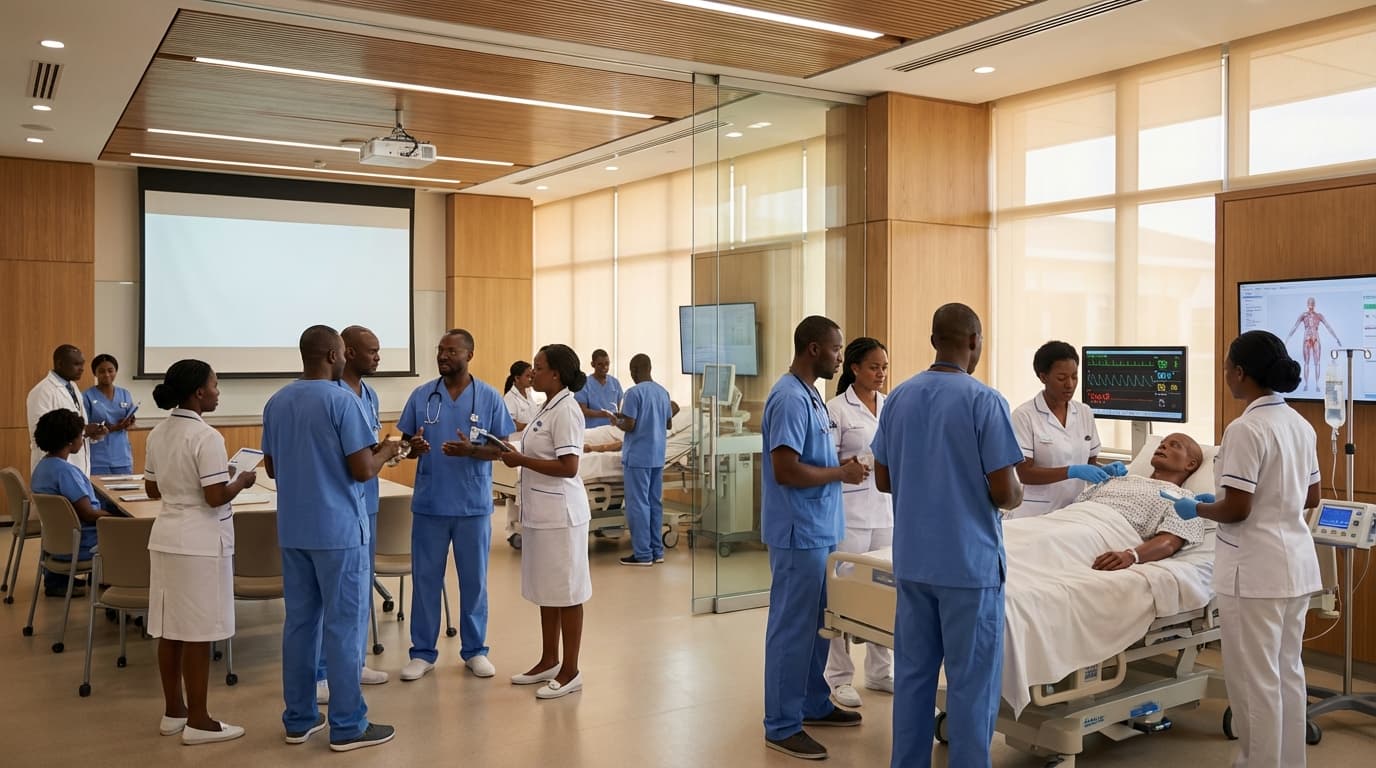
Equipment Training & Education in South Africa
Engineering Excellence & Technical Support
Comprehensive equipment training and certification programs High-standard technical execution following OEM protocols and local regulatory frameworks.
Localized Equipment Manuals & Simulations
We provide South Africa-specific training materials, including equipment manuals translated into local languages and interactive 3D simulations that replicate real-world operational scenarios. This ensures clear understanding and safe practice for all operators across diverse geographical and operational contexts.
Certified 'Train-the-Trainer' Programs
Our comprehensive 'Train-the-Trainer' programs empower key personnel within South African organizations to become certified equipment instructors. This sustainable model builds internal expertise, fostering ongoing skill development and knowledge transfer directly within your workforce.
Performance Analytics & Compliance Tracking
Leveraging digital platforms, we offer advanced analytics to track operator performance, identify skill gaps, and ensure ongoing compliance with safety regulations. This data-driven approach allows for targeted intervention and continuous improvement in equipment operation across South Africa.
What Is Equipment Training & Education In South Africa?
Equipment training and education in South Africa refers to the formal and informal processes of imparting knowledge, skills, and competencies necessary for the safe, efficient, and effective operation, maintenance, and repair of various types of equipment. This encompasses theoretical instruction, practical hands-on experience, and ongoing professional development tailored to the specific equipment and the industry context within South Africa. The objective is to ensure personnel are proficient in utilizing equipment to meet operational demands, adhere to safety regulations, minimize downtime, and optimize performance, thereby contributing to overall productivity and economic growth. This service is crucial for a wide spectrum of industries operating within the South African economic landscape, including mining, manufacturing, construction, agriculture, logistics, and energy.
| Who Needs Equipment Training & Education? | Typical Use Cases & Industries |
|---|---|
| Operators: Individuals directly responsible for the day-to-day operation of machinery and equipment. | Operating excavators, bulldozers, and cranes on construction sites (Construction); driving forklifts and operating conveyor systems in warehouses (Logistics); piloting agricultural machinery for planting and harvesting (Agriculture); operating mining haul trucks and drilling rigs (Mining). |
| Maintenance Personnel: Technicians and engineers tasked with the upkeep, repair, and servicing of equipment. | Performing preventative maintenance on manufacturing assembly lines (Manufacturing); diagnosing and repairing faults in power generation turbines (Energy); servicing specialized laboratory equipment in research facilities (Healthcare/Research); conducting routine checks on heavy-duty mining vehicles (Mining). |
| Supervisors & Managers: Individuals overseeing teams and operations, requiring an understanding of equipment capabilities and limitations for effective planning and resource allocation. | Planning project timelines and allocating specific machinery for tasks (Construction); optimizing production schedules based on equipment efficiency (Manufacturing); managing safety protocols related to equipment usage (All Industries); assessing the need for equipment upgrades or replacements (All Industries). |
| Safety Officers & Compliance Auditors: Professionals responsible for ensuring adherence to safety regulations and standards related to equipment operation and maintenance. | Conducting safety audits of construction sites to ensure proper machinery operation (Construction); developing and implementing equipment safety training programs (All Industries); investigating incidents involving equipment malfunction (All Industries); ensuring compliance with mining safety legislation (Mining). |
| New Entrants to the Workforce: Individuals seeking to acquire foundational skills for employment in equipment-intensive sectors. | Entry-level operator training for general construction machinery (Construction); basic forklift operation certification for warehouse roles (Logistics); introductory training on agricultural equipment for farm assistants (Agriculture). |
Key Components of Equipment Training & Education in South Africa:
- Theoretical Knowledge Acquisition: Understanding equipment principles, functionality, operational parameters, safety protocols, and relevant legislation (e.g., OHSA Act).
- Practical Skill Development: Hands-on proficiency in operating, calibrating, troubleshooting, and performing routine maintenance tasks on specific equipment.
- Safety Compliance Training: Emphasis on hazard identification, risk assessment, safe work procedures, emergency response, and the use of personal protective equipment (PPE).
- Maintenance & Repair Training: Instruction on preventative maintenance schedules, diagnostic techniques, component replacement, and basic repair procedures.
- Specialized Equipment Modules: Training tailored to unique equipment types such as heavy machinery, industrial automation systems, medical devices, or laboratory instruments.
- Certification and Accreditation: Formal assessment and issuance of certificates to validate competency, often aligned with national occupational standards (NOSA, SAQA) or manufacturer specifications.
- Refresher and Advanced Training: Ongoing education to update skills, introduce new technologies, or address evolving operational requirements and regulatory changes.
Who Needs Equipment Training & Education In South Africa?
In South Africa, a wide range of individuals and organizations require equipment training and education to ensure safe, efficient, and productive operations. This training is crucial across various industries, from manufacturing and construction to healthcare and agriculture. It empowers employees with the knowledge and skills to operate machinery, tools, and complex systems effectively, minimizing risks, maximizing output, and promoting a culture of safety. Investing in equipment training is not just a regulatory requirement in many cases, but a strategic imperative for businesses aiming for operational excellence and sustained growth.
| Target Customer/Industry | Key Departments Requiring Training | Examples of Equipment/Skills |
|---|---|---|
| Manufacturing & Production | Production Line Operators, Machine Technicians, Quality Control, Maintenance Staff | CNC Machines, Industrial Robots, Assembly Lines, Forklifts, Lathes, Welding Equipment |
| Construction & Civil Engineering | Site Operatives, Machine Operators, Foremen, Supervisors, Safety Officers | Cranes, Excavators, Bulldozers, Graders, Power Tools, Scaffolding, Concrete Mixers |
| Mining & Resources | Miners, Plant Operators, Maintenance Engineers, Safety Personnel | Drilling Rigs, Haul Trucks, Conveyor Systems, Crushers, Ventilation Systems, Explosives Handling |
| Agriculture & Farming | Farm Workers, Tractor Operators, Equipment Technicians, Agronomists | Tractors, Harvesters, Planters, Sprayers, Irrigation Systems, Milking Machines |
| Healthcare & Medical | Nurses, Doctors, Radiologists, Lab Technicians, Biomedical Engineers | MRI Machines, CT Scanners, X-ray Equipment, Ventilators, Surgical Instruments, Laboratory Analyzers |
| Logistics & Warehousing | Forklift Operators, Warehouse Operatives, Inventory Managers, Logistics Coordinators | Forklifts, Pallet Jacks, Automated Storage Systems, Conveyor Belts, Warehouse Management Systems (WMS) |
| Energy & Utilities | Power Plant Operators, Technicians, Field Service Engineers, Safety Personnel | Turbines, Generators, Transformers, Switchgear, Pipelines, Control Systems |
| Automotive & Transportation | Mechanics, Technicians, Service Advisors, Fleet Managers | Diagnostic Tools, Vehicle Lifts, Tire Changers, Engine Repair Equipment, Fleet Management Software |
| Hospitality & Food Service | Kitchen Staff, Catering Personnel, Maintenance Teams | Commercial Ovens, Industrial Mixers, Dishwashers, Refrigeration Units, Food Processing Machinery |
| Information Technology (IT) | Network Administrators, Data Center Technicians, Cybersecurity Analysts | Servers, Network Devices, Data Storage Systems, Virtualization Platforms, Cybersecurity Tools |
Target Customers & Departments for Equipment Training & Education in South Africa
- Industries requiring hands-on operational skills.
- Organizations prioritizing workplace safety and compliance.
- Businesses looking to improve operational efficiency and productivity.
- Companies dealing with specialized or complex equipment.
- New entrants to the workforce needing foundational skills.
- Experienced personnel requiring upskilling or certification.
Equipment Training & Education Process In South Africa
The Equipment Training & Education Process in South Africa typically follows a structured workflow to ensure that participants gain the necessary knowledge and practical skills for operating and maintaining specific equipment safely and effectively. This process caters to a diverse range of industries, from manufacturing and mining to agriculture and construction, and is often governed by industry-specific regulations and best practices. The workflow encompasses several key stages, beginning with an initial inquiry and culminating in the successful execution of the training program. This systematic approach ensures that training needs are accurately identified, resources are allocated appropriately, and the desired learning outcomes are achieved, contributing to improved workplace safety, productivity, and compliance within South African organizations.
| Stage | Description | Key Activities | Responsible Parties | Output/Deliverable |
|---|---|---|---|---|
| Inquiry & Needs Assessment | The initial contact from a client seeking training for specific equipment. | Client expresses interest, identifies equipment, states desired outcomes, and provides context. | Prospective Client, Training Provider Sales/Consultant | Understanding of client's training needs and context. |
| Proposal Development & Quotation | Based on the needs assessment, the training provider prepares a tailored proposal. | Outline training scope, modules, duration, methodology, trainer qualifications, and costs. | Training Provider (Technical & Sales Teams) | Detailed Training Proposal & Quotation. |
| Agreement & Contract Finalization | Formal agreement on the terms and conditions of the training. | Negotiation of terms, contract signing, payment schedule confirmation. | Client & Training Provider Legal/Procurement Teams | Signed Training Agreement/Contract. |
| Training Program Design & Customization | Development or adaptation of training materials to suit the specific equipment and client requirements. | Curriculum development, module creation, practical exercise design, assessment tool preparation. | Training Provider (Instructional Designers, Subject Matter Experts) | Customized Training Curriculum & Materials. |
| Trainer & Resource Allocation | Identifying and assigning qualified trainers and necessary resources. | Selecting trainers with relevant expertise and certifications, securing training venues, equipment, and consumables. | Training Provider (Operations Manager, HR) | Assigned Trainers & Allocated Resources. |
| Scheduling & Logistics | Planning the dates, times, and locations for the training sessions. | Coordinating with client on availability, booking venues, arranging travel and accommodation if necessary. | Training Provider (Logistics Coordinator) | Confirmed Training Schedule & Logistics Plan. |
| Participant Enrolment & Pre-assessment | Registering participants and assessing their prior knowledge or experience. | Collecting participant details, conducting pre-training questionnaires or assessments (optional). | Client (HR/Training Department), Training Provider | Participant List & Pre-assessment Results (if applicable). |
| Training Delivery (Theory & Practical) | The actual execution of the training program. | Classroom-based instruction, hands-on practical sessions, demonstrations, simulations, group activities. | Assigned Trainer(s) | Trained Participants. |
| Assessment & Evaluation | Measuring the participants' understanding and ability to apply the learned skills. | Written tests, practical skill demonstrations, observation, competency assessments. | Assigned Trainer(s), Independent Assessors (if required) | Participant Assessment Scores & Competency Records. |
| Certification & Feedback | Issuing certificates of completion and gathering feedback on the training. | Awarding certificates upon successful completion, collecting participant feedback through surveys. | Training Provider (Administration), Participants | Certificates of Completion, Training Feedback Reports. |
| Post-Training Support & Follow-up | Providing ongoing support and evaluating the long-term impact of the training. | Answering follow-up questions, providing refresher training (if agreed), post-training impact assessment. | Training Provider (Support Team), Client | Sustained Competency & Improved Performance. |
Equipment Training & Education Workflow: South Africa
- Inquiry & Needs Assessment
- Proposal Development & Quotation
- Agreement & Contract Finalization
- Training Program Design & Customization
- Trainer & Resource Allocation
- Scheduling & Logistics
- Participant Enrolment & Pre-assessment
- Training Delivery (Theory & Practical)
- Assessment & Evaluation
- Certification & Feedback
- Post-Training Support & Follow-up
Equipment Training & Education Cost In South Africa
The cost of equipment training and education in South Africa can vary significantly depending on several factors. These include the type of equipment being trained on, the complexity of the training, the duration of the course, the provider's reputation and location, and the level of certification offered. General industry training for common machinery might be more standardized, while specialized training for advanced industrial or technical equipment will command higher prices. Furthermore, the inclusion of hands-on practical sessions, simulations, and customized training programs can influence the overall cost. The currency used for all pricing is the South African Rand (ZAR).
| Training Category | Typical Price Range (ZAR) | Notes |
|---|---|---|
| Basic Machinery Operation (e.g., Forklift, Pallet Jack) | R1,500 - R4,000 | Often a one-day course, including theory and practical. Certification usually included. |
| Construction Equipment (e.g., Excavator, Bobcat, Crane) | R3,000 - R8,000 | Typically 2-5 days, involving hands-on operation and safety procedures. May lead to operator competency certificates. |
| Industrial Machinery (e.g., Lathe, Milling Machine, Welding) | R2,500 - R7,000 | Can be short courses or longer apprenticeships. Focus on technical skills and safety. |
| IT & Specialized Software (e.g., CAD, BIM, Advanced ERP) | R4,000 - R15,000+ | Varies greatly by software complexity and duration. Often delivered by vendors or specialized training centers. May include certifications. |
| Health & Safety Equipment (e.g., Fall Arrest, Confined Space Entry) | R1,000 - R5,000 | Focus on safe usage and emergency procedures. Often shorter courses with certification. |
| Medical Equipment (e.g., Defibrillator, Basic Life Support) | R800 - R2,500 | Shorter courses, often with recognized accreditation. Focus on emergency response. |
| Advanced Technical/Engineering Equipment | R8,000 - R30,000+ | Longer, specialized courses, often for highly technical roles. May involve advanced simulations and expert instructors. Can be part of formal qualification programs. |
| On-site Corporate Training | Varies widely based on customization and number of participants | Typically quoted per day or per program, taking into account travel and instructor fees. Can be more cost-effective for larger groups. |
Key Pricing Factors for Equipment Training & Education in South Africa:
- Type and complexity of equipment
- Duration of the training program
- Provider's reputation and expertise
- Geographic location of the training (e.g., major city vs. remote area)
- Level of certification or qualification offered
- Inclusion of practical/hands-on sessions
- Use of simulators or advanced training technology
- Customization of training content
- On-site vs. off-site training delivery
- Number of participants (group discounts may apply)
Affordable Equipment Training & Education Options
Investing in equipment training and education is crucial for operational efficiency, safety, and employee skill development. Fortunately, there are many affordable options available. Understanding how to leverage value bundles and employ cost-saving strategies can significantly reduce the overall investment without compromising quality. Value bundles often combine multiple training modules, certifications, or resources at a discounted rate, offering more for your budget. Cost-saving strategies focus on maximizing resources, exploring alternative delivery methods, and seeking out promotional offers. This guide will explore these avenues to help you make informed decisions about your equipment training needs.
| Strategy | Description | Potential Savings | Considerations |
|---|---|---|---|
| Value Bundles | Purchase multiple related training modules or certifications as a package. | 10-30% per module | Ensure all components are relevant to your needs; check for renewal costs. |
| Train-the-Trainer | Empower internal staff to deliver training. | Significant long-term savings (reduces external fees) | Requires investment in qualified internal trainers and materials; ongoing quality control. |
| Online/E-Learning | Utilize web-based courses and virtual classrooms. | 20-50% less than in-person | Requires reliable internet access; consider interactivity and practical application. |
| Manufacturer Resources | Leverage free or low-cost materials provided by equipment vendors. | Can be free to very low cost | May be product-specific; assess the depth and breadth of coverage. |
| Group Discounts | Enroll multiple employees simultaneously. | Varies, often 5-20% off | Requires coordinated scheduling; ensure uniform skill levels are addressed. |
| Community College/Vocational | Enroll in courses at local educational institutions. | Up to 70% less than private providers | May have fixed schedules; curriculum might be broader than specific equipment needs. |
Affordable Equipment Training & Education Options
- {"title":"Value Bundles","description":"Combining related training programs or resources into a package often results in a lower per-unit cost compared to purchasing them individually. This can include foundational training plus advanced modules, or training on multiple pieces of related equipment."}
- {"title":"Cost-Saving Strategies","description":"These are proactive approaches to minimize expenses while still achieving your training objectives. They involve smart planning, resourcefulness, and strategic choices in how and where you acquire training."}
- {"title":"Online & E-Learning Platforms","description":"Web-based courses offer flexibility and often a lower price point than in-person sessions. Many platforms provide interactive modules, video tutorials, and assessments, making them an effective and budget-friendly option."}
- {"title":"Train-the-Trainer Programs","description":"Investing in a program to train internal staff members to become certified instructors allows for ongoing, cost-effective training within your organization, reducing reliance on external providers."}
- {"title":"Manufacturer-Provided Resources","description":"Many equipment manufacturers offer free or low-cost training materials, webinars, and even basic certifications for their products. Checking with your equipment suppliers is a vital first step."}
- {"title":"Government & Non-Profit Grants/Subsidies","description":"Explore local, state, or federal programs that offer financial assistance for workforce development and employee training, especially in critical industries."}
- {"title":"Community Colleges & Vocational Schools","description":"These institutions often offer specialized equipment courses and certification programs at significantly lower tuition rates than private training companies."}
- {"title":"Promotional Offers & Discounts","description":"Keep an eye out for early bird discounts, group rates, seasonal promotions, and partnerships with industry associations that may offer reduced training fees."}
- {"title":"On-Demand & Microlearning","description":"Short, focused training modules that can be accessed as needed are cost-effective for specific skill gaps or refresher training, avoiding the expense of comprehensive courses."}
- {"title":"Bulk Purchasing & Group Discounts","description":"If multiple employees or departments require the same training, negotiating a bulk discount or group rate can lead to substantial savings."}
Verified Providers In South Africa
In South Africa's dynamic healthcare landscape, identifying truly verified providers is crucial for ensuring quality care and peace of mind. Franance Health stands out by rigorously credentialing its network, offering a benchmark of excellence. This meticulous process not only verifies the qualifications and experience of healthcare professionals but also underscores their commitment to ethical practice and patient safety. Choosing a Franance Health verified provider means opting for transparency, accountability, and a superior healthcare experience.
| Credentialing Aspect | Franance Health Approach | Benefit to Patients |
|---|---|---|
| Professional Qualifications | Scrutinizes degrees, certifications, and licenses from recognized institutions. | Ensures providers possess the foundational knowledge and skills required for their practice. |
| Clinical Experience | Verifies years of practical experience in relevant medical fields. | Guarantees that providers have practical experience in treating various conditions. |
| Professional Standing & Disciplinary Records | Conducts background checks and inquiries with regulatory bodies. | Protects patients from practitioners with a history of misconduct or disciplinary actions. |
| Continuing Professional Development (CPD) | Confirms ongoing engagement in learning and skill enhancement. | Ensures providers remain up-to-date with the latest medical research and techniques. |
| Insurance & Liability | Validates adequate professional indemnity insurance. | Provides financial recourse for patients in case of negligence or malpractice. |
| Ethical Compliance | Assesses adherence to codes of conduct and ethical practice guidelines. | Upholds patient rights and promotes respectful, professional patient-provider interactions. |
Why Franance Health Credentials Represent the Best Choice:
- Rigorous Verification Process: Franance Health employs a multi-faceted verification system, going beyond basic registration to confirm qualifications, experience, and adherence to professional standards.
- Enhanced Patient Safety: By ensuring providers meet stringent criteria, Franance Health significantly reduces risks associated with unqualified or uncredentialed practitioners.
- Commitment to Quality of Care: Verified providers are demonstrably committed to delivering high-quality, evidence-based healthcare, ensuring patients receive the best possible treatment.
- Increased Transparency and Trust: The credentialing process fosters trust by providing patients with the assurance that their chosen healthcare professionals have undergone thorough scrutiny.
- Access to a Network of Excellence: Franance Health's network comprises a curated selection of healthcare professionals who have proven their mettle, offering a reliable source for diverse medical needs.
- Professional Development Emphasis: Verified providers are often encouraged and supported in continuous professional development, staying abreast of the latest medical advancements.
- Ethical Practice Standards: Franance Health's verification includes checks for adherence to ethical guidelines and professional conduct, protecting patient rights and well-being.
Scope Of Work For Equipment Training & Education
This Scope of Work (SOW) outlines the requirements for comprehensive training and educational services for the newly acquired [Equipment Name/System]. The objective is to ensure proficient and safe operation, maintenance, and troubleshooting of the equipment by designated personnel. This SOW details the technical deliverables, learning objectives, and standard specifications for the training program.
| Deliverable | Description | Standard Specification | Verification Method |
|---|---|---|---|
| Training Curriculum | A detailed outline of all training modules, topics covered, learning objectives, and estimated duration for each. | Must be comprehensive, covering all aspects of the equipment's operation and maintenance as per manufacturer's guidelines. | Review and approval by [Client Stakeholder Name/Department]. |
| Training Materials (Participant Guides) | Printed or digital handbooks provided to each trainee, including theoretical concepts, practical exercises, and reference information. | Clear, concise language, high-quality visuals (diagrams, images), and indexed for easy navigation. Content aligned with curriculum. | Trainee feedback surveys and instructor assessment. |
| Training Materials (Instructor Guides) | Detailed lesson plans, presentation slides, demonstration guides, and answer keys for exercises, for the use of the trainer. | Structured for effective delivery, including timing suggestions, key talking points, and potential Q&A prompts. | Review by [Client Subject Matter Expert]. |
| Hands-on Practical Sessions | Supervised practical exercises and simulations utilizing the actual [Equipment Name/System] or a functional replica. | Sufficient equipment availability for effective hands-on learning. Scenarios should reflect real-world operational challenges. | Observation of trainee performance by instructor, completion of practical task checklists. |
| Competency Assessment | Evaluations to measure the trainees' understanding and proficiency in operating and maintaining the equipment. | Includes written examinations (multiple-choice, short answer) and practical skills assessments. Passing score defined as [e.g., 85%] for each assessment. | Review of assessment results by [Client Training Manager]. |
| Certificate of Completion | Official document issued to trainees who successfully complete the training program. | Includes trainee name, course title, completion date, and issuing organization's credentials. Aligns with [Industry Standard/Certification Body, if applicable]. | Issuance to all eligible trainees. |
| Post-Training Support (Optional) | Availability of trainers for a specified period to answer follow-up questions and provide remote assistance. | Defined response time for inquiries (e.g., within 24 business hours) and duration of support (e.g., 30 days post-training). | Tracking of support requests and resolution. |
Key Training Areas
- Fundamental Principles of [Equipment Name/System]
- Equipment Installation and Setup Procedures
- Routine Operation and Workflow
- Preventive Maintenance and Calibration
- Troubleshooting and Diagnostic Techniques
- Safety Protocols and Emergency Procedures
- Data Management and Reporting (if applicable)
- Advanced Functionality and Optimization
Service Level Agreement For Equipment Training & Education
This Service Level Agreement (SLA) outlines the guaranteed response times and uptime for Equipment Training & Education services provided by [Your Company Name] to [Client Company Name]. This SLA aims to ensure the timely and effective delivery of training and educational resources, minimizing disruption and maximizing the value derived from the training.
| Service Component | Response Time Guarantee | Uptime Guarantee | Notes/Details |
|---|---|---|---|
| Initial Response to Training Request (On-site/Remote) | Within 2 business days | N/A (Service is initiated upon request) | Includes confirmation of request, initial scheduling discussion, and identification of trainer availability. |
| Confirmation of Training Schedule & Details | Within 3 business days of initial response | N/A | Includes finalized date, time, location, trainer, and required participant information. |
| Support for Pre-Training Technical Issues (Virtual Training Platforms) | Within 4 business hours during business hours (9 AM - 5 PM [Client's Time Zone], Mon-Fri) | 99.5% uptime for all scheduled virtual training sessions | Applies to access and functionality of the agreed-upon virtual training platform. Excludes issues related to the client's internet connection or local hardware. |
| Support for Training Material Access (Online Modules/Resources) | Within 8 business hours during business hours | 99.8% uptime for the online learning management system (LMS) | Applies to the availability and accessibility of all digital training content. Excludes scheduled maintenance windows. |
| Post-Training Follow-up & Clarification Requests | Within 1 business day | N/A | Applies to requests for clarification on training content, material updates, or additional resources. |
| Development of Customized Training Materials (Quoted Separately) | As per project timeline agreed upon in the Statement of Work (SOW) | N/A | Specific response and delivery timelines will be detailed in the individual SOW for custom material development. |
| Emergency Technical Support (Critical Training Platform Outage) | Within 1 business hour during business hours | N/A | For critical platform failures impacting scheduled training. We will provide workarounds or reschedule as soon as possible. |
Scope of Services Covered
- On-site equipment training sessions.
- Remote/virtual equipment training sessions.
- Access to online training modules and resources.
- Development of customized training materials.
- Technical support for training platforms and materials.
Frequently Asked Questions

Ready when you are
Let's scope your Equipment Training & Education in South Africa project in South Africa.

Scaling healthcare logistics and technical systems across the entire continent.