
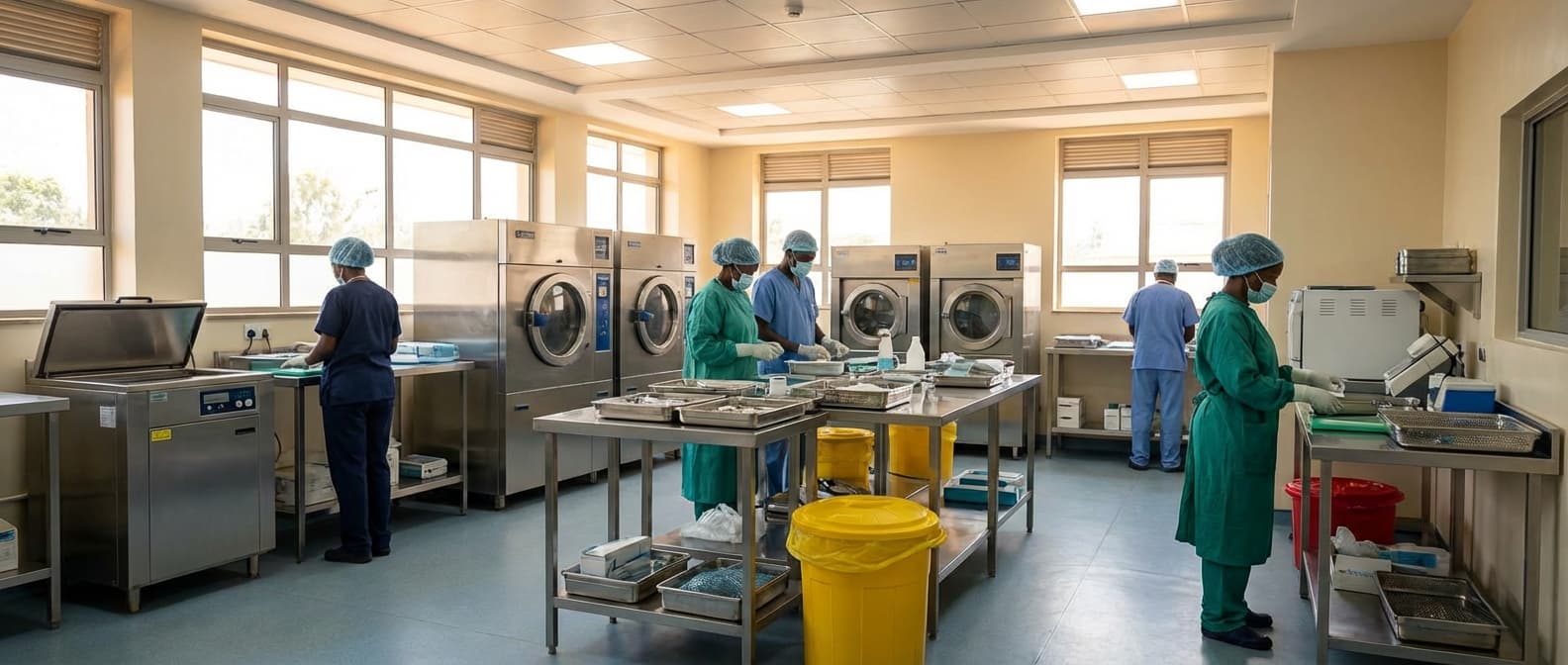
Medical Equipment Decontamination Service (Pre-Repair/Pre-Relocation) in South Africa
Engineering Excellence & Technical Support
Medical Equipment Decontamination Service (Pre-Repair/Pre-Relocation) High-standard technical execution following OEM protocols and local regulatory frameworks.
Enhanced Safety Protocols
Our pre-repair/pre-relocation decontamination service in South Africa adheres to strict international and local safety standards, employing validated multi-spectrum disinfection techniques and EPA-registered disinfectants. This minimizes bioburden and residual contamination on critical medical devices, safeguarding your staff, patients, and the integrity of the repair/relocation process.
Streamlined Turnaround Times
We understand the critical nature of medical equipment uptime. Our specialized decontamination process is designed for efficiency, ensuring devices are safely prepared for repair or relocation swiftly and effectively. This reduces downtime and supports uninterrupted patient care across South African healthcare facilities.
Traceable Decontamination Verification
Every decontamination service includes comprehensive verification reporting, utilizing advanced detection methods and batch-specific disinfectant lot tracking. This provides a traceable audit trail for compliance and peace of mind, confirming the successful reduction of pathogens and contaminants before your valuable medical equipment undergoes its next phase in South Africa.
What Is Medical Equipment Decontamination Service (Pre-repair/pre-relocation) In South Africa?
Medical Equipment Decontamination Service (Pre-Repair/Pre-Relocation) in South Africa refers to the process of rendering medical devices safe for handling by technical personnel prior to their repair or relocation. This service is crucial for mitigating the risk of pathogen transmission to maintenance technicians, hospital staff, and the wider healthcare environment. It involves a systematic approach to cleaning, disinfecting, and, where appropriate, sterilizing medical equipment that has been in contact with patients, bodily fluids, or potentially infectious materials. The objective is to reduce the bioburden to a level that poses no significant health risk during the subsequent phases of maintenance or transfer.
| Who Needs This Service | Typical Use Cases | |||
|---|---|---|---|---|
| Hospitals and Healthcare Facilities: All departments that utilize medical equipment, including operating rooms, intensive care units (ICUs), emergency departments, diagnostic imaging, laboratories, and patient wards. | Medical Device Manufacturers/Distributors: For equipment returned for warranty repair, refurbishment, or after initial setup prior to use. | Third-Party Biomedical Engineering Service Providers: When collecting equipment for off-site repair or maintenance. | Equipment Relocation Services: For facilities undergoing renovation, expansion, or closure. | Research and Development Laboratories: Handling of specialized biomedical research equipment. |
| Repair and Maintenance: Equipment requiring scheduled preventative maintenance or unscheduled repairs, particularly after direct patient contact. | Equipment Relocation: Moving medical devices between departments, facilities, or to new locations to prevent cross-contamination. | Equipment Commissioning: Decontamination of newly acquired equipment that may have been handled in various environments during transit or storage. | Loaner/Rental Equipment: Ensuring that equipment provided to facilities on a temporary basis is decontaminated before and after use. | End-of-Life Equipment Disposal/Recycling: Preparing equipment for safe handling and transport for disposal or recycling. |
Key Components of Medical Equipment Decontamination Service (Pre-Repair/Pre-Relocation)
- Initial Assessment and Risk Stratification: Evaluating the type of equipment, its intended use, and the potential level of contamination (e.g., presence of blood, bodily fluids, suspected biohazards).
- Cleaning: The physical removal of gross soil, debris, and organic matter using detergents and water. This is a prerequisite for effective disinfection.
- Disinfection: The application of chemical agents or physical methods (e.g., UV-C irradiation) to eliminate or inactivate pathogenic microorganisms on the surface of the equipment. The level of disinfection (low, intermediate, or high) is determined by the risk assessment.
- Sterilization (where applicable): For critical or semi-critical devices, a more rigorous process of eliminating all viable microorganisms, including bacterial spores, may be required. Common methods include autoclaving (steam sterilization) or ethylene oxide sterilization.
- Drying: Ensuring the equipment is thoroughly dried after cleaning and disinfection to prevent microbial regrowth and facilitate subsequent steps.
- Packaging and Labeling: Appropriately packaging decontaminated equipment to maintain its sterile or disinfected state and clearly labeling it to indicate that it has undergone decontamination and is safe for handling.
- Documentation: Maintaining meticulous records of the decontamination process, including the agents used, exposure times, parameters, and personnel involved, for traceability and regulatory compliance.
- Waste Management: Proper segregation and disposal of contaminated materials generated during the decontamination process according to established protocols and environmental regulations.
Who Needs Medical Equipment Decontamination Service (Pre-repair/pre-relocation) In South Africa?
In South Africa, the need for pre-repair and pre-relocation medical equipment decontamination services is crucial for ensuring the safety and efficiency of healthcare operations. This specialized service targets facilities and individuals that handle medical devices, particularly before they undergo maintenance, repair, or are moved to a new location. The primary goal is to eliminate or significantly reduce bioburden, chemical residues, and other contaminants that could pose a risk to technicians, patients, and the environment. This proactive approach minimizes the spread of infections, protects the integrity of the equipment during handling, and ensures compliance with stringent healthcare regulations.
| Department/Entity | Reason for Decontamination (Pre-Repair/Pre-Relocation) | Key Equipment Examples |
|---|---|---|
| Biomedical Engineering Department | Protecting technicians from biohazards, preventing equipment damage during repair. | Diagnostic imaging (X-ray, CT, MRI), patient monitors, surgical tools, ventilators. |
| Sterilization and Decontamination Units | Ensuring equipment is safe for handling and transport to repair facilities. | Autoclaves, instrument washers, sterile processing equipment. |
| Infection Prevention and Control (IPC) Department | Minimizing the risk of healthcare-associated infections (HAIs) during equipment movement. | All medical devices that have been in patient contact. |
| Facilities Management / Estates Department | Ensuring safe and compliant relocation of equipment and departments. | Large fixed medical equipment, mobile units, entire ward setups. |
| Procurement and Asset Management | Maintaining the condition and value of medical assets, ensuring compliance with disposal/transfer protocols. | All types of medical equipment undergoing lifecycle management. |
| IT/Information Technology (for networked medical devices) | Protecting sensitive data and network integrity during equipment servicing. | PACS workstations, EKG machines with network capabilities, EMR-integrated devices. |
Target Customers and Departments in South Africa for Medical Equipment Decontamination Service (Pre-Repair/Pre-Relocation)
- {"title":"Hospitals (Public and Private)","description":"Hospitals are the largest consumers of medical equipment, ranging from large imaging machines to small surgical instruments. Decontamination is essential before any repair work to protect biomedical engineers and technicians from potential biohazards. Relocation of departments or entire facilities necessitates thorough decontamination to prevent cross-contamination between old and new environments and to ensure equipment is safe for reintroduction into clinical use."}
- {"title":"Specialized Clinics and Surgical Centers","description":"These facilities, often focusing on specific procedures (e.g., dental, ophthalmology, cardiology), have highly specialized and sensitive equipment. Pre-repair decontamination is vital to prevent damage to delicate internal components from residual biological materials and to safeguard the health of repair personnel. Relocation requires similar decontamination protocols to maintain the sterile or clean environment essential for their operations."}
- {"title":"Diagnostic Laboratories and Pathology Services","description":"Laboratories handle a wide array of equipment used for testing biological samples. Before repair or relocation, instruments like centrifuges, incubators, and automated analyzers must be decontaminated to remove blood, tissue, or microbial residues, protecting both lab technicians and the equipment itself."}
- {"title":"Medical Equipment Manufacturers and Service Providers","description":"Companies that manufacture, distribute, or provide third-party repair services for medical equipment in South Africa rely heavily on decontamination. They receive equipment for repair from various healthcare settings and must ensure it is decontaminated before their technicians begin work. This protects their staff and prevents them from becoming conduits for disease transmission."}
- {"title":"Research and Development Institutions","description":"Institutions involved in medical research often use specialized equipment that may come into contact with potentially infectious agents or novel compounds. Decontamination before repair or relocation is critical to protect researchers and prevent contamination of research integrity."}
- {"title":"Ambulance Services and Emergency Medical Services (EMS)","description":"EMS vehicles are equipped with various life-saving devices (e.g., defibrillators, ventilators, suction units) that are frequently used in challenging environments. Before these devices are sent for repair or if an entire ambulance needs to be serviced/relocated, thorough decontamination is paramount to prevent the spread of pathogens encountered in the field."}
- {"title":"Veterinary Clinics and Animal Hospitals","description":"While the focus is often on human health, veterinary facilities also utilize medical equipment. Decontamination before repair or relocation is important to prevent the transmission of zoonotic diseases and to protect veterinary staff and equipment."}
- {"title":"Healthcare Equipment Leasing Companies","description":"Companies that lease medical equipment to various healthcare providers must ensure that returned equipment is decontaminated before being re-leased or moved. This protects the integrity of the equipment and ensures it meets hygiene standards for the next user."}
Medical Equipment Decontamination Service (Pre-repair/pre-relocation) Process In South Africa
This document outlines the standard workflow for a Medical Equipment Decontamination Service in South Africa, specifically for equipment requiring decontamination before repair or relocation. The process ensures that equipment is rendered safe for handling by technicians or during transport, mitigating risks of cross-contamination and infection transmission.
| Step | Description | Key Activities | Responsible Party | Deliverables |
|---|---|---|---|---|
| The client contacts the decontamination service provider to request services for their medical equipment. | Receive inquiry, gather initial details about equipment type, quantity, condition, and purpose (repair/relocation), assess urgency and potential hazards. | Client, Decontamination Service Provider | Initial understanding of service requirements, preliminary hazard assessment. |
| Based on the initial assessment, a formal quotation and service agreement are provided. | Prepare a detailed quotation outlining services, pricing, turnaround time, and any specific requirements. Draft a service agreement outlining terms and conditions, liability, and compliance with relevant South African regulations (e.g., health and safety, environmental). | Decontamination Service Provider, Client | Formal quotation, signed service agreement. |
| Once the agreement is in place, the decontamination and collection/delivery are scheduled. | Coordinate collection and/or delivery times with the client, plan efficient routes, ensure appropriate transportation (e.g., secure, contained vehicles), confirm personnel availability. | Decontamination Service Provider | Confirmed schedule, logistics plan. |
| The equipment is safely collected from the client's premises. | Inspect equipment upon collection for visible contamination, package equipment securely to prevent further contamination during transit, complete collection manifests and initial condition reports. | Decontamination Service Provider | Collected equipment, initial condition report, collection manifest. |
| The specialized decontamination procedures are performed. | Utilize approved disinfectants and sterilants appropriate for the equipment type and identified contaminants. Implement validated decontamination protocols. Employ safety measures for personnel and the environment. Conduct thorough cleaning and disinfection according to manufacturer guidelines and industry best practices. | Decontamination Service Provider | Decontaminated medical equipment. |
| Proof of successful decontamination is provided. | Issue a Certificate of Decontamination, detailing the equipment, date of service, methods used, and confirmation of decontamination. Maintain detailed records of the decontamination process for traceability and compliance. | Decontamination Service Provider | Certificate of Decontamination, decontamination process records. |
| The decontaminated equipment is returned to the client or handed over to the repair/relocation agent. | Coordinate with the client for safe handover, ensure equipment is packaged appropriately for its next stage, obtain signed delivery/handover confirmation. | Decontamination Service Provider, Client/Repair Agent | Returned/handed-over decontaminated equipment, signed delivery confirmation. |
| The final invoice is issued and payment is processed. | Submit a final invoice to the client based on the agreed-upon service agreement. Process payment according to the agreed terms. | Decontamination Service Provider, Client | Final invoice, payment confirmation. |
Medical Equipment Decontamination Service (Pre-Repair/Pre-Relocation) Workflow in South Africa
- Inquiry & Initial Assessment
- Quotation & Service Agreement
- Scheduling & Logistics
- Equipment Collection
- Decontamination Process
- Certification & Documentation
- Equipment Handover/Return
- Invoicing & Payment
Medical Equipment Decontamination Service (Pre-repair/pre-relocation) Cost In South Africa
The cost of medical equipment decontamination services in South Africa, particularly for pre-repair or pre-relocation purposes, is influenced by several key factors. These services are crucial for ensuring the safety of technicians and the environment, preventing cross-contamination, and complying with regulatory standards. The pricing can vary significantly based on the complexity of the equipment, the level of contamination, the urgency of the service, and the service provider's expertise and reputation. It's important for healthcare facilities to obtain detailed quotes from multiple accredited service providers to ensure competitive pricing and quality of service.
| Equipment Category | Estimated Cost Range (ZAR) | Notes |
|---|---|---|
| Small Diagnostic Equipment (e.g., BP monitors, thermometers) | R 500 - R 1,500 | Basic surface decontamination, standard disinfectants. |
| Medium Complexity Equipment (e.g., ECG machines, ultrasound probes) | R 1,000 - R 3,500 | May involve more targeted cleaning of specific components, potentially specialized solutions. |
| Large/Complex Equipment (e.g., Endoscopes, Dialysis Machines) | R 2,500 - R 8,000+ | Requires specialized knowledge, multi-step processes, potentially automated cleaning systems, and disposal of biohazardous waste. |
| High-Risk/Specialized Equipment (e.g., Anaesthesia machines, Ventilators) | R 3,000 - R 10,000+ | Critical components, strict protocols, biohazard considerations, and potential for complex internal cleaning. |
| Urgent/Emergency Call-Out | Additional 50% - 100% on base rate | Applies to services required outside of normal working hours or with immediate turnaround. |
Key Pricing Factors for Medical Equipment Decontamination in South Africa:
- Type and Complexity of Equipment: Larger, more intricate medical devices (e.g., MRI machines, CT scanners, complex surgical robots) require more time, specialized chemicals, and expertise for decontamination compared to smaller, simpler equipment (e.g., stethoscopes, blood pressure monitors).
- Level and Nature of Contamination: The extent and type of biological or chemical contaminants present will directly impact the decontamination process. Heavy contamination or the presence of hazardous pathogens will necessitate more rigorous and potentially costly procedures and personal protective equipment (PPE).
- Scope of Decontamination: Whether the decontamination is a surface clean, a deep clean of internal components, or a full sterilization process will affect the cost. Pre-repair decontamination often focuses on critical contact areas.
- Downtime and Urgency: Emergency decontamination services or those required outside standard business hours will typically incur higher charges due to overtime or expedited service fees.
- Service Provider's Expertise and Accreditation: Reputable decontamination companies with specialized training, certifications, and adherence to safety protocols often command higher prices due to their reliability and assurance of quality.
- Geographic Location: Service costs can vary regionally within South Africa due to differences in operational costs, travel expenses, and local market competition.
- Required Documentation and Certification: If specific certifications, detailed reports, or waste disposal manifests are required for regulatory compliance or record-keeping, these may add to the overall cost.
- Consumables and Disposables: The cost of specialized cleaning agents, disinfectants, sterilants, PPE, and disposal of contaminated waste are factored into the service price.
Affordable Medical Equipment Decontamination Service (Pre-repair/pre-relocation) Options
Our affordable medical equipment decontamination service offers pre-repair and pre-relocation cleaning solutions to ensure your equipment is safe and compliant. We understand the financial pressures healthcare facilities face, so we've developed flexible value bundles and cost-saving strategies to make essential decontamination accessible without compromising quality.
| Cost-Saving Strategy | Description | Benefit |
|---|---|---|
| Volume Discounts | Lower per-unit cost when decontaminating multiple pieces of equipment simultaneously. | Significant savings on larger decontamination projects. |
| Scheduled Service Agreements | Pre-book regular decontamination services for ongoing equipment maintenance and gain priority scheduling. | Predictable budgeting, reduced downtime, and potential for further price reductions. |
| Tiered Service Levels | Choose the decontamination level that matches the equipment's actual needs, avoiding overspending on unnecessary treatments. | Pay only for the decontamination service your equipment requires. |
| Bundled Repair & Decontamination | Combine decontamination services with your equipment repair appointments for added convenience and potential discounts. | Streamlined process and cost reduction by addressing both needs together. |
| Off-Peak Scheduling | Schedule decontamination during slower periods (e.g., weekends, evenings) for potential reduced rates. | Cost savings for facilities with flexible operational hours. |
| Equipment Tagging & Inventory | A streamlined process where equipment is clearly tagged and inventoried pre-decontamination, speeding up the workflow. | Faster turnaround times and more efficient resource allocation, leading to lower costs. |
Value Bundles Designed for Your Needs
- {"title":"Essential Decontamination Package","description":"Ideal for routine cleaning of non-critical equipment or before standard maintenance. Includes surface disinfection, visible dirt removal, and basic biohazard cleaning."}
- {"title":"Comprehensive Decontamination Package","description":"Recommended for equipment with higher exposure risks or before more complex repairs. Adds specialized cleaning for hard-to-reach areas, instrument disinfection, and initial sterilization assessment."}
- {"title":"High-Level Decontamination Package","description":"Our most thorough package, suitable for critical care equipment or before relocation of sensitive devices. Incorporates advanced sterilization techniques, deep cleaning of internal components (where accessible), and complete bioburden reduction."}
- {"title":"Customizable Bundle","description":"Don't see a perfect fit? We can tailor a package based on your specific equipment types, usage, and decontamination requirements. Contact us for a personalized quote."}
Verified Providers In South Africa
In South Africa's evolving healthcare landscape, identifying trustworthy and competent healthcare providers is paramount for individuals seeking quality medical services. Franance Health stands out as a beacon of reliability, meticulously vetting its network of providers to ensure they meet stringent standards of professionalism, expertise, and patient care. This rigorous credentialing process underscores Franance Health's commitment to delivering exceptional healthcare experiences.
| Credentialing Aspect | Franance Health's Verification | Benefit to Patients |
|---|---|---|
| Professional Licenses & Certifications | Thorough verification of all active and relevant medical licenses and board certifications. | Ensures providers are legally qualified and possess recognized expertise in their fields. |
| Educational Background | Confirmation of degrees, diplomas, and postgraduate training from accredited institutions. | Guarantees a strong foundation of medical knowledge and training. |
| Experience & Specialization | Assessment of clinical experience and specific areas of specialization. | Connects patients with providers best suited for their condition or required treatment. |
| Peer Review & Reputation | Consideration of peer references and professional standing within the medical community. | Provides an indicator of a provider's ongoing competence and ethical conduct. |
| Compliance & Ethics | Checks for any disciplinary actions or adherence to ethical medical practices. | Protects patients from substandard or unethical care. |
Why Franance Health Providers are the Best Choice:
- Uncompromising Quality Standards: Franance Health implements a multi-faceted verification process that goes beyond basic licensing. This includes in-depth background checks, verification of qualifications and specializations, and a review of practice history.
- Exceptional Clinical Expertise: All Franance Health-affiliated providers are recognized for their advanced clinical skills, continuous professional development, and commitment to evidence-based medical practices.
- Patient-Centric Approach: Beyond technical proficiency, Franance Health providers are selected for their dedication to compassionate care, effective communication, and a genuine focus on patient well-being and satisfaction.
- Comprehensive Network: Franance Health offers access to a diverse range of specialists and general practitioners across various medical disciplines, ensuring that patients can find the right care for their specific needs.
- Transparency and Trust: The credentialing process provides patients with the assurance that they are engaging with verified and reputable healthcare professionals, fostering a sense of trust and confidence in their medical journey.
Scope Of Work For Medical Equipment Decontamination Service (Pre-repair/pre-relocation)
This Scope of Work (SOW) outlines the requirements for pre-repair or pre-relocation decontamination services for medical equipment. The objective is to ensure that medical equipment is rendered safe to handle, transport, and service by removing biological and chemical contaminants, thus protecting personnel, the environment, and preventing cross-contamination. The service includes pre-cleaning, disinfection/sterilization (as applicable and specified), and documentation.
| Activity/Process | Description | Technical Deliverable | Standard Specification/Reference | Quality Assurance |
|---|---|---|---|---|
| Initial Assessment & Triage | Visual inspection of equipment for type of contamination (biohazard, chemical, radioactive - if applicable), degree of soiling, and accessibility for decontamination. | Decontamination assessment report, including equipment identification, estimated decontamination level required, and potential challenges. | Internal SOPs, Manufacturer's Instructions for Use (IFU) for cleaning, risk assessment matrix. | Checklist-based assessment, trained personnel sign-off. |
| Pre-cleaning (Gross Decontamination) | Removal of loose debris, blood, body fluids, and other visible contaminants using appropriate cleaning agents and tools. | Cleaned equipment surface, free from visible gross contamination. | Manufacturer's IFU for cleaning, OSHA Bloodborne Pathogens Standard (29 CFR 1910.1030) for biohazards, SDS for chemical contaminants. | Visual inspection, photographic documentation (if required), adherence to cleaning agent dilution and contact times. |
| Disinfection/Sterilization (Level to be specified based on equipment risk and intended downstream use) | Application of EPA-registered disinfectants or approved sterilization methods to achieve the required microbial reduction. | Validated level of disinfection (high-level, intermediate-level, low-level) or sterilization achieved. | EPA registration of disinfectants, FDA cleared sterilization devices, CDC Guidelines for Disinfection and Sterilization in Healthcare Facilities, manufacturer's validated protocols. | Use of calibrated dispensing systems, verification of contact times, temperature/humidity monitoring (for sterilization), bioburden testing (if required). |
| Rinsing & Drying | Thorough rinsing with appropriate water (e.g., potable, deionized) to remove residual cleaning/disinfection agents, followed by complete drying. | Equipment free of cleaning/disinfection agent residue, completely dry. | Manufacturer's IFU, water quality standards (e.g., AAMI standards for water used in processing medical devices). | Visual inspection, use of lint-free materials for drying. |
| Final Inspection & Verification | Comprehensive visual inspection to confirm cleanliness, absence of contamination, and integrity of the equipment. | Certified decontaminated equipment, prepped for repair/relocation. | Internal quality control checklists, client-specific acceptance criteria. | Independent QA review, multi-point inspection checklist sign-off. |
| Packaging & Labeling | Securely packaging the decontaminated equipment to prevent recontamination during transport and clearly labeling it with its decontamination status. | Sealed, appropriately labeled packaging (e.g., 'Decontaminated for Service/Relocation', date, technician initials). | Client's packaging requirements, regulatory requirements for transport of regulated materials (if applicable). | Verification of correct labeling, integrity of packaging. |
| Documentation & Certification | Providing a detailed report of all decontamination activities, including equipment details, processes used, agents/materials, personnel involved, date, and verification results. | Decontamination Certificate/Report, Chain of Custody documentation (if applicable). | Client's documentation requirements, regulatory standards (e.g., ISO 13485 principles). | Auditable records, management review of documentation quality. |
Key Service Components
- Pre-cleaning: Removal of gross debris, visible soil, and organic matter.
- Disinfection/Sterilization: Application of appropriate agents or methods to eliminate or significantly reduce microbial load.
- Decontamination Verification: Procedures to confirm the effectiveness of the decontamination process.
- Packaging and Labeling: Secure packaging of decontaminated equipment with appropriate labeling indicating its status.
- Documentation: Comprehensive record-keeping of all decontamination activities.
Service Level Agreement For Medical Equipment Decontamination Service (Pre-repair/pre-relocation)
This Service Level Agreement (SLA) outlines the response times and uptime guarantees for the Medical Equipment Decontamination Service, specifically for pre-repair and pre-relocation decontamination. This agreement ensures timely and effective decontamination to minimize downtime and maintain operational readiness of critical medical equipment.
| Service Level | Response Time (Business Hours) | Uptime Guarantee (Decontamination Completion) |
|---|---|---|
| Standard Decontamination (Non-Critical Equipment) | Within 24 business hours of notification | Completion within 48 business hours of equipment receipt at decontamination facility |
| Priority Decontamination (Critical Equipment - e.g., life-support, imaging) | Within 8 business hours of notification | Completion within 24 business hours of equipment receipt at decontamination facility |
| Emergency Decontamination (Urgent - e.g., outbreak, critical patient care interruption) | Within 4 business hours of notification (24/7 availability) | On-site decontamination or expedited processing within 12 business hours of equipment receipt at decontamination facility |
Scope of Service
- Decontamination of specified medical equipment prior to repair or relocation.
- Adherence to all relevant safety and infection control protocols.
- Provision of a decontamination certificate upon completion of service.
Frequently Asked Questions

Ready when you are
Let's scope your Medical Equipment Decontamination Service (Pre-Repair/Pre-Relocation) in South Africa project in South Africa.

Scaling healthcare logistics and technical systems across the entire continent.