
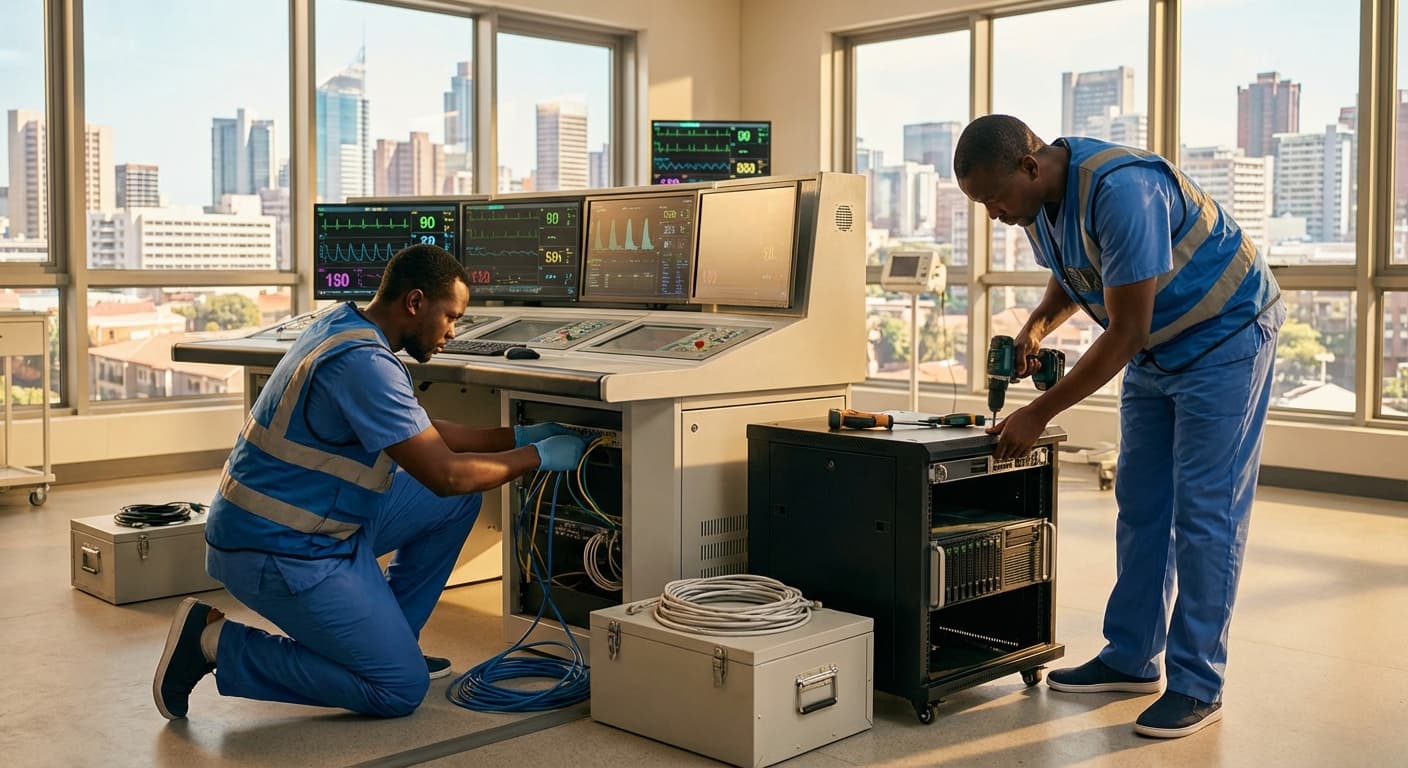
ICU Central Monitoring Station Installation Service in South Africa
Engineering Excellence & Technical Support
ICU Central Monitoring Station Installation Service High-standard technical execution following OEM protocols and local regulatory frameworks.
Robust Network Infrastructure
We design and implement secure, high-bandwidth networks for seamless real-time data transmission, ensuring uninterrupted patient monitoring even during peak loads. Our installations adhere to stringent cybersecurity protocols and South African healthcare regulations, guaranteeing data integrity and privacy.
Scalable Central Server Solutions
Our expert technicians deploy and configure powerful, scalable central server systems capable of handling vast amounts of patient data from multiple ICU beds. We ensure optimal performance, data redundancy, and easy integration with existing hospital IT infrastructure, future-proofing your monitoring capabilities.
Redundant Power & Data Backup
Critical care demands unwavering reliability. We install comprehensive redundant power supply systems and data backup solutions, including UPS and generator integration, to guarantee continuous operation of your ICU central monitoring station during power outages or system failures, safeguarding patient lives.
What Is Icu Central Monitoring Station Installation Service In South Africa?
ICU Central Monitoring Station Installation Service in South Africa refers to the comprehensive process of designing, procuring, installing, configuring, and commissioning a centralized facility equipped to monitor physiological parameters of multiple Intensive Care Unit (ICU) patients simultaneously. This service ensures that healthcare facilities in South Africa can establish or upgrade their critical care infrastructure by integrating advanced patient monitoring technology. The core objective is to provide clinicians with real-time, aggregated, and often analyzed data from various bedside monitors, facilitating prompt decision-making, improved patient outcomes, and enhanced workflow efficiency within the ICU environment. It encompasses the physical setup of the monitoring station, the integration of networked patient monitors, the establishment of secure data transmission protocols, and the implementation of alerting systems.
| Stakeholder/Entity | Necessity for ICU Central Monitoring Station Installation | Typical Use Cases |
|---|---|---|
| Hospitals (Public & Private): | Essential for modern critical care. Enables continuous oversight of high-acuity patients, reducing workload on individual nurses and improving response times to critical events. | Real-time visualization of all ICU patient vital signs, EKG waveforms, and ventilator data. Centralized alarm management. Facilitation of rapid response teams. Post-event data review and analysis for quality improvement. |
| Specialized ICU Units (e.g., Cardiac, Neurological, Surgical): | Tailored monitoring capabilities to specific patient populations and their unique physiological parameters. Enhances specialized care delivery. | Monitoring complex hemodynamic profiles in cardiac ICUs. Advanced neurological monitoring (e.g., ICP) in neuro ICUs. Integration of specialized surgical monitoring devices. |
| Healthcare Administrators & Procurement Departments: | Strategic investment in technology to enhance patient safety, optimize resource allocation, and improve clinical outcomes, thereby reducing length of stay and associated costs. | Justification for capital expenditure based on improved patient safety metrics. Contract negotiation for maintenance and upgrade services. Planning for future expansion and technological integration. |
| IT Departments: | Requires robust and secure network infrastructure, data integration capabilities, and compliance with healthcare data privacy regulations (e.g., POPIA). | Ensuring network bandwidth and security. Interfacing with existing Hospital Information Systems (HIS) and Electronic Health Records (EHR). Data backup and disaster recovery planning. |
| Biomedical Engineering Departments: | Responsible for the ongoing maintenance, calibration, and troubleshooting of the integrated monitoring equipment. | Installation and integration of new medical devices. Routine maintenance and performance verification. Technical support for hardware-related issues. |
| Clinical Staff (Doctors & Nurses): | Directly benefits from an organized, comprehensive view of patient status, leading to more efficient and effective patient management. | Continuous patient surveillance without constant bedside presence. Early detection of subtle physiological changes. Improved communication and handover of patient information. Enhanced ability to manage multiple critical patients concurrently. |
Key Components of ICU Central Monitoring Station Installation Service:
- Site Survey and Needs Assessment: Evaluating existing infrastructure, patient load, and specific clinical requirements to determine the optimal configuration and scale of the central monitoring station.
- System Design and Planning: Developing a detailed architectural plan including network topology, hardware placement, power requirements, and data flow management.
- Hardware Procurement and Installation: Sourcing and physically installing central monitoring workstations, servers, network switches, UPS systems, and necessary cabling.
- Patient Monitor Integration: Connecting and configuring bedside ICU monitors (e.g., vital signs monitors, ventilators, ECG machines) to the central monitoring network, ensuring seamless data acquisition.
- Network Infrastructure Setup: Establishing a robust, secure, and reliable local area network (LAN) specifically for the ICU monitoring system, adhering to IT and cybersecurity best practices.
- Software Installation and Configuration: Deploying and configuring the central monitoring software platform, including patient demographic integration, alarm management, data storage, and reporting functionalities.
- Data Management and Storage Solutions: Implementing secure and compliant data storage solutions for patient data, ensuring accessibility for clinical review and historical analysis.
- Alarm System Implementation: Configuring customizable alarm parameters and notification mechanisms to alert clinicians to critical physiological changes, both audibly and visually.
- System Testing and Validation: Conducting rigorous testing of all integrated components and functionalities to ensure accuracy, reliability, and performance under simulated clinical scenarios.
- User Training and Support: Providing comprehensive training to clinical staff on the operation and utilization of the central monitoring system, along with ongoing technical support and maintenance agreements.
Who Needs Icu Central Monitoring Station Installation Service In South Africa?
The installation of an ICU Central Monitoring Station (CMS) is a critical infrastructure upgrade for healthcare facilities aiming to enhance patient care, streamline workflow, and improve overall patient outcomes. This sophisticated system allows for the continuous, real-time monitoring of multiple critically ill patients from a centralized location, enabling rapid response to deteriorating conditions. This service is vital for hospitals that prioritize advanced patient management and wish to leverage technology to improve the efficiency and effectiveness of their Intensive Care Units.
| Target Customer Segment | Specific Departments/Units | Key Needs Addressed by CMS Installation |
|---|---|---|
| Public Hospitals | Intensive Care Units (ICU), High Care Units (HCU), Surgical ICUs, Medical ICUs | Improving capacity for critical care, standardization of monitoring protocols, enhanced patient safety, efficient resource utilization. |
| Private Hospitals & Healthcare Groups | All ICUs, specialized ICUs (e.g., Cardiac, Neurological, Neonatal), Post-Anesthesia Care Units (PACU) | Maintaining competitive edge through advanced technology, optimizing patient outcomes, improving staff efficiency, meeting international standards of care. |
| Tertiary & Academic Hospitals | Comprehensive ICUs, research-focused ICUs, teaching ICUs | Facilitating complex patient management, supporting research and data collection, providing a comprehensive learning environment for medical professionals, enabling multi-disciplinary team collaboration. |
| Specialized Medical Centers (e.g., Oncology, Cardiology) | Dedicated ICUs within these specialized centers | Ensuring continuous and specialized monitoring for high-risk patient populations, integrating with existing diagnostic and treatment equipment, providing early detection of complications. |
| Government & Provincial Health Departments (for public facilities) | Hospitals under their purview, particularly those requiring significant infrastructure upgrades | Improving the standard of critical care across the public health sector, ensuring equitable access to advanced monitoring, enhancing capacity to manage public health emergencies. |
| Military Hospitals | Combat Support Hospitals, General ICUs | Ensuring rapid and reliable monitoring in diverse and potentially challenging environments, facilitating efficient management of mass casualty incidents, maintaining operational readiness. |
Who Needs ICU Central Monitoring Station Installation Service in South Africa? Target Customers and Departments
- Hospitals seeking to upgrade their existing ICU infrastructure.
- New hospital construction projects requiring state-of-the-art patient monitoring.
- Facilities aiming to centralize patient data and alarm management.
- Healthcare providers focused on improving patient safety and reducing response times to critical events.
- Hospitals looking to optimize staff allocation and reduce the burden on individual bedside nurses.
- Trauma centers and emergency departments with high patient turnover and complex monitoring needs.
Icu Central Monitoring Station Installation Service Process In South Africa
The installation of an ICU Central Monitoring Station (CMS) in South Africa is a complex process involving multiple stages to ensure seamless integration and optimal functionality. This service typically begins with an initial inquiry and culminates in a fully operational system with ongoing support.
| Phase | Key Activities | Deliverables | Estimated Duration (South Africa Context) |
|---|---|---|---|
| Initial contact, needs analysis, system overview, proposal discussion. | Needs assessment report, preliminary proposal. | 1-2 Weeks |
| On-site survey, infrastructure review, detailed planning, risk assessment. | Site assessment report, detailed project plan, network diagrams. | 1-3 Weeks |
| Hardware/software selection, network architecture, user interface customization. | System design document, software configuration specifications. | 2-4 Weeks |
| Ordering, shipping, customs clearance, delivery to site. | Procurement confirmations, shipping manifests, received equipment. | 4-12 Weeks (depending on lead times and local availability) |
| Hardware setup, network cabling, device connectivity, software installation. | Installed hardware, connected devices, functional software baseline. | 2-6 Weeks |
| User profiles, alarm settings, data storage, device calibration. | Configured system, calibrated medical devices. | 1-3 Weeks |
| Functional tests, performance tests, security tests, user acceptance testing (UAT). | Test reports, validation certificates, UAT sign-off. | 1-2 Weeks |
| On-site or remote training sessions, user manuals, Q&A. | Trained staff, training materials, competency assessments. | 1-2 Weeks |
| Final system checks, transition to live operation, initial monitoring. | Live CMS, commissioning report, initial operational support. | 1-3 Days |
| Helpdesk, remote support, on-site visits, software updates, preventative maintenance. | Service level agreement (SLA), maintenance logs, ongoing support. | Ongoing (as per contract) |
ICU Central Monitoring Station Installation Service Process in South Africa
- Inquiry & Consultation: The process starts when a healthcare facility expresses interest in an ICU CMS. This involves an initial consultation to understand their specific needs, existing infrastructure, and desired outcomes.
- Site Assessment & Planning: A detailed site assessment is conducted by the service provider. This includes evaluating the physical space, network infrastructure, power availability, and existing medical equipment. Based on this assessment, a comprehensive project plan is developed.
- System Design & Configuration: The CMS is designed and configured to meet the facility's unique requirements. This involves selecting appropriate hardware (servers, workstations, displays), software, and network components, as well as defining patient monitoring parameters and alarm settings.
- Procurement & Logistics: All necessary equipment and software are procured from suppliers. The service provider manages the logistics of delivery to the installation site in South Africa, ensuring timely arrival and proper handling.
- Installation & Integration: Skilled technicians install the hardware and software components. This includes setting up servers, workstations, network cabling, and integrating the CMS with existing medical devices (e.g., ventilators, ECG monitors, pulse oximeters).
- Configuration & Calibration: The CMS is configured according to the pre-defined specifications. This involves setting up user accounts, access levels, data storage, and patient profiles. Calibration of connected medical devices is also performed to ensure accurate data acquisition.
- Testing & Validation: Rigorous testing is conducted to validate the functionality and performance of the CMS. This includes simulating patient scenarios, testing alarm systems, and verifying data integrity and transmission.
- User Training: Comprehensive training is provided to the clinical staff (doctors, nurses) on how to effectively use the CMS, interpret data, manage alarms, and troubleshoot common issues.
- Go-Live & Commissioning: Once all testing and training are successfully completed, the CMS is officially commissioned and goes live. The service provider offers on-site support during the initial operational period.
- Post-Installation Support & Maintenance: Ongoing support and maintenance services are provided, including software updates, hardware servicing, technical assistance, and system optimization to ensure continued optimal performance.
Icu Central Monitoring Station Installation Service Cost In South Africa
Installing an ICU Central Monitoring Station (CMS) in South Africa is a significant investment involving specialized medical equipment, integration with existing hospital infrastructure, and the expertise of trained professionals. The cost can vary widely based on several factors, making it crucial for healthcare facilities to obtain detailed quotes tailored to their specific needs. This service typically encompasses the supply and installation of the central monitoring unit, network infrastructure, display systems, patient monitoring devices (where not already present), and the necessary software for data acquisition, display, and analysis.
| Cost Component | Estimated Range (ZAR) | Notes |
|---|---|---|
| Basic System (Small ICU, Limited Features) | R 200,000 - R 750,000 | Covers essential central monitoring hardware, basic software, and installation for a few beds. May require significant existing infrastructure. |
| Mid-Range System (Medium ICU, Standard Features) | R 750,000 - R 2,500,000 | Includes more advanced central monitoring, integration capabilities, comprehensive software for a moderate number of beds, and standard installation services. |
| High-End System (Large ICU, Advanced Features, Full Integration) | R 2,500,000 - R 10,000,000+ | Encompasses top-tier central monitoring solutions, extensive integration with EMR/EHR, advanced analytics, multiple display stations, comprehensive training, and full project management for a large number of beds. |
| Network Infrastructure Upgrades | R 50,000 - R 500,000+ | Highly variable depending on the extent of required upgrades to cabling, switches, and network security. |
| Integration with New Patient Monitors (per bed) | R 20,000 - R 100,000+ | Cost depends on the type and brand of monitor, including sensor and module costs. |
| Training (per session/group) | R 10,000 - R 50,000+ | Depends on the duration, complexity, and number of staff trained. |
| Annual Support & Maintenance Contract | 5% - 15% of initial system cost per year | Covers software updates, technical support, and often hardware repairs/replacements. |
Key Pricing Factors for ICU Central Monitoring Station Installation in South Africa:
- {"title":"Scale and Scope of the ICU:","description":"The number of ICU beds that will be integrated with the CMS is a primary cost driver. A larger ICU requiring monitoring for more patients will necessitate more sophisticated hardware, software licenses, and network capacity, thus increasing the overall price."}
- {"title":"Type and Brand of Central Monitoring System:","description":"Different manufacturers offer varying levels of technology, features, and reliability. High-end, feature-rich systems from reputable international brands will generally be more expensive than more basic or locally sourced solutions. This includes the central console, server hardware, and software."}
- {"title":"Integration with Existing Patient Monitors:","description":"If the hospital already has compatible patient monitors, the cost might be reduced as only the central station and network integration are needed. However, if new monitors are required, or if existing monitors need upgrades or specific interface modules, this will add to the expense. Compatibility is a critical consideration."}
- {"title":"Network Infrastructure Requirements:","description":"A robust and secure network is essential for reliable data transmission. Costs can increase if the hospital's existing network needs significant upgrades, including cabling, switches, routers, and potential Wi-Fi infrastructure for wireless monitoring components."}
- {"title":"Software Features and Licensing:","description":"Advanced software features like EMR/EHR integration, advanced trend analysis, predictive alarming, remote access capabilities, and data archiving all come at a cost. The licensing model (perpetual, subscription-based) also influences the total price."}
- {"title":"Installation and Commissioning Services:","description":"This includes the physical installation of all hardware, network configuration, software setup, system testing, calibration, and final commissioning by certified technicians. The complexity of the installation, travel distances for technicians, and the duration of the project will impact these costs."}
- {"title":"Training:","description":"Comprehensive training for clinical staff (nurses, doctors) and IT support personnel on operating and maintaining the CMS is often included or offered as an additional service. The extent and duration of training will affect the overall cost."}
- {"title":"Support and Maintenance Contracts:","description":"Post-installation support, including technical assistance, software updates, and hardware maintenance, is usually provided through annual service contracts. The level of support and warranty period will influence ongoing costs."}
- {"title":"Ancillary Equipment:","description":"This could include large display screens for the central station, workstations, UPS (Uninterruptible Power Supply) systems for reliable power, and specialized cabling."}
- {"title":"Location and Accessibility:","description":"Installation in remote areas of South Africa might incur higher travel and logistical costs for the installation team and equipment."}
Affordable Icu Central Monitoring Station Installation Service Options
Installing an Intensive Care Unit (ICU) central monitoring station is a critical investment for any healthcare facility. This technology allows for real-time, consolidated oversight of patient vital signs, enabling faster response to critical events, improved patient outcomes, and optimized staff efficiency. This document outlines affordable installation service options, emphasizing value bundles and cost-saving strategies to help facilities make informed decisions.
| Installation Service Option | Description | Typical Value Proposition | Cost Considerations | Cost-Saving Strategies | |
|---|---|---|---|---|---|
| Basic Installation Package | Includes essential hardware setup, network configuration, and initial system testing. | Cost-effective for facilities with existing IT infrastructure and in-house technical expertise. | Lower upfront cost; potential for additional charges for unforeseen complexities. | Leverage existing IT staff for network integration; consider phased implementation. | Negotiate bulk discounts on hardware with package deals. |
| Standard Installation Package | Includes basic installation plus system training for clinical staff, basic user manuals, and initial troubleshooting support. | Balances cost with essential training and support for immediate operational readiness. | Moderate upfront cost; training quality can vary. | Prioritize hands-on training for key personnel; explore online training resources. | Bundle installation with ongoing maintenance contracts for discounts. |
| Comprehensive Value Bundle | Includes standard installation, in-depth staff training, customized workflow integration, system optimization, and extended post-installation support (e.g., 90-day premium support). | Maximizes return on investment through seamless integration and optimized performance, reducing long-term operational issues. | Higher upfront cost, but potential for significant long-term savings through efficiency gains and reduced downtime. | Phased rollout of advanced features; negotiate value-added services like workflow consultation. | Look for packages that include remote monitoring and predictive maintenance services to proactively address issues. |
| Customized Installation Service | Tailored to specific hospital needs, including integration with existing EMR systems, advanced data analytics setup, and specialized hardware configurations. | Addresses unique clinical workflows and technical environments for optimal performance and user adoption. | Variable cost based on complexity and specific requirements; may involve significant integration effort. | Clearly define scope of work to avoid scope creep; consider open-source integration options where feasible. | Collaborate with vendors on long-term partnerships that might offer preferential pricing on future upgrades or services. |
Key Benefits of an ICU Central Monitoring Station
- Enhanced Patient Safety: Continuous, real-time monitoring of vital signs allows for immediate detection of patient deterioration.
- Improved Staff Efficiency: Reduces the need for constant physical checks, freeing up nurses and physicians for higher-level care.
- Data-Driven Decision Making: Centralized data facilitates trend analysis and evidence-based clinical decisions.
- Reduced Medical Errors: Early intervention based on monitoring alerts can prevent adverse events.
- Optimized Resource Allocation: Better situational awareness can lead to more efficient deployment of staff and equipment.
Verified Providers In South Africa
When seeking healthcare services in South Africa, identifying verified providers is paramount for ensuring quality care and patient safety. Franance Health stands out as a leader in this regard, offering a robust network of accredited and credentialed healthcare professionals and facilities. Their rigorous vetting process and commitment to upholding the highest industry standards make them the premier choice for individuals and organizations looking for reliable healthcare solutions.
| Franance Health Verification Aspect | What it Entails | Benefit to Patients |
|---|---|---|
| Professional Licenses & Certifications | Verification of active and valid medical licenses and relevant professional certifications. | Ensures providers are legally qualified and possess the necessary expertise. |
| Educational Background & Training | Confirmation of academic qualifications and specialized training from accredited institutions. | Guarantees a strong foundation of medical knowledge and skills. |
| Clinical Experience | Assessment of practical experience in relevant medical fields and practice settings. | Indicates a proven track record of delivering effective patient care. |
| Reputation & Peer Review | Consideration of professional reputation and feedback from peers where applicable. | Highlights providers known for ethical conduct and high-quality practice. |
| Adherence to Ethical Standards | Confirmation of commitment to medical ethics and professional conduct guidelines. | Promotes patient trust and ensures respectful, professional interactions. |
Why Franance Health Credentials Matter:
- Unwavering Commitment to Quality: Franance Health's credentialing process goes beyond basic registration. It involves a deep dive into the qualifications, experience, and ethical standing of each provider, ensuring they meet stringent benchmarks for clinical excellence and patient care.
- Patient Safety First: By thoroughly verifying every provider, Franance Health significantly mitigates risks. This includes background checks, verification of licenses and certifications, and assessments of past performance, all contributing to a safer healthcare experience for patients.
- Access to Top-Tier Professionals: Their network comprises highly skilled and reputable doctors, specialists, nurses, and allied health professionals. Franance Health actively seeks out providers who demonstrate a commitment to continuous professional development and are at the forefront of medical advancements.
- Streamlined and Transparent Processes: Franance Health simplifies the process of finding verified providers, offering a clear and transparent platform. Patients can have confidence knowing that the providers listed have undergone a thorough and trustworthy verification procedure.
- Comprehensive Coverage and Network: Whether you require general medical services, specialized treatments, or hospital care, Franance Health's extensive network ensures access to a wide range of verified providers across South Africa, catering to diverse healthcare needs.
- Enhanced Trust and Peace of Mind: Partnering with Franance Health provides an invaluable layer of trust. Knowing that your healthcare provider has been meticulously vetted and meets the highest standards offers significant peace of mind during potentially stressful health situations.
Scope Of Work For Icu Central Monitoring Station Installation Service
This Scope of Work (SOW) outlines the requirements for the installation of an ICU Central Monitoring Station (CMS) service. The project encompasses all necessary tasks from site preparation to system commissioning, ensuring a fully functional and integrated ICU CMS. This document details the technical deliverables, standard specifications, and key activities involved in the successful implementation of the CMS.
| Technical Deliverable | Description | Standard Specifications / Requirements |
|---|---|---|
| Site Survey Report | Detailed assessment of the ICU environment, including existing infrastructure, power availability, network connectivity, and physical space constraints. | Report to include floor plans, site photographs, power outlet audit, network port availability, and any identified environmental challenges. To be submitted within 7 days of site visit. |
| System Design and Architecture Document | Comprehensive plan outlining the CMS architecture, network topology, hardware placement, data flow, and integration points with existing hospital systems (e.g., HIS, EMR). | Document to adhere to hospital IT policies and industry best practices for healthcare IT. Includes network diagrams, IP addressing schemes, and security protocols. Approved by Client IT and Clinical Engineering departments. |
| Installed CMS Hardware | All physical components of the CMS, including servers, workstations, displays, network switches, and any associated peripherals, physically installed and connected. | All hardware to be new, from reputable manufacturers, and meet specified performance criteria (e.g., server processing power, monitor resolution). Installation to comply with electrical and safety codes. |
| Configured CMS Software | The CMS software suite installed, configured, and operational. This includes patient data management, alarm management, data visualization, and reporting modules. | Software version to be the latest stable release from the vendor. Configuration to align with ICU clinical workflows and hospital protocols. All user roles and permissions to be defined. |
| Integrated Bedside Monitors | All ICU bedside monitors within the designated area to be successfully connected to the CMS and transmitting vital signs data. | Monitors to be compatible with the CMS, and data transmission to be real-time and accurate. Integration to be tested for all specified vital sign parameters (e.g., ECG, SpO2, NIBP, respiration, temperature). All bedside units to be identified and documented. |
| Network Infrastructure | All necessary network cabling, switches, and wireless access points (if applicable) installed and configured to support the CMS data transmission. | Network infrastructure to provide reliable, high-bandwidth, and secure connectivity. All cabling to be clearly labeled. Network segregation for medical devices to be implemented as per hospital policy. Minimum bandwidth requirements to be met. |
| Power Distribution | Adequate and reliable power supply to all CMS components, including UPS backup for critical systems. | All outlets to be surge-protected. UPS capacity to be sufficient for at least 30 minutes of operation during power outages. Compliance with hospital electrical safety standards. |
| System Test Reports | Comprehensive documentation of all testing performed on the CMS, including functional tests, performance tests, integration tests, and alarm testing. | Test scripts and results to be detailed and signed off by both the installation team and client representatives. All identified issues and their resolutions to be documented. Uptime and data integrity tests to be performed. |
| User Training Materials and Sessions | Training provided to end-users (nurses, physicians, IT staff) on the operation, maintenance, and troubleshooting of the CMS. Includes user manuals and training sessions. | Materials to be in clear, concise language and relevant to user roles. Training sessions to be hands-on and interactive. Post-training competency assessments may be required. |
| Commissioning Report and Handover Documentation | Formal documentation confirming the successful installation and functionality of the CMS, including all relevant manuals, warranty information, and maintenance schedules. | Report to include final system configuration, a list of all installed components, contact information for support, and a sign-off from the client. All original vendor documentation to be provided. |
| Post-Installation Support Plan | Outline of the support services to be provided by the installation vendor following system handover, including warranty period and escalation procedures. | Support to cover hardware and software issues. Response times and availability to be clearly defined. Remote and on-site support options to be included. |
Key Activities
- Site Survey and Assessment
- System Design and Planning
- Hardware Procurement and Delivery
- Infrastructure Preparation (Cabling, Power, Network)
- CMS Server and Workstation Installation
- Bedside Monitor Integration and Configuration
- Network Configuration and Security Setup
- Software Installation and Configuration
- System Testing and Calibration
- User Training
- Commissioning and Handover
- Post-Installation Support and Documentation
Service Level Agreement For Icu Central Monitoring Station Installation Service
This Service Level Agreement (SLA) outlines the response times and uptime guarantees for the installation service of the ICU Central Monitoring Station. This SLA is integral to the overall service contract and defines the performance expectations for the installation provider.
| Service Component | Response Time Target (Business Hours) | Resolution Time Target (Business Hours) | Uptime Guarantee |
|---|---|---|---|
| Critical System Failure (e.g., complete station outage) | 1 Hour | 4 Business Hours | 99.9% (Excluding Scheduled Maintenance) |
| Major Functionality Issue (e.g., inability to monitor specific parameters) | 2 Business Hours | 8 Business Hours | 99.9% (Excluding Scheduled Maintenance) |
| Minor Functionality Issue (e.g., display glitch, minor configuration problem) | 4 Business Hours | 24 Business Hours | 99.9% (Excluding Scheduled Maintenance) |
| Request for Basic User Training (post-installation) | 1 Business Day | 3 Business Days | N/A (Service related, not uptime) |
| Scheduled Maintenance (Notification required 7 days in advance) | N/A | N/A | N/A |
Scope of Service
- Installation of new ICU Central Monitoring Station hardware.
- Configuration and integration of the monitoring station with existing hospital IT infrastructure.
- Initial system testing and validation.
- Basic user training for nursing and technical staff on the operation of the monitoring station.
- Post-installation support for a defined warranty period.
Frequently Asked Questions

Ready when you are
Let's scope your ICU Central Monitoring Station Installation Service in South Africa project in South Africa.

Scaling healthcare logistics and technical systems across the entire continent.