
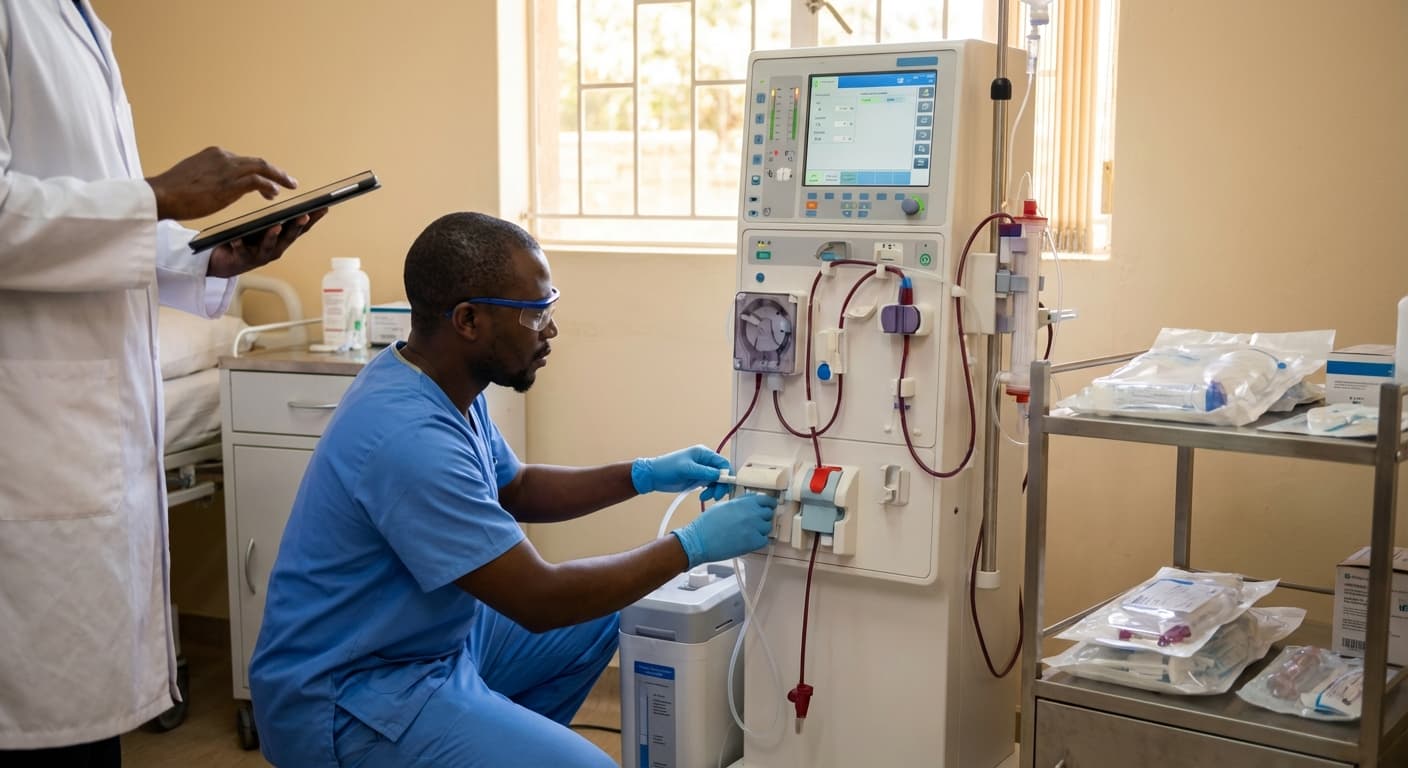
Hemodialysis Machine Installation Service in South Africa
Engineering Excellence & Technical Support
Hemodialysis Machine Installation Service High-standard technical execution following OEM protocols and local regulatory frameworks.
Certified Biomedical Engineers
Our installation team consists of highly trained and certified biomedical engineers with extensive experience in hemodialysis machine setup and calibration, ensuring adherence to the highest industry standards and patient safety protocols.
On-Site Diagnostic & Integration
We provide comprehensive on-site diagnostic services and seamless integration with existing hospital infrastructure, including water purification systems and power supply, guaranteeing optimal machine performance and minimal disruption.
Compliance & Quality Assurance
Our service prioritizes strict adherence to all South African regulatory requirements and manufacturer specifications, backed by rigorous quality assurance checks and comprehensive documentation for full compliance and peace of mind.
What Is Hemodialysis Machine Installation Service In South Africa?
Hemodialysis Machine Installation Service in South Africa refers to the professional process of setting up and configuring hemodialysis machines within healthcare facilities. This service encompasses a comprehensive suite of technical procedures designed to ensure the safe, efficient, and compliant operation of these critical medical devices. The installation process is typically managed by certified biomedical engineers or specialized technicians with expertise in hemodialysis technology and relevant healthcare regulations. It is essential for establishing or expanding renal replacement therapy services, ensuring that patients with end-stage renal disease (ESRD) can receive life-sustaining dialysis treatments.
| Who Needs Hemodialysis Machine Installation Service? | Typical Use Cases | ||||
|---|---|---|---|---|---|
| Hospitals (public and private) establishing or expanding nephrology departments and dialysis units. | Renal dialysis centers and standalone dialysis clinics. | Medical equipment suppliers and distributors requiring installation for their clients. | Healthcare facilities undergoing renovations or relocating dialysis units. | Government health initiatives aiming to increase access to dialysis services in underserved areas. | |
| Setting up a new dialysis unit from inception. | Replacing end-of-life or outdated hemodialysis machines. | Relocating existing dialysis machines to a new facility or within the same facility. | Adding new hemodialysis machines to an existing unit to increase patient capacity. | Commissioning of newly acquired hemodialysis equipment for clinical use. | Ensuring continued compliance with evolving healthcare standards and manufacturer recommendations. |
Key Components of Hemodialysis Machine Installation Service:
- Site Assessment and Planning: Evaluating the proposed location for the dialysis unit, considering space requirements, utility access (water, electricity, drainage), and infection control protocols.
- Machine Unpacking and Inspection: Carefully unpacking new or relocated hemodialysis machines and conducting a thorough visual and functional inspection to identify any transit damage or pre-existing defects.
- Electrical and Plumbing Connections: Connecting the hemodialysis machine to the designated power supply, ensuring proper grounding, and establishing connections to the medical water system (reverse osmosis - RO - units) and waste drainage.
- Medical Water System Integration: Installing and integrating the RO unit and associated plumbing with the hemodialysis machines, ensuring compliance with stringent water quality standards for dialysis.
- Calibration and Configuration: Performing precise calibration of all machine parameters, including blood flow rates, dialysate flow, temperature, conductivity, and pressure settings, according to manufacturer specifications and clinical protocols.
- System Testing and Validation: Conducting comprehensive diagnostic tests to verify the functionality of all machine components, safety features, and alarm systems. This includes simulated dialysis runs.
- User Training and Handover: Providing initial training to clinical staff (nurses, technicians) on the operation, basic maintenance, and troubleshooting of the installed hemodialysis machines.
- Documentation and Certification: Completing all necessary installation documentation, service reports, and providing certifications to confirm that the installation meets regulatory and manufacturer requirements.
- Regulatory Compliance Verification: Ensuring that the installation adheres to South African healthcare regulations, including those pertaining to medical device safety and efficacy.
- Post-Installation Support and Maintenance Planning: Establishing a schedule for ongoing preventive maintenance and providing information on available technical support and service contracts.
Who Needs Hemodialysis Machine Installation Service In South Africa?
Hemodialysis machine installation services are crucial for a range of healthcare providers and institutions across South Africa. Ensuring these complex machines are set up correctly, calibrated, and integrated with existing infrastructure is paramount for patient safety, treatment efficacy, and operational efficiency. This service is not a one-time need but often involves initial setup, relocation, upgrades, and ongoing maintenance support.
| Customer Type | Key Departments Involved | Specific Needs Addressed |
|---|---|---|
| Hospitals (Public & Private) | Nephrology Department, Intensive Care Unit (ICU), Renal Unit, Biomedical Engineering Department, Facilities Management | New unit setup, expansion of existing services, replacement of old equipment, relocation of machines, integration with water purification systems. |
| Dialysis Clinics/Centers | Clinical Operations, Technical Support, Administration, Facilities Management | Initial establishment of the clinic, increasing patient capacity, upgrading to newer models, ensuring compliance with regulations. |
| Government & Provincial Health Departments | Procurement Departments, Public Health Infrastructure Units, Hospital Management | Equipping new public hospitals, upgrading outdated facilities, ensuring equitable access to dialysis services across provinces. |
| Military Hospitals/Clinics | Medical Services Command, Biomedical Engineering, Logistics | Maintaining operational readiness of dialysis units for service members, emergency preparedness. |
| Research Institutions/Universities | Research Departments, Medical Faculties, Clinical Trial Units, Biomedical Engineering | Setting up specialized dialysis equipment for research protocols, ensuring accurate calibration for experimental accuracy, training facilities. |
Target Customers and Departments Requiring Hemodialysis Machine Installation Service in South Africa
- Hospitals (Public and Private): The primary consumers, requiring installation in their nephrology units, intensive care units, and general wards for dialysis patients.
- Dialysis Clinics/Centers: Standalone facilities dedicated to providing hemodialysis treatment, needing installations for their operational capacity.
- Government and Provincial Health Departments: Responsible for equipping public hospitals and health facilities, often procuring and overseeing installations.
- Military Hospitals and Clinics: Serving defense personnel and their families, requiring functional dialysis units.
- Large Corporate Healthcare Providers: Companies with extensive networks of hospitals and clinics that offer specialized medical services.
- Research Institutions and Universities: For training, research, and clinical trials involving hemodialysis.
- Non-Governmental Organizations (NGOs) and Charities: Operating healthcare initiatives, particularly in underserved communities, may require dialysis facilities.
- Remote and Rural Health Facilities: In areas where specialized care is limited, setting up or upgrading dialysis services is vital.
Hemodialysis Machine Installation Service Process In South Africa
This document outlines the typical workflow for Hemodialysis Machine Installation Services in South Africa, covering the process from initial client inquiry to the successful execution and handover of the installed machine. The aim is to provide a clear and structured understanding of the steps involved, ensuring a smooth and efficient installation experience for healthcare facilities.
| Stage | Description | Key Activities | Responsible Parties |
|---|---|---|---|
| The client (hospital, clinic, or dialysis center) contacts the service provider to inquire about hemodialysis machine installation. | Receive inquiry, understand client needs, provide initial information about services and machine types, schedule a preliminary consultation. | Client, Service Provider Sales/Technical Representative |
| A thorough assessment of the installation site is conducted to ensure all technical and logistical requirements are met. | Visit the facility, assess space, power supply, water quality, drainage, and ventilation. Discuss specific machine models and configurations, identify any potential challenges. | Service Provider Technical Team, Client Facilities Manager/Biomedical Engineer |
| Based on the site assessment and client requirements, a detailed quotation and proposal are prepared. | Itemize costs for the machine, installation labor, materials, training, and any additional services. Submit a comprehensive proposal outlining the scope of work, timeline, and terms. | Service Provider Sales/Project Management Team |
| Upon acceptance of the quotation, a formal contract is signed, and the installation date is scheduled. | Finalize contract terms, sign agreement, confirm installation dates, and communicate schedule to all relevant parties. | Client Management, Service Provider Management |
| Ensuring all necessary preparations are made at the site before the installation team arrives. | Client: Prepare the designated installation area, ensure power, water, and drainage are ready. Service Provider: Confirm availability of technicians, tools, and necessary components. | Client Facilities Team, Service Provider Logistics/Project Management |
| The hemodialysis machine is delivered to the client's facility and carefully unpacked. | Coordinate delivery logistics, transport machine to the installation site, inspect for any damage during transit, and carefully unpack. | Service Provider Logistics Team, Client Receiving Department |
| The technical team installs and connects the hemodialysis machine to the facility's infrastructure. | Physically position the machine, connect to power, water supply, drainage, and any required network. Securely mount any accessories. | Service Provider Certified Technicians |
| The installed machine undergoes rigorous testing and calibration to ensure optimal performance and safety. | Perform operational checks, diagnostic tests, water system tests, and blood circuit tests. Calibrate settings according to manufacturer specifications and client needs. | Service Provider Certified Technicians, Client Biomedical Engineer (optional oversight) |
| Training is provided to the healthcare staff on the operation and basic maintenance of the hemodialysis machine. | Conduct theoretical and practical training sessions covering machine functions, setup, patient monitoring, alarms, and troubleshooting. Provide user manuals and support documentation. | Service Provider Certified Technicians/Trainers, Client Clinical Staff (nurses, technicians) |
| The machine is officially commissioned, and ownership is transferred to the client. | Final review of all installation and training activities. Obtain client sign-off, providing all necessary documentation, warranty information, and service records. | Service Provider Project Manager, Client Authorized Representative |
| Ongoing support is offered to address any immediate post-installation queries or issues. | Provide contact information for support. Schedule follow-up calls or visits to ensure satisfaction and address any operational concerns. Initiate service contract discussions if applicable. | Service Provider Technical Support/Customer Service, Client Clinical Team |
Hemodialysis Machine Installation Service Workflow in South Africa
- Initial Inquiry & Consultation
- Site Assessment & Requirements Gathering
- Quotation & Proposal Submission
- Contract Agreement & Scheduling
- Pre-Installation Preparation
- Machine Delivery & Unpacking
- Installation & Connection
- Testing & Calibration
- Staff Training
- Commissioning & Handover
- Post-Installation Support & Follow-up
Hemodialysis Machine Installation Service Cost In South Africa
The installation of a hemodialysis machine is a critical and often complex process that requires specialized expertise. In South Africa, the cost of this service can vary significantly due to a number of factors. These machines are highly sophisticated medical devices, and their installation involves not just the physical setup but also ensuring they are calibrated, tested, and integrated with existing infrastructure. Understanding these pricing factors is essential for healthcare facilities planning to acquire and implement new hemodialysis units.
Several key elements influence the overall cost. The type and complexity of the hemodialysis machine itself is a primary driver. More advanced, feature-rich machines will naturally incur higher installation costs due to their intricate nature and potentially greater calibration requirements. The number of machines to be installed also directly impacts the price, with bulk installations often benefiting from economies of scale. Furthermore, the location of the installation within South Africa can play a role, with travel and accommodation expenses for technicians being a factor in more remote areas. The existing infrastructure at the facility is another significant consideration. If the facility requires substantial modifications to plumbing, electrical systems, water purification units, or even the physical space to accommodate the machines, these upgrades will add to the overall expense.
Beyond these core factors, the reputation and experience of the installation service provider are crucial. Established companies with a proven track record and certified technicians typically command higher fees, reflecting the quality and reliability of their service. The scope of the installation service also matters; a basic setup might be less expensive than a comprehensive package that includes extensive training for medical staff, post-installation support, and system integration with hospital networks. Finally, ongoing maintenance and service agreements that are often bundled with or recommended after installation can influence the initial cost or be a separate, albeit related, expense to consider.
Due to the variability of these factors, providing a precise, universal price is challenging. However, for planning purposes, healthcare facilities can expect a range. The cost typically encompasses the technician's time, necessary tools and equipment, travel expenses, and potentially minor consumables. It is always advisable to obtain detailed quotes from multiple reputable service providers to compare offerings and ensure the best value.
| Service Component | Estimated Cost Range (ZAR) | Notes |
|---|---|---|
| Basic Installation (per machine) | 5,000 - 15,000 | Includes physical setup, initial connection, and basic testing. |
| Comprehensive Installation (per machine) | 15,000 - 40,000+ | Includes advanced calibration, system integration, staff training, and initial operational support. |
| Site Preparation & Infrastructure Upgrades | Variable (highly dependent on facility needs) | Can range from minor electrical work to significant plumbing and water treatment system overhauls. |
| Travel & Accommodation (for technicians) | Variable (dependent on distance and duration) | Often charged separately, especially for installations outside major urban centers. |
| Calibration & Testing (specialized) | 2,000 - 8,000 | Ensuring precise functionality and adherence to medical standards. |
| Initial Training for Staff (per session/group) | 3,000 - 10,000 | Essential for safe and effective machine operation. |
Key Factors Influencing Hemodialysis Machine Installation Costs in South Africa
- Type and complexity of the hemodialysis machine
- Number of machines to be installed
- Geographical location of the installation site
- Condition and requirements of existing facility infrastructure (plumbing, electrical, water purification)
- Reputation and expertise of the installation service provider
- Scope of installation services (basic setup vs. comprehensive package including training and support)
- Need for specialized calibration and testing equipment
- Potential costs associated with site preparation and modifications
- Travel and accommodation expenses for technicians
- Integration with existing hospital information systems
Affordable Hemodialysis Machine Installation Service Options
Installing a hemodialysis machine requires specialized expertise and careful planning to ensure optimal performance and patient safety. We offer a range of affordable installation service options designed to meet diverse needs and budgets. Our value bundles provide comprehensive solutions, combining essential services with cost-saving benefits, while our targeted cost-saving strategies empower clients to manage expenses without compromising quality.
| Value Bundle Name | Included Services | Key Benefits | Estimated Price Range |
|---|---|---|---|
| Essential Connect | Site Assessment, Delivery, Basic Installation, System Testing, Initial User Training | Cost-effective for standard installations; focuses on core requirements; foundational training for staff. | $X,XXX - $X,XXX |
| Comprehensive Care | All Essential Connect services + Extended Calibration, Advanced User Training, 3 Months Post-Installation Support | Ideal for new facilities or complex setups; ensures thorough understanding and immediate support; minimizes downtime risks. | $X,XXX - $X,XXX |
| Premium Partnership | All Comprehensive Care services + On-site validation by senior technician, Remote monitoring setup, Annual preventive maintenance plan (first year) | Maximum assurance and long-term operational efficiency; proactive maintenance; peace of mind for critical healthcare environments. | $X,XXX - $X,XXX |
Key Components of Hemodialysis Machine Installation Services
- Site Assessment and Planning: Evaluating the installation location for space, utilities (water, power, drainage), and environmental factors to ensure compliance and functionality.
- Equipment Delivery and Unpacking: Safe and timely transportation of the hemodialysis machine to the installation site, followed by careful unpacking and initial inspection.
- Technical Installation and Calibration: Professional setup of the machine, including connection to water purification systems, power sources, and necessary plumbing. Precise calibration for accurate treatment delivery.
- System Testing and Validation: Rigorous testing of all machine functions, alarms, and safety features to guarantee optimal performance and adherence to regulatory standards.
- User Training and Education: Comprehensive training for healthcare professionals on machine operation, maintenance, and troubleshooting, ensuring confident and competent use.
- Post-Installation Support and Warranty: Ongoing technical assistance, troubleshooting, and warranty coverage to address any issues that may arise after the installation is complete.
Verified Providers In South Africa
In South Africa's dynamic healthcare landscape, identifying verified providers is crucial for ensuring quality and trustworthy medical services. Franance Health stands out as a beacon of excellence, rigorously vetting its network to guarantee the highest standards. This commitment to credentialing not only assures patients of receiving care from qualified professionals but also reflects Franance Health's dedication to patient safety and optimal health outcomes. Their stringent verification process encompasses thorough background checks, confirmation of qualifications and accreditations, and ongoing performance monitoring. This meticulous approach makes Franance Health the premier choice for individuals seeking reliable and superior healthcare.
| Credential Type | Franance Health Verification Process | Benefit to Patient |
|---|---|---|
| Medical Licensure & Registration | Confirmed with relevant South African regulatory bodies (e.g., HPCSA). | Guarantees providers are legally qualified and authorized to practice. |
| Educational Qualifications | Verified against official transcripts and certificates from accredited institutions. | Ensures providers possess the foundational knowledge and training. |
| Professional Experience | Reviewed through references and past employment verification. | Confirms practical application of knowledge and skill. |
| Specialist Certifications | Validated with issuing bodies and professional associations. | Assures specialized expertise for complex medical conditions. |
| Malpractice Insurance | Proof of current and adequate professional indemnity insurance is required. | Provides financial protection and recourse in the unlikely event of adverse outcomes. |
| Sanctions & Disciplinary Records | Checked against national and professional databases. | Filters out providers with a history of misconduct or disciplinary action. |
Key Franance Health Credentials & Why They Matter
- Accredited Healthcare Professionals: All providers on the Franance Health network are fully accredited by recognized South African medical councils and professional bodies (e.g., HPCSA, SANC). This ensures they meet and exceed the required educational, ethical, and practical standards.
- Rigorous Background Checks: Franance Health conducts comprehensive background checks, including criminal record verification and confirmation of professional history, to safeguard patients and maintain a secure healthcare environment.
- Continuous Professional Development (CPD) Compliance: Providers are mandated to participate in ongoing training and development to stay abreast of the latest medical advancements, treatments, and best practices. This commitment to learning guarantees patients receive up-to-date and effective care.
- Specialist Expertise Verification: For specialists, Franance Health verifies their specific qualifications, experience, and areas of expertise. This ensures patients are matched with the most appropriate and skilled professionals for their particular medical needs.
- Patient Feedback & Quality Assurance: Franance Health actively collects and analyzes patient feedback to monitor provider performance and ensure consistent quality of care. This iterative process allows for continuous improvement and a patient-centric approach.
- Ethical Practice Adherence: All Franance Health providers are committed to upholding the highest ethical standards and patient rights, ensuring a compassionate and respectful healthcare experience.
Scope Of Work For Hemodialysis Machine Installation Service
This Scope of Work (SOW) details the requirements for the installation and commissioning of hemodialysis machines. It outlines the technical deliverables, standard specifications, and responsibilities of the service provider. The objective is to ensure a seamless and compliant installation that guarantees the optimal performance and safety of the hemodialysis equipment.
| Category | Technical Deliverable | Standard Specifications / Requirements |
|---|---|---|
| Site Preparation & Assessment | Pre-installation Site Survey Report | Detailed report on electrical, plumbing, and environmental conditions. Identification of any potential conflicts or necessary modifications. Confirmation of adequate space and accessibility. |
| Installation | Installed Hemodialysis Machine(s) | Machine(s) physically mounted and secured as per manufacturer's recommendations. All required accessories (e.g., trolleys, stands) correctly assembled. Compliance with ergonomic standards for user access. |
| Electrical Connection | Secure and Compliant Electrical Connections | Connection to dedicated, properly grounded, and surge-protected power outlets. Voltage and frequency within manufacturer's specifications. Use of appropriate gauge wiring and certified connectors. Electrical safety testing (e.g., leakage current, insulation resistance). |
| Plumbing & Water Treatment Connection | Functional Water Supply and Return Connections | Connection to a pre-filtered water supply and appropriate drain system. Integration with existing or new water treatment system (e.g., reverse osmosis unit) if applicable. Leak-free connections for both incoming and outgoing water. Water quality parameters (e.g., conductivity, pH, microbial load) meeting AAMI/ISO standards. |
| Ancillary Equipment Setup | Connected and Operational Ancillary Equipment | Integration and setup of any supplied or pre-existing ancillary equipment such as dialysis chairs, patient monitors, or dialyzer reprocessing units. Ensuring proper communication and power supply to these devices. |
| Initial System Calibration & Testing | Calibrated and Functionally Tested Machine(s) | Performance of initial calibration routines as per manufacturer's manual. Executing all built-in diagnostic tests. Verification of alarm systems, flow rates, pressures, and temperature controls. Performing mock dialysis runs with approved solutions. |
| Commissioning & Performance Verification | Commissioning Report & Performance Validation | Documented evidence of successful commissioning. Verification of machine performance against manufacturer's specifications and established benchmarks. Final quality check of all installation aspects. |
| Documentation & Handover | Complete Installation & Commissioning Documentation Package | Submission of installation checklists, test reports, calibration certificates, user manuals (in the specified language), warranty information, and a final commissioning report. Formal handover of the installed system to the hospital. |
| User Training | Basic Operator Training Session(s) | Training for designated biomedical engineers and nursing staff on machine setup, pre-treatment checks, basic operation, alarm management, post-treatment procedures, and essential troubleshooting. Training materials provided. |
Key Objectives
- To ensure the safe and functional installation of hemodialysis machines according to manufacturer guidelines and relevant regulatory standards.
- To verify that all installed components meet specified technical requirements and are compatible with existing infrastructure.
- To provide comprehensive documentation of the installation and commissioning process.
- To train designated hospital personnel on the basic operation and maintenance of the installed machines.
Service Level Agreement For Hemodialysis Machine Installation Service
This Service Level Agreement (SLA) outlines the response times and uptime guarantees for the Hemodialysis Machine Installation Service provided by [Your Company Name] to [Client Name]. This SLA is effective from [Start Date] to [End Date].
| Service Component | Response Time Guarantee | Uptime Guarantee (Post-Installation) |
|---|---|---|
| Critical System Failure (e.g., machine not powering on, major operational error) | Within 4 hours of service request submission during business hours. | 99.5% |
| Major Functionality Issue (e.g., inaccurate readings, performance degradation affecting patient care) | Within 8 business hours of service request submission. | 99.0% |
| Minor Issue (e.g., minor alert notification, user interface glitch) | Within 24 business hours of service request submission. | 98.5% |
| Routine Maintenance/Preventative Checks (if applicable and scheduled) | As per agreed-upon schedule. | N/A (Proactive maintenance contributes to uptime) |
Scope of Service
- Installation of new hemodialysis machines.
- Configuration and calibration of installed machines.
- Testing and verification of machine functionality.
- Basic user training on machine operation.
- On-site technical support for initial setup issues.
Frequently Asked Questions

Ready when you are
Let's scope your Hemodialysis Machine Installation Service in South Africa project in South Africa.

Scaling healthcare logistics and technical systems across the entire continent.