
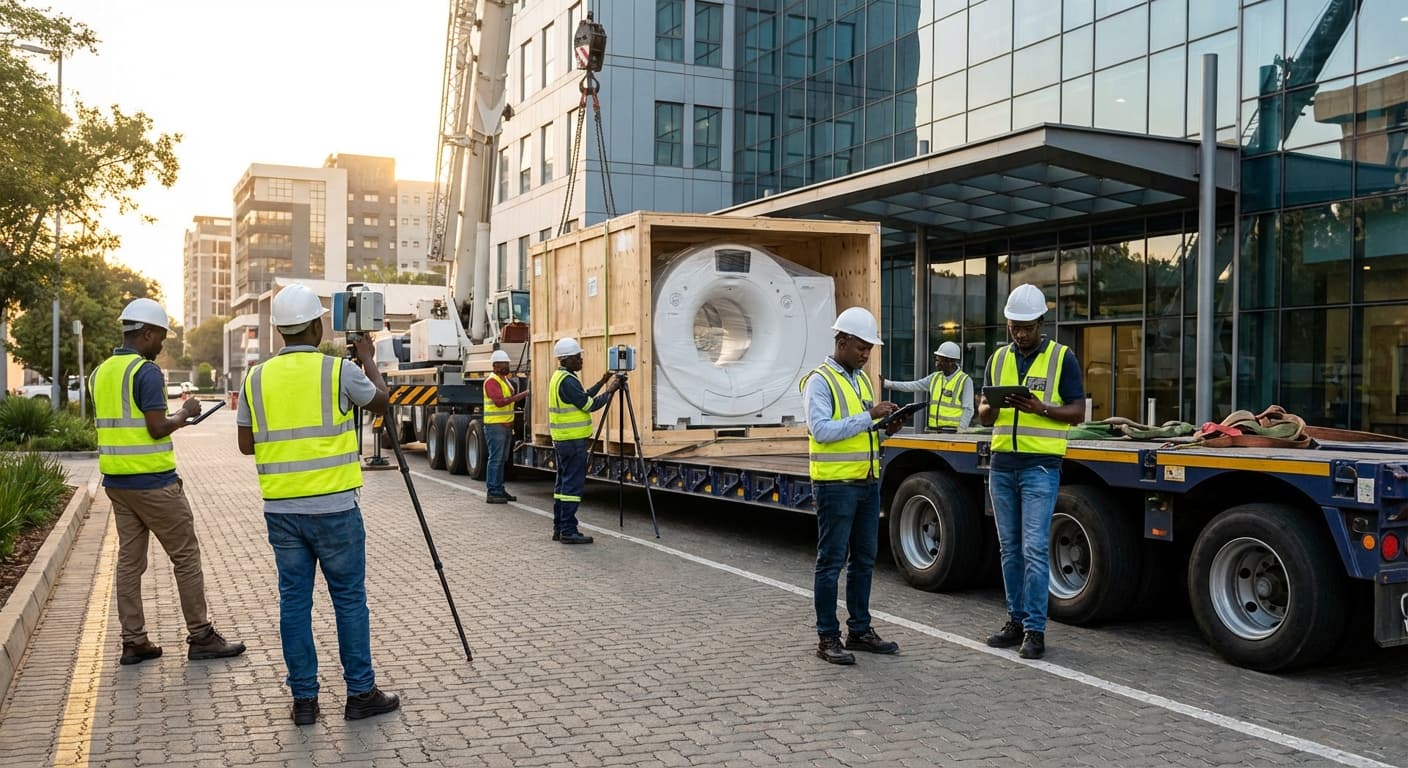
Route Survey & Rigging Plan Service for Heavy Medical Equipment in South Africa
Engineering Excellence & Technical Support
Route Survey & Rigging Plan Service for Heavy Medical Equipment High-standard technical execution following OEM protocols and local regulatory frameworks.
Precision Route Mapping & Obstacle Mitigation
Leveraging advanced GPS and LiDAR technology, we meticulously survey all potential transport routes, identifying and analyzing all critical obstacles (e.g., bridge heights, weight restrictions, overhead cables, narrow passages). Our sophisticated planning software generates detailed route maps with precise clearances, ensuring a safe and unimpeded journey for sensitive medical equipment across South Africa's diverse terrain.
Engineered Lifting & Securing Solutions
Our certified rigging engineers design bespoke lifting and securing plans tailored to the specific weight, dimensions, and fragility of each medical device. Utilizing specialized lifting gear, engineered bracing, and validated load calculations, we guarantee secure handling and transport, mitigating the risk of shock, vibration, and damage during every phase of the operation within South Africa's demanding logistical environment.
Comprehensive Risk Assessment & Compliance Assurance
We conduct thorough risk assessments, identifying potential hazards and developing proactive mitigation strategies in accordance with South African regulatory standards (e.g., Department of Transport, health and safety regulations). Our service includes detailed documentation, permit acquisition support, and on-site supervision to ensure full compliance and the highest level of safety throughout the entire heavy medical equipment transport process.
What Is Route Survey & Rigging Plan Service For Heavy Medical Equipment In South Africa?
Route Survey & Rigging Plan Service for Heavy Medical Equipment in South Africa is a specialized engineering and logistics undertaking focused on the safe and efficient transportation, installation, and commissioning of large-scale, high-value medical apparatus. This service is critical for ensuring that complex medical machinery, often weighing several tons and possessing intricate operational requirements, can be moved from a point of origin (e.g., port, manufacturing facility) to its final installation site within a healthcare facility, and then properly integrated into the existing infrastructure. The process involves a meticulous assessment of all potential physical constraints, structural capacities, and logistical challenges along the planned route, culminating in a detailed, site-specific rigging and installation strategy. This comprehensive approach mitigates risks of damage to the equipment, infrastructure, and personnel, while adhering to stringent safety regulations and operational parameters. It is an indispensable component of major medical equipment procurement and deployment projects in South Africa.
| Who Needs This Service | Typical Use Cases |
|---|---|
| Hospitals and Healthcare Facilities: Public and private hospitals, specialized clinics, and diagnostic centers undertaking new construction, expansions, or upgrading their medical equipment inventory. | Installation of large-scale imaging equipment (MRI, CT scanners, PET scanners), linear accelerators for radiotherapy, large surgical robots, modular operating theaters, and other high-capacity diagnostic and therapeutic apparatus. |
| Medical Equipment Manufacturers and Suppliers: Companies that import, distribute, or sell heavy medical equipment and are responsible for its delivery and installation at client sites. | Ensuring the safe and compliant delivery and installation of imported or domestically manufactured heavy medical machinery, managing the transition from ex-works to operational status. |
| Project Management Firms: Engineering, procurement, and construction (EPC) companies or specialized project managers overseeing major healthcare infrastructure development. | Integrating the safe and efficient handling of critical medical equipment as part of larger construction or renovation projects, ensuring timelines and budgets are met while managing complex technical requirements. |
| Government and Public Health Agencies: Bodies responsible for equipping public healthcare facilities or responding to public health emergencies requiring specialized medical infrastructure. | Deployment of essential medical technology in remote areas, establishing new healthcare hubs, or augmenting existing facilities with advanced diagnostic and treatment capabilities. |
| Research Institutions and Universities: Facilities with advanced medical research departments requiring specialized and often custom-configured heavy equipment. | Installation of cutting-edge research instrumentation, pre-clinical imaging systems, and specialized laboratory equipment that demands precise placement and integration. |
Key Components of Route Survey & Rigging Plan Service
- Route Assessment: Detailed analysis of transport pathways, including roads, bridges, tunnels, and access points, to determine feasibility and identify potential obstructions (e.g., overhead clearances, weight restrictions, turning radii).
- Site Survey: Comprehensive evaluation of the destination facility, including the final installation location, access routes within the building, doorways, corridors, floor load capacities, and the presence of existing services (e.g., utilities, structural supports).
- Risk Assessment & Mitigation: Identification and quantification of potential hazards during transit and installation, followed by the development of strategies to minimize these risks (e.g., temporary structural reinforcement, specialized lifting equipment, traffic management plans).
- Rigging Plan Development: Creation of detailed technical drawings and procedures for lifting, maneuvering, and positioning the equipment. This includes specifying required lifting gear (cranes, hoists, gantries), rigging components (slings, shackles), and load calculations.
- Installation & Commissioning Procedures: Outlining the step-by-step process for physically installing the equipment, connecting it to power and other services, and performing initial functional tests to ensure operational readiness.
- Documentation & Permitting: Preparation of all necessary documentation, including survey reports, rigging plans, method statements, risk assessments, and obtaining any required permits or approvals from local authorities or building management.
- Logistics Coordination: Integration of the survey and rigging plan with the overall transportation and delivery schedule, ensuring seamless execution.
- Decommissioning & Relocation Planning (Optional): While primarily for new installations, the principles of route survey and rigging plans are also applied for the relocation or decommissioning of existing heavy medical equipment.
Who Needs Route Survey & Rigging Plan Service For Heavy Medical Equipment In South Africa?
When transporting and installing heavy medical equipment in South Africa, specialized Route Survey & Rigging Plan services are not just a luxury, but a critical necessity. These services ensure the safe, efficient, and compliant movement of sensitive and often oversized medical machinery. Without them, institutions risk significant damage to equipment, infrastructure, and personnel, leading to costly delays and potential legal liabilities. This specialized service caters to a defined set of target customers and departments who handle such high-stakes logistics.
| Target Customer | Key Departments Involved | Why they need the service |
|---|---|---|
| Hospitals and Healthcare Facilities | Facilities Management, Biomedical Engineering, Procurement, Capital Projects, Infection Control | Installation of new imaging machines (MRI, CT scanners), linear accelerators, large surgical robots, or replacement of aging equipment. Ensuring safe ingress/egress, minimal disruption to patient care, and compliance with building codes. |
| Medical Equipment Manufacturers & Distributors | Logistics, Project Management, Technical Support, Installation Teams, Sales | Delivering and installing high-value equipment at client sites across South Africa. Requires detailed planning for transportation routes, site access, and on-site rigging to protect both the equipment and the client's premises. |
| Third-Party Logistics (3PL) Providers | Project Logistics, Heavy Haulage, Specialized Transport, Operations Management | Contracted to move and install medical equipment for their clients. Need expert route surveys and rigging plans to ensure they meet contractual obligations, manage risks, and provide a professional, reliable service. |
| Construction & Infrastructure Companies | Project Management, Site Operations, Health & Safety | Involved in building or renovating healthcare facilities where new, heavy medical equipment needs to be integrated. Requires coordination to ensure building structures, doorways, and internal pathways can accommodate the equipment's dimensions and weight during installation. |
| Government & Public Health Agencies | Procurement, Infrastructure Development, Public Health Services | Managing the acquisition and installation of medical equipment for public hospitals and clinics, often in remote or challenging locations. Need to ensure cost-effectiveness, compliance, and the safe deployment of essential medical technologies. |
| Research Institutions & Universities | Laboratory Management, Facilities Management, Research Project Leads | Installing advanced research equipment, such as specialized microscopes, centrifuges, or analytical instruments, which are often sensitive, heavy, and require precise placement and environmental control. |
Who Needs Route Survey & Rigging Plan Service for Heavy Medical Equipment in South Africa?
- Hospitals and Healthcare Facilities
- Medical Equipment Manufacturers & Distributors
- Third-Party Logistics (3PL) Providers
- Construction & Infrastructure Companies
- Government & Public Health Agencies
- Research Institutions & Universities
Route Survey & Rigging Plan Service For Heavy Medical Equipment Process In South Africa
This document outlines the typical workflow for a Route Survey & Rigging Plan Service for Heavy Medical Equipment Process in South Africa. This service is crucial for ensuring the safe and efficient transportation and installation of large, sensitive medical machinery, often involving complex logistical challenges and specialized handling requirements. The process moves from initial client inquiry to the final execution and handover of the equipment.
| Stage | Description | Key Activities | Deliverables | South African Specific Considerations |
|---|---|---|---|---|
| Inquiry & Initial Consultation | The client contacts the service provider to request a quote and discuss their specific heavy medical equipment relocation needs. | Receive and review equipment specifications (dimensions, weight, sensitivity). Discuss origin, destination, and timeline. Provide preliminary cost estimates. | Initial proposal/quote, understanding of client requirements. | Understanding of South African customs regulations for imported/exported equipment, relevant industry standards (e.g., health sector regulations). |
| Site Assessment & Data Collection | A site visit is conducted at both the origin and destination to gather detailed information about the environment. | Measure access points (doorways, corridors, elevators), floor load capacities, ceiling heights, and available space. Identify any obstacles or potential hazards. Document existing infrastructure (power, ventilation). | Detailed site survey report, photographic/video evidence. | Assessment of existing building infrastructure compliance with South African building codes and standards, including load-bearing requirements. |
| Route Survey & Risk Analysis | The transportation route is thoroughly examined, both within the site and externally, to identify potential challenges and risks. | Analyze internal routes (pathways within buildings), external routes (road networks, traffic, bridges, tunnels, height/width restrictions). Identify potential obstructions (low bridges, narrow streets, traffic lights, utility lines). Assess ground conditions and potential for soil instability. | Route survey report with maps and marked potential issues, risk assessment matrix. | Understanding of South African road classifications and permissible vehicle dimensions/weights, traffic management regulations, and potential for road closures or diversions due to events or construction. |
| Rigging Plan Development | Based on the collected data, a comprehensive plan for the safe lifting, moving, and placement of the equipment is created. | Determine required lifting equipment (cranes, hoists, gantries), specialized transport vehicles, and rigging gear. Develop detailed step-by-step procedures for lifting, securing, and moving. Specify safety protocols, personnel roles, and emergency procedures. | Detailed rigging plan document (including CAD drawings/diagrams), equipment list, personnel allocation. | Compliance with South African Occupational Health and Safety Act (OHSA) regulations, particularly concerning lifting operations and the use of heavy machinery. |
| Client Review & Approval | The developed plan is presented to the client for their review, feedback, and final approval. | Present the rigging plan, route survey findings, and risk assessment. Address any client concerns or requests for modifications. Obtain formal sign-off on the plan. | Approved rigging and route plan, minutes of review meeting. | Ensuring the plan aligns with hospital or clinic operational schedules and minimizes disruption to ongoing medical services. |
| Pre-Execution Preparations | All necessary preparations are made before commencing the actual rigging and transportation process. | Obtain necessary permits and road closures. Schedule and book specialized equipment and transport. Brief and train the rigging crew. Conduct pre-operation safety checks of all equipment. Inform relevant authorities and stakeholders (e.g., traffic police, building management). | Permits, equipment bookings, crew briefing notes, safety checklists. | Liaison with local municipalities and traffic authorities for permits and road closures, adherence to South African transport laws and regulations. |
| Execution of Rigging & Transport | The plan is implemented in a controlled and safe manner. | Execute lifting and rigging operations according to the plan. Carefully transport the equipment along the approved route. Monitor progress and address any unforeseen issues. Ensure all safety protocols are followed. | Successful relocation of equipment, incident reports (if any). | Real-time communication with traffic control where necessary, adherence to any specific access times or conditions imposed by the client or authorities. |
| Post-Execution & Handover | The equipment is safely placed at its destination, and the project is formally concluded. | Unload and position the equipment. Conduct final checks to ensure no damage occurred. Provide a post-project report. Obtain client sign-off on completion. Debrief the team and address lessons learned. | Post-completion report, client satisfaction sign-off, debriefing notes. | Ensuring compliance with any handover protocols specific to healthcare facilities in South Africa. |
Workflow Stages
- Inquiry & Initial Consultation
- Site Assessment & Data Collection
- Route Survey & Risk Analysis
- Rigging Plan Development
- Client Review & Approval
- Pre-Execution Preparations
- Execution of Rigging & Transport
- Post-Execution & Handover
Route Survey & Rigging Plan Service For Heavy Medical Equipment Cost In South Africa
Determining the precise cost for a route survey and rigging plan service for heavy medical equipment in South Africa is a complex process influenced by several key factors. These services are crucial to ensure the safe and efficient transportation and installation of specialized and often delicate medical machinery. The final price will be a tailored quote based on the specific requirements of each project. Below, we explore the primary pricing determinants and provide estimated cost ranges in South African Rand (ZAR).
| Service Component | Estimated Cost Range (ZAR) | Notes |
|---|---|---|
| Initial Route Survey (desktop & basic site assessment) | 5,000 - 15,000 | Covers assessment of primary routes and basic feasibility checks. |
| Detailed Route Survey (including physical inspections & GPS mapping) | 15,000 - 40,000 | More in-depth analysis of multiple routes, potential obstacles, and road suitability. |
| Basic Rigging Plan (for standard equipment and straightforward installations) | 10,000 - 30,000 | Covers standard lifting procedures and equipment. Assumes good site access. |
| Complex Rigging Plan (for large/heavy equipment, intricate sites, or specialized lifting) | 30,000 - 80,000+ | Involves detailed engineering calculations, specialized equipment, and potentially multi-stage lifts. Highly dependent on equipment specifications. |
| Combined Route Survey & Rigging Plan (standard complexity) | 20,000 - 50,000 | A bundled service for moderately complex projects. |
| Combined Route Survey & Rigging Plan (high complexity) | 50,000 - 150,000+ | Comprehensive planning for the most challenging medical equipment relocations. |
| On-site Supervision & Execution Support (per day, per team) | 8,000 - 25,000 | Cost for experienced personnel overseeing the actual rigging and placement. |
| Permit Acquisition & Management Fees | 2,000 - 10,000+ | Variable depending on the number and type of permits required. |
Key Pricing Factors for Route Survey & Rigging Plan Services:
- Scope of the Survey: This includes the distance to be covered, the number of potential routes assessed, and the level of detail required in the survey (e.g., GPS mapping, physical site inspections).
- Complexity of the Equipment: The size, weight, fragility, and specific handling requirements of the medical equipment are paramount. Larger, heavier, or more sensitive items will necessitate more specialized planning and execution, increasing costs.
- Rigging Requirements: The complexity of the rigging operation itself – the type of cranes, hoists, specialized lifting gear, and the number of personnel required – significantly impacts the price. This also includes any need for custom rigging solutions.
- Access and Site Conditions: Difficult terrain, narrow access points, multi-story buildings, or the need for temporary road closures or modifications will add to the logistical challenges and costs.
- Transportation Logistics: While not directly part of the survey and rigging plan, the chosen mode of transport (e.g., specialized trucks, air freight) and the distance of the transport leg will influence the overall planning and may be factored in by some providers.
- Permits and Approvals: Obtaining necessary permits for oversized loads, road closures, or working in specific areas can incur administrative fees and take time, affecting project timelines and costs.
- Specialized Personnel: The need for highly skilled and certified riggers, engineers, or project managers with specific experience in handling heavy medical equipment will command higher rates.
- Insurance: Adequate insurance coverage for the equipment and the operation is essential and will be a component of the overall service cost.
- Project Timeline and Urgency: Expedited services or projects requiring work outside standard business hours may incur premium charges.
- Geographic Location: Costs can vary slightly depending on the specific region or province within South Africa due to differences in labor rates and local operational expenses.
Affordable Route Survey & Rigging Plan Service For Heavy Medical Equipment Options
Navigating the complex logistics of transporting and installing heavy medical equipment requires specialized expertise. Our Affordable Route Survey & Rigging Plan Service offers comprehensive solutions designed to ensure the safe, efficient, and cost-effective delivery and placement of your valuable assets. We understand the unique challenges associated with medical equipment, from its weight and fragility to the need for precise positioning. Our service eliminates guesswork, minimizes risks of damage, and optimizes the entire process. We provide detailed route surveys to identify potential obstacles and ensure accessibility, coupled with meticulously crafted rigging plans that outline the safest and most efficient methods for lifting, moving, and securing your equipment. This proactive approach prevents costly delays, unexpected charges, and potential damage, ultimately saving you time and resources.
| Bundle Name | Included Services | Key Benefits | Cost Savings Potential |
|---|---|---|---|
| Basic Visibility Package | Single-site route survey and preliminary rigging assessment. | Identifies major route challenges and initial equipment needs. | Avoids initial site access mistakes; provides baseline understanding. |
| Standard Efficiency Bundle | Comprehensive route survey, detailed rigging plan, and risk assessment. | Complete logistical blueprint, optimized for safety and speed. | Minimizes on-site delays, reduces need for emergency rentals, prevents damage costs. |
| Premium Project Management Suite | Includes Standard Efficiency Bundle, plus on-site supervision during rigging and installation, coordination with facility staff, and post-installation verification. | End-to-end project oversight for maximum peace of mind. | Significant reduction in potential for errors, rework, and downtime; ensures compliance and operational readiness. |
| Volume Discount | Applicable to multiple equipment moves within the same facility or across a network of facilities. | Leverages scaled processes for greater efficiency. | Lower per-unit cost for route surveys and rigging plans. |
| Early Bird Booking | Bookings made more than X weeks in advance. | Allows for better resource allocation and scheduling. | Discounted rates on standard and premium packages. |
Value Bundles & Cost-Saving Strategies
- Comprehensive Route Survey: Thorough assessment of all access points, pathways, and potential site challenges (doorways, stairwells, elevator capacities, floor load limits).
- Detailed Rigging Plan: Professional engineering and visual schematics outlining lifting points, required equipment (cranes, dollies, specialized lifting devices), safety protocols, and personnel requirements.
- Risk Mitigation: Proactive identification and elimination of potential hazards to prevent equipment damage, personnel injury, and property damage.
- Efficiency Optimization: Streamlined planning that reduces on-site installation time and minimizes disruption to your facility's operations.
- Cost Predictability: Clear upfront planning eliminates unforeseen expenses and provides a precise budget for the rigging and installation phase.
- Compliance Assurance: Ensures all procedures adhere to relevant safety regulations and industry best practices.
Verified Providers In South Africa
In South Africa's dynamic healthcare landscape, discerning patients seek assurance and reliability when choosing medical providers. This is where verified providers, like Franance Health, play a crucial role. Franance Health stands out by upholding stringent credentialing processes, ensuring that their network comprises highly qualified, ethical, and competent healthcare professionals. Their commitment to verification goes beyond basic registration, delving into rigorous checks of qualifications, experience, specializations, and adherence to best practices. This meticulous approach offers patients unparalleled peace of mind, knowing they are receiving care from individuals who have met and exceeded industry standards. Choosing Franance Health means prioritizing quality, safety, and ultimately, superior health outcomes.
| Credential Type | Franance Health Verification Process | Benefit to Patients |
|---|---|---|
| Medical Degrees & Licenses | Verified against official South African medical council records. | Ensures providers are legally qualified and registered to practice. |
| Specialist Certifications | Cross-referenced with relevant professional bodies and academic institutions. | Confirms specialized expertise and advanced training in specific fields. |
| Professional Experience | Thorough review of work history, including references and practice duration. | Guarantees a level of practical knowledge and established competence. |
| Continuing Professional Development (CPD) | Confirmation of ongoing engagement in learning and skill enhancement. | Indicates providers are up-to-date with the latest medical advancements and techniques. |
| Professional Indemnity Insurance | Mandatory requirement and verification of valid coverage. | Provides an additional layer of protection and accountability for patients. |
Why Franance Health Credentials Matter
- Rigorous qualification verification
- In-depth experience assessment
- Specialization validation
- Adherence to ethical standards
- Commitment to best medical practices
- Ensured patient safety and trust
- Access to top-tier healthcare professionals
Scope Of Work For Route Survey & Rigging Plan Service For Heavy Medical Equipment
This Scope of Work (SOW) outlines the requirements for Route Survey and Rigging Plan Services for the transportation and installation of heavy medical equipment. The objective is to ensure safe, efficient, and compliant movement of sensitive and high-value medical machinery from its point of origin to its final installation site. The services encompass detailed route assessment, identification of potential hazards, development of comprehensive rigging and lifting strategies, and the creation of all necessary documentation.
| Task Area | Description | Technical Deliverables | Standard Specifications & Considerations |
|---|---|---|---|
| Route Survey | Comprehensive assessment of the planned transportation route from origin to destination, including all access roads and intermediate points. |
|
|
| Rigging Plan Development | Design of safe and efficient rigging, lifting, and securing procedures for the heavy medical equipment. |
|
|
| Permitting & Approvals | Identification and acquisition of all necessary permits, escorts, and authorizations for route access and transportation. |
|
|
| Risk Assessment & Mitigation | Identification and analysis of potential risks throughout the transportation and installation process, and development of mitigation strategies. |
|
|
| Documentation & Reporting | Compilation and submission of all technical deliverables and supporting documentation. |
|
|
Key Objectives
- To meticulously assess and document the entire transportation route, identifying all physical and logistical constraints.
- To design and document a detailed rigging and lifting plan that ensures the safety of personnel, equipment, and surrounding infrastructure.
- To obtain all necessary permits and approvals for route access and specialized transportation.
- To provide clear and actionable documentation for all involved parties.
- To minimize risks associated with the movement of heavy and sensitive medical equipment.
Service Level Agreement For Route Survey & Rigging Plan Service For Heavy Medical Equipment
This Service Level Agreement (SLA) outlines the guaranteed response times and uptime for the Route Survey & Rigging Plan Service for Heavy Medical Equipment. This service is critical for ensuring the safe and efficient transportation and installation of sensitive medical devices. This SLA defines the standards of service delivery and the remedies available in case of non-compliance.
| Service Component | Service Level Objective (SLO) | Measurement Method | Remedy for Non-Compliance |
|---|---|---|---|
| Initial Consultation & Assessment Request Acknowledgment | Acknowledge all requests within 2 business hours. | Timestamp of request receipt and acknowledgment. | 10% discount on the affected service if acknowledgment exceeds 2 business hours. |
| Route Survey Data Collection Completion | Within 5 business days of the site visit (unless weather or site access delays are unavoidable, which will be communicated). | Date of site visit and date of data collection completion. | 15% discount on the affected service if data collection is delayed beyond the agreed timeframe without valid reason. |
| Rigging & Lifting Plan Delivery | Within 3 business days of route survey data completion. | Date of data completion and date of plan delivery. | 20% discount on the affected service if the plan is not delivered within the specified timeframe. |
| Urgent Request (e.g., critical equipment placement) | Acknowledgment: 1 business hour. Plan Delivery: Within 24 business hours. | Timestamp of request, acknowledgment, and plan delivery. | 50% discount on the affected service if urgent request SLOs are not met. |
| Service Availability (for access to survey data/plans, and support) | 99.5% Uptime during standard business hours (9 AM - 5 PM local time, Monday-Friday, excluding public holidays). | System logs and monitoring reports. | 1 day of service credit for every 4 hours of unscheduled downtime within a calendar month. |
| Technical Support & Clarifications | Respond to inquiries regarding the survey or plan within 4 business hours. | Timestamp of inquiry and response. | No direct remedy, but repeated failures may lead to review of contract and potential for future discounts. |
Scope of Service
- Pre-installation route assessment and optimization.
- Development of detailed rigging and lifting plans.
- Identification of potential logistical challenges and mitigation strategies.
- Coordination with relevant stakeholders (e.g., building management, transport providers).
- Post-survey and plan delivery.
Frequently Asked Questions

Ready when you are
Let's scope your Route Survey & Rigging Plan Service for Heavy Medical Equipment in South Africa project in South Africa.

Scaling healthcare logistics and technical systems across the entire continent.