
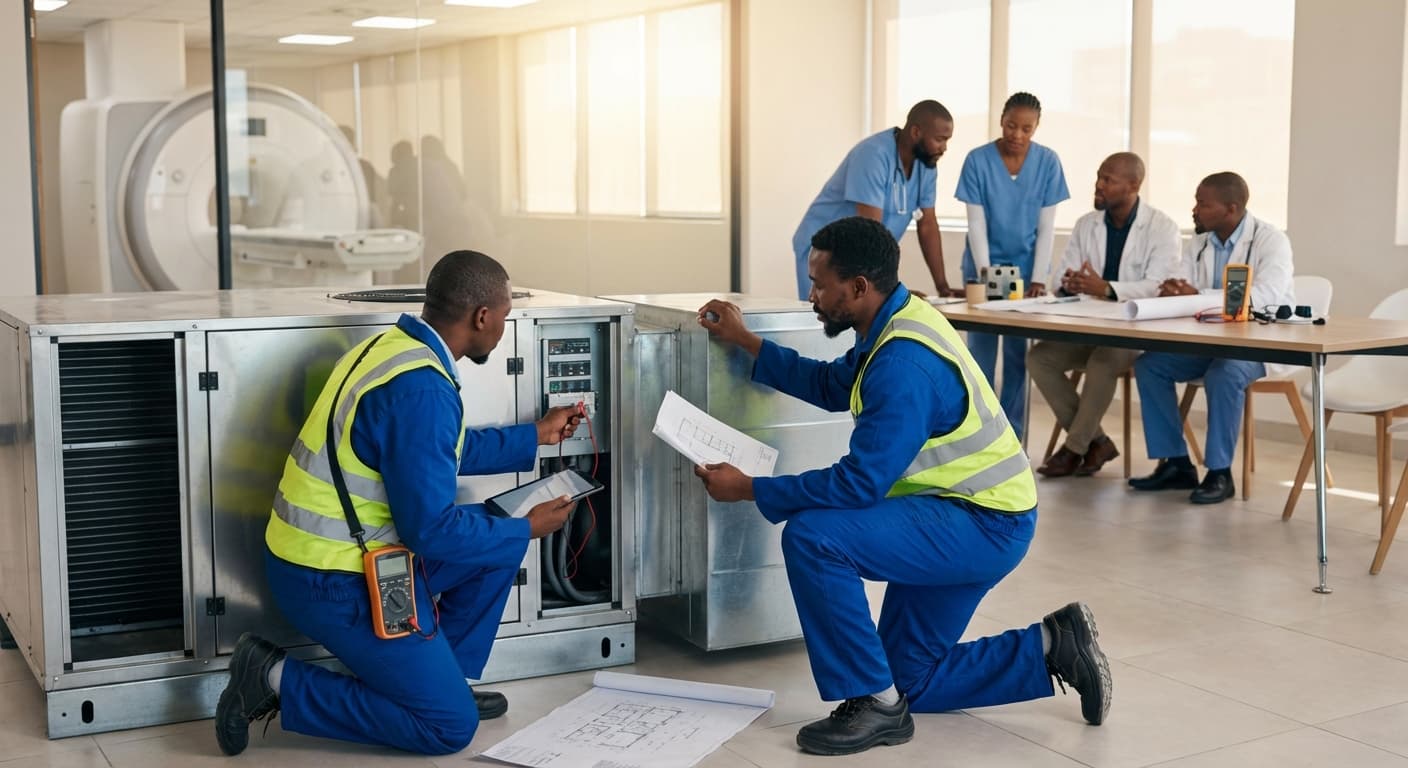
Site Readiness Assessment Service (Space/Access/HVAC/Power/Shielding) in South Africa
Engineering Excellence & Technical Support
Site Readiness Assessment Service (Space/Access/HVAC/Power/Shielding) High-standard technical execution following OEM protocols and local regulatory frameworks.
Optimised Power & Cooling for Mission-Critical Infrastructure
We conduct in-depth power and HVAC audits across South Africa, ensuring your site's capacity and redundancy meet demanding data center, telco, or industrial facility requirements. Our assessments identify potential bottlenecks and propose energy-efficient solutions for optimal uptime and cost savings.
Strategic Site Access & Physical Security Evaluation
Leveraging our local expertise, we meticulously assess site accessibility for construction, maintenance, and emergency response in diverse South African terrains. Our detailed reviews cover road infrastructure, security protocols, and ingress/egress points, ensuring smooth operations and enhanced physical security for your assets.
Comprehensive Shielding & Environmental Compliance
Our technical team performs rigorous assessments of existing shielding (EMI/RFI, radiation) and environmental factors crucial for specialized facilities in South Africa. We identify compliance gaps and recommend advanced solutions to safeguard sensitive equipment and personnel, adhering to local and international standards.
What Is Site Readiness Assessment Service (Space/access/hvac/power/shielding) In South Africa?
The Site Readiness Assessment Service (Space/Access/HVAC/Power/Shielding) in South Africa is a comprehensive technical evaluation designed to determine the suitability of a proposed or existing site for the deployment and optimal operation of critical infrastructure, particularly in the context of data centers, telecommunications facilities, and other high-density technology deployments. This service meticulously scrutinizes key environmental, structural, and utility parameters to ensure the site can reliably support the specified hardware and operational requirements. The assessment provides actionable insights into potential deficiencies and outlines necessary remediation steps to achieve the desired site readiness level, thereby mitigating deployment risks, ensuring operational uptime, and optimizing long-term cost-effectiveness.
| Who Needs This Service? | Typical Use Cases | ||||||
|---|---|---|---|---|---|---|---|
| Data Center Operators (Colocation, Enterprise, Cloud): To ensure new or existing facilities meet stringent uptime and performance requirements for servers, storage, and networking equipment. | Telecommunications Companies: For the deployment of base stations, switching centers, and network aggregation points, ensuring reliable connectivity and equipment operation. | Critical Infrastructure Providers (e.g., Financial Institutions, Healthcare): To secure and maintain highly available IT environments for sensitive data and essential services. | Technology Manufacturers and Integrators: When deploying specialized equipment or pilot projects that require specific environmental conditions and robust infrastructure. | Government Agencies and Defense Organizations: For secure and resilient IT deployments, often with stringent shielding and redundancy requirements. | Real Estate Developers and Property Managers: To assess and enhance the suitability of commercial properties for IT-intensive tenants. | Companies Planning Expansion or Relocation of IT Infrastructure: To proactively identify and address potential site limitations before significant investment. | |
| New Data Center Construction: Establishing a baseline for design and ensuring the selected site can support the intended capacity and operational requirements. | Data Center Expansion or Retrofitting: Evaluating the feasibility and necessary upgrades for adding more racks, improving cooling, or increasing power density. | Deployment of New Server Farms or High-Performance Computing (HPC) Clusters: Ensuring sufficient space, power, and cooling to support intensive computational loads. | Establishment of Edge Computing Facilities: Assessing smaller, distributed sites for their ability to host critical edge infrastructure. | Relocation of Existing IT Infrastructure: Planning and executing a move with minimal disruption by understanding the target site's readiness. | Security Audits and Compliance Assessments: Verifying that the physical site meets security and environmental standards for sensitive equipment. | Evaluation of Potential Disaster Recovery (DR) Sites: Ensuring secondary sites have the necessary infrastructure to take over critical operations. | Telecommunications Network Upgrades and Densification: Assessing sites for the installation of new equipment and increased capacity. |
Key Components of Site Readiness Assessment:
- Space Assessment: Evaluation of available floor space, ceiling height, and layout to accommodate current and future equipment racks, networking infrastructure, and support systems. This includes assessing load-bearing capacities of floors.
- Access Assessment: Determination of physical access routes for equipment delivery (including large-scale components), personnel ingress/egress, and emergency evacuation. This encompasses assessing aisle widths, door sizes, elevator capacities, and proximity to major transportation networks.
- HVAC (Heating, Ventilation, and Air Conditioning) Assessment: Analysis of the existing or proposed HVAC system's capacity to provide adequate cooling, humidity control, and air filtration to maintain optimal operating temperatures for sensitive electronic equipment. This includes assessing redundancy, airflow management, and potential for heat dissipation.
- Power Assessment: Verification of available power capacity from utility providers, assessment of the existing electrical infrastructure (substations, transformers, distribution panels), and evaluation of backup power solutions (UPS, generators). This also includes power quality analysis and grounding.
- Shielding Assessment: Evaluation of the site's electromagnetic interference (EMI) shielding and radio frequency interference (RFI) mitigation capabilities. This is critical for sensitive networking equipment, secure facilities, and compliance with specific industry standards. It also considers potential external interference sources.
Who Needs Site Readiness Assessment Service (Space/access/hvac/power/shielding) In South Africa?
A Site Readiness Assessment Service is crucial for any organization in South Africa planning to deploy new IT infrastructure, data centers, or mission-critical systems. This service ensures that the physical location is adequately prepared to support the demanding requirements of modern technology, encompassing space, access, HVAC (Heating, Ventilation, and Air Conditioning), power, and shielding. Without a thorough assessment, businesses risk project delays, budget overruns, and operational failures due to unforeseen infrastructure limitations.
| Target Customer Group | Typical Departments Involved | Key Concerns Addressed by Site Readiness Assessment |
|---|---|---|
| Large Enterprises (National & Multinational) | IT Infrastructure, Facilities Management, Project Management, Security, Finance | Scalability for future growth, Power redundancy for business continuity, HVAC for optimal equipment performance, Secure physical access, Compliance with international standards, Cost optimization for large-scale deployments. |
| Small to Medium-sized Enterprises (SMEs) | IT Management, Operations, Finance, Business Owners | Cost-effective solutions, Adequate power and cooling for current needs, Physical security against theft/damage, Space optimization for limited budgets, Reliability to avoid business disruption. |
| Telecommunications Companies | Network Operations, Engineering, Facilities, Planning, Security | High power density requirements for network equipment, Robust cooling for 24/7 operation, Network cabling infrastructure, Physical security of network nodes, Geographic accessibility for maintenance. |
| Financial Services & Banking | IT Operations, Risk Management, Compliance, Facilities Management, Security | High availability and uptime, Redundant power and cooling systems, Enhanced physical security, Data integrity and protection (shielding), Disaster recovery readiness, Regulatory compliance (e.g., POPIA). |
| Government & Public Sector | IT Departments, Procurement, Facilities Management, National Security Agencies | Secure infrastructure for sensitive data, Compliance with government IT standards, Scalability for public service delivery, Redundancy for critical operations, Long-term planning and lifecycle management. |
| Cloud Service Providers & Data Centers | Data Center Operations, Engineering, Construction, Capacity Planning, Network Engineering | Massive power and cooling capacity, Efficient space utilization, Advanced HVAC systems, Robust physical security, Scalable power distribution, Fire suppression and environmental controls. |
| Healthcare Providers | IT Operations, Biomedical Engineering, Facilities Management, Compliance Officers | Uptime for critical medical systems, Data security and patient privacy (HIPAA/POPIA compliance), Reliable power for life-support equipment, Environmental controls for sensitive equipment, Disaster preparedness. |
Who Needs Site Readiness Assessment Service (Space/Access/HVAC/Power/Shielding) in South Africa?
- Organizations undertaking digital transformation initiatives.
- Companies expanding their IT footprint or deploying new data centers.
- Businesses relocating or upgrading existing IT facilities.
- Financial institutions requiring highly reliable and secure infrastructure.
- Telecommunications providers building new network hubs or points of presence.
- Healthcare organizations handling sensitive patient data and requiring high uptime.
- Government agencies implementing secure and robust IT systems.
- Any entity planning the installation of high-density computing, AI/ML clusters, or high-performance computing (HPC) environments.
- Companies looking to improve energy efficiency and operational costs of their IT infrastructure.
- Businesses seeking to meet specific compliance and regulatory requirements related to data center design and operations.
Site Readiness Assessment Service (Space/access/hvac/power/shielding) Process In South Africa
The Site Readiness Assessment Service (SRAS) in South Africa is a crucial process designed to ensure a proposed site is adequately prepared to host specialized equipment and infrastructure, particularly in fields like telecommunications, data centers, and scientific research. This service systematically evaluates key aspects of a site's suitability, including space, access, HVAC (Heating, Ventilation, and Air Conditioning), power, and shielding. The workflow typically begins with an initial inquiry from a client and culminates in a comprehensive readiness report, guiding the client on any necessary modifications or confirming the site's preparedness.
| Assessment Area | Key Considerations | Typical Deliverables/Actions |
|---|---|---|
| Space | Floor area, ceiling height, column spacing, layout, environmental factors (e.g., dust, water ingress potential) | Measurements, layout diagrams, suitability assessment, recommendations for space optimization or modification |
| Access | Entry points, loading docks, elevators, pathways, security, door sizes, weight limits | Path analysis, clearance verification, security review, recommendations for access improvements |
| HVAC | Cooling capacity, airflow, temperature/humidity control, redundancy, filtration, ventilation | Capacity calculations, airflow analysis, redundancy assessment, recommendations for upgrades or new systems |
| Power | Utility supply capacity, distribution panels, UPS, generators, grounding, surge protection, power quality | Capacity verification, redundancy assessment, grounding check, power quality analysis, recommendations for power upgrades or new installations |
| Shielding | Electromagnetic Interference (EMI), Radio Frequency Interference (RFI), susceptibility of equipment, potential interference sources | Site survey for interference sources, EMI/RFI testing (if required), recommendations for shielding materials or mitigation strategies |
Site Readiness Assessment Service (SRAS) Workflow in South Africa
- Inquiry and Initial Consultation:
- Client expresses interest in the SRAS.
- Initial meeting to understand project scope, site location, and specific requirements (e.g., equipment type, capacity needs).
- Discussion of key assessment areas (Space, Access, HVAC, Power, Shielding).
- Provision of preliminary site information and documentation by the client (e.g., floor plans, existing power schematics).
- Proposal and Agreement:
- SRAS provider develops a detailed proposal outlining the scope of work, methodology, deliverables, timelines, and costs.
- Client reviews and negotiates the proposal.
- Formal agreement or contract is signed.
- Site Visit and Data Collection:
- Scheduled site visit by the SRAS team.
- Space Assessment: Verifying available floor space, ceiling height, column spacing, and layout suitability for equipment racks, cabling, and personnel movement. Measurement of all relevant dimensions.
- Access Assessment: Evaluating entry points (doors, loading docks, elevators), pathways for equipment transportation, and security measures. Assessing clearance for movement of large or heavy components.
- HVAC Assessment: Analyzing existing cooling capacity, airflow distribution, temperature and humidity control capabilities, and redundancy. Assessing the feasibility of upgrades or new installations.
- Power Assessment: Reviewing existing power supply capacity, distribution panels, redundancy (UPS, generators), and grounding systems. Verifying availability and stability of power from the utility provider.
- Shielding Assessment: Evaluating the site's electromagnetic interference (EMI) and radio frequency interference (RFI) shielding properties. Assessing potential sources of interference and the need for mitigation.
- Collection of photographic and video evidence of site conditions.
- Detailed note-taking and documentation of all observations.
- Analysis and Recommendation Development:
- Post-site visit, the SRAS team analyzes all collected data.
- Identification of any gaps, deficiencies, or potential risks related to space, access, HVAC, power, and shielding.
- Development of specific, actionable recommendations for each assessment area.
- Estimation of costs and timelines for proposed remediation or upgrade works.
- Consultation with relevant stakeholders (e.g., electrical engineers, HVAC specialists) if required.
- Report Generation:
- Compilation of a comprehensive Site Readiness Assessment Report.
- The report includes:
- Executive Summary- Detailed findings for each assessment area (Space, Access, HVAC, Power, Shielding)- Identification of strengths and weaknesses- Specific, prioritized recommendations- Proposed solutions with estimated costs and timelines- Risk assessment and mitigation strategies- Supporting documentation (photos, diagrams, schematics)- Client Review and Presentation:
- The SRAS report is submitted to the client.
- A presentation of the findings and recommendations is typically conducted.
- Opportunity for the client to ask questions and seek clarification.
- Implementation Support (Optional):
- The SRAS provider may offer ongoing support for the implementation of recommended solutions.
- This can include project management, contractor selection, and oversight of remediation works.
- Final Sign-off/Confirmation:
- Upon satisfactory completion of recommended works or confirmation of readiness, the client can proceed with their project with confidence.
- This marks the conclusion of the SRAS process.
Site Readiness Assessment Service (Space/access/hvac/power/shielding) Cost In South Africa
Assessing site readiness for projects requiring specialized infrastructure like data centres, laboratories, or medical facilities is a crucial first step. This involves evaluating critical aspects such as available space, physical access, HVAC (Heating, Ventilation, and Air Conditioning) capacity, power availability and quality, and necessary shielding (e.g., RF, radiation). In South Africa, the cost of a comprehensive Site Readiness Assessment Service for these elements can vary significantly. This document outlines the key pricing factors and provides estimated cost ranges in South African Rand (ZAR).
| Assessment Component | Typical Cost Range (ZAR) | Notes |
|---|---|---|
| High-Level Desktop Assessment (Initial Review) | R 5,000 - R 15,000 | Primarily document review and preliminary feasibility. Limited site interaction. |
| Basic Site Visit & Visual Inspection (Single Discipline Focus) | R 10,000 - R 25,000 | On-site visit to assess one or two aspects (e.g., space and access). Basic measurements and observations. |
| Comprehensive Site Readiness Assessment (Multiple Disciplines) | R 30,000 - R 100,000+ | Involves in-depth on-site investigation of Space, Access, HVAC, Power, and Shielding. May include basic testing. Larger or more complex sites will be at the higher end. |
| Specialised Testing & Analysis (Per Discipline/Per Day) | R 8,000 - R 20,000 per day | Cost for dedicated testing services like power quality analysis, RF shielding effectiveness tests, detailed HVAC load calculations, etc. This is often an add-on to a broader assessment. |
| Detailed Reporting & Recommendations | Included in assessment cost, but complex reports can add 10-20% | The final output of the assessment, including actionable insights and technical specifications. |
Key Factors Influencing Site Readiness Assessment Costs in South Africa:
- Scope of Assessment: The breadth and depth of the assessment are primary drivers. A high-level review will be less expensive than a detailed, on-site investigation involving extensive testing and analysis.
- Site Complexity and Size: Larger or more complex sites (e.g., multiple buildings, challenging existing infrastructure, remote locations) will naturally incur higher assessment costs due to increased time and resources required.
- Number of Disciplines Assessed: The more elements you require assessment for (Space, Access, HVAC, Power, Shielding), the higher the overall cost. A combined assessment across all these areas will be more than assessing just one or two.
- Existing Documentation Availability: If comprehensive existing documentation (building plans, electrical schematics, HVAC reports) is readily available and accurate, it can reduce the on-site investigation time and thus the cost.
- Specialized Testing Requirements: Certain assessments might necessitate specialized testing equipment (e.g., RF signal strength meters, power quality analyzers, thermal imaging cameras). The cost of renting or using such equipment will be factored in.
- Consultant Expertise and Reputation: Highly experienced and reputable engineering or consulting firms with a proven track record in similar assessments will generally command higher fees than smaller or less established entities.
- Location within South Africa: Travel and accommodation costs for assessors will vary depending on the remoteness of the site and the location of the consulting firm. Major metropolitan areas might have more competitive pricing, but travel to remote regions can significantly increase costs.
- Urgency of the Assessment: Expedited assessments often come with a premium due to the need for prioritisation and potential overtime for the consulting team.
- Reporting Deliverables: The complexity and detail required in the final assessment report (e.g., executive summary, detailed technical findings, recommendations, bill of materials) will impact the time spent on report generation.
Affordable Site Readiness Assessment Service (Space/access/hvac/power/shielding) Options
Navigating the complexities of site readiness for your project can be a daunting and expensive undertaking. Our Affordable Site Readiness Assessment Service provides a comprehensive evaluation of critical infrastructure elements, including Space, Access, HVAC, Power, and Shielding. We understand that budget constraints are paramount, and our goal is to deliver high-quality assessments that empower you to make informed decisions, minimize costly surprises, and optimize your project's timeline and budget. We offer flexible service bundles tailored to your specific needs and provide actionable insights to identify cost-saving opportunities throughout the assessment and subsequent implementation phases.
| Value Bundle Name | Included Assessments | Key Benefits | Target Use Case | Estimated Price Range (USD) | Cost-Saving Strategies |
|---|---|---|---|---|---|
| Essential Essentials | Space, Access, Power (Basic) | Foundation for critical physical and electrical needs. Quick identification of major gaps. | New small office setup, basic lab expansion, or initial project feasibility studies. | $1,500 - $3,000 | Focuses on immediate needs, avoiding over-assessment. Prioritizes essential upgrades. Leverages existing infrastructure where possible. |
| Core Infrastructure | Space, Access, HVAC (Basic), Power (Standard) | Comprehensive evaluation of core operational requirements. Addresses environmental controls and reliable power. | Medium-sized office build-outs, data center relocations, or technology deployment projects. | $3,000 - $6,000 | Bundled pricing offers a discount over individual assessments. Identifies opportunities for energy-efficient HVAC solutions. Standardized power assessment avoids unnecessary in-depth analysis if not required. |
| Advanced Operations | Space, Access, HVAC (Comprehensive), Power (Advanced), Shielding (Basic) | Suitable for projects with specialized environmental, power redundancy, or initial shielding considerations. | R&D facilities, clean rooms, critical infrastructure deployments, or initial regulatory compliance checks. | $5,000 - $10,000 | Strategic identification of shielding needs early on prevents costly retrofits. Analysis of HVAC and power for efficiency leads to long-term operational savings. Bundle offers integration insights across disciplines. |
| Full Spectrum | Space, Access, HVAC (Comprehensive), Power (Advanced), Shielding (Comprehensive) | Complete assessment for projects with stringent environmental, power, and shielding requirements, ensuring full compliance and optimal performance. | High-tech manufacturing, sensitive research labs, medical facilities, or high-security operations. | $8,000 - $15,000+ | Proactive identification of all potential site readiness issues, preventing extensive rework. Negotiation leverage with vendors based on detailed assessment findings. Integration of all elements for a holistic, cost-optimized design. |
Key Components of Our Site Readiness Assessment:
- Space Assessment: Evaluating available physical space for equipment, operations, and future expansion, considering layout, ergonomics, and environmental factors.
- Access Assessment: Determining ease of access for personnel, equipment delivery, maintenance, and emergency services, including vehicle access, loading docks, and interior pathways.
- HVAC Assessment: Analyzing existing heating, ventilation, and air conditioning systems for capacity, efficiency, reliability, and suitability for project requirements, including environmental controls (temperature, humidity, air quality).
- Power Assessment: Reviewing electrical infrastructure, including capacity, reliability, voltage stability, redundancy, and potential upgrade requirements for current and future loads.
- Shielding Assessment: Evaluating existing shielding (electromagnetic, RF, acoustic, radiation) or identifying the need for new shielding solutions to meet regulatory compliance and operational requirements.
Verified Providers In South Africa
In the South African healthcare landscape, the distinction between a verified provider and any other service provider is crucial for patient safety, quality of care, and overall trust. Verified providers adhere to stringent standards, ensuring their legitimacy and commitment to excellence. Franance Health stands out as a leading example of such a verified provider, demonstrating a deep commitment to credentialing and upholding the highest benchmarks in the industry. This commitment not only assures patients of receiving care from qualified professionals but also signifies an organization dedicated to continuous improvement and ethical practice. Choosing a verified provider like Franance Health means opting for reliability, expertise, and a patient-centric approach to healthcare.
| Key Verification Aspects | Franance Health's Approach | Patient Benefit |
|---|---|---|
| Licensing and Registration | Mandatory verification of current, valid medical licenses and registrations with relevant South African regulatory bodies (e.g., HPCSA). | Ensures practitioners are legally authorized to practice medicine and meet professional requirements. |
| Education and Training | Thorough review of academic qualifications, postgraduate training, and specialized certifications. | Guarantees that providers possess the necessary knowledge and skills for their scope of practice. |
| Professional Experience | Verification of work history, including previous employment, roles, and responsibilities. | Confirms practical experience and competence in real-world healthcare settings. |
| Peer Review and References | Collection and assessment of references and, where applicable, peer review feedback. | Provides insights into a provider's professional conduct and reputation among colleagues. |
| Criminal Background Checks | Undertaken to ensure the safety and security of patients. | Minimizes risks and promotes a secure healthcare environment. |
| Continuing Professional Development (CPD) | Confirmation of ongoing engagement with CPD activities to stay updated with medical advancements. | Ensures providers remain current with the latest treatments and best practices. |
Why Franance Health is the Best Choice:
- Rigorous Credentialing Process: Franance Health employs a comprehensive and transparent credentialing process for all its healthcare professionals, ensuring they meet and exceed industry standards for qualifications, experience, and ethical conduct.
- Commitment to Quality Assurance: Beyond initial verification, Franance Health maintains ongoing quality assurance programs, regularly assessing and monitoring the performance of its providers to guarantee consistent, high-quality patient care.
- Patient Safety Focus: Verification inherently prioritizes patient safety. Franance Health's credentialing protocols are designed to identify and engage only those practitioners who have demonstrated a commitment to safe and effective medical practices.
- Reputation for Excellence: Through its unwavering dedication to verified standards, Franance Health has built a strong reputation for providing reliable and exceptional healthcare services across South Africa.
- Access to Specialized Expertise: The verification process allows Franance Health to identify and onboard specialists with proven expertise, ensuring patients can access the right care for their specific needs.
- Trust and Transparency: Patients can have confidence in the care they receive from Franance Health, knowing that each provider has undergone a thorough verification process, fostering trust and transparency in the healthcare journey.
Scope Of Work For Site Readiness Assessment Service (Space/access/hvac/power/shielding)
This Scope of Work (SOW) outlines the services for conducting a comprehensive Site Readiness Assessment for [Project Name] at [Site Location]. The assessment will evaluate the existing site infrastructure against the requirements for the proposed installation, focusing on Space, Access, HVAC, Power, and Shielding. The objective is to identify any deficiencies and provide recommendations for remediation to ensure a successful and compliant deployment.
| Technical Deliverable | Description | Standard Specifications / Considerations |
|---|---|---|
| Site Survey Report | Documented findings from the on-site survey, including photographs, measurements, and notes. | Includes floor plans, rack layouts, cable routing diagrams, and environmental readings (temperature, humidity). |
| Space Availability Analysis | Detailed assessment of physical space allocated for the installation. | Compliance with equipment footprint, aisle clearance, safety zones (e.g., NEC, TIA standards). |
| Access Pathway Evaluation | Assessment of all routes for equipment and personnel. | Doorway widths, corridor clearances, elevator capacity and access, loading dock availability and condition. |
| HVAC Capacity and Performance Report | Analysis of current HVAC system's ability to maintain specified environmental conditions. | Temperature range: [Specify Range, e.g., 20-25°C ± 2°C], Humidity range: [Specify Range, e.g., 40-60% RH]. Airflow rates, air changes per hour (ACH), redundancy (N, N+1). |
| Power Infrastructure Assessment | Evaluation of electrical supply, distribution, and protection systems. | Available power capacity (kW/kVA), voltage stability, UPS and generator availability/capacity, grounding resistance, circuit breaker ratings, PDU (Power Distribution Unit) requirements. |
| Shielding Requirements Analysis | Assessment of current shielding and identification of potential EMI/RFI sources and mitigation strategies. | Compliance with relevant shielding standards (e.g., FCC Part 15, MIL-STD-461), dB attenuation requirements, material specifications (if new shielding is required). |
| Site Readiness Report | Comprehensive document summarizing all findings, identified deficiencies, and proposed remediation plan. | Includes executive summary, detailed findings per category, risk assessment, recommended actions, cost/timeline estimates, and appendices with supporting data. |
Scope of Work - Site Readiness Assessment
- 1. Site Survey and Data Collection: Conduct a thorough on-site survey to gather detailed information regarding the existing site conditions.
- 2. Space Assessment: Evaluate available space for equipment, cabling, and personnel access, ensuring compliance with layout requirements and safety regulations.
- 3. Access Assessment: Verify accessibility for equipment delivery, installation, maintenance, and emergency egress. This includes assessing pathways, doorways, elevators, and loading docks.
- 4. HVAC Assessment: Analyze existing Heating, Ventilation, and Air Conditioning (HVAC) systems to determine their capacity, reliability, and suitability for the specified environmental requirements (temperature, humidity, airflow).
- 5. Power Assessment: Evaluate the existing electrical infrastructure, including power availability, capacity, redundancy, grounding, and distribution systems, to meet the project's power demands.
- 6. Shielding Assessment: Assess any existing electromagnetic interference (EMI) or radio frequency interference (RFI) shielding, or the need for its implementation, to ensure signal integrity and compliance with relevant standards.
- 7. Deficiency Identification: Document all identified discrepancies between the existing site conditions and the project's technical requirements.
- 8. Recommendations and Remediation Plan: Provide detailed recommendations for any necessary upgrades, modifications, or construction to address the identified deficiencies. This will include cost and timeline estimates for proposed remediation activities.
- 9. Final Report Generation: Compile all findings, analyses, and recommendations into a comprehensive Site Readiness Assessment Report.
Service Level Agreement For Site Readiness Assessment Service (Space/access/hvac/power/shielding)
This Service Level Agreement (SLA) outlines the agreed-upon standards for the Site Readiness Assessment Service, covering Space, Access, HVAC, Power, and Shielding. It defines the response times for reported issues and the uptime guarantees for the assessment platform and reporting portal. This SLA is an integral part of the Master Service Agreement (MSA) between [Your Company Name] and [Client Company Name].
| Service Component | Response Time Target (Business Hours) | Resolution Target (Business Hours) | Uptime Guarantee (Assessment Platform) | Uptime Guarantee (Reporting Portal) |
|---|---|---|---|---|
| Site Readiness Assessment (Initial Request) | 24 Business Hours | N/A (Initial assessment is scheduled) | 99.5% | 99.5% |
| Follow-up Questions/Clarifications on Existing Assessment | 8 Business Hours | 24 Business Hours | 99.5% | 99.5% |
| Critical Issue Reporting (e.g., Platform Unavailability) | 4 Business Hours | 8 Business Hours | 99.5% | 99.5% |
| Non-Critical Issue Reporting (e.g., minor reporting discrepancies) | 16 Business Hours | 48 Business Hours | 99.5% | 99.5% |
Scope of Service
- Space Assessment: Evaluation of physical space suitability for proposed equipment, including dimensions, layout, and environmental considerations.
- Access Assessment: Verification of physical access routes for equipment delivery, installation, and maintenance, including doorways, corridors, and elevator capacity.
- HVAC Assessment: Review of existing Heating, Ventilation, and Air Conditioning systems to ensure adequate cooling and environmental control for proposed equipment.
- Power Assessment: Analysis of electrical infrastructure to confirm sufficient capacity, distribution, and redundancy for proposed equipment.
- Shielding Assessment: Evaluation of electromagnetic interference (EMI) and radio frequency interference (RFI) shielding requirements and existing capabilities.
- Reporting: Provision of detailed assessment reports documenting findings, recommendations, and identified risks.
Frequently Asked Questions

Ready when you are
Let's scope your Site Readiness Assessment Service (Space/Access/HVAC/Power/Shielding) in South Africa project in South Africa.

Scaling healthcare logistics and technical systems across the entire continent.