
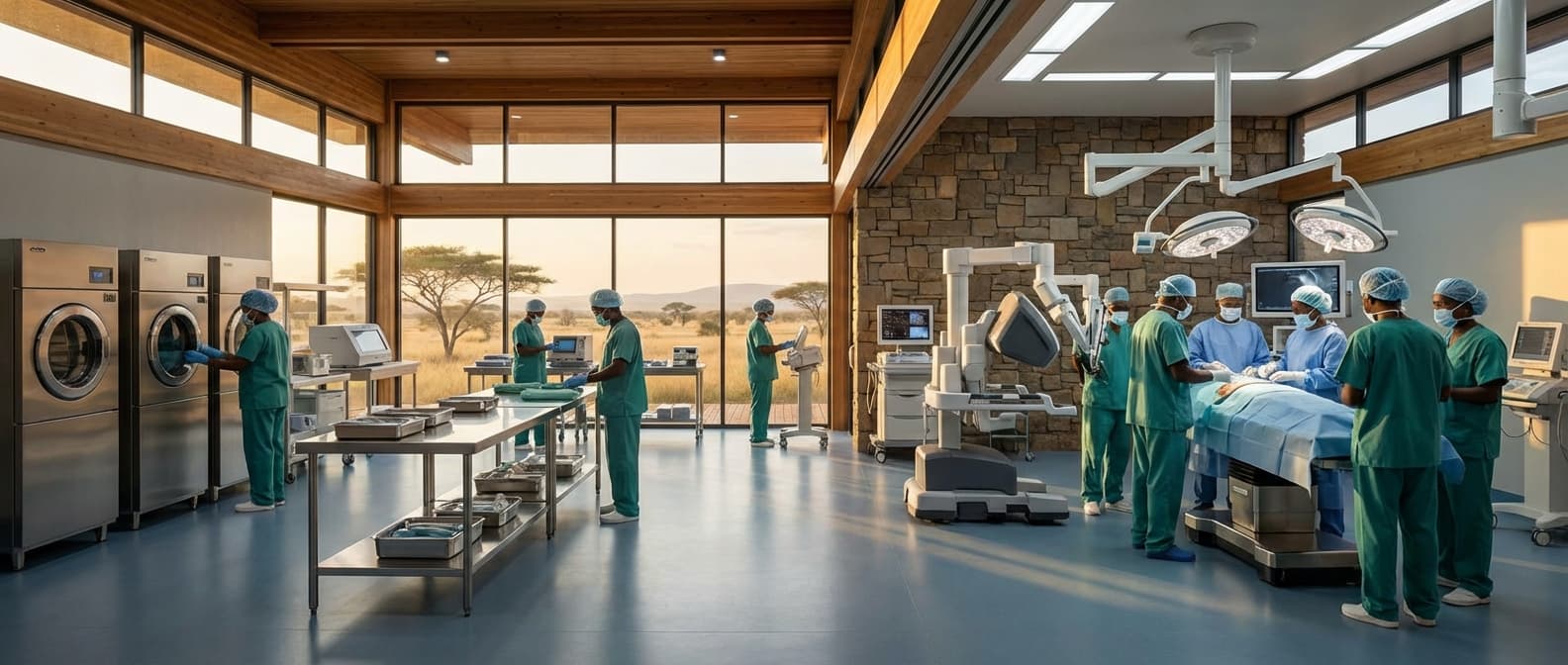
Operating Theatre Turnkey Build in South Africa
Engineering Excellence & Technical Support
Complete OR design, equipment integration and commissioning High-standard technical execution following OEM protocols and local regulatory frameworks.
Integrated Airflow & Infection Control
Leveraging advanced HEPA filtration and laminar flow systems to create ultra-clean environments, significantly reducing surgical site infection rates and ensuring patient safety, compliant with SANS 10400-XA and international healthcare standards.
Robust MEP Systems & Redundancy
Designing and implementing highly reliable Mechanical, Electrical, and Plumbing (MEP) systems with built-in redundancy for critical medical gases, power supply (including UPS and generators), and HVAC, guaranteeing uninterrupted operation during emergencies and power outages.
Advanced Biomedical Integration & Customisation
Seamlessly integrating state-of-the-art medical equipment, surgical lighting, imaging systems, and theatre control panels, offering fully customized solutions tailored to specific surgical specialties and hospital workflows for optimal clinical efficiency.
What Is Operating Theatre Turnkey Build In South Africa?
An Operating Theatre Turnkey Build in South Africa refers to a comprehensive service that delivers a fully functional and ready-to-operate surgical suite from design inception to final commissioning. This involves managing all aspects of the project, from initial architectural planning and regulatory compliance to the procurement and installation of specialized medical equipment, HVAC systems, sterile environments, and all supporting infrastructure. The 'turnkey' nature implies a single point of responsibility for the entire project, ensuring a seamless transition for the client and minimizing their direct involvement in the complexities of construction and specialized fit-out.
| Who Needs This Service? | Typical Use Cases | |||
|---|---|---|---|---|
| Hospitals and Healthcare Facilities: Both public and private hospitals requiring new operating theatres or upgrades to existing ones. | Specialty Clinics: Facilities focusing on specific surgical disciplines (e.g., cardiology, orthopedics, ophthalmology, neurosurgery) that require tailored operating environments. | Day Surgery Centers: Ambulatory surgery centers needing efficient and cost-effective operating theatre solutions. | Research and Training Institutions: Academic medical centers developing advanced surgical training facilities or conducting clinical research. | Government Health Departments: For public health infrastructure development and expansion. |
| Construction of New Surgical Suites: Building entirely new operating theatres from the ground up. | Renovation and Modernization of Existing Theatres: Upgrading outdated facilities to meet current technological and safety standards. | Expansion of Surgical Capacity: Adding new operating theatres to accommodate increased patient demand. | Establishment of Specialized Surgical Units: Creating dedicated theatres for highly specific procedures requiring unique equipment and environmental controls. | Emergency Response Facilities: Rapid deployment of functional surgical spaces in response to public health crises or disaster relief. |
Key Components of a Turnkey Operating Theatre Build:
- Design and Planning: Conceptualization, detailed architectural and engineering design, space planning, workflow optimization, and adherence to national and international healthcare standards (e.g., SANS, HTM).
- Civil and Structural Works: Demolition (if applicable), new construction, structural modifications, wall construction, flooring (anti-static, seamless, coved), ceiling installation, and door systems.
- MEP (Mechanical, Electrical, and Plumbing) Services: Installation of specialized HVAC systems with HEPA filtration, positive pressure differentials, temperature and humidity control, medical gas pipeline systems (oxygen, medical air, vacuum, nitrous oxide), advanced electrical distribution, emergency power backup (generators, UPS), lighting (surgical, ambient, task), and water/drainage systems.
- Specialized Medical Equipment Integration: Procurement, installation, and calibration of surgical lights, booms (medical pendants), anesthesia workstations, imaging equipment (C-arms, X-ray), electrosurgical units, monitoring systems, and communication systems.
- Sterile Environment Control: Design and implementation of infection control measures, including seamless finishes, non-porous materials, and pressure gradient management.
- Finishes and Furnishings: Application of specialized wall coatings, installation of sterile cabinetry, surgical instrument storage, and preparation areas.
- Testing, Commissioning, and Validation: Rigorous testing of all systems to ensure optimal performance, safety, and compliance, including air quality testing, pressure testing, and equipment functionality validation.
- Regulatory Approvals and Handover: Facilitation of necessary permits and certifications from relevant South African health authorities and regulatory bodies, followed by a complete handover of the facility.
- Project Management: End-to-end management of the project lifecycle, including budgeting, scheduling, risk management, and stakeholder communication.
Who Needs Operating Theatre Turnkey Build In South Africa?
Operating theatre turnkey builds in South Africa are a comprehensive solution for healthcare facilities requiring new, upgraded, or expanded surgical spaces. These projects encompass the entire process, from initial design and construction to the installation of specialized medical equipment and finishing. This holistic approach ensures that the operating theatre is fully functional, compliant with all relevant regulations and standards, and equipped with state-of-the-art technology, all delivered within a set budget and timeline. Turnkey solutions minimize the burden on the healthcare provider, allowing them to focus on patient care while experts manage the complex build process.
| Target Customer/Facility Type | Primary Departments & Needs | Key Considerations for Turnkey Builds |
|---|---|---|
| Public Hospitals | General Surgery, Orthopedics, Gynecology, Urology, Emergency Surgery. Need for cost-effective, high-capacity solutions and compliance with national health regulations. | Budget optimization, durability, infection control, modularity for future expansion, compliance with SANS standards. |
| Private Hospitals & Specialist Clinics | Cardiovascular Surgery, Neurosurgery, Bariatric Surgery, Fertility Treatment, Plastic & Reconstructive Surgery. Emphasis on advanced technology, patient experience, and surgeon preference. | Integration of advanced imaging (e.g., intra-operative MRI/CT), robotic surgery systems, specialized lighting and ventilation, premium finishes, workflow optimization, custom design. |
| Day Hospitals & Surgical Centres | Orthopedic procedures, Endoscopies, Cataract surgery, Minor surgical interventions. Focus on efficiency, patient throughput, and rapid turnaround times. | Streamlined layout, efficient instrument sterilization areas, advanced patient recovery spaces, integration of scheduling and IT systems. |
| Tertiary & Academic Hospitals | All surgical specialties, including complex transplants, reconstructive microsurgery, and experimental procedures. Need for research facilities and teaching capabilities. | Integration of research equipment, advanced AV systems for teaching, sterile processing departments designed for high complexity, simulation facilities, flexible configurations. |
| Emergency & Trauma Centres | Trauma surgery, general emergency procedures, acute care. Requirement for rapid deployment, high-volume capacity, and resilience. | Robust construction, advanced life support integration, rapid setup capabilities, easy access for emergency services, durable materials. |
Target Customers & Departments for Operating Theatre Turnkey Builds in South Africa
- Public Hospitals: Government-funded hospitals often require upgrades to existing facilities or the construction of new operating theatres to meet growing patient demands and improve service delivery. They may have budget constraints but a strong need for modern, efficient surgical spaces.
- Private Hospitals & Specialist Clinics: These institutions prioritize cutting-edge technology, patient comfort, and operational efficiency to attract both patients and leading surgeons. They often have more flexible budgets and a greater emphasis on premium finishes and specialized equipment.
- Day Hospitals & Surgical Centres: Facilities focused on same-day surgical procedures need well-designed and efficiently laid-out operating theatres that can accommodate a high throughput of cases. Turnkey solutions can streamline the setup process for these specialized environments.
- Tertiary & Academic Hospitals: These institutions require advanced operating theatres for complex procedures, research, and the training of medical professionals. They often need highly specialized facilities with integrated imaging and teleconferencing capabilities.
- Emergency & Trauma Centres: Facilities dealing with high-volume emergency surgeries need robust and rapidly deployable operating theatre solutions. Turnkey builds can ensure these critical areas are built to withstand demanding conditions and are equipped for immediate use.
- Rehabilitation & Long-Term Care Facilities with Surgical Units: While less common, some facilities offering extended care may have dedicated surgical units that require specialized operating theatre construction or upgrades.
Operating Theatre Turnkey Build Process In South Africa
The turnkey operating theatre (OT) build process in South Africa is a comprehensive and highly regulated undertaking that aims to deliver a fully functional and compliant surgical suite. This process involves a series of meticulously planned and executed stages, from the initial client inquiry to the final handover and commissioning. It demands expertise in architectural design, mechanical and electrical engineering, medical gas systems, infection control, and regulatory compliance. South Africa's stringent healthcare regulations necessitate a thorough approach to ensure patient safety and operational efficiency. The turnkey model simplifies the process for the client by consolidating all aspects of the build under a single point of responsibility, ensuring seamless integration and coordination.
| Phase | Key Activities | Deliverables | Typical Duration |
|---|---|---|---|
| Initial client consultation, understanding operational requirements, budget, and desired specifications. Site visit and initial assessment. | Project brief, preliminary scope of work, initial budget estimate. | 1-2 Weeks |
| Detailed analysis of site suitability, workflow optimization, equipment integration, and preliminary architectural layouts. Engagement with specialist consultants. | Feasibility report, conceptual design drawings, indicative cost breakdown. | 2-4 Weeks |
| Development of comprehensive architectural, structural, mechanical, electrical, and medical gas engineering drawings. Equipment selection and specification. Production of Bills of Quantities (BoQs). | Full set of detailed design drawings (CAD), specifications for all systems and finishes, BoQs, project schedule. | 4-8 Weeks |
| Submission of design documents to relevant authorities (e.g., Department of Health, local municipalities) for approval. Obtaining building permits and other necessary clearances. | Approved building plans, construction permits, environmental impact assessments (if required). | 4-12 Weeks (highly variable) |
| Sourcing and ordering of all materials, equipment, and specialized OT components. Manufacturing of custom-built items. | Procurement contracts, material delivery schedules, fabricated components. | 8-20 Weeks (overlaps with installation) |
| Demolition (if applicable), excavation, foundation work, structural construction, and ensuring the integrity of the building envelope. | Completed structural shell, prepared site for internal fit-out. | 6-10 Weeks |
| Installation of specialized HVAC systems (critical for infection control), medical gas pipelines, electrical wiring for medical equipment, and nurse call systems. | Installed and pressure-tested medical gas systems, functional HVAC, completed electrical infrastructure. | 10-16 Weeks |
| Installation of wall and floor finishes (antimicrobial, seamless), lighting, ceiling systems, OT doors, and integration of medical equipment consoles. | Completed interior finishes, installed lighting and ceiling, functional OT doors. | 6-10 Weeks |
| Thorough testing of all systems (HVAC, electrical, medical gases, lighting, safety). Performance verification against design specifications. Validation by accredited bodies to ensure compliance with international and national standards (e.g., SANS). | Commissioning reports, validation certificates, system performance data. | 2-4 Weeks |
| Comprehensive training for hospital staff on the operation and maintenance of the OT systems and equipment. Formal handover of the completed facility. | Training manuals, operational guides, Certificate of Practical Completion. | 1 Week |
| Defect liability period, ongoing maintenance, and support services as per contract. | Warranty documents, maintenance agreements. | Ongoing |
Operating Theatre Turnkey Build Process Workflow
- Inquiry and Needs Assessment
- Feasibility Study and Conceptual Design
- Detailed Design and Planning
- Regulatory Approvals and Permits
- Procurement and Manufacturing
- Site Preparation and Civil Works
- Installation of Medical Infrastructure
- Finishing and Interior Fit-out
- Testing, Commissioning, and Validation
- Training and Handover
- Post-Occupancy Support
Operating Theatre Turnkey Build Cost In South Africa
The cost of constructing an operating theatre turnkey project in South Africa is a complex calculation influenced by a multitude of factors. These can range from the geographical location within South Africa to the specific technological requirements and finishes chosen. A "turnkey" solution implies a fully equipped, ready-to-operate facility, encompassing design, construction, installation of medical equipment, and final commissioning. Prices are quoted in South African Rand (ZAR).
| Category | Estimated Cost Range (ZAR) |
|---|---|
| Small, basic operating theatre (general surgery, minimal equipment) | R 5,000,000 - R 15,000,000 |
| Medium-sized, well-equipped operating theatre (multiple specialties, advanced equipment) | R 15,000,000 - R 35,000,000 |
| Large, highly specialised, state-of-the-art operating theatre (e.g., cardiac, robotic surgery) | R 35,000,000 - R 100,000,000+ |
| Turnkey Project Management & Consultancy | Typically 5-15% of the total project cost |
| Medical Equipment (as a percentage of total build) | Can range from 30% to 60% or more, depending on specialization |
| HVAC & Sterilisation Systems | A significant portion, often R 2,000,000 - R 10,000,000+ per theatre |
Key Pricing Factors for Operating Theatre Turnkey Builds in South Africa:
- Size and Square Footage: The larger the operating theatre suite, the higher the overall construction cost.
- Number of Operating Theatres: A multi-theatre facility will naturally be more expensive than a single theatre.
- Level of Specialisation: General surgery theatres are typically less complex and costly than highly specialised ones (e.g., cardiac, neurosurgery, robotic surgery) which require more advanced infrastructure and equipment.
- Medical Equipment: This is a significant cost driver. The type, brand, and quantity of surgical lights, anesthesia machines, imaging equipment, patient monitors, sterilisation units, surgical tables, and specialized instruments will greatly impact the budget.
- Building Materials and Finishes: High-grade, anti-microbial, and durable materials for walls, floors, and ceilings are essential for infection control and longevity, but come at a premium.
- Ventilation and Air Filtration Systems (HVAC): Operating theatres require sophisticated, high-efficiency particulate air (HEPA) filtration systems to maintain sterile environments. These are custom-designed and expensive.
- Integrated Technology: Features like integrated video systems, digital recording, smart lighting, and nurse call systems add to the cost.
- Architectural and Engineering Design: The complexity of the design, including the layout of the theatre, pre-operative areas, post-operative recovery rooms, sterile corridors, and support spaces, will affect costs.
- Plumbing and Electrical Infrastructure: Specialised plumbing for medical gases, suction, and specific water requirements, along with robust electrical systems with backup power (generators, UPS), are crucial and costly.
- Safety Features: Requirements for radiation shielding (if applicable), fire suppression systems, and emergency power are factored in.
- Location and Site Conditions: Construction costs can vary significantly between major metropolitan areas (e.g., Johannesburg, Cape Town) and more remote locations. Site accessibility, ground conditions, and existing infrastructure also play a role.
- Regulatory Compliance and Certifications: Adherence to SANS standards, national health regulations, and potential international accreditations adds to the design and construction complexity and cost.
- Project Management and Consultancy Fees: The cost of experienced project managers and specialized consultants throughout the design and construction phases.
- Contingency: It is always advisable to include a contingency fund for unforeseen issues.
- Finishes and Aesthetics: While infection control is paramount, aesthetic choices for patient comfort and staff well-being can also influence cost.
- Turnkey Provider's Margin: The profit margin of the company providing the turnkey solution.
Affordable Operating Theatre Turnkey Build Options
Establishing an operating theatre is a significant undertaking, often perceived as prohibitively expensive. However, by exploring 'affordable operating theatre turnkey build options,' healthcare facilities can achieve their goals without compromising on quality or essential functionality. Turnkey solutions offer a streamlined approach, encompassing design, construction, equipment installation, and commissioning, all managed by a single provider. This integrated model inherently offers cost efficiencies. Value bundles are pre-defined packages of services and equipment designed to meet specific operational needs at a predictable price point. Cost-saving strategies are crucial for maximizing budget while ensuring a safe and compliant surgical environment.
| Value Bundle Type | Included Components | Key Cost-Saving Benefit |
|---|---|---|
| Basic Procedure Room Bundle | Standard Operating Light, Surgical Table, Anesthesia Machine, Essential Monitoring Equipment, Basic Ventilation, Standard Finishes. | Focuses on core surgical needs, minimizing specialized or high-end additions. Predictable pricing for essential functionality. |
| Intermediate Surgical Suite Bundle | Advanced Operating Light with Camera Integration, Powered Surgical Table, Comprehensive Anesthesia Workstation, Digital Imaging Integration, Advanced Ventilation (HEPA Filtration), Scrub Sink Stations. | Balances essential features with improved imaging and workflow capabilities, offering a good return on investment for common surgical procedures. |
| Specialty Module Bundle (e.g., Endoscopy) | Specialized Endoscopic Tower, Dedicated Imaging Equipment, Appropriate Lighting, Customised Ventilation for specific instruments, Integrated Control Systems. | Tailored for specific surgical disciplines, consolidating necessary equipment and infrastructure, avoiding over-specialization for general use. |
| Refurbishment & Upgrade Bundle | Assessment of existing infrastructure, upgrade of ventilation and lighting systems, integration of new equipment into existing space, minimal structural modifications. | Leverages existing building structure, significantly reducing overall capital expenditure compared to new construction. |
Key Components of Affordable Turnkey Operating Theatre Builds
- Modular Construction: Prefabricated modules can significantly reduce on-site construction time and labor costs.
- Standardized Equipment Packages: Opting for pre-selected, high-quality, yet cost-effective equipment can save on individual procurement and integration.
- Phased Development: Breaking down the project into manageable phases allows for staggered investment and potential utilization of existing infrastructure.
- Energy-Efficient Design: Incorporating LED lighting, efficient HVAC systems, and insulation reduces long-term operational expenses.
- Smart Technology Integration: Utilizing technology for workflow optimization and remote monitoring can improve efficiency and reduce staffing needs.
- Strategic Sourcing of Materials: Leveraging bulk purchasing and established supplier relationships for building materials.
- Experienced Project Management: A skilled project manager ensures efficient execution, minimizes delays, and prevents costly rework.
Verified Providers In South Africa
In South Africa's rapidly evolving healthcare landscape, identifying verified providers is crucial for patients seeking quality and trustworthy medical services. Franance Health stands out as a leading organization that rigorously vets its network of healthcare professionals. This commitment to credentialing ensures that patients have access to safe, effective, and ethically sound medical care. Understanding Franance Health's credentialing process sheds light on why their network represents the best choice for South Africans.
| Benefit for Patients | Why Franance Health Excels | Impact on Healthcare Experience |
|---|---|---|
| Peace of Mind and Trust | Franance Health's rigorous vetting process eliminates the guesswork, ensuring you are connected with legitimate and qualified practitioners. | Reduces anxiety and empowers patients to make informed decisions about their health. |
| Access to High-Quality Care | By selecting providers who meet stringent standards, Franance Health guarantees a higher caliber of medical expertise and patient care. | Leads to better health outcomes and a more positive treatment journey. |
| Reduced Risk of Malpractice or Negligence | The comprehensive background checks and verification procedures minimize the likelihood of encountering underqualified or unethical providers. | Enhances patient safety and protects against potential harm. |
| Streamlined Healthcare Navigation | Franance Health's curated network simplifies the search for specialized care, saving patients time and effort. | Provides a more efficient and less stressful experience when seeking medical assistance. |
| Commitment to Continuous Improvement | Franance Health's credentialing is not a one-time event; it often involves ongoing monitoring and adherence to evolving best practices. | Ensures that providers maintain their skills and knowledge, keeping pace with medical advancements. |
Key Aspects of Franance Health's Credentialing Process
- Thorough verification of medical licenses and registrations.
- In-depth review of educational background and qualifications.
- Assessment of professional experience and practice history.
- Background checks for any disciplinary actions or sanctions.
- Adherence to ethical practice guidelines and quality standards.
Scope Of Work For Operating Theatre Turnkey Build
This Scope of Work (SOW) outlines the requirements for a turnkey operating theatre build, encompassing all stages from design and procurement to construction, installation, commissioning, and handover. The project aims to deliver a fully functional, state-of-the-art operating theatre compliant with all relevant international and local standards and regulations. This document details the technical deliverables and standard specifications required for successful project completion.
| Category | Standard Specification | Description | Example Requirement |
|---|---|---|---|
| General Room Specifications | ISO 14644-1 | Cleanroom classification for operating theatres to control airborne particulate contamination. | Class ISO 7 or ISO 8 for general operating theatres; Class ISO 5 for specialized areas if required. |
| Air Handling Unit (AHU) & Ventilation | ASHRAE 170 | Ventilation of health care facilities, including air change rates, pressure differentials, and filtration. | Minimum 20 air changes per hour (ACH), with 15 ACH from outside air. Positive pressure relative to adjacent areas. |
| Filtration | EN 1822-1 | High-efficiency particulate air (HEPA) filters for removing airborne particles. | HEPA filters with a minimum efficiency of 99.97% for particles of 0.3 micrometers in diameter. |
| Surgical Lighting | IEC 60601-2-41 | Medical electrical equipment - Part 2-41: Particular requirements for the basic safety and essential performance of surgical luminaires and examination luminaires. | Illuminance levels of at least 160,000 lux at the focal point, with good color rendering index (CRI) and adjustable focus. |
| Medical Gas Outlets | ISO 32 & BS 5682 | Standards for medical gas pipeline systems, including outlet configurations and safety features. | Color-coded outlets for oxygen, medical air, vacuum, nitrous oxide, and other gases, with keyed-indexed connectors. |
| Wall and Ceiling Finishes | ASTM E84 | Surface burning characteristics of building materials, ensuring fire safety. | Class A fire rating for all wall and ceiling finishes. |
| Flooring | ASTM F1700 | Sheet vinyl flooring for healthcare facilities, emphasizing durability, chemical resistance, and infection control properties. | Seamless, coved, antimicrobial, and non-porous sheet vinyl flooring with heat-welded seams. |
| Electrical Systems | NFPA 99 | Health care facilities code, covering electrical safety, grounding, and emergency power systems. | Isolated power systems for critical areas, surge protection, and uninterrupted power supply (UPS) for essential equipment. |
| Noise Levels | ISO 1996 | Acoustics - Description, measurement and assessment of environmental noise. | Maximum noise levels not exceeding 40 dBA within the operating theatre during procedures. |
| X-ray Protection | NCRPM Report No. 147 | Recommendations of the National Council on Radiation Protection and Measurements for shielding in diagnostic imaging facilities. | Adequate lead shielding for walls, doors, and windows to maintain radiation exposure within safe limits. |
Key Project Stages and Responsibilities
- Phase 1: Design & Planning * Detailed architectural, mechanical, electrical, and plumbing (MEP) design development. * Compliance with infection control standards (e.g., laminar flow, HEPA filtration). * Integration of medical gas systems, lighting, and communication infrastructure. * Development of Bill of Quantities (BOQ) and specifications. * Obtaining all necessary permits and approvals.
- Phase 2: Procurement & Manufacturing * Sourcing and procurement of all materials, equipment, and finishes. * Manufacturing and pre-fabrication of modular components (if applicable). * Quality control and assurance of all procured items.
- Phase 3: Construction & Installation * Civil and structural works for the operating theatre space. * Installation of wall systems, flooring, and ceiling. * Installation of medical equipment (surgical lights, tables, booms, imaging systems, etc.). * Installation of MEP systems, including HVAC, electrical, medical gases, and data. * Integration of sterile processing and ancillary areas.
- Phase 4: Commissioning & Validation * Testing and commissioning of all installed systems and equipment. * Performance validation to ensure compliance with specifications. * Infection control validation and air quality testing. * Training of hospital staff on the operation and maintenance of the new facility.
- Phase 5: Handover & Closeout * Final inspection and acceptance by the client. * Provision of comprehensive documentation (as-built drawings, manuals, warranties). * Project closeout and final payment.
Service Level Agreement For Operating Theatre Turnkey Build
This Service Level Agreement (SLA) outlines the response times and uptime guarantees for the Operating Theatre Turnkey Build project. This agreement ensures timely resolution of critical issues and maintains the operational readiness of the newly constructed operating theatre facility.
| Category | Service Level Target | Measurement Period | Reporting Frequency | Penalty/Remedy |
|---|---|---|---|---|
| Critical Issue Response (e.g., system failure impacting immediate surgical procedures) | 15 minutes for initial acknowledgment; 1 hour for commencement of resolution efforts | 24/7/365 | Real-time notifications and daily reports | For each incident exceeding the resolution time, a daily credit equivalent to 0.5% of the monthly facility operating cost will be applied. For repeated critical failures (more than 2 within a month), a root cause analysis and corrective action plan will be mandatory. |
| High Priority Issue Response (e.g., non-critical equipment malfunction or performance degradation) | 1 hour for initial acknowledgment; 4 business hours for commencement of resolution efforts | Business Hours (Mon-Fri, 8 AM - 6 PM) | Daily reports | For each incident exceeding the resolution time, a daily credit equivalent to 0.2% of the monthly facility operating cost will be applied. |
| Standard Issue Response (e.g., minor non-functional issues, cosmetic defects) | 4 business hours for initial acknowledgment; 2 business days for commencement of resolution efforts | Business Hours (Mon-Fri, 8 AM - 6 PM) | Weekly reports | Issues not addressed within the stated timeframe will be escalated to project management for review and a revised action plan. |
| Facility Uptime Guarantee | 99.8% operational uptime | Monthly | Monthly reports | For every 30 minutes of unplanned downtime below the guaranteed uptime, a credit of 0.1% of the monthly facility operating cost will be applied. Uptime is defined as the ability to conduct scheduled surgical procedures without interruption due to facility-related failures. Excludes scheduled maintenance, force majeure events, and client-induced issues. |
| Scheduled Maintenance Notification | Minimum 7 days advance notice for all planned maintenance that may impact uptime | N/A | N/A | Failure to provide adequate notice may result in extended downtime compensation as per the Facility Uptime Guarantee. |
Key Performance Indicators (KPIs)
- Response Time: The maximum allowable time to acknowledge and begin addressing a reported issue.
- Uptime Guarantee: The minimum percentage of time the operating theatre facility is expected to be fully operational and available for use.
Frequently Asked Questions

Ready when you are
Let's scope your Operating Theatre Turnkey Build in South Africa project in South Africa.

Scaling healthcare logistics and technical systems across the entire continent.