
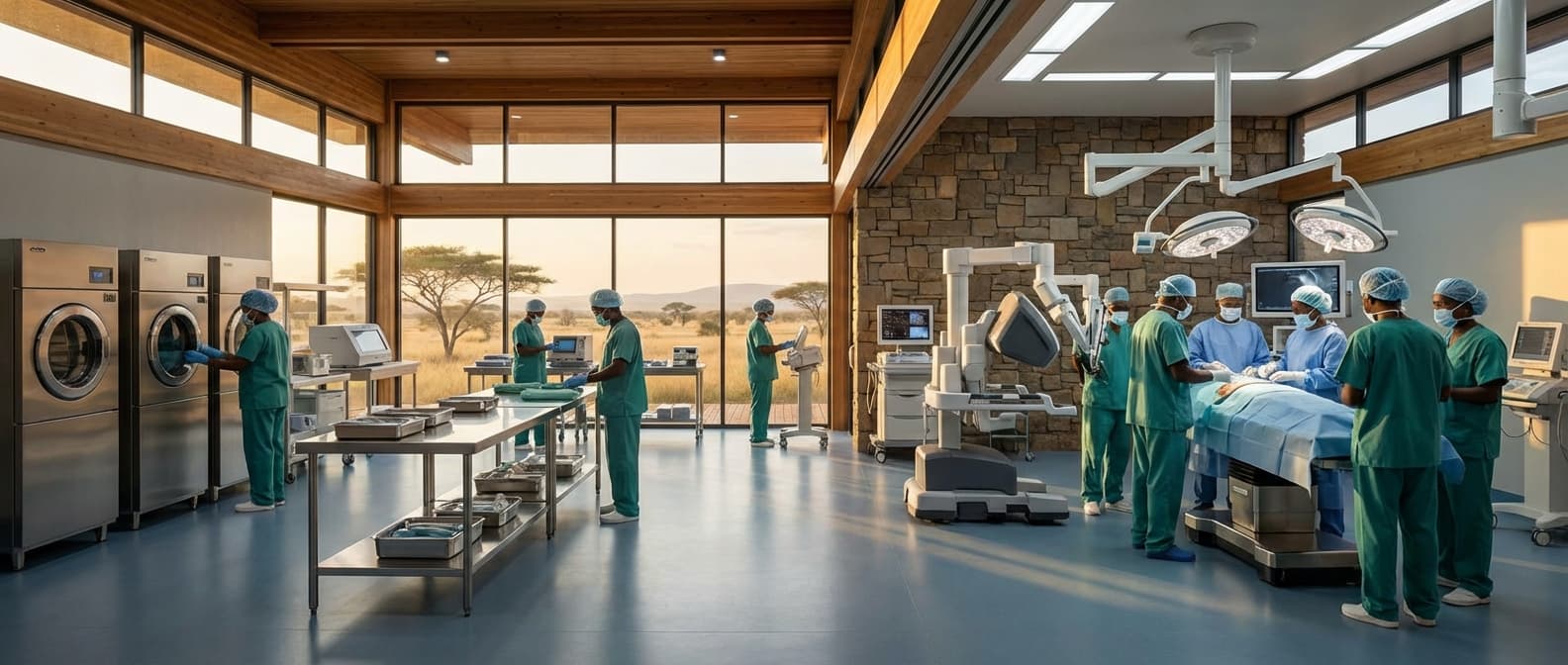
Medical Gas System Design & Installation in South Africa
Engineering Excellence & Technical Support
Medical gas pipeline systems: O2, N2O, air, vacuum High-standard technical execution following OEM protocols and local regulatory frameworks.
Advanced Medical Gas System Design
We engineer state-of-the-art medical gas systems compliant with South African SANS standards. Our designs prioritize patient safety, system reliability, and operational efficiency, incorporating features like redundant supply systems, advanced monitoring, and compliance with NFPA 99 for critical healthcare environments.
Expert Medical Gas System Installation
Our certified technicians provide seamless installation of medical gas pipelines, outlets, alarms, and control systems across South Africa. We adhere to stringent quality control and safety protocols, ensuring minimal disruption to healthcare operations and certifying the integrity of every installation for optimal performance.
Comprehensive Medical Gas System Maintenance & Audits
We offer proactive maintenance and regular auditing services for medical gas systems in South African healthcare facilities. Our preventative maintenance programs and thorough system audits ensure ongoing compliance, identify potential issues before they arise, and guarantee the long-term safety and functionality of your critical life support infrastructure.
What Is Medical Gas System Design & Installation In South Africa?
Medical Gas System Design & Installation in South Africa refers to the specialized engineering and construction process of creating, implementing, and commissioning the infrastructure responsible for the safe and reliable delivery of medical gases within healthcare facilities. This encompasses the planning, specification, and physical installation of gas pipelines, control panels, alarm systems, terminal units, and the integration of central supply sources such as bulk cryogenic vessels, medical gas cylinders, or medical air compressors. The design phase involves rigorous adherence to international standards (e.g., NFPA 99, HTM 02-01) and South African National Standards (SANS) to ensure patient safety, system integrity, and regulatory compliance. Installation requires certified personnel with expertise in handling high-pressure medical gases and specialized welding techniques to prevent leaks and contamination. Commissioning is a critical final stage involving rigorous testing, validation, and documentation to confirm that the system performs to specified parameters under all operating conditions, including emergency scenarios. The service is essential for any healthcare institution requiring a consistent and safe supply of critical medical gases to patient care areas.
| Service/Component | Description | Purpose |
|---|---|---|
| Design | Conceptualization, schematic development, detailed engineering drawings, and specification of materials and equipment. | Ensures system functionality, safety, efficiency, and compliance with relevant standards. |
| Installation | Physical erection of the medical gas network, including piping, valves, pressure regulators, alarm panels, and terminal units, by certified technicians. | Translates the design into a tangible, operational infrastructure. |
| Commissioning | Systematic testing, validation, and verification of all components and the integrated system under various operational and simulated failure conditions. | Confirms system performance, safety, and readiness for clinical use. |
| Medical Air Compressors | Equipment generating clean, dry, and oil-free compressed air for patient ventilation and respiratory support. | Provides a safe and consistent source of breathable air. |
| Oxygen Supply | Delivery of medical-grade oxygen for respiratory therapy, resuscitation, and anesthesia. | Essential for maintaining oxygenation in critically ill patients. |
| Medical Vacuum Systems | Suction systems used for removal of fluids, secretions, and waste from surgical sites and patient airways. | Facilitates surgical procedures and airway management. |
| Nitrous Oxide | Gas used for sedation and analgesia in surgical and dental procedures. | Provides pain relief and anxiolysis. |
| Alarm Systems | Audible and visual indicators that alert staff to pressure fluctuations, gas supply failure, or other system anomalies. | Provides early warning of potential hazards and system failures. |
| Terminal Units/Outlets | Interface points at the patient's bedside or in operating theaters for connecting medical gas devices. | Enables immediate and safe access to medical gases. |
Key Components of Medical Gas System Design & Installation
- Central Gas Supply Systems (Bulk Liquid, Cylinder Banks, Compressors, Vacuum Pumps)
- Medical Gas Pipeline Systems (Piping, Valves, Pressure Regulators)
- Alarm and Monitoring Systems (Pressure, Flow, Gas Composition)
- Terminal Units and Outlets (Wall Outlets, Ceiling Pendants)
- Manifold Systems (Automated Changeover and Control)
- Design and Engineering Calculations
- Regulatory Compliance and Standards Adherence
- Installation and Brazing/Welding
- Pressure Testing and Leak Detection
- Purging and Commissioning
- Documentation and As-Built Drawings
Who Needs Medical Gas System Design & Installation In South Africa?
In South Africa, the demand for reliable and compliant medical gas systems is crucial for ensuring patient safety and the efficient operation of healthcare facilities. These systems are not just about supplying oxygen; they encompass a range of medical gases like nitrous oxide, medical air, and vacuum, each with specific storage, distribution, and safety requirements. Designing and installing these systems requires specialized expertise to meet stringent SANS standards and international best practices. Ignoring proper design and installation can lead to operational failures, contamination risks, and potential harm to patients and medical staff. Therefore, any facility that utilizes medical gases for patient care or laboratory procedures necessitates professional design and installation services.
| Department | Primary Medical Gas Needs | Key Considerations |
|---|---|---|
| Operating Theatres/Surgical Suites | Oxygen, Nitrous Oxide, Medical Air, Vacuum | Anesthesia delivery, patient ventilation, surgical site suction, post-operative recovery |
| Intensive Care Units (ICU) & High Care Units | Oxygen, Medical Air, Vacuum | Mechanical ventilation, respiratory support, nebulization therapy |
| Emergency Departments (ER) | Oxygen, Medical Air, Vacuum | Resuscitation, acute respiratory distress, trauma care |
| General Wards | Oxygen, Medical Air, Vacuum | Routine respiratory support, oxygen therapy for various conditions |
| Maternity Wards & Neonatal Units | Oxygen, Medical Air, Vacuum | Support for premature infants, respiratory distress in newborns |
| Outpatient Clinics & Procedure Rooms | Oxygen, Nitrous Oxide (optional), Medical Air | Minor procedures, sedation, recovery |
| Dialysis Units | Medical Air | Potentially used in patient monitoring equipment |
| Diagnostic Imaging (e.g., MRI) | Helium (for MRI magnets), Medical Air | Specific gas requirements for specialized equipment |
| Central Sterile Services Department (CSSD) | Medical Air | Operation of certain sterilization equipment |
| Pharmacy | Medical Air, Oxygen (limited use) | May be used in compounding or specific testing |
Target Customers and Departments for Medical Gas System Design & Installation in South Africa:
- {"title":"Hospitals (Public & Private)","description":"The primary consumers of medical gas systems. This includes a wide spectrum of facilities, from large tertiary referral hospitals to smaller community clinics."}
- {"title":"Day Clinics & Surgical Centers","description":"Facilities performing outpatient procedures and surgeries often require specialized gases like nitrous oxide for anesthesia and oxygen for recovery."}
- {"title":"Specialized Medical Facilities","description":"This category includes rehabilitation centers, dialysis units, and oncology treatment centers that rely on specific medical gases for their operations."}
- {"title":"Veterinary Hospitals & Clinics","description":"While not human-focused, veterinary practices utilize medical gases for anesthesia, oxygen therapy, and post-operative care for animals."}
- {"title":"Laboratories (Medical & Research)","description":"Medical and research laboratories often require medical-grade gases like pure oxygen, nitrogen, or helium for analytical equipment and experimental procedures."}
- {"title":"Emergency Services & Ambulances","description":"Mobile units require robust and compliant medical gas systems for pre-hospital care and patient transport."}
- {"title":"Educational Institutions (Medical Schools)","description":"Universities and colleges with medical training programs need operational medical gas systems for practical learning and simulation centers."}
- {"title":"Industrial & Manufacturing Plants (Specific Applications)","description":"Certain industrial processes might require medical-grade gases, although this is a less common application compared to healthcare."}
Medical Gas System Design & Installation Process In South Africa
The medical gas system design and installation process in South Africa is a multi-stage undertaking that ensures the safe, reliable, and compliant delivery of essential medical gases to healthcare facilities. This workflow, from the initial client inquiry to the final system handover, involves several key phases, rigorous planning, and adherence to national and international standards.
| Stage | Key Activities | Key Deliverables/Outcomes |
|---|---|---|
| Inquiry & Initial Consultation | Needs assessment, site visit, scope definition | Project brief, initial requirements document |
| Feasibility Study & Conceptual Design | Viability assessment, preliminary layout, budget estimation | Feasibility report, conceptual design drawings |
| Detailed Design & Engineering | P&IDs, layout plans, equipment specification, calculations | Approved design drawings, technical specifications |
| Regulatory Approvals & Permitting | Submission of design documents, obtaining permits | Approved plans, construction permits |
| Procurement & Material Sourcing | Ordering of pipes, fittings, valves, outlets, alarms, etc. | Procurement records, certified materials |
| Fabrication & Pre-assembly | Off-site construction of system components | Fabricated pipe spools, assembled skids |
| Installation & Construction | On-site pipeline installation, equipment fitting | Installed piping network, connected equipment |
| Testing & Commissioning | Leak tests, pressure tests, purging, functional checks, gas analysis | Commissioning reports, test certificates, functional system |
| Training & Handover | Staff training on operation and maintenance | Trained personnel, O&M manuals, as-built drawings |
| Post-Installation Support & Maintenance | Scheduled maintenance, emergency repairs, system checks | Maintained system, service reports |
Key Stages of the Medical Gas System Design & Installation Process
- {"title":"1. Inquiry & Initial Consultation","description":"The process begins with a healthcare facility (or their appointed consultant) initiating contact with a specialized medical gas system provider. This initial stage involves understanding the client's needs, project scope, facility type, and the types and quantities of medical gases required. Site visits may be conducted to assess existing infrastructure and gather crucial information."}
- {"title":"2. Feasibility Study & Conceptual Design","description":"Based on the initial consultation, a feasibility study is conducted to determine the viability of the project, considering factors like space availability, structural integrity, existing utilities, and budget constraints. A conceptual design is then developed, outlining the general layout, primary components, and preliminary sizing of the system. This stage often involves preliminary discussions with regulatory bodies."}
- {"title":"3. Detailed Design & Engineering","description":"This is a critical phase where detailed engineering drawings, schematics, and specifications are produced. This includes P&ID (Piping and Instrumentation Diagrams), layout plans for pipelines, equipment selection (medical gas outlets, alarms, pressure regulators, manifolds, etc.), pipe sizing calculations, and material specifications. Compliance with South African National Standards (SANS) and relevant international codes (e.g., HTM 02-01) is paramount."}
- {"title":"4. Regulatory Approvals & Permitting","description":"The detailed design documents are submitted to relevant authorities for approval. This may include the Department of Health, local municipal authorities, and potentially other safety regulatory bodies. Obtaining necessary permits is crucial before any installation work can commence."}
- {"title":"5. Procurement & Material Sourcing","description":"Once approvals are secured, the procurement of all necessary materials and equipment takes place. This involves sourcing high-quality, medical-grade components from certified suppliers. Strict quality control measures are applied to ensure all items meet the design specifications and regulatory requirements."}
- {"title":"6. Fabrication & Pre-assembly (if applicable)","description":"Certain components, such as pipe spools or skids, may be fabricated off-site in a controlled environment to ensure precision and efficiency. This pre-assembly can reduce on-site disruption and installation time."}
- {"title":"7. Installation & Construction","description":"This is the on-site execution phase. Skilled technicians and certified welders install the medical gas pipelines, connect equipment, and integrate various system components according to the approved design. Strict adherence to safety protocols and installation procedures is maintained throughout this stage."}
- {"title":"8. Testing & Commissioning","description":"A rigorous testing and commissioning process follows installation. This involves leak testing, pressure testing, purging of pipelines to remove contaminants, and verifying the correct operation of all alarms, regulators, and outlets. Gas purity testing is also conducted to ensure the medical gases meet required standards. Comprehensive test reports are generated."}
- {"title":"9. Training & Handover","description":"Upon successful commissioning, facility staff responsible for operating and maintaining the medical gas system receive comprehensive training. This covers the system's functionality, emergency procedures, routine maintenance, and troubleshooting. The system is then formally handed over to the client, along with all documentation, including design drawings, test reports, and operation & maintenance manuals."}
- {"title":"10. Post-Installation Support & Maintenance","description":"Many providers offer ongoing support and maintenance services to ensure the long-term integrity and optimal performance of the medical gas system. This can include scheduled preventative maintenance, emergency call-outs, and system upgrades."}
Medical Gas System Design & Installation Cost In South Africa
Designing and installing a medical gas system in South Africa involves a complex interplay of factors that significantly influence the overall cost. These systems are critical for patient care, requiring adherence to stringent safety and performance standards. The price can vary dramatically based on the scale of the project, the types of gases required, the complexity of the piping network, and the level of technology incorporated. Understanding these pricing factors is crucial for accurate budgeting and project planning within the South African context. Local currency considerations (South African Rand - ZAR) are paramount, as are the availability and cost of specialized components and skilled labor within the country.
| System Component / Service | Estimated Cost Range (ZAR) | Notes |
|---|---|---|
| Medical Gas Piping (per meter) | R 500 - R 2,000+ | Varies by gas type, material, and complexity of installation. |
| Medical Gas Outlets (per outlet) | R 1,000 - R 5,000+ | Depends on gas type, brand, and features (e.g., keyed, integrated alarm). |
| Central Vacuum Systems (e.g., pump, receiver) | R 50,000 - R 500,000+ | Scales with the number of vacuum points and required capacity. |
| Medical Air Compressors (e.g., medical grade) | R 75,000 - R 750,000+ | Depends on required airflow, purity, and redundancy. |
| Oxygen Concentrators (PSA, per unit) | R 100,000 - R 1,000,000+ | Capacity and redundancy are key drivers. |
| Bulk Liquid Oxygen Storage (tank, installation) | R 200,000 - R 2,000,000+ | Size of tank and associated infrastructure. |
| Nitrous Oxide Manifolds (cylinder banks) | R 30,000 - R 300,000+ | Number of cylinders and automation. |
| Alarm & Monitoring Systems (basic to advanced) | R 10,000 - R 250,000+ | Basic pressure monitors versus sophisticated digital systems with remote capabilities. |
| Design & Engineering Fees | 5% - 15% of total project cost | Varies based on complexity and consultant's experience. |
| Installation Labor (skilled technicians) | R 500 - R 2,500+ per day/person | Dependent on the demand for specialized skills in the region. |
| Testing & Commissioning | R 20,000 - R 200,000+ | Includes leak testing, gas purity analysis, and functional checks. |
| Complete Small Clinic System (basic oxygen/vacuum) | R 500,000 - R 2,500,000+ | Excluding bulk storage if applicable. |
| Medium Hospital Wing (multiple gases) | R 2,000,000 - R 10,000,000+ | Scales significantly with complexity and bed count. |
| Large Hospital or Multi-Facility Project | R 10,000,000 - R 100,000,000+ | Highly project-specific and can involve extensive infrastructure. |
Key Pricing Factors for Medical Gas System Design & Installation in South Africa:
- System Size and Scope: The number of medical facilities, wards, operating theaters, and patient beds requiring medical gas supply directly impacts the complexity and material requirements.
- Types of Medical Gases: The specific gases needed (e.g., oxygen, medical air, nitrous oxide, vacuum, nitrogen) influence piping material, pressure regulation, and alarm systems, with some gases requiring more specialized handling.
- Piping Network Design and Layout: The total length of piping, the number of connection points, and the need for specialized materials (like copper alloys to prevent contamination) significantly affect material and labor costs.
- Central Supply Equipment: The type and capacity of medical gas generators (e.g., PSA oxygen generators), bulk liquid oxygen tanks, or compressed gas cylinder manifolds, along with their installation and integration.
- Alarm and Monitoring Systems: The sophistication of the system for monitoring gas pressure, purity, and supply status. Advanced digital systems with remote monitoring capabilities will be more expensive.
- Safety and Compliance Standards: Adherence to South African National Standards (SANS) and international regulations (e.g., ISO, HTM) often necessitates higher quality materials, specialized testing, and more rigorous installation procedures.
- Location and Accessibility: Remote or difficult-to-access locations can incur higher transportation and labor costs.
- Site Preparation and Infrastructure: Any necessary modifications to the building structure, power supply, or ventilation systems required for the medical gas installation.
- Specialized Equipment and Accessories: The inclusion of medical gas outlets, flow meters, regulators, bed head units, and emergency shut-off valves.
- Design and Engineering Fees: The cost of specialized engineers and consultants for system design, specifications, and project management.
- Installation Labor Costs: The availability and cost of skilled technicians, pipefitters, and electricians experienced in medical gas systems within South Africa.
- Testing and Commissioning: The rigorous testing and commissioning process required to ensure system functionality, safety, and compliance.
- Maintenance and Service Agreements: Ongoing costs for maintenance, calibration, and emergency service can be factored into the initial project. Optional, but often recommended.
- Brand and Manufacturer Choice: The selection of specific equipment manufacturers and the quality of components can influence the price.
- Project Timeline and Urgency: Rush projects may incur premium charges for expedited design, procurement, and installation.
Affordable Medical Gas System Design & Installation Options
Designing and installing a medical gas system can be a significant investment for healthcare facilities. However, by exploring various options, understanding value bundles, and implementing cost-saving strategies, facilities can achieve their required infrastructure without compromising on quality or safety. This guide outlines key considerations for affordable medical gas system design and installation, focusing on practical approaches to manage costs effectively.
| Cost-Saving Strategy | Description | Potential Benefits |
|---|---|---|
| Value Bundling | Engaging a single provider or consortium for design, installation, and potentially ongoing maintenance of the medical gas system and related infrastructure (e.g., vacuum, air). This can streamline project management and potentially offer discounts for integrated services. | Reduced administrative overhead, potential volume discounts, coordinated project timelines, simplified communication, and integrated warranty and service plans. |
| Off-the-Shelf Components | Prioritizing the use of readily available, standard medical gas components from reputable manufacturers. This contrasts with highly customized or bespoke solutions. | Lower material costs due to mass production, faster procurement times, easier replacement parts availability, and reduced risk of compatibility issues. |
| Modular Design | Designing the system in modular sections that can be pre-fabricated or easily assembled on-site. This allows for flexibility and potential for future expansion without major overhauls. | Reduced on-site labor, faster installation, easier troubleshooting and repair, and cost-effective scalability. |
| Energy-Efficient Equipment | Selecting energy-efficient medical air compressors and vacuum pumps that consume less power, leading to lower operational costs over the lifespan of the system. | Reduced electricity bills, lower environmental impact, and potentially longer equipment lifespan due to less strain. |
| Preventative Maintenance Contracts | Negotiating a comprehensive preventative maintenance contract with the installer or a specialized service provider. This proactive approach can prevent costly emergency repairs. | Extended equipment life, reduced risk of system failures, improved system reliability, predictable maintenance costs, and extended warranty coverage. |
| In-House Training for Maintenance | Investing in training facility maintenance staff to perform basic diagnostic and preventative maintenance tasks on the medical gas system. | Reduced reliance on external service calls for routine checks, faster response times for minor issues, and cost savings on labor. |
| Bulk Purchasing of Consumables | If a facility has multiple locations or a large system, negotiating bulk purchase agreements for medical gas consumables (e.g., filters, regulators) can lead to discounts. | Lower per-unit costs, reduced inventory management effort, and assured availability of critical parts. |
Key Considerations for Affordable Medical Gas System Design & Installation
- System Scalability and Future-Proofing: Design systems that can be expanded or adapted to future needs, avoiding costly retrofits. Consider modular components and readily available connection points.
- Material Selection: Opt for durable yet cost-effective materials for piping, outlets, and alarms. Balance initial cost with long-term maintenance and replacement expenses.
- Standardization: Utilize standard components and configurations wherever possible to leverage economies of scale in purchasing and simplify maintenance.
- Phased Implementation: For larger projects, consider a phased installation approach to spread costs over time and manage budget fluctuations.
- Automation and Monitoring: Invest in automated shut-off valves and remote monitoring systems to enhance safety and potentially reduce labor costs associated with manual checks.
- Regulatory Compliance: Ensure the design and installation strictly adhere to all relevant medical gas standards (e.g., NFPA 99, ASSE 6000 series) to avoid costly non-compliance penalties and rework.
- Experienced Design Professionals: Engage with experienced and reputable medical gas designers and engineers who can optimize the system for efficiency and cost-effectiveness.
- Competitive Bidding: Obtain multiple quotes from qualified medical gas installation companies to ensure competitive pricing.
Verified Providers In South Africa
Finding verified healthcare providers in South Africa is crucial for ensuring quality care and peace of mind. Franance Health distinguishes itself by its rigorous credentialing process, ensuring that all listed providers meet high standards of professionalism, qualifications, and ethical practice. This commitment to verification makes Franance Health the premier choice for individuals seeking reliable and competent medical professionals across the nation.
| Credential Type | Franance Health Verification Process | Why It Matters for Patients |
|---|---|---|
| Professional Licenses & Registration | Confirmation of current, valid registration with relevant South African medical councils (e.g., HPCSA). | Ensures providers are legally qualified and authorized to practice. |
| Educational Qualifications | Verification of degrees, diplomas, and specialized training from accredited institutions. | Guarantees providers have received foundational and advanced medical education. |
| Professional Experience | Review of past practice history and areas of expertise. | Helps identify providers with proven track records and relevant experience for specific conditions. |
| Continuing Professional Development (CPD) | Confirmation of ongoing engagement in learning and skill enhancement. | Indicates providers stay current with medical advancements and best practices. |
| Background Checks & Disciplinary Record | Inquiries into any past disciplinary actions or malpractice claims. | Protects patients by screening out providers with a history of misconduct. |
Key Benefits of Choosing Franance Health Verified Providers:
- Uncompromised Quality of Care: All providers undergo a thorough vetting process, guaranteeing they possess the necessary qualifications, experience, and licenses.
- Patient Safety First: Verification includes checks on disciplinary actions and professional conduct, prioritizing your well-being.
- Trust and Reliability: Access a network of healthcare professionals who have met Franance Health's stringent criteria, building confidence in your choice.
- Comprehensive Provider Information: Beyond verification, detailed profiles offer insights into specializations, experience, and patient reviews.
- Streamlined Healthcare Access: Easily find and connect with verified specialists and general practitioners tailored to your needs.
Scope Of Work For Medical Gas System Design & Installation
This Scope of Work outlines the requirements for the design and installation of a medical gas system. It details the technical deliverables expected from the contractor and specifies the standard specifications to be adhered to throughout the project. The objective is to ensure a safe, reliable, and compliant medical gas system that meets all regulatory and healthcare facility requirements.
| Category | Standard Specification | Applicable Gas(es) | Key Requirements |
|---|---|---|---|
| Piping | NFPA 99 Health Care Facilities Code | Oxygen (O2), Medical Air (MA), Vacuum (VAC), Nitrous Oxide (N2O), etc. | Material, joint type, pressure rating, purging, cleanliness |
| Materials | ASTM B88 (Copper Tubing) | O2, MA, N2O | Seamless, annealed copper, specific alloy grades |
| Valves | ASSE 1014 / NFPA 99 | All | Pressure rating, material, flow capacity, labeling |
| Alarm Systems | NFPA 99 / ISO 7396-1 | All | Monitoring pressure, audible/visual alarms, backup power |
| Manifolds | NFPA 99 / ISO 7396-1 | O2, MA, N2O | Automatic or manual changeover, pressure regulation, safety features |
| Terminal Units/Outlets | DISS, NIST, Ohmeda | All | Quick connect/disconnect, color-coding, pressure regulation, flow rates |
| Regulators | CGA Standards | All | Pressure regulation, safety relief, connection type |
| Pressure Testing | NFPA 99 | All | Pressure holding time, allowable leakage rate |
| System Cleaning & Purging | NFPA 99 / ISO 7396-1 | All | Methods, acceptable particulate and oil levels |
| System Certification | NFPA 99 | All | Independent testing and verification of system performance and safety |
Technical Deliverables
- Detailed Design Drawings (CAD format)
- System Schematics and Flow Diagrams
- Equipment Submittals and Specifications
- Pressure Test Reports
- Purge and Cleanliness Certificates
- As-Built Drawings
- Operations and Maintenance Manuals
- User Training Programs
- Compliance Documentation (e.g., NFPA, local codes)
- System Performance Test Reports
Service Level Agreement For Medical Gas System Design & Installation
This Service Level Agreement (SLA) outlines the terms and conditions governing the design and installation of medical gas systems by [Your Company Name] for [Client Name]. It specifically details response times for service requests and uptime guarantees for the installed medical gas systems.
| Service Level | Description | Target Response Time | Priority Level | Uptime Guarantee | Notes |
|---|---|---|---|---|---|
| Design Consultation & Development | Initial consultation, system conceptualization, and preliminary design documentation. | 3 Business Days for initial meeting scheduling after request. | Standard | N/A (Service Level applies to operational systems) | Client collaboration is crucial for timely progress. |
| Detailed Design & Documentation | Creation of comprehensive engineering drawings, specifications, and Bill of Materials (BOM). | 5 Business Days for initial design review feedback after submission. | Standard | N/A | Subject to Client's timely provision of necessary site information. |
| Pre-Installation Site Survey & Preparation | On-site verification of design against existing conditions and preparation for installation. | 2 Business Days notice for scheduled site visits. | Standard | N/A | Client must ensure site access and necessary approvals. |
| Installation of Medical Gas System | Physical installation of piping, valves, outlets, alarms, and associated equipment according to approved design. | On-site presence within 10 Business Days of agreed start date. | Standard | N/A (This SLA focuses on post-installation support) | Adherence to all applicable codes and standards. |
| System Testing & Commissioning | Thorough testing, purging, and certification of the installed system. | Completion within 5 Business Days of system readiness for testing. | Standard | N/A | Client representatives must be present for acceptance testing. |
| Emergency Service Request (System Failure) | Immediate cessation of medical gas supply or critical alarm indicating potential system failure. | 2 Hours for on-site arrival or remote troubleshooting initiation. | Critical | 99.9% Uptime Guarantee for critical medical gas supplies (e.g., Oxygen, Medical Air). | This applies to the entire installed medical gas system as a whole. Response requires verified system failure. |
| Urgent Service Request (Minor Issue/Reduced Performance) | Non-critical alarm, intermittent supply issues, or minor component malfunction affecting a single outlet. | 8 Business Hours for remote troubleshooting or dispatch of technician. | High | 99.5% Uptime Guarantee for the overall medical gas system. | Focus on preventing escalation to critical failure. |
| Routine Service Request (Non-critical) | Requests for scheduled maintenance, system checks, or minor adjustments not impacting immediate operation. | 2 Business Days for scheduling, subject to technician availability. | Normal | N/A (Service Level applies to operational systems) | Proactive maintenance is recommended to avoid service disruptions. |
Key Definitions
- Medical Gas System: Refers to the complete network of piping, outlets, alarms, and related equipment for the supply and distribution of medical gases (e.g., oxygen, medical air, nitrous oxide, vacuum) as designed and installed under this agreement.
- Service Request: A formal request for support initiated by the Client regarding the designed or installed medical gas system, submitted through [Designated Communication Channel, e.g., Client Portal, Email Address, Phone Number].
- Downtime: The period during which the medical gas system or a critical component thereof is not fully operational and available for its intended medical use, excluding scheduled maintenance or Force Majeure events.
- Response Time: The maximum time allowed for [Your Company Name] to acknowledge and begin active troubleshooting or dispatch of personnel after receiving a Service Request.
- Uptime Guarantee: The minimum percentage of time the medical gas system is expected to be fully operational and available.
- Critical Component: Any component of the medical gas system whose failure would directly impact the availability of a vital medical gas supply, as identified in the system design documentation.
Frequently Asked Questions

Ready when you are
Let's scope your Medical Gas System Design & Installation in South Africa project in South Africa.

Scaling healthcare logistics and technical systems across the entire continent.