
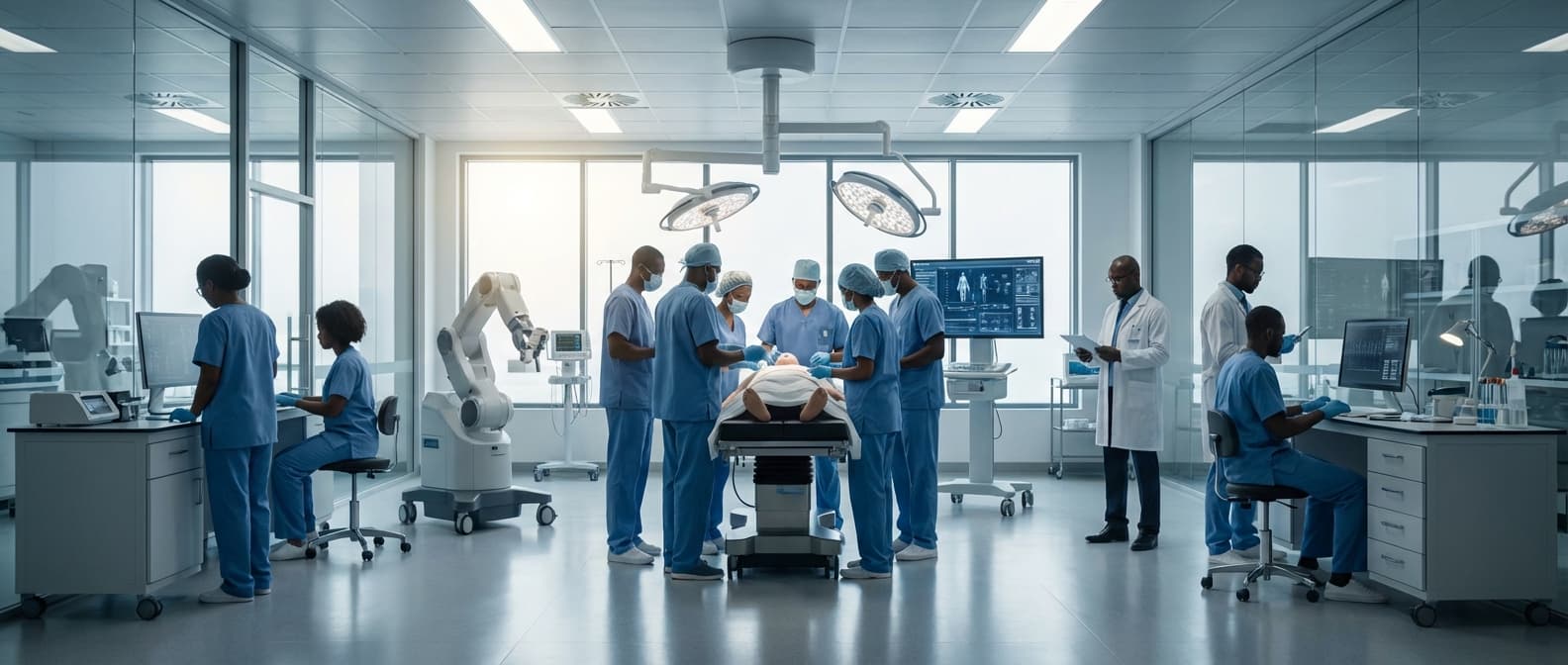
Managed Equipment Service (MES) in South Africa
Engineering Excellence & Technical Support
Long‑term equipment provision with uptime SLAs and lifecycle management. High-standard technical execution following OEM protocols and local regulatory frameworks.
Optimized Fleet Management & Deployment
Leveraging advanced telematics and AI-driven analytics, MES in South Africa optimizes the deployment and maintenance of your critical medical equipment fleet. We ensure maximum uptime, efficient resource allocation, and cost savings through predictive maintenance scheduling and real-time performance monitoring, keeping your operations running seamlessly across diverse geographical locations.
Robust Cybersecurity & Data Integrity
MES prioritizes the security of your sensitive patient data and connected medical devices. Our comprehensive cybersecurity framework, compliant with South African data protection regulations (POPIA), includes proactive threat detection, secure data transmission protocols, and regular vulnerability assessments to safeguard against breaches and ensure uninterrupted operational integrity.
Seamless Integration & Lifecycle Management
MES provides end-to-end management of your medical equipment lifecycle in South Africa. From procurement and seamless integration with existing hospital systems to ongoing maintenance, upgrades, and responsible decommissioning, we ensure optimal performance, compliance, and a reduced total cost of ownership. Our expertise guarantees that your technology is always up-to-date and functioning at peak efficiency.
What Is Managed Equipment Service (Mes) In South Africa?
Managed Equipment Service (MES) in South Africa refers to a comprehensive outsourcing model where a third-party provider takes responsibility for the procurement, installation, maintenance, operation, and lifecycle management of an organization's critical equipment. This service aims to optimize equipment performance, reduce operational costs, mitigate risks, and allow the client organization to focus on its core competencies. MES agreements are typically structured to include a defined scope of services, service level agreements (SLAs), and performance metrics, often on a fixed fee or pay-per-use basis.
| Who Needs MES in South Africa? | Typical Use Cases/Industries | ||||||||
|---|---|---|---|---|---|---|---|---|---|
| Organizations with significant capital investment in specialized or critical equipment: Where equipment downtime or suboptimal performance directly impacts revenue or service delivery. | Healthcare Sector: Medical imaging devices (MRI, CT scanners), laboratory equipment, surgical instruments, patient monitoring systems. | Manufacturing & Industrial: Production lines, heavy machinery, specialized testing equipment, automation systems. | Mining Sector: Heavy-duty vehicles, processing equipment, diagnostic tools, safety systems. | Information Technology (IT): Server infrastructure, networking hardware, data storage systems (though often categorized under IT Managed Services, the principles apply). | Telecommunications: Network infrastructure, base stations, testing and measurement equipment. | Laboratories & Research Facilities: Analytical instruments, high-precision testing equipment, specialized research apparatus. | Companies seeking to offload operational burdens and focus on core business activities. | Organizations facing challenges in internal equipment management due to skill shortages or cost constraints. | Businesses looking to improve predictability of operational expenses and move from CAPEX to OPEX. |
Key Components of Managed Equipment Service (MES)
- Equipment Sourcing & Procurement: Vendor selection, negotiation, and acquisition of new or replacement equipment.
- Installation & Commissioning: Professional setup, integration, and testing of equipment to ensure operational readiness.
- Preventive & Corrective Maintenance: Scheduled inspections, servicing, and timely repairs to minimize downtime and extend equipment lifespan.
- Monitoring & Performance Management: Real-time tracking of equipment status, utilization, and key performance indicators (KPIs) to identify potential issues and optimize efficiency.
- Spares Management & Logistics: Maintaining adequate inventory of critical spare parts and efficient delivery to minimize repair times.
- Technical Support & Expertise: Providing access to skilled technicians and engineers for troubleshooting and operational guidance.
- Lifecycle Management: Planning for equipment upgrades, replacements, and disposal, ensuring continuous technological relevance and compliance.
- Reporting & Analytics: Generating detailed reports on equipment performance, costs, and utilization for informed decision-making.
- Risk Mitigation: Addressing obsolescence, ensuring compliance with industry standards, and managing warranty claims.
Who Needs Managed Equipment Service (Mes) In South Africa?
Managed Equipment Service (MES) in South Africa offers a comprehensive solution for organizations looking to optimize their medical equipment lifecycle, from acquisition and maintenance to eventual disposal. It's particularly beneficial for healthcare providers facing budget constraints, complex technological landscapes, and a growing need for efficient, reliable medical infrastructure. MES allows institutions to focus on patient care rather than the intricacies of equipment management, providing cost predictability and access to advanced technology without significant upfront capital investment.
| Target Customer Type | Key Departments Benefiting from MES |
|---|---|
| Public Hospitals and Clinics | Radiology, Pathology, Operating Theatres, Intensive Care Units (ICUs), Emergency Departments, Renal Dialysis Units, General Wards |
| Private Hospitals and Hospital Groups | All clinical departments requiring specialized medical equipment, including but not limited to Cardiology, Neurology, Orthopaedics, Gastroenterology, and Surgical Units |
| Specialty Clinics | Diagnostic Imaging (X-ray, CT, MRI), Laboratory Services, Radiation Oncology, Cardiology Diagnostic Labs, Endoscopy Units, Physiotherapy Departments |
| Academic Medical Centers | Research Departments, Teaching Hospitals, Clinical Trials Units, all operational clinical departments, and specialized research facilities |
| Government Health Departments | Procurement, Asset Management, Public Health Initiatives, ensuring equitable access to medical technology across the public sector |
| NGOs Operating Healthcare Facilities | Primary Healthcare Clinics, Mobile Clinics, specialized treatment centers, often operating with limited resources |
| Remote or Underserved Healthcare Facilities | Basic diagnostic services, essential patient care equipment, ensuring functionality and uptime in challenging logistical environments |
Who Needs Managed Equipment Service (MES) in South Africa? Target Customers and Departments
- Public Hospitals and Clinics
- Private Hospitals and Hospital Groups
- Specialty Clinics (e.g., diagnostics, oncology, cardiology)
- Academic Medical Centers
- Government Health Departments
- Non-Governmental Organizations (NGOs) operating healthcare facilities
- Remote or underserved healthcare facilities
Managed Equipment Service (Mes) Process In South Africa
The Managed Equipment Service (MES) process in South Africa outlines a comprehensive workflow designed to manage the entire lifecycle of medical equipment for healthcare facilities. This service typically involves a third-party provider taking responsibility for the procurement, installation, maintenance, repair, and eventual replacement of medical devices. The core objective is to ensure optimal equipment performance, reduce operational burdens on the hospital, and provide predictable costs.
| Stage | Description | Key Activities | Stakeholders Involved |
|---|---|---|---|
| Inquiry & Needs Assessment | Initial contact from a healthcare facility to a MES provider, followed by a detailed evaluation of their current equipment needs, pain points, and future requirements. | Initial discussions, site visits, equipment inventory, needs analysis, budget discussions. | Healthcare Facility (Clinical Staff, Procurement, IT, Finance), MES Provider (Business Development, Technical Specialists). |
| Proposal & Contract Negotiation | The MES provider develops a tailored proposal based on the needs assessment, outlining the scope of service, equipment list, service level agreements (SLAs), pricing, and contract terms. This is followed by negotiation. | Proposal development, SLA definition, pricing models, contract drafting, negotiation, legal review. | Healthcare Facility (Procurement, Legal, Finance, Clinical Leads), MES Provider (Sales, Legal, Finance, Operations). |
| Equipment Sourcing & Procurement | Once the contract is signed, the MES provider sources and procures the agreed-upon medical equipment from manufacturers or distributors. | Equipment specification confirmation, vendor selection, purchase orders, import/export processes (if applicable). | MES Provider (Procurement, Logistics), Manufacturers/Distributors. |
| Installation & Commissioning | The procured equipment is delivered, installed, and rigorously tested to ensure it meets all operational and safety standards before being handed over for clinical use. | Site preparation, equipment delivery, installation, calibration, testing, user training, handover. | MES Provider (Technical Engineers, Project Managers, Trainers), Healthcare Facility (Clinical Staff, Biomedical Engineers). |
| Ongoing Operations & Maintenance | This is the core of the MES, involving routine checks, preventive maintenance, and ensuring the equipment is always in optimal working condition. | Scheduled preventive maintenance, routine inspections, cleaning and disinfection protocols, software updates. | MES Provider (Field Service Engineers, Technical Support), Healthcare Facility (Clinical Users). |
| Performance Monitoring & Reporting | Continuous tracking of equipment performance, utilization rates, uptime, and maintenance history. Regular reports are provided to the healthcare facility. | Data collection, performance analysis, uptime tracking, utilization reports, trend analysis. | MES Provider (Operations, Analytics Team), Healthcare Facility (Management, Clinical Leads). |
| Service & Repair | Prompt and efficient response to equipment breakdowns or malfunctions, including diagnosis, repair, and replacement of parts. | Breakdown reporting, troubleshooting, diagnosis, repair, parts sourcing, replacement. | MES Provider (Field Service Engineers, Technical Support), Healthcare Facility (Clinical Staff reporting issues). |
| Equipment Upgrade & Replacement | Based on technological advancements, clinical needs, or contract terms, the MES provider manages the scheduled upgrade or replacement of aging or obsolete equipment. | Technology review, obsolescence assessment, replacement planning, procurement of new equipment, decommissioning of old equipment. | MES Provider (Operations, Procurement, Technical Team), Healthcare Facility (Clinical Leads, Procurement). |
| Contract Review & Renewal | Towards the end of the contract term, a comprehensive review of the service performance, equipment lifecycle, and future needs is conducted. This leads to contract renewal or renegotiation. | Performance review, financial reconciliation, needs reassessment, contract negotiation for renewal. | Healthcare Facility (Management, Procurement, Finance), MES Provider (Account Management, Operations). |
MES Process Workflow in South Africa
- Inquiry & Needs Assessment
- Proposal & Contract Negotiation
- Equipment Sourcing & Procurement
- Installation & Commissioning
- Ongoing Operations & Maintenance
- Performance Monitoring & Reporting
- Service & Repair
- Equipment Upgrade & Replacement
- Contract Review & Renewal
Managed Equipment Service (Mes) Cost In South Africa
Managed Equipment Service (MES) in South Africa offers a comprehensive solution for healthcare facilities to outsource the management, maintenance, and upgrading of their medical equipment. This model shifts the financial burden of capital expenditure and operational costs from the hospital to the MES provider. The pricing for MES in South Africa is influenced by several key factors, leading to a wide range of costs in local currency (ZAR).
| Service Component/Equipment Type | Estimated Monthly Cost Range (ZAR) | Notes |
|---|---|---|
| Basic Maintenance & Repair (per device) | R 500 - R 2,000 | Covers routine checks and basic repairs for less complex equipment. |
| Comprehensive MES (General Imaging - e.g., X-ray) | R 5,000 - R 25,000 per device | Includes maintenance, repairs, some consumables, and basic upgrades. |
| Advanced Imaging (e.g., MRI, CT Scanner) | R 50,000 - R 200,000+ per device | High-end equipment with significant service needs, including specialized engineers and potentially significant upgrade costs. |
| Surgical Equipment (e.g., Endoscopes, Electrosurgical Units) | R 3,000 - R 15,000 per device | Varies based on complexity and number of accessories. |
| Laboratory Equipment (e.g., Analyzers) | R 4,000 - R 30,000+ per device | Dependent on automation level, throughput, and diagnostic capabilities. |
| Critical Care Equipment (e.g., Ventilators, Infusion Pumps) | R 800 - R 4,000 per device | Essential for patient care, requiring high uptime and rapid response. |
| Full Facility MES (Large Hospital) | Millions of ZAR annually (negotiated) | This is a holistic approach covering all equipment, encompassing all the above, often with integrated software and IT support. |
Key Pricing Factors for MES in South Africa:
- Scope of Services: The breadth of services included (e.g., preventative maintenance, corrective repairs, consumables, training, upgrades, asset tracking) significantly impacts the overall cost.
- Equipment Type and Quantity: High-value, complex, or specialized equipment (e.g., MRI, CT scanners, advanced surgical robots) will naturally incur higher MES fees than simpler, less technologically advanced devices.
- Equipment Age and Condition: Older or equipment in poorer condition may require more frequent maintenance and repairs, potentially increasing costs. Providers might also factor in the cost of bringing equipment up to a certain standard.
- Contract Duration: Longer-term MES contracts often come with more favorable pricing due to the provider's ability to better plan and amortize their investment and operational costs.
- Service Level Agreements (SLAs): The responsiveness, uptime guarantees, and turnaround times specified in the SLA directly influence pricing. More stringent SLAs typically command higher fees.
- Technology Lifecycle Management: MES providers often include provisions for technology upgrades. The frequency and cost of these planned upgrades will be factored into the pricing.
- Consumables and Accessories: Whether consumables (e.g., imaging contrast agents, sterilization supplies) and accessories are included in the MES package is a major cost determinant.
- Geographic Location: While less of a primary driver, the accessibility of the facility and the logistical costs associated with servicing equipment in remote areas could slightly influence pricing.
- Provider's Expertise and Reputation: Established providers with a strong track record and specialized expertise might charge a premium for their services.
- Volume Discounts: For larger healthcare groups or facilities with a significant amount of equipment, volume discounts may be negotiated.
Affordable Managed Equipment Service (Mes) Options
Managed Equipment Service (MES) offers businesses a flexible and cost-effective way to access and manage essential equipment without the burden of outright ownership. This can range from IT hardware and software to specialized industrial machinery. Affordable MES options are becoming increasingly popular as businesses look to optimize their operational expenditures and focus on core competencies. Key to achieving affordability are value bundles and smart cost-saving strategies.
| Cost-Saving Strategy | Description | Potential Benefits |
|---|---|---|
| Leasing vs. Buying | Opting for leasing agreements instead of outright purchasing equipment. This shifts capital expenditure to operational expenditure, offering tax advantages and freeing up upfront capital. | Reduced upfront investment, predictable monthly payments, easier upgrades, potential tax benefits. |
| Right-Sizing Equipment | Carefully assessing actual needs to avoid over-provisioning. Selecting equipment that meets current demands without unnecessary features or capacity. | Lower leasing costs, reduced energy consumption, optimized performance. |
| Consolidated Vendor Management | Working with a single MES provider for a wide range of equipment and services. This streamlines communication and can lead to better volume discounts. | Reduced administrative overhead, improved vendor relationships, potential for tiered discounts. |
| Flexible Contract Terms | Negotiating contracts with adaptable terms that allow for scaling up or down based on business needs. This avoids being locked into over-capacity. | Agility to adapt to changing business requirements, avoidance of unnecessary costs during downturns. |
| Proactive Maintenance and Monitoring | Investing in services that prevent equipment failures through regular maintenance, remote monitoring, and predictive analytics. This minimizes costly downtime and emergency repairs. | Reduced unplanned downtime, extended equipment lifespan, lower repair costs, improved productivity. |
| Energy Efficiency Audits | Selecting energy-efficient equipment and implementing best practices for energy management within the MES agreement. | Lower utility bills, reduced environmental impact, contribution to sustainability goals. |
| Lifecycle Management | Partnering with MES providers who manage the entire lifecycle of the equipment, from procurement and deployment to maintenance and eventual disposal or refurbishment. | Reduced internal management burden, optimized asset utilization, responsible disposal. |
Understanding Value Bundles in MES
- Definition: Value bundles in MES involve packaging multiple services or equipment types together at a discounted rate. This encourages a more comprehensive approach to equipment management, leading to greater efficiency and cost savings.
- Common Bundle Components:
* **Hardware + Software + Support:** A common bundle includes the leasing of hardware (e.g., servers, workstations, printers), the necessary software licenses, and ongoing technical support and maintenance.* **Multiple Equipment Categories:** A facility might bundle IT equipment, office furniture, and communication systems for a streamlined procurement and management process.* **Predictive Maintenance + Remote Monitoring:** Bundling proactive maintenance services with remote monitoring tools allows for early detection of issues, preventing costly downtime and emergency repairs.* **Training + Service:** Including user training and ongoing service agreements can enhance productivity and reduce the likelihood of user-induced equipment failures.- Benefits of Value Bundles:
* **Simplified Procurement:** One contract covers multiple needs, reducing administrative overhead.* **Volume Discounts:** Providers offer lower per-unit costs when multiple services or items are bundled.* **Integrated Solutions:** Bundles often ensure compatibility between different components, leading to smoother operations.* **Predictable Budgeting:** Consolidated billing and bundled services make financial planning more straightforward.
Verified Providers In South Africa
In South Africa's evolving healthcare landscape, identifying verified providers is paramount for ensuring quality and reliable medical services. Franance Health stands out as a leading platform dedicated to connecting patients with credentialed healthcare professionals. Their rigorous vetting process and commitment to transparency make them a trusted source for finding the best medical care. This document outlines the credentials that define Franance Health verified providers and explains why they represent the optimal choice for your health needs.
| Why Franance Health Providers are the Best Choice | Description |
|---|---|
| Trust and Reliability: | Franance Health's stringent verification process eliminates the guesswork, providing peace of mind that you are engaging with legitimate and qualified healthcare professionals. |
| **Quality of Care: | By focusing on registered and licensed practitioners, Franance Health ensures access to a higher standard of medical expertise and ethical practice. |
| **Patient Safety: | Verification of disciplinary records and licensing helps mitigate risks associated with unqualified or unprofessional practitioners. |
| **Informed Decision-Making: | Detailed profiles, including verified credentials, empower patients to make informed choices about their healthcare providers based on expertise and specialization. |
| **Streamlined Access: | Franance Health simplifies the process of finding the right healthcare professional, saving you time and effort in your search. |
| **Transparency: | The platform's commitment to transparency regarding provider credentials builds confidence and fosters stronger patient-provider relationships. |
Key Credentials of Franance Health Verified Providers
- Professional Registration: All providers on Franance Health are verified to hold active and current registrations with their respective professional councils (e.g., Health Professions Council of South Africa - HPCSA, South African Nursing Council - SANC, etc.). This ensures they meet the minimum educational and ethical standards set by the regulatory bodies.
- Valid Practicing Licenses: Beyond basic registration, Franance Health confirms that all listed professionals possess valid practicing licenses, permitting them to offer their services legally and competently within South Africa.
- Educational Qualifications: Franance Health verifies the academic credentials of its providers, ensuring they have completed accredited medical, dental, nursing, or allied health programs from recognized institutions.
- Specialization and Competency: For specialists, Franance Health confirms their board certifications and areas of expertise, guaranteeing they have undergone advanced training and demonstrated proficiency in their chosen fields.
- Clean Disciplinary Records: As part of their due diligence, Franance Health endeavors to confirm that providers have no outstanding disciplinary actions or sanctions against them by their professional bodies.
- Continuing Professional Development (CPD): While not always a mandatory verification point for all levels, Franance Health encourages and, where possible, highlights providers who actively engage in CPD to stay abreast of the latest medical advancements and best practices.
- Professional Indemnity Insurance: Franance Health may also verify that providers carry adequate professional indemnity insurance, offering an additional layer of protection for patients.
Scope Of Work For Managed Equipment Service (Mes)
This document outlines the Scope of Work (SOW) for a Managed Equipment Service (MES) agreement. It details the technical deliverables expected from the MES provider and the standard specifications that will govern the service. The MES provider will be responsible for the end-to-end management of designated medical equipment, ensuring its optimal performance, availability, and compliance throughout its lifecycle.
| Category | Specification | Description | Key Performance Indicators (KPIs) | ||
|---|---|---|---|---|---|
| Equipment Inventory Management | Centralized Asset Database | Establish and maintain a comprehensive, real-time database of all managed equipment, including serial numbers, manufacturer, model, acquisition date, location, maintenance history, and warranty status. | Accuracy of inventory records (>99%) | Timeliness of updates (within 24 hours of changes) | |
| Preventive Maintenance (PM) | Scheduled PM Program | Develop and execute a proactive PM schedule based on manufacturer recommendations, regulatory requirements, and usage data. PMs include cleaning, inspection, lubrication, testing, and replacement of worn parts. | PM completion rate (>=95% of scheduled PMs) | Mean Time Between Failures (MTBF) improvement | |
| Corrective Maintenance (CM) | Response and Resolution Times | Provide rapid response and efficient resolution for equipment failures. Define tiered response times based on equipment criticality and impact on patient care. | Average response time (e.g., <4 hours for critical equipment) | Average repair time (e.g., <24 hours for critical equipment) | First-time fix rate (>=85%) |
| Calibration & Performance Verification | Adherence to Standards | Perform regular calibration and performance verification of equipment to ensure accuracy, reliability, and safety, using traceable standards. | Calibration accuracy within specified tolerances | Successful performance verification rates (>=98%) | |
| Compliance & Regulatory | Standards and Regulations | Ensure all managed equipment complies with relevant local, national, and international regulations (e.g., FDA, MDR, local health authorities) and internal policies. | Audit pass rates for regulatory compliance | Absence of non-compliance findings during internal/external audits | |
| Reporting & Metrics | Standardized Reports | Provide regular, comprehensive reports on equipment performance, maintenance activities, costs, asset utilization, and compliance. Reports should include key performance indicators (KPIs). | Timeliness of report delivery (monthly/quarterly) | Accuracy and completeness of reports | |
| Asset Lifecycle Management | Strategic Planning | Develop and implement strategies for equipment acquisition, replacement, and disposal to optimize total cost of ownership and technological relevance. | On-time equipment replacement schedules | Cost savings through strategic procurement and disposal | |
| Training & Support | User Training | Provide training to clinical staff on the safe and effective operation, basic troubleshooting, and care of managed equipment, as agreed upon. | User satisfaction with training sessions | Reduction in user-induced equipment issues | |
| Parts & Inventory Management | Spare Parts Availability | Maintain an adequate stock of critical spare parts to ensure prompt repairs and minimize downtime. Implement efficient parts management processes. | Spare parts availability rate for critical components (>=95%) | Inventory accuracy |
Technical Deliverables for Managed Equipment Service (MES)
- Equipment Inventory Management and Tracking
- Preventive Maintenance (PM) Program
- Corrective Maintenance and Repair Services
- Equipment Calibration and Performance Verification
- Equipment Decommissioning and Disposal
- Compliance and Regulatory Adherence
- Reporting and Performance Metrics
- Training and Education (as applicable)
- Technology Assessment and Recommendations
- Asset Lifecycle Management Strategy
Service Level Agreement For Managed Equipment Service (Mes)
This Service Level Agreement (SLA) outlines the guaranteed response times and uptime for the Managed Equipment Service (MES) provided by [Your Company Name] to [Client Company Name]. This SLA is an integral part of the overall MES contract and aims to ensure the reliable and efficient operation of the client's equipment.
| Service Level | Description | Response Time Guarantee | Uptime Guarantee | Remediation / Service Credits |
|---|---|---|---|---|
| Critical Equipment Failure | Complete loss of functionality for essential, business-critical equipment where operations cannot continue. | Within 2 business hours of notification. | 99.9% Uptime (calculated monthly) | Service Credit equal to 10% of the monthly MES fee for the affected equipment. |
| Major Equipment Malfunction | Significant degradation of equipment performance or loss of non-essential functionality that impacts specific workflows but does not halt all operations. | Within 4 business hours of notification. | 99.5% Uptime (calculated monthly) | Service Credit equal to 5% of the monthly MES fee for the affected equipment. |
| Minor Equipment Issue / Performance Degradation | Minor operational issues, slow performance, or non-critical component malfunctions that do not prevent the primary function of the equipment. | Within 8 business hours of notification. | N/A (Focus on resolution within reasonable business timeframe) | N/A (Resolution targeted within 2 business days, otherwise discussed for potential credit) |
| Preventative Maintenance | Scheduled maintenance activities designed to prevent failures and ensure optimal equipment performance. | N/A (Scheduled in advance with client approval) | N/A (Contributes to overall uptime goal) | N/A |
Scope of Service
- This SLA covers all equipment designated as part of the Managed Equipment Service (MES) contract between [Your Company Name] and [Client Company Name].
- The MES includes proactive monitoring, preventative maintenance, corrective maintenance, and necessary repairs for the specified equipment.
- Specific equipment models and serial numbers covered by this SLA are detailed in Appendix A of the MES contract.
Frequently Asked Questions

Ready when you are
Let's scope your Managed Equipment Service (MES) in South Africa project in South Africa.

Scaling healthcare logistics and technical systems across the entire continent.