
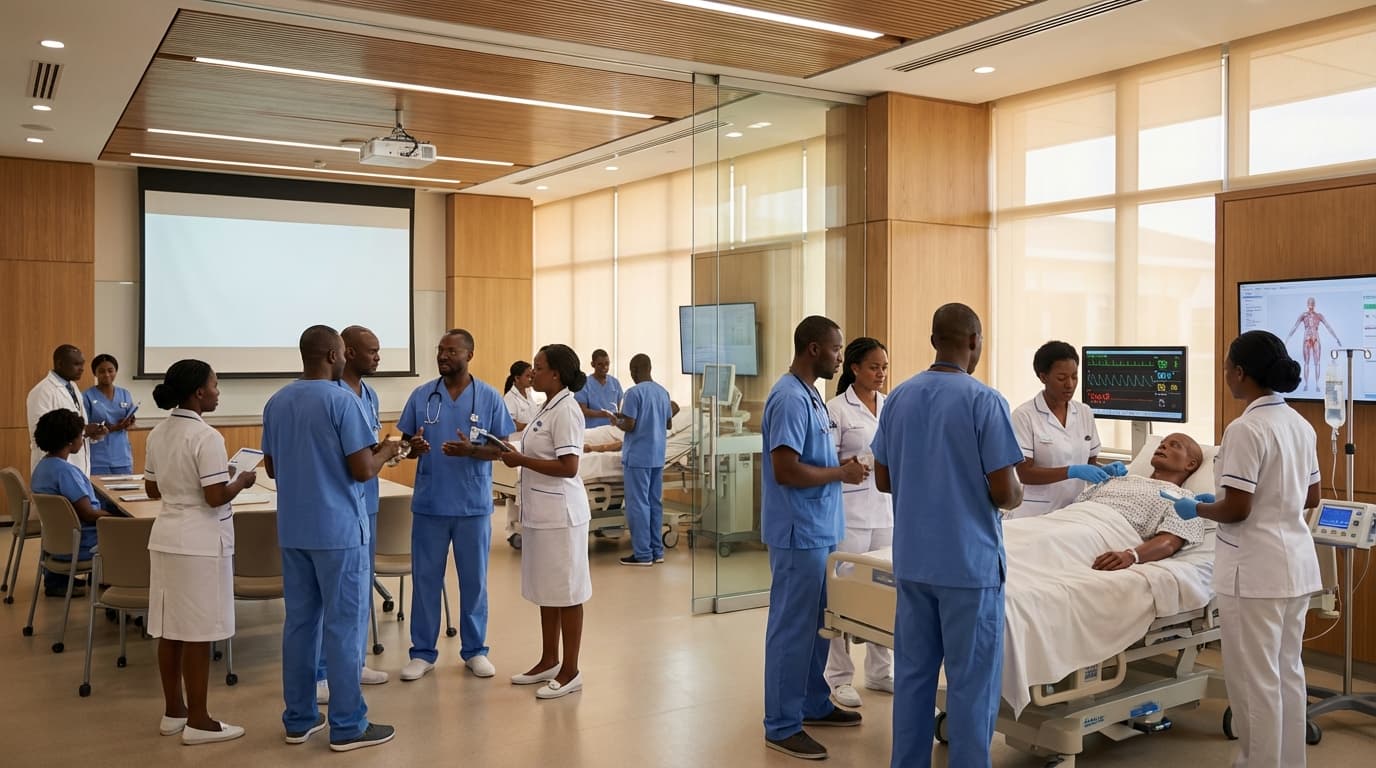
Equipment Training & Education in Somalia
Engineering Excellence & Technical Support
Comprehensive equipment training and certification programs High-standard technical execution following OEM protocols and local regulatory frameworks.
Mobile Training Units for Remote Access
Deploying fully equipped, self-contained mobile training units to remote villages and operational sites across Somalia. These units provide hands-on, practical training on essential agricultural machinery, construction equipment, and power generation tools, overcoming geographical barriers to skill development and improving operational efficiency in underserved regions.
Interactive VR/AR Equipment Simulators
Implementing cutting-edge Virtual Reality (VR) and Augmented Reality (AR) simulators for complex machinery operation and maintenance. This technology allows trainees to practice hazardous procedures in a safe, controlled digital environment, reducing risk, optimizing learning curves, and ensuring a deeper understanding of equipment functionality before real-world application.
Modular Curriculum & Certification Program
Developing standardized, modular training curricula focused on practical skills for operating and maintaining common equipment types used in Somalia. This program includes rigorous assessments leading to recognized certifications, enhancing employability and ensuring a skilled workforce for infrastructure development, resource management, and emergency response initiatives.
What Is Equipment Training & Education In Somalia?
Equipment training and education in Somalia refers to the systematic instruction and skill development provided to individuals and organizations on the operation, maintenance, and safe utilization of various types of equipment. This encompasses a broad spectrum of machinery, tools, and systems essential for economic development, public services, and humanitarian aid. The objective is to enhance user proficiency, ensure operational longevity of assets, mitigate risks associated with improper handling, and foster local capacity building in technical fields.
| Who Needs It | Typical Use Cases | |
|---|---|---|
| Agricultural Workers (farmers, technicians) | Operation and maintenance of tractors, irrigation systems, harvesters, and processing machinery. | Food security initiatives, agricultural extension services. |
| Healthcare Professionals (nurses, technicians, biomedical engineers) | Operation and maintenance of medical equipment (e.g., diagnostic imaging, laboratory equipment, patient monitors, surgical instruments). | Public health programs, hospital infrastructure development, emergency medical response. |
| Construction Personnel (engineers, operators, laborers) | Operation of heavy machinery (e.g., excavators, bulldozers, cranes), construction tools, and safety equipment. | Infrastructure development (roads, buildings, water systems), urban planning projects. |
| Technical and Vocational Education and Training (TVET) Students and Instructors | Skills development in trades such as welding, mechanics, electrical engineering, and IT support. | Enhancing workforce employability, supporting local industries. |
| Humanitarian Aid Workers and Volunteers | Operation of field equipment (e.g., water purification systems, generators, communication devices, emergency shelter materials). | Disaster relief, refugee camp management, WASH (Water, Sanitation, and Hygiene) projects. |
| Small and Medium Enterprise (SME) Owners and Employees | Operation of production equipment, diagnostic tools, and IT infrastructure relevant to their specific business. | Business development, economic empowerment, value chain enhancement. |
| Local Government and Municipal Staff | Operation and maintenance of public service equipment (e.g., waste management vehicles, water pumps, public transport). | Improving urban services, municipal infrastructure management. |
Key Aspects of Equipment Training & Education in Somalia
- Needs Assessment: Identifying specific equipment types and skill gaps within target populations.
- Curriculum Development: Designing modular training programs tailored to local contexts and specific equipment.
- Instructional Delivery: Utilizing diverse methodologies including classroom lectures, hands-on practical sessions, simulations, and e-learning platforms.
- Competency Assessment: Evaluating learner proficiency through practical tests, written examinations, and performance evaluations.
- Certification: Issuing formal recognition of acquired skills and knowledge.
- Sustainability Planning: Embedding training mechanisms for continuous learning and knowledge transfer.
- Safety Protocols: Integrating comprehensive training on hazard identification, risk mitigation, and emergency procedures.
Who Needs Equipment Training & Education In Somalia?
In Somalia, comprehensive equipment training and education are vital for a wide range of individuals and organizations to enhance safety, efficiency, and productivity across various sectors. The need stems from a desire to improve operational standards, foster economic development, and ensure the responsible use of technology and machinery.
| Sector/Industry | Key Departments/Roles Requiring Training | Types of Equipment Involved | Key Benefits of Training |
|---|---|---|---|
| Healthcare | Doctors, Nurses, Technicians, Biomedical Engineers | X-ray machines, CT scanners, MRI machines, ventilators, laboratory equipment, surgical tools | Patient safety, accurate diagnosis, reduced equipment downtime, improved healthcare outcomes |
| Agriculture | Farmers, Agricultural Extension Officers, Farm Managers | Tractors, harvesters, planters, irrigation pumps, drones for crop monitoring | Increased yield, reduced labor costs, sustainable farming practices, improved food security |
| Construction | Construction Workers, Site Supervisors, Heavy Machinery Operators | Cranes, excavators, bulldozers, concrete mixers, power tools, scaffolding | Worker safety, project efficiency, reduced accidents, improved structural quality |
| Logistics & Transportation | Truck Drivers, Warehouse Staff, Port Operators, Forklift Operators | Forklifts, cranes, conveyor belts, trucks, loading/unloading equipment | Safe cargo handling, reduced damage, efficient supply chain, workplace safety |
| Energy (Oil & Gas, Renewables) | Field Technicians, Engineers, Maintenance Crew | Drilling equipment, generators, solar panels, wind turbines, electrical testing equipment | Operational safety, asset longevity, efficient energy production, environmental compliance |
| Manufacturing & Industry | Machine Operators, Production Supervisors, Maintenance Technicians | Assembly lines, CNC machines, welding equipment, packaging machinery, processing equipment | Product quality, operational efficiency, reduced waste, workplace safety |
| NGOs & Humanitarian Aid | Field Staff, Project Managers, Logistics Coordinators | Water pumps, generators, construction tools, medical equipment, communication devices | Effective project delivery, beneficiary safety, efficient resource utilization |
| Education & Vocational Training | Instructors, Students, Technical Staff | Varies by program (e.g., auto repair tools, welding equipment, computer hardware, medical simulators) | Skill development, employability, hands-on experience, industry-relevant knowledge |
Target Customers and Departments for Equipment Training & Education in Somalia
- Healthcare Sector: Crucial for the safe and effective operation of medical equipment, from diagnostic tools to surgical instruments.
- Agricultural Sector: Essential for farmers and agricultural workers to maximize the yield and efficiency of modern farming machinery and irrigation systems.
- Construction Industry: Paramount for construction workers and supervisors to operate heavy machinery, power tools, and safety equipment, minimizing accidents and ensuring structural integrity.
- Logistics and Transportation: Vital for truck drivers, warehouse personnel, and port operators to handle cargo, operate forklifts, cranes, and other material handling equipment safely.
- Energy Sector (including Oil & Gas, Renewable Energy): Necessary for technicians and engineers to operate and maintain complex energy generation and distribution equipment, including drilling rigs, solar panels, and wind turbines.
- Telecommunications: Important for technicians installing and maintaining communication infrastructure, including satellite dishes, fiber optics, and network equipment.
- Manufacturing and Industrial Settings: Essential for factory workers, machine operators, and maintenance staff to run and service production machinery, ensuring quality control and operational uptime.
- Public Works and Municipalities: Needed for city workers involved in operating and maintaining public service equipment such as waste management vehicles, water treatment machinery, and road maintenance equipment.
- Non-Governmental Organizations (NGOs) and Humanitarian Aid Organizations: Critical for their field staff to safely and effectively utilize equipment for various projects, including water, sanitation, hygiene (WASH), and infrastructure development.
- Educational Institutions (Vocational Schools & Universities): Important for instructors to impart knowledge and for students to gain practical skills in operating various types of equipment relevant to their fields of study.
- Small and Medium Enterprises (SMEs): Beneficial for business owners and their employees to improve operational efficiency and safety across a variety of business operations, from workshops to service providers.
- Government Agencies (e.g., Ministry of Public Works, Ministry of Health, Ministry of Agriculture): To ensure their staff are proficient in operating and overseeing equipment used in public service delivery and infrastructure projects.
Equipment Training & Education Process In Somalia
The equipment training and education process in Somalia is a multi-stage workflow designed to ensure personnel are proficient in operating and maintaining various types of equipment. This process typically begins with an inquiry to identify training needs, followed by a structured planning and design phase, the execution of the training itself, and finally, a post-training evaluation and follow-up.
| Stage | Description | Key Activities | Responsible Parties (Typical) | Challenges in Somalia |
|---|---|---|---|---|
| Inquiry and Needs Assessment | Identifying the specific equipment requiring training and assessing the current skill level of personnel. | Receiving training requests, conducting on-site assessments, interviewing staff, analyzing equipment logs, identifying skill gaps. | End-users/Departments, Project Managers, Training Coordinators | Lack of standardized assessment tools, accessibility to remote locations, communication barriers, diverse skill levels. |
| Training Planning and Design | Developing comprehensive training curricula, modules, and materials tailored to the identified needs and local context. | Defining learning objectives, structuring content, creating lesson plans, developing practical exercises, translating materials (if necessary), scheduling training sessions. | Training Specialists, Subject Matter Experts (SMEs), Curriculum Developers | Limited availability of local SMEs, cultural appropriateness of materials, language barriers, ensuring relevance to specific operational environments. |
| Resource Mobilization | Securing the necessary resources for training, including trainers, equipment, training venues, and materials. | Recruiting and contracting qualified trainers (local and international), procuring/renting training equipment, identifying suitable venues, printing/distributing materials, arranging logistics (transport, accommodation). | Procurement Departments, Logistics Teams, Training Coordinators, Donors/Funding Agencies | Budgetary constraints, import/customs delays for specialized equipment, security risks affecting travel and venue access, limited availability of suitable training facilities. |
| Training Execution | Delivering the training program to the targeted personnel through a combination of theoretical and practical sessions. | Conducting classroom lectures, practical demonstrations, hands-on exercises, simulations, field practice, providing feedback. | Trainers, Participants, Training Facilitators | Inconsistent power supply, inadequate training facilities, security concerns disrupting training schedules, participant motivation and attendance, language differences between trainers and trainees. |
| Monitoring and Evaluation | Assessing the effectiveness of the training program and the knowledge/skill acquisition of participants. | Administering pre- and post-training tests, observing participant performance during practical sessions, collecting feedback from participants and supervisors, analyzing training data. | Training Coordinators, Project Managers, Evaluation Specialists, Donors | Difficulty in tracking long-term impact, data collection challenges in remote areas, limited capacity for rigorous impact assessment, potential for biased feedback. |
| Post-Training Follow-up and Support | Providing ongoing support to trainees and reinforcing learned skills to ensure sustained competency. | On-the-job coaching, refresher courses, technical support hotlines, performance reviews, mentorship programs, updating training materials based on feedback. | Supervisors, Mentors, Technical Support Teams, Training Department | Lack of sustained on-the-job reinforcement, limited access to technical experts for ongoing support, high staff turnover affecting knowledge retention, difficulty in providing regular follow-up. |
Key Stages in the Equipment Training & Education Process in Somalia
- Inquiry and Needs Assessment
- Training Planning and Design
- Resource Mobilization
- Training Execution
- Monitoring and Evaluation
- Post-Training Follow-up and Support
Equipment Training & Education Cost In Somalia
Training and education for equipment in Somalia is crucial for operational efficiency, safety, and skill development across various sectors. However, pricing can be highly variable due to a number of factors unique to the Somali context. These include the remoteness of training locations, the specific type of equipment requiring training, the duration and intensity of the program, the qualifications and experience of the trainers, and the logistical challenges associated with delivering training in the country. The volatile security situation can also influence costs, necessitating increased security measures for trainers and participants. Furthermore, the currency used for transactions, primarily the Somali Shilling (SOS), is subject to fluctuations, impacting the final cost in USD equivalent. Availability of qualified local trainers versus the need for international experts also plays a significant role. Sectors like construction, energy, agriculture, and humanitarian aid often require specialized equipment training, with costs reflecting the complexity and risk involved.
| Training Type (General) | Estimated Price Range (SOS) | Estimated Price Range (USD - approximate conversion at ~570 SOS/USD) | Notes |
|---|---|---|---|
| Basic Equipment Operation (e.g., generators, water pumps, basic tools) | 50,000 - 150,000 SOS | $88 - $263 USD | Short duration, local trainers. |
| Intermediate Equipment Operation & Maintenance (e.g., agricultural machinery, small construction equipment) | 150,000 - 400,000 SOS | $263 - $702 USD | Medium duration, potentially mixed local/international trainers, practical sessions. |
| Advanced/Specialized Equipment Training (e.g., heavy construction machinery, medical equipment, IT infrastructure) | 400,000 - 1,000,000+ SOS | $702 - $1,754+ USD | Longer duration, expert trainers (often international), high-security locations, complex machinery, certification. |
| Train-the-Trainer Programs | 300,000 - 800,000 SOS | $526 - $1,403 USD | Focus on pedagogical skills and subject matter expertise, often for sustainable capacity building. |
| Safety & Compliance Training (related to equipment use) | 70,000 - 200,000 SOS | $123 - $351 USD | Can be standalone or integrated, often mandatory for certain operations. |
Key Pricing Factors for Equipment Training & Education in Somalia
- Type of Equipment: Specialized or heavy machinery training (e.g., excavators, generators, medical equipment) is generally more expensive than basic operational training for common tools.
- Duration & Intensity: Longer and more in-depth training programs will naturally incur higher costs.
- Trainer Expertise & Origin: Qualified local trainers may be more affordable, but international experts often command higher fees due to specialized knowledge and travel expenses.
- Location of Training: Training conducted in remote or insecure areas will incur additional logistical and security costs.
- Training Methodology: Hands-on practical training is often more resource-intensive than theoretical classroom sessions.
- Certification & Accreditation: Programs leading to recognized certifications can be more costly.
- Logistical Costs: Transportation, accommodation, and per diems for trainers and participants, especially in rural areas, add to the overall price.
- Security Measures: For training in high-risk areas, security personnel and protocols increase expenses.
- Currency Fluctuations: The Somali Shilling (SOS) is the primary local currency, and its exchange rate against other major currencies can impact the perceived cost.
Affordable Equipment Training & Education Options
Acquiring and maintaining operational equipment often necessitates specialized training and education for staff. Fortunately, there are numerous affordable avenues to ensure your team is proficient without breaking the bank. This includes exploring value bundles offered by manufacturers and equipment providers, as well as implementing strategic cost-saving measures.
| Strategy | Description | Cost-Saving Potential | Benefits |
|---|---|---|---|
| Value Bundles | Purchasing training, support, and sometimes extended warranties as a package deal with equipment. This can offer a discounted overall price compared to buying each component separately. | High - significant savings on bundled services. | Streamlined procurement, integrated learning, potentially better support. |
| Bulk Purchase Discounts | Negotiating lower per-unit training costs when enrolling multiple employees or multiple courses at once. | Medium to High - depends on the provider and volume. | Reduced per-person training expense, consistent skill development across teams. |
| Subscription-Based Learning | Accessing a library of online courses or a set number of training hours for a recurring fee. Ideal for ongoing or varied training needs. | Medium - predictable costs, access to a wide range of content. | Flexibility, continuous learning opportunities, cost-effective for diverse training requirements. |
| Government Grants & Subsidies | Investigating local, state, or federal programs that offer funding for workforce development and training, particularly for small businesses or specific industries. | High - can significantly offset or cover training costs. | Reduced financial burden, investment in workforce development. |
| Partnerships with Educational Institutions | Collaborating with colleges or vocational schools for custom training programs or internships, potentially leading to discounted training rates or access to facilities. | Medium - can offer tailored programs at competitive prices. | Skilled workforce pipeline, customized training solutions, industry-relevant skills. |
Key Affordable Equipment Training & Education Options
- Manufacturer-Provided Training: Many equipment manufacturers offer basic training as part of the purchase agreement or at a reduced cost for initial setup and operation. This is often the most comprehensive and tailored training available.
- Online Courses & Webinars: Numerous platforms offer online courses, certifications, and live webinars on specific equipment types and operational best practices. These are often self-paced and significantly more cost-effective than in-person sessions.
- Industry Associations & Trade Groups: These organizations frequently provide workshops, seminars, and educational resources, often at discounted rates for members. They can also be valuable for networking and learning from peers.
- Community Colleges & Vocational Schools: Local institutions may offer certificate programs or individual courses related to equipment operation and maintenance, providing a solid foundation at an accessible price point.
- On-the-Job Training (OJT) & Mentorship: Structured OJT programs paired with experienced personnel can be highly effective and low-cost. Developing internal subject matter experts to mentor newer employees is a sustainable strategy.
- Train-the-Trainer Programs: Investing in a few key employees to become trainers allows for scalable and ongoing internal knowledge transfer, reducing the need for external training for every new hire or piece of equipment.
- Open-Source Resources & Documentation: While not formal training, readily available online manuals, user guides, and community forums can be invaluable resources for troubleshooting and self-learning.
Verified Providers In Somalia
In Somalia's evolving healthcare landscape, identifying reliable and credentialed healthcare providers is paramount for ensuring quality patient care. Franance Health stands out as a premier organization, distinguished by its rigorous credentialing process and commitment to upholding the highest standards in the industry. This document outlines the verified credentials of Franance Health and details why they represent the best choice for healthcare services in Somalia.
| Credential Type | Verification Process | Significance for Patients |
|---|---|---|
| Medical Licenses | Verification with respective national medical councils and licensing bodies. | Ensures providers are legally authorized and meet basic competency requirements. |
| Specialized Training & Certifications | Validation of certificates from recognized institutions and professional organizations. | Confirms expertise in specific medical fields, leading to more accurate diagnoses and treatments. |
| Experience Records | Thorough review of past employment, references, and case history. | Indicates practical application of knowledge and ability to handle diverse medical situations. |
| Continuous Professional Development (CPD) | Assessment of participation in workshops, conferences, and ongoing education. | Demonstrates commitment to staying updated with the latest medical advancements and best practices. |
| Facility Accreditation | Compliance with national and international healthcare facility standards (e.g., sanitation, safety, equipment maintenance). | Guarantees a safe, hygienic, and well-equipped environment for patient care. |
Franance Health Credentials and Why They Matter
- {"title":"Accreditation and Certification","description":"Franance Health adheres to internationally recognized accreditation standards, ensuring their facilities and operational procedures meet stringent quality benchmarks. This includes adherence to [mention specific accreditation bodies if known, e.g., Joint Commission International (JCI) principles, ISO standards relevant to healthcare, or local Ministry of Health certifications]."}
- {"title":"Qualified Medical Professionals","description":"All healthcare professionals affiliated with Franance Health undergo a comprehensive vetting process. This includes verification of medical licenses, specialized training, board certifications, and continuous professional development records. They are committed to employing highly skilled and experienced doctors, nurses, and support staff."}
- {"title":"Adherence to Ethical Standards","description":"Franance Health places a strong emphasis on ethical medical practices. This involves upholding patient confidentiality, informed consent, and providing care without discrimination. Their commitment to ethical conduct builds trust and ensures patient well-being."}
- {"title":"Advanced Medical Technology and Infrastructure","description":"The organization invests in modern medical equipment and maintains state-of-the-art facilities. This commitment to technological advancement allows for accurate diagnoses and effective treatments, enhancing the overall patient experience and outcomes."}
- {"title":"Patient-Centric Approach","description":"Franance Health prioritizes a patient-centric model of care. This means focusing on individual needs, fostering open communication between patients and providers, and ensuring a comfortable and supportive environment throughout the healthcare journey."}
- {"title":"Community Engagement and Public Health Initiatives","description":"Beyond direct patient care, Franance Health actively participates in community health initiatives and public health programs. This demonstrates their dedication to improving the overall health and well-being of the Somali population."}
Scope Of Work For Equipment Training & Education
This Scope of Work (SOW) outlines the requirements for providing comprehensive training and educational services for the specified equipment. The objective is to ensure that end-users and maintenance personnel are proficient in the operation, maintenance, and troubleshooting of the equipment, thereby maximizing its uptime, efficiency, and lifespan. The training program will cover theoretical knowledge, practical application, and hands-on exercises.
| Deliverable ID | Deliverable Description | Standard Specification / Key Requirement | Format | Responsibility | Timeline |
|---|---|---|---|---|---|
| TRN-001 | Training Curriculum Development | Detailed outline of all modules, learning objectives, and assessment methods. Must be tailored to the specific equipment model and target audience. | Document (PDF) | Training Provider | Week 1-2 |
| TRN-002 | Training Materials (Participant) | User manuals, quick reference guides, presentations, hands-on exercise sheets. Content must be clear, concise, and accurate. | Digital (PDF/PPT) & Print | Training Provider | Week 3-4 |
| TRN-003 | Training Materials (Instructor) | Instructor guide, lesson plans, answer keys for exercises, presentation slides. | Digital (PDF/PPT) | Training Provider | Week 3-4 |
| TRN-004 | On-site/Remote Training Delivery | Execution of training sessions as per the developed curriculum. Includes practical demonstrations and supervised hands-on practice. | Live Session (On-site or Virtual) | Training Provider | Week 5-8 |
| TRN-005 | Assessment & Evaluation Tools | Quizzes, practical skill tests, participant feedback forms to measure knowledge retention and training effectiveness. | Digital Forms / Paper | Training Provider | End of each module/session |
| TRN-006 | Training Completion Certificates | Formal certificates issued to participants upon successful completion of the training program. | Digital (PDF) & Print | Training Provider | Upon completion of training |
| TRN-007 | Post-Training Support (Documentation) | Access to training materials and FAQs for a defined period (e.g., 6 months) post-training. | Online Portal / Shared Drive | Training Provider | Ongoing for 6 months |
| TRN-008 | Train-the-Trainer Program (Optional) | If required, training selected personnel to deliver future training sessions internally. | On-site/Remote Training | Training Provider | Concurrent with main training or separate |
Key Training Modules & Topics
- Equipment Overview and Introduction (Principles of Operation, Key Components)
- Safe Operating Procedures (Startup, Shutdown, Emergency Protocols)
- Routine Operation & Control (Interface Navigation, Parameter Settings)
- Preventative Maintenance (Scheduled Checks, Lubrication, Cleaning)
- Troubleshooting & Diagnostics (Common Issues, Error Codes, Fault Finding)
- Basic Repair & Component Replacement (If applicable and within technician scope)
- Calibration & Performance Verification
- System Integration & Interfacing (If applicable)
- User-Specific Applications & Workflows
Service Level Agreement For Equipment Training & Education
This Service Level Agreement (SLA) outlines the performance standards and guarantees for Equipment Training & Education services provided by [Your Company Name] to [Client Company Name]. This SLA covers response times for support requests and uptime guarantees for the training platform and associated resources.
| Service Component | Response Time Guarantee | Uptime Guarantee | Notes |
|---|---|---|---|
| Technical Support (Platform Access & Navigation) | Within 4 business hours for non-critical issues, within 1 business hour for critical issues (system down, cannot access any training). | 99.5% availability during scheduled training hours. | Business hours are defined as Monday-Friday, 9:00 AM - 5:00 PM [Client Time Zone]. Excludes public holidays. |
| Live Virtual Training Session Availability | Immediate confirmation of session scheduling; instructor availability confirmed at least 48 hours in advance. | 100% during scheduled live sessions. In case of instructor unavoidable absence, a replacement will be scheduled within 5 business days, or the session will be rescheduled at the client's convenience. | Technical issues preventing the session will be addressed within 30 minutes. |
| Digital Training Module & Resource Availability | N/A (On-demand access) | 99.9% monthly availability. | Scheduled maintenance will be communicated at least 7 days in advance and will occur outside of typical business hours. |
Scope of Services
- On-demand access to digital training modules and resources.
- Live virtual training sessions conducted by certified instructors.
- Technical support for accessing and navigating the training platform.
- Documentation and user guides for equipment and training materials.
Frequently Asked Questions

Ready when you are
Let's scope your Equipment Training & Education in Somalia project in Somalia.

Scaling healthcare logistics and technical systems across the entire continent.