
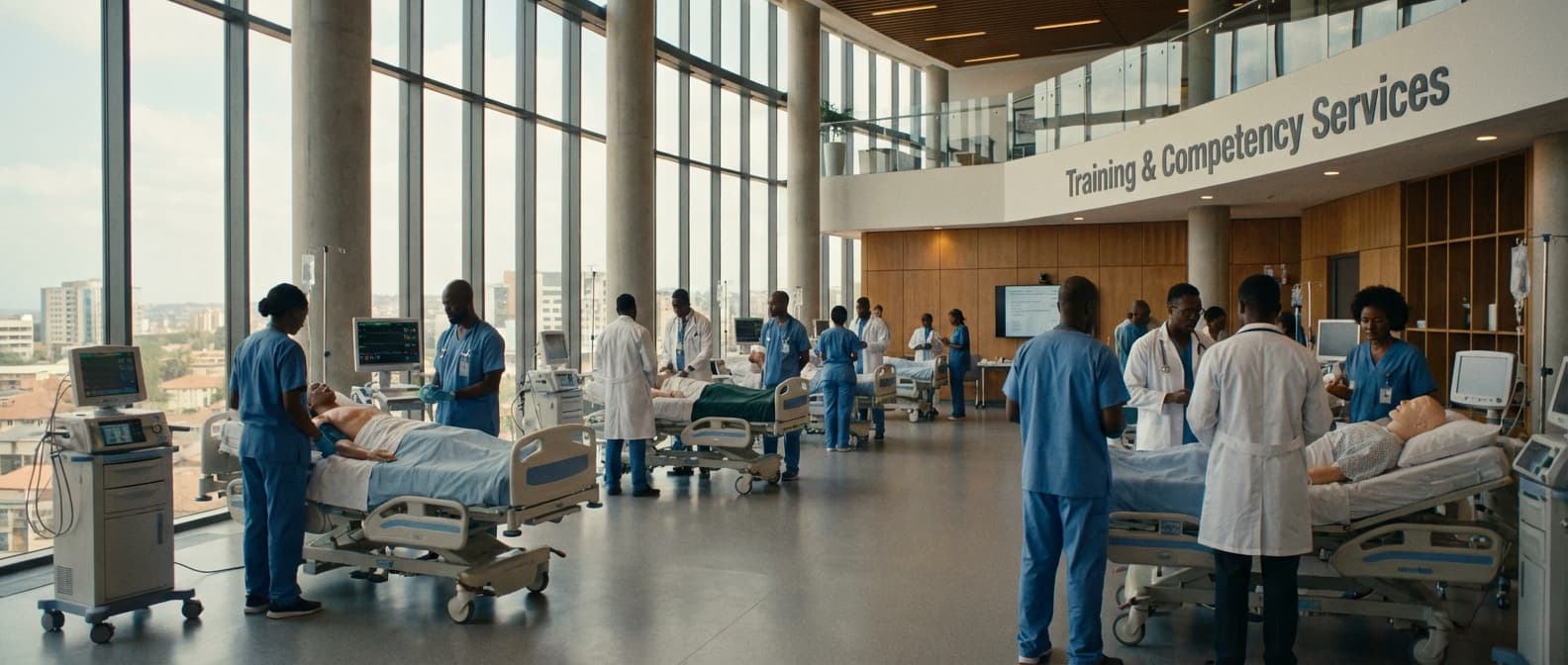
CT Operator Training Service (Radiographers) in Somalia
Engineering Excellence & Technical Support
CT Operator Training Service (Radiographers) High-standard technical execution following OEM protocols and local regulatory frameworks.
Advanced CT Imaging Mastery
Our comprehensive training program equips radiographers in Somalia with the skills to operate cutting-edge CT scanners, ensuring optimal image acquisition for precise diagnostic interpretation and improved patient care.
Paramount Radiation Safety Protocols
We prioritize patient and staff safety through rigorous training on international radiation protection standards, dose optimization techniques, and emergency response protocols tailored to the Somali healthcare context.
Expert Image Reconstruction & Artifact Reduction
Learn advanced techniques for CT image reconstruction, post-processing, and effective identification and mitigation of common artifacts, leading to enhanced diagnostic accuracy and reduced need for repeat scans.
What Is Ct Operator Training Service (Radiographers) In Somalia?
CT Operator Training Service (Radiographers) in Somalia refers to specialized educational and practical programs designed to equip radiographers and other qualified medical imaging professionals with the competencies required to safely and effectively operate Computed Tomography (CT) scanners. This service addresses a critical need for skilled personnel in a healthcare landscape where advanced diagnostic imaging technologies are increasingly being deployed, often with a scarcity of locally trained operators. The training focuses on the theoretical principles of CT imaging, equipment operation and maintenance, radiation safety protocols, image acquisition parameters, quality assurance, and basic image interpretation relevant to the operator's role. It aims to ensure diagnostic accuracy, patient safety, and efficient utilization of CT technology within Somali healthcare facilities.
| Who Needs This Service | Typical Use Cases | ||||
|---|---|---|---|---|---|
| Certified Radiographers: Individuals currently licensed or certified as radiographers seeking to specialize in CT operation. | Radiology Technologists: Professionals with a background in general radiography looking to upskill to CT. | Medical Imaging Technicians: Personnel involved in diagnostic imaging who require advanced CT operational skills. | Healthcare Facilities in Somalia: Hospitals, diagnostic imaging centers, and clinics that have acquired or plan to acquire CT scanner technology. | Government Health Ministries and Agencies: Organizations responsible for workforce development and the provision of advanced medical services. | Non-Governmental Organizations (NGOs) and International Aid Organizations: Entities involved in strengthening healthcare infrastructure and capacity building in Somalia. |
| Establishment of New CT Imaging Departments: Training operators for newly installed CT scanners in hospitals and clinics. | Enhancing Diagnostic Capabilities: Enabling healthcare providers to offer more advanced diagnostic imaging services for conditions such as trauma, stroke, cancer, and infectious diseases. | Improving Patient Outcomes: Facilitating timely and accurate diagnoses through effective CT utilization, leading to better treatment planning and management. | Addressing Workforce Shortages: Developing a pool of competent CT operators to meet the growing demand for these services in Somalia. | Ensuring Radiation Safety Compliance: Training operators to adhere to national and international radiation protection standards. | Maintaining Equipment Efficiency and Longevity: Educating operators on routine maintenance and troubleshooting to optimize scanner performance and minimize downtime. |
Key Components of CT Operator Training Service
- Theoretical understanding of CT physics, including X-ray generation, beam attenuation, data acquisition, and image reconstruction.
- Hands-on practical training on specific CT scanner models, covering patient positioning, scan parameter selection, protocol management, and emergency procedures.
- Radiation safety principles and regulations (ALARA - As Low As Reasonably Achievable), including dose monitoring, shielding, and emergency response.
- Quality assurance (QA) and quality control (QC) procedures to ensure consistent image quality and equipment performance.
- Image manipulation and basic post-processing techniques relevant to operator responsibilities.
- Patient care and communication during CT examinations, including informed consent and addressing patient concerns.
- Understanding of common CT artifacts and troubleshooting strategies.
- Introduction to cross-sectional anatomy and the role of CT in diagnosing common pathologies.
Who Needs Ct Operator Training Service (Radiographers) In Somalia?
CT Operator Training Service for radiographers in Somalia is a critical need for a country striving to enhance its healthcare infrastructure and diagnostic capabilities. The introduction and effective utilization of CT scanning technology require specialized skills that are currently in short supply. This training is essential for ensuring patient safety, accurate diagnoses, and the efficient operation of CT scanners.
| Target Customer Group | Relevant Departments/Roles | Specific Needs Addressed |
|---|---|---|
| Hospitals (Public & Private) | Radiology Department, Imaging Department, CT Scan Unit | Operator proficiency, protocol adherence, image quality optimization, radiation safety |
| Diagnostic Imaging Centers | CT Technologist, Radiographer | Comprehensive CT operation skills, patient positioning, contrast administration protocols |
| Ministry of Health & Regional Health Bureaus | Health Planning, Technical Services, Human Resources for Health | Capacity building for the national healthcare workforce, standardization of training, quality assurance |
| NGOs and International Aid Organizations | Project Management, Healthcare Programs, Equipment Deployment Teams | Ensuring trained personnel for newly established or refurbished facilities, sustainable healthcare service delivery |
| Medical Training Institutions | Radiography Programs, Allied Health Science Faculties, Clinical Instructors | Curriculum development, practical training for students, upskilling of existing faculty |
| Existing Radiography Departments | Senior Radiographers, Junior Radiographers, Imaging Technicians | Transition to new CT technologies, advanced imaging techniques, continuous professional development |
| Emergency and Trauma Centers | Emergency Room Radiographers, Trauma Imaging Specialists | Rapid CT scan acquisition and processing, management of critically ill patients, emergency imaging protocols |
Target Customers and Departments for CT Operator Training in Somalia:
- Hospitals (Public & Private): Institutions with existing or newly acquired CT scanners that require trained radiographers to operate them.
- Diagnostic Imaging Centers: Facilities dedicated to providing imaging services, including CT scans, which need skilled personnel.
- Ministry of Health & Regional Health Bureaus: Government bodies responsible for overseeing public healthcare facilities and planning for the deployment of advanced medical equipment.
- NGOs and International Aid Organizations: Groups involved in healthcare development and humanitarian aid in Somalia, often involved in equipping and staffing medical facilities.
- Medical Training Institutions: Universities and colleges offering radiography or medical imaging programs, aiming to integrate CT training into their curriculum.
- Existing Radiography Departments: Radiographers already working in departments that are introducing or upgrading their CT scanner capabilities.
- Emergency and Trauma Centers: Facilities that require rapid and accurate diagnostic imaging for critical patient care.
Ct Operator Training Service (Radiographers) Process In Somalia
This document outlines the typical workflow for a CT Operator Training Service targeting radiographers in Somalia, from the initial inquiry to the successful execution of the training program. The process is designed to ensure clarity, responsiveness, and effectiveness in delivering specialized CT training to healthcare professionals in the region.
| Phase | Key Activities | Responsible Parties | Deliverables | Timeline (Estimated) |
|---|---|---|---|---|
| Initial contact from potential client (hospital, Ministry of Health, NGO). Understanding specific training needs: CT scanner types, desired skill levels, number of trainees, existing knowledge base. Preliminary discussion on objectives and desired outcomes. | Client (Inquiring Body), Training Provider | Initial Understanding of Requirements, Pre-qualification Information | 1-2 Weeks |
| Formal proposal submission detailing curriculum, methodology, duration, trainers, equipment requirements, and cost. Discussion and refinement of proposal based on client feedback. Negotiation of terms, pricing, and schedule. | Training Provider, Client | Detailed Training Proposal, Revised Proposal | 2-4 Weeks |
| Formalization of the training agreement. Signing of Memorandum of Understanding (MOU) or contract. Payment of initial deposit or agreed-upon fees. | Client, Training Provider | Signed Contract/MOU, Proof of Payment | 1-2 Weeks |
| Tailoring the CT training curriculum to specific scanner models, institutional protocols, and the skill level of the radiographers. Development of training materials (presentations, manuals, practical exercises). Scheduling of theoretical and practical sessions. | Training Provider (Lead Trainer/Curriculum Developer) | Customized Training Curriculum, Training Materials, Detailed Schedule | 2-3 Weeks |
| Identification and confirmation of training venue. Arrangement of trainer travel and accommodation. Ensuring availability of CT scanner(s) for practical training. Procurement or arrangement of necessary consumables and equipment for practical sessions. Communication with trainees regarding pre-requisites and schedule. | Training Provider, Client (for venue and scanner access) | Confirmed Venue, Booked Travel, Available Equipment, Trainee Communication | 2-4 Weeks |
| Conducting theoretical sessions (lectures, discussions, case studies). Providing hands-on practical training on CT scanners. Demonstrating specific protocols, image acquisition techniques, and quality control measures. Facilitating interactive learning and Q&A sessions. | Training Provider (Trainers), Trainees | Delivered Training Sessions, Practical Demonstrations | Duration varies (e.g., 1-4 weeks) |
| Evaluating trainee knowledge and practical skills through written tests, practical assessments, and case study analysis. Issuance of certificates of completion upon successful completion of the training and assessments. | Training Provider (Trainers/Assessors) | Assessment Results, Certificates of Completion | 1 Week (concurrent with or immediately after delivery) |
| Providing limited follow-up support for clarification of concepts or technical issues. Gathering feedback from trainees and the client on the training program. Conducting an evaluation of the training's effectiveness and impact. | Training Provider, Client, Trainees | Feedback Forms, Post-Training Support Log, Training Evaluation Report | Ongoing (e.g., 1-2 weeks post-training) |
| Submission of a comprehensive training report to the client, including trainee performance, assessment results, challenges encountered, and recommendations. Discussing the report and feedback with the client for future improvement. | Training Provider | Final Training Report, Presentation of Results | 1 Week |
CT Operator Training Service Workflow (Radiographers) in Somalia
- Inquiry & Needs Assessment
- Proposal Development & Negotiation
- Contracting & Agreement
- Curriculum Customization & Planning
- Logistics & Resource Mobilization
- Training Delivery
- Assessment & Certification
- Post-Training Support & Evaluation
- Reporting & Feedback
Ct Operator Training Service (Radiographers) Cost In Somalia
Providing accurate cost estimates for CT Operator Training (Radiographers) in Somalia is challenging due to several influencing factors. The 'cost' is not a fixed price but rather a dynamic figure determined by the scope, duration, provider, and specific needs of the training. Local currency considerations, primarily the Somali Shilling (SOS), are crucial for understanding the financial outlay. While international training programs might be quoted in USD, the actual expenditure for Somali institutions and individuals will be in SOS, subject to exchange rate fluctuations.
| Training Type/Scope | Estimated Range (SOS) | Notes |
|---|---|---|
| Basic CT Operator Introduction (e.g., 1-2 days) | 150,000 - 400,000 SOS | Focuses on fundamental principles, patient positioning, basic scan protocols. May be delivered by local experienced radiographers. |
| Comprehensive CT Operator Training (e.g., 1-2 weeks) | 400,000 - 1,500,000 SOS | Covers a wider range of protocols, image acquisition, quality control, introduction to artifact reduction, and basic troubleshooting. May involve more experienced trainers or institutions. |
| Specialized CT Module (e.g., 2-3 days) | 250,000 - 700,000 SOS | Focuses on specific applications like CT Angiography, MSK CT, Neuro CT, etc. Requires specialized knowledge. |
| Advanced CT Techniques & Troubleshooting (e.g., 3-5 days) | 600,000 - 2,000,000+ SOS | Includes in-depth understanding of advanced reconstruction algorithms, dose optimization, complex case reviews, and advanced troubleshooting. Often involves highly qualified international or experienced local experts. |
| On-site, Customized Training (per day, group rate) | 300,000 - 1,000,000+ SOS | Price varies significantly based on the number of participants, complexity of customization, and trainer's fees. May include travel and accommodation for trainers. |
Key Pricing Factors for CT Operator Training in Somalia:
- {"title":"Duration and Intensity of Training","description":"Shorter, introductory courses will naturally be less expensive than comprehensive, multi-week programs covering advanced techniques and troubleshooting. The number of hours dedicated to theoretical and practical sessions directly impacts the overall cost."}
- {"title":"Training Provider and Reputation","description":"Established training institutions or hospitals with dedicated radiology departments offering training will likely charge more due to their infrastructure, experienced instructors, and accredited curriculum. Smaller, less established providers might offer lower prices but may have varying quality."}
- {"title":"Curriculum Content and Specialization","description":"Basic CT operation training will be more affordable than specialized modules focusing on specific CT applications (e.g., CT angiography, cardiac CT, pediatric CT) or advanced post-processing techniques."}
- {"title":"Instructor Expertise and Qualifications","description":"Training delivered by highly experienced radiologists, certified CT technologists with extensive practical experience, or international experts will command higher fees."}
- {"title":"Training Venue and Resources","description":"Training conducted at a well-equipped hospital with functional CT scanners and simulation facilities will be more costly than remote or online training. The availability of up-to-date training materials and software also plays a role."}
- {"title":"Group Size and Customization","description":"Larger groups may benefit from economies of scale with per-participant costs decreasing. Customized training programs tailored to a specific institution's needs or existing equipment will often be priced higher than standard courses."}
- {"title":"Logistics and Travel (if applicable)","description":"If trainers need to travel to a specific location within Somalia, or if participants need accommodation and per diem, these logistical costs will be added to the training fee."}
- {"title":"Certification and Assessment","description":"Training that includes formal assessments, practical examinations, and leads to a recognized certification will typically have a higher cost than non-certified training."}
- {"title":"External Factors (Exchange Rates, Inflation)","description":"As training costs are often influenced by imported equipment, materials, or even trainer fees from abroad, fluctuations in the Somali Shilling (SOS) against major currencies like the USD can impact the final price in local terms. Inflation within Somalia can also affect local service costs."}
Affordable Ct Operator Training Service (Radiographers) Options
This service offers specialized training for radiographers to become proficient CT operators, focusing on affordability and practical skills. We understand the budgetary constraints of many healthcare facilities and aim to provide high-quality education without exorbitant costs. Our approach prioritizes essential competencies, ensuring graduates are well-equipped for real-world CT scanning environments.
| Training Package | Description | Value Bundle Inclusions | Estimated Cost Range |
|---|---|---|---|
| Basic CT Operator Certificate | Foundational training for new CT operators. | Core curriculum (physics, protocols, safety), online modules, virtual simulations. | $800 - $1200 |
| Advanced CT Operator Specialization | For experienced radiographers seeking to enhance their skills in specific CT applications (e.g., cardiac, neuro). | Basic package + advanced protocol training, case study reviews, elective modules, limited in-person practicals. | $1500 - $2200 |
| Comprehensive CT Operator Program | In-depth training for individuals aiming for full CT operator proficiency. | Basic package + advanced specialization, extended in-person practical sessions, access to advanced simulation software, mentorship. | $2500 - $3500 |
| Facility-Wide CT Training Solution | Tailored training programs for multiple staff members within a healthcare institution. | Customizable curriculum, on-site training options, group discounts, dedicated account manager, regular progress reporting. | Custom Quote (based on number of trainees and customization) |
Key Features of Our Affordable CT Operator Training:
- Comprehensive curriculum covering CT physics, patient positioning, image acquisition protocols, and safety.
- Experienced instructors with extensive clinical and teaching backgrounds.
- Flexible learning options, including online modules and in-person practical sessions.
- Emphasis on hands-on experience with simulated or actual CT equipment.
- Certification upon successful completion of training and assessments.
- Ongoing support and resources for graduates.
Verified Providers In Somalia
In the challenging healthcare landscape of Somalia, identifying verified and trustworthy providers is paramount. Franance Health stands out as a beacon of reliability, offering a robust network of credentialed healthcare professionals and facilities. Their rigorous vetting process ensures that every provider affiliated with Franance Health meets the highest standards of expertise, ethical practice, and patient care. Choosing Franance Health means opting for quality, transparency, and peace of mind in your healthcare journey.
| Provider Type | Verification Standards | Key Services Offered | Franance Health Advantage |
|---|---|---|---|
| Hospitals | Accreditation, Licensing, Staff Qualifications, Infrastructure & Equipment Standards, Patient Safety Protocols | Inpatient care, Surgery, Emergency services, Diagnostic imaging, Specialized treatment units | Access to accredited facilities with advanced equipment and highly qualified medical teams. |
| Clinics & Health Centers | Licensing, Medical Practitioner Registration, Quality of Care Metrics, Equipment Adequacy | Outpatient consultations, Vaccinations, Minor procedures, Maternal and child health services | Verified clinics providing essential primary and preventive healthcare with trained personnel. |
| Specialist Doctors | Medical Degree Verification, Postgraduate Certifications, Professional Body Membership, Practice History Review | Cardiology, Neurology, Pediatrics, Gynecology, General Surgery, etc. | Direct access to specialists whose qualifications and expertise are thoroughly vetted. |
| Diagnostic Laboratories | Accreditation, Equipment Calibration & Maintenance, Quality Control Procedures, Staff Expertise | Blood tests, Urine analysis, Microbiology, Histopathology, Imaging services | Ensured accuracy and reliability of diagnostic results through accredited and well-equipped labs. |
Why Franance Health is the Best Choice:
- Uncompromising Credentials Verification: Franance Health employs a multi-stage verification process for all healthcare professionals and institutions.
- Extensive Network of Specialists: Access a wide range of medical disciplines and sub-specialties.
- Patient-Centric Approach: Emphasis on personalized care and positive patient outcomes.
- Commitment to Ethical Practices: Adherence to strict ethical guidelines and professional conduct.
- Improved Accessibility and Affordability: Working to make quality healthcare more accessible to all.
- Technological Integration: Leveraging technology to enhance service delivery and patient experience.
Scope Of Work For Ct Operator Training Service (Radiographers)
This Scope of Work (SOW) outlines the services for providing comprehensive CT Operator Training for Radiographers. The training aims to equip radiographers with the necessary theoretical knowledge and practical skills to safely and effectively operate CT scanners, ensuring high-quality diagnostic imaging while adhering to radiation safety protocols. The technical deliverables will include training materials, competency assessments, and a final report. Standard specifications will cover the training methodology, content, duration, and instructor qualifications.
| Deliverable | Description | Specification | Format |
|---|---|---|---|
| Training Manuals | Comprehensive theoretical and practical guides for each module. | Includes detailed explanations, diagrams, case studies, and troubleshooting guides. Content must be up-to-date with current CT technology and best practices. | Digital (PDF) and/or Hardcopy |
| Practical Training Sessions | Hands-on experience operating CT scanners under supervision. | Minimum of X hours per trainee. Sessions to cover protocol selection, patient positioning, scanning techniques, and emergency scenarios. Real patient scans are to be utilized where feasible and ethically permitted. | In-person practical sessions |
| Competency Assessment | Evaluation of trainee's understanding and practical skills. | Includes written examinations (multiple choice, short answer) and practical skill evaluations. Pass mark for each assessment is Y%. Assessments must be validated for content and reliability. | Written (Digital/Paper) and Practical Observation Checklist |
| Certification | Formal recognition of successful completion of the training program. | Issued upon successful completion of all modules and assessments. Certificates must include trainee name, training dates, course title, and issuing authority. | Digital (PDF) and/or Hardcopy |
| Training Report | Summary of the training program, including participant performance and feedback. | Details include number of participants, attendance records, overall assessment results, common areas of difficulty, and recommendations for future training. Confidentiality of individual results will be maintained. | Digital (PDF) |
| Instructor Qualifications | Criteria for personnel delivering the training. | Instructors must be certified radiographers with a minimum of Z years of experience in CT imaging and a proven track record in training and education. Advanced qualifications in CT technology or medical physics are desirable. | Instructor CVs and certifications |
Key Training Modules
- CT Physics and Principles
- CT Scanner Hardware and Software Operation
- Image Acquisition Protocols and Optimization
- Contrast Media Administration and Safety
- Radiation Protection and Safety (ALARA Principle)
- Artifact Recognition and Mitigation
- Image Post-processing and Analysis
- Quality Assurance and Control in CT
- Emergency Procedures and Patient Management
Service Level Agreement For Ct Operator Training Service (Radiographers)
This Service Level Agreement (SLA) outlines the guaranteed response times and uptime for the CT Operator Training Service provided to Radiographers. It defines the expected performance standards and remedies for service failures.
| Service Component | Response Time Guarantee | Uptime Guarantee | Notes |
|---|---|---|---|
| Online Learning Platform Access | 99.5% Availability | 24/7, 365 days a year | Scheduled maintenance will be communicated at least 48 hours in advance and will not exceed 4 hours per month. |
| Technical Support (Online Platform Issues) | Within 4 business hours during business days (9 AM - 5 PM local time, Mon-Fri) | N/A | For issues impacting access to core training materials or functionality. |
| Scheduled Virtual Webinars/Training Sessions | 15 minutes prior to scheduled start time for connectivity checks | 100% of scheduled session time | If a session is canceled by the provider, it will be rescheduled within 5 business days. No guarantee for participant attendance. |
| Access to Recorded Webinars/Materials | Available within 24 hours of live session completion | N/A | Provided the original live session was successfully completed. |
Scope of Service
- The CT Operator Training Service includes access to online learning modules, simulation exercises, expert-led webinars, and practical assessment sessions (where applicable).
- This SLA specifically covers the availability and responsiveness of the online platform and scheduled virtual sessions.
- It does not cover on-site training, hardware failures at the client's location, or issues arising from third-party internet connectivity.
Frequently Asked Questions

Ready when you are
Let's scope your CT Operator Training Service (Radiographers) in Somalia project in Somalia.

Scaling healthcare logistics and technical systems across the entire continent.