
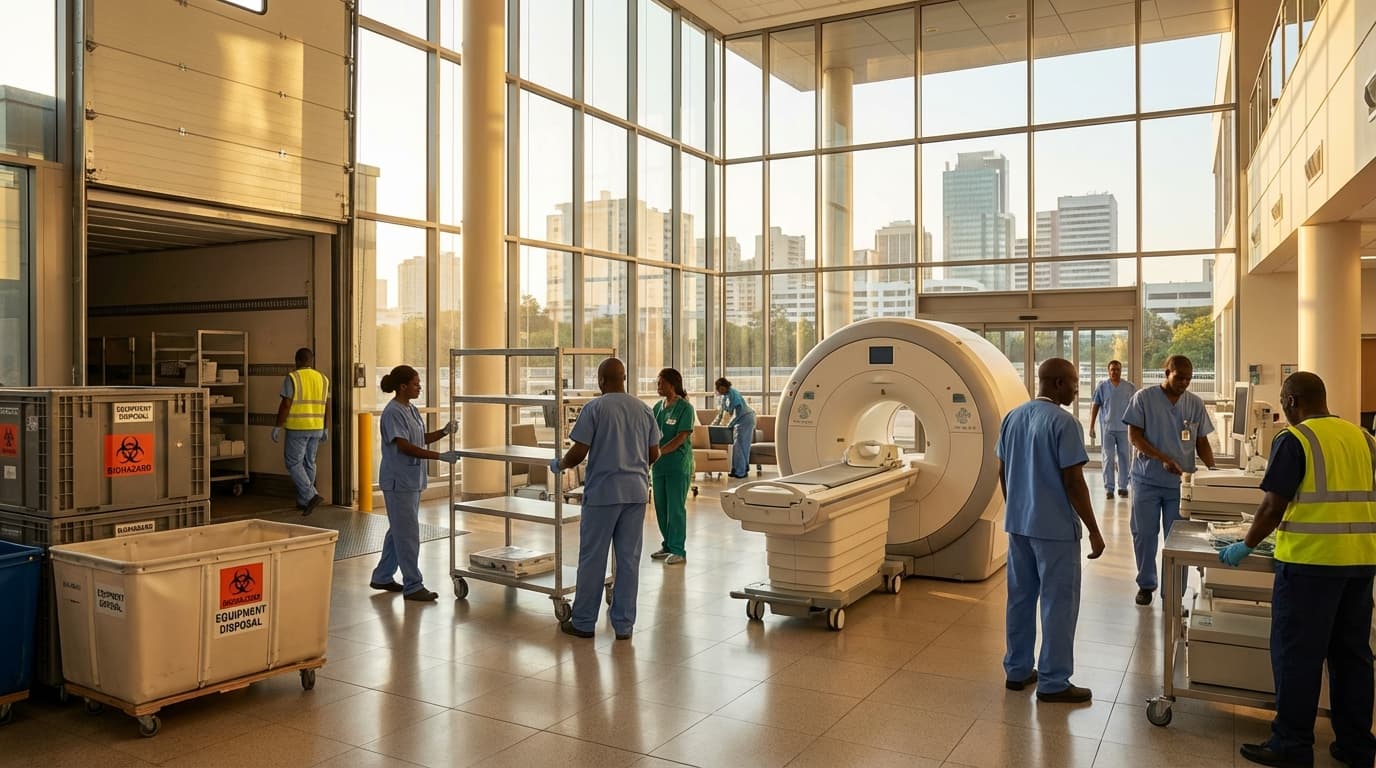
Heavy Medical Equipment De-Installation Service (MRI/CT/Cath Lab) in Somalia
Engineering Excellence & Technical Support
Heavy Medical Equipment De-Installation Service (MRI/CT/Cath Lab) High-standard technical execution following OEM protocols and local regulatory frameworks.
Expedited Project Turnaround
Leveraging extensive experience and optimized workflows, we ensure rapid and efficient de-installation of complex medical imaging systems (MRI, CT, Cath Labs), minimizing downtime and accelerating readiness for relocation or upgrade in challenging Somali environments.
Advanced Decontamination & Containment Protocols
Our highly trained technicians adhere to stringent international safety and environmental standards, employing specialized decontamination procedures and containment measures crucial for handling sensitive medical equipment like MRI and CT scanners in specific regional conditions.
End-to-End Logistics & Compliance Mastery
We provide comprehensive de-installation, packaging, and transportation solutions for heavy medical equipment across Somalia, navigating complex logistical landscapes and ensuring full compliance with all local regulations and import/export requirements.
What Is Heavy Medical Equipment De-installation Service (Mri/ct/cath Lab) In Somalia?
Heavy Medical Equipment De-Installation Service (MRI/CT/Cath Lab) in Somalia refers to the specialized process of safely and systematically dismantling, packing, and preparing high-value, large-scale medical imaging and interventional diagnostic equipment such as Magnetic Resonance Imaging (MRI) scanners, Computed Tomography (CT) scanners, and Cardiac Catheterization (Cath) laboratories for relocation, storage, or disposal within the Somali context. This service is critical due to the intricate nature of these systems, their significant weight and bulk, the requirement for precise handling to prevent damage, and the potential for complex infrastructure integrations (e.g., RF shielding, cooling systems, high-voltage power).
| Who Needs the Service | Typical Use Cases | |||
|---|---|---|---|---|
| Hospitals and Diagnostic Centers in Somalia: Facilities upgrading or replacing existing MRI, CT, or Cath Lab systems. | Medical Institutions Undergoing Relocation: When a healthcare facility is moving to a new site and requires the transfer of its advanced diagnostic imaging equipment. | Equipment Manufacturers or Distributors: For end-of-life equipment removal, trade-in programs, or demonstration unit transportation. | International Aid Organizations or NGOs: Involved in establishing or upgrading medical infrastructure in Somalia, requiring the deployment or redeployment of specialized equipment. | Asset Management Companies: Managing the lifecycle of medical equipment for healthcare providers. |
| Equipment Upgrades: De-installing an older generation MRI/CT/Cath Lab to make way for a newer, more advanced model. | Facility Renovation or Expansion: Removing equipment temporarily to allow for structural modifications to the imaging suite or its supporting infrastructure. | Asset Redeployment: Moving functional MRI/CT/Cath Lab systems from one location within Somalia to another, or for export/import. | End-of-Life Equipment Retirement: Safely dismantling and preparing equipment for disposal or recycling in compliance with environmental regulations. | Disaster Recovery or Emergency Situations: Facilitating the rapid removal of critical equipment from damaged facilities or for temporary storage during crises. |
Key Aspects of Heavy Medical Equipment De-Installation Service
- Technical Assessment and Planning: Comprehensive site survey to evaluate equipment configuration, infrastructure dependencies (power, cooling, ventilation, structural support), access routes, and potential hazards. Development of a detailed de-installation plan.
- Disassembly and Component Segregation: Expert dismantling of the equipment into manageable sections. This involves meticulous disconnection of electrical, data, cooling, and mechanical components, with strict adherence to manufacturer specifications and safety protocols.
- Specialized Handling and Packaging: Utilization of appropriate lifting equipment (cranes, specialized dollies), shock-absorbing materials, and custom crating to protect sensitive components during transit.
- Logistical Coordination: Management of transportation logistics, including coordination with shipping companies, customs clearance, and adherence to any import/export regulations relevant to medical devices in Somalia.
- Environmental and Safety Compliance: Strict adherence to occupational health and safety (OHS) regulations, including the safe handling of refrigerants (e.g., helium in MRI), high-voltage systems, and potential hazardous materials.
- Documentation and Inventory: Thorough cataloging of all disassembled parts, including serial numbers, component descriptions, and condition reports, to facilitate re-installation or asset tracking.
Who Needs Heavy Medical Equipment De-installation Service (Mri/ct/cath Lab) In Somalia?
Heavy medical equipment de-installation services, such as for MRI, CT scanners, and Cath Labs, are critically important for a variety of healthcare facilities and organizations operating in Somalia. These services are not just about moving equipment; they involve the complex and precise dismantling, packaging, and preparation for transport of highly sensitive and often irreplaceable medical imaging and interventional systems. This is crucial for upgrades, replacements, relocation within a facility or to another site, or for decommissioning old units. The unique challenges in Somalia, including infrastructure limitations, security concerns, and the need for specialized expertise, make professional de-installation services indispensable.
| Target Customer Type | Key Departments Involved | Specific Needs/Reasons for De-installation |
|---|---|---|
| Hospitals (Public and Private) | Radiology/Imaging Department, Cardiology Department, IT Department, Biomedical Engineering Department, Facilities Management, Administration | Upgrading to newer MRI/CT/Cath Lab technology, Replacing aging equipment, Relocating equipment within the hospital, Consolidating imaging services, Decommissioning obsolete units. |
| Specialty Clinics | Cardiology Department, Imaging Department, Technical Staff, Management | Expansion of services, Relocation to a larger facility, Replacing existing, older-generation equipment. |
| Government Health Ministries/Agencies | Procurement Department, Health Infrastructure Division, National Medical Stores | Managing national medical equipment assets, Facilitating upgrades to public healthcare facilities, Centralized procurement and distribution of equipment, Decommissioning outdated national assets. |
| International NGOs/Humanitarian Aid Agencies | Logistics Department, Program Management, Biomedical Engineering Support, Field Operations | Establishing new healthcare facilities in remote areas, Upgrading existing facilities supported by the NGO, Relocating equipment to different project sites, Responding to emergency medical needs with mobile or temporary solutions. |
| Military Medical Facilities | Medical Corps, Logistics and Supply Chain, Biomedical Engineering | Modernizing military healthcare infrastructure, Relocating specialized medical units, Decommissioning outdated equipment in military hospitals. |
| Equipment Manufacturers/Distributors | Field Service Engineers, Installation Teams, Sales & Marketing, Logistics | Performing de-installations as part of upgrade contracts, Removing old equipment prior to new installations, Managing returns or equipment repossessions, Preparing equipment for shipment to new clients. |
Target Customers and Departments for Heavy Medical Equipment De-Installation Service in Somalia
- Hospitals (Public and Private)
- Specialty Clinics (e.g., Cardiac Centers, Imaging Centers)
- Government Health Ministries and Agencies
- International Non-Governmental Organizations (NGOs) and Humanitarian Aid Agencies
- Military Medical Facilities
- Research Institutions and Universities (if applicable)
- Equipment Manufacturers and Distributors (for returns, upgrades, or new installations)
Heavy Medical Equipment De-installation Service (Mri/ct/cath Lab) Process In Somalia
This document outlines the typical workflow for a Heavy Medical Equipment De-Installation Service, specifically focusing on MRI, CT, and Cath Lab systems, within Somalia. The process encompasses stages from the initial client inquiry to the successful execution and handover of the de-installed equipment.
| Stage | Description | Key Activities | Considerations (Somalia Specific) |
|---|---|---|---|
| Inquiry & Initial Assessment | The client contacts the service provider with a request for de-installation of heavy medical equipment. | Receive inquiry, gather initial equipment details (make, model, serial number), understand client's timeline and location. | Language barriers, understanding the current operational status and age of equipment, potential for remote initial assessments due to accessibility. |
| Quotation & Contract Negotiation | Based on the initial assessment, a detailed quotation is prepared and negotiated. | Develop a comprehensive quotation including labor, materials, risk assessment, and potential contingencies. Negotiate terms, pricing, and payment schedules. | Currency fluctuations, import/export regulations (if applicable for spare parts or specialized tools), understanding local contract law and dispute resolution. |
| Pre-De-Installation Planning | Detailed planning to ensure a smooth and safe de-installation process. | Site visit (if feasible), detailed technical assessment of the equipment, identification of access routes, power requirements, and specialized tools needed. Develop a step-by-step de-installation plan. | Security assessments of the site, availability of skilled local labor for support roles, potential need for specialized scaffolding or lifting equipment not readily available locally. |
| Site Preparation & Safety Protocols | Ensuring the de-installation area is safe and prepared. | Clear the de-installation area, establish safety zones, implement lockout/tagout procedures, ensure adequate lighting and ventilation, manage any residual fluids or hazardous materials. | Adherence to international safety standards despite potential local infrastructure limitations, managing dust and environmental factors, securing the site from unauthorized access. |
| Equipment De-Installation | The core physical process of dismantling the medical equipment. | Following the approved plan, carefully disconnect power, remove ancillary components, dismantle the main equipment units using specialized tools and techniques. | Handling delicate components in potentially challenging environmental conditions (heat, dust), availability of spare parts for unexpected issues during de-installation, communication with local authorities if required. |
| Packaging & Crating | Properly preparing the de-installed equipment for transport and storage. | Disassemble components further for efficient packaging, use protective materials (foam, bubble wrap), crate or box equipment according to its sensitivity and transport method. | Sourcing appropriate and durable packaging materials locally, ensuring crates are robust enough for potential rough handling during transit, protection against humidity and pests. |
| Logistics & Transportation | Moving the de-installed equipment from the site to the designated destination. | Arrange for appropriate transport vehicles (trucks, containers), coordinate with local logistics providers, manage customs clearance (if applicable), and ensure proper loading and securing of the equipment. | Navigating challenging road conditions, ensuring security of transport, obtaining necessary permits for oversized or heavy loads, working with established and reliable local transport companies. |
| Site Handover & Documentation | Formalizing the completion of the de-installation and handover. | Conduct a final site inspection with the client, provide a detailed report of the de-installation process, including photographs and any relevant certifications. Hand over all documentation. | Ensuring clear and concise documentation in a language understood by the client, providing proof of responsible disposal or relocation of waste materials. |
| Post-Execution Support | Addressing any immediate post-de-installation queries or issues. | Be available to answer client questions regarding the de-installation process, provide support for any unexpected logistical challenges that arise after handover. | Establishing clear communication channels for post-execution support, understanding potential delays in communication due to infrastructure. |
Workflow Stages for Heavy Medical Equipment De-Installation in Somalia
- Inquiry & Initial Assessment
- Quotation & Contract Negotiation
- Pre-De-Installation Planning
- Site Preparation & Safety Protocols
- Equipment De-Installation
- Packaging & Crating
- Logistics & Transportation
- Site Handover & Documentation
- Post-Execution Support
Heavy Medical Equipment De-installation Service (Mri/ct/cath Lab) Cost In Somalia
De-installing heavy medical equipment like MRI, CT scanners, and Cath Labs in Somalia is a complex and specialized service. The cost is influenced by several critical factors, and it's essential to understand these to obtain accurate quotes. Due to the sensitive nature and logistical challenges of such operations in Somalia, pricing can vary significantly. Generally, this service is not offered by many local entities, often requiring specialized international or regional teams to be brought in.
| Equipment Type | Estimated De-installation Cost Range (USD) | Estimated De-installation Cost Range (Somali Shilling - SOS) - Approximate |
|---|---|---|
| MRI Scanner (e.g., 1.5T or 3T) | $15,000 - $50,000+ | ~ 8,700,000 - 29,000,000+ SOS |
| CT Scanner (e.g., 64-slice or higher) | $10,000 - $30,000+ | ~ 5,800,000 - 17,400,000+ SOS |
| Cath Lab System | $12,000 - $40,000+ | ~ 6,960,000 - 23,200,000+ SOS |
Key Pricing Factors for Heavy Medical Equipment De-installation in Somalia
- Type and Size of Equipment: Larger and more complex machines (e.g., an MRI with its superconducting magnet) will naturally incur higher de-installation costs due to the expertise, specialized tools, and time required. CT scanners and Cath Lab equipment also have varying complexities.
- Accessibility and Location: The ease of access to the equipment within the medical facility and the overall remoteness of the location in Somalia are major determinants. Facilities in major cities like Mogadishu or Hargeisa will generally be less expensive to service than those in more remote regions, where transportation and logistics become a significant challenge.
- Dismantling Complexity: The number of components to be disassembled, the need for specialized tools (e.g., for cryogen handling in MRI), and the structural integrity of the equipment all contribute to the complexity and cost.
- Specialized Personnel: The cost of engaging highly skilled engineers, technicians, and project managers with experience in heavy medical equipment de-installation is a primary cost driver. This often includes international travel, accommodation, and per diems if external teams are brought in.
- Logistics and Transportation: Moving the de-installed components from the facility to storage or for shipment requires careful planning and execution. The cost of specialized transport vehicles, cranes, rigging equipment, and securing appropriate permits are all factored in.
- Safety and Environmental Precautions: Adhering to strict safety protocols and environmental regulations during de-installation, especially concerning hazardous materials (e.g., refrigerants in CT scanners), adds to the overall expense.
- Insurance and Risk Management: Comprehensive insurance coverage for the equipment and personnel during the de-installation process is crucial and will be reflected in the pricing.
- Permits and Approvals: Obtaining necessary permits from local authorities for the de-installation and transportation of heavy equipment can incur administrative fees.
- Timeframe and Urgency: Rush jobs or tight deadlines can lead to increased costs due to the need for expedited logistics and potentially overtime pay for personnel.
- Site Preparation: Any necessary modifications or preparation of the facility to allow for safe and efficient de-installation will also add to the cost.
Affordable Heavy Medical Equipment De-installation Service (Mri/ct/cath Lab) Options
When it comes to de-installing large, complex medical equipment like MRI, CT scanners, and Cath Labs, cost is a significant factor. This service requires specialized expertise, precise handling, and adherence to strict safety and regulatory protocols. Fortunately, there are strategies to manage these expenses effectively. Understanding value bundles and implementing cost-saving measures can make a substantial difference in your budget.
| Cost-Saving Strategy | Description | Potential Savings |
|---|---|---|
| Value Bundles | Combining multiple services (e.g., de-installation, transport, and storage) into a single package often comes with a discounted rate compared to individual service bookings. | 10-20% |
| Off-Peak Scheduling | Scheduling de-installation during less busy periods (e.g., weekends, holidays, or slower months) can sometimes lead to lower labor and equipment rental costs. | 5-15% |
| Early Planning & Lead Time | Giving service providers ample notice allows for better resource allocation, bulk purchasing of materials, and potentially negotiating better rates. | 5-10% |
| Equipment Preparation by Facility | If the facility can pre-disconnect power, water, and perform basic internal checks, it can reduce on-site labor hours for the de-installation crew. | 3-7% |
| Negotiating Service Level Agreements (SLAs) | For healthcare systems with multiple de-installations, establishing long-term SLAs can secure preferential pricing and dedicated resources. | Variable, can be substantial for repeat business |
| Choosing a Reputable Provider | While not a direct discount, a reliable provider minimizes costly errors, delays, and potential damage, ultimately saving money. | Indirect, but significant in preventing unforeseen expenses |
| Understanding Scope of Work | Clearly defining what is included in the de-installation (e.g., site restoration extent) avoids scope creep and unexpected charges. | Can prevent significant overruns |
| Consolidating Transportation | If de-installing multiple pieces of equipment or moving them to a single destination, consolidating transport can be more cost-effective. | 5-15% |
Key Components of De-Installation Services
- {"title":"Specialized Labor","description":"Highly trained technicians with expertise in the specific equipment being de-installed. This includes engineers, riggers, and project managers."}
- {"title":"Equipment Disassembly","description":"Careful dismantling of the medical machinery, often involving complex procedures and proprietary tools."}
- {"title":"Rigging and Hoisting","description":"Using specialized equipment to safely lift, move, and secure heavy components within the facility or for transport."}
- {"title":"Environmental Controls","description":"Managing temperature, humidity, and dust during the de-installation process to protect sensitive components."}
- {"title":"Decommissioning and Disposal","description":"Properly powering down, disabling, and disposing of equipment according to environmental and regulatory standards."}
- {"title":"Transportation Logistics","description":"Arranging for specialized transport vehicles and ensuring secure transit to a new location or recycling facility."}
- {"title":"Site Restoration","description":"Returning the de-installation area to its original condition, including repairs to walls, floors, and utilities."}
- {"title":"Project Management","description":"Coordinating all aspects of the de-installation, from planning and scheduling to execution and documentation."}
Verified Providers In Somalia
In Somalia's developing healthcare landscape, identifying and accessing verified providers is crucial for ensuring quality and trustworthy medical services. Franance Health stands out as a premier organization, meticulously vetting its network of healthcare professionals and facilities. This commitment to verification ensures that patients receive care from qualified and ethical practitioners, fostering a safer and more effective healthcare experience. Franance Health's stringent credentialing process, encompassing background checks, license verification, and peer reviews, instills confidence in both patients and partner organizations.
| Verification Aspect | Franance Health's Approach | Benefit to Patients |
|---|---|---|
| Medical Licenses | Thorough verification of all active and valid medical licenses. | Guarantees practitioners are legally authorized to practice medicine. |
| Professional Qualifications | Validation of educational background, specialist certifications, and training. | Ensures competence in specific medical fields and procedures. |
| Experience and Track Record | Review of past performance, references, and peer evaluations. | Provides assurance of practical experience and positive patient outcomes. |
| Ethical Conduct | Screening for any disciplinary actions or malpractice claims. | Upholds the highest standards of patient care and integrity. |
| Facility Standards | Inspection and verification of healthcare facility infrastructure, equipment, and hygiene. | Ensures a safe and conducive environment for treatment. |
Why Franance Health Credentials Matter
- Rigorous Vetting Process: Franance Health employs a multi-layered approach to verify every provider, ensuring they meet the highest standards of medical expertise and ethical practice.
- Enhanced Patient Safety: By partnering exclusively with verified providers, Franance Health significantly reduces the risk of encountering unqualified or fraudulent healthcare services, prioritizing patient well-being.
- Improved Healthcare Access: Franance Health's network connects individuals with trusted doctors, specialists, and hospitals, streamlining access to essential medical care.
- Ethical Standards Compliance: All Franance Health providers are held to strict ethical guidelines, ensuring patient confidentiality, respect, and equitable treatment.
- Trust and Transparency: The verification process fosters trust and transparency in the Somali healthcare sector, empowering patients to make informed decisions about their health.
- Facilitating Partnerships: For organizations seeking reliable healthcare partners in Somalia, Franance Health offers a pre-vetted selection of the best providers.
Scope Of Work For Heavy Medical Equipment De-installation Service (Mri/ct/cath Lab)
This Scope of Work (SOW) outlines the services required for the professional de-installation of heavy medical equipment, specifically Magnetic Resonance Imaging (MRI), Computed Tomography (CT) scanners, and Cardiac Catheterization (Cath Lab) systems. The objective is to safely and efficiently dismantle the specified equipment from its current location, preparing it for transport or relocation. This SOW details the technical deliverables and standard specifications to be adhered to by the service provider.
| Phase/Activity | Description | Technical Deliverables | Standard Specifications/Requirements |
|---|---|---|---|
| Site Assessment and Planning | Pre-installation evaluation of the equipment's location, access routes, power requirements, and structural considerations. | Detailed site survey report including measurements, potential hazards, and logistical plan. | Access to manufacturer's installation and de-installation manuals. Identification of all necessary tools and equipment. Coordination with facility management for access and safety protocols. |
| Equipment De-Energization and Isolation | Safely powering down and isolating all electrical, pneumatic, and hydraulic systems of the equipment. | Confirmation of zero energy state through lock-out/tag-out procedures. | Adherence to facility's safety and electrical standards. Use of qualified electricians/technicians. Verification of isolation through testing. |
| Component Disassembly and Removal | Systematic dismantling of the equipment into manageable components, following manufacturer specifications. | Organized staging of removed components, clearly labeled for re-installation. | Manufacturer's approved de-installation procedures. Specialized lifting equipment (e.g., cranes, gantry systems) as required. Proper handling of sensitive components (e.g., superconducting magnets, X-ray tubes). |
| Cooling System Management (MRI) | Safe and controlled venting and recovery of cryogen (e.g., Helium) for MRI systems. | Documentation of cryogen levels and recovery process. Provision of appropriate cryogen containment and handling equipment. | Compliance with all environmental and safety regulations regarding cryogen handling. Use of experienced cryogen technicians. Secure storage of recovered cryogen. |
| Shielding and Structural Component Removal | De-installation and removal of RF shielding, lead shielding, and any associated structural modifications. | Disposal or secure storage of removed shielding materials in accordance with regulations. | Compliance with radiation safety standards (for CT/Cath Lab). Proper handling and disposal of lead. Documentation of shielding removal. |
| System Decontamination and Cleaning | Cleaning of equipment components to prevent contamination during transport and to prepare for potential decontamination. | Completed cleaning log and visual inspection report. | Use of approved cleaning agents. Environmentally sound disposal of cleaning waste. |
| Documentation and Handover | Comprehensive documentation of the entire de-installation process, including photos and logs. | Final de-installation report including a manifest of all removed components and a record of any issues encountered. | Digital and/or hard copy report. Sign-off by authorized facility representative. Record of all serial numbers of removed components. |
| Site Restoration | Restoration of the de-installation area to its original condition, as agreed upon. | Photos of the restored site. | Removal of all debris and equipment used during the de-installation. Repair of any minor damage caused during the process. |
Key Objectives
- Safe and complete de-installation of MRI, CT, and Cath Lab systems.
- Compliance with all manufacturer guidelines and industry best practices.
- Minimization of disruption to facility operations.
- Documentation of the de-installation process.
- Preparation of equipment for subsequent transport/relocation.
Service Level Agreement For Heavy Medical Equipment De-installation Service (Mri/ct/cath Lab)
This Service Level Agreement (SLA) outlines the performance expectations and guarantees for the de-installation of heavy medical equipment, specifically Magnetic Resonance Imaging (MRI), Computed Tomography (CT), and Cardiac Catheterization Laboratory (Cath Lab) systems. It covers response times for service requests and uptime guarantees for the provided services.
| Service Category | Response Time (Initial Contact) | On-Site Arrival Time (Within Service Window) | Uptime Guarantee (Service Execution) |
|---|---|---|---|
| MRI De-Installation | 4 Business Hours | 8 Business Hours | 98% of scheduled service time within the agreed Service Window will be successfully utilized for de-installation activities, excluding client-caused delays. |
| CT De-Installation | 4 Business Hours | 8 Business Hours | 98% of scheduled service time within the agreed Service Window will be successfully utilized for de-installation activities, excluding client-caused delays. |
| Cath Lab De-Installation | 4 Business Hours | 8 Business Hours | 98% of scheduled service time within the agreed Service Window will be successfully utilized for de-installation activities, excluding client-caused delays. |
| All Critical Equipment (Combined Service Request) | 2 Business Hours (for initial prioritization) | 6 Business Hours (for a combined team) | 98% of scheduled service time within the agreed Service Window will be successfully utilized for de-installation activities, excluding client-caused delays. |
Service Definitions
- Service Request: A formal notification from the Client to the Service Provider requesting de-installation services for specified heavy medical equipment.
- Response Time: The maximum allowable time from the confirmation of a Service Request to the initiation of contact by a qualified Service Provider technician.
- On-Site Arrival Time: The maximum allowable time from the confirmation of a Service Request to the physical arrival of a qualified Service Provider technician at the Client's designated location.
- Uptime Guarantee: Refers to the availability of the de-installation service within the agreed-upon service window. For de-installation services, this primarily relates to the timely and effective execution of the service once initiated, rather than continuous operational uptime of the equipment itself (as it is being de-installed).
- Critical Equipment: MRI, CT, and Cath Lab systems requiring specialized handling, certified technicians, and adherence to strict safety protocols for de-installation.
- Service Window: The agreed-upon period during which de-installation services can be scheduled and performed, typically during business hours or as specified in the project scope.
Frequently Asked Questions

Ready when you are
Let's scope your Heavy Medical Equipment De-Installation Service (MRI/CT/Cath Lab) in Somalia project in Somalia.

Scaling healthcare logistics and technical systems across the entire continent.