
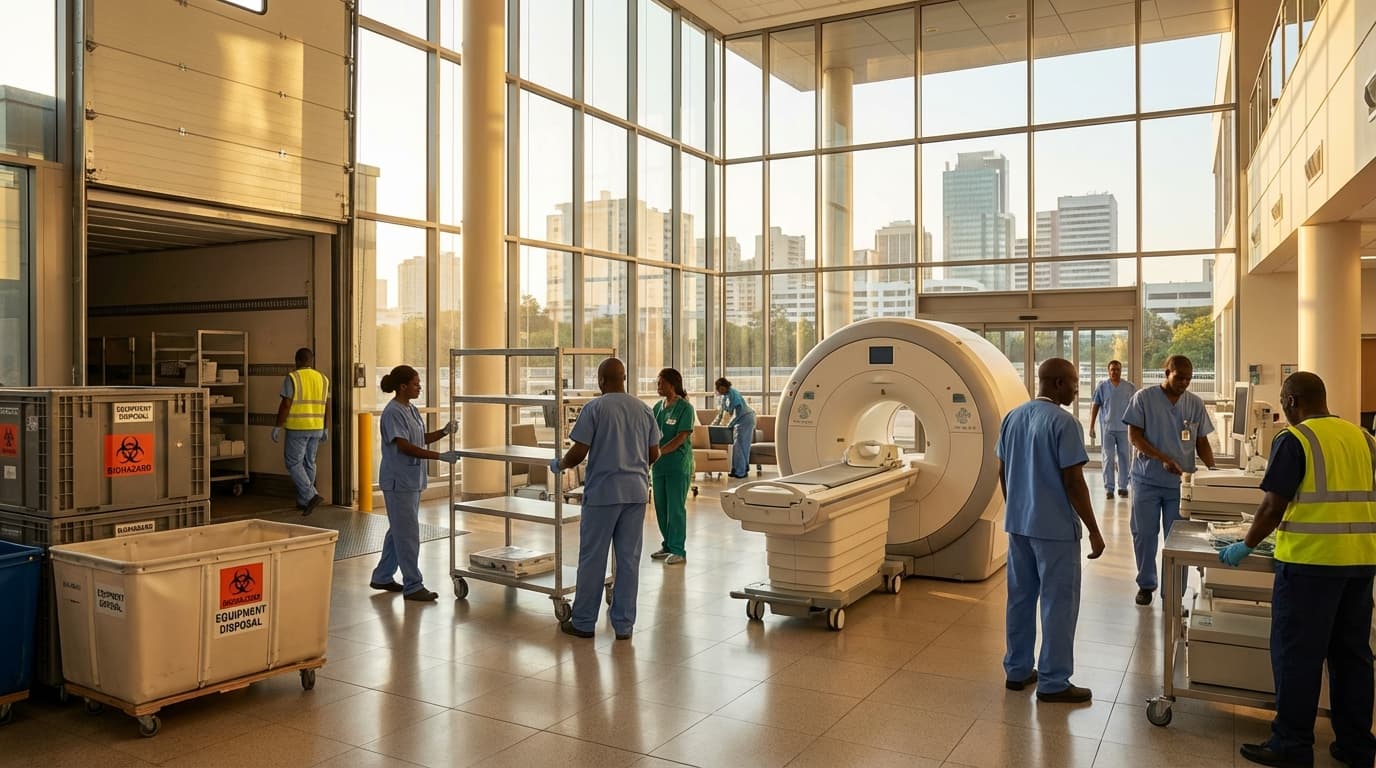
Decommissioning Service for Medical Devices in Somalia
Engineering Excellence & Technical Support
Decommissioning Service for Medical Devices High-standard technical execution following OEM protocols and local regulatory frameworks.
Safe & Compliant Decommissioning
Expertly and ethically remove expired, non-functional, or surplus medical devices, ensuring full compliance with international safety standards and local Somali regulations. We prioritize secure data erasure and prevent potential misuse of sensitive information.
Environmentally Responsible Disposal
Minimize environmental impact through sustainable decommissioning practices. We employ responsible disposal methods, including eco-friendly waste segregation, recycling of salvageable components, and proper handling of hazardous materials, protecting Somalia's natural resources.
Streamlined Logistics & Documentation
Navigate the complexities of medical device decommissioning in Somalia with our integrated logistics and comprehensive documentation services. We manage the entire process, from site assessment and transportation to final certification, providing clear audit trails and ensuring transparency.
What Is Decommissioning Service For Medical Devices In Somalia?
Decommissioning service for medical devices in Somalia refers to the comprehensive process of safely and compliantly retiring and disposing of end-of-life, obsolete, or malfunctioning medical equipment. This service ensures that medical devices are rendered inoperable, their data is securely erased, and their physical components are managed according to relevant environmental and safety regulations. It is a critical aspect of lifecycle management for medical technology within healthcare facilities in Somalia.
| Who Needs Decommissioning Service? | Typical Use Cases |
|---|---|
| Hospitals and Clinics (Public and Private): Facilities that upgrade or replace aging medical equipment, or that have devices that are no longer functional or repairable. | End-of-life disposal of X-ray machines, MRI scanners, CT scanners, and other imaging equipment. Retirement of anesthesia machines, ventilators, and patient monitoring systems that are obsolete or beyond repair. Secure data erasure and disposal of laboratory analyzers and diagnostic equipment containing patient information. Managing the decommissioning of surgical instruments and sterilization equipment. Disposal of older or non-functional imaging modalities like ultrasound machines and endoscopes. |
| Medical Research Institutions: Organizations that have decommissioned specialized research equipment that may contain sensitive data or hazardous materials. | Decommissioning of high-precision analytical instruments from research labs. Safe disposal of any biomedical research equipment no longer in use. |
| Government Health Ministries and Agencies: Entities responsible for overseeing the medical infrastructure and ensuring compliance with health and environmental regulations. | Establishing standardized protocols for medical device decommissioning across the nation. Managing the disposal of equipment from public health programs or mobile clinics. Facilitating the removal and disposal of obsolete or donated medical equipment. |
| Medical Device Manufacturers and Distributors (in relation to service contracts or end-of-life support): Companies that may offer or be responsible for the end-of-life management of their products. | Handling returns of devices under warranty or service agreements that are deemed irreparable. Facilitating the decommissioning of demonstration or loaner equipment. |
Key Components of Medical Device Decommissioning Services in Somalia:
- Data Sanitization and Destruction: Securely erasing all patient data, operational logs, and sensitive information stored on the device's memory or storage media, adhering to privacy standards.
- Physical Disassembly and Segregation: Carefully dismantling devices to separate hazardous materials (e.g., mercury, batteries, radioactive isotopes) from recyclable components and general waste.
- Environmental Impact Mitigation: Implementing procedures to prevent the release of harmful substances into the environment during disposal, often involving specialized waste handlers.
- Regulatory Compliance: Ensuring all decommissioning activities adhere to national and international regulations pertaining to medical waste management, data privacy, and environmental protection.
- Asset Tracking and Documentation: Maintaining detailed records of the decommissioning process, including device identification, disposal methods, and certificates of destruction or recycling.
- Safe Transportation: Arranging for the secure and compliant transport of decommissioned devices to authorized disposal or recycling facilities.
Who Needs Decommissioning Service For Medical Devices In Somalia?
Decommissioning of medical devices in Somalia is a critical service essential for ensuring public safety, environmental protection, and compliance with regulatory standards. This process involves the safe and secure removal, disposal, or recycling of obsolete, damaged, or expired medical equipment. Several entities in Somalia have a pressing need for these services.
| Customer Type | Key Departments/Functions Requiring Decommissioning |
|---|---|
| Hospitals and Healthcare Facilities | Biomedical Engineering Department, Procurement Department, Facilities Management, Clinical Departments (e.g., Radiology, Surgery, ICU) |
| Government Ministries and Agencies | Ministry of Health (various directorates), Environmental Protection Agency (if applicable), Public Health Departments |
| NGOs and International Aid Organizations | Program Management, Logistics and Procurement, Health Program Officers |
| Diagnostic Laboratories and Imaging Centers | Laboratory Management, Radiology Department, Technical Operations |
| Medical Training and Educational Institutions | Biomedical Science Departments, Simulation Labs, Procurement and Estates Management |
| Pharmaceutical and Medical Supply Companies | Research and Development, Quality Control, Warehouse Management, Logistics |
Target Customers and Departments in Somalia Requiring Medical Device Decommissioning Services
- {"title":"Hospitals and Healthcare Facilities","description":"These are the primary consumers of medical devices. As equipment ages, becomes technologically outdated, or is damaged beyond repair, it requires professional decommissioning. This includes both public and private sector hospitals, clinics, and specialized medical centers."}
- {"title":"Government Ministries and Agencies","description":"The Ministry of Health and other relevant government bodies are responsible for overseeing the healthcare sector. They may require decommissioning services for centrally managed medical equipment, or they may mandate and regulate such services for other facilities."}
- {"title":"Non-Governmental Organizations (NGOs) and International Aid Organizations","description":"Numerous NGOs and international organizations provide healthcare services and donate medical equipment in Somalia. When this equipment reaches the end of its lifecycle, these organizations need reliable decommissioning partners to manage its disposal responsibly."}
- {"title":"Diagnostic Laboratories and Imaging Centers","description":"Specialized facilities focused on diagnostics, such as X-ray departments, MRI centers, and pathology labs, often have complex and expensive equipment that requires specific decommissioning procedures."}
- {"title":"Medical Training and Educational Institutions","description":"Universities and vocational schools that train healthcare professionals often utilize medical equipment for educational purposes. When this equipment is no longer functional or relevant for training, it needs to be decommissioned."}
- {"title":"Pharmaceutical and Medical Supply Companies","description":"While not direct users of medical devices in a clinical sense, these companies may possess outdated or recalled medical equipment from their inventory or during product development phases that require professional decommissioning."}
Decommissioning Service For Medical Devices Process In Somalia
This document outlines the standard workflow for decommissioning medical devices in Somalia, ensuring compliance with local regulations and best practices for safe and environmentally responsible disposal. The process begins with an initial inquiry from a healthcare facility or entity and culminates in the complete removal and disposal of the device.
| Phase | Stage | Description | Key Activities | Responsible Party | Documentation |
|---|---|---|---|---|---|
| Inquiry & Assessment |
| Healthcare facility/entity contacts the decommissioning service provider to request services for one or more medical devices. | Contacting the service provider, providing device details (type, model, serial number, condition). | Healthcare Facility/Entity | Inquiry Request Form |
| Inquiry & Assessment |
| Service provider visits the facility to inspect the devices, assess their condition, and determine the scope of work. | Physical inspection, data assessment (if applicable), identification of disposal requirements, risk assessment. | Decommissioning Service Provider | Site Survey Report, Device Assessment Form |
| Planning & Preparation |
| Service provider submits a formal proposal detailing the scope, timeline, costs, and methodology. Upon agreement, a service contract is signed. | Proposal preparation, cost estimation, contract negotiation, contract signing. | Decommissioning Service Provider, Healthcare Facility/Entity | Service Proposal, Signed Service Agreement |
| Planning & Preparation |
| A detailed plan is created, outlining the specific steps for decommissioning, including safety procedures and environmental considerations. | Defining dismantling procedures, waste segregation plan, transportation logistics, safety protocols. | Decommissioning Service Provider | Decommissioning Plan Document |
| Execution |
| For devices with data storage, information is securely erased to prevent unauthorized access. | Implementing certified data wiping methods, physical destruction of storage media (if necessary). | Decommissioning Service Provider | Data Sanitization Certificate |
| Execution |
| The medical device is safely dismantled or rendered inoperable according to the decommissioning plan. | Following safety procedures, component separation, rendering the device non-functional. | Decommissioning Service Provider | Decommissioning Log, Photographic Evidence (optional) |
| Execution |
| Dismantled components and materials are sorted and packaged according to their classification (hazardous, non-hazardous, recyclable). | Identifying waste streams, appropriate containment and labeling. | Decommissioning Service Provider | Waste Manifest/Log |
| Execution |
| The decommissioned devices and waste materials are transported to the designated disposal or recycling facility. | Using licensed transport vehicles, adhering to transport regulations. | Decommissioning Service Provider | Transportation Manifest |
| Execution |
| Waste materials are disposed of or recycled at authorized facilities in an environmentally sound manner. | Incineration (for hazardous waste), landfill (for non-hazardous), material recovery and recycling. | Authorized Disposal/Recycling Facility | Disposal Certificate, Recycling Certificate |
| Completion & Reporting |
| A comprehensive report is provided to the healthcare facility detailing the entire decommissioning process and its completion. | Compiling all relevant documentation, issuing a final decommissioning certificate. | Decommissioning Service Provider | Final Decommissioning Report, Final Certificate of Decommissioning |
Decommissioning Service for Medical Devices Process in Somalia
- The decommissioning process is managed by authorized service providers who adhere to specific protocols.
- Compliance with Ministry of Health regulations and environmental standards is paramount throughout the workflow.
- Secure data sanitization is a critical step for devices with data storage capabilities.
- Proper categorization of medical waste is essential for appropriate disposal routes.
- Documentation and certification are maintained at each stage of the process.
Decommissioning Service For Medical Devices Cost In Somalia
Decommissioning medical devices in Somalia is a critical but often overlooked service. The cost is influenced by several factors, including the type and complexity of the device, its location, the required level of data sanitization or destruction, and the regulatory compliance demands. Due to the nascent nature of regulated medical device decommissioning in Somalia, established pricing structures are less common, and costs can vary significantly based on the provider's expertise, available technology, and logistical challenges within the country. It's crucial for healthcare facilities to obtain detailed quotes tailored to their specific needs.
| Device Category (Examples) | Estimated Cost Range (Somali Shilling - SOS) | Notes |
|---|---|---|
| Small Diagnostic/Examination Tools (e.g., Stethoscopes, Blood Pressure Monitors, basic lab equipment) | 15,000 - 75,000 | Primarily labor and basic transport. Minimal data security concerns. |
| Mid-Range Medical Equipment (e.g., ECG machines, basic ultrasound, dental chairs, patient monitors) | 75,000 - 300,000 | Involves more complex dismantling, potentially some hazardous materials, and moderate data security considerations. |
| Large/Complex Imaging Equipment (e.g., X-ray machines, CT scanners, MRI machines) | 300,000 - 1,500,000+ | Significant expertise, specialized tools, hazardous material handling (e.g., radiation, refrigerants), extensive data sanitization/destruction, and complex logistics. Costs can escalate significantly. |
| Sterilization/Autoclave Units | 100,000 - 500,000 | Potential for hazardous materials (e.g., steam, chemicals), requires specialized dismantling. |
| Laboratory Analyzers (Sophisticated) | 150,000 - 750,000+ | Complex internal components, potential hazardous reagents, and significant data storage. |
| Hospital Beds & Furniture (Medical Grade) | 20,000 - 100,000 | Primarily transportation and disposal of bulk items, potential for minor biohazards. |
| General Waste Disposal (Non-Hazardous) | 10,000 - 50,000 | Basic collection and landfill disposal, for non-medical or fully sanitized items. |
Key Pricing Factors for Medical Device Decommissioning in Somalia
- Device Type & Complexity: Simple devices like basic examination tables will cost less than complex imaging equipment (e.g., X-ray machines, CT scanners) or sophisticated laboratory analyzers, which require specialized knowledge and tools for safe dismantling and disposal.
- Data Security Requirements: Devices containing patient data (e.g., electronic health records systems, imaging machines) require thorough data sanitization or physical destruction to comply with privacy regulations. The level of security mandated will impact costs.
- Location of Device: Decommissioning costs are higher for devices located in remote or difficult-to-access areas due to increased transportation and logistical expenses. Accessibility to the facility also plays a role.
- Dismantling & Transportation: The labor involved in safely dismantling devices, along with the cost of transporting hazardous or bulky components to designated disposal sites, are significant cost drivers.
- Environmental Considerations & Disposal Fees: Proper disposal of medical waste, especially hazardous materials (e.g., refrigerants, certain chemicals, radioactive components), incurs fees at specialized disposal facilities. Compliance with environmental regulations is paramount.
- Regulatory Compliance: While formal regulations for medical device decommissioning might be evolving in Somalia, adhering to international best practices or any emerging local guidelines will influence the service scope and associated costs.
- Provider Expertise & Equipment: Specialized companies with trained technicians and appropriate equipment for handling various medical devices will generally charge more than general waste removal services, but offer a higher level of assurance.
- Condition of Device: Devices that are severely damaged or require extensive disassembly may incur higher costs.
- Urgency of Service: Expedited decommissioning services may come with a premium.
Affordable Decommissioning Service For Medical Devices Options
Decommissioning medical devices involves safely and securely removing them from service, ensuring data privacy and environmental compliance. For healthcare facilities, managing this process affordably is crucial. This guide explores cost-effective options for medical device decommissioning, focusing on value bundles and strategic cost-saving measures.
| Cost-Saving Strategy | Description | Potential Benefits |
|---|---|---|
| Bulk Service Agreements | Negotiating a contract for a large volume of devices to be decommissioned over a specific period. This allows for volume discounts. | Lower per-device costs, predictable budgeting, streamlined logistics for ongoing needs. |
| Phased Decommissioning | Planning and executing decommissioning in stages based on device age, usage, or departmental priorities. This avoids large upfront capital outlays and allows for better resource allocation. | Spreads costs over time, enables proactive planning, minimizes operational disruption. |
| In-House vs. Outsourced Evaluation | Carefully assessing whether certain decommissioning tasks (like basic data wiping for non-sensitive data) can be handled by internal IT staff to reduce external service fees. | Reduced reliance on external vendors for simpler tasks, potential internal staff utilization. |
| Partnering with Certified Recyclers | Choosing vendors who are certified for environmentally sound recycling and disposal. This ensures compliance and can sometimes offer rebates for valuable components. | Environmental compliance, potential revenue from recycled materials, reduced disposal fees. |
| Long-Term Contracts with Price Lock-ins | Securing multi-year contracts with decommissioning providers that include fixed pricing, protecting against future price increases. | Cost predictability, protection against inflation, stable budgeting. |
| Data Sanitization Tiering | Understanding that not all devices require the highest level of data destruction. Offering different tiers of data sanitization based on data sensitivity can reduce costs. | Cost efficiency by matching service level to data risk, avoids overspending on unnecessary secure wipes. |
Understanding Decommissioning Value Bundles
- {"title":"What are Value Bundles?","description":"Value bundles are service packages that combine multiple decommissioning tasks into a single, often discounted, offering. Instead of paying for each service individually, clients benefit from a consolidated price, simplifying budgeting and potentially reducing overall costs."}
- {"title":"Common Components of Value Bundles","description":"These bundles typically include: data sanitization/destruction, physical disassembly, asset tracking and inventory, environmentally responsible disposal/recycling, and certification of service."}
- {"title":"Benefits of Bundled Services","description":"Choosing a value bundle offers convenience, predictable pricing, and often a lower per-device cost compared to à la carte services. It streamlines the process by working with a single vendor for multiple needs."}
Verified Providers In Somalia
In Somalia's challenging healthcare landscape, identifying and trusting verified healthcare providers is paramount. Franance Health stands out as a beacon of reliability, offering a robust network of credentialed professionals and facilities. This commitment to verification ensures patients receive safe, effective, and high-quality medical care. Understanding Franance Health's credentialing process and the benefits it offers is crucial for anyone seeking dependable healthcare solutions in Somalia.
| Credential Type | Verification Process | Benefit for Patients |
|---|---|---|
| Medical Doctor (MD) | Verification of medical degree, licensure, residency completion, and continuous professional development. | Ensures competency in diagnosis, treatment, and patient management. |
| Specialist Physician (e.g., Surgeon, Cardiologist) | Includes MD verification plus proof of advanced training, board certification, and specialized experience. | Guarantees access to expert care for complex medical conditions. |
| Nurses (RN, LPN) | Verification of nursing education, licensure, and relevant certifications. | Ensures safe and effective patient care, medication administration, and monitoring. |
| Hospitals & Clinics | Assessment of facility infrastructure, equipment, hygiene standards, adherence to medical protocols, and qualified staffing. | Confirms a safe, well-equipped environment with competent medical teams. |
| Paramedics & Technicians | Verification of relevant certifications, training, and practical skills. | Ensures reliable emergency medical services and accurate diagnostic procedures. |
| Pharmacists | Verification of pharmacy degree, licensure, and adherence to dispensing regulations. | Guarantees access to safe and appropriate medications. |
Why Franance Health Credentials Matter:
- Rigorous Vetting: Franance Health employs a stringent verification process for all its affiliated healthcare professionals and institutions.
- Quality Assurance: Credentials ensure providers meet established standards for education, training, and ethical practice.
- Patient Safety: Verified providers minimize risks associated with unqualified or fraudulent medical practitioners.
- Access to Expertise: Franance Health connects patients with specialists and facilities equipped to handle diverse medical needs.
- Peace of Mind: Knowing you are accessing care from a credentialed and trusted source offers invaluable reassurance.
- Improved Health Outcomes: High-quality, verified care directly contributes to better patient health and recovery.
Scope Of Work For Decommissioning Service For Medical Devices
This Scope of Work (SOW) outlines the services required for the decommissioning of medical devices. Decommissioning encompasses the safe and compliant removal of medical devices from service, including data sanitization, physical dismantling, and disposal or transfer of components.
| Item | Description | Standard Specification / Requirement | Deliverable |
|---|---|---|---|
| 1 | Decommissioning Methodology | Methodology must ensure safety, data security, environmental compliance, and preservation of reusable components. | Decommissioning Plan, Incident Reports (if any) |
| 2 | Data Sanitization/Destruction | Adherence to NIST SP 800-88 R1 Guidelines or equivalent approved standards for data sanitization/destruction. Full disk overwrite, physical destruction, or cryptographic erasure as appropriate. | Certificate of Data Sanitization/Destruction for each affected device |
| 3 | Physical Dismantling | Safe and systematic dismantling of devices. Identification and segregation of hazardous materials (e.g., mercury, batteries, radioactive sources). | Waste manifests, photographs of dismantled components (if required) |
| 4 | Environmental Compliance | Proper disposal of all materials in accordance with local, state, and federal environmental regulations. Recycling of components where feasible and appropriate. | Waste manifests, recycling certificates |
| 5 | Asset Management & Tracking | Real-time tracking of devices throughout the decommissioning process. Accurate record-keeping of device status, location, and final disposition. | Asset Reconciliation Report, Final Inventory List |
| 6 | Documentation & Reporting | All documentation must be clear, concise, accurate, and readily auditable. | All listed Technical Deliverables |
| 7 | Personnel Qualifications | Personnel performing decommissioning must be trained, certified (if applicable), and have demonstrated experience in medical device handling and data security. | Resumes/Certifications of key personnel (upon request) |
| 8 | Safety Procedures | Implementation of strict safety protocols to protect personnel, facilities, and the environment during all decommissioning activities. | Safety Plan, Incident Reports (if any) |
Technical Deliverables and Standard Specifications
- Comprehensive decommissioning plan detailing methodology, timelines, and resource allocation.
- Asset inventory reconciliation and verification prior to decommissioning.
- Detailed reporting on each device decommissioned, including serial numbers, model numbers, and decommissioning date.
- Certificates of data sanitization/destruction for all devices containing sensitive patient or operational data.
- Waste manifests for all disposed materials, categorized by type (e.g., hazardous, non-hazardous, recyclable).
- Compliance documentation demonstrating adherence to all relevant regulations (e.g., HIPAA, FDA, local environmental laws).
- Photographic or video evidence of the decommissioning process, where applicable.
- Final project completion report summarizing all activities, findings, and compliance.
Service Level Agreement For Decommissioning Service For Medical Devices
This Service Level Agreement (SLA) outlines the response times and uptime guarantees for the Decommissioning Service for Medical Devices. This SLA is an addendum to the Master Service Agreement (MSA) between [Your Company Name] ('Service Provider') and [Client Company Name] ('Client').
| Service Level | Priority Level | Response Time (during Business Hours) | Response Time (outside Business Hours) | Uptime Guarantee |
|---|---|---|---|---|
| Decommissioning Service Request | Critical Device | 1 Hour | 2 Hours | 99.5% (excluding scheduled maintenance) |
| Decommissioning Service Request | High Priority Device | 4 Business Hours | 8 Business Hours | 99.5% (excluding scheduled maintenance) |
| Decommissioning Service Request | Standard Priority Device | 1 Business Day | 2 Business Days | 99.5% (excluding scheduled maintenance) |
Definitions
- Decommissioning Service: The end-to-end process of safely and compliantly removing medical devices from service, including data sanitization, physical disposal, and asset tracking.
- Critical Device: A medical device whose failure or malfunction would result in immediate patient harm or loss of life.
- High Priority Device: A medical device whose failure or malfunction would significantly impact patient care or hospital operations.
- Standard Priority Device: A medical device whose failure or malfunction has minimal immediate impact on patient care or hospital operations.
- Service Request: A formal request submitted by the Client to initiate the decommissioning of one or more medical devices.
- Response Time: The maximum allowable time from the Service Provider receiving a Service Request to the commencement of service-related activities (e.g., acknowledgement, initial assessment, site visit scheduling).
- Downtime: The period during which the Decommissioning Service is unavailable due to a failure of the Service Provider's systems or personnel, excluding scheduled maintenance.
- Uptime Guarantee: The minimum percentage of time the Decommissioning Service is expected to be available to the Client.
- Scheduled Maintenance: Pre-announced periods of planned downtime for system updates, upgrades, or preventative maintenance, communicated in advance to the Client.
- Force Majeure: Events beyond the reasonable control of the Service Provider, including but not limited to, natural disasters, acts of war, or widespread infrastructure failures, which may impact response times and uptime.
- Business Hours: Monday to Friday, 8:00 AM to 5:00 PM [Client's Time Zone], excluding public holidays recognized in [Client's Jurisdiction].
Frequently Asked Questions

Ready when you are
Let's scope your Decommissioning Service for Medical Devices in Somalia project in Somalia.

Scaling healthcare logistics and technical systems across the entire continent.