
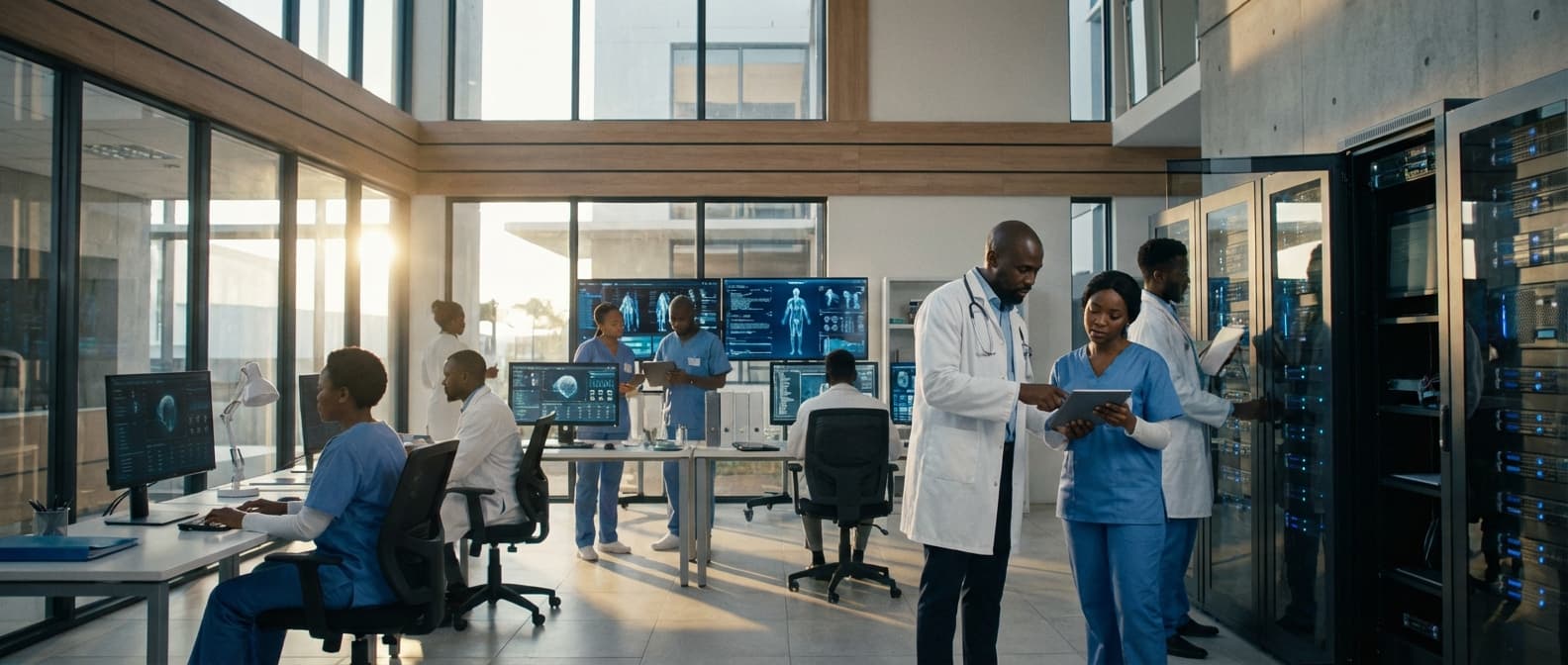
Medical IT Consultation in Somalia
Engineering Excellence & Technical Support
Strategic technology consulting to optimize healthcare operations, streamline workflows, and integrate cutting-edge medical information systems. High-standard technical execution following OEM protocols and local regulatory frameworks.
Establishing Secure & Scalable Network Infrastructure
Designing and implementing robust, high-availability network architectures to support critical healthcare operations, ensuring seamless data flow and secure access to electronic health records (EHRs) and medical imaging systems across multiple facilities.
Implementing Advanced Cybersecurity Protocols
Developing and deploying comprehensive cybersecurity strategies, including data encryption, access controls, intrusion detection systems, and regular vulnerability assessments, to safeguard sensitive patient data and comply with international data privacy standards.
Enabling Remote Patient Care & Diagnostics
Integrating and optimizing telemedicine platforms and remote monitoring solutions, enabling healthcare providers to deliver consultations, diagnostics, and follow-up care to underserved populations, bridging geographical barriers and improving healthcare accessibility.
What Is Medical It Consultation In Somalia?
Medical IT Consultation in Somalia refers to the provision of specialized technical expertise and strategic guidance to healthcare organizations and professionals within the Somali context. This service addresses the unique challenges and opportunities present in Somalia's healthcare landscape, including limited infrastructure, a nascent digital ecosystem, and the need for resilient and adaptable IT solutions. It encompasses the assessment, design, implementation, and optimization of information technology systems and strategies to improve healthcare delivery, data management, patient care, and operational efficiency. The overarching goal is to leverage technology to enhance the quality, accessibility, and sustainability of healthcare services in Somalia.
| Who Needs Medical IT Consultation? | Typical Use Cases |
|---|---|
| Hospitals and Clinics (Public and Private) | Implementing EHR systems for patient registration, medical history tracking, and appointment scheduling. Designing and deploying secure networks for internal communication and data exchange. Establishing telemedicine capabilities to extend specialist care to remote areas. Developing data analytics platforms to monitor disease prevalence and treatment outcomes. |
| Government Health Ministries and Agencies | Developing national health information systems (NHIS) for disease surveillance and public health reporting. Formulating IT strategies and policies to guide national healthcare digitalization efforts. Assessing and recommending appropriate technologies for public health initiatives. Implementing interoperability standards to facilitate data sharing between different health facilities. |
| Non-Governmental Organizations (NGOs) and International Aid Organizations | Implementing mobile health (mHealth) solutions for data collection and patient monitoring in field operations. Setting up IT infrastructure for emergency response and humanitarian health projects. Providing technical support for the deployment of medical equipment with IT components. Developing secure platforms for program management and reporting. |
| Medical Training Institutions and Universities | Integrating IT into medical curricula for digital health literacy. Developing virtual learning environments and simulation tools. Establishing IT infrastructure to support research and data analysis. Providing access to online medical resources and databases. |
| Individual Healthcare Practitioners | Advising on the selection and implementation of practice management software. Ensuring compliance with data protection regulations. Establishing secure methods for patient communication and data storage. |
Key Components of Medical IT Consultation in Somalia
- Needs Assessment and Gap Analysis
- IT Infrastructure Design and Planning
- Electronic Health Record (EHR) System Implementation and Customization
- Data Management and Analytics Strategy
- Cybersecurity and Data Privacy Solutions
- Telemedicine and Remote Healthcare Platform Integration
- Training and Capacity Building for Healthcare Staff
- Procurement and Vendor Management
- IT Policy and Governance Development
- Disaster Recovery and Business Continuity Planning
Who Needs Medical It Consultation In Somalia?
In the complex and often challenging healthcare landscape of Somalia, Medical IT consultation is becoming increasingly vital. As healthcare providers strive to improve patient care, streamline operations, and ensure data security, specialized IT expertise is no longer a luxury but a necessity. This consultation helps organizations navigate the unique technological hurdles and opportunities present in Somalia, fostering a more efficient and resilient healthcare system.
| Target Customer | Relevant Departments | Key IT Needs |
|---|---|---|
| Hospitals & Clinics (Public & Private) | IT Department, Administration, Clinical Departments (e.g., Radiology, Pathology, Pharmacy), Patient Records, Finance | Electronic Health Records (EHR) implementation & optimization, Network infrastructure, Cybersecurity, Data management & analytics, Telemedicine integration, Medical equipment integration, IT support & maintenance |
| NGOs Operating Healthcare Facilities | Program Management, IT Support, Field Operations, Data Management | Secure data collection & reporting, Communication systems, Network setup in remote areas, Training for local staff, Cloud solutions for data accessibility, Logistics & supply chain IT |
| Government Health Ministries & Agencies | Health Information Systems Unit, Planning & Policy, Public Health Surveillance, Procurement | National health data repositories, Disease surveillance systems, Interoperability between facilities, E-health strategy development, Data security & privacy regulations, Training & capacity building for government IT staff |
| Medical Training & Educational Institutions | IT Department, Academic Departments, Library Services | Learning Management Systems (LMS), Simulation software, Digital libraries, Secure student data management, Research data infrastructure |
| Diagnostic Laboratories & Imaging Centers | IT Department, Laboratory Information System (LIS) team, Radiology Information System (RIS) team, Administration | LIS & RIS implementation & integration, PACS (Picture Archiving and Communication System) management, Data integrity & quality control, Secure reporting and data sharing, Hardware & software maintenance |
| Pharmacies & Pharmaceutical Distributors | Inventory Management, Supply Chain, IT Department | Inventory management systems, Supply chain tracking & traceability, Point-of-sale (POS) systems, Data security for sensitive stock information, Integration with regulatory bodies |
| Telemedicine Providers | IT Department, Clinical Operations, Patient Services | Secure video conferencing platforms, Patient portals, Remote monitoring systems, Data storage & retrieval, Integration with local healthcare providers |
| Healthcare Technology Vendors & Implementers | Project Management, Technical Support, Sales & Marketing | Needs assessment, System design & architecture, Implementation & deployment strategy, Training & change management, Post-implementation support, Cybersecurity best practices tailored for the Somali context |
Who Needs Medical IT Consultation in Somalia?
- Hospitals and Clinics (Public and Private)
- Non-Governmental Organizations (NGOs) operating healthcare facilities
- Government Health Ministries and Agencies
- Medical Training and Educational Institutions
- Diagnostic Laboratories and Imaging Centers
- Pharmacies and Pharmaceutical Distributors (managing inventory and supply chains)
- Telemedicine Providers
- Healthcare Technology Vendors and Implementers
Medical It Consultation Process In Somalia
This document outlines the typical workflow for a medical IT consultation process in Somalia, from initial inquiry to the successful execution of agreed-upon services. The process is designed to be adaptable to the specific needs of healthcare facilities, considering the unique operational environment and resource availability in Somalia.
| Phase | Key Activities | Description | Key Stakeholders Involved | Deliverables/Outcomes |
|---|---|---|---|---|
| 1: Inquiry and Initial Contact | Client expresses interest, requests information, initial discussion. | Healthcare facility (hospital, clinic, lab) identifies a need for IT solutions or consultation. They reach out to IT consulting firms via email, phone, or through professional networks. An initial call or meeting is scheduled to understand the basic nature of their inquiry. | Healthcare Facility Representative (e.g., Administrator, IT Manager, Clinical Lead), IT Consulting Firm Sales/Business Development. | Initial understanding of client need, basic company information shared, meeting scheduled. |
| 2: Needs Assessment and Scoping | Detailed understanding of current IT infrastructure, challenges, and objectives. | Consultants conduct on-site or remote assessments (depending on feasibility and client preference) to evaluate existing hardware, software, network, data security, workflows, and user capabilities. This phase involves in-depth interviews with various stakeholders to capture specific pain points and desired outcomes. | Healthcare Facility Staff (IT, Administration, Clinical, Pharmacy, Lab), IT Consultants (Technical Analysts, Project Managers). | Detailed needs assessment report, identification of gaps, scope of work document (initial draft). |
| 3: Proposal Development and Negotiation | Developing a tailored solution, cost estimation, and presenting the offer. | Based on the needs assessment, the IT consulting firm develops a comprehensive proposal outlining recommended solutions, project timelines, resource allocation, deliverables, and a detailed cost breakdown. This is presented to the client for review and discussion. Negotiations may involve scope adjustments, pricing, or payment terms. | IT Consulting Firm (Proposal Writers, Technical Experts, Pricing Specialists), Healthcare Facility Management/Procurement. | Formal proposal document, refined scope of work, preliminary budget. |
| 4: Contract and Agreement | Formalizing the engagement and terms. | Once the proposal is accepted, a formal contract or service agreement is drafted and signed by both parties. This document legally binds the parties and details all aspects of the engagement, including payment schedules, confidentiality clauses, intellectual property rights, and dispute resolution mechanisms. | Legal Counsel (for both parties), Healthcare Facility Management, IT Consulting Firm Leadership. | Signed contract/service agreement. |
| 5: Project Planning and Mobilization | Detailed project plan creation and resource allocation. | A dedicated project team is assigned. A detailed project plan is developed, including task breakdowns, milestones, risk management strategies, communication protocols, and a clear project schedule. Resources (personnel, equipment, software) are mobilized and prepared for deployment. | IT Consulting Firm Project Manager, Technical Team Leads, Healthcare Facility IT Liaison. | Detailed project plan, resource allocation plan, kick-off meeting agenda. |
| 6: Execution and Implementation | Deploying solutions, configuring systems, and integrating IT infrastructure. | This is the core phase where the agreed-upon IT solutions are implemented. This could involve hardware installation, software deployment, network configuration, system integration, data migration, and customization of existing systems to meet specific healthcare workflows. | IT Consulting Firm Technical Team (Engineers, Developers, Technicians), Healthcare Facility IT Staff, Relevant Departmental Staff. | Implemented IT systems and infrastructure, functional software, integrated platforms. |
| 7: Training and Knowledge Transfer | Empowering end-users and IT staff. | Comprehensive training is provided to the end-users (doctors, nurses, administrative staff) on how to effectively use the new IT systems. Knowledge transfer sessions are also conducted for the facility's IT staff to ensure they can maintain and manage the systems post-implementation. | IT Consulting Firm Trainers, Healthcare Facility End-Users, Healthcare Facility IT Staff. | Trained personnel, training materials (manuals, guides), knowledge transfer documentation. |
| 8: Go-Live and Support | Launching new systems and providing initial assistance. | The new IT systems are officially launched. A period of intensive support is provided to address any immediate issues or challenges that arise during the initial operational phase. This may include on-site support, remote assistance, and help desk services. | IT Consulting Firm Support Team, Healthcare Facility IT Staff, End-Users. | Operational IT systems, initial bug fixes, user support. |
| 9: Post-Implementation Review and Handover | Evaluating success, final documentation, and transition to ongoing support. | A formal review is conducted to assess the success of the project against the initial objectives. Lessons learned are documented. All project documentation, including user manuals, system configurations, and support procedures, is handed over to the healthcare facility. Transition to an ongoing maintenance and support agreement (if applicable) is finalized. | IT Consulting Firm Project Manager, Healthcare Facility Management/IT Team, Key End-Users. | Project closure report, final documentation, handover confirmation, satisfaction survey (optional). |
Medical IT Consultation Process Workflow in Somalia
- Phase 1: Inquiry and Initial Contact
- Phase 2: Needs Assessment and Scoping
- Phase 3: Proposal Development and Negotiation
- Phase 4: Contract and Agreement
- Phase 5: Project Planning and Mobilization
- Phase 6: Execution and Implementation
- Phase 7: Training and Knowledge Transfer
- Phase 8: Go-Live and Support
- Phase 9: Post-Implementation Review and Handover
Medical It Consultation Cost In Somalia
Consulting on Medical IT in Somalia involves a nuanced approach to pricing due to various local factors. The cost is not uniform and can fluctuate significantly based on the complexity of the project, the specific services required, the experience of the consultant, and the location within Somalia. Smaller clinics might require basic network setup and EHR implementation, while larger hospitals could need comprehensive system integration, cybersecurity solutions, and data analytics. The availability of qualified IT professionals, particularly those with specialized healthcare IT knowledge, also plays a role. Furthermore, the logistical challenges of operating in certain regions, including security and accessibility, can add to the overall expense.
| Service Category | Estimated Price Range (in Somali Shilling - SOS) | Notes |
|---|---|---|
| Initial IT Assessment & Strategy Development | 2,000,000 - 7,000,000 SOS | For understanding current infrastructure and planning future improvements. |
| Network Infrastructure Setup/Upgrade | 3,000,000 - 10,000,000 SOS | Includes cabling, routers, switches, Wi-Fi for a medium-sized facility. |
| Electronic Health Record (EHR) System Implementation (Consulting) | 5,000,000 - 25,000,000 SOS | Covers selection, customization, data migration strategy, and initial setup support. Software costs are separate. |
| Cybersecurity Assessment & Basic Implementation | 3,000,000 - 15,000,000 SOS | Firewall setup, antivirus deployment, basic security policies. |
| Advanced Cybersecurity Solutions (e.g., threat detection, penetration testing) | 10,000,000 - 40,000,000 SOS+ | More complex and ongoing services. |
| Telemedicine Platform Setup (Consulting) | 4,000,000 - 18,000,000 SOS | Advice on platform selection, hardware, connectivity, and workflow integration. |
| Data Analytics & Reporting Setup (Consulting) | 3,000,000 - 12,000,000 SOS | For setting up systems to analyze patient data and generate reports. |
| IT Staff Training (per session/module) | 1,000,000 - 4,000,000 SOS | Focused training on specific software or systems. |
| Hourly Consulting Rate (for ad-hoc support) | 200,000 - 800,000 SOS | Varies greatly by consultant expertise and urgency. |
| Full-time Project Management (per month) | 6,000,000 - 20,000,000 SOS | For dedicated project oversight. |
Key Pricing Factors for Medical IT Consultation in Somalia:
- Scope and Complexity of the Project: Basic setup versus advanced system integration.
- Type of Services Required: Network infrastructure, EHR implementation, cybersecurity, data analytics, cloud solutions, telemedicine setup, etc.
- Consultant Experience and Expertise: Local vs. international consultants, years of experience, specific healthcare IT certifications.
- Project Duration: Short-term assessment versus long-term strategic planning and implementation support.
- Location within Somalia: Accessibility and logistical considerations for on-site work.
- Technology Stack: Open-source versus proprietary solutions, hardware requirements.
- Training and Support Needs: Level of user training and ongoing technical support required.
- Regulatory and Compliance Requirements: Adherence to any nascent healthcare IT regulations.
- Travel and Accommodation Expenses: For consultants traveling to remote or less accessible areas.
- Security Considerations: Enhanced security measures may be required in certain environments.
Affordable Medical It Consultation Options
Securing expert Medical IT consultation is crucial for healthcare organizations aiming to optimize their technology infrastructure, enhance patient care, and ensure regulatory compliance. However, budget constraints can be a significant challenge. Fortunately, there are several affordable options available, often centered around flexible engagement models and value-driven service packages. Understanding these options can help healthcare providers make informed decisions to maximize their IT ROI.
| Cost-Saving Strategy | Description | Example Application |
|---|---|---|
| Leverage Value Bundles | Pre-packaged services often offer a discount compared to individual services. Ensures a comprehensive approach to common needs. | A bundle for HIPAA compliance assessment and initial remediation can be more cost-effective than procuring each service separately. |
| Opt for Project-Based Engagement | Pay for specific deliverables and time spent, avoiding ongoing retainer fees for services not immediately required. | Hiring consultants for a defined EHR optimization project rather than a continuous management contract. |
| Prioritize Remote Consultations | Reduces travel and accommodation expenses for consultants, leading to lower overall project costs. | Conducting a cybersecurity vulnerability assessment and report generation entirely via video calls and remote system access. |
| Engage Niche Specialists | Smaller, focused firms may have lower overhead and offer more competitive rates for specialized expertise. | Using a dedicated medical device integration consultant for a specific project instead of a large, general IT firm. |
| Consider Phased Implementation | Breaking down large IT initiatives into smaller, manageable stages allows for better budget control and staggered investment. | Rolling out a new Picture Archiving and Communication System (PACS) in phases rather than a full organizational deployment at once. |
| Negotiate Service Level Agreements (SLAs) | Clearly define response times, uptime guarantees, and support levels to ensure you're paying for the services you truly need. | Establishing specific response times for critical system outages in a managed IT services contract. |
| Explore Open-Source Solutions (with caution) | While not direct consultation savings, understanding open-source options can reduce software licensing costs, freeing up budget for expert implementation advice. | Consulting on the integration of an open-source EHR system for a small clinic, where the primary cost is expertise, not licensing. |
Affordable Medical IT Consultation Options
- {"title":"Value Bundles & Packaged Services","sub_list":["HIPAA Compliance Audit & Remediation Bundle: Covers assessment of current practices, identification of vulnerabilities, and development of action plans to achieve and maintain HIPAA compliance.","EHR Optimization Package: Focuses on improving the efficiency and usability of your Electronic Health Record system through workflow analysis, user training, and system configuration adjustments.","Cybersecurity Essentials Package: Includes vulnerability scanning, penetration testing, security policy development, and employee training to bolster defenses against cyber threats.","Cloud Migration Strategy & Planning: Assists in assessing cloud readiness, selecting appropriate cloud solutions (e.g., for data storage, telehealth), and developing a phased migration plan."],"description":"Many IT consulting firms offer pre-defined service bundles that package common needs into a single, often discounted, price. These bundles can provide cost predictability and ensure you're getting a comprehensive solution for a specific area of concern."}
- {"title":"On-Demand & Project-Based Consulting","sub_list":["Ad-hoc Support: For immediate troubleshooting or advice on specific IT issues.","Phased Project Implementation: Breaking down large IT projects into smaller, manageable phases, allowing for budget allocation and progress tracking at each stage."],"description":"Instead of long-term retainers, consider engaging consultants for specific projects or on an as-needed basis. This approach is ideal for addressing particular challenges or implementing defined initiatives without ongoing commitment."}
- {"title":"Remote & Virtual Consultations","sub_list":["Virtual Workshops & Training: Delivering educational sessions on new technologies or best practices remotely.","Remote System Monitoring & Management: Proactive oversight of IT infrastructure to prevent issues before they impact operations."],"description":"Leveraging remote access and video conferencing can significantly reduce travel costs associated with traditional on-site consulting. Many complex IT issues can be effectively diagnosed and resolved without a physical presence."}
- {"title":"Specialized Niche Providers","sub_list":["EHR Implementation Specialists: Expertise solely focused on deploying and optimizing specific EHR systems.","Medical Device Integration Experts: Focused on connecting and managing various medical devices with IT systems."],"description":"Instead of large, general IT consulting firms, consider smaller, specialized firms that focus on specific areas of medical IT. They may offer more competitive pricing due to lower overhead."}
- {"title":"Peer-to-Peer Networks & Associations","sub_list":["Industry Conferences & Webinars: Learning about emerging trends and best practices from peers and experts.","Online Forums & Communities: Seeking advice and solutions to common IT challenges from other healthcare IT professionals."],"description":"Engaging with professional associations or informal networks of healthcare IT professionals can provide access to shared knowledge and sometimes even informal consulting advice at little to no cost."}
Verified Providers In Somalia
Navigating the healthcare landscape in Somalia requires confidence in the providers you choose. Franance Health stands out as a leader, offering a commitment to quality, ethical practice, and patient-centered care. Their rigorous credentialing process ensures that all healthcare professionals associated with Franance Health meet the highest standards of expertise and integrity. This dedication to verification is not just a formality; it's a cornerstone of their mission to provide accessible, reliable, and exceptional healthcare services across Somalia. Choosing Franance Health means choosing peace of mind, knowing you are in the hands of qualified and trusted medical professionals.
| Provider Type | Franance Health Verification Process | Benefits of Choosing Franance Health |
|---|---|---|
| Doctors (General Practitioners) | Verification of medical degree, valid medical license, and at least 2 years of post-internship experience. | Access to experienced GPs trained in common illnesses and preventive care. |
| Doctors (Specialists) | Verification of medical degree, specialist certification, valid medical license, and proven track record in their field. | Expert diagnosis and treatment for complex medical conditions. |
| Nurses | Verification of nursing degree/diploma, valid nursing license, and relevant certifications (e.g., BLS, ACLS). | Skilled and compassionate nursing care, crucial for patient recovery and comfort. |
| Paramedics/Emergency Medical Technicians | Verification of certification, relevant training in emergency care, and valid licenses. | Timely and effective pre-hospital emergency medical response. |
| Allied Health Professionals (e.g., Lab Technicians, Radiologists) | Verification of relevant certifications, diplomas, and practical experience. | Accurate diagnostic support services ensuring proper treatment planning. |
Why Franance Health is the Premier Choice:
- Rigorous Credentialing: Franance Health employs an exhaustive verification process for all its healthcare providers, scrutinizing qualifications, licenses, and experience.
- Experienced Professionals: Their network comprises highly skilled and experienced doctors, nurses, and specialists dedicated to delivering top-tier medical care.
- Ethical Practice Standards: Adherence to strict ethical guidelines and patient privacy is paramount at Franance Health.
- Comprehensive Services: From primary care to specialized treatments, Franance Health aims to provide a wide spectrum of healthcare solutions.
- Community Focus: Franance Health is deeply committed to serving the Somali community, understanding local health needs and cultural nuances.
- Commitment to Quality: Continuous professional development and a focus on best practices ensure the highest quality of healthcare delivery.
Scope Of Work For Medical It Consultation
This Scope of Work (SOW) outlines the services to be provided by [Consulting Firm Name] (hereinafter referred to as "Consultant") to [Client Organization Name] (hereinafter referred to as "Client") for medical IT consultation. The project aims to assess, recommend, and potentially implement improvements to the Client's existing medical IT infrastructure, ensuring compliance with industry standards and best practices, and enhancing operational efficiency and patient care.
| Phase | Key Activities | Deliverables | Timeline (Estimated) |
|---|---|---|---|
| On-site/remote interviews with stakeholders, system audits, data collection, security posture review, compliance gap analysis. | Current State Assessment Report, Infrastructure Inventory, Security Risk Assessment Summary, Compliance Gap Analysis Report. | 2-4 Weeks |
| Analysis of assessment findings, development of strategic IT roadmap, vendor research and evaluation, ROI analysis. | IT Improvement Strategy Document, Technology Recommendations Report, Vendor Selection Criteria, Proposed Budget. | 2-3 Weeks |
| Detailed system design, integration planning, procurement specifications, project management plan, change management strategy. | Technical Design Documents, Implementation Plan, Procurement Specifications, Project Management Plan, Change Management Plan. | 2-3 Weeks |
| Vendor management, system installation oversight, configuration assistance, integration testing, user acceptance testing (UAT). | Implementation Status Reports, Test Case Results, UAT Sign-off. | Variable (Based on scope of implementation) |
| Performance monitoring, post-implementation assessment, training delivery, final documentation. | Post-Implementation Review Report, Training Materials, Final Project Report, System Documentation. | 1-2 Weeks (Post-implementation) |
Project Objectives
- Conduct a comprehensive assessment of the Client's current medical IT infrastructure, including hardware, software, networks, security protocols, and data management practices.
- Identify key areas for improvement related to system performance, reliability, scalability, and interoperability.
- Evaluate the current state of IT security and compliance with relevant regulations (e.g., HIPAA, GDPR, HITECH).
- Develop actionable recommendations for upgrading or replacing existing systems, implementing new technologies, and optimizing workflows.
- Provide guidance on best practices for IT governance, disaster recovery, and business continuity planning.
- Assist in the selection and procurement of new hardware, software, or services as required.
- Support the implementation and integration of recommended solutions.
- Provide training and knowledge transfer to Client IT staff.
Service Level Agreement For Medical It Consultation
This Service Level Agreement (SLA) outlines the response times and uptime guarantees for medical IT consultation services provided by [Your Company Name] to [Client Company Name]. This SLA is an addendum to the Master Service Agreement (MSA) dated [MSA Date].
| Incident Priority | Response Time Target (within Business Hours) | Resolution Time Target (within Business Hours) | Uptime Guarantee |
|---|---|---|---|
| Critical Incident | 15 minutes | 2 hours | 99.9% |
| High Priority Incident | 1 hour | 4 hours | 99.9% |
| Medium Priority Incident | 4 business hours | 8 business hours | 99.8% |
| Low Priority Incident | 8 business hours | As scheduled (communication within 24 business hours) | 99.5% |
Definitions
- Business Hours: Monday to Friday, 9:00 AM to 5:00 PM, excluding national holidays.
- Critical Incident: An incident that renders a critical medical IT system (e.g., EHR, PACS, patient monitoring) completely inaccessible or severely impairs its functionality, posing an immediate risk to patient care or safety.
- High Priority Incident: An incident that significantly degrades the performance or availability of a critical medical IT system, impacting multiple users or a significant portion of operations.
- Medium Priority Incident: An incident that affects non-critical systems or causes minor disruptions to critical systems, with a manageable workaround available.
- Low Priority Incident: A general inquiry, feature request, or minor issue with no immediate impact on system functionality or patient care.
- Uptime: The percentage of time that the IT services are available and functioning as expected. Excludes scheduled maintenance windows.
Frequently Asked Questions

Ready when you are
Let's scope your Medical IT Consultation in Somalia project in Somalia.

Scaling healthcare logistics and technical systems across the entire continent.