
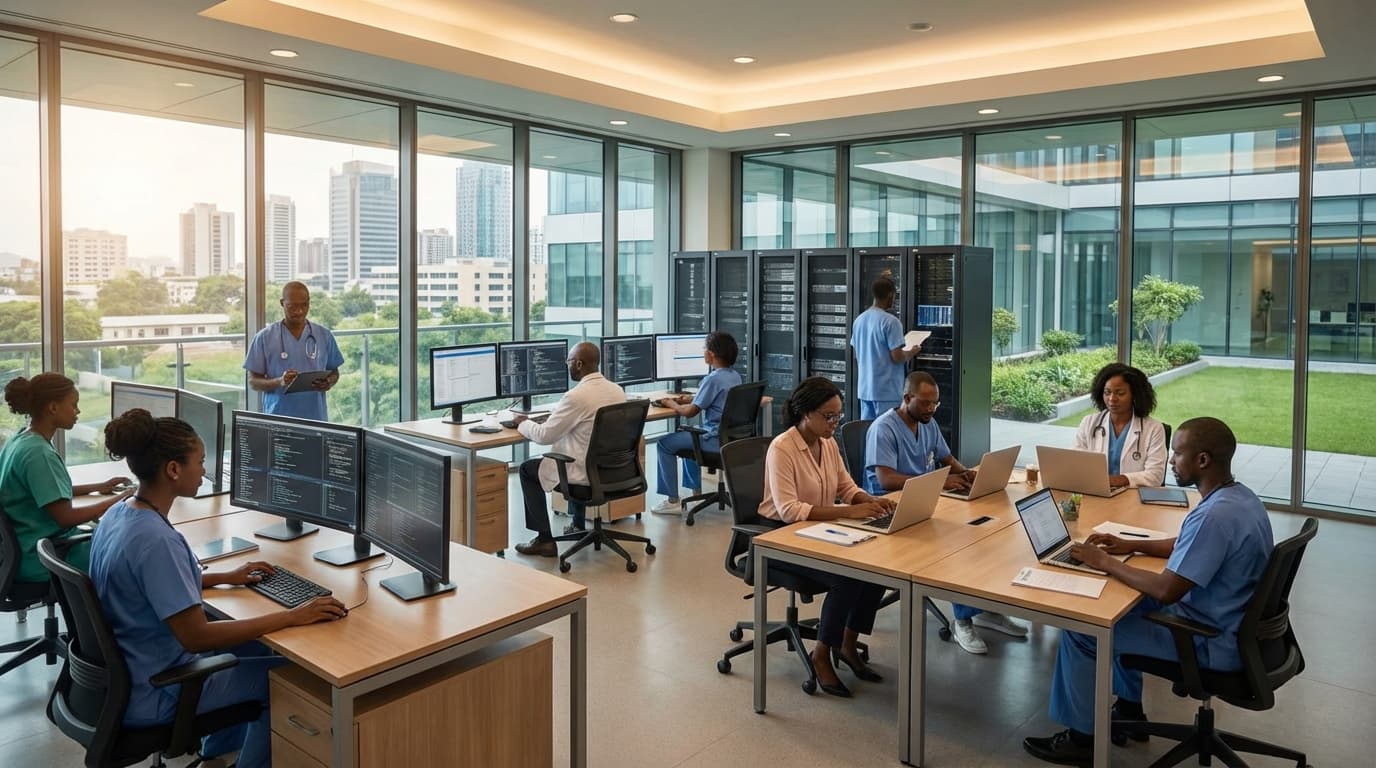
Radiology Reader & Reporting Support in Somalia
Engineering Excellence & Technical Support
Remote radiology reading and reporting services High-standard technical execution following OEM protocols and local regulatory frameworks.
Secure Cloud-Based Image Archiving
Enables secure, remote storage and retrieval of radiological images, overcoming infrastructure limitations and ensuring data integrity for timely diagnosis and reporting, even in remote areas.
AI-Powered Diagnostic Assistance
Leverages artificial intelligence to pre-screen images, highlight potential abnormalities, and offer preliminary findings, empowering radiologists with enhanced accuracy and efficiency for improved patient care.
Tele-Radiology Reporting Platform
Facilitates remote reporting by connecting local healthcare facilities with experienced radiologists, bridging the expertise gap and providing critical diagnostic services where specialists are scarce.
What Is Radiology Reader & Reporting Support In Somalia?
Radiology Reader & Reporting Support in Somalia refers to the provision of expert diagnostic imaging interpretation and structured reporting services to healthcare facilities in Somalia, often in areas with limited access to subspecialist radiologists. This service leverages remote access to medical imaging (e.g., X-rays, CT scans, ultrasounds, MRIs) and a network of qualified radiologists to generate accurate and timely diagnostic reports. The primary objective is to augment local diagnostic capabilities, facilitate evidence-based clinical decision-making, and improve patient care outcomes in a resource-constrained environment. The service is typically delivered through a secure Picture Archiving and Communication System (PACS) and Reporting system, allowing for efficient data transfer and workflow management.
| Who Needs It | Typical Use Cases | ||||||||
|---|---|---|---|---|---|---|---|---|---|
| Hospitals and clinics in Somalia lacking in-house radiology subspecialists. | Initial diagnosis of common pathologies (e.g., fractures, pneumonia, abdominal complaints) in emergency departments. | Second opinion interpretation for complex or equivocal cases. | Support for specialized imaging modalities like CT and MRI, where local expertise is scarce. | Screening programs (e.g., tuberculosis detection via chest X-rays). | Post-operative imaging assessment. | Management of chronic conditions requiring regular imaging follow-up (e.g., musculoskeletal, oncological imaging). | Providing diagnostic support in remote or underserved regions. | Facilities with intermittent access to visiting radiologists. | Public health initiatives requiring broad-scale imaging interpretation. |
Key Components of Radiology Reader & Reporting Support
- Remote interpretation of diagnostic imaging studies (X-ray, CT, MRI, Ultrasound).
- Generation of comprehensive and structured diagnostic reports by subspecialist radiologists.
- Secure digital transmission of images and reports.
- Integration with local PACS/RIS or provision of a cloud-based solution.
- Quality assurance and peer review of interpretations.
- Turnaround time (TAT) management for various study types.
- Training and support for local medical staff on image acquisition and preliminary review (where applicable).
Who Needs Radiology Reader & Reporting Support In Somalia?
Radiology reader and reporting support services are critically needed in Somalia to address the severe shortage of trained radiologists and improve the quality and accessibility of diagnostic imaging services. These services are essential for accurate diagnosis, effective treatment planning, and ultimately, better patient outcomes. The current healthcare infrastructure in Somalia is strained, and access to specialized medical expertise like radiology is a significant challenge, particularly outside of major urban centers. Therefore, any entity or individual involved in providing or facilitating healthcare, especially diagnostic services, can benefit from outsourced radiology reading and reporting.
| Target Customer/Department | Specific Needs and Use Cases | Benefits of Support |
|---|---|---|
| Public Hospitals (Government-run) | Overburdened by patient volume, lack of specialized radiologists for complex cases (e.g., CT, MRI interpretation), delayed reporting leading to treatment delays. Need for basic X-ray interpretation support for common conditions. | Improved diagnostic accuracy, reduced reporting turnaround times, enhanced patient care, efficient use of existing imaging equipment, capacity building for local staff through exposure to remote reporting. |
| Private Hospitals and Clinics | Limited access to in-house radiologists, high cost of employing full-time specialists, desire to offer a wider range of advanced imaging services (CT, MRI) without significant capital investment in personnel. Need for efficient reporting to maintain patient flow and competitiveness. | Expanded service offerings, faster turnaround times for urgent cases, competitive advantage, cost-effectiveness compared to hiring, improved patient satisfaction. |
| Missions and Non-Governmental Organization (NGO) Healthcare Facilities | Operating in remote or underserved areas with minimal access to trained medical professionals, focus on specific health issues (e.g., infectious diseases, trauma, maternal health), need for reliable and timely diagnostic support for their patient populations. | Access to essential diagnostic imaging expertise, improved health outcomes for vulnerable populations, support for public health initiatives, ability to manage diagnostic workflows efficiently in resource-limited settings. |
| Diagnostic Imaging Centers | May have imaging equipment but lack sufficient radiologist capacity to interpret all scans, especially during peak hours or for specialized modalities. Need to ensure timely and accurate reports to referring physicians. | Increased throughput, consistent reporting quality, ability to handle diverse imaging requests, professional and reliable reporting service. |
| Mobile/Outreach Healthcare Programs | Provide essential services in rural and nomadic communities where fixed healthcare facilities are scarce. Require portable imaging equipment and remote reporting solutions to diagnose and manage conditions effectively on-site or with immediate follow-up. | Enables provision of advanced diagnostic capabilities in remote areas, supports early detection and intervention, improves the reach and impact of mobile health services. |
| Emergency and Trauma Centers | Critical need for rapid and accurate interpretation of imaging studies (CT scans of head, abdomen, chest, X-rays for fractures) to guide immediate treatment decisions in life-threatening situations. Any delay can have dire consequences. | Life-saving diagnosis, faster decision-making in critical care, reduced morbidity and mortality, optimized emergency room workflow. |
| Maternal and Child Health Centers | Need for ultrasound interpretation for prenatal care, diagnosis of gynecological conditions, and pediatric imaging. Limited availability of trained sonographers and radiologists for these specific modalities. | Improved prenatal care, early detection of fetal abnormalities, better management of obstetric and gynecological conditions, enhanced care for pediatric patients. |
Target Customers and Departments for Radiology Reader & Reporting Support in Somalia:
- Public Hospitals (Government-run)
- Private Hospitals and Clinics
- Missions and Non-Governmental Organization (NGO) Healthcare Facilities
- Diagnostic Imaging Centers
- Mobile/Outreach Healthcare Programs
- Emergency and Trauma Centers
- Maternal and Child Health Centers
Radiology Reader & Reporting Support Process In Somalia
The Radiology Reader & Reporting Support Process in Somalia is a critical pathway designed to provide essential diagnostic imaging interpretation and reporting services in an environment with limited specialized personnel. This process facilitates access to expert radiology opinions for healthcare facilities across the country, often leveraging remote consultation models. The workflow begins with a facility identifying a need for radiology interpretation and culminates in the delivery of a comprehensive diagnostic report, guiding clinical decision-making and patient care.
| Stage | Description | Key Actors | Inputs | Outputs | Considerations/Challenges (Somalia Context) |
|---|---|---|---|---|---|
| A healthcare facility identifies a patient requiring radiology interpretation and generates a formal request for support. This involves documenting patient demographics, clinical history, and the specific imaging modality used. | Referring Clinician, Facility Administrator | Patient medical record, clinical question | Formal radiology request form/document | Limited internet connectivity for communication, lack of standardized request forms, potential language barriers. |
| Digital imaging files (e.g., DICOM) are securely transmitted from the originating facility to the radiology reading center or a designated repository. This often involves cloud-based platforms, secure email, or specialized telemedicine systems. | Radiology Technologist, IT Support (if available) | DICOM images, patient identifiers | Securely transmitted image files | Low bandwidth and unreliable internet, data security and privacy concerns, lack of PACS (Picture Archiving and Communication System) at many facilities, manual image transfer limitations. |
| Upon receipt, requests are reviewed and assigned to an available and qualified radiologist based on subspecialty, workload, and urgency. Complex or urgent cases may be prioritized. | Triage Coordinator, Lead Radiologist | Radiology requests, image files | Assigned case to a radiologist | Limited pool of available radiologists, potential delays due to workload, difficulty in ensuring subspecialty coverage for all modalities/areas. |
| The assigned radiologist meticulously reviews the medical images, correlates them with the provided clinical information, and forms a diagnostic opinion. | Radiologist | Image files, clinical history | Diagnostic findings | Varying image quality due to equipment limitations, need for robust remote reading software, potential for misinterpretation without complete clinical context, limited access to previous imaging studies. |
| The radiologist dictates or types a comprehensive report detailing findings, impressions, and recommendations. In some models, a senior radiologist may review the report for quality assurance. | Radiologist, Report Typist (if applicable), Senior Radiologist (for QA) | Diagnostic findings, clinical history | Draft diagnostic report | Limited availability of trained reporting staff, potential for dictation challenges with poor audio quality, need for standardized reporting templates. |
| The final, signed radiology report is transmitted back to the referring healthcare facility through secure channels. This could be via email, a secure portal, or integrated into an electronic health record system. | Radiology Reading Center Administrator, IT Support | Finalized diagnostic report | Disseminated radiology report | Ensuring secure and timely delivery, confirmation of receipt, accessibility of reports by referring clinicians (e.g., on mobile devices). |
| Mechanisms are in place to collect feedback from referring clinicians on the timeliness and accuracy of the reports. This feedback is used for continuous improvement of the radiology service. | Referring Clinician, Radiology Reading Center Management | Radiology report, clinician feedback | Quality improvement data, service adjustments | Establishing clear channels for feedback, encouraging active participation, utilizing feedback to identify training needs for technologists and radiologists. |
Radiology Reader & Reporting Support Process Workflow
- Initial Inquiry & Request Generation
- Image Transmission
- Case Triage & Assignment
- Radiology Reading & Interpretation
- Report Generation & Review
- Report Dissemination
- Feedback & Quality Assurance
Radiology Reader & Reporting Support Cost In Somalia
Providing radiology reading and reporting support in Somalia is a developing area, and pricing can vary significantly due to several factors. The absence of established, widespread teleradiology services means that costs are often project-based, dependent on the provider's operational model, and influenced by local logistical challenges. This response outlines the key pricing factors and provides estimated cost ranges in Somali Shillings (SOS).
| Service Type (Estimated) | Estimated Range (Somali Shillings - SOS) | Notes |
|---|---|---|
| Basic X-ray Interpretation (per study) | 50,000 - 150,000 SOS | For simple findings. May include report generation. Volume discounts likely. |
| Ultrasound Interpretation (per study) | 75,000 - 200,000 SOS | Depends on the region scanned (e.g., abdominal, obstetric). More detailed reports incur higher costs. |
| CT Scan Interpretation (per study) | 150,000 - 400,000 SOS | Complexity of scan and number of slices/protocols influence cost. Subspecialty interpretation adds to the price. |
| MRI Scan Interpretation (per study) | 200,000 - 500,000+ SOS | Generally the most expensive due to complexity and need for specialized expertise. Advanced sequences and protocols increase cost. |
| Dedicated Teleradiology Platform Setup (per month/project) | Negotiable (potentially millions of SOS) | Includes software, hardware, connectivity, and potentially radiologist fees. Highly project-dependent. |
| Urgent/STAT Reporting Surcharge (per study) | 25% - 100% increase on base rate | For reporting within a few hours. |
| Radiologist Consultation (per hour) | 100,000 - 300,000 SOS | For complex cases or second opinions. Varies based on radiologist's experience. |
Key Pricing Factors for Radiology Reader & Reporting Support in Somalia:
- {"title":"Scope of Services:","description":"The type of imaging modalities covered (X-ray, Ultrasound, CT, MRI), the complexity of interpretations required, and the volume of studies to be read will directly impact the cost. Basic X-ray readings will be less expensive than comprehensive CT or MRI interpretations."}
- {"title":"Provider Type:","description":"This can range from individual radiologists offering freelance services, to local clinics with reporting capabilities, to international organizations or companies establishing a presence. International providers may have higher overheads but potentially greater expertise and reliability. Local providers might offer more competitive pricing but could have limitations in advanced technology or subspecialty expertise."}
- {"title":"Technology & Infrastructure:","description":"The ability of the provider to access and interpret digital images (PACS systems, high-resolution monitors) is crucial. If images need to be physically transported or scanned, this adds significant cost and time. The reliability of internet connectivity for teleradiology is a major factor, influencing the feasibility and cost of remote reporting."}
- {"title":"Radiologist Expertise & Subspecialty:","description":"Highly specialized radiologists (e.g., neuro-radiologists, pediatric radiologists) will command higher fees than general radiologists. The experience and qualifications of the reporting radiologist are paramount for diagnostic accuracy."}
- {"title":"Turnaround Time (TAT):","description":"Urgent or STAT reporting will always incur a premium compared to routine reporting. The required TAT will influence the radiologist's scheduling and resource allocation."}
- {"title":"Location & Logistics:","description":"Costs can be higher in remote or insecure areas due to increased logistical challenges, travel expenses, and potential security risks associated with personnel and equipment."}
- {"title":"Volume & Contractual Agreements:","description":"Long-term contracts and higher volumes of studies are likely to result in discounted per-study rates. Project-based or ad-hoc requests will typically be more expensive."}
- {"title":"Regulatory & Compliance Factors:","description":"While formal regulatory frameworks for teleradiology are still developing in Somalia, adherence to international best practices and ethical guidelines may influence operational costs."}
Affordable Radiology Reader & Reporting Support Options
Radiology departments and imaging centers are constantly seeking ways to optimize their operations while maintaining high-quality diagnostic services. Leveraging affordable radiology reader and reporting support options can significantly impact both cost-efficiency and workflow effectiveness. This involves exploring various service models, understanding their benefits, and implementing strategic cost-saving measures. Value bundles offer a comprehensive approach, often integrating multiple services for a more predictable and potentially lower overall cost, while targeted cost-saving strategies can be applied to specific areas of need.
| Value Bundle Component | Cost-Saving Strategy | Description | Potential Benefit |
|---|---|---|---|
| Teleradiology Core Hours Package | Volume-Based Pricing & Predictable Staffing | Guaranteed availability of remote radiologists during defined peak hours (e.g., 9 AM - 5 PM weekdays). | Reduces reliance on expensive in-house staff for routine coverage, ensuring timely reads for core business hours. |
| AI Image Analysis + Reporting Assistant | Increased Radiologist Throughput | Software that flags potential findings, automates measurements, and pre-populates report sections. Often bundled with a transcription service. | Frees up radiologist time for complex interpretation, potentially increasing the number of studies read per shift. |
| After-Hours & Weekend Teleradiology Subscription | Reduced Overtime & Staffing Costs | A fixed monthly fee for unlimited or a high volume of off-hours reads. Often includes critical result notification. | Eliminates costly radiologist overtime, provides 24/7 coverage without the overhead of permanent night staff. |
| Subspecialty Consultation Package | Access to Expertise Without Full-Time Overhead | A set number of subspecialty reads per month or a tiered pricing structure based on complexity. | Provides access to specialized diagnostic insights for challenging cases, improving diagnostic accuracy without the need to hire expensive subspecialists. |
| Managed Transcription & Initial Report Generation | Streamlined Workflow & Reduced Administrative Burden | Outsourced service that handles the initial dictation capture, transcription, and formatting of reports, ready for radiologist review and sign-off. | Significantly reduces administrative time for radiologists and support staff, allowing them to focus on diagnostic tasks. |
Key Affordable Radiology Reader & Reporting Support Options
- Remote Reading Services (Teleradiology): Utilizing off-site radiologists to interpret medical images, particularly beneficial for after-hours, weekends, or during periods of high volume.
- AI-Powered Diagnostic Assistance Tools: Software that assists radiologists in identifying potential abnormalities, prioritizing urgent cases, and improving reporting efficiency.
- Managed Reporting Services: Outsourcing the transcription and initial report generation process to specialized vendors.
- On-Demand Radiologist Support: Access to a pool of radiologists for peak demand coverage or specialized case consultations.
- Subspecialty Read Services: Engaging remote subspecialists for complex cases (e.g., neuroimaging, musculoskeletal imaging) without the need for full-time hires.
- Training and Quality Improvement Programs: Investing in efficient reporting techniques and quality assurance to reduce rework and improve turnaround times.
Verified Providers In Somalia
In Somalia's evolving healthcare landscape, identifying truly verified and competent healthcare providers is paramount for ensuring quality patient care. Franance Health stands out as a beacon of excellence, boasting a rigorous credentialing process that guarantees their providers meet the highest standards of skill, ethics, and professionalism. This commitment to verification not only builds trust but also directly translates into superior health outcomes for the communities they serve. Their dedication to upholding stringent requirements sets them apart as the best choice for healthcare services in Somalia.
| Credential Verification Aspect | Franance Health's Standard | Benefit to Patients |
|---|---|---|
| Medical Licenses and Certifications | Thoroughly verified and up-to-date. | Ensures providers are legally authorized and possess recognized qualifications. |
| Professional Experience | Verified through reference checks and documentation. | Guarantees access to practitioners with practical, hands-on expertise. |
| Criminal Background Checks | Mandatory for all personnel. | Protects patients from potential harm and ensures a safe healthcare environment. |
| Continuing Medical Education (CME) | Providers demonstrate ongoing commitment to skill development. | Ensures patients receive care informed by the latest medical advancements. |
| Ethical Conduct and Patient Feedback | Monitored through established protocols and feedback mechanisms. | Upholds a high standard of patient care, empathy, and respect. |
Why Franance Health Providers are the Best Choice in Somalia:
- Rigorous Credentialing Process: Franance Health employs an exhaustive vetting system to confirm the qualifications, licenses, and experience of all their healthcare professionals.
- Commitment to Ethics and Professionalism: Beyond technical skills, Franance Health ensures their providers adhere to the highest ethical codes and professional conduct.
- Focus on Patient Safety and Outcomes: The verification process is directly linked to ensuring patient safety and achieving the best possible health results.
- Experienced and Skilled Professionals: Franance Health actively recruits and retains a team of highly qualified and experienced medical practitioners.
- Trust and Reliability: Their verified status provides a crucial layer of trust and reliability for patients seeking healthcare in Somalia.
Scope Of Work For Radiology Reader & Reporting Support
This Scope of Work (SOW) outlines the requirements for Radiology Reader & Reporting Support services. The objective is to provide expert radiological interpretation and reporting to support [Client Name/Department] in delivering accurate and timely diagnostic services. This includes the provision of qualified radiologists, adherence to established reporting standards, and the delivery of high-quality, actionable reports.
1. Background: [Provide a brief overview of the client's need, e.g., increasing workload, specialized subspecialty coverage gaps, need for after-hours support, etc.]
2. Objective: To supplement existing radiology services by providing efficient and accurate reading and reporting of radiological studies, ensuring adherence to best practices and client-specific protocols.
3. Scope of Services: The Vendor shall provide qualified and licensed radiologists to perform the following services:
* Interpretation of diagnostic imaging studies (e.g., X-ray, CT, MRI, Ultrasound, Mammography, Nuclear Medicine).
* Generation of comprehensive, accurate, and timely radiology reports.
* Communication of critical findings to referring physicians as per established protocols.
* Adherence to all client-specific workflows, protocols, and IT systems.
* Maintaining continuous professional development and staying abreast of advancements in radiology.
4. Technical Deliverables: The primary technical deliverable is the accurate and timely generation of radiology reports. These reports will be delivered electronically through [Specify the method, e.g., PACS integration, secure portal, HL7 interface].
5. Standard Specifications & Quality Assurance:
* **Reporting Timeliness:** Reports shall be delivered within specified turnaround times (TATs) based on urgency and modality. [Define specific TATs here, e.g., STAT CTs within 1 hour, routine X-rays within 24 hours].
* **Report Content:** Reports shall include, but not be limited to: Patient demographics, clinical history, examination technique, comparison with prior studies, findings, impression/conclusion, and recommendations (if applicable).
* **Reporting Language:** Reports shall be in English, using clear, concise, and medically accurate terminology.
* **Subspecialty Expertise:** Radiologists will be assigned based on the required subspecialty expertise for complex cases.
* **Quality Control:** The Vendor shall implement a robust internal quality assurance program, including peer review of reports, ongoing education, and performance monitoring.
* **Data Security & Privacy:** All services shall be performed in compliance with HIPAA and other relevant data privacy regulations.
* **IT Integration:** The Vendor's reporting system must seamlessly integrate with the Client's PACS and RIS for efficient workflow. [Specify technical requirements for integration, e.g., HL7, DICOM standards].
* **Communication Protocols:** Establishment of clear communication channels for critical findings notification and clarification.
6. Reporting Structure: [Describe how reports will be structured, e.g., standard template, specific sections required].
7. Vendor Responsibilities:
* Provide licensed and board-certified/eligible radiologists.
* Ensure adequate staffing to meet service level agreements (SLAs).
* Maintain insurance and professional liability coverage.
* Comply with all Client policies and procedures.
* Provide regular performance reports to the Client.
8. Client Responsibilities:
* Provide access to necessary IT systems (PACS, RIS).
* Clearly define reporting protocols and preferences.
* Facilitate communication for critical findings.
* Provide timely feedback on report quality.
9. Performance Metrics:
* Report Turnaround Time (TAT) compliance.
* Report Accuracy Rate.
* Radiologist Availability.
* Client Satisfaction.
10. Term: [Specify the duration of the contract].
11. Pricing: [Reference separate pricing document or outline pricing model].
| Service Component | Standard/Specification | Measurement Method | Acceptable Threshold |
|---|---|---|---|
| Report Turnaround Time (STAT CT) | Within 60 minutes of image availability | System timestamps | ≥ 95% |
| Report Turnaround Time (Routine X-ray) | Within 24 hours of image availability | System timestamps | ≥ 98% |
| Report Accuracy | Minimization of clinically significant errors or omissions | Peer review, discrepancy audits | ≤ 2% discrepancy rate |
| Critical Findings Communication | Verbal notification to referring physician within 15 minutes of identification | Call logs, physician confirmation | 100% compliance for documented critical findings |
| Report Content Completeness | All required sections present and accurate per defined template | Audits of report content | ≥ 99% |
| IT Integration Compliance | Seamless data exchange (DICOM, HL7) with Client PACS/RIS | System diagnostics, user feedback | No critical integration failures |
| Radiologist Availability | Coverage for scheduled shifts/on-call periods | Scheduling adherence, performance logs | 100% coverage |
Key Performance Indicators (KPIs) for Radiology Reporting
- Report Turnaround Time (TAT) - Overall and by urgency/modality.
- Report Accuracy Rate - Measured through peer review and discrepancy analysis.
- Radiologist Availability and Responsiveness.
- Client Satisfaction Scores - Gathered through surveys and feedback.
- Compliance with Client-Specific Protocols.
- Number of Critical Findings Communication Incidents.
- Adherence to IT Integration Standards.
Service Level Agreement For Radiology Reader & Reporting Support
This Service Level Agreement (SLA) outlines the performance standards for Radiology Reader & Reporting Support services. It defines the agreed-upon response times for incident resolution and uptime guarantees to ensure efficient and reliable service delivery.
| Service Component | Severity Level | Response Time Target | Resolution Time Target | Uptime Guarantee |
|---|---|---|---|---|
| Radiology Reporting System Access | Critical (System Outage, Affecting All Users) | 15 Minutes | 2 Hours | 99.9% |
| Radiology Reporting System Access | High (Major Functionality Impaired, Affecting Multiple Users) | 30 Minutes | 4 Hours | 99.9% |
| Radiology Reporting System Access | Medium (Minor Functionality Impaired, Affecting Few Users) | 1 Hour | 8 Business Hours | 99.9% |
| Radiology Reporting System Access | Low (Non-Urgent Request, Informational) | 4 Business Hours | 2 Business Days | 99.9% |
| Reader/Reporting Workflow Issues (e.g., dictation, template errors) | Critical (Prevents any reporting for a significant group of users) | 30 Minutes | 3 Hours | N/A (Related to system uptime) |
| Reader/Reporting Workflow Issues (e.g., dictation, template errors) | High (Significantly slows down reporting for multiple users) | 1 Hour | 6 Business Hours | N/A (Related to system uptime) |
| Reader/Reporting Workflow Issues (e.g., dictation, template errors) | Medium (Minor impact on reporting efficiency for a few users) | 2 Business Hours | 1 Business Day | N/A (Related to system uptime) |
| Reader/Reporting Workflow Issues (e.g., dictation, template errors) | Low (User assistance, clarification, minor adjustments) | 8 Business Hours | 3 Business Days | N/A (Related to system uptime) |
| Integration with PACS/RIS | Critical (Complete loss of data flow) | 30 Minutes | 3 Hours | 99.5% |
| Integration with PACS/RIS | High (Intermittent data flow issues) | 1 Hour | 6 Business Hours | 99.5% |
Key Service Level Objectives
- To provide timely and effective support for radiology reading and reporting workflows.
- To ensure high availability of the radiology reporting systems and associated tools.
- To minimize disruption to clinical operations by meeting defined response and resolution times.
Frequently Asked Questions

Ready when you are
Let's scope your Radiology Reader & Reporting Support in Somalia project in Somalia.

Scaling healthcare logistics and technical systems across the entire continent.