
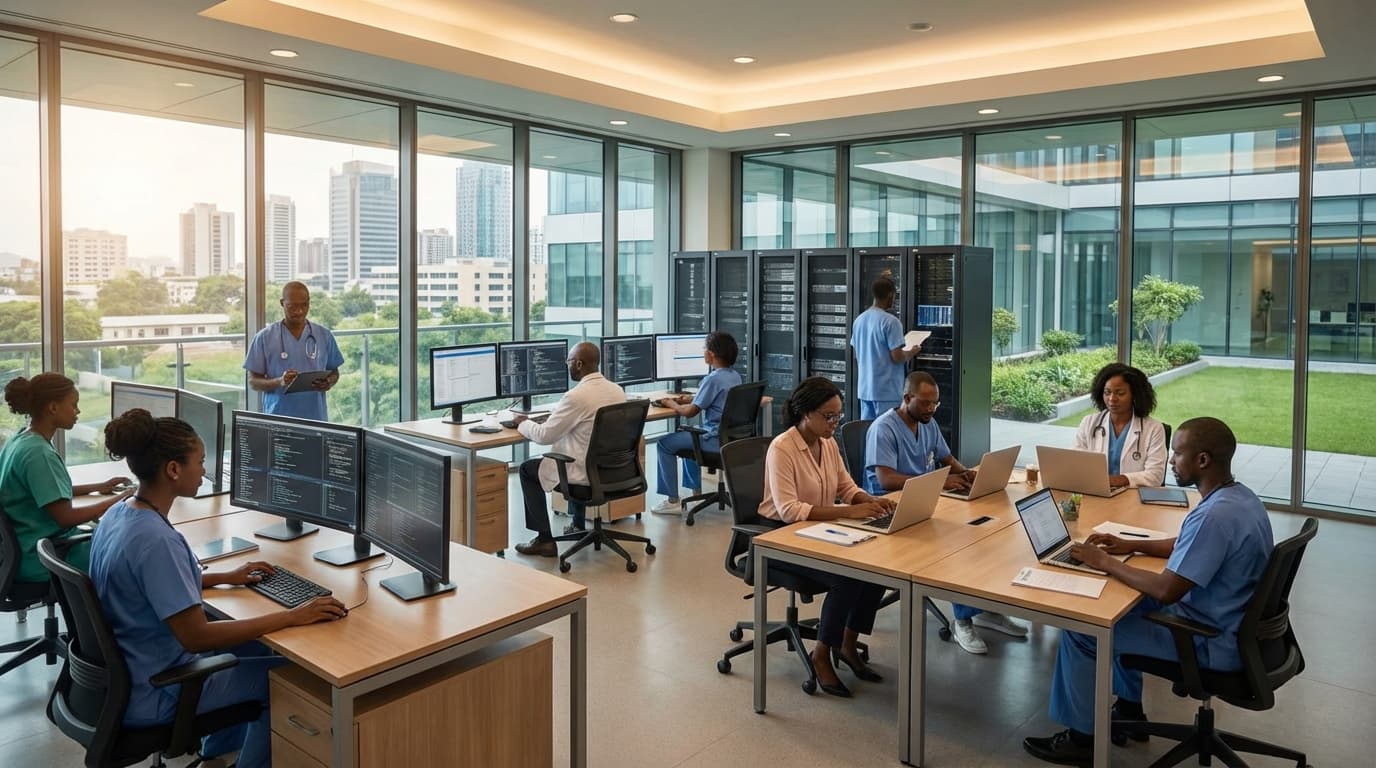
Hospital IT Integration Services in Somalia
Engineering Excellence & Technical Support
EHR, PACS, RIS and equipment integration High-standard technical execution following OEM protocols and local regulatory frameworks.
Seamless Health Data Interoperability
We architect and implement robust Electronic Health Record (EHR) integration solutions, connecting disparate hospital systems (e.g., labs, pharmacies, radiology) to ensure a unified, patient-centric view of health data. This minimizes data silos, reduces manual data entry errors, and empowers clinicians with real-time, comprehensive information for improved decision-making.
Secure and Scalable Network Infrastructure
Our services focus on designing and deploying secure, high-performance network architectures tailored to the unique demands of healthcare environments in Somalia. We prioritize data security through advanced firewalls, VPNs, and access control mechanisms, while ensuring scalability to accommodate future growth and the integration of new medical devices and applications, all within the context of local infrastructure realities.
Enabling Remote Patient Care and Consultation
We facilitate the integration of telemedicine platforms and remote monitoring solutions, bridging geographical barriers to healthcare access. By connecting primary care facilities with specialist centers and enabling remote consultations, we enhance diagnostic capabilities, reduce patient travel burdens, and improve the overall efficiency and reach of healthcare services across Somalia's diverse regions.
What Is Hospital It Integration Services In Somalia?
Hospital IT Integration Services in Somalia refer to the specialized provision of technical expertise and solutions aimed at connecting disparate healthcare information technology systems within Somali healthcare facilities. This service is crucial for establishing a cohesive and interoperable digital healthcare ecosystem, enabling seamless data flow, improved operational efficiency, and enhanced patient care delivery. The core objective is to overcome the challenges posed by legacy systems, diverse vendor solutions, and limited existing infrastructure, facilitating a unified approach to health informatics.
| Who Needs Hospital IT Integration Services in Somalia? | Typical Use Cases | ||||||
|---|---|---|---|---|---|---|---|
| Hospitals and Healthcare Facilities: Public, private, and non-governmental organization (NGO)-run hospitals requiring improved patient management, clinical decision support, and operational efficiency. | Ministry of Health: To establish a national health information exchange, monitor public health trends, and manage resources effectively. | Specialized Clinics and Diagnostic Centers: Laboratories, imaging centers, and specialized clinics needing to integrate their diagnostic data with broader patient records. | Health Insurance Providers: To streamline claims processing, verify patient eligibility, and access clinical data for risk assessment. | Medical Research Institutions: To access aggregated and anonymized patient data for epidemiological studies and health outcome research. | International Aid Organizations: Providing healthcare services or implementing health programs, requiring robust data management and reporting capabilities. | New Healthcare Ventures: Establishing new facilities with a focus on modern, integrated digital health infrastructure. | |
| Patient Record Continuity: Enabling a patient's complete medical history to be accessible across different departments and potentially different facilities, even if they use different EHR systems. | Enhanced Clinical Decision Support: Integrating data from various sources (e.g., lab results, radiology reports, past medications) to provide clinicians with a comprehensive view for diagnosis and treatment planning. | Streamlined Workflow Automation: Automating administrative tasks such as patient registration, appointment scheduling, billing, and inventory management through interconnected systems. | Improved Resource Management: Real-time data on bed occupancy, equipment availability, and staff allocation for optimized operational efficiency. | Public Health Surveillance: Aggregating anonymized data for disease outbreak detection, trend analysis, and public health intervention planning. | Telemedicine and Remote Patient Monitoring: Facilitating the secure exchange of patient data for remote consultations and continuous health monitoring. | Interoperable Supply Chain Management: Integrating pharmacy and inventory systems with procurement platforms to ensure efficient stock management and reduce waste. | Data Analytics for Performance Improvement: Leveraging integrated data for quality improvement initiatives, cost analysis, and strategic planning. |
What Hospital IT Integration Services Involve:
- System Interoperability: Connecting Electronic Health Records (EHRs), Laboratory Information Systems (LIS), Picture Archiving and Communication Systems (PACS), Pharmacy Management Systems (PMS), and other clinical and administrative applications. This includes adhering to relevant data exchange standards (e.g., HL7, FHIR) where feasible.
- Data Migration and Consolidation: Transferring, cleansing, and consolidating data from existing disparate systems into a unified platform or ensuring bidirectional data exchange between systems.
- Network Infrastructure Assessment and Enhancement: Evaluating and upgrading network hardware, bandwidth, and security protocols to support increased data traffic and real-time access.
- Middleware Development and Implementation: Designing and deploying middleware solutions to facilitate communication and data transformation between incompatible systems.
- API Development and Management: Creating and managing Application Programming Interfaces (APIs) to enable programmatic access and exchange of data between applications.
- System Security and Compliance: Implementing robust cybersecurity measures, including data encryption, access controls, and audit trails, to protect sensitive patient information and comply with any nascent healthcare data regulations.
- Training and Support: Providing comprehensive training to IT staff and end-users on integrated systems, along with ongoing technical support and maintenance.
- Cloud Integration: Migrating or integrating on-premises systems with cloud-based healthcare platforms for scalability, accessibility, and disaster recovery.
- Legacy System Modernization: Developing strategies and implementing solutions to bridge the gap between older, proprietary systems and newer, interoperable technologies.
- Data Warehousing and Analytics: Establishing data warehouses for aggregated clinical and operational data to support reporting, research, and decision-making.
Who Needs Hospital It Integration Services In Somalia?
Hospital IT integration services are crucial for modern healthcare facilities in Somalia to streamline operations, improve patient care, and enhance overall efficiency. These services address the fragmented nature of technology adoption and the need for seamless data flow within and between healthcare institutions. The target customers are primarily healthcare providers facing challenges with disparate systems, manual processes, and a lack of interoperability. Departments within these institutions that would benefit most are those directly involved in patient management, data analysis, and administrative functions.
| Department | Key Challenges Addressed by IT Integration | Benefits of Integration |
|---|---|---|
| Patient Registration & Admissions | Manual record keeping, duplicate entries, difficulty in patient tracking | Faster patient intake, accurate patient identification, reduced errors, improved bed management |
| Electronic Health Records (EHR/EMR) | Paper-based records, lack of centralized patient history, data silos | Improved access to comprehensive patient information, better clinical decision-making, reduced medical errors, enhanced data security |
| Laboratory Services | Manual test ordering and reporting, delayed results, difficulty in tracking samples | Automated test ordering, faster and more accurate results reporting, real-time sample tracking, reduced turnaround times |
| Radiology & Imaging | Film-based imaging, manual report generation, difficulty in archiving and retrieval | Digital imaging (PACS), faster report generation, improved image archiving and retrieval, enhanced collaboration with remote specialists |
| Pharmacy | Manual prescription management, stock control issues, potential for medication errors | Electronic prescribing, real-time inventory management, automated drug interaction checks, improved patient safety |
| Billing & Revenue Cycle Management | Manual billing, delayed payments, revenue leakage, lack of financial reporting | Automated billing processes, improved claim submission and tracking, enhanced financial reporting, increased revenue capture |
| Administration & Management | Inefficient reporting, lack of operational visibility, difficulty in resource allocation | Centralized data for reporting and analytics, improved operational efficiency, better resource management, strategic decision-making support |
| Public Health & Surveillance | Fragmented data collection, delayed disease outbreak detection, limited public health insights | Interoperable systems for data aggregation, real-time disease surveillance, improved public health planning and intervention |
Target Customers for Hospital IT Integration Services in Somalia
- Public Hospitals (Ministry of Health operated)
- Private Hospitals and Clinics
- Non-Governmental Organization (NGO) Healthcare Facilities
- Specialized Medical Centers (e.g., maternity, trauma, diagnostic)
- Regional and District Health Offices
- Medical Training Institutions with clinical components
Hospital It Integration Services Process In Somalia
The Hospital IT Integration Services Process in Somalia outlines the systematic workflow for implementing and integrating IT solutions within healthcare facilities. This process aims to enhance efficiency, improve patient care, and streamline administrative operations. It begins with an initial inquiry from a hospital and culminates in the full execution and handover of the integrated IT system.
| Stage | Description | Key Activities | Deliverables | Responsible Parties |
|---|---|---|---|---|
| Inquiry & Initial Consultation | The process begins with a hospital expressing interest in IT integration services. | Initial contact, understanding basic needs, preliminary discussion of scope. | Inquiry form, meeting minutes. | Hospital, IT Service Provider |
| Needs Assessment & Requirement Gathering | A detailed understanding of the hospital's current IT infrastructure, workflows, and specific integration needs. | Site visits, interviews with stakeholders, documentation review, gap analysis. | Needs assessment report, detailed requirements document. | IT Service Provider, Hospital Management & IT Staff |
| Solution Design & Proposal | Developing a tailored IT integration solution that addresses the gathered requirements. | Designing the system architecture, selecting appropriate hardware and software, creating a project plan, cost estimation. | Technical solution design document, project proposal, budget. | IT Service Provider |
| Contracting & Agreement | Formalizing the engagement with a comprehensive service agreement. | Negotiation of terms, scope of work, timelines, payment schedules, and service level agreements (SLAs). | Signed contract, service level agreement (SLA). | Hospital, IT Service Provider |
| System Procurement & Configuration | Acquiring and preparing all necessary hardware and software components. | Ordering, receiving, and initial configuration of servers, workstations, networking equipment, and software licenses. | Procurement records, initial hardware/software configuration logs. | IT Service Provider, Vendors |
| Infrastructure Setup & Network Integration | Establishing the physical and logical network infrastructure required for the integrated system. | Installing network cabling, setting up routers and switches, configuring firewalls, establishing secure network connections. | Network diagrams, infrastructure setup report. | IT Service Provider |
| Software Installation & Customization | Deploying and tailoring the chosen IT solutions to meet specific hospital workflows. | Installing Electronic Health Records (EHR) systems, Picture Archiving and Communication Systems (PACS), Laboratory Information Systems (LIS), etc., and customizing them as needed. | Installed software, customization documentation. | IT Service Provider |
| Data Migration & Validation | Transferring existing patient and operational data into the new integrated system. | Extracting data from legacy systems, cleansing and transforming data, importing data into the new system, validating data integrity and accuracy. | Migrated data, data validation reports. | IT Service Provider, Hospital IT Staff |
| User Training & Capacity Building | Equipping hospital staff with the knowledge and skills to effectively use the new IT systems. | Conducting training sessions, developing user manuals, providing on-the-job support. | Training materials, attendance records, post-training assessments. | IT Service Provider, Hospital Staff |
| Testing & Quality Assurance | Thoroughly testing the integrated system to ensure functionality, reliability, and security. | Unit testing, integration testing, user acceptance testing (UAT), performance testing, security audits. | Test plans, test case results, bug reports, UAT sign-off. | IT Service Provider, Hospital Staff |
| Deployment & Go-Live | Launching the integrated IT system for operational use. | Phased or full system rollout, go-live support, immediate issue resolution. | Live integrated system, go-live checklist. | IT Service Provider, Hospital IT Team |
| Post-Implementation Support & Maintenance | Providing ongoing technical assistance and system upkeep after deployment. | Helpdesk support, bug fixing, regular system updates and patches, hardware maintenance. | Support tickets, maintenance logs, updated system versions. | IT Service Provider, Hospital IT Staff |
| Performance Monitoring & Optimization | Continuously evaluating the system's performance and making improvements. | Monitoring system usage, identifying performance bottlenecks, implementing optimizations, reviewing user feedback. | Performance reports, optimization recommendations. | IT Service Provider |
| Project Closure & Handover | Formally concluding the project and transferring full ownership and responsibility to the hospital. | Final project review, documentation handover, training completion confirmation, final payment processing. | Project closure report, final documentation, handover certificate. | IT Service Provider, Hospital Management |
Hospital IT Integration Services Process in Somalia Workflow
- Inquiry & Initial Consultation
- Needs Assessment & Requirement Gathering
- Solution Design & Proposal
- Contracting & Agreement
- System Procurement & Configuration
- Infrastructure Setup & Network Integration
- Software Installation & Customization
- Data Migration & Validation
- User Training & Capacity Building
- Testing & Quality Assurance
- Deployment & Go-Live
- Post-Implementation Support & Maintenance
- Performance Monitoring & Optimization
- Project Closure & Handover
Hospital It Integration Services Cost In Somalia
The cost of Hospital IT Integration Services in Somalia is highly variable and depends on several key factors. These services are crucial for modernizing healthcare operations, improving data management, enhancing patient care, and streamlining administrative processes. The pricing is often influenced by the complexity of the existing IT infrastructure, the specific integration modules required, the vendor's experience and reputation, and the project's scope and duration. Given the evolving IT landscape and the specific economic conditions in Somalia, providing exact price ranges in Somali Shillings (SOS) requires careful consideration of current market dynamics, import costs for hardware and software, and the availability of skilled local IT professionals. However, we can outline the primary drivers of cost and provide estimated ranges based on common service components.
| Service Component | Estimated Cost Range (Somali Shillings - SOS) Per Project | Notes |
|---|---|---|
| Initial Consultation & Needs Assessment | 500,000 - 2,000,000 SOS | Covers understanding existing infrastructure and defining integration requirements. |
| EHR/HIS Integration (Core Module) | 5,000,000 - 25,000,000 SOS | Depends on vendor, complexity, and modules (e.g., patient registration, appointment scheduling, basic clinical notes). |
| PACS/LIS/Pharmacy Integration (Specialized Modules) | 3,000,000 - 15,000,000 SOS (per module) | Costs vary based on the specific system and its data exchange needs. |
| Network Infrastructure Upgrade/Setup | 2,000,000 - 10,000,000 SOS | If existing network is inadequate for integrated systems. |
| Hardware Procurement (Servers, Workstations, Peripherals) | 4,000,000 - 20,000,000+ SOS | Highly dependent on hospital size, number of users, and specific hardware choices (often imported). |
| Software Licensing Fees (Perpetual or Subscription) | 1,000,000 - 5,000,000+ SOS (annual/one-time) | Varies by software provider and number of users/modules. |
| Data Migration & Cleansing | 1,500,000 - 8,000,000 SOS | Labor-intensive; cost depends on volume and complexity of existing data. |
| Customization & Development | 2,000,000 - 10,000,000+ SOS | For bespoke features or workflows not covered by standard solutions. |
| Project Management & Implementation Services | 3,000,000 - 12,000,000 SOS | Vendor's overhead for managing the project lifecycle. |
| Staff Training & Capacity Building | 1,000,000 - 5,000,000 SOS | Crucial for user adoption and system proficiency. |
| Ongoing Support & Maintenance (Annual Contract) | 2,000,000 - 8,000,000+ SOS | Typically 15-25% of initial implementation cost. |
| Small Clinic/Health Post Basic Integration (e.g., basic patient registration, simple billing) | 3,000,000 - 10,000,000 SOS | Simplified scope with limited modules. |
| Medium-Sized Hospital Comprehensive Integration (EHR, LIS, Pharmacy, Billing) | 15,000,000 - 50,000,000 SOS | Multiple systems integrated for a holistic approach. |
| Large Hospital/Tertiary Care Center Advanced Integration (EHR, PACS, LIS, Pharmacy, Specialized Depts, Interoperability) | 40,000,000 - 150,000,000+ SOS | Highly complex, multi-faceted integration projects. |
Key Pricing Factors for Hospital IT Integration Services in Somalia
- Scope and Complexity of Integration: Integrating disparate systems like Electronic Health Records (EHR), Picture Archiving and Communication Systems (PACS), Laboratory Information Systems (LIS), Pharmacy Management Systems, and billing systems is more expensive than integrating simpler applications.
- Hardware and Software Requirements: The cost of new servers, network infrastructure, workstations, and specialized medical imaging or diagnostic software can significantly impact the overall budget. This also includes licensing fees for integrated software.
- Vendor Expertise and Reputation: Established vendors with a proven track record in healthcare IT integration, especially within the Somali context, may command higher prices due to their experience, reliability, and support capabilities.
- Customization vs. Off-the-Shelf Solutions: Highly customized integration solutions tailored to specific hospital workflows will be more costly than implementing standardized, off-the-shelf integration platforms.
- Data Migration and Cleansing: Transferring existing patient data from legacy systems to new integrated platforms, and ensuring data accuracy and consistency, is a labor-intensive and therefore costly process.
- Training and Support: Comprehensive training for hospital staff on new integrated systems and ongoing technical support are essential components of integration projects and contribute to the overall cost.
- Project Timeline and Urgency: Expedited project timelines often incur additional costs due to the need for increased resources and overtime.
- Geographical Location and Accessibility: Remote locations within Somalia might lead to higher logistical costs for hardware deployment and on-site support.
- Regulatory Compliance: Ensuring integration meets any local healthcare regulations or data privacy standards can add complexity and cost.
- Level of Third-Party Integration: Integrating with external systems like national health registries or insurance providers will have associated costs.
Affordable Hospital It Integration Services Options
Hospital IT integration is crucial for seamless data flow, improved patient care, and operational efficiency. However, the cost of implementing and maintaining robust integration solutions can be a significant barrier for many healthcare organizations. This document outlines affordable IT integration service options, focusing on the value of value bundles and practical cost-saving strategies.
| Cost-Saving Strategy | Description | Examples/Considerations |
|---|---|---|
| Leverage Cloud-Based Integration Platforms (iPaaS) | Utilize Software-as-a-Service (SaaS) integration solutions that offer scalability, reduced upfront infrastructure costs, and pay-as-you-go pricing. | Reduces capital expenditure, maintenance overhead. Look for vendors with healthcare-specific connectors and security certifications (HIPAA). Examples: Mulesoft, Dell Boomi, Redox. |
| Prioritize Essential Integrations | Focus on the integrations that provide the most significant impact on patient care and operational efficiency, deferring less critical ones. | Start with critical patient data flow (EHR to LIS/PACS). Analyze ROI for each potential integration. Avoid 'nice-to-have' integrations initially. |
| Phased Implementation Approach | Break down large integration projects into smaller, manageable phases to spread costs and allow for learning and adjustments. | Integrate one system at a time or focus on specific data types. This allows for iterative improvements and feedback. |
| Open Standards and APIs | Opt for integration solutions that support open standards (HL7, FHIR) and offer robust APIs, reducing vendor lock-in and enabling easier future connections. | Promotes interoperability and reduces reliance on proprietary solutions. Look for vendors who are committed to open standards. |
| Managed Services and Outsourcing | Consider outsourcing some or all of your integration management to specialized vendors, which can be more cost-effective than building and maintaining an in-house team. | Reduces staffing costs, training, and specialized tool acquisition. Vendors have expertise and economies of scale. |
| Negotiate Vendor Contracts Carefully | Thoroughly review and negotiate contract terms, including licensing, support, and implementation fees. Look for opportunities for bundled discounts. | Understand all fees, service level agreements (SLAs), and termination clauses. Explore multi-year contracts for potential discounts. |
| Evaluate Open-Source Integration Tools | For less complex or highly specialized needs, open-source integration platforms can offer a lower cost of entry, though they may require more in-house expertise. | Requires internal IT expertise for implementation and maintenance. Suitable for specific use cases where customization is key. |
| Focus on Data Standardization and Governance | Implementing strong data governance policies and ensuring data standardization upfront can significantly reduce the complexity and cost of integration projects. | Clean, standardized data is easier to integrate. Reduces data mapping and transformation efforts. Invest in data quality initiatives. |
Understanding Value Bundles in Hospital IT Integration
- Definition: Value bundles are pre-packaged service offerings that combine multiple integration needs into a single, often discounted, solution.
- Components: These typically include services like Electronic Health Record (EHR) interoperability, patient portal integration, medical device connectivity, laboratory information system (LIS) integration, and picture archiving and communication system (PACS) integration.
- Benefits:
- Cost Predictability: Bundles offer a fixed price, making budgeting easier and avoiding unexpected expenses.
- Streamlined Implementation: A single vendor managing multiple integrations reduces complexity and coordination efforts.
- Discounted Pricing: Vendors often offer a lower overall cost compared to procuring individual services.
- Accelerated Time to Value: Integrated systems are often quicker to deploy, leading to faster realization of benefits.
- Comprehensive Support: Bundles usually include ongoing support and maintenance for all integrated components.
Verified Providers In Somalia
In Somalia's complex healthcare landscape, identifying reliable and ethical providers is paramount. Franance Health stands out as a beacon of trust, built upon a foundation of stringent credentialing and an unwavering commitment to patient well-being. This document outlines why Franance Health's verified providers represent the best choice for individuals and organizations seeking quality medical services in Somalia. We delve into their rigorous credentialing process and the tangible benefits this offers to patients.
| Benefit for Patients | How Franance Health's Verification Ensures This |
|---|---|
| Access to Qualified and Skilled Professionals: Patients can be confident they are receiving care from doctors, nurses, and specialists who meet high standards of medical knowledge and practice. | Rigorous verification of professional licensure, certifications, and demonstrated competency eliminates the risk of engaging unqualified individuals. |
| Enhanced Patient Safety and Reduced Risk: Minimizing the likelihood of medical errors, malpractice, or unethical treatment. | Thorough background checks, ethical standard enforcement, and continuous quality monitoring proactively identify and mitigate potential risks. |
| Trust and Peace of Mind: Knowing that your healthcare provider has been thoroughly vetted and adheres to a strict code of ethics. | Transparency in the credentialing process and a demonstrable commitment to patient-centric care build a strong foundation of trust. |
| Improved Healthcare Outcomes: Access to competent professionals who are up-to-date with the latest medical advancements leads to better diagnoses and treatments. | Emphasis on continuous professional development and quality improvement ensures providers are offering the most effective and evidence-based care. |
| Respectful and Culturally Sensitive Care: Patients feel understood and respected, leading to better communication and adherence to treatment plans. | Mandatory cultural competency training equips providers to deliver care that is sensitive to the unique needs and beliefs of Somali patients. |
Franance Health's Credentialing Pillars
- Professional Licensure and Certification Verification: Franance Health meticulously confirms that all its affiliated healthcare professionals hold valid and current licenses and certifications from recognized national and international medical boards. This includes verifying educational qualifications, residency completion, and any specialized training.
- Experience and Competency Assessment: Beyond formal qualifications, Franance Health evaluates the practical experience and demonstrated competency of its providers. This may involve peer reviews, surgical outcome analysis, and ongoing professional development tracking.
- Background Checks and Ethical Standards: A thorough vetting process includes background checks to ensure providers have no history of malpractice, fraud, or ethical violations. Franance Health enforces a strict code of conduct, prioritizing patient safety, confidentiality, and respectful care.
- Continuous Quality Improvement: Franance Health actively monitors the performance of its verified providers through patient feedback mechanisms, clinical audits, and participation in continuing medical education programs. This ensures a commitment to staying abreast of the latest medical advancements and best practices.
- Cultural Competency Training: Recognizing the diverse needs of the Somali population, Franance Health ensures its providers receive training in cultural competency, promoting understanding and effective communication with patients from various backgrounds.
Scope Of Work For Hospital It Integration Services
This Scope of Work (SOW) outlines the services required for the successful integration of Hospital IT systems. The objective is to ensure seamless data flow, interoperability between disparate systems, enhanced patient care through unified information access, and improved operational efficiency. This SOW covers the definition of technical deliverables, adherence to standard specifications, and the overall project management framework. The project aims to integrate Electronic Health Records (EHR), Laboratory Information Systems (LIS), Picture Archiving and Communication Systems (PACS), and other critical hospital applications. A phased approach will be adopted, focusing on discovery, design, development, testing, deployment, and post-implementation support.
| Technical Deliverable | Description | Standard Specifications / Protocols | Acceptance Criteria |
|---|---|---|---|
| Integration Architecture Document | Detailed blueprint of the integrated system, including data flows, middleware, and security protocols. | HL7 FHIR, DICOM, JSON, XML, OpenAPI Specification, ISO 27001 | Document approved by hospital IT stakeholders, clearly defining all integration points and data exchange mechanisms. |
| Interoperability Connectors/APIs | Custom-built or configured connectors and APIs to facilitate data exchange between systems. | HL7 v2.x messaging, HL7 FHIR R4, RESTful APIs, SOAP Web Services | All defined data elements are successfully exchanged between systems without data loss or corruption, validated through automated tests. |
| Data Mapping and Transformation Rules | Documentation of how data elements from source systems are mapped and transformed for target systems. | Custom mapping logic based on project requirements, adhering to data governance policies. | Successful transformation of all critical data fields as per the mapping specifications, verified by sample data validation. |
| Middleware Configuration | Configuration of the integration engine or middleware platform to manage message routing, transformation, and logging. | Vendor-specific configurations for chosen middleware (e.g., Mirth Connect, Rhapsody), adherence to security best practices. | Middleware successfully routes all defined messages, logs are generated appropriately, and performance meets defined thresholds. |
| Test Cases and Scripts | Comprehensive set of test cases and automated scripts for functional, integration, performance, and security testing. | Industry-standard testing methodologies (e.g., Black Box, White Box, End-to-End), unit testing frameworks. | All critical test cases pass, with a defect resolution rate of 95% for critical and high-priority defects. |
| Deployment Plan | Detailed plan for deploying the integrated solution into the production environment. | ITIL-based change management processes, rollback procedures, communication plan. | Successful deployment with minimal downtime, as per the approved deployment plan. |
| User Training Materials | Documentation and guides for end-users and IT support staff on the integrated system. | Clear, concise language, role-based instructions, FAQs. | Training materials are reviewed and approved by relevant department heads. |
| Post-Implementation Support Plan | Outline of support procedures, SLAs, and escalation paths for the post-go-live period. | Defined SLAs for incident response and resolution, knowledge base articles. | Support plan is finalized and agreed upon by both parties, with clear contact points. |
| Security Audit Report | Report detailing the security posture of the integrated system, including vulnerability assessments. | HIPAA, GDPR, OWASP Top 10, penetration testing standards. | All critical and high-risk vulnerabilities identified are remediated before go-live. |
Key Project Phases and Activities
- Phase 1: Discovery and Requirements Gathering
- Phase 2: System Architecture and Design
- Phase 3: Integration Development and Configuration
- Phase 4: Testing and Quality Assurance
- Phase 5: Deployment and Go-Live
- Phase 6: Post-Implementation Support and Optimization
Service Level Agreement For Hospital It Integration Services
This Service Level Agreement (SLA) outlines the guaranteed response times and uptime for Hospital IT Integration Services provided by [Provider Name] to [Hospital Name]. This SLA is an integral part of the Master Service Agreement (MSA) between the parties.
| Service Component | Uptime Guarantee | Response Time (Critical Incident) | Resolution Target (Critical Incident) | Response Time (Major Incident) | Resolution Target (Major Incident) | Response Time (Minor Incident) | Resolution Target (Minor Incident) |
|---|---|---|---|---|---|---|---|
| Core Integration Platform | 99.95% | 15 minutes | 4 hours | 30 minutes | 8 business hours | 2 hours | 2 business days |
| Data Synchronization Processes | 99.90% | 30 minutes | 4 business hours | 1 hour | 12 business hours | 4 hours | 3 business days |
| Critical APIs (e.g., Patient Data Exchange) | 99.95% | 15 minutes | 2 hours | 30 minutes | 6 business hours | 2 hours | 1 business day |
| Non-Critical APIs (e.g., Reporting) | 99.80% | 1 hour | 8 business hours | 2 hours | 2 business days | 8 hours | 5 business days |
Key Service Components
- System Integration: Ensuring seamless data flow and interoperability between various hospital IT systems (e.g., EMR, PACS, LIS, Billing).
- Data Synchronization: Maintaining the accuracy and consistency of data across integrated systems.
- API Management: Developing, deploying, and maintaining APIs for system integration.
- System Monitoring: Proactive monitoring of integrated systems for performance, availability, and security.
- Incident Management: Responding to and resolving issues affecting the integrated systems.
- Change Management: Managing planned changes to integrated systems to minimize disruption.
Frequently Asked Questions

Ready when you are
Let's scope your Hospital IT Integration Services in Somalia project in Somalia.

Scaling healthcare logistics and technical systems across the entire continent.