
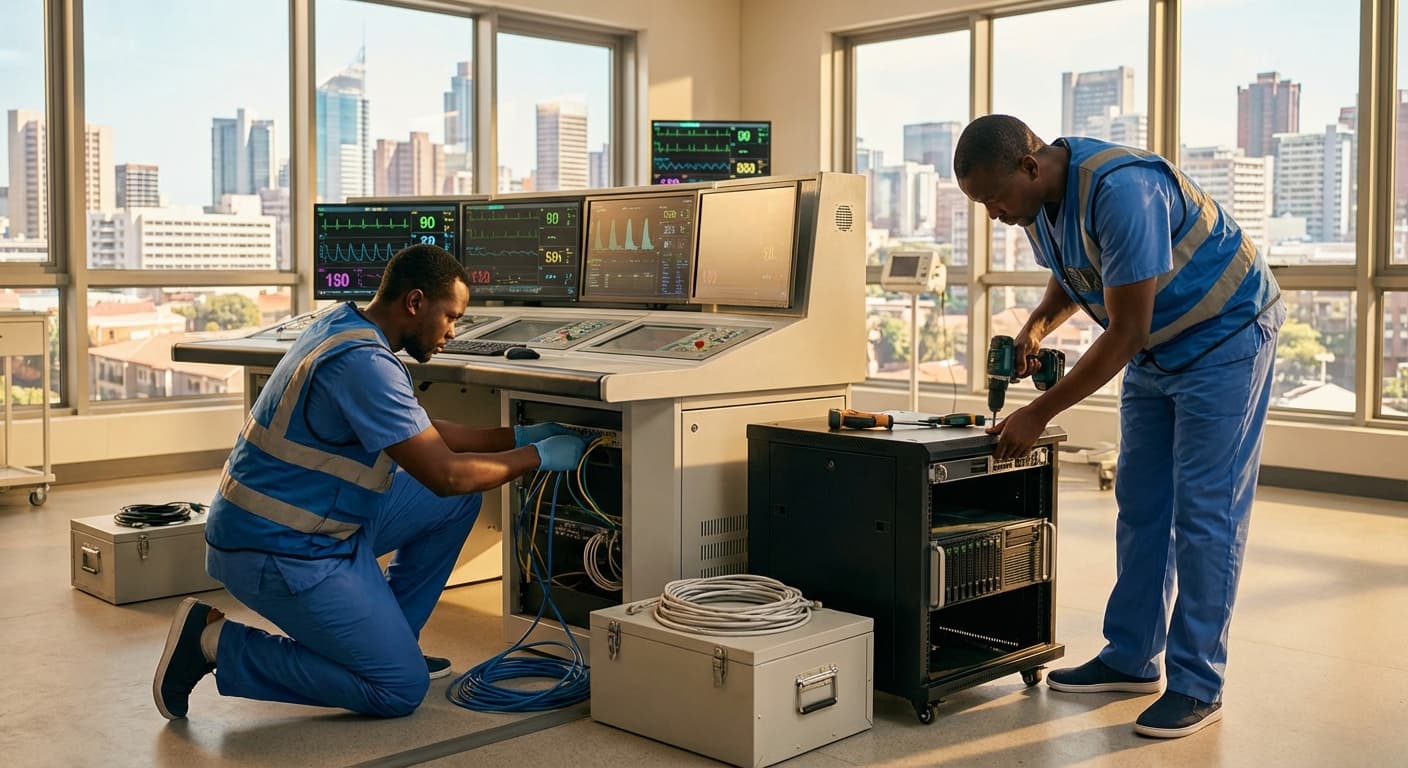
ICU Central Monitoring Station Installation Service in Somalia
Engineering Excellence & Technical Support
ICU Central Monitoring Station Installation Service High-standard technical execution following OEM protocols and local regulatory frameworks.
24/7 Uninterrupted Patient Monitoring
Our installation service ensures robust and reliable 24/7 critical care monitoring. We deploy high-availability systems with redundant power supplies and network infrastructure, guaranteeing continuous patient data streams and immediate alerts to vital signs, even during power outages or network fluctuations.
Seamless Integration with Existing Medical Equipment
We specialize in the seamless integration of our advanced central monitoring stations with a wide range of existing ICU medical devices (ventilators, infusion pumps, ECGs, etc.) and hospital information systems (HIS). This ensures comprehensive data aggregation and a unified view of patient status, optimizing clinical workflows and decision-making.
Expert Installation & On-site Training in Challenging Environments
Our certified technicians possess extensive experience in deploying sophisticated medical technology in diverse and sometimes challenging environments. We provide comprehensive on-site installation, rigorous system testing, and hands-on training for your ICU staff, empowering them to effectively utilize the monitoring system from day one.
What Is Icu Central Monitoring Station Installation Service In Somalia?
ICU Central Monitoring Station Installation Service in Somalia refers to the comprehensive process of designing, procuring, installing, configuring, and commissioning a centralized system for real-time surveillance and management of patients in Intensive Care Units (ICUs) within healthcare facilities in Somalia. This service ensures continuous, integrated monitoring of vital physiological parameters from multiple ICU beds, aggregating data at a central console for immediate clinician access and intervention. It involves the deployment of a network of patient monitors, telemetry devices, and a sophisticated software platform that collects, displays, and analyzes critical patient data. The primary objective is to enhance patient safety, improve clinical decision-making, and optimize resource allocation within the ICU environment.
| Who Needs ICU Central Monitoring Installation? | Typical Use Cases | ||||||
|---|---|---|---|---|---|---|---|
| Hospitals and Healthcare Facilities in Somalia: Particularly those with established or developing Intensive Care Units (ICUs) aiming to elevate the standard of critical care. | Improving Patient Safety: Real-time, continuous monitoring reduces the risk of undetected patient deterioration, enabling proactive interventions. | Tertiary and Referral Hospitals: Facilities serving as advanced care centers and receiving complex patient cases. | Enhancing Clinical Efficiency: Centralized data access allows clinicians to monitor multiple patients simultaneously, optimizing workflow and reducing response times. | Government and Non-Governmental Organization (NGO) Run Hospitals: Institutions focused on providing comprehensive healthcare services and improving public health outcomes. | Supporting Remote Patient Monitoring: In regions with limited specialist availability, a central monitoring station can facilitate remote oversight and guidance from experienced intensivists. | Medical Training Institutions: Facilities that serve as teaching hospitals and require advanced diagnostic and monitoring capabilities for medical education. | Disaster Relief and Emergency Response: Enabling effective management of critically injured or ill patients during mass casualty incidents or health crises. |
Key Components of ICU Central Monitoring Station Installation Service:
- System Design and Planning: Site assessment, network topology design, hardware and software selection based on facility requirements and budget.
- Hardware Procurement and Deployment: Sourcing and installation of patient monitors (e.g., for ECG, SpO2, NIBP, respiration, temperature), telemetry transmitters, central workstations, servers, and associated networking infrastructure (cables, switches, routers).
- Software Installation and Configuration: Deployment of the central monitoring software, establishing patient profiles, configuring alarm parameters, setting up data logging and retrieval functionalities, and integrating with existing Electronic Health Record (EHR) systems where applicable.
- Network Integration and Testing: Establishing reliable connectivity between patient monitors and the central station, conducting comprehensive network diagnostics to ensure data integrity and transmission speed, and performing load testing.
- Calibration and Validation: Ensuring all connected monitors are accurately calibrated and validated against established clinical standards.
- User Training and Support: Providing in-depth training to clinical staff (physicians, nurses, technicians) on the operation, interpretation of data, alarm management, and troubleshooting of the central monitoring system. Ongoing technical support and maintenance agreements are typically included.
- Documentation and Handover: Providing comprehensive system documentation, user manuals, and as-built drawings.
Who Needs Icu Central Monitoring Station Installation Service In Somalia?
The installation of an ICU Central Monitoring Station (CMS) is a critical infrastructure upgrade for healthcare facilities in Somalia. A CMS centralizes the monitoring of vital signs from multiple Intensive Care Unit (ICU) beds, providing healthcare professionals with real-time, comprehensive patient data. This significantly enhances patient care, improves response times to critical events, and optimizes resource allocation within the ICU. Due to the current healthcare landscape and the growing need for advanced medical technology, various entities in Somalia would benefit immensely from such a service.
| Target Customer Type | Specific Departments/Units Involved | Key Needs/Benefits of CMS Installation |
|---|---|---|
| Government Hospitals | Intensive Care Unit (ICU), Critical Care Units, Hospital Administration | Improved patient outcomes, enhanced diagnostic capabilities, better resource management, increased ICU bed utilization efficiency, support for national health initiatives. |
| Private Hospitals and Clinics | ICU, Critical Care, Cardiology, Neurology, Emergency Department, Hospital Management | Elevated service quality, competitive differentiation, attracting specialized medical professionals, efficient patient management, data-driven decision making, potential for telemedicine integration. |
| NGOs and International Aid Organizations | ICU, Field Hospitals, Emergency Medical Services, Program Management | Optimized patient care in resource-limited settings, standardized critical care protocols, improved data for reporting and impact assessment, capacity building for local staff, enhanced operational efficiency. |
| Teaching Hospitals/Medical Institutions | ICU, Critical Care Training Programs, Medical Simulation Centers, Department of Anesthesiology/Critical Care | Hands-on training for medical students and residents, demonstration of advanced critical care practices, research capabilities, fostering innovation in critical care, attracting top medical faculty. |
| Military/Security Force Medical Units | Combat Support Hospitals, Field Hospitals, Medical Evacuation Units, Trauma Centers | Rapid assessment and continuous monitoring of critically injured personnel, efficient triage and management, improved survival rates, integration with battlefield medical information systems. |
| Disaster Relief/Emergency Response Centers | Temporary ICUs, Emergency Triage Centers, Mobile Medical Units | Rapid deployment of monitoring capabilities, efficient management of multiple critical patients during emergencies, real-time data for informed decision-making, improved coordination of medical teams. |
Target Customers and Departments for ICU Central Monitoring Station Installation Service in Somalia:
- Government Hospitals: These are primary beneficiaries, often serving a large and diverse patient population. Upgrading their ICUs with a CMS is crucial for improving the quality and capacity of critical care services offered to the general public.
- Private Hospitals and Clinics: As the private healthcare sector grows in Somalia, established and emerging private facilities aiming to offer specialized and high-standard medical care will see a CMS as a significant competitive advantage and a necessity for advanced patient management.
- Non-Governmental Organizations (NGOs) and International Aid Organizations: Many NGOs operate hospitals and clinics in Somalia, particularly in underserved areas. Installing a CMS in their ICUs would allow for more efficient and effective management of critically ill patients, often in challenging environments.
- Teaching Hospitals and Medical Training Institutions: Facilities that are involved in training future healthcare professionals require state-of-the-art equipment to provide hands-on experience and demonstrate best practices in critical care. A CMS is an integral part of a modern ICU for educational purposes.
- Military and Security Force Medical Units: In situations requiring rapid and advanced medical intervention for personnel, military or security force medical units may require robust ICU monitoring capabilities, including a centralized system.
- Disaster Relief and Emergency Response Centers: In the event of mass casualties or natural disasters, temporary or permanent critical care facilities would benefit from the streamlined monitoring offered by a CMS to manage a surge of critically ill patients.
Icu Central Monitoring Station Installation Service Process In Somalia
This document outlines the comprehensive service process for the installation of an ICU Central Monitoring Station in Somalia, from the initial customer inquiry to the final execution and handover. The process is designed to ensure a seamless and efficient deployment, addressing the unique logistical and operational considerations of the region.
| Phase | Key Activities | Deliverables | Notes/Considerations (Somalia Specific) |
|---|---|---|---|
| Receive customer inquiry, understand requirements (number of beds, specific monitoring needs, existing infrastructure). Initial project scope definition. Provide preliminary quotations and service agreements. | Service proposal, preliminary cost estimate, agreed project scope. | Understanding of local healthcare regulations and standards. Communication challenges due to language and connectivity. |
| On-site visit by technical team. Assess physical space, power availability and stability, network infrastructure, environmental conditions (temperature, humidity). Detailed site survey and risk assessment. Develop detailed project plan including timelines, resource allocation, and risk mitigation strategies. | Detailed site survey report, finalized project plan, Bill of Materials (BOM). | Security assessments for site access and personnel. Power grid instability requiring backup solutions (generators, UPS). Limited availability of specialized construction materials. Local transportation challenges. |
| Order all necessary equipment and materials based on the finalized BOM. Coordinate international and local shipping. Manage customs clearance and import duties. Secure transportation to the installation site. | Procured equipment and materials, shipping manifests, customs clearance documents. | Complex customs procedures and potential delays. Reliable local logistics partners are crucial. Importation regulations for medical equipment. |
| Prepare the installation site (e.g., cabling, mounting points). Install central monitoring system hardware, workstations, and bedside monitors. Configure network settings and software. Integrate with existing hospital systems (if applicable). | Installed and connected hardware, configured software, basic network setup. | Need for skilled local technicians for assistance. Adapting to existing infrastructure that may not meet international standards. Power surge protection is paramount. |
| Conduct comprehensive system testing to ensure all components are functioning correctly. Simulate patient monitoring scenarios. Verify data accuracy and alarm functionality. System performance validation. | Test reports, commissioning certificates, validated system functionality. | Availability of diagnostic tools and spare parts. Ensuring robust performance under potentially challenging environmental conditions. |
| Provide comprehensive training to clinical staff (doctors, nurses) and IT personnel on system operation, maintenance, and troubleshooting. Formal handover of the installed system with all documentation. | Trained personnel, user manuals, technical documentation, handover report. | Tailoring training materials to different literacy levels. Providing ongoing support for effective adoption. |
| Provide ongoing technical support, maintenance services, and software updates as per the service agreement. Remote monitoring and troubleshooting capabilities. Proactive system checks. | Maintenance reports, support logs, updated system documentation. | Establishing reliable communication channels for remote support. Planning for eventual replacement or upgrade of components. |
ICU Central Monitoring Station Installation Service Process
- Phase 1: Inquiry & Consultation
- Phase 2: Site Assessment & Planning
- Phase 3: Procurement & Logistics
- Phase 4: Installation & Configuration
- Phase 5: Testing & Commissioning
- Phase 6: Training & Handover
- Phase 7: Post-Installation Support
Icu Central Monitoring Station Installation Service Cost In Somalia
Installing an ICU Central Monitoring Station (CMS) in Somalia involves a complex interplay of factors that influence the overall cost. These stations are critical for patient care, requiring reliable technology and skilled implementation. The pricing can vary significantly based on the scope of the project, the specific equipment chosen, the location within Somalia, and the expertise of the service provider.
Several key elements contribute to the total cost. The type and quantity of patient monitors are primary drivers. High-end, feature-rich monitors with advanced physiological parameter tracking will naturally be more expensive than basic models. The central monitoring software and hardware themselves constitute a substantial part of the budget, including servers, network infrastructure, and the display consoles for the nursing station. Installation services encompass site assessment, cabling, power backup solutions (UPS and generators, crucial in Somalia), and system integration. The training of medical and technical staff on operating and maintaining the system is another essential cost component. Finally, ongoing maintenance and support agreements are vital for ensuring the longevity and optimal performance of the CMS.
Given the unique logistical and economic conditions in Somalia, factors such as import duties and taxes, transportation and shipping costs (often by air or sea to specific locations), currency fluctuations, and the availability of specialized technical personnel can add premiums to the standard equipment and service costs. Projects in more remote or less accessible regions might also incur higher logistical expenses.
Pricing Ranges in Somali Shilling (SoSh):
It's challenging to provide exact figures due to the dynamic nature of the market and bespoke project requirements. However, for a comprehensive ICU Central Monitoring Station installation, including patient monitors, central station hardware/software, basic installation, and initial training, one can anticipate a range that starts from a lower end for a smaller, less equipped setup and extends significantly higher for advanced, multi-bed solutions.
- Basic System (e.g., 5-8 Beds): This might include standard vital signs monitors and a functional central station.
- Intermediate System (e.g., 8-15 Beds): Offering more advanced monitoring capabilities and potentially redundant systems.
- Advanced System (e.g., 15+ Beds): Comprehensive, high-end equipment with integrated features, extensive training, and longer support contracts.
| System Scope / Bed Count | Estimated Cost Range (SoSh) | Key Features Included |
|---|---|---|
| Basic (5-8 Beds) | 100,000,000 - 250,000,000 SoSh | Standard vital signs monitoring, basic central station software, initial installation, essential training. |
| Intermediate (8-15 Beds) | 250,000,000 - 500,000,000 SoSh | Enhanced monitoring parameters, more robust central station, advanced software features, comprehensive training, basic power backup. |
| Advanced (15+ Beds) | 500,000,000+ SoSh | High-end monitors with advanced features (e.g., invasive pressure, capnography), sophisticated central station, integrated network, extended training, robust power solutions, longer-term support. |
Key Pricing Factors for ICU Central Monitoring Station Installation in Somalia
- Type and Quantity of Patient Monitors (e.g., ECG, NIBP, SpO2, IBP, EtCO2)
- Central Monitoring Software and Hardware (Servers, Consoles, Network)
- Installation Services (Site Survey, Cabling, Integration)
- Power Backup Solutions (UPS, Generators - highly critical)
- Training for Medical and Technical Staff
- Import Duties, Taxes, and Customs Clearance
- Transportation and Logistics (Shipping, Local Delivery)
- Currency Exchange Rates and Fluctuations
- Availability and Cost of Skilled Technicians
- Geographic Location within Somalia (Accessibility)
- Ongoing Maintenance and Support Contracts
- Brand and Manufacturer of Equipment
- System Scalability and Future Expansion Potential
Affordable Icu Central Monitoring Station Installation Service Options
Implementing an Intensive Care Unit (ICU) Central Monitoring Station (CMS) is crucial for patient safety and efficient care delivery. This service focuses on providing comprehensive installation solutions, offering value bundles and strategic cost-saving options to make this essential technology accessible. We understand that budget constraints are a significant factor, and our aim is to deliver a high-quality, reliable CMS installation that maximizes return on investment.
| Value Bundle | Description | Included Services | Potential Cost Savings |
|---|---|---|---|
| Essential Foundation Bundle | A cost-effective solution for smaller ICUs or those with basic monitoring needs. | Basic needs assessment, hardware integration (limited scope), core software setup, standard installation, initial user training. | Lower upfront hardware costs, streamlined installation process, reduced training overhead. |
| Advanced Integration Bundle | Designed for medium to large ICUs requiring seamless integration with EMR/EHR systems and advanced features. | Comprehensive needs assessment, hardware procurement & integration, advanced software configuration (including EMR/EHR interface), extensive installation & testing, in-depth user training, initial post-installation support. | Bulk hardware purchasing discounts, reduced integration errors, improved workflow efficiency, potential for government incentives related to EHR adoption. |
| Comprehensive Care Bundle | Our premium offering, providing end-to-end management from initial planning to long-term optimization. | Full system design, all hardware procurement & integration, custom software development (if needed), complete network infrastructure setup, professional installation & validation, extensive and ongoing user training, multi-year support and maintenance contract. | Long-term cost predictability, reduced downtime through proactive maintenance, optimized system performance, potential for extended warranty benefits. |
Key Components of an ICU CMS Installation Service
- Needs Assessment & System Design: Tailoring the CMS to your specific ICU size, patient acuity, and existing infrastructure.
- Hardware Procurement & Integration: Sourcing and seamlessly integrating vital sign monitors, patient beds, networking equipment, and central server hardware.
- Software Configuration & Customization: Setting up the CMS software, including alarm parameters, data storage, and user interface customization.
- Network Infrastructure Setup: Ensuring robust and secure network connectivity for real-time data transmission.
- Installation & Cabling: Professional and organized installation of all hardware and cabling, adhering to healthcare standards.
- System Testing & Validation: Thorough testing to guarantee accuracy, reliability, and adherence to all specifications.
- User Training: Comprehensive training for clinical staff on operating and managing the CMS effectively.
- Post-Installation Support & Maintenance: Ongoing technical support, software updates, and maintenance packages.
Verified Providers In Somalia
In Somalia's evolving healthcare landscape, identifying trustworthy and qualified medical providers is paramount for ensuring quality care. Franance Health has established itself as a beacon of reliability, offering a network of verified providers who meet stringent credentialing standards. This commitment to verification not only safeguards patient well-being but also fosters confidence in the healthcare system. Understanding Franance Health's credentialing process and the caliber of their providers illuminates why they represent the best choice for individuals seeking dependable medical services in Somalia.
| Provider Type | Credentialing Focus | Why Franance Health Excels |
|---|---|---|
| Doctors (General & Specialists) | Medical School Graduation, Licensing Board Certification, Specialty Board Certification, Residency/Fellowship Completion, Experience in Field | Franance Health meticulously verifies each doctor's academic and practical qualifications, ensuring they are licensed to practice and possess the stated specializations. This prevents unqualified individuals from offering services and guarantees access to competent specialists. |
| Nurses (RNs, LPNs, etc.) | Nursing School Graduation, Professional Nursing License, Specialized Certifications (e.g., critical care, pediatrics) | Their nurses are confirmed to have completed accredited nursing programs and hold valid licenses. Franance Health also looks for specialized certifications that indicate advanced skills and a commitment to specific areas of patient care. |
| Pharmacists | Pharmacy Degree, Pharmacy Board License, Accreditation of Pharmacy Practice | Franance Health ensures pharmacists are licensed and have graduated from accredited pharmacy programs. This verification is vital for safe medication dispensing and ensuring accurate pharmaceutical advice. |
| Laboratory Technicians | Relevant Degree/Diploma in Medical Laboratory Science, Certification/Licensure, Experience with Diagnostic Equipment | The organization validates the qualifications of lab technicians, ensuring they have the necessary training and certifications to perform accurate diagnostic tests. This directly impacts the reliability of medical diagnoses. |
| Allied Health Professionals (e.g., Physiotherapists, Radiologists) | Specific Degree/Diploma in their field, Professional Registration/Licensure, Relevant Experience | Franance Health extends its verification to allied health professionals, confirming their academic achievements and licenses to practice. This ensures a comprehensive and integrated approach to patient treatment. |
Key Aspects of Franance Health's Verified Provider Program
- Rigorous Screening Process: Franance Health employs a multi-faceted approach to vet all healthcare professionals within their network. This includes verifying medical licenses, educational qualifications, and professional experience.
- Specialty Verification: Beyond general credentials, Franance Health ensures that providers' claimed specialties are accurate and backed by relevant training and certifications. This is crucial for patients seeking specialized medical attention.
- Continuing Professional Development (CPD) Monitoring: The organization actively monitors and encourages ongoing professional development among its providers. This ensures they remain up-to-date with the latest medical advancements and best practices.
- Patient Feedback Integration: Franance Health incorporates patient feedback as a vital component of its verification and ongoing evaluation process. Positive patient experiences and satisfaction are indicators of quality care.
- Ethical Conduct Review: Providers are assessed for their adherence to ethical medical practices and professional conduct standards, ensuring a patient-centered and respectful approach to healthcare.
- Reputation and Peer Review: Where applicable, Franance Health may consider peer reviews and established professional reputations as part of their due diligence.
Scope Of Work For Icu Central Monitoring Station Installation Service
This Scope of Work (SOW) outlines the requirements for the installation of an Intensive Care Unit (ICU) Central Monitoring Station (CMS) service. It details the technical deliverables, standard specifications, and activities involved in successfully deploying and commissioning the CMS.
| Technical Deliverable | Description | Standard Specification/Requirement | Acceptance Criteria |
|---|---|---|---|
| CMS Hardware Installation | Physical installation of all CMS servers, workstations, displays, and associated network equipment within the designated control room. | All hardware to be installed according to manufacturer's guidelines and site-specific engineering drawings. Power and network connectivity to be verified. Rack mounting and cable management to meet industry best practices. | All hardware physically secured, powered on, and network accessible. Cable management neat and organized. No physical damage to equipment. |
| CMS Software Installation and Configuration | Installation and configuration of the CMS software platform, including operating systems, database, and application modules. | Software to be installed on designated servers and workstations. Configuration to align with hospital network architecture, security policies, and clinical workflow requirements. Database integrity to be ensured. | All software components installed and functional. System accessible via designated user accounts. Configuration parameters documented and verified against requirements. |
| Network Integration | Integration of the CMS with the hospital's existing network infrastructure, including patient monitoring devices and other relevant systems. | Secure network connectivity established between CMS and all connected patient monitors. IP addressing scheme to be managed according to hospital IT policy. Network latency and bandwidth to be within acceptable limits. | Data flow from patient monitors to CMS verified. Network security protocols implemented and tested. Successful communication established between CMS and all designated network devices. |
| Database Setup and Configuration | Setup and configuration of the CMS database, including schema definition, user access control, and data archiving policies. | Database to be optimized for performance and security. Backup and recovery procedures to be implemented. Data retention policies to comply with regulatory requirements. | Database accessible and functioning. User roles and permissions correctly assigned. Backup and recovery processes demonstrated to be functional. |
| System Integration with Existing Medical Devices | Seamless integration of the CMS with existing ICU patient monitoring devices (e.g., ventilators, ECG monitors, NIBP, SpO2). | All connected devices to be identified and their data streams correctly interpreted by the CMS. Data accuracy and timeliness to be validated. | Real-time physiological data from all connected devices displayed accurately on CMS workstations. Alarm notifications from devices received and displayed by CMS. |
| Alarm Management System Configuration | Configuration of the CMS alarm management system, including alarm thresholds, prioritization, and notification methods. | Alarm parameters to be set according to clinical guidelines and hospital policy. Notification channels (e.g., audible alarms, visual alerts, pagers) to be configured and tested. | Alarms trigger correctly based on defined thresholds. Notifications sent to designated personnel via configured methods. Alarm silencer and reset functions operate as expected. |
| User Interface (UI) and User Experience (UX) Customization | Customization of the CMS user interface and user experience to meet specific clinical workflow needs. | Layouts, screen configurations, and display options to be tailored to ICU staff preferences and operational efficiency. User roles to dictate access and visibility. | CMS interface intuitive and easy to navigate. Key patient data readily accessible. Customizations documented and approved by clinical stakeholders. |
| System Documentation | Comprehensive documentation of the installed CMS, including system architecture, configuration details, network diagrams, and user manuals. | Documentation to be clear, concise, and accurate. Provided in both electronic and hardcopy formats. | All required documentation delivered and reviewed by hospital IT and clinical teams. Documentation reflects the final deployed system. |
| System Testing and Validation Report | A detailed report outlining the results of all system testing and validation activities, demonstrating compliance with specified requirements. | Report to include test plans, executed test cases, results, and any identified issues and resolutions. | Test report signed off by both the service provider and the hospital's designated representative. All critical and major issues resolved and verified. |
| Training Materials | Development and delivery of comprehensive training materials for ICU clinical staff and IT administrators. | Materials to cover system operation, alarm management, troubleshooting, and maintenance. Training sessions to be interactive and tailored to different user groups. | Training materials provided in advance for review. Training sessions conducted as scheduled, with attendance and comprehension verified. |
Project Phases and Activities
- Phase 1: Planning and Design
- Phase 2: Procurement and Staging
- Phase 3: Installation and Configuration
- Phase 4: Testing and Commissioning
- Phase 5: Training and Handover
- Phase 6: Post-Installation Support
Service Level Agreement For Icu Central Monitoring Station Installation Service
This Service Level Agreement (SLA) outlines the response times and uptime guarantees for the installation and initial setup services of the ICU Central Monitoring Station. This SLA applies to all customers who have purchased the ICU Central Monitoring Station Installation Service from [Your Company Name].
| Service Component | Response Time Guarantee | Uptime Guarantee (Initial Post-Installation) |
|---|---|---|
| Critical System Failure (Complete Station Unavailability) | Within 2 hours of verified notification (phone or email) | 99.9% for the first 72 hours post-installation |
| Major System Malfunction (Partial Station Unavailability, affecting key functionalities) | Within 4 hours of verified notification (phone or email) | 99.5% for the first 72 hours post-installation |
| Minor System Issue (Non-critical functionality affecting less essential features) | Within 8 business hours of verified notification (phone or email) | N/A (Focus on resolution of critical/major issues during this period) |
Scope of Service
- On-site installation and configuration of the ICU Central Monitoring Station hardware and software.
- Integration with existing ICU network infrastructure.
- Initial system testing and validation.
- Basic user training for designated ICU staff.
Frequently Asked Questions

Ready when you are
Let's scope your ICU Central Monitoring Station Installation Service in Somalia project in Somalia.

Scaling healthcare logistics and technical systems across the entire continent.