
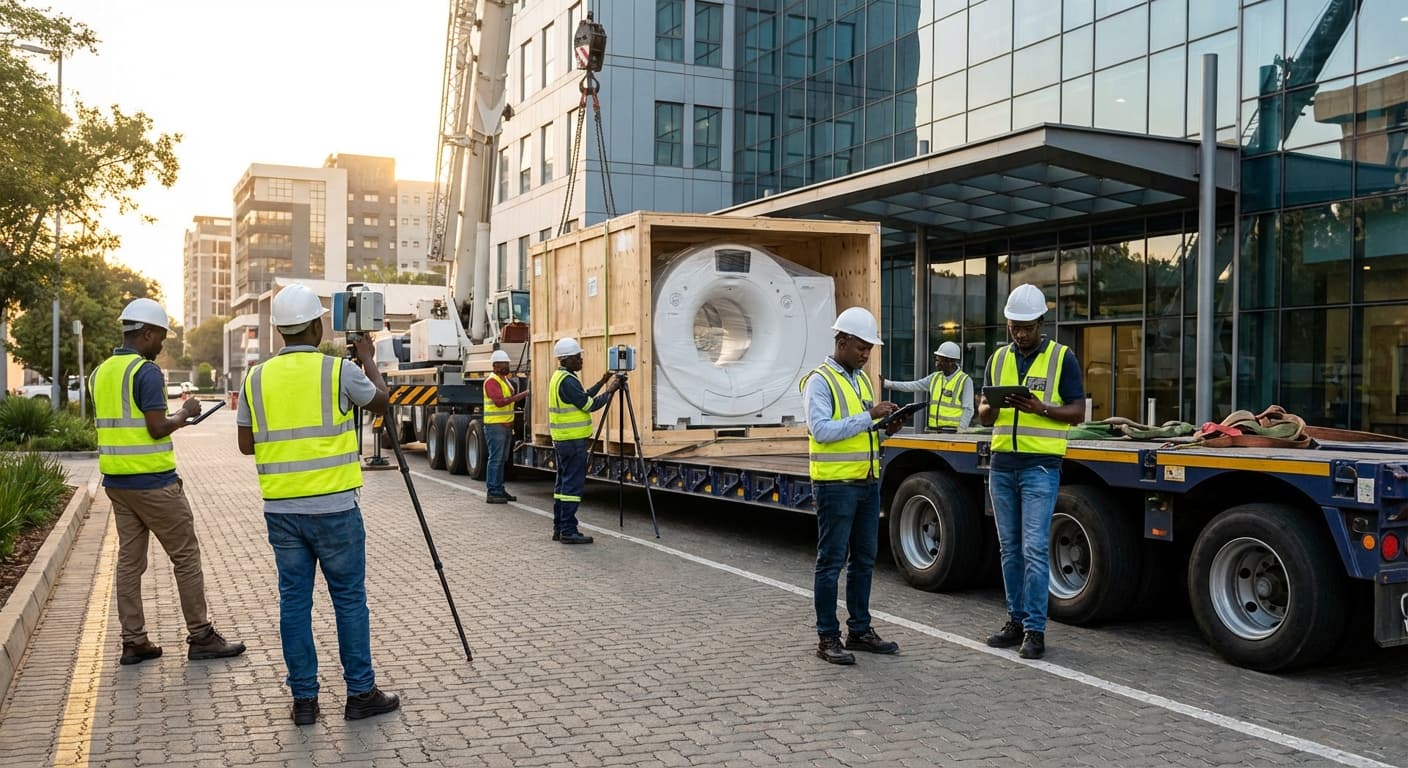
Route Survey & Rigging Plan Service for Heavy Medical Equipment in Somalia
Engineering Excellence & Technical Support
Route Survey & Rigging Plan Service for Heavy Medical Equipment High-standard technical execution following OEM protocols and local regulatory frameworks.
Precise Route Mapping & Obstacle Avoidance
Leveraging advanced GPS and drone technology, we conduct meticulous route surveys to identify and mitigate potential hazards like uneven terrain, narrow passages, and overhead obstructions. Our detailed digital maps ensure the safest and most efficient pathway for your critical medical equipment.
Customized Rigging & Lifting Solutions
Our experienced rigging teams develop bespoke plans utilizing specialized equipment for safe and secure lifting and maneuvering of heavy medical equipment. We consider weight distribution, structural integrity, and site-specific challenges to prevent damage and ensure operational readiness.
Logistics & Customs Facilitation for Somalia
Navigating the complexities of Somali logistics, our service includes comprehensive pre-planning for import, customs clearance, and last-mile delivery. We streamline the entire process, minimizing delays and ensuring your vital medical equipment reaches its destination promptly and securely.
What Is Route Survey & Rigging Plan Service For Heavy Medical Equipment In Somalia?
Route Survey & Rigging Plan Service for Heavy Medical Equipment in Somalia is a specialized logistical and engineering service critical for the safe and efficient transportation and installation of large, complex, and often sensitive medical apparatus within the Somali context. This service encompasses the meticulous evaluation of transport routes, identification and mitigation of logistical challenges, and the development of comprehensive rigging and lifting strategies to ensure the integrity of both the equipment and the infrastructure during transit and placement. Given the prevalent infrastructure limitations, potential security considerations, and the unique environmental conditions in Somalia, such a service is indispensable for minimizing risks and guaranteeing the successful deployment of vital healthcare assets.
| Who Needs This Service? | Typical Use Cases in Somalia | ||||
|---|---|---|---|---|---|
| Hospitals and Healthcare Facilities: Both new constructions and existing facilities undergoing upgrades or expansions requiring the installation of new heavy medical equipment (e.g., MRI machines, CT scanners, linear accelerators, large X-ray units). | Government Health Ministries and Agencies: Responsible for equipping public healthcare institutions, particularly in remote or underserved areas where infrastructure challenges are significant. | International Aid Organizations and NGOs: Involved in the development and support of healthcare infrastructure in Somalia, often donating or facilitating the procurement of advanced medical technology. | Equipment Manufacturers and Suppliers: Requiring specialized logistical support to ensure their products reach end-users safely and are installed correctly, often in challenging environments. | Construction and Infrastructure Development Companies: Undertaking projects that involve the integration of heavy medical equipment into new or renovated healthcare facilities. | Emergency Response and Disaster Relief Operations: When rapid deployment of critical medical equipment is required following crises or natural disasters. |
| Installation of MRI and CT Scanners: These are high-mass, sensitive instruments requiring precise placement and shielding considerations, often necessitating specialized transport and lifting within existing or new hospital wings. | Deployment of Linear Accelerators for Radiotherapy: Requiring heavy-duty transport, precise positioning, and integration into shielded bunkers, with significant consideration for structural integrity. | Installation of Large-Scale Sterilization Equipment: Such as autoclaves, which can be substantial in size and weight, requiring careful maneuvering and utility connections. | Transport and Installation of Diagnostic Imaging Equipment: Including large X-ray machines and angiography suites, often involving complex cable runs and specific environmental controls. | Equipping Mobile Medical Units or Field Hospitals: Where the transport and assembly of heavy medical systems in temporary or remote locations are critical. | Upgrading Existing Hospital Infrastructure: Replacing older, heavy equipment with newer, technologically advanced systems, necessitating careful removal and precise installation within established footprints. |
Service Components:
- Route Assessment and Planning: Involves detailed surveying of all potential transport paths from port of entry or origin to the final installation site. This includes evaluating road conditions, bridge load capacities, overhead clearances (e.g., power lines, awnings), turning radii, gradient, and potential obstacles. Consideration is given to the physical dimensions and weight of the medical equipment and its transport vehicle.
- Site Survey and Access Analysis: Assessment of the final destination for accessibility. This includes evaluating doorways, stairwells, elevator capacities, floor loading capabilities, and internal routing within the facility. Identification of any necessary structural modifications or temporary supports.
- Risk Assessment and Mitigation: Proactive identification of potential hazards associated with the transport and installation. This can include weather conditions, seismic activity, security concerns, dust, and potential damage to existing infrastructure. Development of contingency plans and mitigation strategies.
- Rigging and Lifting Plan Development: Creation of detailed engineering plans for lifting, hoisting, and maneuvering the heavy medical equipment. This includes specifying appropriate lifting equipment (cranes, forklifts, gantries), rigging hardware (slings, shackles, spreaders), load calculations, center of gravity determination, and the sequence of operations. Emphasis is placed on load stability and securing the equipment.
- Specialized Transport and Handling: Coordination and execution of specialized transportation, often requiring custom trailers, escorts, and specialized vehicles. This may involve temporary road closures or traffic management.
- Installation and Positioning: Overseeing the precise placement and final positioning of the medical equipment at its designated location, adhering to manufacturer specifications and operational requirements.
- Documentation and Reporting: Comprehensive documentation of all survey findings, planning procedures, risk assessments, and executed operations, including photographic and video evidence. This is crucial for insurance, compliance, and future reference.
Who Needs Route Survey & Rigging Plan Service For Heavy Medical Equipment In Somalia?
The transportation and installation of heavy medical equipment in Somalia presents unique logistical challenges due to the country's infrastructure and operating environment. Route survey and rigging plan services are crucial for ensuring the safe, efficient, and successful delivery and deployment of such vital assets. These services mitigate risks, prevent damage, and guarantee that the equipment reaches its intended location and is installed correctly, ready for immediate use. Without them, projects involving heavy medical equipment face significant delays, increased costs, and potential damage to the investment, ultimately impacting healthcare delivery.
| Customer Type | Relevant Departments/Roles | Specific Needs/Considerations |
|---|---|---|
| Government Health Ministries and Agencies | Procurement Department, Logistics Department, Project Management Office, Technical Services Department | Ensuring compliance with national regulations, identifying safe access routes to public hospitals, coordinating with local authorities, planning for installation in existing structures. |
| International NGOs & Humanitarian Aid Agencies | Logistics and Operations Department, Program Management, Procurement, Field Coordinators | Navigating challenging terrain, ensuring security for transit, rapid deployment to remote areas, coordinating with local communities, often dealing with time-sensitive delivery for crisis response. |
| Hospitals and Healthcare Facilities (Public & Private) | Facility Management, Biomedical Engineering Department, Procurement Department, Hospital Administration | Site-specific surveys for access points and installation areas, structural assessments for load-bearing capacity, coordination for internal movement within the facility, ensuring minimal disruption to patient care during installation. |
| United Nations Agencies | Logistics and Supply Chain Management, Procurement, Health Program Managers | Coordinating international shipments, managing customs clearance, ensuring delivery to UN-supported facilities or partner organizations, adherence to UN safety and security protocols. |
| Development Banks and Funding Institutions | Project Oversight, Technical Advisory Teams, Procurement Specialists | Due diligence on project logistics, ensuring efficient use of funds, verifying that the delivery plan aligns with project objectives and timelines. |
| Private Healthcare Providers and Investors | Operations Management, Development and Construction Teams, Procurement Department | Ensuring smooth delivery to private clinics or specialized medical centers, integration with new construction or renovation projects, maintaining brand reputation through professional installation. |
Target Customers and Departments for Route Survey & Rigging Plan Services for Heavy Medical Equipment in Somalia
- Government Health Ministries and Agencies
- International Non-Governmental Organizations (NGOs) & Humanitarian Aid Agencies
- Hospitals and Healthcare Facilities (Public & Private)
- United Nations Agencies (e.g., WHO, UNICEF)
- Development Banks and Funding Institutions
- Private Healthcare Providers and Investors
Route Survey & Rigging Plan Service For Heavy Medical Equipment Process In Somalia
This document outlines the comprehensive workflow for our Route Survey & Rigging Plan Service, specifically tailored for the intricate process of transporting and installing heavy medical equipment in Somalia. Our service ensures a safe, efficient, and compliant movement of critical healthcare infrastructure from port of entry to its final destination.
| Stage | Description | Key Activities | Deliverables | Timeline (Indicative) |
|---|---|---|---|---|
| Inquiry & Needs Assessment | Initial contact and detailed understanding of the client's requirements, including equipment specifications, origin, destination, and any known site constraints. | Client consultation, data gathering on equipment, site context, and project scope definition. | Project scope document, preliminary equipment profile. | 1-3 Business Days |
| Site Survey & Route Planning | Physical inspection of the proposed route and destination site to identify potential obstacles, assess ground conditions, and determine the safest and most efficient path. This includes assessing road quality, bridge load capacities, overhead clearances, and turning radii. | On-site physical survey, GPS mapping of route, obstacle identification, environmental assessment, measurement of critical dimensions (height, width, length, weight). | Detailed route map with identified hazards and alternative routes, site layout assessment report. | 5-10 Business Days (depending on complexity and location) |
| Rigging Plan Development | Creation of a detailed technical plan for the lifting, moving, and placement of the heavy medical equipment. This plan addresses all aspects of the rigging operation, including equipment selection, safety protocols, and personnel roles. | Load analysis, selection of appropriate lifting/transport equipment (cranes, forklifts, specialized trailers), development of lifting points and procedures, risk assessment and mitigation strategies, personnel training plan. | Comprehensive rigging and lifting plan, including diagrams, load charts, and safety checklists. | 7-14 Business Days |
| Permitting & Approvals | Securing all necessary permits and approvals from relevant local, regional, and national authorities in Somalia for transportation and site access. | Liaison with government agencies, submission of documentation, coordination with local authorities, obtaining road permits, special movement permits, and site access approvals. | All required permits and official approvals. | Variable (5-20 Business Days or more, depending on bureaucracy) |
| Equipment Procurement & Logistics | Sourcing and arranging for the transportation of specialized rigging equipment, vehicles, and any necessary ancillary materials to the project site. | Procurement of cranes, forklifts, trailers, safety gear, and fuel; coordination of transportation and warehousing. | Logistics plan, equipment inventory, delivery schedule. | 7-15 Business Days (concurrent with other stages) |
| Execution & Installation | The physical operation of moving, rigging, and installing the heavy medical equipment at its designated location. This phase is conducted by highly skilled and experienced personnel adhering strictly to the developed rigging plan and safety protocols. | On-site preparation, equipment mobilization, rigging operation, precise placement and installation, adherence to safety standards, real-time monitoring. | Successful transportation and installation of equipment. | 3-7 Business Days (per equipment unit, dependent on complexity) |
| Post-Installation & Handover | Final checks and verification of the equipment's position and stability. Formal handover to the client and relevant stakeholders, confirming successful completion of the rigging and installation. | Final inspection, quality assurance checks, documentation review, client sign-off. | Completion certificate, post-installation report. | 1-2 Business Days |
| Documentation & Reporting | Comprehensive documentation of the entire process, including survey reports, rigging plans, permits, incident reports (if any), and final completion reports. | Compilation of all project-related documents, preparation of a final project report for client review. | Final project report, all supporting documentation. | Ongoing throughout the project, final report within 5 Business Days post-handover |
Workflow Stages
- Inquiry & Needs Assessment
- Site Survey & Route Planning
- Rigging Plan Development
- Permitting & Approvals
- Equipment Procurement & Logistics
- Execution & Installation
- Post-Installation & Handover
- Documentation & Reporting
Route Survey & Rigging Plan Service For Heavy Medical Equipment Cost In Somalia
The cost of route survey and rigging plan services for heavy medical equipment in Somalia is highly variable, depending on several key factors. These services are critical to ensure the safe and efficient transport and installation of specialized, often oversized and delicate, medical machinery. Factors influencing pricing include the complexity of the route, the weight and dimensions of the equipment, the accessibility of the destination, the required level of detail in the survey and plan, and the urgency of the service. Specialized expertise and equipment are necessary, leading to higher costs.
| Service Component | Estimated Cost Range (USD) | Estimated Cost Range (Somali Shilling - SOS - Approx.) |
|---|---|---|
| Basic Route Survey (Short Distance, Urban) | $200 - $600 | 1,200,000 - 3,600,000 SOS |
| Detailed Route Survey (Long Distance, Complex Terrain) | $500 - $2,000+ | 3,000,000 - 12,000,000+ SOS |
| Basic Rigging Plan (Standard Equipment) | $300 - $1,000 | 1,800,000 - 6,000,000 SOS |
| Comprehensive Rigging Plan (Large/Sensitive Equipment) | $800 - $3,000+ | 4,800,000 - 18,000,000+ SOS |
| Combined Survey & Rigging Plan (Standard) | $500 - $1,500 | 3,000,000 - 9,000,000 SOS |
| Combined Survey & Rigging Plan (Complex/Heavy Equipment) | $1,000 - $5,000+ | 6,000,000 - 30,000,000+ SOS |
| Potential Additional Costs (e.g., Permits, Security, Site Prep) | Variable (can add 10-50%+) | Variable (can add 10-50%+) |
Key Pricing Factors for Route Survey & Rigging Plan Services in Somalia:
- Equipment Specifications: Weight, dimensions, fragility, and specific handling requirements.
- Route Complexity: Distance, terrain (urban vs. rural, paved vs. unpaved roads), potential obstacles (bridges, power lines, narrow passages, traffic congestion).
- Destination Accessibility: Ease of access to the final installation site, including proximity to road networks and any on-site preparation needs.
- Survey & Planning Detail: The depth of the survey (e.g., basic visual vs. detailed topographical, structural integrity checks) and the comprehensiveness of the rigging plan (e.g., basic lift vs. multi-stage, contingency planning).
- Time Sensitivity: Rush jobs or projects with tight deadlines typically incur higher costs.
- Specialized Equipment & Personnel: Requirement for cranes, specialized transport vehicles, experienced riggers, engineers, and safety officers.
- Risk Assessment & Mitigation: The level of risk associated with the move and the necessary precautions.
- Permits & Approvals: Obtaining necessary permits from local authorities can add to the cost and time.
- Security: In certain regions of Somalia, security escorts or enhanced security measures may be required, impacting the overall cost.
Affordable Route Survey & Rigging Plan Service For Heavy Medical Equipment Options
Navigating the complexities of transporting and installing heavy medical equipment requires meticulous planning. Our Affordable Route Survey & Rigging Plan Service provides the expertise and documentation necessary to ensure a safe, efficient, and cost-effective move. We specialize in evaluating transportation routes, identifying potential challenges, and developing detailed rigging plans tailored to the specific requirements of your medical devices. This proactive approach minimizes risks, prevents costly delays, and safeguards your valuable equipment. We offer flexible value bundles and employ several cost-saving strategies to make this essential service accessible to a wide range of healthcare providers.
| Value Bundle | Description | Cost-Saving Strategy | Included Services | Ideal For |
|---|---|---|---|---|
| Essential Route & Rigging Essentials | Our foundational package for straightforward moves, focusing on core planning needs. | Streamlined process for standard equipment and routes, leveraging efficient data collection. | Basic Route Survey, Standard Rigging Plan, Risk Assessment Summary. | Smaller clinics, standard imaging equipment, single-site moves. |
| Comprehensive Care Package | A more in-depth service covering a wider range of potential complexities and providing enhanced documentation. | Bundled services offer a discount compared to individual service purchases; digital reporting reduces printing costs. | Detailed Route Survey with 3D modeling (optional), Advanced Rigging Plan with CAD drawings, Detailed Risk Mitigation Plan, Stakeholder Coordination Support. | Hospitals, multi-site facilities, complex diagnostic or surgical equipment, new construction projects. |
| Custom Solutions | Tailored to unique project needs, including highly specialized equipment or challenging logistical scenarios. | Flexible scope allows for precise resource allocation, avoiding unnecessary costs. Negotiated rates for unique challenges. | Bespoke Route Survey (e.g., air or sea route assessment), Highly Specialized Rigging Plan, Emergency Response Planning, On-Site Supervision (optional). | Large-scale hospital renovations, international moves, custom-built medical modules, exceptionally large or sensitive equipment. |
Key Services Included:
- Comprehensive Route Surveys: Detailed analysis of potential transportation paths, including road conditions, bridge clearances, turning radii, and weight restrictions.
- On-Site Rigging Assessments: Evaluation of installation locations, access points, and structural considerations.
- Customized Rigging Plans: Step-by-step procedures for lifting, maneuvering, and securing heavy medical equipment, including specialized equipment requirements.
- Risk Mitigation Strategies: Identification of potential hazards and development of protocols to address them.
- Professional Documentation: Clear, concise, and legally compliant reports for insurance, regulatory, and project management purposes.
- Coordination with Stakeholders: Facilitation of communication between your team, logistics providers, and site personnel.
Verified Providers In Somalia
In Somalia's challenging healthcare landscape, identifying and trusting verified healthcare providers is paramount for individuals and organizations seeking reliable medical services. Franance Health stands out as a beacon of quality and integrity. This document outlines why Franance Health's credentials make them the best choice for your healthcare needs in Somalia.
| Credential Type | Franance Health Verification Process | Significance for Patients |
|---|---|---|
| Medical Licenses and Certifications | Verified with respective national and international medical boards. | Ensures providers are legally qualified and possess the requisite medical knowledge and skills. |
| Professional Experience and Specialization | Reviewed curriculum vitae (CVs), peer reviews, and past performance records. | Confirms expertise in specific medical fields and years of practical experience, leading to better diagnosis and treatment. |
| Clinical Competency Assessments | May include observed practice or case study reviews where applicable. | Guarantees that providers can effectively apply their knowledge to real-world medical scenarios. |
| Ethical Conduct and Professionalism | Background checks for any history of malpractice or disciplinary actions; reference checks. | Assures patients of trustworthy and ethical medical care, free from exploitation. |
| Facility Standards (if applicable) | Inspection of clinics and hospitals for hygiene, equipment, and safety protocols. | Ensures a safe and well-equipped environment for treatments and procedures. |
| Patient Feedback and Reputation | Collection and analysis of patient testimonials and reviews. | Provides insights into the provider's bedside manner, communication skills, and overall patient satisfaction. |
Why Franance Health is the Premier Choice:
- Rigorous Vetting Process: Franance Health employs an extensive and multi-faceted vetting process for all its partner providers. This includes thorough background checks, verification of medical licenses and accreditations, assessment of clinical expertise, and review of patient satisfaction records.
- Commitment to Quality Standards: We ensure all our verified providers adhere to international best practices and quality assurance protocols. This means you can expect high standards of care, safety, and patient well-being.
- Comprehensive Network: Franance Health has cultivated a broad network of specialists, general practitioners, and healthcare facilities across Somalia, ensuring access to a wide range of medical services, from routine check-ups to complex surgical procedures.
- Transparency and Accountability: We believe in transparency. Our vetting process is designed to be robust, and we hold our partner providers accountable for maintaining the highest ethical and professional standards. Any concerns raised are addressed promptly and effectively.
- Focus on Patient Experience: Beyond clinical excellence, Franance Health prioritizes the patient experience. Our verified providers are committed to compassionate care, effective communication, and patient-centered approaches.
- Adaptability to Local Needs: Franance Health understands the unique healthcare challenges and cultural nuances of Somalia. Our network comprises providers who are not only medically proficient but also deeply understand and cater to the local community's needs.
Scope Of Work For Route Survey & Rigging Plan Service For Heavy Medical Equipment
This Scope of Work (SOW) outlines the services required for a comprehensive route survey and detailed rigging plan for the transportation and installation of heavy medical equipment. The objective is to ensure safe, efficient, and compliant movement and placement of the equipment from its point of origin to its final installed location within the healthcare facility.
| Phase | Description | Technical Deliverables | Standard Specifications/Considerations |
|---|---|---|---|
| Route Survey & Assessment | Thorough examination of all potential transport routes, including external access, internal pathways, doorways, elevators, stairwells, and final installation area. Identification of potential obstacles, structural limitations, and environmental factors. | Detailed route maps with critical measurements (width, height, turning radii, gradient). Obstacle register and mitigation strategies. Structural capacity assessments (flooring, load-bearing walls, elevator capacity). Photographic and video documentation of the route. | Adherence to relevant building codes and safety standards. Consideration of equipment dimensions, weight, and center of gravity. Identification of temporary structural modifications or reinforcement requirements. Analysis of power and utility clearances along the route. Weather impact assessment for external routes. |
| Rigging Plan Development | Creation of a comprehensive plan detailing the methodology, equipment, personnel, and safety protocols for lifting, moving, and positioning the heavy medical equipment. This includes selecting appropriate lifting devices, securing mechanisms, and personnel coordination. | Detailed rigging diagrams and schematics. Selection of appropriate lifting equipment (cranes, hoists, gantries, dollies, skates) with load capacities. Specification of rigging hardware (slings, shackles, spreader bars, etc.). Step-by-step execution sequence with clear roles and responsibilities. Risk assessment and hazard analysis for all rigging operations. Emergency procedures and contingency plans. | Compliance with OSHA, ASME, and other relevant lifting standards. Load calculations and safety factor application. Environmental conditions (wind, temperature) affecting rigging operations. Minimum required clearance for all lifting and maneuvering operations. Communication protocols between all involved personnel. Training and certification verification for rigging personnel. |
| Pre-Installation Coordination & Verification | Collaborative meetings with facility management, engineering, IT, and medical staff to review the route survey findings and rigging plan. Verification of site readiness, including necessary clearances, power availability, and environmental controls. | Minutes of coordination meetings. Confirmation of site readiness checklist. Pre-installation site survey report. Finalized rigging plan incorporating any feedback or site-specific adjustments. | Ensuring all stakeholders are informed and aligned with the plan. Verification of necessary permits or authorizations. Confirmation of equipment availability and readiness for transport and installation. Pre-operation checks of all equipment and tools. |
| On-Site Execution Support (as required) | Provision of expert supervision and technical guidance during the actual movement and installation of the equipment to ensure adherence to the approved rigging plan and safety protocols. | On-site supervision presence. Real-time troubleshooting and problem-solving. Adherence to the approved rigging plan and safety procedures. Progress reporting during execution. | Maintaining constant communication with the site team. Immediate reporting of any deviations or incidents. Ensuring all safety measures are strictly followed throughout the operation. |
| Documentation & Reporting | Comprehensive documentation of all phases of the project, including the route survey, rigging plan, execution records, and any incident reports. Final handover of all project-related documents. | Final SOW compliance report. As-built drawings (if modifications were made). Photographic and video evidence of the completed installation. Sign-off and acceptance documents from the client. | Clear, concise, and accurate reporting. Retention of project records as per client requirements. Lessons learned documentation for future projects. |
Key Project Phases
- Route Survey & Assessment
- Rigging Plan Development
- Pre-Installation Coordination & Verification
- On-Site Execution Support (as required)
- Documentation & Reporting
Service Level Agreement For Route Survey & Rigging Plan Service For Heavy Medical Equipment
This Service Level Agreement (SLA) outlines the guaranteed response times and uptime for the Route Survey & Rigging Plan Service specifically for heavy medical equipment. It defines the commitments our service provides to ensure timely and reliable support for critical operations.
| Service Component | Priority Level | Response Time Target | Uptime Guarantee |
|---|---|---|---|
| Route Survey Request Initiation & Preliminary Assessment | Critical (Equipment Installation/Relocation Blocking) | 2 Business Hours | 99.8% |
| Route Survey Request Initiation & Preliminary Assessment | High (Potential Delay to Installation/Relocation) | 4 Business Hours | 99.8% |
| Route Survey Request Initiation & Preliminary Assessment | Medium (Routine Survey Request) | 8 Business Hours | 99.8% |
| Rigging Plan Development & Review | Critical (Equipment Installation/Relocation Blocking) | 4 Business Hours (for initial review/feedback) | 99.8% |
| Rigging Plan Development & Review | High (Potential Delay to Installation/Relocation) | 8 Business Hours (for initial review/feedback) | 99.8% |
| Rigging Plan Development & Review | Medium (Routine Plan Development) | 16 Business Hours (for initial review/feedback) | 99.8% |
| Technical Support & Troubleshooting (for service platform issues) | Critical (Service Platform Unavailable) | 1 Business Hour | 99.8% |
| Technical Support & Troubleshooting (for service platform issues) | High (Service Platform Functionality Impaired) | 2 Business Hours | 99.8% |
| Technical Support & Troubleshooting (for service platform issues) | Medium (General Inquiry/Non-critical Issue) | 4 Business Hours | 99.8% |
Service Level Objectives (SLOs)
- The following SLOs are designed to provide clear expectations regarding the availability and responsiveness of the Route Survey & Rigging Plan Service.
- Definition of Downtime: Downtime is defined as the period during which the Route Survey & Rigging Plan Service is unavailable for use due to a failure in the service itself, excluding scheduled maintenance, customer-induced issues, force majeure events, or third-party provider failures beyond our direct control.
- Definition of Response Time: Response time is measured from the moment a valid support request is submitted through our designated support channels until the first meaningful engagement from our technical support team.
- Definition of Resolution Time: Resolution time is measured from the moment a valid support request is submitted until the issue is resolved to a functional state, allowing for the continuation of the service.
Frequently Asked Questions

Ready when you are
Let's scope your Route Survey & Rigging Plan Service for Heavy Medical Equipment in Somalia project in Somalia.

Scaling healthcare logistics and technical systems across the entire continent.