
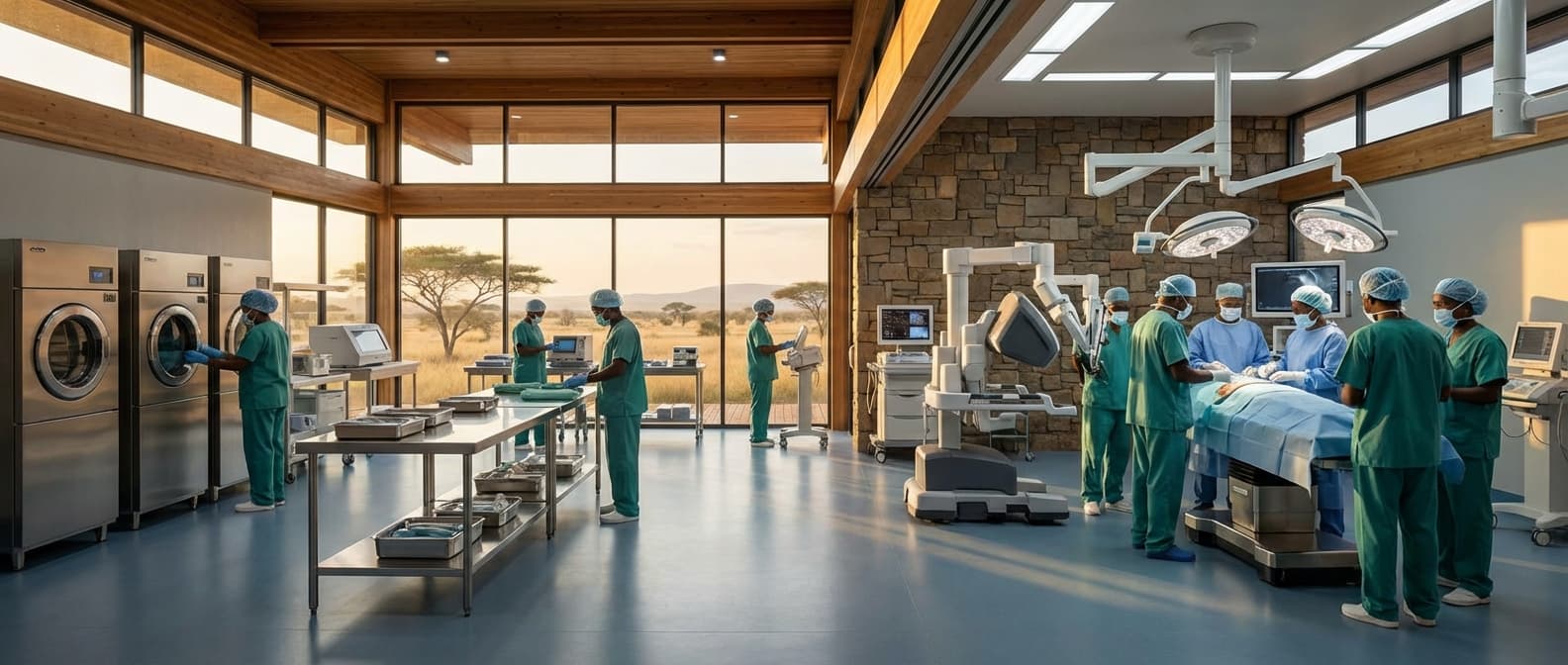
Operating Theatre Turnkey Build in Somalia
Engineering Excellence & Technical Support
Complete OR design, equipment integration and commissioning High-standard technical execution following OEM protocols and local regulatory frameworks.
State-of-the-Art Medical Equipment Integration
We ensure the seamless integration of cutting-edge surgical technology, including advanced anesthesia machines, diagnostic imaging systems (e.g., portable X-ray, ultrasound), and specialized surgical instruments, tailored to the specific needs of Somali healthcare facilities. Our turnkey solution guarantees optimal equipment performance and immediate readiness for complex procedures.
Robust HVAC and Infection Control Systems
Implementing highly efficient HVAC systems with HEPA filtration and sophisticated air handling units to maintain sterile environments, critical for minimizing hospital-acquired infections. Our designs prioritize temperature and humidity control, crucial for the Somali climate, ensuring patient safety and optimal surgical conditions.
Redundant Power and Utility Infrastructure
Designing and installing comprehensive, redundant power systems, including generators with automatic transfer switches and UPS, to guarantee uninterrupted operation of essential medical equipment and lighting. This ensures the theatre can function effectively even during power outages, a vital consideration for operational continuity in Somalia.
What Is Operating Theatre Turnkey Build In Somalia?
An Operating Theatre Turnkey Build in Somalia refers to a comprehensive, end-to-end service that encompasses the design, construction, equipping, and commissioning of a fully functional surgical suite. This integrated approach aims to deliver a ready-to-use operating theatre facility with minimal involvement from the client beyond initial consultation and final handover. The 'turnkey' aspect signifies that the provider takes full responsibility for all phases of the project, from conceptualization to operational readiness, allowing clients to acquire a state-of-the-art surgical environment without needing to manage multiple contractors and complex logistics.
| Who Needs This Service? | Typical Use Cases in Somalia | |
|---|---|---|
| Government Healthcare Institutions: Ministry of Health, public hospitals seeking to upgrade or establish new surgical capacity. | Establishment of a new general surgical operating theatre in a regional hospital to address unmet demand for essential surgical procedures. | Modernization of existing operating theatres in major urban centers to improve infection control and incorporate advanced surgical technologies. |
| Non-Governmental Organizations (NGOs) and Humanitarian Organizations: Organizations focused on improving healthcare access and delivery in underserved areas. | Construction of mobile or semi-permanent operating theatre units for deployment in disaster-affected regions or remote areas with limited infrastructure. | Setting up specialized surgical units (e.g., trauma, obstetrics) to address specific health crises or public health priorities. |
| Private Healthcare Providers: Emerging private hospitals and clinics aiming to offer advanced surgical services. | Development of a state-of-the-art operating theatre for a new private hospital to attract specialists and cater to a higher socio-economic demographic. | Expansion of an existing private facility with the addition of a dedicated surgical suite for a specific specialty (e.g., orthopedics, ophthalmology). |
| Military and Defense Medical Services: Establishing surgical capabilities for forward operating bases or specialized medical units. | Deployment of modular operating theatres for field hospitals supporting peacekeeping operations or humanitarian interventions. |
Key Components of an Operating Theatre Turnkey Build Service
- Site Assessment and Feasibility Studies: Evaluating existing infrastructure, determining structural integrity, assessing utility availability (power, water, waste management), and conducting environmental impact assessments.
- Architectural and Engineering Design: Developing detailed plans for the operating theatre layout, including patient flow, sterile zones, ventilation systems (HVAC with HEPA filtration), lighting, and specialized equipment integration. Compliance with international healthcare standards (e.g., ISO, local building codes) is paramount.
- Construction and Civil Works: Executing the physical construction of the operating theatre shell, including interior finishing, wall and floor treatments (antimicrobial, seamless), ceiling installation, and ensuring proper sealing for infection control.
- MEP (Mechanical, Electrical, and Plumbing) Systems: Installation of specialized electrical systems (e.g., medical-grade power, emergency generators, UPS), medical gas pipelines (oxygen, medical air, vacuum), water supply and drainage, and sophisticated HVAC systems designed for laminar airflow and controlled environmental conditions.
- Medical Equipment Procurement and Installation: Sourcing, delivering, installing, and calibrating all necessary surgical equipment, including operating tables, surgical lights, anesthesia machines, patient monitors, imaging modalities (e.g., C-arms), sterilization equipment (autoclaves), and surgical instruments.
- IT and Communication Infrastructure: Integrating audiovisual systems for training and remote consultation, network infrastructure for electronic health records (EHR) and PACS (Picture Archiving and Communication System), and communication systems.
- Sterilization and Waste Management Systems: Establishing robust systems for instrument sterilization and safe disposal of medical waste, adhering to strict infection control protocols.
- Commissioning and Validation: Rigorous testing of all systems and equipment to ensure optimal performance, safety, and compliance with operational and regulatory requirements. This includes performance qualification (PQ), operational qualification (OQ), and functional qualification (FQ).
- Training and Handover: Providing comprehensive training to clinical and technical staff on the operation and maintenance of the facility and its equipment, followed by formal handover.
Who Needs Operating Theatre Turnkey Build In Somalia?
Operating theatre turnkey builds are crucial for modernizing healthcare infrastructure in Somalia, which has faced decades of conflict and underdevelopment. These comprehensive solutions provide fully equipped, ready-to-use surgical suites, addressing critical needs for safe and effective surgical care. The demand for such services stems from a desire to improve patient outcomes, increase surgical capacity, and enhance the overall quality of medical services available to the Somali population.
| Customer Type | Description | Key Needs Addressed |
|---|---|---|
| Government Hospitals | Publicly funded hospitals operated by the Somali federal government or regional administrations. | Expanding access to essential surgical services, replacing outdated facilities, improving infection control, increasing surgical throughput. |
| NGO Hospitals | Hospitals operated by international and local non-governmental organizations providing humanitarian medical aid. | Establishing or upgrading surgical capacity in underserved areas, responding to emergencies, providing specialized surgical interventions, training local medical staff. |
| Private Hospitals and Clinics | For-profit healthcare facilities catering to a segment of the population with the ability to pay for private healthcare. | Offering advanced surgical procedures, attracting skilled surgeons, enhancing patient experience, meeting international standards of care, competitive differentiation. |
Target Customers and Departments for Operating Theatre Turnkey Builds in Somalia:
- Government Hospitals
- Non-Governmental Organization (NGO) Hospitals
- Private Hospitals and Clinics
- Mogadishu
- Hargeisa
- Bosaso
- Kismayo
- General Surgery
- Orthopedic Surgery
- Obstetrics and Gynecology
- Emergency Medicine
- Trauma Surgery
- Ophthalmology
- ENT (Ear, Nose, and Throat)
Operating Theatre Turnkey Build Process In Somalia
The turnkey build process for an operating theatre in Somalia involves a comprehensive workflow, commencing from the initial inquiry and culminating in a fully functional and commissioned facility. This process is particularly sensitive to the unique logistical, security, and resource challenges present in the region. It demands meticulous planning, robust risk management, and strong collaboration with local stakeholders.
| Stage | Key Activities | Considerations in Somalia |
|---|---|---|
| Client consultation, requirement definition, site visit, initial feasibility. | Security assessment, logistical constraints, local stakeholder engagement, infrastructure availability (power, water). |
| Preliminary architectural drawings, workflow planning, budget estimation, risk assessment. | Adaptability to local climate, material availability, potential for modular construction, security measures in design. |
| Full architectural, structural, MEP designs, equipment specifications. | Compliance with international healthcare standards, robust and low-maintenance systems, consideration for ease of repair. |
| Sourcing, purchasing, logistics, customs clearance. | Complex import procedures, secure transportation (convoy management), potential for delays, local sourcing opportunities, managing currency fluctuations. |
| Land preparation, foundation, building shell construction. | Site security during construction, availability of skilled local labor, quality control of materials, potential for landmines or unexploded ordnance. |
| Installation of HVAC, electrical, plumbing, medical gases, integration with equipment. | Reliable power backup (generators, UPS), quality of medical gas supply, robust ventilation for infection control, skilled technicians for complex systems. |
| Sterile finishes, infection control measures, specialized rooms. | Durability of materials, ease of cleaning, availability of specialized finishes, climate control considerations. |
| Placement, connection, testing, and calibration of all medical equipment. | Post-installation support, warranty management, availability of spare parts, training on specific equipment models. |
| Training for clinical and technical staff. | Language barriers, cultural considerations in training delivery, long-term sustainability of training programs, development of local expertise. |
| Final testing, audits, documentation, formal handover. | Independent verification of quality and safety, comprehensive operational manuals, clear lines of responsibility for ongoing maintenance. |
Operating Theatre Turnkey Build Process in Somalia: Workflow Stages
- 1. Initial Inquiry & Needs Assessment: The process begins with a client (e.g., Ministry of Health, NGO, private hospital) expressing interest and outlining their requirements. This stage involves detailed discussions to understand the desired capacity, specialized equipment needs, budget constraints, and the intended location of the operating theatre. Site feasibility studies, including infrastructure assessment (power, water, waste management) and security analysis, are crucial.
- 2. Conceptual Design & Feasibility Study: Based on the needs assessment, preliminary architectural and engineering designs are developed. This includes space planning, workflow analysis within the operating theatre, and initial equipment lists. A detailed feasibility study is conducted, assessing technical viability, financial projections, regulatory compliance (if any), and potential risks specific to the Somali context.
- 3. Detailed Design & Engineering: Once the conceptual design is approved, comprehensive architectural, structural, mechanical, electrical, and plumbing (MEP) designs are produced. This includes detailed specifications for all building components, finishes, medical gases, ventilation systems (HVAC), sterile water systems, and power backup solutions. Equipment procurement specifications are finalized.
- 4. Procurement & Supply Chain Management: This is a critical and complex phase in Somalia. It involves sourcing and procuring all necessary building materials, specialized medical equipment, and furniture. Robust supply chain management strategies are essential to navigate import regulations, customs clearance, secure transportation (often by land convoy or sea freight), and mitigate risks of damage or loss. Establishing reliable local partnerships is often beneficial.
- 5. Site Preparation & Civil Works: The chosen site is prepared, which may involve land clearing, excavation, and foundation laying. Civil works encompass the construction of the building shell, including walls, roofing, flooring, and internal partitions. Adherence to international standards for infection control and material durability is paramount.
- 6. MEP Installation & Medical Systems Integration: This stage involves installing all mechanical, electrical, and plumbing systems, including HVAC, lighting, power distribution, emergency generators, UPS systems, and medical gas pipelines. Crucially, specialized medical equipment, such as surgical lights, operating tables, anesthesia machines, and sterilization equipment, are integrated into the building's infrastructure.
- 7. Interior Finishing & Specialised Construction: Interior finishes are applied, prioritizing hygienic and durable materials. This includes sterile wall and floor finishes, specialized door systems, and the installation of medical gas outlets and control panels. Construction of cleanrooms and decontamination areas is also completed.
- 8. Equipment Installation & Commissioning: All procured medical equipment is installed and rigorously tested to ensure it meets manufacturer specifications and operational requirements. This includes calibration, functional testing, and integration with existing hospital systems if applicable.
- 9. Training & Capacity Building: To ensure the sustainable operation of the operating theatre, comprehensive training is provided to clinical staff (surgeons, nurses, anesthesiologists) and technical personnel responsible for equipment maintenance. This training covers the use of new equipment, sterilization protocols, infection control practices, and basic maintenance procedures.
- 10. Testing, Validation & Handover: The entire operating theatre facility undergoes rigorous testing and validation to ensure it meets all design specifications, regulatory requirements, and international standards. This includes performance testing of all systems, infection control audits, and a final inspection. Once all criteria are met, the facility is formally handed over to the client.
Operating Theatre Turnkey Build Cost In Somalia
Constructing a turnkey operating theatre in Somalia presents a unique set of challenges and cost considerations. The 'turnkey' aspect implies a fully functional, ready-to-use facility, encompassing design, construction, medical equipment installation, and commissioning. Pricing is highly variable, influenced by numerous factors, with local currency (Somali Shilling, SOS) being the primary medium of exchange, though USD is often used for larger contracts or imported goods. Security, logistical complexities, the availability of skilled labor and materials, the size and sophistication of the theatre, and the specific location within Somalia all play significant roles in determining the final cost.
| Category | Estimated Cost Range (SOS) | Estimated Cost Range (USD Equivalent - Approximate) |
|---|---|---|
| Small, Basic Operating Theatre (1 OR) | 150,000,000 - 300,000,000 SOS | $250,000 - $500,000 USD |
| Medium, Standard Operating Theatre (2-3 ORs) | 300,000,000 - 750,000,000 SOS | $500,000 - $1,250,000 USD |
| Large, Advanced Operating Theatre Suite (4+ ORs, high-tech equipment) | 750,000,000 - 1,500,000,000+ SOS | $1,250,000 - $2,500,000+ USD |
| Specialized Equipment (e.g., C-arm, anesthesia machines, ventilators - per unit) | 10,000,000 - 50,000,000+ SOS | $17,000 - $85,000+ USD |
| Imported High-Grade Building Materials (per m²) | 500,000 - 1,500,000 SOS | $850 - $2,500 USD |
| Skilled Expatriate Labor (per month) | 8,000,000 - 20,000,000+ SOS | $13,000 - $34,000+ USD |
Key Pricing Factors for Turnkey Operating Theatre Builds in Somalia
- Location and Security: Areas with higher security risks will incur increased costs due to the need for enhanced security measures during construction and operation.
- Facility Size and Scope: The number of operating rooms, recovery rooms, sterilization areas, and associated support spaces directly impacts material and labor requirements.
- Level of Medical Sophistication: The complexity of surgical procedures intended to be performed dictates the type and quality of medical equipment, from basic instruments to advanced imaging and life support systems.
- Quality of Materials: Imported high-quality building materials will be significantly more expensive than locally sourced or lower-grade alternatives.
- Medical Equipment and Technology: This is often the largest single cost component. Sourcing, transportation, installation, and calibration of advanced medical equipment from international suppliers can be costly.
- Skilled Labor Availability: A shortage of experienced local construction workers and medical technicians can necessitate the use of expatriate staff, significantly increasing labor costs.
- Logistics and Transportation: Transporting materials and equipment to remote or underdeveloped areas within Somalia can be challenging and expensive, involving road, sea, or even air freight.
- Design and Architectural Services: The cost of specialized architectural and engineering design, particularly for specialized healthcare facilities, needs to be factored in.
- Contingency and Risk Management: Due to the volatile environment, a higher contingency budget is usually required to account for unforeseen delays, price fluctuations, or security incidents.
- Regulatory Approvals and Permits: Navigating local bureaucracy for permits and approvals can incur administrative costs and delays.
Affordable Operating Theatre Turnkey Build Options
Establishing an operating theatre is a significant undertaking, requiring specialized infrastructure and equipment. For healthcare providers seeking cost-effective solutions, 'Affordable Operating Theatre Turnkey Build Options' offer a streamlined approach. A turnkey build means the entire project is managed by a single provider, from initial design and construction to equipment installation and commissioning. Value bundles are pre-packaged combinations of services and equipment designed to offer a comprehensive solution at a potentially lower price than sourcing each component individually. These bundles aim to simplify the procurement process, ensure compatibility between systems, and provide cost savings through bulk purchasing and standardized designs.
| Cost-Saving Strategy | Description | Impact on Affordability |
|---|---|---|
| Standardized Module Design | Utilizing pre-designed, modular operating theatre layouts and systems that can be adapted to various sites. This reduces custom design time and leverages economies of scale in manufacturing. | Lowers design and manufacturing costs, leading to a reduced overall price. |
| Bundle Procurement | Purchasing a complete package of construction, equipment, and services from a single provider. This often includes discounted pricing on equipment and integrated systems. | Reduces procurement overhead, provides potential for volume discounts, and simplifies project management. |
| Phased Development | Breaking down the project into manageable phases, allowing for deployment as budget becomes available. This could involve building the core theatre first and adding advanced equipment later. | Manages upfront capital expenditure and allows for staggered investment, making it more accessible. |
| Efficient Material Selection | Opting for durable, high-quality, yet cost-effective materials for construction and finishes that meet infection control requirements without unnecessary luxury. | Reduces material and installation costs while maintaining essential functionality and safety. |
| Pre-fabrication and Modular Construction | Manufacturing certain components (e.g., wall panels, service columns) off-site in a controlled environment. This speeds up on-site construction and reduces waste. | Lowers on-site labor costs and construction time, potentially reducing overall project duration and associated expenses. |
| Refurbishment of Existing Spaces | Instead of new construction, adapting and upgrading existing hospital spaces to meet operating theatre standards. This requires careful assessment but can be significantly cheaper than building from scratch. | Avoids land acquisition and extensive new construction costs. |
| Long-Term Maintenance Contracts | Negotiating comprehensive service and maintenance agreements as part of the turnkey package. While an upfront cost, it can prevent unexpected, costly breakdowns and extend equipment lifespan. | Ensures predictable operational costs and minimizes disruptive, expensive emergency repairs. |
Key Components of Operating Theatre Turnkey Builds & Value Bundles
- Design and Planning: Architectural drawings, room layout, HVAC, electrical, and plumbing specifications.
- Construction and Civil Works: Building the operating theatre shell, including walls, flooring, and ceilings to meet infection control standards.
- Specialized Medical Equipment: Surgical lights, operating tables, anesthesia machines, patient monitors, imaging equipment (e.g., C-arms), electrosurgical units, and sterilization equipment.
- Integrated Systems: Medical gas supply, nurse call systems, audiovisual integration, and IT infrastructure.
- Finishing and Fit-out: Infection-resistant wall and floor coatings, cabinetry, and workflow-optimized elements.
- Commissioning and Training: Testing all systems, ensuring functionality, and providing staff training on equipment operation.
- Regulatory Compliance: Ensuring adherence to national and international healthcare facility standards and building codes.
Verified Providers In Somalia
In Somalia's evolving healthcare landscape, identifying reliable and accredited medical facilities is paramount. Verified providers offer a crucial assurance of quality, safety, and adherence to established medical standards. Franance Health has emerged as a leading entity, meticulously vetting and credentialing healthcare providers across Somalia. Their rigorous process ensures that the listed facilities meet stringent criteria, empowering patients to make informed decisions about their health.
| Franance Health Verified Provider | Location | Specialties Offered | Key Services |
|---|---|---|---|
| Global Care Hospital | Mogadishu | General Medicine, Surgery, Pediatrics, Obstetrics & Gynecology | Emergency services, Diagnostic imaging, Laboratory services, Outpatient consultations |
| Hargeisa General Hospital | Hargeisa | Internal Medicine, Cardiology, Neurology, Ophthalmology | Inpatient care, Surgical procedures, Physiotherapy, Pharmacy |
| Banaadir Regional Hospital | Mogadishu | Pediatrics, Infectious Diseases, Mental Health, Dentistry | Vaccination programs, Nutritional support, Family planning, Dental care |
| Bosaso Medical Center | Bosaso | General Practice, Dermatology, Urology, ENT | Routine check-ups, Minor surgery, Specialist referrals, Health education |
| Galkayo Health Initiative | Galkayo | Primary Healthcare, Maternal and Child Health, Community Health | Antenatal care, Postnatal care, Child health services, Health outreach programs |
Why Franance Health Credentials Matter:
- Ensured Quality of Care: Franance Health's verification process involves a thorough review of medical staff qualifications, equipment, and facility infrastructure, guaranteeing a high standard of medical treatment.
- Patient Safety: Credentials confirm that providers adhere to strict hygiene protocols, safety procedures, and ethical medical practices, minimizing risks for patients.
- Access to Expertise: Verified providers often indicate a commitment to ongoing professional development and access to specialized medical knowledge.
- Trust and Transparency: The Franance Health seal of approval provides a transparent indicator of a provider's legitimacy and reliability, fostering trust between patients and healthcare institutions.
- Improved Healthcare Accessibility: By streamlining the identification of reputable providers, Franance Health contributes to better access to quality healthcare services throughout Somalia.
Scope Of Work For Operating Theatre Turnkey Build
This Scope of Work (SOW) outlines the requirements for the turnkey construction and commissioning of a state-of-the-art operating theatre. It covers all aspects from initial design and civil works to the installation and integration of specialized medical equipment, culminating in a fully functional operating suite ready for clinical use. The SOW also details the essential technical deliverables and standard specifications that must be adhered to throughout the project lifecycle.
| Category | Technical Deliverable | Standard Specification / Requirement |
|---|---|---|
| Design & Engineering | Architectural Drawings | ISO 9001 certified architectural design, compliance with local building codes, healthcare facility design guidelines (e.g., FGI Guidelines, HTM), ergonomic layout for workflow efficiency, infection control considerations. |
| Design & Engineering | Structural Engineering Drawings | Adherence to relevant building codes for seismic, wind, and load-bearing requirements, material specifications. |
| Design & Engineering | MEP System Design | Design for redundancy in critical systems, compliance with ASHRAE standards for HVAC (HEPA filtration, positive pressure for ORs, specific air change rates), electrical load calculations, UPS and generator sizing, plumbing design for medical gases, waste, and water supply, adherence to NFPA 99 for medical gas systems. |
| Civil & Structural Works | Foundation and Structural Frame | Concrete strength, rebar specifications, adherence to approved structural drawings. |
| Civil & Structural Works | Wall & Ceiling Construction | Antimicrobial finishes, non-porous materials, seamless joints, sound insulation requirements, fire-rated materials where applicable. |
| Civil & Structural Works | Flooring | Antistatic, seamless, non-slip, chemical-resistant flooring material (e.g., conductive vinyl, epoxy resin) with appropriate coving. |
| MEP Systems | HVAC System | Commissioned HVAC system with HEPA filtration (ISO 16890), differential pressure control (positive pressure for ORs), temperature and humidity control ± 1°C and ± 5% RH respectively, minimum air changes per hour (e.g., 20-25 ACH), laminar flow capabilities if specified. |
| MEP Systems | Medical Gas Systems | Installation and testing of medical gas pipelines (Oxygen, Medical Air, Vacuum, Nitrous Oxide) to ISO 7396-1 standards, pressure and purity testing, alarm systems. |
| MEP Systems | Electrical Systems | Isolated power systems for surgical equipment, grounding and bonding, UPS and generator backup for critical equipment, emergency lighting, compliance with IEC 60364-7-710 for medical locations. |
| MEP Systems | Plumbing Systems | Dedicated sterile water supply, appropriate drainage systems, backflow prevention, compliance with local plumbing codes. |
| Specialized Equipment | Surgical Lights | LED technology, adjustable intensity and color temperature, shadowless illumination, ergonomic design, ceiling-mounted or mobile. |
| Specialized Equipment | Surgical Tables | Electromagnetic or hydraulic, radiolucent top, multi-articulating for various procedures, high weight capacity, remote control functionality. |
| Specialized Equipment | Anesthesia Workstation | Integrated gas delivery, ventilation, monitoring, and vaporizers. |
| Specialized Equipment | X-ray/Imaging Integration Points | Provision for mobile C-arm or fixed imaging systems, including necessary power, data, and structural support. |
| Specialized Equipment | Surgical Navigation Systems (if applicable) | Pre-wiring and mounting points for chosen navigation system. |
| Specialized Equipment | Video and Communication Systems | Integration of video displays, cameras, recording devices, and communication interfaces for remote consultation or teaching. |
| Integration & Commissioning | System Integration Plan | Detailed plan for interconnecting all MEP and specialized equipment, ensuring seamless operation. |
| Integration & Commissioning | Commissioning Report | Comprehensive documentation of all system tests, performance verification, and calibration. |
| Testing & Validation | Infection Control Validation | Validation of air filtration, pressure differentials, and surface materials to meet infection control standards. |
| Testing & Validation | Performance Testing | End-to-end testing of all integrated systems under simulated clinical scenarios. |
| Testing & Validation | User Acceptance Testing (UAT) | Clinical staff verification of functionality and workflow. |
| Training & Handover | Operator Training Manuals | Detailed manuals for all installed equipment and systems. |
| Training & Handover | On-site Training | Comprehensive training sessions for clinical and technical staff on equipment operation, maintenance, and troubleshooting. |
| Training & Handover | As-Built Drawings | Updated drawings reflecting the final installed configuration of all systems and equipment. |
| Training & Handover | Warranty Documentation | Manufacturer and contractor warranties for all equipment and works. |
Key Project Phases
- Project Initiation and Planning
- Design and Engineering
- Civil and Structural Works
- MEP (Mechanical, Electrical, Plumbing) Systems Installation
- Specialized Operating Theatre Equipment Installation
- Integration and Commissioning
- Testing and Validation
- Training and Handover
Service Level Agreement For Operating Theatre Turnkey Build
This Service Level Agreement (SLA) outlines the response times and uptime guarantees for the Operating Theatre Turnkey Build project. It aims to ensure minimal disruption and efficient resolution of any issues that may arise during the project lifecycle and the initial operational phase.
| Service Area | Response Time (Business Hours) | Resolution Time (Business Hours) | Uptime Guarantee (%) |
|---|---|---|---|
| Critical System Failure (e.g., HVAC failure impacting sterile field, major power outage) | 30 minutes | 4 hours | 99.9% (for initial operational phase) |
| Major Equipment Malfunction (e.g., imaging equipment failure, surgical light failure) | 1 hour | 8 hours | 99.5% (for initial operational phase) |
| Minor Equipment Malfunction (e.g., minor instrument failure, communication system issue) | 2 hours | 24 hours | 99.0% (for initial operational phase) |
| Non-Critical System/Facility Issue (e.g., minor aesthetic issue, non-essential utility problem) | 4 hours | 48 hours | 98.0% (for initial operational phase) |
| Project Deliverable Delays (related to contractor's scope) | 1 business day to acknowledge | As per agreed mitigation plan | N/A (addressed through project management processes) |
Key Performance Indicators (KPIs)
- Response Time: The maximum allowable time for the project team to acknowledge a reported issue and begin diagnosis.
- Resolution Time: The maximum allowable time to fully resolve a reported issue and restore normal operations.
- Uptime Guarantee: The minimum percentage of time the operating theatre facilities are operational and available for use, excluding scheduled maintenance.
- Downtime: Any period during which the operating theatre facilities are not operational and available for use.
Frequently Asked Questions

Ready when you are
Let's scope your Operating Theatre Turnkey Build in Somalia project in Somalia.

Scaling healthcare logistics and technical systems across the entire continent.