
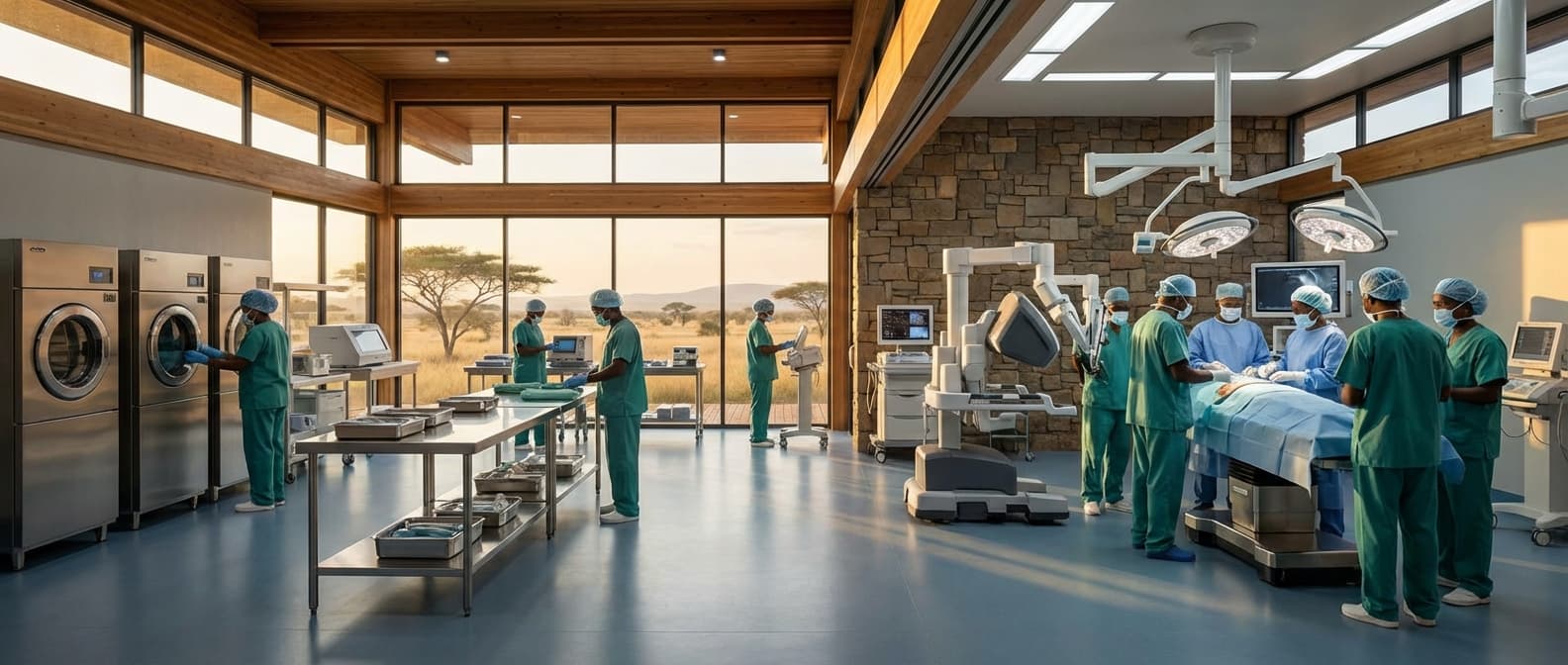
CSSD Design & Validation in Somalia
Engineering Excellence & Technical Support
CSSD workflow design, validation and process development High-standard technical execution following OEM protocols and local regulatory frameworks.
CSSD Process Optimization for Infection Control
Implemented standardized CSSD workflows and validation protocols, significantly reducing the risk of surgical site infections and improving patient safety in Somali healthcare facilities through rigorous monitoring of sterilization cycles, instrument tracking, and environmental controls.
Customized Sterilization Equipment Validation
Developed and executed validation strategies for diverse sterilization equipment (autoclaves, ethylene oxide, etc.) adapted to the specific environmental conditions and resource availability in Somalia, ensuring efficacy and compliance with international standards for medical device reprocessing.
Staff Training and Competency Assurance
Designed and delivered comprehensive training programs for CSSD personnel on best practices, equipment operation, and validation procedures, ensuring the competency and sustained performance of staff in maintaining sterile environments and preventing healthcare-associated infections.
What Is Cssd Design & Validation In Somalia?
Central Sterile Supply Department (CSSD) design and validation in Somalia refers to the systematic process of conceptualizing, planning, constructing, equipping, and subsequently verifying that the designed and implemented CSSD facility meets predefined standards for sterility, functionality, efficiency, and safety. This encompasses the architectural layout, workflow optimization, selection and integration of sterilization equipment, environmental controls, and robust validation protocols to ensure patient safety and infection prevention.
| Who Needs CSSD Design & Validation in Somalia? | Typical Use Cases |
|---|---|
| Hospitals (Public and Private) | Establishment of new hospital facilities or major renovations to existing ones requiring a functional CSSD. |
| Surgical Centers & Clinics | Ensuring adequate sterilization capacity and processes for specialized surgical procedures. |
| Diagnostic Laboratories (with instrument sterilization needs) | Validation of sterilization processes for reusable laboratory equipment. |
| Government Health Ministries & Regulatory Bodies | Development of national standards, guidelines, and oversight for CSSD facilities to improve healthcare quality and safety across the nation. |
| International Aid Organizations & NGOs | Supporting the development or upgrading of healthcare infrastructure in underserved regions. |
| Healthcare Facility Management & Engineering Departments | Ongoing maintenance, troubleshooting, and re-validation of existing CSSD systems. |
Key Components of CSSD Design & Validation in Somalia:
- Functional Area Zoning: Establishing distinct and segregated areas for receiving/decontamination, assembly/packaging, sterilization, sterile storage, and dispatch.
- Workflow Analysis: Optimizing the unidirectional flow of materials to prevent cross-contamination.
- Equipment Selection & Integration: Identifying appropriate sterilization technologies (e.g., autoclaves, low-temperature sterilizers) based on instrument types, volume, and local infrastructure, and ensuring their seamless integration.
- Environmental Control Systems: Designing and validating HVAC systems for appropriate air pressure differentials, filtration (HEPA), temperature, and humidity to maintain a controlled environment and prevent airborne contamination.
- Material & Finishes Specification: Selecting durable, non-porous, and easily cleanable materials for surfaces, floors, and walls that can withstand harsh cleaning agents and frequent sterilization cycles.
- Ergonomics & Safety: Incorporating ergonomic principles for staff well-being and implementing safety features to mitigate risks associated with sharps, chemicals, and high-temperature equipment.
- Regulatory Compliance: Adhering to relevant international (e.g., ISO, AAMI) and any developing national guidelines and standards for CSSD operations.
- Validation Protocols: Developing and executing comprehensive validation procedures, including Installation Qualification (IQ), Operational Qualification (OQ), Performance Qualification (PQ), and ongoing re-validation, to ensure equipment and processes consistently achieve sterility.
- Training & Staffing Requirements: Defining the necessary skills and training for CSSD personnel to operate and maintain the facility and equipment effectively.
Who Needs Cssd Design & Validation In Somalia?
Central Sterile Services Departments (CSSDs) are critical for infection prevention and control in healthcare settings worldwide. In Somalia, where the healthcare infrastructure is rebuilding and striving for higher standards, the design and validation of CSSDs are essential to ensure the safety of patients and healthcare professionals. Without properly designed and validated CSSDs, the risk of healthcare-associated infections (HAIs) significantly increases, undermining the effectiveness of medical procedures and potentially leading to preventable complications and fatalities. This applies to all levels of healthcare facilities, from primary care clinics to tertiary hospitals.
| Customer Segment | Key Departments Involved | Specific Needs/Benefits of CSSD Design & Validation |
|---|---|---|
| Public Hospitals | Surgery, ICU, Maternity, OPDs, Administration, Infection Control | Patient safety, reduction of HAIs, compliance with national standards, efficient workflow, extended lifespan of equipment, cost savings through reduced reprocessing failures. |
| Private Hospitals & Clinics | Surgery, Dentistry, Ophthalmology, Administration, Infection Control | Reputation management, patient trust, competitive advantage, adherence to international best practices, minimizing risks and associated liabilities. |
| Government Health Ministries | Planning & Policy, Quality Assurance, Public Health | Establishing and enforcing national sterilization standards, improving overall healthcare quality, data collection for infection rates, strategic resource allocation. |
| NGOs & International Aid Organizations | Program Management, Procurement, Healthcare Services | Ensuring effective utilization of donated funds, verifiable patient safety outcomes, long-term sustainability of healthcare infrastructure, demonstrating accountability to donors. |
| Healthcare Training Institutions | Anatomy & Physiology, Surgery, Nursing, Infection Control | Providing hands-on training in sterile processing, equipping future professionals with essential skills, fostering a culture of safety and best practices from the outset. |
Target Customers & Departments for CSSD Design & Validation in Somalia
- Hospitals (Public & Private): All hospitals, regardless of size or ownership, require robust CSSD services to process surgical instruments, medical devices, and other sterile supplies.
- Specialty Clinics: Clinics focusing on surgery, dentistry, ophthalmology, and other procedures requiring sterile instruments are prime candidates.
- Maternity Wards: Ensuring the sterility of instruments used in childbirth is paramount.
- Emergency Departments: Rapid and reliable sterilization of emergency medical equipment is crucial.
- Operating Theatres: The heart of CSSD's contribution, requiring high volumes of perfectly sterilized instruments.
- Intensive Care Units (ICUs): Maintaining sterile environments for critically ill patients depends on effective sterilization processes.
- Outpatient Departments (OPDs): Even for minor procedures, sterile equipment is necessary to prevent infections.
- Government Health Ministries/Agencies: Responsible for setting healthcare standards, overseeing quality, and often funding public healthcare facilities. They need to ensure compliance and best practices.
- NGOs and International Aid Organizations: Organizations involved in healthcare development and humanitarian aid in Somalia often fund and manage healthcare facilities. They need to ensure their investments result in safe and effective services.
- Healthcare Training Institutions: Medical and nursing schools need to educate future professionals on sterile processing principles and practices, requiring properly designed and functional CSSDs for training.
- Medical Device Suppliers & Manufacturers: While not directly operating CSSDs, they benefit from well-designed facilities that can properly maintain and sterilize their products, ensuring optimal performance and longevity.
Cssd Design & Validation Process In Somalia
The design and validation process for a Central Sterile Supply Department (CSSD) in Somalia, like in any region, is a multi-stage undertaking that prioritizes patient safety and infection control. This workflow outlines the typical progression from an initial inquiry to the successful execution and validation of a CSSD.
Phase 1: Inquiry and Feasibility
This initial phase involves understanding the needs and scope of the project. It begins with a formal or informal inquiry from a healthcare facility in Somalia or a governing health body. The inquiry typically expresses a need for a new or upgraded CSSD. This leads to a feasibility study, which assesses the project's viability in the Somali context, considering factors like available resources, infrastructure, regulatory environment, and the specific needs of the healthcare facility. A preliminary budget and timeline are often established during this stage. Discussions focus on the required capacity, types of sterilization processes needed (e.g., steam, low-temperature), and the anticipated volume of surgical instruments and medical devices to be processed.
| Phase | Key Activities | Considerations for Somalia |
|---|---|---|
| Phase 1: Inquiry and Feasibility | Initial request, needs assessment, feasibility study, preliminary budget & timeline, stakeholder identification. | Understanding local healthcare infrastructure, availability of specialized expertise, funding sources (local/international), current infection control practices, potential for future expansion. |
| Phase 2: Design and Planning | Detailed architectural and engineering design, space allocation (decontamination, packing, sterilization, storage), workflow planning, selection of sterilization technologies, development of Standard Operating Procedures (SOPs). | Climate control (temperature, humidity), power supply reliability (generators), water quality and availability, waste management infrastructure, security considerations, adherence to international guidelines (e.g., WHO, AAMI) adapted to local context. |
| Phase 3: Procurement and Construction/Renovation | Sourcing and purchasing of building materials and equipment, construction or renovation of the CSSD space. | Logistics and transportation challenges, customs clearance, availability of skilled local labor, quality control of materials, ensuring compliance with designs despite potential supply chain disruptions. |
| Phase 4: Equipment Installation and Commissioning | Installation of sterilization equipment (autoclaves, washer-disinfectors, etc.), validation of utility connections (water, steam, electricity, ventilation), initial equipment testing. | Ensuring trained technicians are available for installation, testing of backup power systems, availability of spare parts, proper calibration of initial settings. |
| Phase 5: Validation and Qualification | Installation Qualification (IQ), Operational Qualification (OQ), Performance Qualification (PQ) for all equipment, validation of cleaning and sterilization processes, environmental monitoring. | Availability of specialized validation engineers or consultants, training local staff on validation procedures, documenting all validation activities thoroughly, ensuring consistent results under local operating conditions. |
| Phase 6: Staff Training and Operationalization | Comprehensive training for CSSD staff on all aspects of operation (cleaning, disinfection, sterilization, packaging, storage, documentation), developing and implementing SOPs, initial operational run-throughs. | Language barriers, cultural considerations in training, developing accessible training materials, assessing competency of staff, establishing clear reporting lines and accountability. |
| Phase 7: Ongoing Monitoring and Quality Assurance | Regular quality control testing (e.g., biological and chemical indicators), equipment maintenance schedules, continuous staff training, auditing of processes, performance review, data analysis for improvement. | Establishing a robust system for monitoring and reporting, ensuring access to consumables and maintenance services, fostering a culture of continuous improvement, adapting to evolving best practices and local health needs. |
CSSD Design & Validation Workflow in Somalia
- Phase 1: Inquiry and Feasibility
- Phase 2: Design and Planning
- Phase 3: Procurement and Construction/Renovation
- Phase 4: Equipment Installation and Commissioning
- Phase 5: Validation and Qualification
- Phase 6: Staff Training and Operationalization
- Phase 7: Ongoing Monitoring and Quality Assurance
Cssd Design & Validation Cost In Somalia
Designing and validating a Central Sterile Supply Department (CSSD) in Somalia involves a complex interplay of factors that influence overall costs. These costs are not fixed and can vary significantly based on the specific needs of the healthcare facility, the chosen technology, the scope of services offered, and the prevailing economic conditions within Somalia. The pricing is typically discussed in Somali Shilling (SOS).
| Cost Component | Estimated Range (SOS) | Notes |
|---|---|---|
| CSSD Design & Architectural Fees | 2,000,000 - 10,000,000+ | Depends on project complexity and consultant reputation. |
| Basic Equipment (Washer, Small Autoclave, Sealer) | 15,000,000 - 50,000,000 | For small-scale facilities. Can be significantly higher for larger capacity or advanced models. |
| Intermediate Equipment (Larger Autoclaves, Washer-Disinfectors) | 50,000,000 - 150,000,000 | Suitable for medium-sized hospitals. Includes more robust systems. |
| Advanced/Automated Equipment (High-capacity Autoclaves, Fully Automated Lines) | 150,000,000 - 500,000,000+ | For large hospitals or specialized facilities with high throughput needs. |
| Infrastructure Modifications (Plumbing, Electrical, HVAC) | 10,000,000 - 75,000,000+ | Highly variable depending on existing building condition and required upgrades. |
| Water Treatment Systems (Deionization) | 3,000,000 - 15,000,000 | Essential for reliable sterilization. |
| Validation & Testing Services | 5,000,000 - 30,000,000 | Includes IQ, OQ, PQ. Varies with the number of equipment and complexity of processes. |
| Installation & Commissioning | 2,000,000 - 10,000,000 | Cost of setting up and ensuring equipment functionality. |
| Initial Consumables (Packaging Materials, Detergents) | 1,000,000 - 5,000,000 | For the first few months of operation. |
| Contingency (10-15%) | Variable | Recommended for unexpected costs. |
Key Pricing Factors for CSSD Design & Validation in Somalia
- Facility Size and Capacity: The square footage of the CSSD and the volume of instruments to be processed directly impact the size and number of equipment required, thus influencing costs.
- Equipment Selection: The choice between manual, semi-automated, or fully automated equipment (autoclaves, washer-disinfectors, sterile packaging machines) is a major cost driver. High-end, energy-efficient, and technologically advanced equipment will naturally be more expensive.
- Infrastructure Requirements: This includes the need for specialized plumbing, electrical systems, ventilation (HVAC), water treatment (e.g., deionized water systems), and potentially building modifications or new construction to accommodate the CSSD layout and workflow.
- Regulatory and Quality Standards: Adherence to international (e.g., ISO, AAMI) and national health guidelines necessitates specific design features, validation procedures, and quality control measures, which add to the cost.
- Design and Consultancy Fees: Engaging experienced CSSD designers, architects, and validation specialists incurs professional fees. The complexity of the design and the reputation of the consultants will affect these charges.
- Validation and Testing: This crucial stage involves rigorous testing of equipment, processes, and the overall environment to ensure sterility and safety. It often requires specialized equipment and qualified personnel.
- Training and Staffing: The cost of training CSSD personnel on new equipment and protocols, as well as the ongoing staffing needs, should be factored in, although this might be considered operational rather than upfront design/validation cost.
- Location and Accessibility: For imported equipment and specialized services, transportation costs, import duties, and customs clearance can add to the overall expense, especially in landlocked regions or areas with poor infrastructure.
- Supplier and Manufacturer: Different manufacturers offer varying price points for comparable equipment. The availability of local support and spare parts from suppliers can also influence long-term cost considerations.
- Project Timeline: Urgency can sometimes lead to increased costs, especially if expedited shipping or specialized labor is required.
- Contingency: It is prudent to include a contingency fund for unforeseen issues that may arise during the design and validation phases.
Affordable Cssd Design & Validation Options
Designing and validating a Central Sterile Supply Department (CSSD) is crucial for infection control and patient safety. However, the upfront costs can be a significant barrier for many healthcare facilities. This document outlines affordable design and validation options, emphasizing value bundles and cost-saving strategies to make essential CSSD improvements accessible.
| Value Bundle Type | Components Included | Cost-Saving Benefit | Ideal For |
|---|---|---|---|
| Basic Design Consultation + Workflow Analysis | Initial site assessment, layout recommendations, process mapping, bottleneck identification | Reduces need for costly design revisions, optimizes existing resources, identifies efficiency gains before equipment purchase | Facilities with basic CSSD operations looking for immediate workflow improvements and cost-effective design guidance. |
| Refurbished Equipment Package (Washer-Disinfector + Autoclave) | Certified pre-owned washer-disinfector and autoclave, installation, basic operational training, limited warranty | Significant reduction in capital expenditure (up to 50% or more), reliable performance with warranty | Facilities with limited budgets requiring essential sterilization equipment. |
| Annual Validation Service Contract (Multiple Equipment) | Scheduled validation and calibration for autoclaves, washer-disinfectors, and other critical equipment, periodic performance testing | Predictable annual cost, reduced risk of equipment downtime due to unvalidated cycles, potential volume discounts | Mid-sized facilities with a moderate volume of CSSD equipment needing ongoing compliance and maintenance. |
| Staff Training & Competency Program | On-site or remote training on CSSD protocols, sterilization techniques, equipment operation, and basic validation principles | Empowers internal staff, reduces reliance on external consultants for routine tasks, improves overall quality and safety | Any facility aiming to enhance staff skills and reduce external service costs for basic operational knowledge. |
| Consumables & Decontamination Supply Bundle | Bulk purchasing of cleaning agents, disinfectants, sterilization wraps, indicators, and testing strips | Lower per-unit cost through bulk discounts, simplified inventory management, consistent quality of essential supplies | All facilities looking to reduce ongoing operational expenses and ensure a steady supply of critical consumables. |
Affordable CSSD Design & Validation Options
- {"title":"Phased Implementation","description":"Instead of a complete overhaul, consider breaking down CSSD upgrades into manageable phases. Prioritize critical areas like decontamination or sterilization bays first, addressing less critical aspects in subsequent stages as budget allows."}
- {"title":"Modular Design Principles","description":"Utilize modular furniture and equipment. This allows for flexibility, easier relocation, and potential reuse if workflows or layouts need to be adjusted, reducing the need for costly custom fabrications."}
- {"title":"Used or Refurbished Equipment","description":"Explore reputable vendors offering certified used or refurbished CSSD equipment. High-quality autoclaves, washer-disinfectors, and instrument trays can be sourced at a fraction of the cost of new, often with warranties."}
- {"title":"Streamlined Workflow Analysis","description":"Before investing in new layouts or equipment, conduct a thorough workflow analysis. Identifying bottlenecks and inefficiencies can often lead to significant improvements with minimal capital expenditure, simply by optimizing existing processes."}
- {"title":"DIY & Low-Cost Material Options","description":"For non-critical areas or temporary solutions, consider using durable, easy-to-clean materials that are more budget-friendly. Stainless steel shelving and robust flooring can be cost-effective choices."}
- {"title":"In-House Training & Competency Development","description":"Invest in training your existing staff on proper CSSD procedures and validation protocols. This reduces reliance on expensive external consultants for routine validation tasks and builds internal expertise."}
- {"title":"Consolidated Validation Services","description":"Seek out validation service providers who offer bundled packages for multiple equipment types or for a period of time. This can lead to discounts compared to individual service calls."}
- {"title":"DIY Validation Kits & Procedures","description":"While professional validation is often required, some basic competency checks and routine monitoring can be performed with affordable DIY kits and meticulously documented procedures, under the guidance of a qualified person."}
- {"title":"Partnerships & Group Purchasing","description":"Collaborate with other healthcare facilities to negotiate better prices on equipment, consumables, and validation services through group purchasing organizations (GPOs) or informal partnerships."}
- {"title":"Focus on Essential Validation","description":"Prioritize validation efforts on critical sterilization equipment and processes. While full validation is ideal, ensure that at a minimum, all sterilization cycles are monitored and documented according to regulatory requirements."}
Verified Providers In Somalia
Ensuring access to high-quality healthcare in Somalia requires a robust network of verified providers. Franance Health stands out as a premier organization dedicated to this mission, offering a comprehensive range of services and upholding the highest standards of medical practice. Their commitment to credentialing, patient-centered care, and community well-being makes them the definitive choice for healthcare needs in Somalia.
| Aspect | Franance Health's Approach | Benefit to Patients |
|---|---|---|
| Provider Verification | Multi-stage credentialing including license verification, experience assessment, and peer review. | Access to trusted, competent, and ethical healthcare professionals. |
| Service Quality | Regular audits and performance monitoring against established benchmarks. | Consistent delivery of high-quality medical care and positive health outcomes. |
| Patient Experience | Emphasis on patient feedback mechanisms and continuous improvement initiatives. | Responsive, respectful, and satisfactory healthcare interactions. |
| Ethical Standards | Strict adherence to medical ethics codes and anti-corruption policies. | Protection of patient rights and equitable treatment. |
| Reach and Network | Extensive network of clinics, hospitals, and specialists across key regions of Somalia. | Convenient access to a wide array of healthcare services, regardless of location. |
Why Franance Health is the Best Choice for Verified Providers in Somalia
- Rigorous Credentialing Process: Franance Health implements a stringent vetting procedure for all healthcare professionals and facilities. This ensures that only qualified and ethical practitioners are part of their network, providing patients with peace of mind.
- Commitment to Quality and Safety: Adherence to international best practices in healthcare delivery and patient safety is paramount. Franance Health continuously monitors and evaluates their providers to maintain exceptional standards.
- Comprehensive Service Offering: From primary care to specialized medical services, Franance Health connects patients with a diverse range of providers capable of addressing a wide spectrum of health concerns.
- Focus on Accessibility and Affordability: Understanding the unique challenges in Somalia, Franance Health strives to make quality healthcare accessible and affordable for all communities.
- Community Engagement and Trust: Franance Health actively works with local communities to build trust and tailor their services to meet specific regional needs, fostering a sustainable healthcare ecosystem.
- Technological Integration: Utilizing modern technology for efficient record-keeping, appointment scheduling, and information dissemination enhances the patient experience and provider effectiveness.
Scope Of Work For Cssd Design & Validation
This Scope of Work (SOW) outlines the design and validation requirements for a Central Sterile Services Department (CSSD). It details the technical deliverables and the standard specifications to be adhered to, ensuring a functional, efficient, and compliant sterile processing environment. The SOW encompasses all phases from conceptual design through to final validation and handover.
| Stage | Key Activities | Technical Deliverables | Standard Specifications/References |
|---|---|---|---|
| Stage 1: Conceptual Design & Planning | Needs assessment, space allocation, workflow analysis, preliminary equipment selection, regulatory review, budget estimation. | Conceptual Layout Drawings, Workflow Diagrams, Preliminary Equipment List, Needs Assessment Report. | Local building codes, healthcare facility guidelines (e.g., FGI Guidelines), infection control standards (e.g., CDC, WHO). |
| Stage 2: Detailed Design & Engineering | Architectural design, MEP (Mechanical, Electrical, Plumbing) design, equipment specification, utility requirements, safety features, material selection, infection control measures. | Detailed Architectural Drawings, MEP Drawings, Equipment Specifications (RFP-ready), Material Schedules, Safety & Infection Control Plans, BIM Model (if applicable). | ASHRAE Standards, NFPA Standards, local plumbing/electrical codes, ANSI/AAMI ST standards, GMP (Good Manufacturing Practices) principles, HTM (Health Technical Memoranda) series (e.g., HTM 01-01 for CSSD). |
| Stage 3: Procurement & Construction Support | Assisting with equipment procurement, reviewing contractor submittals, site visits for construction progress, addressing site queries. | Approved Equipment Submittals, Site Visit Reports, Clarification Responses to Contractors. | Manufacturer's Installation Manuals, Project Specifications, Quality Control Plans. |
| Stage 4: Commissioning & Validation | Installation verification, functional testing of equipment, performance qualification (PQ) of processes and equipment, cleaning efficacy testing, sterility assurance validation, environmental monitoring. | Installation Qualification (IQ) Reports, Operational Qualification (OQ) Reports, Performance Qualification (PQ) Reports, Validation Master Plan (VMP), Validation Protocols, Validation Reports, Environmental Monitoring Data. | ANSI/AAMI ST standards (e.g., ST79, ST46, ST77), ISO 13485, ISO 17665, FDA guidelines, local regulatory requirements, USP (United States Pharmacopeia) standards where applicable for sterilization and cleaning. |
| Stage 5: Handover & Training | Final documentation review, staff training on equipment operation and maintenance, SOP development and review, warranty information, final project acceptance. | As-Built Drawings, O&M Manuals, Training Materials, Standard Operating Procedures (SOPs) for CSSD operations, Warranty Certificates, Final Project Acceptance Certificate. | Manufacturer's User Manuals, Relevant SOPs for sterile processing, Regulatory compliance documentation. |
Key Stages and Deliverables
- Stage 1: Conceptual Design & Planning
- Stage 2: Detailed Design & Engineering
- Stage 3: Procurement & Construction Support
- Stage 4: Commissioning & Validation
- Stage 5: Handover & Training
Service Level Agreement For Cssd Design & Validation
This Service Level Agreement (SLA) outlines the guaranteed response times and uptime for the CSSD (Central Sterile Services Department) Design & Validation services provided by [Your Company Name]. This SLA is effective as of [Start Date] and will remain in effect until terminated by either party in accordance with the Master Service Agreement.
| Service Category | Response Time Guarantee | Uptime Guarantee |
|---|---|---|
| Initial Design Consultation (Email/Phone Inquiry) | Within 4 business hours | N/A (Service is not dependent on uptime) |
| Design Review & Feedback | Within 2 business days of submission | N/A (Service is not dependent on uptime) |
| Validation Protocol Development | Within 5 business days of receiving all necessary information | N/A (Service is not dependent on uptime) |
| On-site Validation Support (Scheduled) | N/A (Scheduled activity) | 99.0% during scheduled on-site validation activities. This excludes scheduled maintenance and reasonable downtime for unforeseen circumstances beyond our control. |
| Remote Support for Validation Issues (During active validation project) | Within 2 business hours | 99.5% during active validation project hours. This excludes scheduled maintenance and reasonable downtime for unforeseen circumstances beyond our control. |
| Validation Report Generation | Within 7 business days of completion of all testing | N/A (Service is not dependent on uptime) |
Scope of Service
- Design consultation and planning for new or renovated CSSD facilities.
- Development of CSSD workflows and process optimization.
- Equipment selection and layout recommendations.
- Validation planning and protocol development for CSSD equipment and processes.
- Execution of validation testing (IQ, OQ, PQ).
- Generation of validation reports and documentation.
- Troubleshooting and support during the design and validation phases.
Frequently Asked Questions

Ready when you are
Let's scope your CSSD Design & Validation in Somalia project in Somalia.

Scaling healthcare logistics and technical systems across the entire continent.