
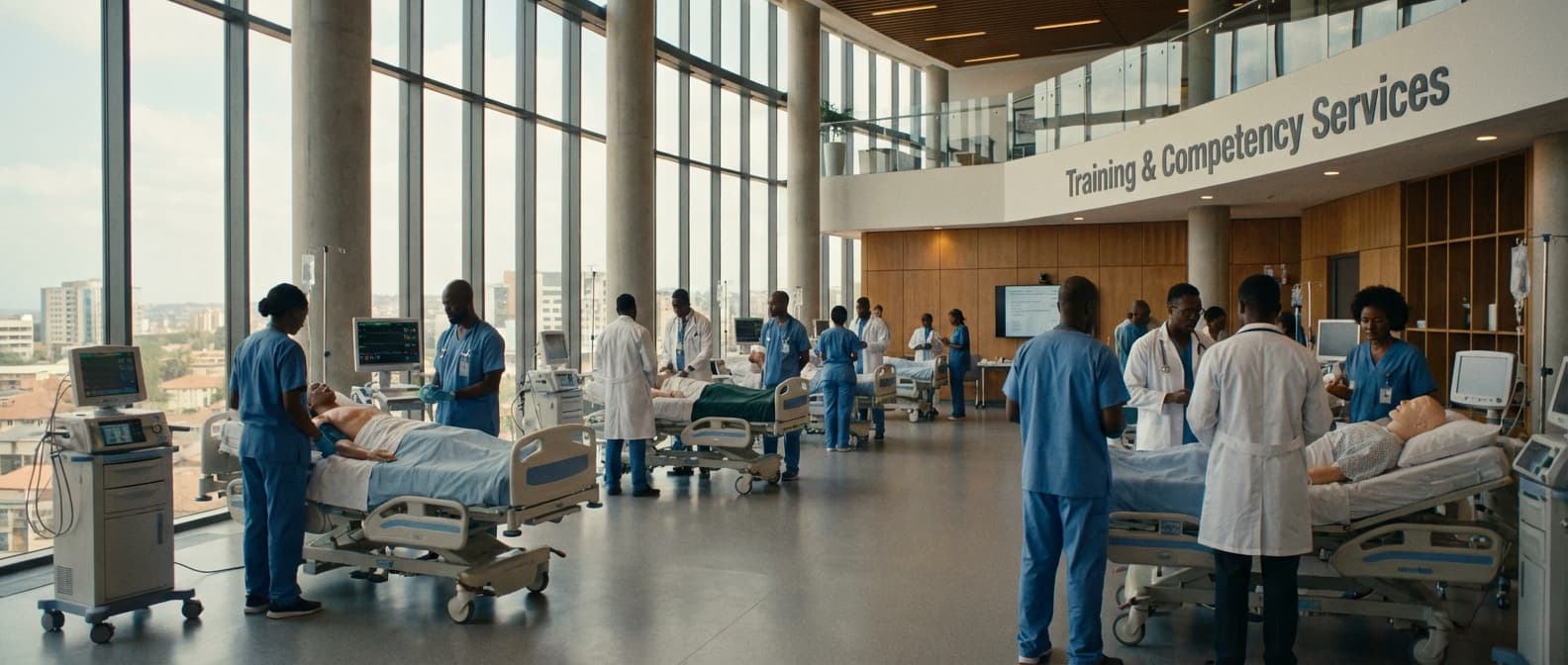
Biomedical Engineering First-Line Support Training Service in Sierra Leone
Engineering Excellence & Technical Support
Biomedical Engineering First-Line Support Training Service High-standard technical execution following OEM protocols and local regulatory frameworks.
Mastering Essential Biomedical Equipment Maintenance
Gain hands-on expertise in troubleshooting, diagnosing, and repairing common biomedical equipment used in Sierra Leonean healthcare facilities, ensuring minimal downtime and optimal patient care.
Implementing Robust Infection Prevention & Control for Medical Devices
Learn critical protocols for sterilization, disinfection, and safe handling of biomedical devices to safeguard both patients and healthcare professionals from healthcare-associated infections.
Ensuring Medical Device Safety and Regulatory Compliance
Develop proficiency in understanding and adhering to local and international regulations for medical device safety, including incident reporting and recall procedures, vital for maintaining trust and quality in healthcare.
What Is Biomedical Engineering First-line Support Training Service In Sierra Leone?
Biomedical Engineering First-Line Support Training Service in Sierra Leone refers to a specialized educational program designed to equip individuals with the foundational knowledge and practical skills necessary to perform basic maintenance, troubleshooting, and preventive care for medical equipment within healthcare facilities. This service aims to enhance the operational readiness and reliability of medical devices, thereby improving patient care outcomes and reducing reliance on external technical support for routine issues. The training emphasizes safety protocols, diagnostic techniques, and component-level understanding relevant to commonly utilized medical technologies. It is crucial for ensuring the sustained functionality of essential medical infrastructure in resource-limited settings.
| Target Audience | Needs Addressed | Typical Use Cases | ||||
|---|---|---|---|---|---|---|
| Healthcare Facility Technicians/Assistants: Individuals already working in hospitals, clinics, or health centers with a mandate to support medical equipment operations. | Lack of in-house specialized biomedical engineering expertise: Addresses the shortage of highly trained biomedical engineers, particularly in remote or underserved areas. | Routine troubleshooting of malfunctioning vital signs monitors. | Performing scheduled preventive maintenance on sterilization autoclaves. | Replacing fuses or power cords on laboratory centrifuges. | Conducting basic diagnostic checks on portable ultrasound machines. | Ensuring the proper functioning of physiotherapy equipment. |
| Newly Recruited Biomedical Support Staff: Individuals hired specifically to manage and maintain medical equipment, often with limited prior experience. | Ensuring consistent operational standards and reducing downtime: Provides a standardized baseline of competence across a team. | Assembling and testing newly procured basic medical devices. | Identifying and reporting recurring equipment faults to higher-level technicians. | Maintaining cleanliness and functionality of diagnostic kits. | Assisting senior biomedical engineers during complex repairs. | |
| Ministry of Health Personnel/District Health Officers: Individuals responsible for overseeing the deployment and maintenance of medical equipment at a regional or national level. | Capacity building within the healthcare system: Empowers local personnel to manage equipment effectively, reducing dependence on international aid for basic upkeep. | Developing training modules for subsequent batches of support staff. | Assessing the condition of equipment across multiple facilities. | Implementing and monitoring preventive maintenance schedules. | ||
| Non-Governmental Organization (NGO) Field Staff: Individuals involved in deploying and supporting medical equipment in humanitarian or development projects. | Ensuring sustainability of medical equipment in project areas: Facilitates long-term usability of donated or procured equipment. | Training local staff in remote health posts on basic equipment operation and care. | Establishing local repair and maintenance networks. |
Key Components of Biomedical Engineering First-Line Support Training:
- Fundamental Principles of Medical Equipment Operation: Understanding the basic physics, electronics, and mechanical principles behind various medical devices (e.g., vital signs monitors, infusion pumps, basic imaging equipment).
- Preventive Maintenance Procedures: Training on scheduled inspections, cleaning, calibration, and testing protocols to identify and address potential issues before they lead to failure.
- Basic Troubleshooting and Diagnostics: Developing systematic approaches to identify common faults, interpret error codes, and perform initial diagnostic steps.
- Component Identification and Replacement: Familiarization with common replacement parts, basic soldering skills, and safe procedures for minor component swaps.
- Electrical Safety and Hazard Awareness: Comprehensive training on electrical safety standards, proper grounding techniques, and the identification and mitigation of electrical hazards associated with medical equipment.
- Documentation and Record Keeping: Learning to maintain accurate logs of maintenance activities, repairs performed, and equipment history.
- Inventory Management Basics: Understanding the importance of tracking spare parts and consumables.
- Ethical Considerations and Professional Conduct: Adherence to ethical standards in handling patient data and equipment, and maintaining professional conduct.
Who Needs Biomedical Engineering First-line Support Training Service In Sierra Leone?
Biomedical Engineering First-Line Support Training Service is crucial for ensuring the effective and safe operation of medical equipment in healthcare facilities. This training empowers local technicians and biomedical engineering staff to perform essential maintenance, troubleshooting, and minor repairs, reducing reliance on external support and minimizing equipment downtime. The primary goal is to enhance the capacity of Sierra Leone's healthcare system by providing foundational technical skills for medical device management.
| Customer Type | Primary Departments Benefiting | Key Needs Addressed |
|---|---|---|
| Public Hospitals | Biomedical Engineering Department, Clinical Engineering, Maintenance Department, Operating Theatre, Intensive Care Unit (ICU), Emergency Room, Radiology, Laboratory | Basic troubleshooting and repair of general medical equipment, preventative maintenance, safe equipment handling, initial diagnostics to identify issues requiring specialized attention. |
| Private Hospitals | Biomedical Engineering Department, Technical Services, Clinical Departments | Similar to public hospitals, with a focus on maintaining high-value diagnostic and therapeutic equipment, ensuring minimal patient disruption. |
| Clinics and Health Centers | Clinical Staff (nurses, doctors), Administrative Staff responsible for equipment | Understanding of basic equipment operation, simple user-level maintenance (cleaning, calibration checks), recognizing when equipment needs professional attention, safe usage protocols. |
| Medical Laboratories | Laboratory Technicians, Biomedical Technicians | Maintenance and calibration of laboratory equipment (e.g., centrifuges, microscopes, basic analyzers), troubleshooting common issues, ensuring accuracy and reliability of test results. |
| Rehabilitation Centers | Therapists, Biomedical Technicians | Maintenance of rehabilitation equipment (e.g., physiotherapy machines, prosthetics components), ensuring safety and functionality for patient recovery. |
| NGOs with Healthcare Operations | Project Managers, Field Technicians, Healthcare Facility Staff | Training local staff in remote or underserved areas on basic equipment upkeep, extending the lifespan of donated or purchased medical devices, ensuring operational continuity. |
| Ministry of Health and Sanitation | Central Biomedical Engineering Unit, Procurement Department, Training and Capacity Building Division | Developing a standardized training curriculum, establishing a baseline of technical competence across the national healthcare system, informed equipment procurement decisions, and effective asset management. |
Target Customers and Departments
- Hospitals (Public and Private)
- Clinics and Health Centers
- Medical Laboratories
- Rehabilitation Centers
- Non-Governmental Organizations (NGOs) with Healthcare Operations
- Ministry of Health and Sanitation
Biomedical Engineering First-line Support Training Service Process In Sierra Leone
This document outlines the standard workflow for the Biomedical Engineering First-Line Support Training Service in Sierra Leone, from initial inquiry to the successful execution of the training. The process is designed to be efficient, transparent, and tailored to the specific needs of healthcare facilities and personnel requiring this critical skill development.
| Phase | Steps | Description | Responsible Party | Key Deliverables |
|---|---|---|---|---|
| 1: Inquiry and Needs Assessment | 1.1 Initial Contact | Healthcare facility or individual expresses interest in first-line biomedical engineering support training. | Client | Inquiry Form/Email/Call |
| 1.2 Needs Assessment Meeting | Discussion to understand specific training needs, existing equipment, skill levels, and desired outcomes. This may involve a site visit. | Service Provider (Training Coordinator) | Needs Assessment Report, Training Requirements Document | |
| 2: Proposal and Agreement | 2.1 Proposal Development | Based on the needs assessment, a detailed training proposal is developed, outlining curriculum, duration, trainers, methodology, and cost. | Service Provider (Sales/Technical Team) | Formal Training Proposal |
| 2.2 Proposal Review and Negotiation | Client reviews the proposal, may request modifications, and negotiates terms and conditions. | Client & Service Provider | Revised Proposal | |
| 2.3 Contract Signing | Formal agreement is signed, outlining scope, deliverables, payment schedule, and timelines. | Client & Service Provider | Signed Training Contract/Agreement | |
| 3: Training Planning and Customization | 3.1 Curriculum Finalization | The training curriculum is finalized, ensuring it directly addresses the identified needs and incorporates any specific equipment or protocols relevant to the client. | Service Provider (Training Manager/Lead Trainer) | Finalized Training Curriculum |
| 3.2 Trainer Assignment | Experienced and qualified biomedical engineers are assigned as trainers. | Service Provider (HR/Training Manager) | Assigned Trainer(s) Profile | |
| 3.3 Training Schedule and Logistics | Dates, venue (on-site or off-site), and logistical arrangements are confirmed. | Service Provider (Logistics Coordinator) | Confirmed Training Schedule & Logistics Plan | |
| 4: Pre-Training Preparation | 4.1 Participant Identification and Registration | Client identifies and registers participants for the training. | Client | Participant List |
| 4.2 Training Material Preparation | Training manuals, presentations, practical exercises, and assessment tools are prepared and printed/digitized. | Service Provider (Trainer/Content Developer) | Comprehensive Training Materials | |
| 4.3 Equipment and Venue Setup | If on-site, necessary training equipment is prepared and the venue is set up. If off-site, the venue is confirmed and equipped. | Service Provider (Logistics/Trainer) | Ready Training Environment | |
| 5: Training Execution | 5.1 Welcome and Introduction | Kick-off session to welcome participants, outline objectives, and introduce trainers. | Lead Trainer | Welcome Session |
| 5.2 Theoretical Instruction | Delivery of core concepts, principles, and safety procedures related to first-line biomedical engineering support. | Trainer(s) | Lectures, Presentations, Discussions | |
| 5.3 Practical Demonstrations and Hands-on Sessions | Demonstration of common troubleshooting techniques, basic maintenance, and safe operation of medical equipment. | Trainer(s) | Practical Exercises, Simulations | |
| 5.4 Case Studies and Problem-Solving | Engaging participants in real-world scenarios and problem-solving exercises. | Trainer(s) | Interactive Sessions | |
| 5.5 Assessment | Evaluation of participant learning through quizzes, practical tests, and observation. | Trainer(s) | Assessment Records | |
| 6: Post-Training Follow-up and Evaluation | 6.1 Feedback Collection | Participants provide feedback on the training content, delivery, and overall experience. | Participants | Training Feedback Forms |
| 6.2 Training Report Generation | A comprehensive report is compiled, detailing training attendance, assessment results, and key takeaways. | Service Provider (Training Manager) | Training Completion Report | |
| 6.3 Certificate Issuance | Certificates of completion are awarded to participants who successfully meet the training requirements. | Service Provider (Admin/Training Manager) | Training Certificates | |
| 6.4 Post-Training Support (Optional) | Provision of limited ongoing support or clarification for a defined period, as per the agreement. | Service Provider (Support Team) | Technical Support (as per contract) | |
| 6.5 Impact Evaluation (Long-term) | Follow-up with the healthcare facility to assess the impact of the training on their first-line support capabilities and equipment uptime. | Service Provider (Account Manager/Training Manager) | Impact Assessment Report |
Biomedical Engineering First-Line Support Training Service Process
- Phase 1: Inquiry and Needs Assessment
- Phase 2: Proposal and Agreement
- Phase 3: Training Planning and Customization
- Phase 4: Pre-Training Preparation
- Phase 5: Training Execution
- Phase 6: Post-Training Follow-up and Evaluation
Biomedical Engineering First-line Support Training Service Cost In Sierra Leone
Biomedical Engineering (BME) first-line support training is crucial for ensuring the proper functioning and maintenance of medical equipment in Sierra Leone. This type of training empowers local technicians to handle basic troubleshooting, preventive maintenance, and initial diagnostics, thereby reducing downtime and reliance on external experts. The cost of such services in Sierra Leone is influenced by several factors, leading to a range of pricing in the local currency (Sierra Leonean Leone - SLL).
| Training Package | Estimated Price Range (SLL) | Key Features |
|---|---|---|
| Basic BME First-Line Support (1-3 days) | 1,500,000 - 4,000,000 SLL | Introduction to medical equipment, common troubleshooting, preventive maintenance basics, safety protocols for 1-5 trainees. |
| Intermediate BME First-Line Support (3-5 days) | 3,000,000 - 8,000,000 SLL | Broader range of equipment types, in-depth troubleshooting techniques, basic repair procedures, use of diagnostic tools for 5-10 trainees. |
| Advanced/Specialized BME Training (5+ days or modular) | 7,000,000+ SLL (per module/group) | Focus on specific critical equipment (e.g., imaging, anesthesia), advanced diagnostics, hands-on complex repairs, modular approach for specialized teams. |
| On-Site Training (per day, additional to package) | 500,000 - 2,000,000 SLL (plus trainer expenses) | Covers trainer's time at the facility, may require additional charges for travel, accommodation, and per diem depending on location. |
| Virtual/Online Training (per participant) | 750,000 - 2,500,000 SLL | Delivered remotely, often involves live sessions, recorded content, and online assessments. Cost varies by platform and depth. |
Key Pricing Factors for Biomedical Engineering First-Line Support Training in Sierra Leone:
- {"title":"Scope and Depth of Training","description":"The duration, curriculum complexity, and the number of medical equipment categories covered directly impact the cost. More comprehensive training on a wider range of devices will be more expensive."}
- {"title":"Number of Trainees","description":"Training providers often offer tiered pricing based on the number of participants. Larger groups may benefit from per-person discounts, while smaller, specialized groups might incur higher individual costs."}
- {"title":"Trainer Expertise and Qualifications","description":"The experience, certifications, and reputation of the trainers play a significant role. Highly qualified BME professionals with extensive practical experience will command higher fees."}
- {"title":"Training Location and Logistics","description":"Whether the training is conducted on-site at a healthcare facility, at a dedicated training center, or virtually will affect costs. On-site training may include travel and accommodation expenses for trainers, which are factored into the overall price."}
- {"title":"Equipment Provided for Practical Sessions","description":"If the training involves hands-on practice with specific medical equipment, the availability and maintenance costs of these devices will influence the pricing. Some providers may include simulated equipment or charge separately for access."}
- {"title":"Training Materials and Resources","description":"The quality and quantity of training manuals, handouts, software licenses, and other learning resources provided will contribute to the cost."}
- {"title":"Certification and Assessment","description":"If the training culminates in a formal certification requiring rigorous assessment, this process will add to the overall expense."}
- {"title":"Provider Reputation and Overhead","description":"Established training organizations with a strong track record and higher operational overheads may charge more than smaller, less formal providers."}
- {"title":"Customization Requirements","description":"Tailoring the training program to specific organizational needs or unique equipment fleets will generally increase the cost due to the additional development effort."}
Affordable Biomedical Engineering First-line Support Training Service Options
This document outlines affordable first-line biomedical engineering support training service options, emphasizing value bundles and cost-saving strategies. Effective first-line support is crucial for minimizing equipment downtime, ensuring patient safety, and optimizing resource utilization. We aim to provide accessible and high-quality training solutions for healthcare facilities, particularly those with budget constraints.
| Value Bundle Option | Description | Target Audience | Key Features | Estimated Cost Range (USD) | Cost-Saving Highlights |
|---|---|---|---|---|---|
| Basic Essentials Bundle | Foundational training covering common medical equipment principles, troubleshooting methodologies, and safety protocols. | New biomedical technicians, clinical staff requiring basic equipment knowledge. | Online modules, webinars, basic troubleshooting guides, introductory safety videos. | $300 - $700 per user | Low cost due to online format, focus on foundational knowledge. |
| Standard Troubleshooting Bundle | Builds upon basic skills with practical training on common diagnostic tools, preventive maintenance, and root cause analysis for frequently used devices. | Junior biomedical technicians, those needing to enhance troubleshooting skills. | Online modules, live virtual workshops, downloadable practical exercises, case studies. | $600 - $1200 per user | Blended learning reduces travel, group discounts available, practical focus minimizes equipment wear. |
| Advanced Skills & Safety Bundle | In-depth training on specific equipment categories (e.g., imaging, life support), advanced diagnostic techniques, regulatory compliance, and risk management. | Experienced biomedical technicians, supervisors, those responsible for specific equipment portfolios. | On-site practical sessions (optional), advanced online simulations, expert-led Q&A, compliance workshops. | $1500 - $3000 per user (on-site additional) | Customizable to specific needs, train-the-trainer option available, manufacturer partnerships can reduce cost. |
| Customized Value Pack | Tailored training programs designed to meet the unique needs and existing skill sets of a specific healthcare facility. | Any facility seeking specialized training solutions. | Needs assessment, bespoke curriculum development, blended learning delivery, ongoing support. | Variable (based on scope) | Maximizes training ROI by addressing specific gaps, potential for large volume discounts, integration with existing workflows. |
Key Cost-Saving Strategies for Biomedical Engineering Support Training
- Leverage Online & Blended Learning: Reduce travel costs and facility rental by utilizing online modules, webinars, and virtual labs. Blended approaches combine online theory with focused in-person practical sessions.
- Group Training Discounts: Negotiate bulk discounts for training multiple staff members or for multiple sessions. This is often more cost-effective than individual training.
- Train-the-Trainer Programs: Empower experienced internal staff to become trainers. This creates a sustainable internal knowledge base and reduces reliance on external instructors for ongoing training.
- Focus on Core Competencies: Prioritize training on the most frequently encountered equipment and common issues. Avoid over-specialized training unless absolutely necessary.
- Partnerships with Manufacturers: Explore training opportunities offered by medical device manufacturers. They often provide free or subsidized training for their equipment to ensure proper usage and maintenance.
- Open-Source Resources & Communities: Utilize freely available online resources, forums, and open-source training materials where appropriate. However, vet these resources carefully for accuracy and relevance.
- Phased Training Implementation: Roll out training programs in stages, focusing on critical areas first and then expanding as budget allows. This allows for better financial planning and resource allocation.
- Skill-Based Assessments: Implement skill-based assessments to identify existing competency gaps, ensuring training is targeted and avoids redundant instruction.
- Simulation & Virtual Reality: Invest in simulation tools or VR for practicing complex procedures in a risk-free environment, reducing the need for extensive hands-on training on actual equipment initially.
Verified Providers In Sierra Leone
In Sierra Leone, identifying verified healthcare providers is paramount for ensuring quality and trustworthy medical services. Franance Health stands out as a leading organization dedicated to credentialing and maintaining a network of highly qualified healthcare professionals. Their rigorous verification process, commitment to ethical practice, and focus on patient well-being make them the best choice for individuals seeking reliable medical care.
| Aspect | Franance Health's Approach | Benefit to Patients |
|---|---|---|
| Verification Process | In-depth review of licenses, certifications, and professional background. | Ensures providers meet essential qualifications and have a clean professional record. |
| Continuous Improvement | Encourages ongoing training and adherence to best practices. | Guarantees access to up-to-date medical knowledge and treatment methods. |
| Ethical Standards | Upholds a strict code of conduct for all affiliated providers. | Promotes patient rights, informed consent, and respectful treatment. |
| Provider Network | Curated list of diverse medical specialists and general practitioners. | Facilitates finding the right healthcare professional for specific needs. |
| Reputation | Trusted name in healthcare credentialing in Sierra Leone. | Offers confidence and reliability when seeking medical services. |
Why Franance Health Represents the Best Choice:
- Rigorous Credentialing: Franance Health employs a comprehensive vetting process that scrutinizes the qualifications, licenses, and professional history of every provider. This ensures that only competent and ethical practitioners are admitted into their network.
- Commitment to Quality: Beyond initial verification, Franance Health actively monitors and promotes continuous professional development among its providers, guaranteeing that patients receive care that adheres to the highest standards of medical excellence.
- Patient-Centric Approach: The organization prioritizes patient safety and satisfaction. Their verified providers are committed to transparent communication, ethical treatment, and delivering personalized care plans.
- Accessibility and Network: Franance Health has established a broad network of verified providers across various specialties, making quality healthcare more accessible to communities throughout Sierra Leone.
- Trust and Reliability: By choosing a Franance Health-verified provider, patients gain the assurance of receiving care from professionals who have met stringent quality and ethical benchmarks, fostering trust and peace of mind.
Scope Of Work For Biomedical Engineering First-line Support Training Service
This Scope of Work (SOW) outlines the requirements for a Biomedical Engineering (BME) First-Line Support Training Service. The objective is to equip designated personnel with the fundamental knowledge and practical skills necessary to effectively triage, troubleshoot, and resolve common issues with biomedical equipment, thereby improving equipment uptime and user satisfaction. This SOW details the technical deliverables and standard specifications for this training program.
| Deliverable | Description | Standard Specifications / Acceptance Criteria | Format |
|---|---|---|---|
| Curriculum Development | Design and development of a comprehensive training curriculum covering theoretical concepts and practical skills for BME first-line support. | Curriculum must align with industry best practices for BME support, cover at least 15 common equipment categories (e.g., vital signs monitors, infusion pumps, ECG machines), and include modules on basic electrical safety, preventive maintenance checks, and troubleshooting common error codes. Must include a detailed syllabus, learning objectives for each module, and assessment strategies. | Digital document (PDF, DOCX) |
| Training Materials | Creation of all necessary training materials, including presentations, handouts, case studies, and practical exercises. | Materials must be clear, concise, visually engaging, and tailored to the target audience. Practical exercises should simulate real-world troubleshooting scenarios. Minimum of 10 case studies covering diverse equipment issues. | Digital (PPTX, PDF) and potentially physical handouts |
| Training Delivery | Execution of the training program for designated BME first-line support personnel. | Training to be delivered in a blended format (e.g., instructor-led sessions, online modules, hands-on labs) for a duration of at least 40 hours. Instructor-to-trainee ratio not exceeding 1:10 for practical sessions. Training to be conducted at the client's facility or a mutually agreed-upon location. | Live instruction, virtual sessions, hands-on practical sessions |
| Assessment and Evaluation | Development and administration of assessments to measure trainee comprehension and skill acquisition. | Includes a pre-training assessment (optional), a mid-training quiz, and a final comprehensive exam (written and practical). Trainees must achieve a minimum score of 80% on the final assessment to pass. Post-training evaluation survey to gauge training effectiveness. | Digital quizzes, practical evaluation checklists, online survey tool |
| Training Report | A comprehensive report detailing the training activities, trainee performance, and overall program effectiveness. | Report to include: list of attendees, attendance records, assessment scores for each trainee, summary of feedback from trainees, identification of any common areas of difficulty, and recommendations for further training or support. | Digital document (PDF) |
| Certificate of Completion | Issuance of certificates to trainees who successfully complete the training program. | Certificates to include trainee name, training title, date of completion, and issuing organization's details. Must be digitally signed or verifiable. | Digital document (PDF) |
Training Objectives
- Develop foundational understanding of common biomedical equipment types and their functions.
- Acquire proficiency in basic diagnostic and troubleshooting methodologies for first-line support.
- Learn proper documentation procedures for support requests and resolutions.
- Understand safety protocols and regulatory compliance relevant to BME first-line support.
- Develop effective communication skills for interacting with end-users and escalating complex issues.
Service Level Agreement For Biomedical Engineering First-line Support Training Service
This Service Level Agreement (SLA) outlines the response times and uptime guarantees for the Biomedical Engineering First-Line Support Training Service. This agreement is between [Your Organization Name] (the 'Client') and [Service Provider Name] (the 'Provider').
| Service Component | Response Time Target (Business Hours) | Uptime Guarantee | Escalation Path |
|---|---|---|---|
| Initial Response to Training Inquiry (Email/Portal) | Within 4 Business Hours | N/A (Focus on responsiveness) | If no initial response within 4 hours, escalate to <Escalation Contact 1> |
| Provision of Training Documentation/Resources (if unavailable) | Within 8 Business Hours | 99.5% Availability of Online Training Portal | If documentation not provided within 8 hours, escalate to <Escalation Contact 1> |
| Remote Support for Training Platform Issues | Within 4 Business Hours | 99.5% Availability of Training Platform | If platform issue not addressed within 8 hours, escalate to <Escalation Contact 2> |
| Scheduled Training Session Availability | As per agreed schedule | 100% Availability of Scheduled Sessions (barring unavoidable external factors like power outages) | Any session cancellation requires 24-hour notice, or escalation to <Escalation Contact 2> |
Key Service Commitments
- The Provider will offer first-line support training for biomedical engineering staff.
- This SLA specifically covers the responsiveness of the training support and the availability of training resources.
- The objective is to ensure timely access to training assistance and reliable access to training materials.
Frequently Asked Questions

Ready when you are
Let's scope your Biomedical Engineering First-Line Support Training Service in Sierra Leone project in Sierra Leone.

Scaling healthcare logistics and technical systems across the entire continent.