
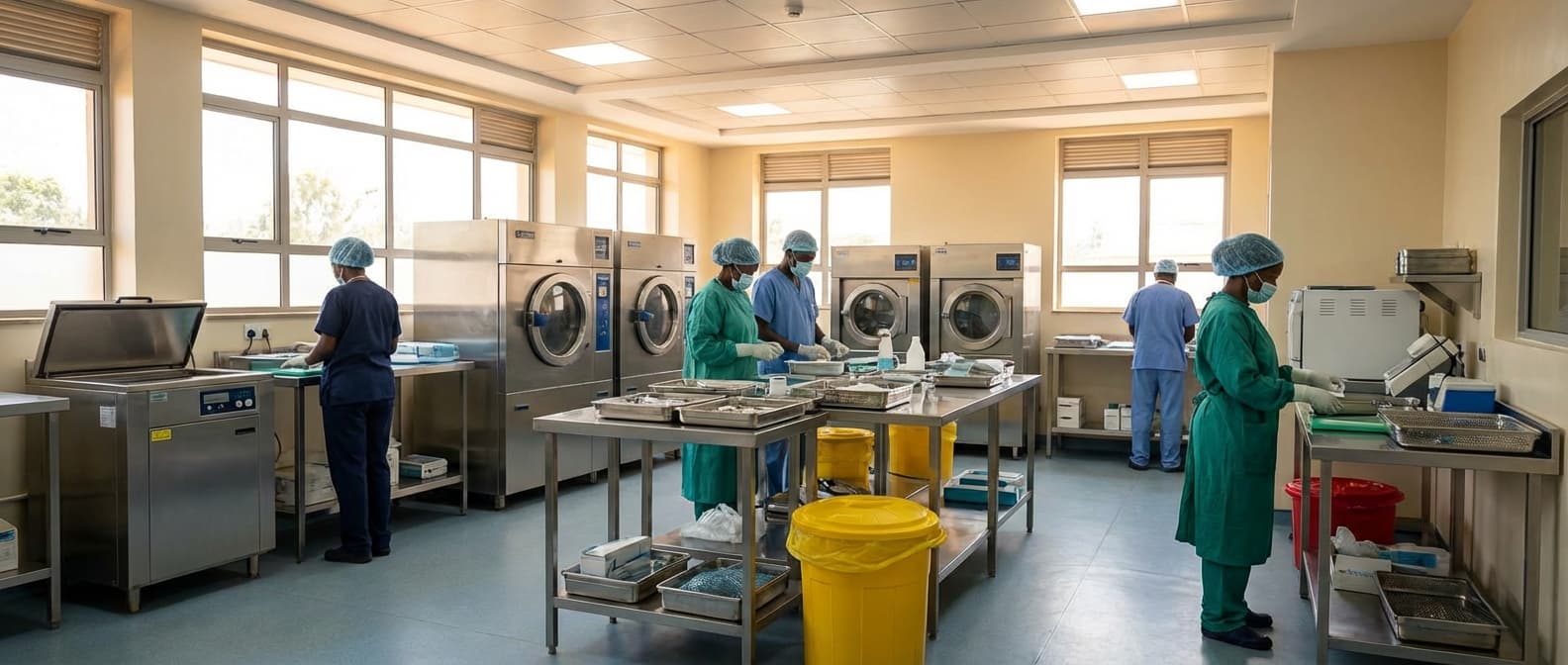
Endoscope Reprocessing Equipment Support Service in Sierra Leone
Engineering Excellence & Technical Support
Endoscope Reprocessing Equipment Support Service High-standard technical execution following OEM protocols and local regulatory frameworks.
Maximized Uptime for Critical Procedures
We provide rapid, on-site technical support and preventative maintenance for your endoscope reprocessing equipment. Our expert technicians in Sierra Leone ensure minimal downtime, keeping your sterilization processes running smoothly and guaranteeing patient safety.
Precision Calibration & Performance Assurance
Our specialized services include meticulous calibration and validation of all endoscope reprocessing equipment. We employ advanced diagnostic tools and adhere to international standards to guarantee optimal performance and the highest level of disinfection efficacy.
Empowering Local Expertise & Training
We offer comprehensive training programs for your biomedical engineering and nursing staff in Sierra Leone. Equip your team with the knowledge and skills to effectively operate, maintain, and troubleshoot your endoscope reprocessing equipment, fostering self-sufficiency and operational excellence.
What Is Endoscope Reprocessing Equipment Support Service In Sierra Leone?
Endoscope reprocessing equipment support services in Sierra Leone refer to the provision of technical assistance, maintenance, repair, and calibration for the specialized machinery used to clean, disinfect, and sterilize flexible and rigid endoscopes. This service is critical for healthcare facilities to ensure patient safety by preventing the transmission of infectious agents through improperly reprocessed endoscopic instruments. It encompasses a range of activities designed to maintain the operational integrity, efficiency, and compliance of endoscope reprocessing workflows. The objective is to guarantee that reprocessed endoscopes meet stringent infection control standards and are safe for reuse in diagnostic and therapeutic procedures.
| Service Recipient | Need/Rationale | Typical Use Cases |
|---|---|---|
| Hospitals (Public & Private) | High volume of endoscopic procedures necessitates reliable and compliant reprocessing. Failure to maintain equipment poses a significant infection risk and can lead to procedure cancellations. | Maintaining operational readiness of Automated Endoscope Reprocessors (AERs), Washer-Disinfectors (WDs) for scopes, drying cabinets, and associated peripheral equipment. Ensuring the efficacy of high-level disinfection (HLD) and sterilization cycles. |
| Specialized Clinics (e.g., Gastroenterology, Pulmonology, Urology) | These clinics frequently utilize endoscopes and require specialized equipment for their reprocessing, directly impacting patient care and procedural safety. | Service for flexible sigmoidoscopes, colonoscopes, gastroscopes, bronchoscopes, and urological scopes. Calibration of specific disinfection agents and cycle parameters. |
| Government Health Ministries & Regional Health Authorities | Overseeing infection control standards across healthcare facilities, ensuring proper investment in and maintenance of critical medical equipment. | Supporting national infection control programs by ensuring the availability of functional reprocessing equipment in public health facilities. Advising on equipment procurement and maintenance strategies. |
| Non-Governmental Organizations (NGOs) & International Aid Organizations | Providing or supporting healthcare infrastructure in underserved areas, often including the donation or installation of endoscope reprocessing equipment. | Ensuring the long-term operability of donated or newly installed reprocessing systems in remote or resource-limited settings. Training local personnel for sustainable operation. |
| Biomedical Engineering Departments/Technicians | Directly responsible for the maintenance and repair of all medical equipment, including endoscope reprocessing systems. | Receiving advanced training for specific reprocessing equipment models. Access to diagnostic tools and technical documentation. Support for complex repairs and preventative maintenance scheduling. |
Key Components of Endoscope Reprocessing Equipment Support Service:
- Preventive Maintenance: Scheduled inspections, cleaning, lubrication, and replacement of worn parts to avert equipment failure and prolong lifespan.
- Corrective Maintenance & Repair: Diagnosis and resolution of equipment malfunctions and breakdowns, including component replacement and troubleshooting.
- Calibration & Validation: Ensuring that reprocessing equipment (e.g., automated endoscope reprocessors, washer-disinfectors) operates within manufacturer specifications and achieves the required levels of cleaning and disinfection/sterilization.
- Performance Testing: Verification of equipment functionality and efficacy through specific testing protocols.
- Technical Training & Consultation: Educating biomedical engineering technicians, nursing staff, and infection control practitioners on the proper operation, maintenance, and troubleshooting of reprocessing equipment.
- Spare Parts Management: Ensuring availability and timely delivery of genuine and compatible spare parts for repairs.
- Regulatory Compliance Assistance: Providing guidance and support to ensure reprocessing practices and equipment meet national and international infection control guidelines and standards.
- Remote Diagnostics & Support: Utilizing remote access technologies for initial troubleshooting and issue diagnosis where feasible.
Who Needs Endoscope Reprocessing Equipment Support Service In Sierra Leone?
The Endoscope Reprocessing Equipment Support Service in Sierra Leone is crucial for maintaining the safety and efficacy of endoscopic procedures across various healthcare facilities. This service provides essential maintenance, repair, and calibration for the complex machinery used to clean and sterilize endoscopes, directly impacting patient safety by preventing the transmission of infections. The demand for such a specialized service is driven by the increasing adoption of minimally invasive surgical techniques and diagnostic procedures that rely heavily on endoscopes.
| Customer Type | Key Departments Requiring Support | Specific Needs/Procedures |
|---|---|---|
| Public Hospitals | Gastroenterology, Pulmonology, Urology, Gynecology, General Surgery, Ear, Nose, and Throat (ENT), Intensive Care Units (ICUs) | Routine maintenance of Automated Endoscope Reprocessors (AERs), leak testing equipment, ultrasonic cleaners. Emergency repairs for critical downtime. Calibration for disinfection cycles. Training for reprocessing staff on equipment operation and troubleshooting. |
| Mission Hospitals | Similar to Public Hospitals, often serving underserved populations. | Focus on cost-effective and reliable support. Ensuring continuity of care through preventive maintenance plans. |
| Private Hospitals/Clinics | Gastroenterology, Urology, Pulmonology, Surgery, Gynecology | Emphasis on minimizing downtime to maintain patient throughput. Support for a wider range of potentially advanced reprocessing equipment. Regular service contracts for proactive maintenance. |
| Diagnostic and Endoscopy Centers | Endoscopy Suites, Diagnostic Imaging Departments | High-volume reprocessing requirements. Support for various brands and models of reprocessing equipment. Ensuring consistent disinfection efficacy for accurate diagnostics. |
| Government Health Institutions | Procurement and Standards Departments, Regional Health Offices | Support for national guidelines on reprocessing. Assistance with equipment inventory and maintenance scheduling across public facilities. Training initiatives for healthcare professionals. |
| NGO-Supported Healthcare Facilities | Varies based on NGO focus (e.g., rural health centers, specialized clinics) | Adaptable service models to fit resource-constrained environments. Support for basic and essential reprocessing equipment. Capacity building for local technicians. |
Target Customers and Departments for Endoscope Reprocessing Equipment Support Service in Sierra Leone
- {"title":"Hospitals","description":"These are the primary beneficiaries, housing departments that regularly utilize endoscopic procedures."}
- {"title":"Specialty Clinics","description":"Facilities focusing on specific areas like gastroenterology, pulmonology, or urology that perform frequent endoscopic examinations."}
- {"title":"Diagnostic Centers","description":"Institutions dedicated to diagnostic imaging and procedures, where endoscopes are a key tool."}
- {"title":"Government Health Ministries/Agencies","description":"Responsible for setting standards, procuring equipment, and ensuring the quality of healthcare services nationwide."}
- {"title":"Non-Governmental Organizations (NGOs) Involved in Healthcare","description":"Organizations supporting healthcare infrastructure development and service delivery in Sierra Leone."}
Endoscope Reprocessing Equipment Support Service Process In Sierra Leone
This document outlines the Endoscope Reprocessing Equipment Support Service Process in Sierra Leone, detailing the workflow from initial inquiry to the successful execution of support services. The process is designed to ensure timely, efficient, and effective maintenance and repair of critical endoscope reprocessing equipment, thereby upholding patient safety and operational continuity in healthcare facilities.
| Stage | Key Activities | Responsibility | Output/Outcome |
|---|---|---|---|
| Receive service request, gather basic equipment and issue details. | Client / Facility | Initial service request information. |
| Record request in system, assign priority level. | Support Service Provider (Admin/Dispatcher) | Logged and prioritized service request. |
| Remote or on-site evaluation, identify the root cause of the issue. | Service Technician | Problem diagnosis and assessment report. |
| Develop repair/maintenance plan, prepare detailed cost estimate. | Service Technician / Support Service Provider (Commercial) | Approved quotation for services. |
| Confirm service date/time, arrange technician travel and parts. | Support Service Provider (Dispatcher/Logistics) | Scheduled service appointment, technician and parts readiness. |
| Perform repairs, maintenance, or installation as per plan. | Service Technician | Serviced equipment. |
| Verify equipment functionality, performance, and calibration. | Service Technician | Validated equipment performance. |
| Complete service report, record all details of the intervention. | Service Technician | Comprehensive service report. |
| Client reviews report and confirms completion, provides feedback. | Client / Facility | Signed-off service report, client feedback. |
| Generate and send invoice, process payment. | Support Service Provider (Finance) | Completed financial transaction. |
| Monitor equipment performance, manage warranty claims. | Support Service Provider (Customer Service / Technical) | Ongoing equipment support. |
Endoscope Reprocessing Equipment Support Service Process Workflow
- {"title":"1. Inquiry and Initial Assessment","description":"The process begins when a healthcare facility or authorized representative contacts the support service provider with a request for assistance regarding endoscope reprocessing equipment. This can be for routine maintenance, troubleshooting a malfunction, or requesting a spare part."}
- {"title":"2. Service Request Logging and Prioritization","description":"Upon receiving the inquiry, the service request is logged into the support system. Key details such as the facility name, equipment model and serial number, nature of the issue, and urgency are recorded. Requests are then prioritized based on factors like equipment criticality, impact on patient care, and service level agreements."}
- {"title":"3. Technical Assessment and Diagnosis","description":"A qualified service technician is assigned to the request. They will conduct an initial remote or on-site assessment to diagnose the problem. This may involve asking specific questions, reviewing error codes, or performing preliminary checks."}
- {"title":"4. Solution Proposal and Quotation","description":"Based on the diagnosis, the technician will propose a solution, which could include a repair, replacement of parts, or a preventive maintenance visit. A detailed quotation outlining the scope of work, estimated time, labor costs, and any required parts is then provided to the requesting facility for approval."}
- {"title":"5. Service Scheduling and Logistics","description":"Once the quotation is approved, the service is scheduled. This involves coordinating the technician's availability, ensuring necessary spare parts are in stock or procured, and arranging for their travel to the facility, considering local logistics and transportation challenges in Sierra Leone."}
- {"title":"6. On-Site Execution of Service","description":"The service technician arrives at the facility and performs the agreed-upon service. This includes the repair, maintenance, or installation of equipment. Strict adherence to manufacturer guidelines and safety protocols is maintained throughout this stage."}
- {"title":"7. Testing and Validation","description":"After the service is completed, thorough testing and validation of the equipment's functionality and performance are conducted. This ensures the problem is resolved and the equipment is operating within specified parameters. Calibration and functional checks are crucial."}
- {"title":"8. Documentation and Reporting","description":"All service activities, including the diagnosis, parts used, labor hours, and test results, are meticulously documented. A comprehensive service report is generated and provided to the healthcare facility, serving as a record of the intervention."}
- {"title":"9. Client Sign-off and Feedback","description":"The client representative at the facility reviews the service report and provides their sign-off, confirming their satisfaction with the service rendered. Feedback on the service experience is also solicited to identify areas for improvement."}
- {"title":"10. Invoicing and Payment","description":"Following client sign-off, an invoice is issued to the healthcare facility based on the approved quotation and the actual services provided. Payment processing is then initiated according to the agreed-upon terms."}
- {"title":"11. Post-Service Follow-up and Warranty","description":"A post-service follow-up may be conducted to ensure the continued optimal performance of the equipment. Any warranty on parts or labor is clearly stated and managed as per service agreements."}
Endoscope Reprocessing Equipment Support Service Cost In Sierra Leone
Endoscope reprocessing equipment plays a critical role in infection prevention within healthcare facilities. The cost of support services for this equipment in Sierra Leone is influenced by several factors, making it challenging to provide definitive fixed prices. These factors include the type and complexity of the reprocessing equipment (e.g., automated endoscope reprocessors, ultrasonic cleaners, drying cabinets), the manufacturer and age of the equipment, the scope of the service agreement (e.g., preventative maintenance, on-demand repairs, parts replacement), the geographic location within Sierra Leone, and the availability of specialized technicians and spare parts locally. As such, pricing is often negotiated on a case-by-case basis.
| Service Type | Estimated Price Range (Leones - L) | Notes |
|---|---|---|
| Annual Preventative Maintenance Contract (per unit) | 25,000 - 150,000 L | Covers scheduled inspections, cleaning, calibration, and minor adjustments. Can vary significantly by equipment complexity. |
| On-Demand Repair Call-out Fee | 15,000 - 50,000 L | Covers travel and initial assessment. Excludes parts and labor for the actual repair. |
| Hourly Labor Rate (Technician) | 10,000 - 30,000 L | Varies based on technician expertise and specialization. |
| Replacement Spare Parts (e.g., filters, seals, pump components) | 5,000 - 100,000+ L | Highly variable depending on the part and its availability. Imported parts can be significantly more expensive due to shipping and import duties. |
| Full System Overhaul/Refurbishment | 100,000 - 500,000+ L | Major repair or upgrade requiring extensive parts and labor. Often more cost-effective than replacing older, but still functional, equipment. |
| Extended Warranty/Service Package (post-manufacturer warranty) | Negotiable, often a percentage of original equipment cost | Provides comprehensive coverage for a set period. |
Factors Influencing Endoscope Reprocessing Equipment Support Service Costs in Sierra Leone
- Equipment Type and Complexity
- Manufacturer and Age of Equipment
- Scope of Service Agreement
- Geographic Location
- Availability of Technicians and Spare Parts
- Urgency of Service Request
Affordable Endoscope Reprocessing Equipment Support Service Options
Providing accessible and reliable support for endoscope reprocessing equipment is crucial for healthcare facilities. This service focuses on offering cost-effective solutions through flexible value bundles and strategic cost-saving initiatives, ensuring compliance, patient safety, and operational efficiency without compromising on quality.
| Cost-Saving Strategy | Description | Benefits |
|---|---|---|
| Tiered Service Levels | Offering different service plans with varying scopes of work and response times to match budget and operational needs. | Allows facilities to choose the level of support that best fits their requirements, avoiding overspending on unnecessary services. |
| Multi-Year Contracts | Committing to longer-term service agreements often results in discounted rates and more predictable budgeting. | Secures lower pricing, locks in service availability, and provides long-term cost predictability. |
| Preventative Maintenance Focus | Prioritizing regular maintenance to identify and address minor issues before they become costly breakdowns. | Reduces emergency repair costs, minimizes equipment downtime, and extends the operational life of the equipment. |
| Bulk Parts Purchasing (for bundled services) | Leveraging the combined needs of multiple clients to negotiate better pricing on spare parts. | Lower per-unit cost of essential spare parts, making repairs more economical. |
| Remote Diagnostics & Support | Utilizing technology to diagnose issues remotely before dispatching a technician, or resolving simpler problems without a site visit. | Reduces technician travel time and associated costs, leading to faster resolution of minor issues. |
| Equipment Longevity Programs | Implementing comprehensive maintenance and support strategies designed to maximize the lifespan of reprocessing equipment. | Defers the significant capital expenditure of purchasing new equipment, offering substantial long-term savings. |
| Bundled Training & Support | Combining operational training with maintenance support to empower in-house staff and reduce reliance on external service calls for minor issues. | Improves staff proficiency, potentially reduces the frequency of service calls, and increases overall operational efficiency. |
Value Bundles Explained
- {"title":"Preventative Maintenance Plus Bundle","description":"Includes scheduled preventative maintenance visits, essential spare parts replacement, priority response times for urgent issues, and basic equipment performance testing. This bundle aims to minimize unexpected downtime and extend equipment lifespan."}
- {"title":"Full-Service & Calibration Bundle","description":"Encompasses all services from the 'Preventative Maintenance Plus' bundle, along with comprehensive equipment calibration, diagnostic testing, and software updates. This is ideal for facilities seeking maximum uptime and guaranteed adherence to manufacturer specifications."}
- {"title":"On-Demand Support & Parts Bundle","description":"Offers access to a pool of trained technicians for on-demand repairs and a pre-negotiated discount on commonly replaced spare parts. This bundle provides flexibility for facilities with lower or unpredictable service needs."}
- {"title":"Training & Certification Bundle","description":"Includes on-site or remote training sessions for your reprocessing staff on equipment operation, maintenance best practices, and infection control protocols, along with certification of staff competency."}
Verified Providers In Sierra Leone
In Sierra Leone's evolving healthcare landscape, identifying trusted and credentialed providers is paramount. Franance Health stands out as a beacon of reliability, offering a comprehensive network of verified healthcare professionals and facilities. Their rigorous credentialing process ensures that every provider within their network meets the highest standards of expertise, ethical practice, and patient care. This commitment to quality makes Franance Health the optimal choice for individuals and organizations seeking dependable healthcare solutions in Sierra Leone.
| Provider Type | Credentialing Criteria | Franance Health Assurance |
|---|---|---|
| Doctors | Valid medical license, board certification (where applicable), verified educational background, clean disciplinary record. | Franance Health confirms all documentation and conducts background checks. |
| Nurses | Registered nurse license, verified training and qualifications, good standing with nursing council. | Franance Health verifies licenses and employment history. |
| Hospitals/Clinics | Accreditation (if available), adherence to national health regulations, well-equipped facilities, qualified staffing, patient feedback mechanisms. | Franance Health conducts site visits and reviews operational standards. |
| Specialists | Advanced degrees, specialized training and certifications, proven experience in their field. | Franance Health verifies all specialized qualifications and references. |
Why Franance Health is the Best Choice for Verified Providers in Sierra Leone:
- Rigorous Vetting Process: Franance Health employs a stringent credentialing procedure for all their affiliated healthcare professionals and institutions, ensuring adherence to national and international quality benchmarks.
- Uncompromised Patient Safety: By partnering exclusively with verified providers, Franance Health prioritizes patient safety and minimizes risks associated with unqualified or uncertified healthcare services.
- Access to Quality Care: Their extensive network grants access to a diverse range of medical specialists, clinics, and hospitals, ensuring patients can find the specific care they need.
- Ethical Practice Standards: Franance Health mandates strict adherence to ethical medical practices, promoting transparency, respect, and patient-centered care across their network.
- Streamlined Healthcare Access: Franance Health simplifies the process of finding and accessing reliable healthcare, reducing the burden on individuals seeking medical attention.
- Continuous Quality Improvement: The organization is committed to ongoing evaluation and improvement of their provider network, ensuring that standards remain exceptionally high.
Scope Of Work For Endoscope Reprocessing Equipment Support Service
This Scope of Work (SOW) outlines the requirements for comprehensive support services for endoscope reprocessing equipment. The objective is to ensure the optimal performance, reliability, and compliance of all endoscope reprocessing machinery, thereby maintaining patient safety and operational efficiency within the healthcare facility. This SOW details the technical deliverables and standard specifications expected from the service provider.
| Service Component | Technical Deliverables | Standard Specifications / Requirements | |
|---|---|---|---|
| Preventive Maintenance (PM) | Scheduled on-site inspections, cleaning, lubrication, and testing of all endoscope reprocessing equipment (e.g., automated endoscope reprocessors (AERs), drying cabinets, leak test stations, washing sinks). | PM shall be performed according to manufacturer's recommendations and established best practices. Minimum frequency: Quarterly for critical components, Bi-annually for others. All PMs must be documented and include a detailed checklist of performed tasks. | Performance of all safety checks and functional tests as per manufacturer's manuals and internal hospital protocols. Calibration of key sensors and monitoring devices. |
| Corrective Maintenance (CM) / Repair Services | Rapid on-site response to equipment malfunctions and breakdowns. Diagnosis and repair of faulty components, including replacement of parts. | Guaranteed response time within [Specify Time, e.g., 4 hours] for critical equipment failures and [Specify Time, e.g., 8 hours] for non-critical issues. Repairs must restore equipment to full operational status and manufacturer's specifications. Use of genuine OEM or approved equivalent parts. | Post-repair testing and validation to ensure full functionality and compliance with all safety standards. |
| Validation and Calibration Services | Performance of IQ (Installation Qualification), OQ (Operational Qualification), and PQ (Performance Qualification) for new or repaired equipment. Regular calibration of critical parameters such as temperature, pressure, flow rates, and disinfectants. | Validation and calibration shall be performed by certified technicians using N.I.S.T.-traceable standards and equipment. All validation and calibration activities must be documented and accompanied by certificates. | Compliance with relevant regulatory guidelines (e.g., FDA, AAMI) and accreditation standards (e.g., Joint Commission). |
| Technical Training and Support | On-site training for biomedical engineering staff and relevant clinical personnel on the proper operation, basic troubleshooting, and routine maintenance of endoscope reprocessing equipment. | Training sessions shall be tailored to the specific equipment models in use and the skill level of the attendees. Provision of comprehensive training manuals and reference materials. | Availability of remote technical support for immediate assistance and guidance. |
| Parts Management and Inventory Control | Maintenance of an adequate inventory of critical spare parts for all supported equipment to minimize downtime. | Proactive identification and stocking of commonly used and critical spare parts. Regular review and replenishment of inventory. Provision of a detailed parts usage report. | Ensuring timely availability of parts for both PM and CM activities. |
| Documentation and Reporting | Comprehensive documentation of all service activities, including PM reports, CM logs, calibration certificates, and training records. Regular reporting on equipment performance, service history, and recommendations. | All reports shall be provided in a timely manner (e.g., within 5 business days of service completion) and in a clear, organized format (e.g., electronic or hard copy as requested). Records shall be maintained for a minimum of [Specify Duration, e.g., 7 years]. | Detailed breakdown of parts used, labor hours, and costs for each service call. |
Key Areas of Service
- Preventive Maintenance (PM)
- Corrective Maintenance (CM) / Repair Services
- Validation and Calibration Services
- Technical Training and Support
- Parts Management and Inventory Control
- Documentation and Reporting
Service Level Agreement For Endoscope Reprocessing Equipment Support Service
This Service Level Agreement (SLA) outlines the guaranteed response times and uptime for support services provided for endoscope reprocessing equipment. The objective is to ensure minimal disruption to clinical operations and maintain patient safety through timely and effective equipment maintenance and repair.
| Severity Level | Description | Response Time Guarantee (Standard Support) | Resolution Target (Standard Support) | Response Time Guarantee (Emergency Support) | Uptime Guarantee |
|---|---|---|---|---|---|
| Critical (Severity 1) | Complete equipment failure, significant patient care impact, or immediate safety risk. | Within 1 hour | Within 4 business hours | Within 30 minutes | 99.5% |
| High (Severity 2) | Major functional impairment, impacting a significant portion of reprocessing capabilities but alternative solutions may exist. | Within 2 business hours | Within 8 business hours | Within 1 hour | 99.0% |
| Medium (Severity 3) | Minor functional issue, affecting a single feature or non-critical component, with minimal impact on overall reprocessing. | Within 4 business hours | Within 2 business days | N/A (Managed during standard support) | N/A (Impact on uptime is minimal) |
| Low (Severity 4) | Informational request, feature clarification, or cosmetic issue with no impact on functionality. | Within 1 business day | As per documentation or customer guidance | N/A (Managed during standard support) | N/A (No impact on uptime) |
Key Service Commitments
- This SLA applies to all endoscope reprocessing equipment maintained under a current service contract with [Service Provider Name].
- The service hours for standard support requests are [Start Time] to [End Time], [Days of Week], [Time Zone].
- Emergency support is available 24/7/365 for critical equipment failures impacting patient care.
- Uptime guarantees are calculated on a monthly basis, excluding scheduled maintenance and planned downtime.
- Definitions of severity levels are provided to categorize incoming support requests.
Frequently Asked Questions

Ready when you are
Let's scope your Endoscope Reprocessing Equipment Support Service in Sierra Leone project in Sierra Leone.

Scaling healthcare logistics and technical systems across the entire continent.