
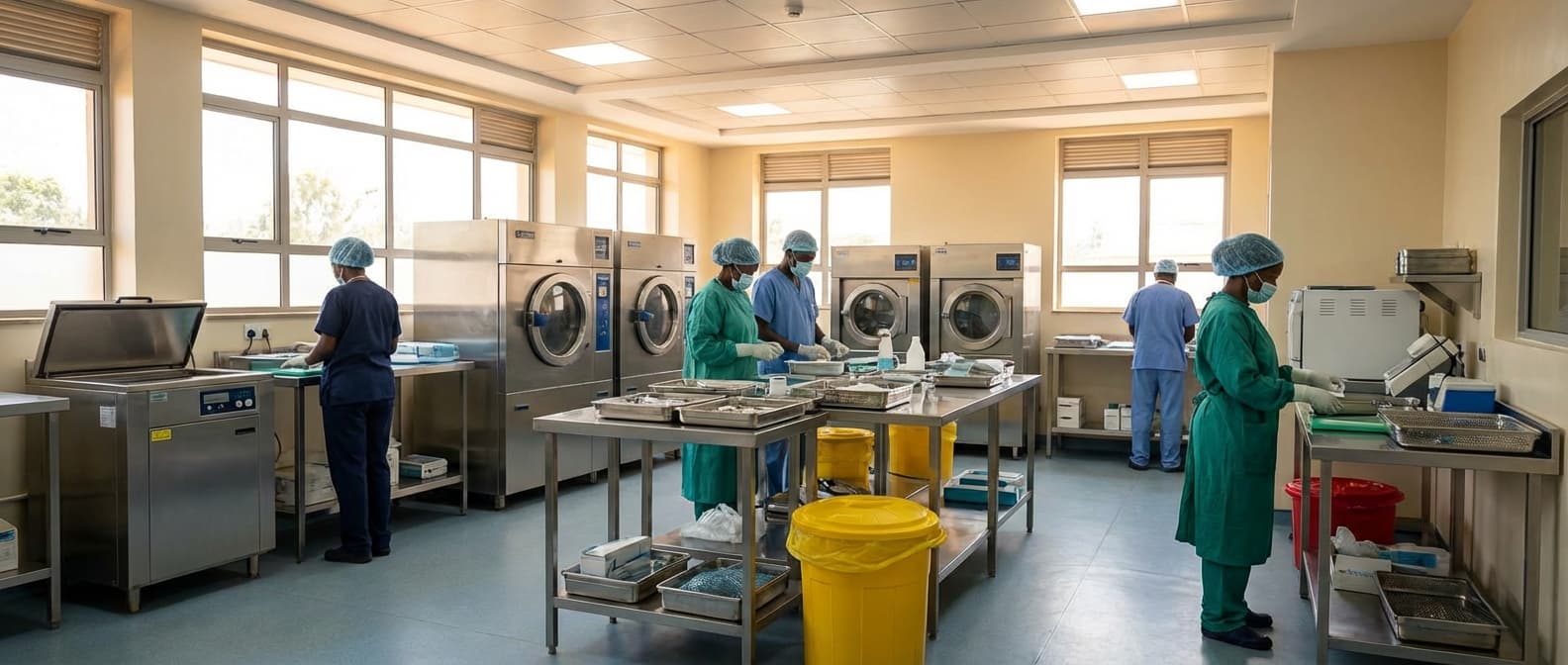
Autoclave Validation Support Service in Sierra Leone
Engineering Excellence & Technical Support
Autoclave Validation Support Service High-standard technical execution following OEM protocols and local regulatory frameworks.
Comprehensive Biological Indicator Testing
We provide robust biological indicator testing for autoclaves in Sierra Leone, ensuring effective sterilization through independent verification of spore kill, a critical step for healthcare and laboratory compliance.
Rigorous Cycle Parameter Validation
Our service meticulously validates critical autoclave parameters including temperature, pressure, and time across multiple cycle runs. This ensures consistent and reliable sterilization cycles, minimizing the risk of non-compliance and patient safety concerns.
Detailed Documentation & Compliance Reporting
We deliver comprehensive validation reports formatted for adherence to international standards and local health regulations in Sierra Leone. Our detailed documentation provides irrefutable evidence of autoclave efficacy for regulatory bodies and internal quality assurance.
What Is Autoclave Validation Support Service In Sierra Leone?
Autoclave validation support services in Sierra Leone are critical to ensuring the efficacy and reliability of steam sterilization processes. These services are designed to confirm that autoclaves consistently achieve and maintain the necessary parameters (temperature, pressure, time) to effectively eliminate microbial contamination from medical devices, laboratory equipment, and other susceptible materials. This validation process is not a one-time event but a recurring necessity to comply with regulatory standards, maintain patient safety, and uphold the integrity of scientific research and healthcare operations.
| Who Needs Autoclave Validation Support Service? | Typical Use Cases | |||
|---|---|---|---|---|
| Hospitals and Clinics: All healthcare facilities utilizing autoclaves for sterilization of surgical instruments, dental tools, laboratory glassware, and other medical supplies to prevent healthcare-associated infections (HAIs). | Sterilization of surgical instruments (scalpels, forceps, retractors). | Sterilization of dental instruments (burs, probes, mirrors). | Sterilization of respiratory therapy equipment (nebulizer kits, tubing). | Sterilization of diagnostic equipment and consumables. |
| Diagnostic and Research Laboratories: Laboratories that require sterile equipment, media, and consumables for accurate and reproducible scientific experiments and diagnostic testing. | Sterilization of culture media and petri dishes. | Sterilization of laboratory glassware (beakers, flasks, pipettes). | Sterilization of serological equipment. | Decontamination of biohazardous waste (in some instances, depending on autoclave type and waste classification). |
| Pharmaceutical and Biotechnology Companies: Organizations involved in drug manufacturing, research, and development that require sterile environments and validated sterilization processes for critical equipment and materials. | Sterilization of production equipment and components. | Sterilization of laboratory equipment used in research and quality control. | Sterilization of raw materials and packaging components. | |
| Veterinary Clinics and Animal Research Facilities: Facilities involved in animal care and research that sterilize surgical instruments and other equipment. | Sterilization of veterinary surgical instruments. | Sterilization of animal husbandry equipment. | ||
| Manufacturers of Medical Devices: Companies that produce medical devices that require sterilization prior to packaging and distribution. | Validation of sterilization processes for sterile medical devices. |
What Autoclave Validation Support Service Involves:
- Installation Qualification (IQ): Verifying that the autoclave has been installed correctly according to the manufacturer's specifications and relevant industry standards. This includes checking utilities, environmental conditions, and physical placement.
- Operational Qualification (OQ): Testing the autoclave's ability to operate within its specified parameters across its entire operational range. This typically involves running empty cycles with calibrated sensors to confirm temperature and pressure uniformity and penetration.
- Performance Qualification (PQ): Demonstrating that the autoclave consistently sterilizes a defined load (e.g., porous loads, solid loads, hollow loads) under worst-case conditions, using biological indicators (BIs) and chemical indicators (CIs) to confirm microbial kill and cycle effectiveness.
- Calibration and Maintenance: Ensuring that all critical measuring instruments (temperature probes, pressure gauges) used during validation are calibrated and that the autoclave undergoes scheduled preventative maintenance to ensure ongoing optimal performance.
- Documentation and Reporting: Providing comprehensive, auditable documentation of all validation activities, including protocols, test results, calibration certificates, and final validation reports that meet regulatory requirements.
- Cycle Development and Optimization: Assisting in the development and refinement of sterilization cycles tailored to specific loads and materials to achieve the desired sterility assurance level (SAL) while minimizing cycle times and impact on materials.
Who Needs Autoclave Validation Support Service In Sierra Leone?
Autoclave validation support services are crucial for ensuring the safety, efficacy, and regulatory compliance of sterilization processes in various healthcare and research settings. In Sierra Leone, where access to reliable and sterile medical equipment is paramount for public health, these services play a vital role. The primary need arises from institutions that rely on autoclaves for sterilizing medical instruments, laboratory equipment, and other critical items. Without proper validation, there's a significant risk of failed sterilization, leading to infections, disease transmission, and compromised diagnostic or treatment outcomes. This directly impacts patient care and the operational integrity of healthcare facilities and research labs.
| Target Customer/Department | Specific Needs/Reasons for Validation |
|---|---|
| Hospitals (Operating Theaters, Central Sterile Supply Department - CSSD) | Ensuring surgical instruments are sterile to prevent surgical site infections. Validating the efficacy of sterilization cycles for all instrument types and loads. Compliance with national and international healthcare standards. Maintaining patient safety and trust. |
| Hospitals (Outpatient Departments, Wards) | Sterilizing equipment used in routine procedures, wound care, and diagnostics. Ensuring the safety of materials used for patient care. Preventing cross-contamination between patients. |
| Clinics and Health Centers | Providing safe and sterile equipment for basic medical procedures, vaccinations, and wound management. Often have limited in-house technical expertise for validation. Ensuring public health safety in resource-limited settings. |
| Diagnostic Laboratories (Pathology, Microbiology, etc.) | Sterilizing glassware, culture media preparation equipment, and other lab apparatus. Ensuring accurate and reliable test results by preventing contamination. Maintaining biosafety and biosecurity standards. |
| Research Institutions | Sterilizing research equipment, consumables, and biohazardous waste. Maintaining the integrity of research experiments. Ensuring compliance with ethical and safety guidelines in research. |
| Dental Practices | Sterilizing dental instruments (drills, probes, extractors). Preventing the transmission of infections between patients. Meeting professional and regulatory requirements for dental care. |
| Veterinary Clinics | Sterilizing surgical instruments for animal care. Ensuring the health and safety of animals undergoing procedures. Preventing the spread of zoonotic diseases. |
| Medical Device Manufacturers (if any) | Validating autoclaves used in their manufacturing process for sterile medical devices or components. Meeting regulatory requirements for product sterility (e.g., FDA, EMA equivalents). |
Who Needs Autoclave Validation Support Service in Sierra Leone?
- Hospitals (Public and Private)
- Clinics and Health Centers
- Diagnostic Laboratories
- Research Institutions
- Dental Practices
- Veterinary Clinics
- Manufacturing Facilities (if applicable, for sterile product packaging)
Autoclave Validation Support Service Process In Sierra Leone
This document outlines the standard workflow for Autoclave Validation Support Services provided in Sierra Leone. The process is designed to be efficient and transparent, ensuring clients receive comprehensive validation for their autoclaves, crucial for maintaining sterility and compliance in healthcare and laboratory settings. The workflow begins with an initial inquiry and culminates in the final validation report and certification.
| Stage | Description | Key Activities | Deliverables/Outcomes | Timeline (Typical) |
|---|---|---|---|---|
| Inquiry & Initial Consultation | The client contacts the service provider to express interest in autoclave validation. This stage involves understanding the client's needs and the specific autoclave(s) requiring validation. | Initial contact (phone, email, website form), discussion of validation requirements, autoclave type, size, and frequency of use. | Understanding of client needs, preliminary scope definition. | 1-2 business days |
| Quotation & Service Agreement | Based on the initial consultation, a detailed quotation is prepared, outlining the scope of work, methodology, timeline, and cost. Upon agreement, a formal service contract is signed. | Preparation of quotation, proposal review and negotiation, contract signing. | Formalized service agreement, agreed-upon terms and conditions. | 2-3 business days |
| Site Visit & Pre-Validation Assessment | A qualified technician visits the client's site to inspect the autoclave, assess its operational status, and gather essential information prior to the validation execution. | Autoclave inspection, verification of utility connections (water, power, steam), review of maintenance logs, identification of any immediate issues. | Pre-validation readiness assessment, identification of any pre-requisites for validation. | 1 business day (per site) |
| Validation Execution (IQ, OQ, PQ) | This is the core of the validation process, involving Installation Qualification (IQ), Operational Qualification (OQ), and Performance Qualification (PQ). | IQ: Verifying the autoclave is installed correctly according to manufacturer specifications. OQ: Testing the autoclave's functionality across its operational range. PQ: Demonstrating that the autoclave consistently performs as intended under normal operating conditions, typically using biological indicators. | Recorded test results, calibration certificates for equipment used during validation. | 2-5 business days (depending on number and complexity of autoclaves) |
| Data Analysis & Report Generation | All collected data from the IQ, OQ, and PQ stages is meticulously analyzed to determine the autoclave's compliance with predefined acceptance criteria. | Review of test logs, processing of sensor data, calculation of key parameters (e.g., temperature, pressure, cycle times), comparison against standards. | Raw data compilation, preliminary findings. | 2-3 business days |
| Validation Report & Certificate Issuance | A comprehensive validation report is generated, detailing the entire process, results, and conclusions. A validation certificate is issued upon successful completion. | Compilation of the final validation report, including executive summary, methodology, results, discussion, and recommendations. Issuance of the official validation certificate. | Official Autoclave Validation Report, Autoclave Validation Certificate. | 3-5 business days |
| Post-Validation Support & Recommendations | The service provider offers guidance and recommendations to the client for maintaining autoclave performance and compliance, including advice on calibration and revalidation schedules. | Clarification of report findings, recommendations for optimal operation and maintenance, scheduling of future revalidations. | Enhanced operational efficiency, maintained compliance, planned future validation activities. | Ongoing (as needed) |
Autoclave Validation Support Service Process in Sierra Leone: Workflow Stages
- Inquiry & Initial Consultation
- Quotation & Service Agreement
- Site Visit & Pre-Validation Assessment
- Validation Execution (IQ, OQ, PQ)
- Data Analysis & Report Generation
- Validation Report & Certificate Issuance
- Post-Validation Support & Recommendations
Autoclave Validation Support Service Cost In Sierra Leone
The cost of autoclave validation support services in Sierra Leone is influenced by several key factors, leading to a range of pricing. These services are crucial for ensuring that autoclaves are functioning correctly and meeting regulatory standards, particularly in healthcare and laboratory settings. The price is generally determined by the complexity of the validation process, the type and number of autoclaves to be validated, the geographical location within Sierra Leone, and the experience and reputation of the service provider.
| Service Component | Estimated Price Range (Leones) | Notes |
|---|---|---|
| Basic Operational Qualification (OQ) for a single small autoclave | 1,500,000 - 3,000,000 | Covers functional checks and basic calibration verification. |
| Full Validation (IQ/OQ/PQ) for a single medium-sized autoclave | 3,000,000 - 6,000,000 | Includes installation, operational, and performance testing with detailed reporting. |
| Validation for multiple autoclaves (per unit, volume discount may apply) | 2,500,000 - 5,000,000 | Price per unit decreases with a higher number of autoclaves. |
| On-site Calibration and Validation | Additional 500,000 - 1,500,000 | Depending on complexity and travel distance. |
| Validation Report Generation and Certification | Included in overall service, but specialized reports may incur extra | Standard reports are usually bundled. |
| Emergency/Expedited Service Surcharge | Additional 20% - 50% | For urgent requests outside of standard working hours or schedules. |
Key Pricing Factors for Autoclave Validation Support Services in Sierra Leone
- Scope of Validation: Comprehensive validation, including Installation Qualification (IQ), Operational Qualification (OQ), and Performance Qualification (PQ), will naturally cost more than a basic operational check.
- Number and Size of Autoclaves: Larger or multiple autoclaves will require more time, resources, and potentially specialized equipment for validation, thus increasing the overall cost.
- Service Provider's Expertise and Reputation: Established companies with a proven track record and highly qualified technicians often command higher prices due to their reliability and quality of service.
- Geographical Location: Travel and accommodation expenses for technicians to reach remote locations within Sierra Leone can add to the final cost.
- Urgency of Service: Expedited or emergency validation services may incur additional surcharges.
- Calibration Requirements: If the validation process necessitates recalibration of the autoclave's sensors or other components, this will add to the cost.
- Reporting and Documentation: The level of detail and customization required for validation reports can also influence pricing.
Affordable Autoclave Validation Support Service Options
Navigating the complexities of autoclave validation can be a significant challenge for healthcare facilities, laboratories, and other organizations reliant on sterile equipment. This process ensures that autoclaves consistently achieve the necessary conditions for effective sterilization. However, specialized expertise and resources are often required, leading to potential cost concerns. This document outlines affordable autoclave validation support service options, focusing on value bundles and effective cost-saving strategies to make this essential compliance requirement more accessible.
| Service Component | Description | Typical Cost Factor | Cost-Saving Opportunity |
|---|---|---|---|
| Installation Qualification (IQ) | Verifies that the autoclave is installed correctly according to manufacturer specifications and relevant standards. | Technician time, documentation review, calibration checks. | Bundle with OQ and PQ for a reduced overall price. Ensure vendor provides comprehensive pre-installation checklists. |
| Operational Qualification (OQ) | Tests the autoclave's ability to operate within specified parameters (e.g., temperature, pressure, time) across its operational range. | Sensor calibration, load testing, temperature mapping. | Bundle with IQ and PQ. Leverage remote monitoring capabilities to reduce on-site visits. |
| Performance Qualification (PQ) | Demonstrates consistent and effective sterilization of representative loads over a defined period. | Biological indicator testing, chemical indicator use, data analysis. | Bundle with IQ and OQ. Optimize load configurations to minimize testing cycles. |
| Calibration Services | Ensures the accuracy of sensors and measuring devices within the autoclave. | Traceable calibration certificates, technician time. | Schedule calibrations concurrently with validation services. Negotiate bulk calibration discounts for multiple units. |
| Documentation & Reporting | Creation of comprehensive validation reports, protocols, and certificates. | Technical writing, data compilation, quality assurance review. | Utilize vendors offering templated, yet customizable, documentation. Request digital delivery to save on printing and shipping. |
| Revalidation Services | Periodic re-testing to ensure continued compliance after significant repairs, modifications, or according to regulatory schedules. | Similar to initial validation, but often with reduced scope. | Proactive maintenance schedules to minimize the need for extensive revalidation. Contract for regular, scheduled revalidation to lock in rates. |
Understanding Autoclave Validation Essentials
- What is Autoclave Validation? The documented verification that an autoclave operates according to pre-defined specifications and consistently achieves the conditions required for sterilization (e.g., temperature, pressure, time).
- Key Validation Stages: Typically includes Installation Qualification (IQ), Operational Qualification (OQ), and Performance Qualification (PQ).
- Why is it Crucial? Ensures patient safety, prevents cross-contamination, meets regulatory requirements (e.g., FDA, CDC, ISO), and maintains the integrity of sterile instruments.
- Common Validation Parameters: Temperature distribution, steam penetration, pressure maintenance, cycle repeatability, and sterilant efficacy.
- Consequences of Non-Compliance: Fines, product recalls, reputational damage, and potential harm to patients or users.
Verified Providers In Sierra Leone
Finding reliable healthcare in Sierra Leone can be a challenge. This is where Franance Health distinguishes itself by providing access to a network of verified healthcare providers. Our rigorous credentialing process ensures that every practitioner within our system meets the highest standards of medical expertise, ethical practice, and patient care. Choosing a Franance Health verified provider means opting for quality, trust, and peace of mind.
| Credential | Verification Process | Provider Benefit | Patient Benefit |
|---|---|---|---|
| Medical Licenses & Certifications | Cross-referenced with official licensing boards and educational institutions. | Ensures providers possess the required legal and academic qualifications. | Guarantees that your healthcare provider is officially recognized and competent. |
| Professional Experience & Specialization | Verified through peer reviews, hospital affiliations, and documented practice history. | Confirms a provider's practical expertise and suitability for specific medical needs. | Ensures you are treated by a specialist with relevant experience for your condition. |
| Ethical Conduct & Disciplinary Records | Background checks and review of any professional disciplinary actions. | Upholds a high standard of ethical practice and patient trust. | Provides assurance of professional integrity and patient safety. |
| Continuing Medical Education (CME) | Verification of ongoing participation in accredited CME programs. | Ensures providers stay updated with the latest medical advancements and best practices. | Guarantees you receive care informed by current medical knowledge and techniques. |
Why Franance Health Providers are the Best Choice:
- Rigorous Credentialing: We meticulously vet all our providers, confirming their qualifications, licenses, and professional standing.
- Commitment to Quality: Our verified providers adhere to stringent quality of care standards, ensuring you receive the best possible treatment.
- Patient-Centric Approach: We prioritize patient well-being and satisfaction, and our verified providers are trained to offer compassionate and effective care.
- Accessibility and Convenience: Franance Health simplifies the process of finding and accessing trusted healthcare professionals across Sierra Leone.
- Ongoing Monitoring: We continuously monitor the performance and adherence to standards of our verified network.
Scope Of Work For Autoclave Validation Support Service
This document outlines the Scope of Work (SOW) for Autoclave Validation Support Services. The objective is to provide expert services to ensure the qualification and validation of autoclaves meet regulatory requirements and industry best practices. This includes protocol development, execution, data analysis, and report generation.
| Technical Deliverable | Description | Standard Specification / Acceptance Criteria |
|---|---|---|
| Validation Master Plan (VMP) Input | Contribution to or review of the VMP, ensuring autoclave validation strategy is integrated and compliant. | VMP aligns with overall site validation strategy; autoclave validation plan is clearly defined. |
| Validation Protocol Development | Creation of IQ (Installation Qualification), OQ (Operational Qualification), and PQ (Performance Qualification) protocols specific to the autoclave(s) and their intended use. | Protocols include: system description, objectives, scope, responsibilities, test procedures, acceptance criteria, sampling plans, reference documents, and report format. Must be reviewed and approved by client stakeholders. |
| Installation Qualification (IQ) Execution & Report | Verification that the autoclave is installed according to manufacturer specifications and design. Includes equipment verification, calibration checks, utility connections, and documentation review. | All critical parameters verified against protocol. Installation documentation (manuals, drawings) reviewed. Deviations documented and resolved. IQ report approved. |
| Operational Qualification (OQ) Execution & Report | Verification that the autoclave operates within defined operating ranges and parameters under no-load conditions. Includes temperature, pressure, cycle time, and safety feature checks. | All critical control parameters (e.g., temperature uniformity, pressure hold, sterilization times) meet protocol acceptance criteria. Alarms and interlocks function as intended. OQ report approved. |
| Performance Qualification (PQ) Execution & Report | Verification that the autoclave consistently performs its intended function under normal operating conditions, typically with challenging loads. Includes temperature mapping, biological challenge studies (if applicable), and load penetration studies. | Temperature uniformity and penetration within load meet protocol acceptance criteria for all tested cycles. Biological indicators (BIs) or chemical indicators (CIs) demonstrate lethality (e.g., F0 values). PQ report approved. |
| Requalification Protocol Development & Execution | Development and execution of protocols for periodic or change-controlled requalification of the autoclave. | Requalification protocols address specific changes or time-based requirements. Acceptance criteria are defined and met. |
| Deviation Management | Documentation, investigation, and resolution of any deviations encountered during validation activities. | Deviations are thoroughly investigated, root cause identified, and CAPAs implemented. Impact assessment performed and documented. |
| Final Validation Report | Compilation of all IQ, OQ, and PQ data, analysis, and conclusions into a comprehensive validation report. | Report includes executive summary, protocol references, executed data, deviation summaries, conclusion of validation status (qualified/non-qualified), and recommendations. Report approved by client. |
| Calibration Certificates Review | Review of calibration certificates for critical instruments (e.g., temperature probes, pressure sensors) used during validation. | Calibration certificates are current, traceable to national standards, and within acceptable tolerances. |
| SOP Review and/or Development | Review of existing SOPs related to autoclave operation, maintenance, and calibration, or development of new SOPs. | SOPs are clear, comprehensive, and compliant with regulatory requirements and site procedures. |
Key Objectives
- To develop comprehensive and compliant validation protocols for autoclave systems.
- To execute validation studies accurately and efficiently, adhering to approved protocols.
- To analyze validation data to determine system performance and compliance.
- To generate detailed validation reports summarizing findings and conclusions.
- To provide expert recommendations for system improvements or revalidation.
- To ensure all activities are conducted in accordance with relevant regulatory guidelines (e.g., FDA, EMA) and company Standard Operating Procedures (SOPs).
Service Level Agreement For Autoclave Validation Support Service
This Service Level Agreement (SLA) outlines the response times and uptime guarantees for the Autoclave Validation Support Service provided by [Your Company Name]. This SLA is an integral part of the Master Service Agreement between [Your Company Name] and [Client Company Name].
| Service Component | Response Time (Business Hours) | Uptime Guarantee |
|---|---|---|
| Critical Incident Response (Emergency): | 1 hour for initial acknowledgement and assignment. [Your Company Name] will strive to initiate diagnosis and remediation steps within 2 business hours. | N/A (Focus on rapid resolution) |
| High Priority Incident Response: (e.g., significant deviation in validation results, potential regulatory non-compliance) | 4 business hours for initial acknowledgement and assignment. Remediation efforts to commence within 8 business hours. | N/A (Focus on rapid resolution) |
| Medium Priority Incident Response: (e.g., minor deviations in validation, requests for clarification) | 8 business hours for initial acknowledgement and assignment. Remediation or clarification efforts to commence within 16 business hours. | N/A (Focus on timely resolution) |
| Low Priority Incident Response/Request: (e.g., general inquiries, requests for documentation updates) | 24 business hours for initial acknowledgement. Resolution or response within 48 business hours. | N/A (Focus on timely response) |
| Consultation and Advisory Services: | Initial response to consultation requests within 1 business day. Scheduling of consultations to occur within 3 business days. | N/A (Service is client-driven) |
| Protocol Development/Review Support: | Initial acknowledgement of submission within 1 business day. Provision of feedback or commencement of review within 3 business days. | N/A (Service is client-driven) |
| Reporting and Documentation Services: | Delivery of draft reports/documentation within the agreed project timeline. Finalization of reports/documentation within 5 business days of client feedback. | N/A (Service is project-based) |
| General Service Availability (for remote support, access to knowledge base, etc.): | N/A | 99.5% during Business Hours |
Definitions
- Autoclave Validation Support Service: Refers to the services provided by [Your Company Name] to assist clients in the validation of their autoclaves, including but not limited to, consultation, documentation review, protocol development, execution support, and reporting.
- Business Hours: Refers to the hours between 9:00 AM and 5:00 PM, Monday through Friday, excluding public holidays in [Specify Jurisdiction].
- Emergency: An event that renders the autoclave non-operational or causes critical non-compliance with regulatory requirements, directly impacting patient safety or product integrity. Examples include complete autoclave failure, failure to achieve sterilization parameters, or critical data loss.
- Incident: Any event that causes an unplanned disruption to the Autoclave Validation Support Service, or a deviation from the agreed-upon service standards.
- Response Time: The maximum time allowed for [Your Company Name] to acknowledge and begin addressing a reported Incident or Request.
- Uptime Guarantee: The minimum percentage of time the Autoclave Validation Support Service is available and operational as defined in this SLA.
Frequently Asked Questions

Ready when you are
Let's scope your Autoclave Validation Support Service in Sierra Leone project in Sierra Leone.

Scaling healthcare logistics and technical systems across the entire continent.