
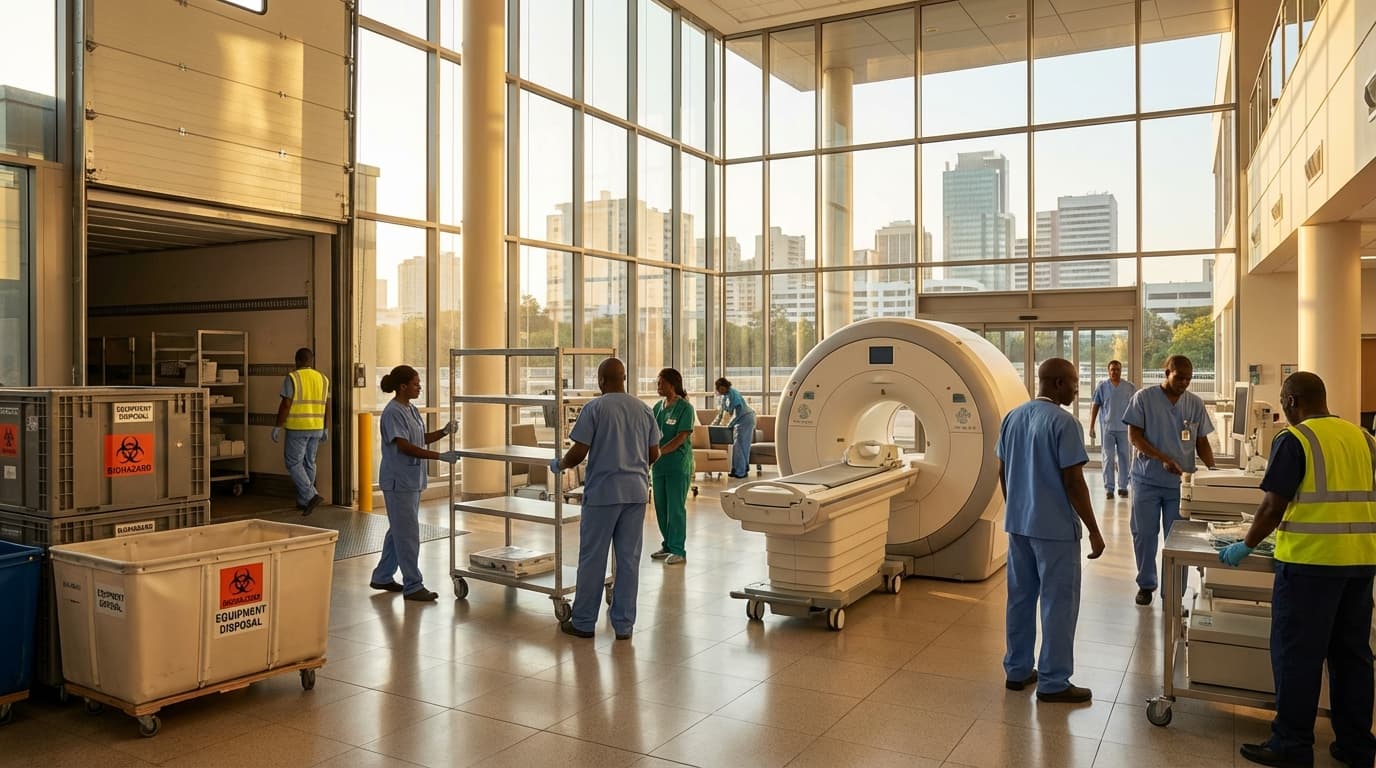
Heavy Medical Equipment De-Installation Service (MRI/CT/Cath Lab) in Sierra Leone
Engineering Excellence & Technical Support
Heavy Medical Equipment De-Installation Service (MRI/CT/Cath Lab) High-standard technical execution following OEM protocols and local regulatory frameworks.
Specialized De-installation Expertise
Our highly trained technicians possess the specialized knowledge and tooling required for the safe and precise de-installation of complex medical imaging equipment, including MRI, CT scanners, and Cath Labs, adhering to strict manufacturer protocols and safety standards in Sierra Leone.
Unrivaled Safety & Compliance
We prioritize the utmost safety throughout the de-installation process, ensuring all electrical, mechanical, and environmental hazards are mitigated. Our services guarantee full compliance with local regulations and international best practices, safeguarding personnel and equipment integrity.
Logistics & Re-installation Readiness
Beyond de-installation, we manage the secure packaging and transportation of your valuable medical equipment. We offer seamless transition planning, preparing your systems for efficient re-installation at a new facility, minimizing downtime and operational disruption in Sierra Leone.
What Is Heavy Medical Equipment De-installation Service (Mri/ct/cath Lab) In Sierra Leone?
Heavy Medical Equipment De-Installation Service (MRI/CT/Cath Lab) in Sierra Leone refers to the specialized process of safely and systematically dismantling, packaging, and preparing large, complex, and often high-value medical imaging and diagnostic apparatus such as Magnetic Resonance Imaging (MRI) scanners, Computed Tomography (CT) scanners, and Cardiac Catheterization (Cath Lab) systems for relocation, decommissioning, or disposal. This service requires a deep understanding of the intricate engineering, specific safety protocols, and logistical challenges associated with these sophisticated machines, which often involve powerful magnetic fields, high voltages, and sensitive components. The de-installation process meticulously documents each step, ensuring that components are labeled, protected, and prepared for subsequent re-installation or transport without compromising their integrity or functionality.
| Who Needs This Service? | Typical Use Cases | |||||
|---|---|---|---|---|---|---|
| Hospitals and Healthcare Facilities: Both public and private institutions that are upgrading, relocating, or closing down departments equipped with MRI, CT, or Cath Lab systems. | Medical Equipment Vendors and Manufacturers: Requiring de-installation as part of a trade-in, upgrade, or end-of-life management program for their installed base. | Medical Equipment Resellers and Refurbishers: Procuring used or de-installed equipment for refurbishment and resale. | Government Health Ministries or Agencies: Overseeing the management of national medical equipment assets, including decommissioning or redistribution. | Research Institutions: De-installing specialized imaging or diagnostic equipment from laboratories for relocation or upgrade. | Disaster Relief or Humanitarian Organizations: Setting up or decommissioning temporary medical facilities that may utilize such equipment. | |
| Facility Relocation: Moving a hospital or clinic to a new site, necessitating the transfer of existing heavy medical equipment. | Equipment Upgrade: Replacing older MRI, CT, or Cath Lab systems with newer models, requiring the removal of the retired unit. | Departmental Renovation or Expansion: De-installing equipment to facilitate structural changes or the installation of new facilities. | End-of-Life Decommissioning: Safely removing and disposing of equipment that has reached its operational lifespan, often with environmental considerations. | Asset Retirement and Sale: Preparing functional but surplus equipment for sale on the secondary market. | Technological Obsolescence: Replacing equipment due to advancements in technology that render the current systems outdated or inefficient. | Insurance Claims and Damage Assessment: De-installation for evaluation following damage or as part of a claims process. |
Key Components and Scope of Heavy Medical Equipment De-Installation Service:
- Systematic Dismantling: Controlled disassembly of the equipment into manageable modules, adhering to manufacturer specifications and best practices.
- Component Isolation and Securing: Safely disconnecting power, cooling systems, and data interfaces. Securing sensitive components (e.g., superconducting magnets in MRI, X-ray tubes in CT/Cath Lab) to prevent damage during transit.
- Hazardous Material Management: Identification and proper handling of any hazardous materials present (e.g., refrigerants, lubricants).
- Documentation and Labeling: Comprehensive photographic and written records of the de-installation process, including the labeling of all components for accurate re-assembly.
- Packaging and Protection: Utilizing specialized, custom-built crates and protective materials to safeguard equipment from shock, vibration, and environmental factors during transport.
- Logistical Coordination: Planning and executing the removal of large, heavy equipment from the facility, which may involve structural considerations, specialized lifting equipment, and transportation arrangements.
- Environmental and Safety Compliance: Ensuring all de-installation activities comply with relevant health, safety, and environmental regulations in Sierra Leone.
- Disposal or Relocation Preparation: Preparing the equipment for either secure long-term storage, transport to a new location, or environmentally responsible disposal.
Who Needs Heavy Medical Equipment De-installation Service (Mri/ct/cath Lab) In Sierra Leone?
The de-installation of complex and heavy medical equipment like MRI, CT scanners, and Cath Labs is a specialized and critical service required by a select group of entities in Sierra Leone. These sophisticated machines are not commodity items; their removal necessitates expertise in handling delicate, high-value, and often large-scale infrastructure. This service is typically needed during periods of equipment upgrade, relocation within a facility, facility closure, or when decommissioning old units to make way for new technology. The process involves careful disassembly, packaging, and transportation, often requiring specialized lifting gear and a deep understanding of the equipment's internal components to prevent damage and ensure safe handling. It's a niche service that demands precision, safety protocols, and adherence to international standards for medical equipment handling.
| Target Customer Type | Key Departments Involved | Reasons for De-Installation |
|---|---|---|
| Large Public Hospitals (e.g., Connaught Hospital, Sierra Leone Teaching Hospital Complex) | Radiology/Imaging Department, Cardiology Department, Biomedical Engineering Department, Facilities Management | Equipment Upgrade, Relocation within hospital, Replacement of outdated units, Facility renovation |
| Private Hospitals and Clinics (e.g., Swiss Clinic, other established private facilities) | Radiology Department, Cardiology Department, Administration, Facilities Management | Technological Upgrades, Expansion of services, Relocation of clinic, End-of-lease agreements |
| Specialized Diagnostic Imaging Centers | Imaging Services Management, Technical Operations, Administration | Upgrade to newer generation equipment, Relocation to a larger facility, Consolidation of services |
| Research Institutions with Clinical Arms | Medical Research Department, Clinical Services Unit, Equipment Management | Transition to new research protocols, Relocation of research facilities, Upgrade of clinical equipment used in research |
| Government Health Ministry (for national health infrastructure projects) | Procurement Department, Planning and Policy Department, Biomedical Engineering Unit | National equipment replacement programs, Centralized asset disposal, Redeployment of functional equipment to other sites |
| International Aid Organizations / NGOs | Project Management, Logistics Department, Medical Equipment Officer | Project completion and handover, Relocation of operational sites, Donation of upgraded equipment to other facilities, End of project lifecycle |
Target Customers and Departments for Heavy Medical Equipment De-Installation Service in Sierra Leone
- Hospitals (Public and Private)
- Specialized Medical Centers
- Diagnostic Imaging Clinics
- Research Institutions with Medical Facilities
- Government Health Ministries (for centralized asset management)
- International Aid Organizations and NGOs with Medical Projects
Heavy Medical Equipment De-installation Service (Mri/ct/cath Lab) Process In Sierra Leone
This document outlines the comprehensive workflow for the Heavy Medical Equipment De-Installation Service (MRI/CT/Cath Lab) in Sierra Leone, covering the process from initial inquiry to successful execution. Our service ensures a safe, efficient, and compliant de-installation, minimizing downtime and preparing equipment for relocation, disposal, or refurbishment. The process is designed to be transparent and client-focused, adhering to international best practices and local regulations.
| Stage | Description | Key Activities | Deliverables/Outcomes | Timeframe (Typical) |
|---|---|---|---|---|
| Inquiry & Initial Consultation | The client contacts our service provider with a request for de-installation of heavy medical equipment. | Initial discussion of equipment type, location, reason for de-installation (relocation, upgrade, disposal), and desired timeline. Gathering preliminary information. | Understanding of client needs, initial assessment of project scope. | 1-3 business days |
| Site Assessment & Planning | A thorough evaluation of the installation site and the equipment itself is conducted by our experienced technicians. | On-site visit to assess: equipment specifications, physical access routes (doors, hallways, elevators), power and cooling requirements, structural integrity, environmental factors. Developing a detailed de-installation plan, risk assessment, and safety protocols. | Detailed site survey report, de-installation plan, safety and risk management plan. | 3-7 business days (depending on complexity) |
| Quotation & Contract Agreement | Based on the site assessment and plan, a formal quotation is provided, followed by contract finalization. | Preparation of a detailed quotation outlining costs for labor, materials, specialized tools, disposal (if applicable), and any third-party services. Negotiation and signing of the service contract. | Formal quotation, signed service contract, clear understanding of terms and conditions. | 2-5 business days |
| Pre-De-Installation Preparations | All necessary arrangements and preparations are made before commencing the actual de-installation. | Procurement of specialized tools and equipment. Obtaining any required permits or approvals (local authorities, hospital management). Scheduling of personnel. Communication with the client regarding the de-installation schedule and any necessary disruptions. | Mobilized team and equipment, confirmed schedule, all necessary permissions. | 3-7 business days (can overlap with site assessment) |
| Equipment De-Installation | The core phase where the medical equipment is safely and systematically disconnected and dismantled. | Power down and secure disconnection of all components. Careful dismantling of the equipment according to manufacturer specifications and our de-installation plan. Packaging and protection of individual components for transport. | Dismantled and safely packaged medical equipment. | Varies significantly based on equipment type and complexity (e.g., MRI can take several days). |
| Post-De-Installation & Handover | Final checks and formal handover of the de-installed equipment. | Site cleanup and restoration (if required). Final inspection of de-installed components. Documentation of the de-installation process. Formal handover to the client or designated logistics partner. | Cleaned site, documented de-installation, signed handover confirmation. | 1-2 business days |
| Logistics & Transportation (Optional) | Arrangement and management of the transportation of the de-installed equipment. | Coordination with specialized transport providers. Loading of equipment onto transport vehicles. Ensuring all shipping and customs documentation is in order for transit within Sierra Leone or for export. | Equipment safely loaded for transport, necessary documentation provided. | Varies based on destination and logistics complexity |
Key Stages of the De-Installation Process
- Inquiry & Initial Consultation
- Site Assessment & Planning
- Quotation & Contract Agreement
- Pre-De-Installation Preparations
- Equipment De-Installation
- Post-De-Installation & Handover
- Logistics & Transportation (Optional)
Heavy Medical Equipment De-installation Service (Mri/ct/cath Lab) Cost In Sierra Leone
De-installing heavy medical equipment like MRI, CT scanners, and Cath Labs is a highly specialized and complex process that requires expert technicians, specific tools, and rigorous safety protocols. The cost of these services in Sierra Leone can vary significantly due to a number of factors. These include the type and model of the equipment, the complexity of the de-installation (e.g., whether it requires dismantling into smaller components, if it's networked with other systems), the accessibility of the site, the need for specialized lifting and transportation equipment, the duration of the project, and the experience and reputation of the service provider. Labor costs, travel expenses for specialized technicians (if not local), and disposal or packaging fees for components also play a crucial role in the overall pricing. Due to the specialized nature and limited availability of such services in Sierra Leone, costs are generally higher than for standard equipment removal. Prices are typically quoted in United States Dollars (USD) and then converted to Sierra Leonean Leone (SLL) at the prevailing exchange rate at the time of invoicing, or clients may opt for direct USD payment. Due to the scarcity of definitive publicly available price lists for this niche service in Sierra Leone, the following ranges are estimates based on general industry knowledge of de-installation costs for similar complex medical equipment in developing economies, adjusted for local market conditions.
| Equipment Type | Estimated Cost Range (USD) | Estimated Cost Range (SLL - approximate, subject to exchange rate) |
|---|---|---|
| MRI Scanner | $10,000 - $35,000+ | 100,000,000 - 350,000,000+ (approx. at 1 USD = 10,000 SLL) |
| CT Scanner | $8,000 - $25,000+ | 80,000,000 - 250,000,000+ (approx. at 1 USD = 10,000 SLL) |
| Cath Lab (Angiography System) | $12,000 - $40,000+ | 120,000,000 - 400,000,000+ (approx. at 1 USD = 10,000 SLL) |
Key Factors Influencing De-installation Costs in Sierra Leone
- Type and Model of Equipment (MRI, CT, Cath Lab complexity differs)
- Size and Weight of Components
- Dismantling Requirements
- Site Accessibility and Logistics
- Need for Specialized Lifting and Transportation Equipment
- Duration and Man-Hours Required
- Expertise and Experience of the De-installation Team
- Geographical Location within Sierra Leone
- Additional Services (e.g., packing, temporary storage, site restoration)
- Currency Exchange Rates and Payment Terms
Affordable Heavy Medical Equipment De-installation Service (Mri/ct/cath Lab) Options
When it's time to de-install complex and heavy medical equipment like MRI, CT scanners, or Cath Labs, the process can be daunting. Beyond the sheer physical challenge, there are significant safety, logistical, and cost considerations. Fortunately, there are affordable service options and strategies to manage these expenses effectively. Understanding value bundles and implementing smart cost-saving measures can make a substantial difference.
| Value Bundle Component | Description | Cost-Saving Strategy/Benefit |
|---|---|---|
| Comprehensive De-installation Package | Includes professional dismantling, rigging, packaging, and transportation by certified technicians. | Bundling services often leads to discounted rates compared to hiring individual services. Ensures all aspects are covered, preventing unexpected charges. |
| Site Preparation & Planning | Assessment of access routes, structural integrity, and necessary modifications before de-installation begins. | Proactive planning identifies potential roadblocks early, preventing costly delays and on-site improvisations. Can include recommendations for facility adjustments that might be more cost-effective to implement pre-de-installation. |
| Equipment Decontamination & Shielding Removal | Safe removal and disposal of hazardous materials like lead shielding from MRI/CT scanners, or handling of radioactive components. | Specialized handling reduces environmental and safety risks. Bundled services ensure proper protocols are followed, avoiding fines or remediation costs. |
| Crating & Packaging Services | Custom-built crates and protective packaging designed for the specific dimensions and fragility of the equipment. | Proper packaging prevents damage during transit, saving on repair or replacement costs. Often more economical when included in a package than outsourced separately. |
| Logistics & Transportation Coordination | Arranging for specialized heavy-haul trucks, cranes, and permits for secure transport. | Negotiated transport rates within a service bundle can be lower. Experienced providers manage complex logistics, avoiding costly errors and delays. |
| Asset Recovery Consultation | Guidance on selling, trading, or donating the de-installed equipment. | Maximizing the value of existing equipment can offset de-installation costs. Some service providers offer consignment or resale assistance. |
| Extended Warranty/Support (Post-De-installation) | Optional service for reassurance on the integrity of the de-installation process. | While an added cost, it can provide peace of mind and potentially cover minor issues arising from the move, saving on future repair bills. |
Key Considerations for Affordable De-Installation:
- Specialized Expertise: De-installation requires highly trained technicians with specific knowledge of the equipment's architecture, power requirements, and potential hazards.
- Logistics and Transportation: Moving heavy, sensitive equipment necessitates specialized rigging, crating, and transportation, adding to the overall cost.
- Regulatory Compliance: Adhering to environmental, safety, and transportation regulations is crucial and often involves additional costs for permits or specialized disposal.
- Downtime Minimization: Efficient de-installation minimizes the disruption to your facility and potential revenue loss.
- Equipment Condition and Future Use: The condition of the equipment and whether it's being relocated, sold, or decommissioned influences the de-installation approach and associated costs.
Verified Providers In Sierra Leone
In Sierra Leone's evolving healthcare landscape, identifying reliable and qualified medical providers is paramount for ensuring quality patient care. Franance Health stands out as a leading organization dedicated to credentialing and connecting patients with verified healthcare professionals. This commitment to rigorous verification processes ensures that individuals seeking medical services can do so with confidence, knowing they are engaging with competent and ethical practitioners. Franance Health's comprehensive credentialing not only safeguards patient well-being but also contributes to raising the overall standard of healthcare delivery in Sierra Leone.
| Benefit for Patients | How Franance Health Delivers |
|---|---|
| Peace of Mind | Knowing your provider has undergone thorough vetting and meets high standards. |
| Access to Competent Professionals | Connecting with doctors and specialists who possess verified qualifications and experience. |
| Reduced Risk | Minimizing the chances of negative healthcare outcomes due to unqualified practitioners. |
| Improved Healthcare Experience | Engaging with providers committed to ethical practices and patient well-being. |
| Efficient Healthcare Seeking | Easily finding trusted medical professionals without extensive personal research. |
Why Franance Health Credentials Represent the Best Choice:
- Rigorous Verification Process: Franance Health employs a multi-faceted approach to verify the qualifications, licenses, and professional history of all healthcare providers on its platform. This includes checking educational backgrounds, specialty certifications, and any disciplinary actions.
- Commitment to Ethical Practice: Beyond technical qualifications, Franance Health assesses providers for adherence to ethical guidelines and patient-centered care principles.
- Continuous Monitoring: The credentialing process is not a one-time event. Franance Health engages in ongoing monitoring to ensure providers maintain their standards and continue to meet the organization's stringent requirements.
- Enhanced Patient Safety: By entrusting their health to Franance Health-verified providers, patients significantly reduce the risk of encountering unqualified or unethical practitioners.
- Facilitating Access to Quality Care: Franance Health streamlines the process of finding trusted healthcare professionals, making it easier for individuals to access the specialized and general medical services they need.
- Building Trust and Transparency: The transparent nature of Franance Health's credentialing fosters trust between patients and providers, a crucial element for effective healthcare delivery.
- Promoting Professional Excellence: By setting a high bar for entry, Franance Health incentivizes healthcare professionals to uphold and continuously improve their skills and practices.
Scope Of Work For Heavy Medical Equipment De-installation Service (Mri/ct/cath Lab)
This Scope of Work (SOW) outlines the requirements for the de-installation of heavy medical equipment, specifically Magnetic Resonance Imaging (MRI), Computed Tomography (CT) scanners, and Cardiac Catheterization (Cath Lab) systems. The service includes the safe and efficient removal of these complex systems from their current locations, preparing them for transport or storage. This SOW details the technical deliverables and standard specifications to ensure the highest quality of service.
| Category | Specification/Requirement | Details/Notes |
|---|---|---|
| Personnel Qualifications | Certified and experienced technicians | Technicians must possess manufacturer-specific training and certifications for the equipment being de-installed. Minimum of 5 years of experience in heavy medical equipment de-installation. |
| Safety Protocols | Adherence to OSHA and local safety regulations | Implementation of lock-out/tag-out procedures, proper lifting techniques, use of personal protective equipment (PPE), and hazard communication. |
| Tools and Equipment | Specialized de-installation tools and lifting equipment | Provision of all necessary tools, cranes, dollies, lifting straps, and other specialized equipment required for safe and efficient removal of heavy components. Includes helium handling equipment for MRI systems if applicable. |
| De-installation Procedure | Manufacturer-specific de-installation protocols | Strict adherence to the original equipment manufacturer's (OEM) de-installation manuals and recommended procedures. This includes safe venting of cryogens (MRI), controlled ramp-down of systems, and specific disconnection sequences. |
| Site Preparation | Temporary protection of floors, walls, and doorways | Installation of protective coverings and materials to prevent damage to the existing facility during equipment removal. This includes padding and bracing as needed. |
| Magnet Handling (MRI) | Controlled magnet quench or field collapse procedures | If a quench is required, it must be performed by certified personnel following strict safety protocols. If no quench is required, safe and controlled removal of the magnet is essential, considering its significant weight and potential residual magnetism. |
| Cryogen Management (MRI) | Safe handling and disposal/recovery of helium | If the MRI magnet requires helium venting, procedures for safe collection, recovery, or disposal must be in place and documented, adhering to environmental regulations. |
| Component Labeling | Clear and accurate labeling of all removed parts | Each de-installed component shall be labeled with its part number, description, and intended destination to facilitate re-installation or storage. |
| Waste Disposal | Environmentally responsible disposal of consumables | Proper disposal of refrigerants, oils, and other consumables according to environmental regulations. |
| Final Site Condition | Clean and undamaged installation space | The installation area shall be left clean, free of debris, and without any structural or cosmetic damage caused by the de-installation process. |
| Documentation | Comprehensive de-installation report | Includes photographic evidence of the process, confirmation of disconnection, list of all removed components, and a sign-off by the facility representative. |
| Insurance | Adequate liability and cargo insurance | Contractor must provide proof of insurance covering potential damage to property and personnel during the de-installation process. |
Technical Deliverables
- De-installation plan development and approval.
- Site assessment and safety hazard identification.
- Complete de-installation of designated MRI, CT, or Cath Lab system components.
- Disconnection of all power, cooling, data, and RF cables.
- Safe removal of superconducting magnets (MRI) or heavy gantry components.
- Dismantling of patient table and associated support structures.
- Extraction of the system from its installation room.
- Preparation of components for transport (e.g., securing, crating, labeling).
- Post-de-installation site cleaning and verification.
- Handover documentation, including de-installation reports and photographic evidence.
- Compliance with all relevant safety regulations and manufacturer guidelines.
Service Level Agreement For Heavy Medical Equipment De-installation Service (Mri/ct/cath Lab)
This Service Level Agreement (SLA) outlines the agreed-upon response times and uptime guarantees for the de-installation of heavy medical equipment, specifically MRI, CT, and Cath Lab systems. This SLA is intended to ensure minimal disruption and efficient service delivery during the de-installation process.
| Service Type | Response Time (for initial contact/mobilization) | On-site Arrival Time (for scheduled) | Uptime Guarantee (Adherence to Schedule) |
|---|---|---|---|
| Scheduled De-installation (MRI/CT/Cath Lab) | Within 24 business hours of confirmation of schedule and readiness from Client. | Within the agreed-upon Service Window (typically +/- 1 hour of scheduled start time). | 98% Adherence to Scheduled Completion Time. Delays beyond 4 business hours of the original estimated completion time will trigger a review and potential corrective action plan. Minor delays (under 4 hours) due to unforeseen site-specific issues will be communicated promptly. |
| Emergency De-installation (MRI/CT/Cath Lab) | Within 4 business hours of notification from Client. | Within 8 business hours of notification, subject to technician availability and travel time. This is for critical situations requiring immediate decommissioning. | Focus on timely initiation. While an uptime guarantee is not applicable, the Service Provider will prioritize mobilization and commencement of work to minimize extended downtime of the affected area. |
Definitions
- De-installation: The process of safely and systematically disconnecting, dismantling, and preparing heavy medical equipment for transport. This includes all required electrical, mechanical, and structural disconnections.
- Scheduled De-installation: De-installation services planned and agreed upon by both parties in advance, with a defined date and time.
- Emergency De-installation: De-installation required due to unforeseen circumstances that necessitate immediate attention, impacting patient care or facility operations.
- Response Time: The maximum allowable time from the moment a service request is initiated (via agreed-upon channels) until a qualified technician is actively engaged with the issue or begins scheduled work.
- Uptime Guarantee: Not directly applicable to de-installation as the equipment is being decommissioned. However, this section will focus on adherence to scheduled timelines and minimizing delays.
- Service Window: The agreed-upon period during which de-installation activities will take place.
- Force Majeure: Events beyond the reasonable control of either party, including but not limited to natural disasters, acts of war, or widespread power outages, that may affect service delivery.
- Service Provider: The entity responsible for performing the de-installation services.
- Client: The entity receiving the de-installation services.
Frequently Asked Questions

Ready when you are
Let's scope your Heavy Medical Equipment De-Installation Service (MRI/CT/Cath Lab) in Sierra Leone project in Sierra Leone.

Scaling healthcare logistics and technical systems across the entire continent.