
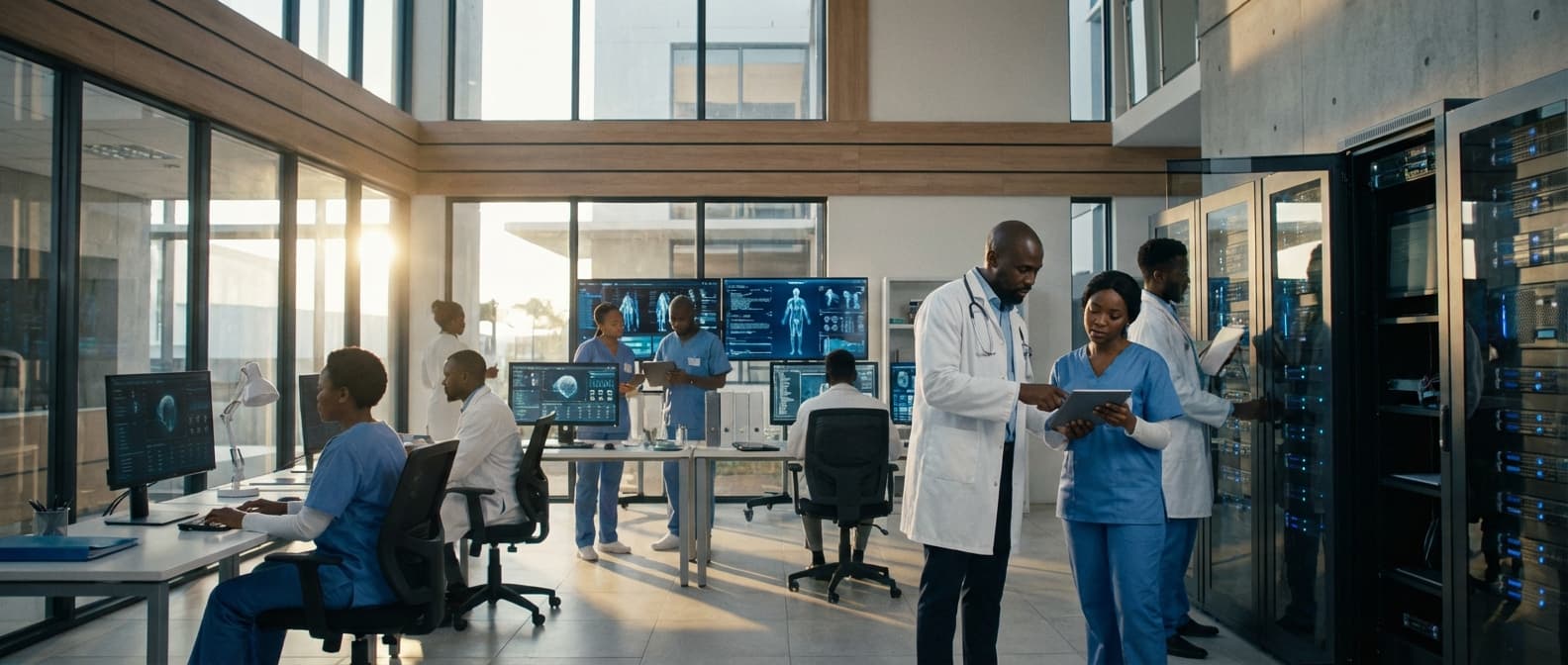
Tele-Radiology in Sierra Leone
Engineering Excellence & Technical Support
24/7 access to certified radiologists providing rapid, accurate remote interpretation of diagnostic imaging studies. High-standard technical execution following OEM protocols and local regulatory frameworks.
Bridging Geographical Gaps for Expert Diagnosis
Leveraging tele-radiology to connect remote healthcare facilities across Sierra Leone with a network of specialized radiologists, ensuring timely and accurate diagnostic interpretations regardless of location, thereby improving patient outcomes in underserved areas.
Enhancing Diagnostic Accuracy with Remote Expertise
Implementing secure, high-speed digital image transmission and cloud-based PACS (Picture Archiving and Communication System) to enable remote radiologists to perform detailed analysis of X-rays, CT scans, and MRIs. This provides a crucial second opinion and reduces diagnostic errors, especially in cases of complex or rare conditions.
Empowering Local Healthcare Professionals Through Knowledge Transfer
Utilizing tele-radiology platforms not only for remote reads but also for interactive training and consultation sessions. This facilitates continuous professional development for local medical imaging technicians and doctors, building long-term diagnostic capacity within Sierra Leone.
What Is Tele-radiology In Sierra Leone?
Tele-radiology, in the context of Sierra Leone, refers to the remote transmission of radiological images (such as X-rays, CT scans, and MRIs) from a healthcare facility to a radiologist for interpretation. This service bridges geographical barriers, allowing patients in underserved or remote areas to access specialist diagnostic imaging expertise that may not be locally available. It involves the secure digital transfer of medical images, often via the internet or dedicated networks, to a radiologist situated elsewhere, who then analyzes the images and provides a diagnostic report. The report is subsequently returned to the referring physician for patient management. This technology is particularly crucial in regions like Sierra Leone, where there is a significant disparity in the distribution of healthcare professionals, including radiologists, and where access to advanced diagnostic equipment might be concentrated in urban centers.
| Who Needs Tele-radiology in Sierra Leone? | Typical Use Cases in Sierra Leone | ||||||
|---|---|---|---|---|---|---|---|
| Patients in rural and remote areas with limited access to diagnostic imaging services. | Diagnosis of fractures and trauma in district hospitals lacking on-site radiologists. | Interpretation of chest X-rays for tuberculosis (TB) screening and diagnosis. | Assessment of abdominal conditions requiring CT scans or ultrasounds. | Follow-up imaging for chronic conditions (e.g., cardiovascular disease, neurological disorders) where local expertise is absent. | Emergency consultations for acute conditions requiring immediate radiological assessment. | Support for referral hospitals that may have imaging equipment but not sufficient radiologist coverage. | Training and capacity building for local healthcare professionals through case review and feedback. |
Key Aspects of Tele-radiology in Sierra Leone
- Remote Image Acquisition and Transmission: Capturing radiological images using digital modalities and securely transmitting them over networks.
- Expert Interpretation by Off-site Radiologists: Specialist radiologists, potentially located internationally or in major urban centers within Sierra Leone, reviewing transmitted images.
- Diagnostic Report Generation and Return: Producing and delivering timely diagnostic reports to the referring clinician.
- Integration with Electronic Health Records (EHRs): Facilitating the seamless incorporation of radiology reports into patient medical histories.
- Quality Assurance and Teleradiology Platforms: Utilizing robust platforms for image viewing, communication, and workflow management, ensuring diagnostic accuracy and efficiency.
Who Needs Tele-radiology In Sierra Leone?
Tele-radiology is a critical solution for enhancing diagnostic imaging services in regions like Sierra Leone, where access to skilled radiologists and advanced imaging equipment can be limited. By connecting local healthcare facilities with remote radiologists, tele-radiology bridges geographical and resource gaps, ensuring timely and accurate diagnoses, which are vital for effective patient care and management. This technology empowers healthcare providers in Sierra Leone to offer a higher standard of diagnostic imaging, improve patient outcomes, and strengthen the overall healthcare infrastructure.
| Target Customer/Department | Key Needs Addressed by Tele-Radiology | Examples of Services |
|---|---|---|
| District Hospitals | Limited access to radiologists, delayed diagnosis, lack of subspecialty expertise. | Remote interpretation of X-rays, CT scans, and ultrasounds for common conditions (e.g., fractures, pneumonia, appendicitis). |
| Regional Hospitals | Higher patient volume, need for more specialized interpretation, staffing challenges. | On-demand interpretation of complex cases, second opinions, support for advanced imaging modalities. |
| Referral Centers / Tertiary Care Hospitals | Overburdened in-house radiologists, need for subspecialty expertise, continuous service availability. | Subspecialty reads (neurology, oncology, cardiology), 24/7 coverage for emergency imaging, peer review. |
| Emergency Departments | Critical need for rapid diagnosis in life-threatening situations, 24/7 availability. | Urgent interpretation of trauma imaging (head CTs, chest X-rays), stroke imaging, acute abdominal pain evaluations. |
| Maternal and Child Health Units | Need for specialized obstetric and pediatric imaging interpretation. | Remote interpretation of obstetric ultrasounds (fetal anomaly scans), pediatric X-rays and CTs. |
| Infectious Disease Centers | Diagnostic imaging for conditions like tuberculosis, pneumonia, and other endemic diseases. | Interpretation of chest X-rays, CT scans for lung pathologies. |
| Diagnostic Imaging Departments | Need to maximize existing equipment, improve turnaround times, and ensure quality control. | Workload balancing, quality assurance of imaging studies, training support. |
| NGO Healthcare Facilities | Serving underserved populations, often with limited resources and infrastructure. | Providing essential diagnostic services to remote communities, supporting mobile clinics. |
Target Customers and Departments for Tele-Radiology in Sierra Leone:
- District Hospitals
- Regional Hospitals
- Referral Centers
- Tertiary Care Hospitals
- Emergency Departments
- Outpatient Clinics (for specialized imaging needs)
- Maternal and Child Health Units
- Infectious Disease Centers
- Trauma Units
- Diagnostic Imaging Departments
- Radiology Departments
- General Practitioner Clinics (referring for imaging)
- Non-Governmental Organization (NGO) Healthcare Facilities
Tele-radiology Process In Sierra Leone
Tele-radiology in Sierra Leone, while still in its nascent stages, follows a structured workflow to bridge the gap in radiological expertise and access. This process typically begins with an inquiry from a healthcare facility lacking on-site radiologists or advanced imaging interpretation capabilities. The inquiry triggers a series of steps involving data acquisition, transmission, interpretation, and finally, reporting back to the originating facility. The ultimate goal is to provide timely and accurate diagnostic insights, improving patient care outcomes in underserved areas.
| Stage | Key Activities | Actors Involved | Technology/Tools |
|---|---|---|---|
| Inquiry and Referral | Patient requires radiological assessment; facility lacks local expertise; initiate contact. | Referring Healthcare Facility Staff, Tele-radiology Service Coordinator | Phone, Email, Dedicated Portal (if available) |
| Data Acquisition | Gather patient demographics, clinical history; capture medical images. | Referring Healthcare Facility Staff, Technicians | X-ray machine, CT scanner, MRI machine, Patient Information System (if any) |
| Image Preparation | Digitize analog images if necessary; ensure DICOM format. | Referring Healthcare Facility Staff, Technicians | Image scanner (for analog), DICOM conversion software |
| Data Transmission | Securely transfer images and patient data to the tele-radiology provider. | Referring Healthcare Facility IT Staff, Tele-radiology Service Provider IT | Internet, VPN, Encrypted Cloud Storage, Secure File Transfer Protocol (SFTP) |
| Platform Upload & Queueing | Receive, organize, and prioritize incoming cases on the tele-radiology platform. | Tele-radiology Service Provider (Operations/IT) | Teleradiology Platform, PACS (Picture Archiving and Communication System) |
| Radiologist Review | Remote radiologist accesses and analyzes images and clinical data. | Remote Radiologist | Teleradiology Workstation, PACS Viewer, DICOM Viewer |
| Report Generation | Dictate or type a diagnostic report with findings and recommendations. | Remote Radiologist, Medical Transcriptionist (if applicable) | Speech Recognition Software, Word Processing Software |
| Report Transmission | Securely send the finalized report back to the referring facility. | Tele-radiology Service Provider (Operations/IT) | Teleradiology Platform, Secure Email, Encrypted Cloud Storage |
| Clinical Application | Referring physician reviews report, makes treatment decisions, and communicates with patient. | Referring Physician | EHR/EMR (if integrated), Printed Report |
Tele-Radiology Workflow in Sierra Leone: Inquiry to Execution
- Inquiry and Case Referral: A healthcare facility (e.g., a rural clinic, district hospital) identifies a patient requiring radiological interpretation for an X-ray, CT scan, or MRI. If they lack a radiologist, they initiate an inquiry, often through a designated tele-radiology service provider or a network. This might involve a phone call, email, or a dedicated online portal.
- Patient Data and Image Acquisition: The referring facility gathers essential patient information (demographics, clinical history, symptoms, reason for the scan) and captures the relevant medical images using their available imaging equipment (X-ray machine, CT scanner, etc.).
- Image Digitization and Preparation: For older analog systems, images may need to be digitized into DICOM (Digital Imaging and Communications in Medicine) format using a scanner or specialized equipment. Modern digital imaging systems produce DICOM images directly.
- Secure Data Transmission: The DICOM images and accompanying patient data are securely transmitted to the tele-radiology service provider. This typically occurs over a stable internet connection, often utilizing encrypted platforms to ensure patient privacy and data security. Dedicated VPNs or secure cloud-based solutions are employed.
- Teleradiology Platform Upload and Queueing: The transmitted data is uploaded to the tele-radiology platform. The cases are then queued for interpretation based on urgency (e.g., emergency cases prioritized) and radiologist availability.
- Radiologist Assignment and Review: A qualified radiologist, who may be located remotely (internationally or within Sierra Leone at a different facility), is assigned the case. They access the images and patient data through the tele-radiology platform on their workstation.
- Image Interpretation and Analysis: The radiologist meticulously reviews the medical images, looking for abnormalities, diagnosing conditions, and assessing the severity of findings. They may utilize advanced software for image manipulation and analysis.
- Report Generation: Based on their interpretation, the radiologist dictates or types a comprehensive diagnostic report. This report includes a summary of findings, diagnosis, and recommendations for further management or treatment.
- Report Secure Transmission and Access: The finalized report is securely transmitted back to the referring healthcare facility through the tele-radiology platform. The referring physician can then access and download the report.
- Clinical Decision Making and Patient Management: The referring physician uses the tele-radiology report to inform their clinical decision-making, communicate findings to the patient, and initiate appropriate treatment or follow-up care.
- Feedback and Quality Assurance: A feedback mechanism is often in place where the referring facility can provide input on the quality of the service and the report. This information is crucial for continuous quality improvement of the tele-radiology service.
Tele-radiology Cost In Sierra Leone
Tele-radiology services in Sierra Leone offer a promising avenue for improving diagnostic imaging access in a country with a limited number of radiologists and advanced imaging equipment. However, the cost of these services can be a significant barrier to widespread adoption, especially for public healthcare facilities and low-income populations. The pricing of tele-radiology in Sierra Leone is influenced by several factors, leading to a range of potential costs.
Key Pricing Factors:
- Volume of Studies: A higher volume of imaging studies typically leads to a lower per-study cost due to economies of scale for both the tele-radiology provider and the referring facility.
- Type of Imaging Modality: Different imaging modalities (X-ray, CT, MRI) require different levels of expertise and have varying image acquisition times and data sizes. CT and MRI interpretations are generally more expensive than X-ray interpretations.
- Urgency of Report: Emergency or STAT interpretations, which require rapid turnaround times (e.g., within an hour), often incur a premium over routine interpretations.
- Radiologist Specialization: The need for subspecialist interpretations (e.g., neuroradiology, musculoskeletal radiology) can increase costs compared to general radiology interpretations.
- Technology and Infrastructure: The cost of the tele-radiology platform itself, including software licenses, secure data transmission capabilities, and any necessary hardware upgrades at the referring site, contributes to the overall pricing.
- Service Provider Business Model: Whether the service is provided by an international company, a regional hub, or a local initiative will impact pricing. International providers might have higher operational costs but also bring specialized expertise. Local initiatives might be more cost-effective but could be limited in scope.
- Contractual Agreements: Long-term contracts with a fixed number of studies or a dedicated service level agreement can lead to more predictable and potentially discounted pricing.
- Government Subsidies or Grants: The availability of external funding can significantly reduce the out-of-pocket cost for healthcare providers and patients.
Cost Ranges in Sierra Leonean Leone (SLL):
It's challenging to provide precise, universally applicable cost ranges for tele-radiology in Sierra Leone due to the nascent nature of the market and the variability of the factors mentioned above. However, based on general market trends for similar services in low-resource settings and potential local cost structures, the following estimations can be made. These figures are indicative and can fluctuate significantly.
It is crucial to note that a direct translation of international pricing would likely be prohibitive. Pricing strategies in Sierra Leone would need to be adapted to local economic realities and the affordability of the healthcare system.
Indicative Pricing per Study (Estimates):
- X-ray Interpretation: SLL 250,000 - SLL 750,000
* This would typically cover the interpretation of a standard X-ray study by a general radiologist.
- CT Scan Interpretation: SLL 750,000 - SLL 1,500,000
* This range accounts for the complexity of CT scans and the expertise required for interpretation.
- MRI Scan Interpretation: SLL 1,000,000 - SLL 2,500,000
* MRI interpretation is generally the most expensive due to its complexity and the specialized knowledge often needed.
- Emergency/STAT Interpretations: An additional 25% - 50% premium on the base rate for X-ray, CT, or MRI.
Important Considerations:
- These are estimates for the interpretation service only. They do not include the cost of imaging equipment, PACS (Picture Archiving and Communication System) implementation, or data transmission infrastructure, which would be additional costs for the referring facility.
- The actual negotiated prices will depend heavily on the specific contract, the provider, and the volume of services rendered.
- Many tele-radiology initiatives in Sierra Leone might be supported by NGOs, international health organizations, or government grants, which would significantly lower the direct cost to local hospitals. In such cases, the 'cost' might be absorbed by the funding body.
- The development of local tele-radiology capacity, potentially through training Sierra Leonean radiologists or leveraging regional expertise, could lead to more sustainable and affordable pricing in the long term.
| Imaging Modality | Estimated Cost Range (SLL) |
|---|---|
| X-ray Interpretation (Routine) | 250,000 - 750,000 |
| CT Scan Interpretation (Routine) | 750,000 - 1,500,000 |
| MRI Scan Interpretation (Routine) | 1,000,000 - 2,500,000 |
| Emergency/STAT Premium (Additional) | 25% - 50% |
Factors Influencing Tele-Radiology Costs in Sierra Leone
- Volume of Imaging Studies
- Type of Imaging Modality (X-ray, CT, MRI)
- Urgency of Report (Routine vs. STAT)
- Radiologist Specialization (Generalist vs. Subspecialist)
- Technology and Infrastructure Costs
- Service Provider Business Model
- Contractual Agreements and Service Level Agreements
- Availability of Government Subsidies or Grants
Affordable Tele-radiology Options
Tele-radiology offers a cost-effective solution for healthcare providers, especially smaller practices or those in underserved areas. By outsourcing radiology interpretation to remote specialists, facilities can reduce overhead associated with in-house radiologists, such as salaries, benefits, and equipment maintenance. Affordable tele-radiology options are increasingly available, focusing on delivering high-quality diagnostic services without the premium price tag. Key to managing these costs are "value bundles" and strategic cost-saving measures.
| Cost-Saving Strategy | Description | Impact on Affordability |
|---|---|---|
| Volume-Based Pricing | Negotiating lower per-study costs based on the projected volume of studies submitted to the tele-radiology provider. | Directly reduces the cost per image interpreted, especially for practices with high throughput. |
| Off-Peak Service Agreements | Utilizing tele-radiology services during non-peak hours (e.g., nights, weekends) for certain study types, often at a reduced rate. | Leverages provider capacity when demand is lower, leading to cost savings. |
| Tiered Service Levels | Choosing service packages that match the complexity and urgency of imaging needs. Basic tiers for routine reads and premium tiers for complex cases or STAT reads. | Avoids paying for higher-level services when not required, optimizing expenditure. |
| Long-Term Contracts | Committing to longer-term contracts (e.g., 1-3 years) can often secure preferential pricing and service guarantees. | Provider incentive to secure business leads to better rates and stability. |
| Technology Integration | Investing in efficient IT integration (e.g., direct PACS integration) can reduce manual administrative work for both parties, potentially leading to lower overall service costs. | Streamlined workflow can translate to operational efficiencies and cost reductions. |
| Subspecialty Triage | Implementing a system where routine studies are read by general radiologists, and complex or subspecialty-requiring studies are automatically routed to the appropriate specialist, potentially at a bundled rate. | Ensures efficient use of subspecialists and can optimize costs by not overpaying for specialist reads on routine cases. |
| Focus on Core Competencies | Outsourcing radiology allows practices to focus resources and capital on patient care and core medical services, rather than the administrative and logistical burden of maintaining an in-house radiology department. | Indirect cost saving by reallocating internal resources and reducing capital expenditure. |
Understanding Value Bundles in Tele-Radiology
- {"title":"What are Value Bundles?","description":"Value bundles are pre-packaged service agreements that combine a defined set of tele-radiology services for a predictable, often discounted, price. Instead of paying per study, practices can opt for a bundle that covers a specific volume or type of imaging studies over a period."}
- {"title":"Common Bundle Components","description":"These can include a certain number of X-rays, CT scans, MRIs, ultrasounds, or mammograms. Bundles may also specify turnaround times for reports, subspecialty coverage, and the level of integration with the client's PACS (Picture Archiving and Communication System)."}
- {"title":"Benefits of Value Bundles","description":"Predictable budgeting, potential cost savings through bulk pricing, streamlined contract management, and ensuring consistent access to services are significant advantages of value bundles."}
Verified Providers In Sierra Leone
In Sierra Leone's evolving healthcare landscape, identifying trusted and qualified providers is paramount. Franance Health stands out as a beacon of reliability, offering a comprehensive suite of services backed by rigorous credentialing and a commitment to excellence. This document outlines the key aspects of Franance Health's credentials and explains why they represent the best choice for healthcare needs in Sierra Leone.
| Credential Type | Franance Health's Commitment | Why it's the Best Choice for You |
|---|---|---|
| Regulatory Compliance | All facilities are licensed and adhere to Ministry of Health and Sanitation standards. | Guarantees safe, legal, and ethically sound medical practices. |
| Professional Expertise | Employs board-certified and highly experienced medical practitioners. | Ensures you receive care from the most qualified and competent healthcare professionals. |
| Quality of Care | Adheres to international best practices and utilizes advanced medical technology. | Provides access to high-quality, modern, and effective medical treatments. |
| Patient Experience | Prioritizes empathy, communication, and personalized care. | Offers a supportive, respectful, and reassuring healthcare journey. |
| Innovation and Advancement | Invests in ongoing training and development for its staff. | Ensures you benefit from the latest medical knowledge and techniques. |
Franance Health: Key Credentials and Why They Matter
- Licensed and Accredited Facilities: Franance Health operates state-of-the-art medical facilities that are fully licensed by the Ministry of Health and Sanitation in Sierra Leone. This ensures adherence to all regulatory standards and safety protocols, providing patients with a secure and trusted environment.
- Highly Qualified Medical Professionals: The medical team at Franance Health comprises experienced and board-certified physicians, specialists, nurses, and allied health professionals. Their qualifications are meticulously verified, guaranteeing that patients receive care from the most competent and skilled individuals.
- International Standards of Care: Franance Health is committed to upholding international best practices in healthcare delivery. This includes implementing evidence-based treatment protocols, utilizing advanced medical technology, and maintaining stringent infection control measures, mirroring the quality expected in leading global healthcare institutions.
- Patient-Centric Approach: Beyond technical expertise, Franance Health prioritizes patient well-being and satisfaction. Their credentialing process includes evaluating healthcare providers on their communication skills, empathy, and dedication to personalized care, ensuring a positive and supportive patient experience.
- Continuous Professional Development: The organization fosters a culture of continuous learning and professional development for its staff. This ensures that all medical professionals remain updated with the latest medical advancements, research, and treatment methodologies, providing patients with access to cutting-edge healthcare.
- Robust Quality Assurance Systems: Franance Health has implemented comprehensive quality assurance programs. These systems continuously monitor and evaluate all aspects of healthcare delivery, from diagnosis and treatment to patient feedback, driving ongoing improvement and ensuring consistent high-quality care.
Scope Of Work For Tele-radiology
This Scope of Work (SOW) outlines the requirements for the provision of Tele-Radiology services, encompassing both technical deliverables and standard specifications. The aim is to ensure seamless, efficient, and high-quality diagnostic imaging interpretation remotely, meeting all regulatory and clinical standards.
| Category | Deliverables | Standard Specifications/Requirements | Notes |
|---|---|---|---|
| Technical Infrastructure | Secure and Reliable Tele-Radiology Platform | HIPAA/GDPR compliant, encrypted data transmission (AES-256), audit trails, user access controls, redundant servers, disaster recovery plan, uptime SLA of 99.9% | Must support DICOM standards. |
| Technical Infrastructure | PACS Integration | Seamless integration with existing hospital PACS for image retrieval and study management. Support for HL7 messaging for patient demographics and reporting. | Requires API or other agreed-upon integration methods. |
| Technical Infrastructure | Workstation Software | High-performance diagnostic viewing software on radiologist workstations. Features include multi-planar reconstruction (MPR), 3D rendering, image manipulation tools, and robust reporting interface. | Must be intuitive and user-friendly. |
| Technical Infrastructure | Network Connectivity | High-bandwidth, stable internet connection at radiologist sites. Redundant internet connectivity recommended. | Minimum bandwidth requirements to be specified based on study volume and modality. |
| Radiologist Services | Radiologist Availability | 24/7 availability or coverage during specified hours, including holidays and weekends. Tiered coverage for different specialties and urgency levels. | On-call and STAT read turnaround times must be clearly defined. |
| Radiologist Services | Expertise and Qualifications | Board-certified or equivalent radiologists with relevant subspecialty expertise. Valid medical licenses in all applicable jurisdictions. | Credentialing process to be defined. |
| Reporting | Report Generation | Timely generation of accurate and comprehensive radiology reports in standard DICOM SR or PDF format. Reports to include findings, impressions, and recommendations. Integration with EMR for report delivery. | Standardized report templates to be agreed upon. |
| Reporting | Urgency Tiers | Defined turnaround times (TAT) for routine, urgent, and STAT interpretations based on clinical protocols. | Example: STAT < 30 mins, Urgent < 2 hours, Routine < 12-24 hours. |
| Quality Assurance | Quality Control Measures | Regular peer review of reports, continuous professional development for radiologists, audit of image quality, and tracking of key performance indicators (KPIs) such as TAT and accuracy. | Monthly QA reports to be submitted. |
| Security and Compliance | Data Security and Privacy | Full compliance with HIPAA, GDPR, and other relevant data protection regulations. Secure data storage and anonymization where applicable. | Regular security audits and penetration testing. |
| Support and Maintenance | Technical Support | 24/7 technical support for the tele-radiology platform and connectivity issues. Defined response and resolution times. | Helpdesk contact information and escalation procedures to be provided. |
| Support and Maintenance | Software Updates and Maintenance | Regular updates and maintenance of the tele-radiology platform and viewing software to ensure optimal performance and security. | Downtime for maintenance to be scheduled in advance with notification. |
| Implementation and Training | System Implementation | On-site or remote installation and configuration of the tele-radiology solution. Integration with existing hospital IT infrastructure. | Project timeline and milestones to be agreed upon. |
| Implementation and Training | User Training | Comprehensive training for hospital staff (IT, referring physicians, radiologists if applicable) on the use of the tele-radiology platform and associated workflows. | Training materials to be provided. |
Key Objectives of Tele-Radiology Service
- Provide timely and accurate interpretation of diagnostic imaging studies.
- Enhance access to expert radiological opinions, especially in underserved areas.
- Improve turnaround times for radiology reports.
- Ensure compliance with all relevant healthcare regulations and data privacy laws.
- Integrate smoothly with existing hospital PACS and EMR systems.
- Maintain a high level of image quality and diagnostic accuracy.
- Offer a scalable and robust solution to meet varying workload demands.
Service Level Agreement For Tele-radiology
This Service Level Agreement (SLA) outlines the performance standards for tele-radiology services provided by [Your Company Name] (hereinafter referred to as 'Provider') to [Client Name] (hereinafter referred to as 'Client'). This SLA covers critical metrics such as response times for image interpretation and system uptime guarantees.
| Service Component | Uptime Guarantee | Response Time (STAT) | Response Time (Routine) | Reporting Format |
|---|---|---|---|---|
| Tele-Radiology Platform Availability | 99.9% | N/A | N/A | N/A |
| Image Transmission and Storage | 99.9% | N/A | N/A | N/A |
| Radiologist Interpretation Availability | 99.9% | Average 30 minutes | Average 24 hours | Standardized Report Templates |
| Report Delivery | 99.9% | Included in Interpretation Response Time | Included in Interpretation Response Time | Secure Electronic Delivery (PACS integration, secure portal, HL7) |
Key Performance Indicators (KPIs)
- Availability: The tele-radiology platform and services will be available and operational for at least 99.9% of the time.
- Response Time - STAT Read: Urgent (STAT) radiology interpretations will be completed and reported within an average of 30 minutes.
- Response Time - Routine Read: Routine radiology interpretations will be completed and reported within an average of 24 hours.
- Data Security: All patient data will be handled in compliance with HIPAA and other relevant privacy regulations, with robust encryption and access controls.
- System Latency: Image loading and transmission times will be optimized for minimal latency, ensuring a smooth user experience.
Frequently Asked Questions

Ready when you are
Let's scope your Tele-Radiology in Sierra Leone project in Sierra Leone.

Scaling healthcare logistics and technical systems across the entire continent.