
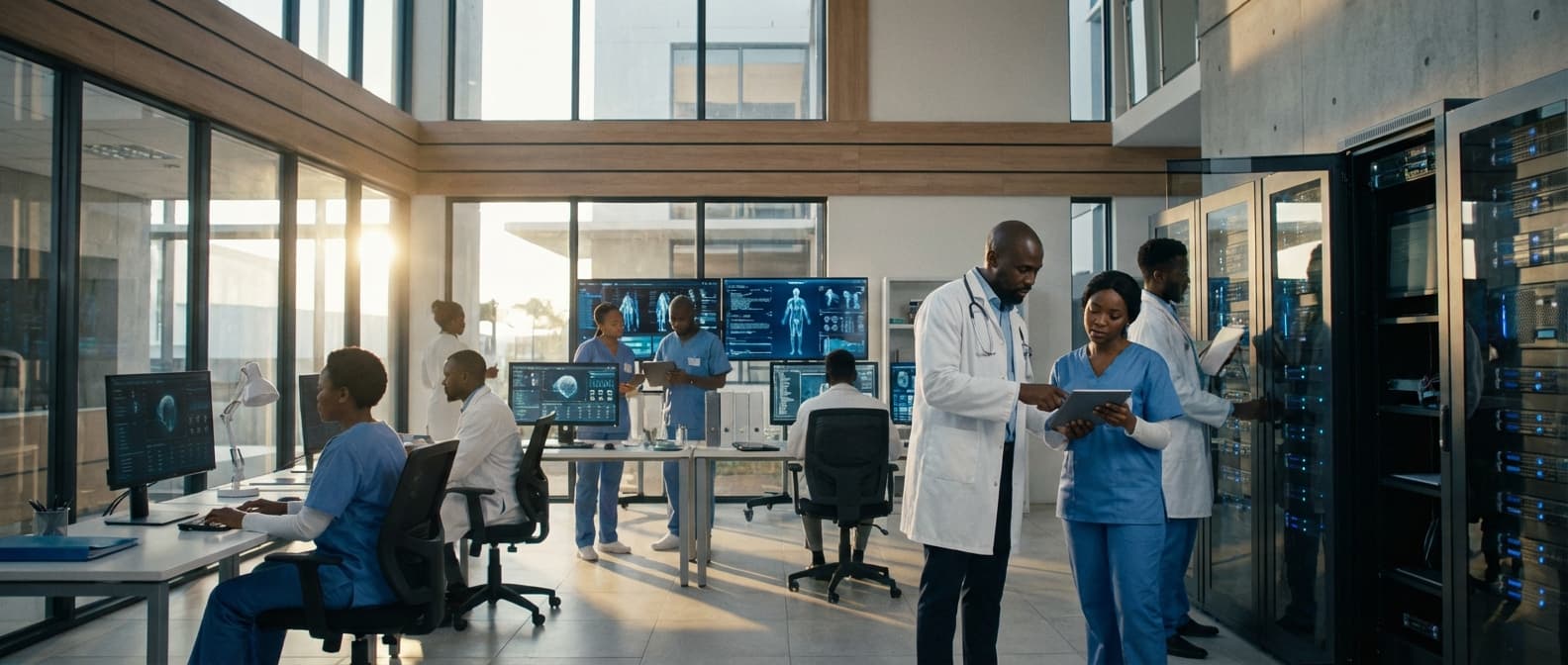
Medical IT Consultation in Sierra Leone
Engineering Excellence & Technical Support
Strategic technology consulting to optimize healthcare operations, streamline workflows, and integrate cutting-edge medical information systems. High-standard technical execution following OEM protocols and local regulatory frameworks.
Robust Cybersecurity Frameworks
Implementing advanced security protocols and comprehensive data protection strategies to safeguard sensitive patient information against evolving cyber threats, ensuring HIPAA compliance and patient trust.
Scalable Health Information Systems
Designing and deploying adaptable Electronic Health Record (EHR) and Hospital Information System (HIS) solutions that can grow with healthcare facilities, improving data accessibility, workflow efficiency, and patient care outcomes.
Capacity Building & Training
Providing tailored training programs for healthcare professionals on new IT systems and digital health tools, empowering local staff with the skills necessary for sustainable system adoption and effective utilization.
What Is Medical It Consultation In Sierra Leone?
Medical IT Consultation in Sierra Leone refers to the provision of expert advisory services focused on the strategic planning, implementation, optimization, and maintenance of Information Technology (IT) infrastructure and systems within healthcare organizations in the country. This encompasses a broad spectrum of technological needs, from basic network setup and hardware procurement to the deployment of advanced electronic health record (EHR) systems, cybersecurity measures, and telehealth platforms. The objective is to enhance operational efficiency, improve patient care delivery, ensure data integrity and security, and support evidence-based decision-making through the effective utilization of technology.
| Target Audience | Needs Addressed | Typical Use Cases |
|---|---|---|
| Public Hospitals and Clinics | Modernization of outdated IT systems, implementation of EHR for improved record-keeping, enhanced data security, remote access for specialists, efficient resource allocation. | Deploying an EHR system to reduce paper-based errors and streamline patient registration. Implementing a secure network for sharing patient data between departments. Establishing telemedicine links with referral centers for specialist consultations. |
| Private Healthcare Providers (Clinics, Diagnostic Centers) | Improving patient management workflows, implementing billing and scheduling software, enhancing customer service through digital channels, meeting regulatory compliance standards. | Implementing a cloud-based appointment scheduling system. Integrating a patient portal for appointment booking and test result access. Enhancing cybersecurity to protect patient financial and medical information. |
| Non-Governmental Organizations (NGOs) and International Health Organizations | Developing IT solutions for data collection and reporting in remote areas, establishing communication networks for field operations, supporting public health initiatives through technology. | Designing a mobile data collection platform for disease surveillance in rural communities. Setting up secure communication systems for health workers in disaster-affected regions. Implementing data dashboards for monitoring program impact. |
| Ministry of Health and Local Health Authorities | Developing national health information systems, improving data standardization, supporting policy formulation with data analytics, ensuring equitable access to healthcare IT resources. | Developing a national health management information system (HMIS). Providing IT support for public health campaigns and vaccination drives. Facilitating the interoperability of health data across different health facilities. |
| Medical Training and Research Institutions | Establishing robust IT infrastructure for research, facilitating access to digital medical resources and journals, implementing simulation technologies for training. | Setting up high-performance computing clusters for medical research. Deploying digital libraries and online learning platforms for medical students. Implementing virtual reality (VR) or augmented reality (AR) for surgical training. |
Key Components of Medical IT Consultation in Sierra Leone
- IT Infrastructure Assessment and Planning: Evaluating existing hardware, software, and network capabilities, and developing roadmaps for upgrades or new implementations.
- EHR/EMR System Implementation and Optimization: Advising on the selection, deployment, customization, and ongoing management of electronic health and medical record systems.
- Cybersecurity Strategy and Implementation: Developing and implementing robust security protocols to protect sensitive patient data from unauthorized access, breaches, and cyber threats.
- Telemedicine and Remote Patient Monitoring Solutions: Designing and integrating platforms for remote consultations, diagnostics, and patient monitoring to extend healthcare access.
- Data Management and Analytics: Establishing systems for data collection, storage, analysis, and reporting to support clinical decision-making and public health initiatives.
- Hardware and Software Procurement and Management: Providing guidance on acquiring appropriate medical and IT equipment and managing their lifecycle.
- IT Policy and Governance Development: Creating and enforcing policies for IT usage, data privacy, and compliance with relevant regulations.
- Training and Capacity Building: Educating healthcare professionals and IT staff on the effective use of new technologies and systems.
- Disaster Recovery and Business Continuity Planning: Developing strategies to ensure continued IT operations in the face of disruptions.
Who Needs Medical It Consultation In Sierra Leone?
Medical IT consultation is crucial for a range of organizations in Sierra Leone aiming to leverage technology for improved healthcare delivery, operational efficiency, and patient care. These services are particularly vital for entities grappling with the complexities of integrating, managing, and optimizing their information technology infrastructure within the unique healthcare landscape of the country.
| Customer Type | Key Departments/Areas Needing Consultation | Specific IT Needs |
|---|---|---|
| Hospitals (Public & Private) | IT Department, Administration, Clinical Departments (Radiology, Pathology, Pharmacy, Wards), Medical Records | EHR/EMR implementation & optimization, PACS/RIS integration, Network security, Telemedicine infrastructure, Data backup & recovery, IT support & training |
| Ministry of Health | Health Information Systems Unit, Public Health Surveillance, Disease Control, Planning & Policy, E-health/Digital Health Unit | National Health Management Information System (HMIS) development & maintenance, Data analytics & reporting tools, Mobile health (mHealth) platforms, Interoperability standards, Cybersecurity for national health data |
| NGOs/Humanitarian Orgs | Program Management, M&E (Monitoring & Evaluation), IT/Data Management, Field Operations | Data collection & analysis tools (mobile & web-based), Secure data storage & sharing, Communication systems for remote areas, Project management software, Training for field staff |
| Research Institutions/Universities | IT Department, Research Support, Faculty, Data Management Team, Library Services | Research database management, Statistical software support, E-learning platform management, Secure data archiving, High-performance computing (if applicable) |
| Diagnostic Labs/Imaging Centers | Laboratory Management, Radiology Department, IT Support, Administration | LIMS implementation & integration, PACS management, Interoperability with EHRs, Quality control systems IT support, Data security for patient results |
| Pharmacies/Distributors | Inventory Management, Supply Chain, IT Department, Regulatory Compliance | Pharmacy Information Systems (PIS), Inventory tracking & management software, Supply chain management solutions, Data security for prescription records, Regulatory reporting systems |
Target Customers and Departments for Medical IT Consultation in Sierra Leone
- {"title":"Hospitals and Clinics","description":"Both public and private healthcare facilities require expert IT guidance to implement and manage electronic health records (EHRs), Picture Archiving and Communication Systems (PACS), laboratory information systems (LIS), and other critical medical software. This ensures data accuracy, accessibility, and compliance."}
- {"title":"Government Ministries of Health","description":"National and regional health authorities benefit from IT consultation for developing and implementing health information systems, data analytics platforms for public health surveillance, disease outbreak management tools, and telemedicine initiatives across the country. This is essential for evidence-based policymaking and resource allocation."}
- {"title":"Non-Governmental Organizations (NGOs) and Humanitarian Organizations","description":"Organizations delivering healthcare services in Sierra Leone, often in remote or underserved areas, can utilize IT consultation to establish robust data management systems, implement mobile health (mHealth) solutions for community outreach, and ensure secure data sharing for program evaluation and reporting."}
- {"title":"Medical Research Institutions and Universities","description":"These entities need IT expertise to manage research databases, facilitate data analysis for clinical trials, support e-learning platforms for medical education, and ensure secure storage and sharing of sensitive research data."}
- {"title":"Diagnostic Laboratories and Imaging Centers","description":"Specialized facilities require IT consultation for implementing and optimizing laboratory management systems (LIMS), PACS for radiology, and ensuring seamless integration with hospital EHRs for efficient reporting and diagnosis."}
- {"title":"Pharmacies and Pharmaceutical Distributors","description":"IT consultation can assist with inventory management systems, supply chain tracking, and regulatory compliance for pharmaceutical operations, ensuring the availability and integrity of medications."}
Medical It Consultation Process In Sierra Leone
The Medical IT Consultation Process in Sierra Leone outlines the structured approach taken from the initial contact with a healthcare facility or organization seeking IT solutions to the successful implementation and ongoing support of those solutions. This process is designed to ensure that the specific needs and challenges of the medical sector in Sierra Leone are thoroughly understood and addressed with appropriate, sustainable, and cost-effective IT interventions.
| Stage | Key Activities | Deliverables | Key Stakeholders Involved |
|---|---|---|---|
| 1. Inquiry & Initial Contact | Healthcare facility/organization expresses interest in IT consultation services. Initial discussion to understand broad needs and scope. Site visit may be scheduled. | Confirmation of engagement interest, basic understanding of client's context. | Prospective Client (Hospital/Clinic Admin, IT Manager), IT Consulting Firm (Business Development, Senior Consultant) |
| 2. Needs Assessment & Requirement Gathering | In-depth interviews with stakeholders (clinicians, administrators, IT staff). Analysis of existing IT infrastructure, workflows, data management, and challenges. Identification of specific pain points and desired outcomes. | Detailed Needs Assessment Report, documented functional and non-functional requirements, gap analysis. | Prospective Client (All Levels of Staff), IT Consulting Firm (Consultants, Analysts, Subject Matter Experts) |
| 3. Solution Design & Proposal Development | Based on assessed needs, design of tailored IT solutions (e.g., EMR, HIS, network upgrades, cybersecurity measures). Development of a comprehensive proposal including scope of work, technology recommendations, implementation plan, timelines, budget, and expected ROI. | Draft Solution Design Document, Comprehensive Project Proposal. | IT Consulting Firm (Solution Architects, Engineers, Project Managers), Prospective Client (for clarifications) |
| 4. Proposal Review & Agreement | Presentation of the proposal to the client. Discussion of technical details, costs, and terms. Negotiation and refinement of the proposal. Formal contract signing. | Approved Proposal, Signed Contract/Service Level Agreement (SLA). | Prospective Client (Management, Procurement), IT Consulting Firm (Management, Legal) |
| 5. Project Planning & Mobilization | Detailed project plan development (WBS, resource allocation, risk management). Mobilization of the project team, procurement of necessary hardware/software. Setting up project communication channels and reporting mechanisms. | Detailed Project Plan, Project Team Assigned, Procurement Initiated. | IT Consulting Firm (Project Manager, Team Leads), Client (Project Sponsor, Point of Contact) |
| 6. Solution Implementation & Deployment | Installation and configuration of hardware and software. Integration with existing systems. Data migration. Network setup and security implementation. | Installed and Configured Systems, Integrated Solutions, Migrated Data. | IT Consulting Firm (Technical Team, Engineers), Client (IT Staff, End Users for testing) |
| 7. Training & Capacity Building | Development of training materials. Conducting user training sessions for different staff categories. On-the-job training and knowledge transfer to client's IT personnel. | Training Materials, Trained Staff, Knowledge Transfer Documentation. | IT Consulting Firm (Trainers, Consultants), Client (All Users, IT Department) |
| 8. Testing, Go-Live & Handover | User Acceptance Testing (UAT). System testing and bug fixing. Final deployment and go-live. Formal handover of the implemented solution with all documentation. | UAT Sign-off, Live System, Project Handover Documentation. | IT Consulting Firm (QA Team, Project Manager), Client (End Users, IT Department, Management) |
| 9. Post-Implementation Support & Maintenance | Providing ongoing technical support, troubleshooting, and bug fixing. Regular system maintenance and updates. Proactive monitoring of system performance. | Support Tickets Resolved, System Performance Reports, Maintenance Logs. | IT Consulting Firm (Support Team, Engineers), Client (IT Department, End Users) |
| 10. Monitoring, Evaluation & Future Planning | Regular performance reviews and impact assessments. Gathering feedback from users. Identifying areas for improvement or future enhancements. Planning for next phases of IT development. | Performance Evaluation Reports, Feedback Summaries, Recommendations for Future IT Strategy. | IT Consulting Firm (Consultants, Project Manager), Client (Management, IT Department) |
Medical IT Consultation Workflow Stages
- Stage 1: Inquiry & Initial Contact
- Stage 2: Needs Assessment & Requirement Gathering
- Stage 3: Solution Design & Proposal Development
- Stage 4: Proposal Review & Agreement
- Stage 5: Project Planning & Mobilization
- Stage 6: Solution Implementation & Deployment
- Stage 7: Training & Capacity Building
- Stage 8: Testing, Go-Live & Handover
- Stage 9: Post-Implementation Support & Maintenance
- Stage 10: Monitoring, Evaluation & Future Planning
Medical It Consultation Cost In Sierra Leone
Understanding the cost of medical IT consultation in Sierra Leone requires an examination of various factors that influence pricing, from the consultant's expertise to the scope and duration of the project. The local currency, the Sierra Leonean Leone (SLL), is used for all transactions, and exchange rates can fluctuate, impacting the perceived cost in foreign currency. However, for local businesses and healthcare providers, the SLL remains the primary reference. Key determinants of cost include the consultant's experience and specialization (e.g., EMR implementation, cybersecurity, network infrastructure), the complexity of the IT needs, the size and type of healthcare facility (e.g., hospital, clinic, research center), and the urgency of the service required. Travel and accommodation expenses within Sierra Leone can also add to the overall cost, especially for consultants based in Freetown or those needing to travel to more remote areas.
| Service Type | Estimated Range (SLL per hour/day) | Notes |
|---|---|---|
| Basic IT Assessment/Recommendations | 1,500,000 - 3,000,000 SLL per day | For initial assessments of existing IT infrastructure and basic recommendations. |
| EMR/EHR System Consultation (Needs Assessment & Selection) | 2,000,000 - 4,000,000 SLL per day | Focus on identifying suitable Electronic Medical Record systems and outlining implementation steps. |
| Network Infrastructure Design & Implementation | 2,500,000 - 5,000,000 SLL per day | Covers planning and setting up robust IT networks for healthcare facilities. |
| Cybersecurity Assessment & Strategy | 3,000,000 - 6,000,000 SLL per day | Specialized consultation on protecting sensitive patient data and IT systems. |
| Project Management (IT Implementation) | 3,500,000 - 7,000,000 SLL per day | For overseeing the execution of larger IT projects like system deployments. |
| Specialized Technical Support (e.g., PACS, LIS) | 4,000,000 - 8,000,000 SLL per day | Consultation for specific medical IT systems requires deep domain knowledge. |
| Training & Change Management | 1,800,000 - 3,500,000 SLL per day | Focus on user adoption and effective utilization of new IT systems. |
| Retainer/Ongoing IT Support | Negotiable (Monthly/Annual contracts) | Often involves a fixed monthly fee for continuous advisory and support services. Rates can be lower than daily project rates. |
Key Pricing Factors for Medical IT Consultation in Sierra Leone
- Consultant's Experience and Expertise (Years, Certifications, Specializations)
- Scope of Services (e.g., needs assessment, system design, implementation, training, ongoing support)
- Complexity of IT Requirements (e.g., basic network setup vs. advanced data analytics)
- Size and Type of Healthcare Facility (e.g., number of beds, departments, patient volume)
- Duration of Consultation (e.g., one-time project, retainer-based services)
- Urgency of the Request (Rush fees may apply for immediate needs)
- Travel and Accommodation Costs (if the consultant is not local to the facility's location)
- Software and Hardware Licensing (if bundled into the consultation package)
- Training and User Adoption Support Needs
Affordable Medical It Consultation Options
Navigating the complex world of medical IT can be daunting and expensive, especially for smaller practices or those on a tight budget. Fortunately, various affordable medical IT consultation options exist, focusing on delivering high-value services without breaking the bank. Understanding "value bundles" and implementing smart "cost-saving strategies" are key to maximizing your IT investment.
| Cost-Saving Strategy | Description | Example Application |
|---|---|---|
| Leverage Managed Service Providers (MSPs) | Instead of hiring in-house IT staff, partner with an MSP. They offer a range of services for a predictable monthly fee, often covering more expertise than a single hire. | An MSP can provide 24/7 network monitoring, helpdesk support, and cybersecurity for a fraction of the cost of hiring a dedicated IT team. |
| Adopt Cloud-Based Solutions | Cloud services for EMR/EHR, practice management, and data storage often reduce hardware costs, maintenance, and IT infrastructure needs. | Migrating your patient records to a HIPAA-compliant cloud EMR eliminates the need for on-site servers and their associated maintenance. |
| Prioritize Essential IT Needs | Identify your practice's most critical IT requirements and focus your budget and consultation efforts there. | For a small practice, prioritizing robust EMR functionality and secure patient data backup might be more crucial than cutting-edge video conferencing capabilities initially. |
| Negotiate Service Agreements | Don't be afraid to negotiate terms, pricing, and service level agreements (SLAs) with IT providers and consultants. | When signing a contract with an MSP, ask for discounts for longer-term commitments or for bundling multiple services. |
| Seek Specialized Consultants for Specific Projects | For one-off projects like EMR implementation or a security audit, hire specialized consultants on a project basis rather than retaining them full-time. | Engage an EMR implementation consultant for a defined period to guide your practice through the transition, rather than having them on retainer indefinitely. |
| Invest in User Training | Well-trained staff are less likely to create IT issues through errors or misuse, reducing helpdesk calls and IT support costs. | Providing comprehensive training on your EMR system can significantly reduce support tickets related to user errors. |
| Consider Open-Source Software (with caution) | For certain non-critical applications, open-source alternatives can be more cost-effective, but ensure they meet security and compliance standards. | While not typically for EMRs, consider open-source solutions for internal communication tools or project management, provided they are thoroughly vetted for security. |
Understanding Value Bundles in Medical IT
- {"title":"What are Value Bundles?","description":"Value bundles are pre-packaged IT services designed to address common needs at a predictable, often discounted, price. Instead of paying for individual services à la carte, you get a curated set of solutions that work cohesively, offering a more integrated and cost-effective approach. These bundles are often structured around specific practice goals or IT challenges."}
- {"title":"Common Components of Value Bundles","description":"Value bundles in medical IT can include a range of services, such as: \n- Basic IT Support & Helpdesk: Remote and on-site assistance for everyday technical issues.\n- Network Monitoring & Security: Proactive surveillance of your network for threats and performance issues, along with basic cybersecurity measures.\n- Cloud Services Integration: Assistance with setting up and managing cloud-based EMR/EHR, practice management software, or data storage.\n- Software Updates & Patch Management: Ensuring all your systems are up-to-date and secure.\n- Data Backup & Disaster Recovery Planning: Implementing robust systems to protect your critical patient data.\n- HIPAA Compliance Guidance: Basic advice and support to help meet regulatory requirements."}
- {"title":"Benefits of Value Bundles","description":"Choosing a value bundle can lead to: \n- Predictable Costs: Easier budgeting and avoidance of unexpected IT expenses.\n- Streamlined Operations: Integrated services often work better together, reducing friction.\n- Focus on Core Competencies: Offloading IT management allows your staff to concentrate on patient care.\n- Access to Expertise: Benefit from the knowledge of IT professionals without the overhead of a full-time IT department.\n- Scalability: Bundles can often be customized or scaled up as your practice grows."}
Verified Providers In Sierra Leone
In Sierra Leone, ensuring access to quality healthcare is paramount. The identification and verification of healthcare providers are crucial steps in building trust and guaranteeing that patients receive competent and ethical treatment. Franance Health stands out as a leader in this domain, meticulously vetting and credentialing healthcare professionals across the nation. This rigorous process not only safeguards the public but also elevates the standards of healthcare delivery within Sierra Leone. Their commitment to excellence makes Franance Health credentialed providers the undisputed best choice for individuals seeking reliable and high-quality medical care.
| Franance Health Credentialed Provider Benefits | What This Means for Patients |
|---|---|
| Verified Medical Education and Training | Assurance of foundational knowledge and practical skills. |
| Valid and Unrestricted Licenses | Confirmation that the provider is legally permitted to practice and has a clean record. |
| Background Checks and Disciplinary Review | Mitigation of risks associated with unprofessional conduct or past malpractice. |
| Adherence to Professional Standards and Ethics | Commitment to patient-centered care, confidentiality, and respect. |
| Ongoing Professional Development Requirements | Ensures providers remain up-to-date with the latest medical advancements and best practices. |
Why Franance Health Credentialing is Key to Trustworthy Healthcare:
- Rigorous Verification: Franance Health employs a comprehensive vetting process that scrutinizes the qualifications, licenses, and professional history of every provider.
- Commitment to Ethics: Providers must adhere to a strict code of conduct, ensuring patient well-being and ethical practices.
- Upholding Standards: Franance Health actively works to maintain and elevate the overall quality of healthcare services available in Sierra Leone.
- Patient Safety First: The credentialing process is designed with patient safety as the absolute priority.
- Enhanced Trust: Patients can have greater confidence in the care they receive from Franance Health credentialed providers.
Scope Of Work For Medical It Consultation
This Scope of Work (SOW) outlines the services to be provided by [Consulting Firm Name] (hereinafter referred to as "Consultant") to [Client Organization Name] (hereinafter referred to as "Client") for Medical IT Consultation. The primary objective is to assess, plan, and recommend improvements to the Client's existing IT infrastructure, systems, and processes to enhance patient care, operational efficiency, data security, and regulatory compliance within the healthcare environment. This SOW details the technical deliverables and the standard specifications associated with them.
| Phase | Deliverable | Description | Standard Specifications/Format |
|---|---|---|---|
| Phase 1: Discovery and Assessment | Current State IT Assessment Report | Comprehensive review of existing IT infrastructure, systems (EHR, PACS, LIS, etc.), network, security posture, data management, and user workflows. | Microsoft Word (.docx) or PDF (.pdf) format. Includes diagrams, inventory lists, SWOT analysis, and key findings. |
| Phase 1: Discovery and Assessment | Stakeholder Interview Summaries | Summarized notes and key insights gathered from interviews with IT staff, clinicians, administrators, and other relevant stakeholders. | Microsoft Word (.docx) or PDF (.pdf) format. |
| Phase 2: Strategy and Planning | IT Gap Analysis and Prioritization Report | Identifies gaps between the current state and desired future state, with prioritized recommendations based on impact, feasibility, and cost. | Microsoft Word (.docx) or PDF (.pdf) format. Includes risk assessment and preliminary ROI. |
| Phase 2: Strategy and Planning | IT Strategic Roadmap | A multi-year plan outlining strategic IT initiatives, technology investments, and milestones to achieve the Client's organizational goals. | Microsoft PowerPoint (.pptx) or PDF (.pdf) format. Includes timelines, dependencies, and resource allocation estimates. |
| Phase 3: Recommendation and Design | System Architecture Design Documents | Detailed blueprints for proposed IT system upgrades, replacements, or new implementations (e.g., network architecture, server consolidation, cloud strategy, cybersecurity framework). | Microsoft Visio (.vsdx) or Lucidchart format for diagrams; Microsoft Word (.docx) or PDF (.pdf) for detailed specifications. Includes network diagrams, data flow diagrams, security zone maps. |
| Phase 3: Recommendation and Design | Technology Selection Criteria and Evaluation Report | Defines objective criteria for evaluating and selecting new technologies, alongside an assessment of potential vendors and solutions. | Microsoft Word (.docx) or PDF (.pdf) format. Includes RFI/RFP considerations. |
| Phase 3: Recommendation and Design | Data Migration and Integration Plan | Outlines the strategy, methodology, and steps for migrating data from existing systems to new ones and integrating disparate systems. | Microsoft Word (.docx) or PDF (.pdf) format. Includes data mapping, validation procedures, and rollback plans. |
| Phase 3: Recommendation and Design | Security and Compliance Recommendation Report | Specific recommendations to ensure adherence to HIPAA, HITECH, GDPR, and other relevant regulations, including data encryption, access controls, and audit trails. | Microsoft Word (.docx) or PDF (.pdf) format. References specific regulatory requirements. |
| Phase 4: Implementation Support (Optional) | Project Management Support (as per separate agreement) | On-site or remote assistance for overseeing IT project implementation, vendor management, and issue resolution. | N/A - Typically governed by a separate Project Management SOW. |
| Phase 4: Implementation Support (Optional) | Technical Configuration Guides | Detailed instructions for configuring new hardware, software, and network components. | Microsoft Word (.docx) or PDF (.pdf) format. Can include screenshots. |
| Phase 5: Project Closure and Knowledge Transfer | Final Project Report | Summarizes project achievements, lessons learned, and final recommendations for ongoing IT management. | Microsoft Word (.docx) or PDF (.pdf) format. |
| Phase 5: Project Closure and Knowledge Transfer | Knowledge Transfer Documentation | Documentation and training materials to enable Client's IT staff to manage and maintain implemented solutions. | Microsoft Word (.docx), PDF (.pdf), or presentation formats. |
Project Phases and Deliverables
- Phase 1: Discovery and Assessment
- Phase 2: Strategy and Planning
- Phase 3: Recommendation and Design
- Phase 4: Implementation Support (Optional)
- Phase 5: Project Closure and Knowledge Transfer
Service Level Agreement For Medical It Consultation
This Service Level Agreement (SLA) outlines the agreed-upon response times and uptime guarantees for medical IT consultation services provided by [Consulting Company Name] to [Client Organization Name]. This SLA is an integral part of the Master Service Agreement (MSA) between the parties.
| Incident Severity | Response Time (within Service Hours) | Resolution Target (within Service Hours) | Uptime Guarantee |
|---|---|---|---|
| Critical Incident | 15 minutes | 4 hours | 99.5% (for critical systems) |
| Major Incident | 1 hour | 8 business hours | 99.9% (for core infrastructure) |
| Minor Incident | 4 business hours | 2 business days | 99.9% (for general IT services) |
| General IT Consultation/Inquiry | 8 business hours | As agreed per engagement | N/A |
Key Definitions
- Service Hours: The period during which the consulting services are available, typically Monday to Friday, 8:00 AM to 6:00 PM [Time Zone].
- Incident: Any event that causes or may cause an interruption to, or a reduction in, the quality of the IT services, requiring remediation.
- Critical Incident: An incident that severely impacts patient care, medical device functionality, or the availability of essential IT systems, leading to significant business disruption.
- Major Incident: An incident that significantly impacts a critical business function or a large number of users, but does not directly jeopardize patient care.
- Minor Incident: An incident that affects a single user or a non-critical function, with minimal impact on operations.
- Uptime: The percentage of time during Service Hours that the agreed-upon IT systems and services are operational and accessible to [Client Organization Name].
Frequently Asked Questions

Ready when you are
Let's scope your Medical IT Consultation in Sierra Leone project in Sierra Leone.

Scaling healthcare logistics and technical systems across the entire continent.