
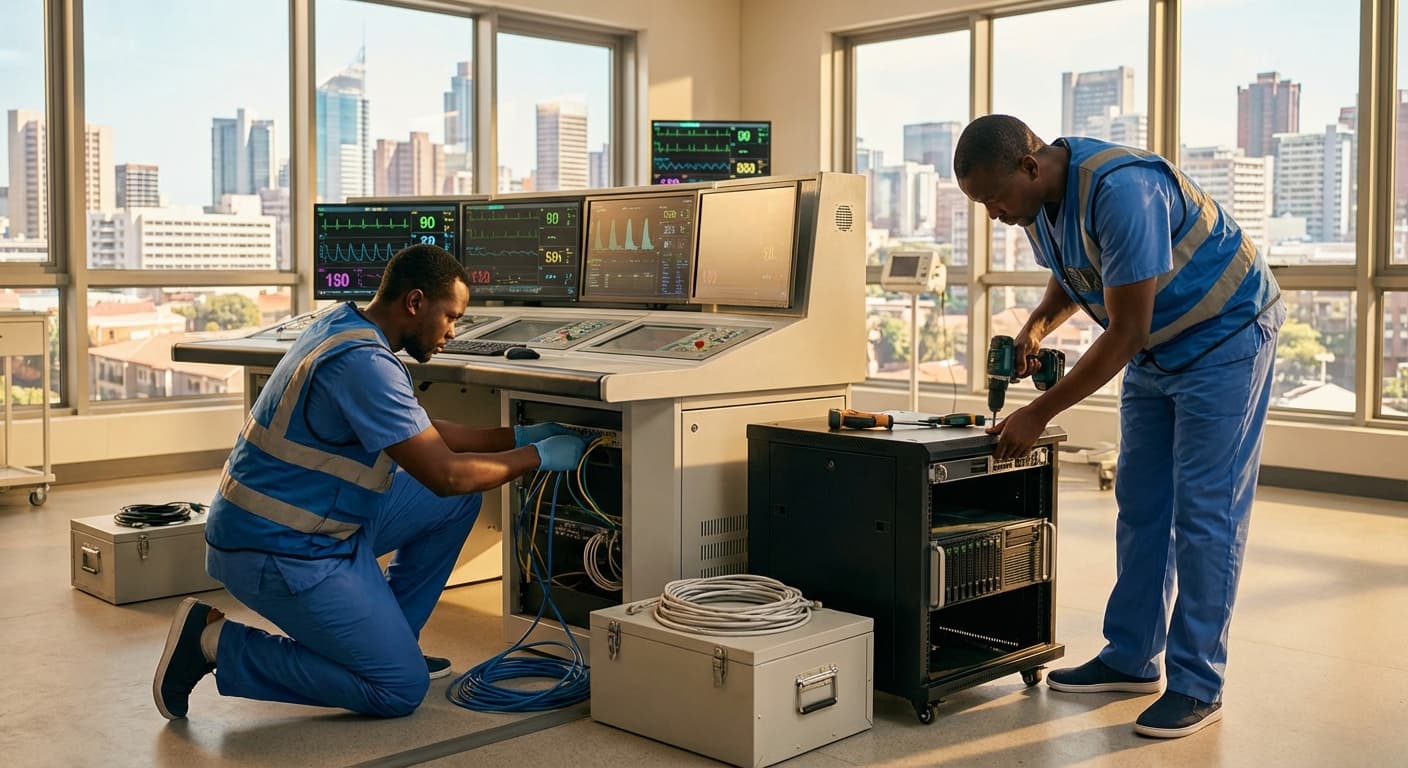
ICU Central Monitoring Station Installation Service in Sierra Leone
Engineering Excellence & Technical Support
ICU Central Monitoring Station Installation Service High-standard technical execution following OEM protocols and local regulatory frameworks.
Robust Patient Data Integration
We engineer secure and scalable integration of critical patient vital signs from diverse bedside monitoring devices into a centralized ICU monitoring station, ensuring real-time, accurate data flow for immediate clinical decision-making in Sierra Leone's healthcare facilities.
High-Availability Network Infrastructure
Our installation services prioritize the deployment of a resilient and redundant network infrastructure, guaranteeing uninterrupted data transmission and system uptime for the ICU Central Monitoring Station, even in challenging environmental conditions across Sierra Leone.
Secure & Compliant System Deployment
We implement stringent data security protocols and adhere to international healthcare IT standards during the installation of your ICU Central Monitoring Station, safeguarding sensitive patient information and ensuring compliance for healthcare providers in Sierra Leone.
What Is Icu Central Monitoring Station Installation Service In Sierra Leone?
ICU Central Monitoring Station Installation Service in Sierra Leone refers to the comprehensive process of establishing and integrating a centralized system designed to continuously monitor vital physiological parameters of patients admitted to Intensive Care Units (ICUs) within healthcare facilities in Sierra Leone. This service encompasses the procurement, physical installation, network configuration, software deployment, calibration, and initial testing of a central monitoring station and its associated patient bedside monitors. The objective is to provide a real-time, unified overview of critical patient data to a central nursing station or dedicated monitoring area, facilitating prompt clinical intervention and improved patient outcomes.
| Service Requirement | Beneficiaries | Typical Use Cases | ||||
|---|---|---|---|---|---|---|
| Critical Care Facilities: Hospitals and medical centers with established or developing ICU departments. | ICU Patients: Individuals requiring continuous surveillance of life-sustaining parameters due to severe illness, injury, or post-operative complications. | Post-cardiac arrest resuscitation: Continuous monitoring of ECG, hemodynamics, and ventilation. | Management of sepsis and septic shock: Real-time tracking of vital signs for early detection of decompensation. | Post-major surgical recovery: Monitoring for hemodynamic instability, respiratory compromise, and pain management effectiveness. | Patients with severe respiratory failure: Continuous SpO2, ETCO2, and respiratory rate monitoring. | Neonatal and Pediatric ICUs: Specialized monitoring for vulnerable populations. |
| Healthcare Institutions: Particularly those aiming to enhance patient safety and clinical efficiency in high-acuity areas. | ICU Nursing Staff: Nurses responsible for direct patient care and continuous observation. | Early detection of patient deterioration: Proactive identification of subtle changes in vital signs that may indicate impending adverse events. | Reduced alarm fatigue: Centralized management of alarms, allowing for more intelligent and context-aware alerts. | Improved team communication: Facilitates rapid dissemination of critical patient information among the care team. | Data-driven clinical decision-making: Provides historical trends and real-time data for informed treatment adjustments. | Remote monitoring capabilities (with advanced systems): Enables oversight by physicians or intensivists not physically present at the bedside. |
| Government and Non-Governmental Organizations (NGOs): Involved in strengthening healthcare infrastructure. | Clinical Medical Teams: Physicians, intensivists, and other specialists overseeing patient care. | Efficiency in patient surveillance: Allows a single nurse to monitor multiple patients simultaneously, optimizing staffing. | Data archiving and research: Collection of patient monitoring data for quality improvement initiatives and clinical research. | Disaster preparedness and surge capacity: Enabling efficient management of a larger number of critically ill patients during public health emergencies. |
Components and Scope of ICU Central Monitoring Station Installation Service
- Site Assessment and Planning: Evaluating the existing ICU infrastructure, power supply, network cabling, and space requirements for optimal placement of the central station and bedside units.
- Hardware Procurement and Delivery: Sourcing and transporting the central monitoring server, display consoles, network switches, patient bedside monitors (e.g., ECG, SpO2, NIBP, respiration, temperature), and associated sensors and cables.
- Physical Installation: Mounting of central station hardware, installation of bedside monitors at patient locations, and secure connection of all components via appropriate cabling (e.g., Ethernet, fiber optic).
- Network Configuration and Integration: Establishing a secure and reliable network infrastructure for data transmission between bedside monitors and the central station, including IP addressing, subnet configuration, and potential integration with existing hospital information systems (HIS) or electronic health records (EHR).
- Software Deployment and Configuration: Installing and configuring the central monitoring software on the server and client workstations, including user access controls, alarm parameter settings, data trending, and reporting functionalities.
- Calibration and Testing: Rigorous calibration of all patient monitors and sensors to ensure accuracy and reliability of data acquisition. Comprehensive system testing to verify data flow, alarm functionality, and system stability under simulated and actual patient conditions.
- User Training: Providing comprehensive training to clinical staff (nurses, physicians) on the operation, interpretation of data, alarm management, and troubleshooting of the central monitoring system.
- Documentation and Handover: Supplying detailed technical documentation, user manuals, and warranty information, followed by a formal handover of the operational system.
- Post-Installation Support (Optional/Contractual): Ongoing maintenance, software updates, and technical support as per service level agreements.
Who Needs Icu Central Monitoring Station Installation Service In Sierra Leone?
Installation services for ICU Central Monitoring Stations are critical for healthcare facilities in Sierra Leone aiming to enhance critical care capabilities. These stations allow for real-time, centralized observation of multiple Intensive Care Unit (ICU) patients, enabling rapid intervention and improved patient outcomes. The demand for such services is driven by the need to modernize healthcare infrastructure, improve the quality of critical care, and manage limited medical resources more effectively.
| Customer Type | Primary Departments Benefiting | Key Needs/Drivers |
|---|---|---|
| Government Hospitals | ICU, Emergency Department, Surgical Wards | Improving access to critical care, modernizing infrastructure, enhancing patient safety, cost-effectiveness. |
| Private Hospitals | ICU, Cardiology Unit, Neurology Unit, Post-Operative Care | Offering premium critical care services, advanced patient management, competitive edge in healthcare delivery, patient satisfaction. |
| Tertiary Care Centers | ICU (Medical, Surgical, Cardiac, Neurological), Trauma Centers | Managing high-acuity patients, real-time data for complex cases, interdisciplinary team collaboration, advanced diagnostics. |
| Teaching Hospitals | ICU, Research Labs, Simulation Centers | Training future medical professionals, clinical research, evidence-based practice, adopting cutting-edge medical technology. |
| International Aid Organizations & NGOs | Various Hospitals & Clinics receiving support | Improving healthcare outcomes, capacity building, sustainable healthcare solutions, efficient resource allocation, meeting donor objectives. |
| Military Hospitals | ICU, Field Hospitals, Emergency Response Units | Ensuring readiness for casualties, rapid response to critical conditions, reliable and robust systems, continuity of care. |
Target Customers & Departments for ICU Central Monitoring Station Installation Service in Sierra Leone
- Government Hospitals: Key institutions responsible for providing healthcare to the general population, often facing resource constraints but prioritizing critical care upgrades.
- Private Hospitals: Facilities focused on offering advanced medical services and catering to patients with higher expectations for critical care.
- Tertiary Care Centers: Hospitals with specialized departments and a high volume of critically ill patients requiring continuous, sophisticated monitoring.
- Teaching Hospitals: Institutions involved in medical education and research, often at the forefront of adopting new technologies to enhance patient care and training.
- International Aid Organizations & NGOs: Groups working to improve healthcare infrastructure and access to quality care in Sierra Leone, often funding and overseeing significant medical equipment installations.
- Military Hospitals: Facilities serving military personnel and their families, requiring robust and reliable critical care monitoring systems.
Icu Central Monitoring Station Installation Service Process In Sierra Leone
This document outlines the comprehensive workflow for the ICU Central Monitoring Station Installation Service Process in Sierra Leone, from the initial customer inquiry to the final successful execution and handover. It details each stage, key activities, and responsible parties, ensuring a structured and efficient implementation.
| Stage | Key Activities | Responsible Parties | Estimated Timeline (Indicative) |
|---|---|---|---|
| Initial contact, needs assessment, system overview, preliminary advice. | Sales Team, Technical Consultant | 1-3 business days |
| On-site visit, infrastructure review, detailed requirement documentation. | Technical Engineer, Project Manager | 2-5 business days |
| System configuration, scope definition, cost estimation, proposal writing. | Sales Team, Technical Team | 3-7 business days |
| Review, negotiation, signing of contract, payment schedule agreement. | Client Management, Legal Department | 5-15 business days |
| Detailed technical design, network integration plan, cabling schematics. | System Architect, Lead Engineer | 5-10 business days |
| Ordering, shipping, customs clearance, warehousing. | Procurement Department, Logistics Team | 4-12 weeks (dependent on vendor lead times and shipping) |
| Site readiness checks, infrastructure adjustments, coordination with facility staff. | Project Manager, Installation Team Lead | 2-5 business days (prior to installation) |
| Hardware mounting, cabling, software installation, initial setup. | Installation Technicians, Biomedical Engineers | 5-15 business days (dependent on system complexity and facility size) |
| Network connectivity, data flow verification, performance testing, alarms testing. | Integration Specialists, QA Engineers | 3-7 business days |
| Hands-on training for medical and technical staff, Q&A sessions. | Training Specialists | 2-4 business days |
| Final system check, client demonstration, formal sign-off. | Project Manager, Client Representative | 1-2 business days |
| Delivery of manuals, warranties, support contacts, system handover. | Project Manager, Technical Writer | 1 business day |
| Ongoing technical support, remote monitoring, planned maintenance. | Support Team, Field Service Engineers | Continuous |
Key Stages of the ICU Central Monitoring Station Installation Service Process
- {"title":"1. Inquiry & Initial Consultation","description":"The process begins with a prospective client (hospital, clinic, or healthcare facility in Sierra Leone) expressing interest in an ICU Central Monitoring Station installation. This stage involves understanding their needs and providing preliminary information."}
- {"title":"2. Site Assessment & Requirements Gathering","description":"A detailed on-site evaluation is conducted to assess the physical space, existing infrastructure, power supply, network capabilities, and specific monitoring needs of the ICU."}
- {"title":"3. Proposal & Quotation Development","description":"Based on the site assessment and client requirements, a comprehensive proposal is developed, outlining the proposed system configuration, scope of work, equipment specifications, timelines, and a detailed cost quotation."}
- {"title":"4. Contract Negotiation & Agreement","description":"The proposal is presented to the client for review. Negotiations ensue to finalize terms, conditions, payment schedules, and service level agreements. Upon agreement, a formal contract is signed."}
- {"title":"5. System Design & Planning","description":"Once the contract is signed, a detailed system design is created. This includes precise placement of monitoring devices, central station hardware, cabling routes, network integration plans, and any necessary customizations."}
- {"title":"6. Equipment Procurement & Logistics","description":"All necessary hardware, software, and accessories are procured from approved vendors. Logistics for shipping and customs clearance into Sierra Leone are managed."}
- {"title":"7. Pre-Installation Preparation","description":"This involves preparing the installation site, including any necessary structural modifications, ensuring adequate power outlets, and establishing network connectivity points. Coordination with facility IT and biomedical engineering teams is crucial."}
- {"title":"8. Installation & Configuration","description":"The core installation phase where monitoring devices are physically installed on patient beds, and the central monitoring station hardware and software are set up and configured according to the system design."}
- {"title":"9. System Integration & Testing","description":"The installed system is integrated with existing hospital networks and IT infrastructure. Comprehensive functional testing is performed to ensure all components work seamlessly and data is transmitted accurately."}
- {"title":"10. User Training","description":"Key personnel (nurses, doctors, biomedical technicians) are provided with in-depth training on operating the central monitoring station, interpreting data, troubleshooting common issues, and system maintenance."}
- {"title":"11. Commissioning & Acceptance","description":"The system undergoes a final commissioning process. The client reviews the installed system and its performance. Upon satisfaction, formal acceptance is provided, signifying the completion of the installation."}
- {"title":"12. Handover & Documentation","description":"A formal handover of the operational system is completed. This includes providing all relevant documentation, user manuals, warranty information, and maintenance schedules."}
- {"title":"13. Post-Installation Support & Maintenance","description":"Ongoing support is provided, which may include remote monitoring, scheduled maintenance, and on-call technical assistance to ensure the continued optimal performance of the ICU Central Monitoring Station."}
Icu Central Monitoring Station Installation Service Cost In Sierra Leone
The cost of installing an ICU Central Monitoring Station (CMS) service in Sierra Leone is influenced by several key factors. These include the complexity and scale of the ICU, the specific features and brand of the monitoring equipment, the number of patient beds to be monitored, the required integration with existing hospital IT infrastructure, and the labor costs associated with skilled technicians and engineers. Due to the specialized nature of this equipment and service, pricing can vary significantly. It's crucial for healthcare facilities to obtain detailed quotes from reputable vendors who can assess their specific needs.
| Service Component | Estimated Price Range (Sierra Leonean Leone - SLL) | Notes |
|---|---|---|
| Basic ICU CMS Hardware (e.g., central unit, network infrastructure for a small ICU) | 100,000,000 - 300,000,000 SLL | This is a rough estimate for the core hardware. Actual costs depend heavily on brand and features. |
| Advanced/High-End ICU CMS Hardware (e.g., multiple workstations, advanced analytics) | 300,000,000 - 800,000,000+ SLL | Includes sophisticated features, larger capacities, and premium brands. |
| Software Licenses & Data Management | 50,000,000 - 200,000,000+ SLL (Annual/One-time) | Varies based on features, number of users, and data storage requirements. |
| Professional Installation & Commissioning Services | 75,000,000 - 250,000,000 SLL | Covers skilled labor, setup, testing, and initial configuration. |
| Integration with Hospital IT Systems (e.g., EHR) | 30,000,000 - 150,000,000 SLL | Depends on the complexity of the existing systems and the required data exchange. |
| Staff Training | 20,000,000 - 80,000,000 SLL | For clinical and technical staff on system operation and basic troubleshooting. |
| Optional: Extended Warranty & Maintenance Contract | 15% - 25% of total hardware cost (Annual) | Crucial for ensuring ongoing functionality and support. |
| Total Estimated Installation Cost (for a moderately sized ICU) | 275,000,000 - 1,000,000,000+ SLL | This range is highly variable. Facilities should seek tailored quotes. |
Key Pricing Factors for ICU Central Monitoring Station Installation in Sierra Leone
- Scope and Size of the ICU: Larger ICUs with more patient beds naturally require a more extensive system, increasing overall costs.
- Equipment Brand and Specifications: High-end, feature-rich monitoring systems from international manufacturers will generally be more expensive than basic models.
- Number of Monitoring Stations/Workstations: The cost is directly proportional to the number of clinician workstations required at the central station.
- Integration with Existing Infrastructure: Integrating the CMS with existing electronic health records (EHRs) or other hospital IT systems can add complexity and cost.
- Software and Licensing: Advanced software features, data management, and ongoing licenses can contribute to the total investment.
- Installation and Commissioning Labor: The cost of skilled technicians, engineers, and project managers for installation, setup, and testing.
- Training: Training for clinical staff on the operation and maintenance of the CMS.
- Warranty and Maintenance Contracts: Post-installation support, warranties, and long-term maintenance agreements.
- Location and Accessibility: Remote or difficult-to-access hospital locations might incur higher logistical and travel costs for installation teams.
- Customization Requirements: Any bespoke configurations or modifications to the standard system.
- Import Duties and Taxes: Government levies on imported medical equipment and technology.
Affordable Icu Central Monitoring Station Installation Service Options
Installing an ICU Central Monitoring Station (CMS) is a critical investment for any healthcare facility, ensuring continuous patient observation and rapid response. While the initial outlay can seem substantial, understanding value bundles and implementing cost-saving strategies can make this essential upgrade significantly more accessible. This guide explores affordable options, focusing on maximizing value and minimizing expenditure without compromising on quality or functionality.
| Cost-Saving Strategy | Description | Potential Impact |
|---|---|---|
| Phased Implementation | Install the core CMS functionality first and gradually add advanced modules or expand to more beds as budget allows. | Reduces upfront capital expenditure, allows for learning and adaptation, and spreads costs over time. |
| Refurbished or Certified Pre-owned Hardware | Utilize high-quality, refurbished servers, workstations, and network equipment from reputable vendors. Ensure these come with a warranty. | Significant reduction in hardware costs compared to new equipment, often by 30-60%. |
| Open-Source or Hybrid Software Solutions | Explore open-source components or hybrid models where certain functionalities are open-source, and proprietary elements are chosen strategically. Consult with IT specialists for feasibility. | Can reduce licensing fees, though may require more internal IT expertise for management and customization. |
| Negotiate Vendor Contracts | Thoroughly compare proposals from multiple vendors. Negotiate pricing on software licenses, hardware, installation, and ongoing support. Consider long-term service agreements for discounts. | Can lead to substantial savings through competitive pricing and bundled discounts. Aim for 10-20% off list prices through negotiation. |
| Leverage Existing Infrastructure | Assess if existing network infrastructure, cabling, or even some workstations can be repurposed or upgraded rather than replaced entirely. | Minimizes costs associated with new infrastructure deployment. |
| Training & Internal Expertise Development | Invest in training your internal IT and clinical staff on CMS operation and basic troubleshooting. This reduces reliance on expensive external support for day-to-day issues. | Lower ongoing support costs and faster issue resolution. |
| Cloud-Based or Hosted Solutions (Consider Carefully) | Explore the possibility of cloud-hosted CMS solutions. While this shifts from CAPEX to OPEX, it can reduce the need for on-site server hardware and maintenance. | Can offer predictable monthly costs and reduced IT overhead, but requires careful evaluation of data security and ongoing subscription fees. |
Key Value Bundles and Features
- Basic Monitoring Bundle: Includes essential CMS software, a dedicated server, and core monitoring capabilities for a defined number of patient beds. Ideal for smaller ICUs or those looking for a foundational system.
- Integrated Care Bundle: Expands on the basic bundle by incorporating EMR (Electronic Medical Record) integration, advanced alarm management, and basic data archiving. Enhances workflow efficiency and data accessibility.
- Advanced Analytics Bundle: Offers comprehensive data analysis tools, predictive alarm capabilities, remote access features for specialists, and advanced reporting. Suitable for research-oriented ICUs or those aiming for proactive patient care.
- Scalable System Bundle: Designed for growing facilities, this bundle allows for easy expansion of patient bed capacity and integration of future technologies. Offers long-term value and adaptability.
- Hardware & Software Synergy: Look for bundles that include pre-configured and tested hardware components (servers, workstations, network infrastructure) optimized to work seamlessly with the CMS software, reducing integration challenges and potential compatibility issues.
Verified Providers In Sierra Leone
In Sierra Leone, ensuring access to reliable and ethical healthcare providers is paramount. Verified providers offer a crucial layer of trust and quality assurance, safeguarding individuals and communities. Franance Health stands out as a leading organization dedicated to credentialing and empowering healthcare professionals, making them the optimal choice for anyone seeking trustworthy medical services. Their rigorous verification process and commitment to ethical standards ensure that patients receive care from highly qualified and dependable practitioners.
| Key Benefit | Franance Health's Contribution | Impact on Patients |
|---|---|---|
| Quality Assurance | Franance Health implements a thorough credentialing process, verifying degrees, licenses, and clinical experience. | Patients can be assured they are receiving care from qualified and competent professionals. |
| Ethical Practice | Their verification includes checks for ethical conduct and adherence to medical best practices. | Reduces the risk of malpractice and ensures patient safety and dignity. |
| Trust and Reliability | Franance Health's seal of approval signifies a provider who has met stringent standards. | Enhances patient confidence and encourages seeking timely medical attention. |
| Accessibility to Expertise | By identifying and promoting verified providers, Franance Health makes it easier to find genuine specialists. | Improves access to appropriate care, especially in remote or underserved areas. |
| Strengthening Healthcare System | Their work contributes to a more regulated and trustworthy healthcare landscape in Sierra Leone. | Leads to better health outcomes and a more robust national health infrastructure. |
Why Franance Health Credentials Matter in Sierra Leone
- Rigorous vetting of medical professionals' qualifications and experience.
- Adherence to the highest ethical standards and patient care practices.
- Combating the prevalence of unqualified or fraudulent practitioners.
- Building patient confidence and trust in the healthcare system.
- Promoting a culture of accountability and continuous professional development.
- Facilitating access to genuine and competent medical expertise.
- Contributing to the overall improvement of healthcare delivery in Sierra Leone.
Scope Of Work For Icu Central Monitoring Station Installation Service
This Scope of Work (SOW) outlines the requirements for the installation services of an Intensive Care Unit (ICU) Central Monitoring Station (CMS). The project encompasses the complete setup and commissioning of the CMS hardware, software, and all associated cabling to ensure seamless integration with existing ICU patient monitoring devices and the hospital's Information Technology (IT) infrastructure. The objective is to provide a reliable and efficient centralized monitoring system for enhanced patient care and timely intervention.
| Deliverable | Description | Standard Specifications / Requirements | Acceptance Criteria |
|---|---|---|---|
| Site Survey Report | Detailed assessment of the ICU environment, existing infrastructure, and potential installation challenges. | Includes floor plans, power outlet availability, network connectivity assessment, environmental conditions (temperature, humidity), and accessibility for equipment installation. | Report approved by the hospital's IT and Facilities departments. |
| System Design Document | Comprehensive design detailing the CMS architecture, hardware placement, network topology, and software configuration. | Includes hardware specifications (servers, workstations, monitors, network devices), software modules, user roles, data flow diagrams, and integration points. | Document approved by the hospital's clinical engineering and IT departments. |
| Installed CMS Hardware | Physical installation of all CMS server(s), operator workstations, large display monitors, and network equipment within the designated CMS room. | All hardware to be rack-mounted, properly grounded, and connected to stable power sources. Cabling to be neatly managed and labeled. | All hardware powered on and functional, meeting manufacturer specifications. |
| Network Cabling and Connectivity | Installation of all necessary network cabling to connect the CMS to existing ICU patient monitoring devices and the hospital network. | Utilize Category 6a (or higher) Ethernet cabling. All drops to be tested for continuity and data transfer rates. Adherence to hospital's IT network standards. | Successful network connectivity established to all intended patient monitoring devices and hospital network resources. Network performance within specified parameters. |
| Installed CMS Software | Installation and configuration of the CMS software on designated servers and workstations. | Includes operating system, database, CMS application software, and any required middleware. Software to be licensed and activated. | All software components installed and running without errors. Basic system functionality verified. |
| Integrated Patient Monitoring | Successful integration of the CMS with all specified ICU patient monitoring devices (e.g., vital signs monitors, ventilators, ECG machines). | Data from patient monitors to be accurately and reliably displayed on the CMS in real-time. Compliance with relevant data communication protocols (e.g., HL7, proprietary protocols). | Real-time data streams from all connected patient monitors are consistently and accurately displayed on the CMS workstations. Alarm conditions are correctly transmitted and displayed. |
| Hospital IT System Integration | Integration of the CMS with the hospital's Electronic Health Record (EHR) system or other relevant IT systems. | Enable bidirectional data exchange for patient demographics, vital signs data, and alarm notifications. Adherence to hospital IT security policies and data privacy regulations. | Successful data exchange with the EHR system as per defined integration points. Patient data accuracy verified. |
| System Testing and Validation Report | Comprehensive report detailing all testing procedures, results, and system validation. | Includes unit testing, integration testing, performance testing, and user acceptance testing (UAT). All identified issues documented and resolved. | All test cases passed, and system performance meets defined requirements. UAT sign-off by clinical stakeholders. |
| Commissioning and Go-Live | Final verification of the entire system and official handover to the hospital for operational use. | System stability and reliability confirmed. Training for clinical and IT staff completed. | Successful operational use of the CMS in the ICU environment with no critical errors or downtime. |
| Training Materials and Sessions | Development and delivery of comprehensive training materials and sessions for end-users and technical support staff. | Includes user manuals, administrator guides, and hands-on training sessions covering system operation, alarm management, troubleshooting, and basic maintenance. | Training attendance records and participant feedback surveys indicating satisfactory understanding and preparedness. |
| As-Built Documentation | Final documentation reflecting the actual installed system, including all design changes and configurations. | Includes updated system design diagrams, hardware inventory, network diagrams, software configuration details, and cabling schematics. | Documentation is accurate, complete, and approved by the hospital's IT and clinical engineering departments. |
Key Project Phases and Activities
- Site Survey and Assessment
- System Design and Configuration
- Hardware Installation and Cabling
- Software Installation and Configuration
- Integration with Existing Systems
- System Testing and Commissioning
- User Training
- Documentation and Handover
Service Level Agreement For Icu Central Monitoring Station Installation Service
This Service Level Agreement (SLA) outlines the response times and uptime guarantees for the installation service of the ICU Central Monitoring Station. This SLA is between [Your Company Name] ('Provider') and [Client Organization Name] ('Client').
| Service Element | SLA Target | Measurement | Notes |
|---|---|---|---|
| Installation Completion | Within 5 business days of Site Readiness | Time from notification of Site Readiness to successful installation and initial system handover. | Site Readiness refers to the Client having all required infrastructure, network connectivity, and physical space prepared and approved by the Provider. |
| Critical Incident Response Time | Within 1 hour | Time from the Client reporting a critical incident (CMS fully inoperable) to Provider's initial acknowledgment and engagement with troubleshooting. | Critical incidents prevent the CMS from functioning entirely. |
| High Priority Incident Response Time | Within 2 business hours | Time from the Client reporting a high priority incident (significant CMS functionality degraded) to Provider's initial acknowledgment and engagement with troubleshooting. | High priority incidents significantly impact CMS functionality but do not render it entirely inoperable. |
| Medium Priority Incident Response Time | Within 4 business hours | Time from the Client reporting a medium priority incident (minor CMS functionality issues) to Provider's initial acknowledgment and engagement with troubleshooting. | Medium priority incidents involve minor issues that do not directly impact patient care but require attention. |
| Critical Incident Resolution Time | Within 4 business hours | Time from the Client reporting a critical incident to the restoration of CMS functionality. | May involve temporary workarounds if full resolution requires longer. |
| High Priority Incident Resolution Time | Within 1 business day | Time from the Client reporting a high priority incident to the restoration of CMS functionality. | |
| Medium Priority Incident Resolution Time | Within 3 business days | Time from the Client reporting a medium priority incident to the restoration of CMS functionality. | |
| Uptime Guarantee | 99.5% during operational hours | Percentage of time the CMS is operational and functioning as intended during scheduled operational hours, excluding Scheduled Maintenance. | Operational hours are defined as 24 hours a day, 7 days a week. |
Key Definitions
- {"item":"Installation Service:","description":"The end-to-end process of setting up, configuring, and testing the ICU Central Monitoring Station hardware and software at the Client's designated location."}
- {"item":"Central Monitoring Station (CMS):","description":"The integrated system responsible for receiving, displaying, and alarming on patient vital signs data from connected ICU devices."}
- {"item":"Downtime:","description":"Any period during which the installed CMS is not functioning as intended and is unable to receive, display, or alarm on patient vital signs data from connected ICU devices, excluding Scheduled Maintenance."}
- {"item":"Scheduled Maintenance:","description":"Pre-planned periods of maintenance, upgrades, or repairs to the CMS, communicated to the Client in advance with at least 72 hours' notice."}
- {"item":"Response Time:","description":"The maximum time allowed for the Provider to acknowledge a reported incident and begin troubleshooting the issue."}
- {"item":"Resolution Time:","description":"The maximum time allowed for the Provider to resolve a reported incident, restoring the CMS to its intended functionality."}
Frequently Asked Questions

Ready when you are
Let's scope your ICU Central Monitoring Station Installation Service in Sierra Leone project in Sierra Leone.

Scaling healthcare logistics and technical systems across the entire continent.