
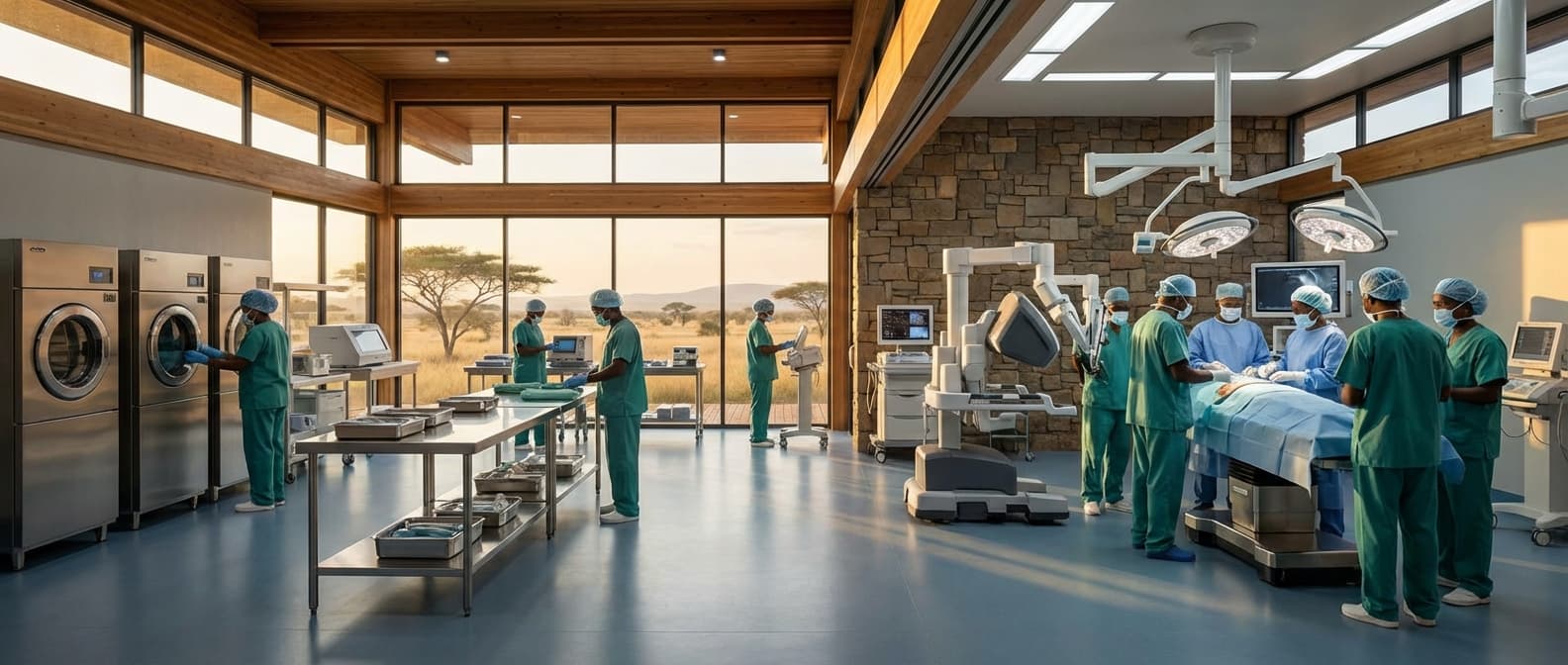
Medical Gas System Design & Installation in Sierra Leone
Engineering Excellence & Technical Support
Medical gas pipeline systems: O2, N2O, air, vacuum High-standard technical execution following OEM protocols and local regulatory frameworks.
Enhanced Medical Oxygen Supply Reliability
Designed and installed a robust, multi-source medical oxygen system, integrating cylinder banks with a state-of-the-art oxygen concentrator, ensuring continuous, uninterrupted supply to critical care units even during periods of high demand or logistical challenges common in Sierra Leone.
Advanced Nitrous Oxide Distribution Network
Engineered and implemented a safe and efficient piped nitrous oxide system for operating theatres, significantly reducing the reliance on manual cylinder handling. This design incorporates advanced pressure regulation and alarm systems, meeting international safety standards for anesthetic gas delivery in Sierra Leone's healthcare facilities.
Integrated Medical Air & Vacuum Infrastructure
Developed a comprehensive medical air and vacuum system, featuring redundant compressors and vacuum pumps, coupled with advanced filtration and drying mechanisms. This ensures the delivery of clean, dry medical air and effective suction across all patient care areas, crucial for infection control and patient safety in Sierra Leone.
What Is Medical Gas System Design & Installation In Sierra Leone?
Medical gas system design and installation in Sierra Leone refers to the comprehensive process of planning, engineering, and constructing centralized systems for the safe and reliable delivery of medical gases to healthcare facilities. This involves the selection of appropriate gas types, determination of flow rates and pressures, specification of piping materials, valves, alarms, outlets, and emergency backup systems. The installation adheres to national and international standards to ensure patient safety and operational efficiency. The service is critical for modern healthcare infrastructure, enabling the administration of essential life-support gases, anesthetic agents, and respiratory therapies.
| Who Needs This Service? | Typical Use Cases |
|---|---|
| Hospitals (Public and Private) | Oxygen therapy for respiratory distress, anesthesia delivery, ventilatory support, post-operative recovery. |
| Surgical Centers | Nitrous oxide for anesthesia, medical air for pneumatic tools and ventilation. |
| Intensive Care Units (ICUs) | Continuous oxygen supply, medical air for ventilators and CPAP machines. |
| Emergency Departments | Rapid delivery of oxygen and medical air for trauma and critical care. |
| Operating Theaters | Anesthetic gas administration (oxygen, nitrous oxide), ventilation, and evacuation of waste anesthetic gases. |
| Maternity Wards and Neonatal Units | Oxygen support for newborns and mothers, medical air for incubators and ventilators. |
| Rehabilitation Centers | Oxygen therapy for patients with chronic respiratory conditions. |
| Specialized Clinics (e.g., Pulmonary, Cardiac) | Medical air and oxygen for diagnostic and therapeutic procedures. |
| New Healthcare Facility Developments | Essential infrastructure for operational readiness. |
| Existing Facility Upgrades and Renovations | Modernization of outdated systems to meet current safety and performance standards. |
Key Components of Medical Gas System Design & Installation:
- Medical Gas Piped Distribution Systems: Design and installation of networks for oxygen, medical air, nitrous oxide, vacuum, and other specialized gases.
- Central Gas Supply: Specification and integration of bulk storage systems (liquid or manifold cylinders) and associated pressure regulation.
- Piping and Tubing: Selection and installation of appropriate medical-grade materials (e.g., copper, stainless steel) with proper brazing and jointing techniques.
- Valves and Regulators: Installation of isolation valves, pressure regulators, and control valves for flow management and safety.
- Alarm Systems: Design and implementation of visual and audible alarm systems to monitor pressure, flow, and gas purity.
- Terminal Units and Outlets: Installation of standardized outlets for the connection of medical equipment at patient care points.
- Emergency Systems: Integration of backup gas supplies (e.g., reserve cylinders, emergency power for air compressors) and changeover mechanisms.
- Ventilation and Exhaust Systems: Design of safe exhaust systems for anesthetic gases.
- Commissioning and Testing: Rigorous testing protocols, including pressure, leak, and purity tests, to verify system integrity and performance.
- Regulatory Compliance: Ensuring adherence to Sierra Leonean health regulations and relevant international standards (e.g., NFPA 99, HTM 02-01).
Who Needs Medical Gas System Design & Installation In Sierra Leone?
Designing and installing medical gas systems is a critical infrastructure requirement for healthcare facilities to ensure the safe and efficient delivery of essential medical gases like oxygen, medical air, and vacuum. In Sierra Leone, the need for these specialized services is driven by the ongoing efforts to strengthen the healthcare sector, improve patient care, and enhance the capacity of medical institutions to handle a range of medical conditions.
| Target Customer Group | Key Departments Requiring Medical Gas Systems | ||||||||
|---|---|---|---|---|---|---|---|---|---|
| Hospitals (Public and Private) | Operating Theatres (Anesthesia, Resuscitation) | Intensive Care Units (ICU) / High Dependency Units (HDU) | Emergency Rooms / Accident & Emergency (A&E) | Maternity Wards (Neonatal Care, Resuscitation) | Pulmonary / Respiratory Wards | General Wards (Oxygen Therapy) | Recovery Rooms | Diagnostic Imaging Departments (e.g., CT Scans requiring medical air) | Central Sterile Supply Department (CSSD - for medical air in sterilization processes) |
| Specialized Clinics and Medical Centers | Cardiology Clinics | Pulmonology Clinics | Neurosurgery Centers | Oncology Centers | Dental Clinics (for medical air) | Rehabilitation Centers | |||
| Diagnostic Laboratories | Laboratories utilizing specific gases for testing equipment or procedures | ||||||||
| Emergency Services and Ambulance Providers | Mobile medical gas supply for patient transport and initial care | ||||||||
| Research and Training Institutions | Facilities for medical education, simulation, and research requiring controlled gas environments |
Who Needs Medical Gas System Design & Installation in Sierra Leone? Target Customers and Departments
- Hospitals (Public and Private)
- Specialized Clinics and Medical Centers
- Diagnostic Laboratories
- Emergency Services and Ambulance Providers
- Research and Training Institutions
Medical Gas System Design & Installation Process In Sierra Leone
Designing and installing a medical gas system in Sierra Leone involves a structured workflow, ensuring compliance with local regulations, international standards, and the specific needs of the healthcare facility. This process typically begins with a client inquiry and progresses through detailed design, procurement, installation, testing, commissioning, and handover. Each stage requires careful planning, coordination, and expertise to deliver a safe and reliable medical gas supply.
| Stage | Description | Key Activities | Deliverables | Key Stakeholders | Typical Duration (Weeks) |
|---|---|---|---|---|---|
| Initial contact from a healthcare facility to discuss requirements for a new or upgraded medical gas system. | Understanding facility type, patient capacity, required gases (oxygen, medical air, vacuum, nitrous oxide, etc.), pressure/flow rates, budget, and timeline. | Initial scope of work document, preliminary understanding of requirements. | Client (Hospital Management, Engineering Department), Potential Vendor/Installer. | 1-2 |
| On-site visit to assess the existing infrastructure, site conditions, and determine the most suitable system layout. | Examining building layout, existing utilities, space availability for plant room and pipe routing, identifying potential challenges. | Site survey report, preliminary system layout options, identification of potential risks and constraints. | Client, Vendor/Installer's Technical Team. | 1-3 |
| Developing a preliminary system design based on the needs assessment and site survey, followed by a cost estimate. | Defining the core system components, pipe sizing estimations, plant room location, and developing a detailed quotation. | Conceptual design drawings, Bill of Quantities (BoQ) estimate, formal quotation. | Client, Vendor/Installer's Design & Sales Team. | 2-4 |
| Producing comprehensive technical drawings and specifications for all system components. | Creating P&ID diagrams, plant room layouts, pipe routing plans, electrical schematics, selecting specific equipment models, material specifications. | Detailed design drawings (CAD), technical specifications, material list, installation manuals. | Vendor/Installer's Engineering Team, Client's Technical Review. | 4-8 |
| Obtaining necessary permits and approvals from relevant Sierra Leonean authorities. | Submitting design documents for review by Ministry of Health and Sanitation, local building authorities, environmental agencies. Ensuring compliance with local building codes and standards. | Approved permits, compliance certificates. | Vendor/Installer, Client, Ministry of Health, Local Authorities. | 4-12 (can be highly variable) |
| Sourcing and purchasing all necessary components for the medical gas system. | Ordering cylinders, manifolds, regulators, medical gas outlets, alarm panels, piping, valves, compressors, vacuum pumps, etc. Ensuring timely delivery. | Procurement orders, delivery schedules, received materials and equipment. | Vendor/Installer's Procurement Team, Suppliers. | 6-10 (dependent on lead times) |
| The physical installation of the medical gas system components according to the approved design. | Installing plant equipment, running pipework, connecting outlets, installing alarm systems, ensuring proper welding and joining techniques. | Installed medical gas system infrastructure. | Vendor/Installer's Installation Team, Site Supervisors. | 8-16 |
| Verifying the functionality, safety, and performance of the installed system. | Pressure testing, leak testing, gas purity analysis, flow rate calibration, alarm function tests, pressure regulation checks. | Test reports, commissioning certificates, performance validation. | Vendor/Installer's Commissioning Team, Client's Representatives. | 2-4 |
| Educating the client's staff on the operation and maintenance of the system and formally handing over the completed project. | Training sessions for biomedical engineers, maintenance staff, and end-users on system operation, troubleshooting, and basic maintenance. Providing all documentation. | Training materials, handover documentation (as-built drawings, O&M manuals, warranties), Certificate of Handover. | Vendor/Installer, Client's Staff (Biomedical Engineers, Maintenance, Nursing Staff). | 1-2 |
| Providing ongoing support and maintenance to ensure the system's continued reliability and safety. | Scheduled preventive maintenance, emergency repair services, spare parts management, system upgrades as needed. | Maintenance contracts, service reports, ongoing system performance. | Vendor/Installer's Service Team, Client. | Ongoing |
Medical Gas System Design & Installation Workflow in Sierra Leone
- Inquiry & Needs Assessment
- Site Survey & Feasibility Study
- Conceptual Design & Quotation
- Detailed Engineering Design
- Regulatory Approvals & Permitting
- Procurement of Materials & Equipment
- On-site Installation
- System Testing & Commissioning
- Training & Handover
- Post-Installation Support & Maintenance
Medical Gas System Design & Installation Cost In Sierra Leone
Designing and installing a medical gas system in Sierra Leone involves several key factors that influence the overall cost. These systems are critical for healthcare facilities, providing essential gases like oxygen, medical air, and vacuum. The pricing can vary significantly based on the complexity of the facility, the type and quantity of gases required, the quality of equipment chosen, and the specific logistical challenges present in Sierra Leone. Local currency (Sierra Leonean Leone - SLL) is used for these transactions, but it's important to note that many specialized components and expertise might be imported, leading to costs influenced by foreign exchange rates and import duties.
| System Component/Service | Estimated Cost Range (SLL) | Notes |
|---|---|---|
| Design and Engineering Fees | 20,000,000 - 70,000,000+ | Varies with facility size and complexity. Includes site surveys, blueprints, and specifications. |
| Medical Gas Manifold (e.g., Oxygen, Air) | 30,000,000 - 150,000,000+ | Depends on the number of gas sources (cylinders, bulk tanks) and redundancy. High-quality imported units are more expensive. |
| Piping Installation (per meter) | 200,000 - 500,000+ | Includes high-purity copper piping, fittings, brazing, and pressure testing. Cost increases with complexity and height. |
| Gas Outlets (per unit) | 150,000 - 400,000+ | Includes the wall outlet, flow regulator (if applicable), and installation. Different gas types may have different costs. |
| Alarm and Monitoring Systems | 10,000,000 - 50,000,000+ | Essential for safety. Cost depends on the number of monitoring points and features. |
| Compressors (Medical Air) | 25,000,000 - 100,000,000+ | Depends on capacity, oil-free technology (highly recommended), and brand. Requires integration with dryers and filters. |
| Vacuum Pumps | 15,000,000 - 70,000,000+ | Varies by capacity and redundancy. Centralized vacuum systems are more common. |
| Installation Labor (Skilled Technicians) | 8,000,000 - 25,000,000+ (per technician, per month) | Rates can vary based on experience and availability of specialized personnel. Travel and accommodation may be additional. |
| Testing, Commissioning, and Certification | 5,000,000 - 20,000,000+ | Essential for ensuring system integrity and compliance. Involves leak testing, pressure testing, and gas purity analysis. |
| Contingency (10-20% of total) | Variable | Recommended for unforeseen costs. |
Key Pricing Factors for Medical Gas System Design & Installation in Sierra Leone
- Facility Size and Complexity: The number of beds, operating rooms, ICUs, and other specialized areas directly impacts the scale of the system, the length of piping, and the number of outlets, thus increasing costs.
- Type and Quantity of Gases: Systems requiring multiple gases (oxygen, medical air, vacuum, nitrous oxide, etc.) or higher flow rates will be more expensive than simpler oxygen-only systems.
- Equipment Quality and Brand: The choice between top-tier international manufacturers and more budget-friendly options will significantly affect pricing. Robustness, reliability, and compliance with international standards often come at a premium.
- Installation Labor and Expertise: Skilled technicians with experience in medical gas systems are essential for safe and compliant installation. The availability of such expertise locally and the associated labor rates are crucial cost components.
- Piping and Material Quality: The type of piping (copper is standard for medical gases), its gauge, and the quality of fittings and valves will influence both initial cost and long-term maintenance.
- Safety and Alarm Systems: Comprehensive alarm systems to monitor gas pressures and purity are mandatory and add to the overall expense.
- Regulatory Compliance and Certification: Meeting national and international standards for medical gas systems often requires specific certifications and testing, which incur costs.
- Project Management and Design Fees: Professional design services, project management, and site surveys are necessary and contribute to the total project cost.
- Logistics and Transportation: Transporting materials and equipment to the installation site, especially in more remote areas of Sierra Leone, can be a significant cost factor due to infrastructure limitations.
- Import Duties and Taxes: Any imported components or specialized equipment will be subject to Sierra Leone's import tariffs and taxes.
- Contingency and unforeseen issues: It's prudent to include a contingency for unexpected challenges during installation.
Affordable Medical Gas System Design & Installation Options
Designing and installing a medical gas system is a critical yet often significant investment for healthcare facilities. Fortunately, there are various affordable options, including value bundles and cost-saving strategies, that can make this essential infrastructure more accessible. Understanding these approaches can help facilities optimize their budget without compromising safety or compliance.
| Strategy/Bundle | Description | Cost-Saving Benefits |
|---|---|---|
| Value Bundles: Vendor-provided packages combining design, installation, and initial equipment. Often includes essential components like manifolds, outlets, regulators, and piping. May also incorporate basic monitoring or alarm systems. | Streamlined procurement process, potentially better pricing through bulk purchasing. Reduced administrative overhead for the facility. Assured compatibility of components. | Reduced upfront negotiation time, potential for discounted pricing compared to procuring services individually. Predictable project costs. |
| Modular System Design: Breaking down the system into smaller, manageable modules that can be installed and commissioned incrementally. This is particularly useful for phased expansions or facilities with budget constraints. | Allows for staggered investment, aligning expenditures with available capital. Easier to manage and implement in stages, minimizing disruption. | Spreads the financial burden over time, making it more manageable for smaller budgets. Reduces the risk of overspending on a large, upfront project. |
| Phased Installation: Similar to modular design, but focusing on installing the core system first and then adding specialized outlets or secondary systems in later phases as needed. | Prioritizes essential medical gas delivery for immediate patient care while deferring non-critical additions. Allows for adaptation to changing facility needs. | Lower initial capital outlay. Enables cost optimization by adding components only when truly required. |
| Equipment Leasing/Financing: Instead of outright purchase, facilities can explore leasing options for major equipment like compressors, vacuum pumps, or generators. Financing can also be arranged for the entire project. | Reduces the immediate capital expenditure. May include maintenance and service within the lease agreement, offering predictable operating costs. | Preserves capital for other operational needs. Can lead to lower monthly payments compared to loan amortization. |
| Standardization of Components: Utilizing standard, widely available medical gas outlets, regulators, and other components reduces the need for custom orders and allows for competitive bidding from multiple suppliers. | Increases availability and reduces lead times. Encourages competitive pricing among manufacturers and distributors. | Lower material costs due to economies of scale and competitive sourcing. Easier and more cost-effective for future repairs and replacements. |
| Optimized Piping Layout: Careful planning of piping routes to minimize length, complexity, and the number of fittings. This not only saves on material costs but also reduces installation labor. | Reduced material consumption (pipe, insulation, fittings). Less labor required for installation and welding. | Direct reduction in material and labor costs. Improved system efficiency with fewer potential leak points. |
| Energy-Efficient Equipment: Selecting energy-efficient compressors, vacuum pumps, and other ancillary equipment can lead to significant long-term operational cost savings. | Lower electricity bills over the lifespan of the system. Reduced environmental impact. | Ongoing savings on utility costs, contributing to a lower total cost of ownership. |
| Pre-Fabricated Modules: Utilizing pre-fabricated medical gas panels or skids can significantly reduce on-site installation time and labor costs. These modules are built and tested in a controlled environment. | Faster on-site installation. Reduced disruption to facility operations. Higher quality control due to factory assembly. | Lower labor costs on-site. Predictable installation timelines and reduced risk of delays. |
Key Considerations for Affordable Medical Gas Systems
- Understanding the scope of work and required medical gases.
- Exploring different system types (e.g., piped vs. cylinder-based).
- Evaluating the expertise and experience of potential vendors.
- Prioritizing long-term maintenance and service contracts.
- Leveraging technology for efficiency and monitoring.
Verified Providers In Sierra Leone
In Sierra Leone's evolving healthcare landscape, identifying verified providers is paramount for ensuring quality care and patient safety. Franance Health stands out as a leading organization committed to upholding the highest standards. This document outlines why Franance Health's credentials and approach make them the premier choice for healthcare services in Sierra Leone.
| Credential/Feature | Description | Benefit to Patients |
|---|---|---|
| Accreditation & Licensing Verification | Franance Health meticulously verifies that all affiliated healthcare professionals hold current and valid licenses from the Sierra Leone Ministry of Health and Sanitation, and that facilities comply with all regulatory requirements. | Guarantees that patients are treated by qualified and legally permitted practitioners in safe environments. |
| Specialist Certification Review | We ensure that specialists possess recognized certifications and postgraduate qualifications relevant to their area of practice. | Ensures access to highly skilled professionals for complex medical conditions, leading to more accurate diagnoses and effective treatments. |
| Quality Assurance Audits | Regular audits are conducted on facilities and practices within the Franance Health network to assess adherence to quality protocols, hygiene standards, and patient care procedures. | Maintains a consistently high level of care and safety, minimizing risks and improving patient outcomes. |
| Patient Feedback & Grievance Mechanism | Franance Health has a robust system for collecting patient feedback and addressing grievances promptly and effectively. | Empowers patients and ensures their concerns are heard and acted upon, fostering trust and accountability. |
| Continuing Professional Development (CPD) Support | We encourage and support our affiliated providers in pursuing ongoing training and professional development to stay abreast of the latest medical advancements. | Ensures patients receive care informed by the most current medical knowledge and techniques. |
Why Franance Health is the Best Choice for Healthcare in Sierra Leone
- Rigorous Verification Process: Franance Health employs a stringent vetting process for all its healthcare professionals and facilities, ensuring they meet national and international standards for competence and safety.
- Commitment to Quality: Beyond basic verification, Franance Health actively promotes a culture of continuous improvement and excellence among its network, encouraging adherence to best practices in patient care.
- Comprehensive Healthcare Network: Franance Health has established a broad network of trusted providers across various specialties, offering a one-stop solution for diverse medical needs.
- Patient-Centric Approach: The organization prioritizes patient well-being and satisfaction, focusing on accessibility, affordability, and compassionate care.
- Technological Integration: Franance Health leverages technology to enhance service delivery, from appointment scheduling to secure health record management, improving efficiency and patient experience.
- Community Engagement and Education: Franance Health is dedicated to improving public health through educational initiatives and community outreach programs, empowering individuals to make informed health decisions.
Scope Of Work For Medical Gas System Design & Installation
This Scope of Work (SOW) outlines the requirements for the comprehensive design and installation of a medical gas system. It covers all phases from initial design and engineering through to final commissioning and handover. The objective is to deliver a fully functional, code-compliant, and safe medical gas system that meets the operational needs of the facility.
1. Project Overview:
This project involves the design and installation of a new medical gas system, including but not limited to oxygen, medical air, vacuum, and nitrous oxide. The system will serve specified patient care areas within the [Facility Name/Location].
2. Scope of Services:
The scope of services encompasses the following key areas:
a. Design & Engineering:
* Detailed system design adhering to all applicable codes, standards, and regulations (e.g., NFPA 99, ASSE Series, local building codes).
* Development of P&IDs (Piping and Instrumentation Diagrams).
* Preparation of construction drawings, including layouts, schematics, and details.
* Equipment selection and specification.
* Coordination with other building systems (HVAC, electrical, structural).
* Obtaining necessary permits and approvals.
b. Procurement & Fabrication:
* Sourcing and purchasing of all required medical gas equipment, piping, fittings, valves, and accessories.
* Pre-fabrication of certain system components where applicable.
c. Installation:
* Installation of main supply lines, branch lines, and terminal outlets.
* Installation of all associated equipment, including gas outlets, pressure regulators, alarms, shut-off valves, and gas sources (e.g., cylinders, manifolds, compressors, vacuum pumps).
* Proper support and bracing of all piping.
* Integration with existing infrastructure where necessary.
d. Testing & Commissioning:
* Pressure testing and leak detection of all piping.
* Flushing and purging of the system.
* Operational testing of all components and the overall system.
* Performance verification against design specifications.
* Final acceptance testing by the owner/representative.
e. Training & Handover:
* Provision of comprehensive training to facility staff on system operation, maintenance, and emergency procedures.
* Delivery of all project documentation, including as-built drawings, operation and maintenance manuals, test reports, and warranty information.
3. Technical Deliverables:
The successful bidder shall provide the following technical deliverables:
4. Standard Specifications:
All design and installation shall adhere to the following standard specifications and codes. Any discrepancies or conflicts shall be reported to the Owner for resolution.
| Category | Description | Referenced Standard/Code |
|---|---|---|
| General Medical Gas Systems | Requirements for medical gas systems, including design, installation, testing, and maintenance. | NFPA 99: Health Care Facilities Code |
| Piping Systems | Requirements for medical gas piping materials, installation, brazing, and testing. | ASSE Series 6010: Standard for the Installation of Medical Gas Systems in Healthcare Facilities |
| Medical Gas Regulators | Requirements for pressure regulators used in medical gas systems. | ASSE Series 6030: Standard for Medical-Gas Pipeline Systems |
| Medical Gas Valves | Requirements for shut-off valves used in medical gas systems. | ASSE Series 6030: Standard for Medical-Gas Pipeline Systems |
| Gas Outlets and Connectors | Requirements for station outlets and quick-connects for medical gases. | NFPA 99: Health Care Facilities Code |
| Alarm Systems | Requirements for medical gas alarm systems. | NFPA 99: Health Care Facilities Code |
| Vacuum Systems | Requirements for medical vacuum systems. | NFPA 99: Health Care Facilities Code |
| Medical Air Compressors | Requirements for medical air compressor systems. | NFPA 99: Health Care Facilities Code |
| Oxygen Systems | Requirements for medical oxygen supply systems. | NFPA 99: Health Care Facilities Code |
| Nitrous Oxide Systems | Requirements for medical nitrous oxide supply systems. | NFPA 99: Health Care Facilities Code |
| General Construction Practices | Adherence to all applicable local building codes and general construction best practices. | Local Building Codes, IBC (International Building Code) |
| Weld/Brazing Standards | Standards for brazing of medical gas piping. | ASME B31.3: Process Piping (as applicable for brazing requirements) |
Technical Deliverables
- Detailed design report with system calculations and justifications.
- Piping and Instrumentation Diagrams (P&IDs).
- Complete set of construction drawings (architectural, mechanical, electrical).
- Equipment schedules and specifications.
- Bill of Materials (BOM).
- Material submittals and shop drawings.
- Quality control and inspection plan.
- Pressure testing and leak detection reports.
- System flushing and purging reports.
- Operational and performance testing reports.
- Commissioning report.
- As-built drawings reflecting the final installed system.
- Operation and Maintenance (O&M) manuals.
- Staff training materials and attendance records.
- Warranty certificates for all equipment and workmanship.
Service Level Agreement For Medical Gas System Design & Installation
This Service Level Agreement (SLA) outlines the terms and conditions for the design and installation of medical gas systems, focusing on guaranteed response times for critical issues and system uptime. This agreement aims to ensure the continuous and safe operation of the medical gas infrastructure, minimizing disruption to patient care.
| Service Category | Description | Response Time Target | Resolution Time Target (Major) | Resolution Time Target (Minor) | Uptime Guarantee |
|---|---|---|---|---|---|
| Design & Consultation | Initial planning, schematic development, and regulatory compliance review. | N/A | N/A | N/A | N/A |
| Installation (New Systems) | Procurement, fabrication, and installation of new medical gas systems. | N/A | N/A | N/A | N/A |
| Installation (System Upgrades/Expansions) | Integration of new components or expansion of existing medical gas systems. | N/A | N/A | N/A | N/A |
| Emergency Support (System Failure) | Immediate response to critical system failures impacting patient care. | 1 Hour (Acknowledgement & Initial Assessment) | 4 Hours (Full Restoration) | N/A | 99.9% (Excluding scheduled maintenance) |
| Urgent Support (System Malfunction) | Response to significant system malfunctions that may impact patient care or safety. | 2 Hours (Acknowledgement & Initial Assessment) | 8 Business Hours (Full Restoration) | N/A | 99.9% (Excluding scheduled maintenance) |
| Routine Support (Minor Issues/Advisories) | Response to non-critical issues, alerts, or performance degradation. | 4 Business Hours (Acknowledgement) | 24 Business Hours (Resolution) | 4 Business Hours (Full Restoration) | 99.9% (Excluding scheduled maintenance) |
| Preventative Maintenance (Scheduled) | Proactive checks, calibration, and servicing as per industry standards and manufacturer recommendations. | Scheduled in advance with client approval | N/A | N/A | N/A |
Key Service Level Objectives
- Response Time: Defines the maximum allowable time for the service provider to acknowledge and begin addressing a reported issue.
- Resolution Time: Defines the maximum allowable time to resolve a reported issue, categorized by severity.
- Uptime Guarantee: Specifies the minimum percentage of time the medical gas system is expected to be operational and functioning correctly.
- System Monitoring: Outlines the proactive monitoring services provided to detect and prevent potential issues.
- Preventative Maintenance: Details scheduled maintenance activities to ensure optimal system performance and longevity.
Frequently Asked Questions

Ready when you are
Let's scope your Medical Gas System Design & Installation in Sierra Leone project in Sierra Leone.

Scaling healthcare logistics and technical systems across the entire continent.