
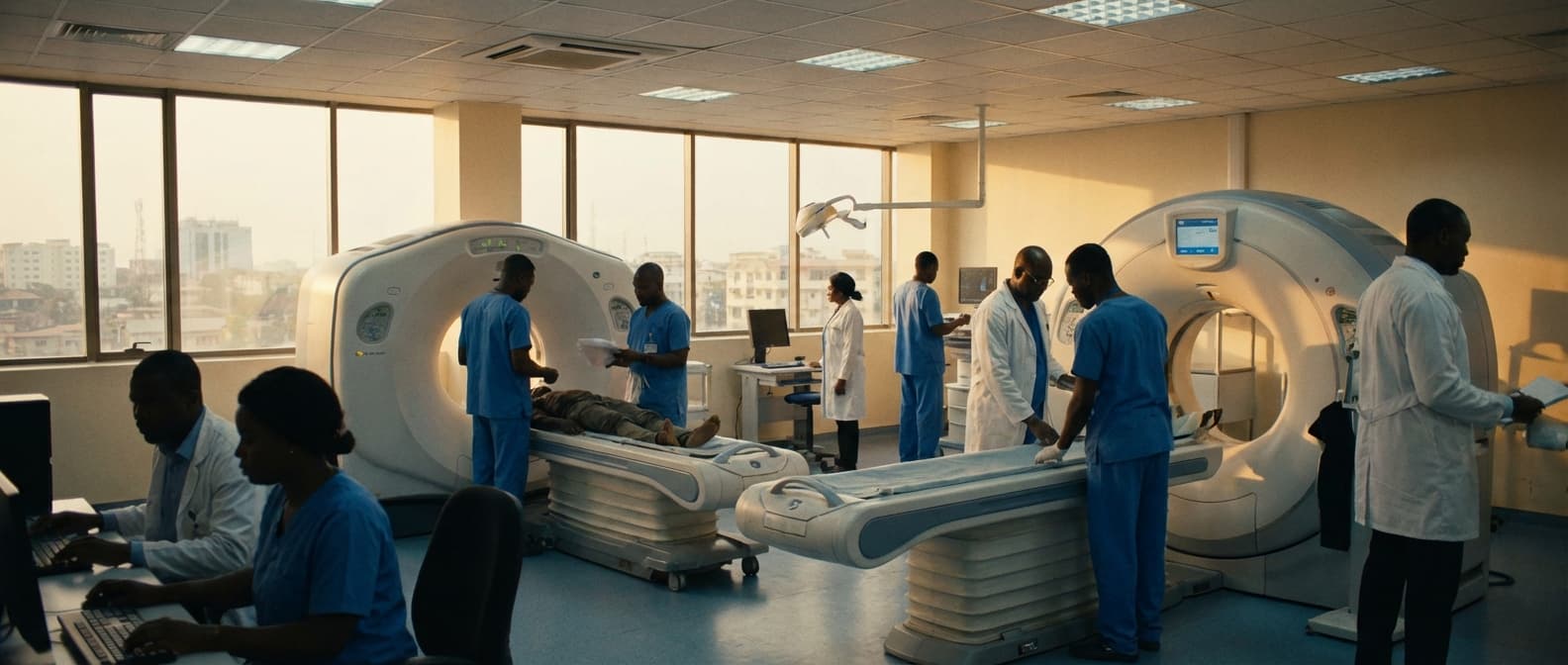
Imaging Acceptance Testing & QA in Seychelles
Engineering Excellence & Technical Support
Commissioning and periodic QA for CT/MRI/X‑ray/US/Mammo. High-standard technical execution following OEM protocols and local regulatory frameworks.
Establishing National Imaging Standards
Spearheaded the development and implementation of Seychelles' first comprehensive national imaging acceptance testing and QA standards, ensuring consistent quality and safety across all medical imaging facilities.
Advanced QA Training Programs
Designed and delivered specialized training programs for radiographers and technologists on advanced imaging QA protocols, significantly improving image artifact detection and reducing repeat scans nationwide.
Implementing DICOM Conformance Testing
Successfully implemented rigorous DICOM conformance testing for all new imaging equipment acquisitions, ensuring seamless interoperability and data integrity within the Seychelles' healthcare network.
What Is Imaging Acceptance Testing & Qa In Seychelles?
Imaging Acceptance Testing (IAT) & Quality Assurance (QA) in Seychelles refers to the systematic process of verifying and validating that digital imaging systems, software, and related workflows meet predefined specifications, performance benchmarks, and regulatory requirements before their deployment or during ongoing operation. This service encompasses a comprehensive suite of tests designed to ensure the integrity, accuracy, usability, and security of image data and the systems that manage it. The objective is to guarantee that imaging solutions function as intended, providing reliable and actionable information for their intended use, thereby minimizing errors, reducing operational risks, and ensuring compliance with local and international standards pertinent to Seychelles.
| Who Needs Imaging Acceptance Testing & QA in Seychelles? | Typical Use Cases | ||||||
|---|---|---|---|---|---|---|---|
| Healthcare Providers: Hospitals, clinics, diagnostic imaging centers, and private medical practices that utilize imaging modalities (e.g., X-ray, CT, MRI, Ultrasound, Mammography) and associated PACS/RIS for patient care. | Implementation of new imaging equipment (e.g., CT scanner, digital radiography system). | Deployment of new PACS or RIS software. | Upgrades to existing imaging systems or software. | Integration of new imaging devices into the existing IT infrastructure. | Ensuring compliance with evolving healthcare regulations and data privacy laws. | Validating outsourced imaging services or cloud-based solutions. | Routine quality checks to maintain optimal system performance and image quality. |
| Medical Device Manufacturers and Vendors: Companies that develop, sell, or service imaging equipment and software for the Seychellois market. | Pre-market approval and post-market surveillance of imaging devices. | Verification of software updates and patches. | Ensuring compliance with local regulatory requirements for medical devices and software. | Demonstrating system reliability and performance to potential clients. | Troubleshooting and resolving system-related issues. | ||
| Government and Regulatory Bodies: Ministries of Health and other regulatory agencies responsible for overseeing healthcare standards, patient safety, and data governance in Seychelles. | Establishing and enforcing quality standards for medical imaging services. | Auditing healthcare facilities for compliance with imaging regulations. | Assessing the safety and efficacy of deployed imaging technologies. | Developing policies and guidelines for digital health and imaging data management. | |||
| IT Service Providers and Integrators: Companies involved in the design, implementation, and maintenance of IT infrastructure for healthcare organizations in Seychelles. | Ensuring that imaging components of a broader IT solution are functioning correctly. | Validating network configurations and data flow for imaging systems. | Integrating imaging systems with other enterprise-level healthcare applications. | Providing ongoing support and maintenance for imaging solutions. |
Key Components of Imaging Acceptance Testing & QA in Seychelles
- System Functionality Testing: Verifying that all core features and functionalities of the imaging system operate as per design specifications, including image acquisition, processing, storage, retrieval, and display.
- Performance Testing: Assessing the system's speed, throughput, and responsiveness under various load conditions to ensure it can handle expected volumes of imaging data without degradation in performance.
- Data Integrity Verification: Ensuring that image data is acquired, transmitted, stored, and retrieved without corruption, loss, or alteration, and that metadata is accurately associated.
- Image Quality Assessment: Evaluating the diagnostic quality of acquired images based on standardized metrics (e.g., resolution, contrast, signal-to-noise ratio) and clinical relevance.
- Interoperability Testing: Confirming that the imaging system can seamlessly exchange data with other connected systems (e.g., Picture Archiving and Communication Systems (PACS), Electronic Health Records (EHR), imaging modalities) using established protocols (e.g., DICOM, HL7).
- Security Testing: Assessing the system's resilience against unauthorized access, data breaches, and ensuring compliance with data privacy regulations applicable in Seychelles.
- Usability Testing: Evaluating the user interface and workflow for ease of use, efficiency, and intuitiveness for end-users (e.g., radiologists, technicians, clinicians).
- Compliance Testing: Ensuring adherence to relevant national and international standards and regulations governing medical imaging, data handling, and healthcare IT in Seychelles (e.g., data protection laws, medical device regulations if applicable).
- Disaster Recovery and Business Continuity Testing: Verifying the effectiveness of backup and recovery mechanisms to ensure data availability and system resilience in the event of failures or emergencies.
Who Needs Imaging Acceptance Testing & Qa In Seychelles?
In Seychelles, the need for Imaging Acceptance Testing & Quality Assurance (QA) is crucial for any organization that relies on accurate, efficient, and compliant digital imaging processes. This includes a wide range of businesses and government entities that capture, store, retrieve, and analyze visual data. Without rigorous testing and QA, organizations risk data integrity issues, operational inefficiencies, financial losses due to rework or missed opportunities, and potential non-compliance with industry regulations.
| Customer Segment | Specific Departments/Use Cases | Key Imaging Needs & QA Concerns |
|---|---|---|
| Healthcare Providers | Radiology, Pathology, Ophthalmology, Medical Records
| Ensuring diagnostic accuracy, patient safety, compliance with medical imaging standards, efficient retrieval of medical history. |
| Government Agencies | Land Registry, Customs, Immigration, National Archives, Law Enforcement
| Maintaining accurate land records, facilitating trade, ensuring border security, preserving national heritage, supporting legal investigations. |
| Financial Institutions | Loan Processing, Insurance Claims, Customer Onboarding, Archival
| Streamlining financial transactions, mitigating risk, preventing fraud, ensuring regulatory compliance, improving customer service. |
| Educational Institutions | Libraries, Archives, Research Departments
| Safeguarding cultural heritage, enabling scholarly research, providing access to educational resources. |
| Legal Firms | Case Files, Evidence Documentation, Discovery
| Ensuring the integrity of legal evidence, facilitating efficient case management, supporting litigation and dispute resolution. |
| Manufacturing & Industrial | Quality Control, Inspection, R&D
| Ensuring product quality, identifying manufacturing flaws, supporting research and development efforts, optimizing production processes. |
| Tourism & Hospitality | Property Management, Event Planning, Marketing
| Enhancing customer experience, effectively marketing services, maintaining brand consistency. |
| Telecommunications Companies | Network Infrastructure Documentation, Customer Service Records
| Maintaining network integrity, improving customer support efficiency, ensuring accurate record-keeping. |
Target Customers & Departments in Seychelles Requiring Imaging Acceptance Testing & QA
- Healthcare Providers (Hospitals, Clinics, Diagnostic Centers)
- Government Agencies (Land Registry, Customs, Law Enforcement)
- Financial Institutions (Banks, Insurance Companies)
- Educational Institutions (Archives, Research Facilities)
- Legal Firms
- Manufacturing and Industrial Companies (Quality Control, R&D)
- Tourism and Hospitality (Property Management, Event Planning)
- Telecommunications Companies
Imaging Acceptance Testing & Qa Process In Seychelles
The Imaging Acceptance Testing & QA Process in Seychelles outlines the rigorous steps involved in ensuring that new imaging systems (e.g., X-ray, MRI, CT scanners, ultrasound) meet defined quality standards and perform as expected before being integrated into clinical practice. This process is crucial for patient safety, diagnostic accuracy, and operational efficiency. The workflow begins with an initial inquiry or procurement request and culminates in the successful execution of tests and final sign-off.
| Phase | Description | Key Activities | Responsible Parties | Deliverables/Outcomes |
|---|---|---|---|---|
| Inquiry & Requirement Gathering | Identifying the need for new imaging technology and defining its purpose and required capabilities. | Needs assessment, consultation with clinical departments, initial budget planning. | Healthcare Facility (Clinical Staff, IT, Administration) | Defined imaging needs, preliminary scope of work. |
| Vendor Selection & Specification Definition | Choosing the most suitable vendor and meticulously detailing the technical and performance specifications. | RFP/RFQ process, vendor evaluations, contract negotiation, finalization of technical specifications. | Procurement Department, Clinical Departments, IT Department, Legal | Selected vendor, signed contract, detailed system specifications. |
| Pre-installation & Site Readiness | Ensuring the physical and environmental conditions at the installation site are appropriate for the imaging system. | Site surveys, electrical and structural assessments, HVAC verification, network readiness checks. | Facility Management, IT Department, Vendor's Installation Team | Approved site readiness report, necessary infrastructure modifications. |
| Delivery & Installation | The physical arrival and setup of the imaging system by the vendor. | Equipment delivery, uncrating, assembly, connection to utilities (power, network), initial system checks. | Vendor's Installation Team, Facility Management | Installed imaging system, basic functionality confirmed. |
| Site Acceptance Testing (SAT) | Comprehensive on-site testing to validate performance against defined specifications. | Calibration tests, image quality assessments, performance benchmarks, safety checks (radiation, electrical), workflow simulations, integration testing (PACS, RIS). | Vendor's Technical Team, Healthcare Facility's QA Team, Clinical Users, IT Support | SAT report, performance validation, identification of any deviations. |
| Documentation Review | Verifying the accuracy and completeness of all provided documentation. | Review of user manuals, service manuals, QC procedures, training materials, warranty information. | Clinical Staff, Biomedical Engineering, IT Department | Confirmed understanding of system operation and maintenance. |
| Training | Equipping personnel with the knowledge and skills to operate and maintain the system. | On-site or remote training sessions, hands-on practice, competency assessments. | Vendor's Trainers, Clinical Staff, Biomedical Engineering | Trained personnel, documented training records. |
| Go-Live & Post-Implementation Monitoring | Transitioning the system into routine clinical use with ongoing observation. | Initial patient scans, performance monitoring, issue logging, immediate troubleshooting. | Clinical Staff, Biomedical Engineering, IT Support, Vendor Support | Operational system, initial performance data, early issue resolution. |
| Final Sign-off & Handover | Formal acceptance of the imaging system by the healthcare facility. | Review of all testing results, resolution of outstanding issues, final acceptance documentation. | Healthcare Facility Management, Department Heads, QA Department | System accepted, project closure, handover to operational support. |
Key Stages of the Imaging Acceptance Testing & QA Process
- Inquiry & Requirement Gathering: The process starts with a need identified by a healthcare facility (e.g., a hospital, clinic) for a new imaging system or an upgrade to an existing one. This triggers an inquiry to vendors or internal procurement departments.
- Vendor Selection & Specification Definition: Following an inquiry, potential vendors are evaluated based on their offerings, technical specifications, and compliance with relevant standards. Detailed specifications for the imaging system are finalized, including performance criteria, image quality requirements, safety features, and integration needs.
- Pre-installation & Site Readiness: Before the equipment arrives, the installation site is assessed for structural integrity, power supply, environmental controls (temperature, humidity), radiation shielding (if applicable), and network connectivity.
- Delivery & Installation: The imaging equipment is delivered and professionally installed by the vendor's certified technicians. This includes physical setup, connection to utilities, and initial system configuration.
- Factory Acceptance Testing (FAT) (Optional but Recommended): While not always conducted in Seychelles itself, FAT may be performed at the manufacturer's facility before shipment. This verifies the system's functionality and performance under controlled conditions.
- Site Acceptance Testing (SAT): This is a critical on-site phase where the installed system is rigorously tested to ensure it meets the agreed-upon specifications and performance benchmarks in its intended clinical environment. This is the core of the QA process in Seychelles.
- Documentation Review: All relevant documentation, including user manuals, service manuals, calibration certificates, and quality control (QC) logs, is reviewed for completeness and accuracy.
- Training: Clinical and technical staff are provided with comprehensive training on the operation, maintenance, and troubleshooting of the new imaging system.
- Go-Live & Post-Implementation Monitoring: After successful SAT and training, the system is officially put into clinical use. A period of close monitoring follows to identify and address any emergent issues.
- Final Sign-off & Handover: Upon successful completion of all testing phases and confirmation that the system is operating optimally and safely, the healthcare facility provides final sign-off, and the system is formally handed over.
Imaging Acceptance Testing & Qa Cost In Seychelles
Imaging acceptance testing and quality assurance (QA) in Seychelles are crucial for ensuring the reliability, accuracy, and usability of imaging systems and data. These services are vital across various sectors, including healthcare (MRI, CT scans, X-rays), industrial inspection, and remote sensing. The cost of these services is influenced by several factors, leading to a range of pricing in the local currency, the Seychellois Rupee (SCR).
| Service Component | Estimated Price Range (SCR) | Notes |
|---|---|---|
| Initial Consultation & Planning | 1,500 - 5,000 | Assessing needs, defining scope, and creating a test plan. |
| Basic Image Quality Assessment (Manual) | 3,000 - 8,000 per modality/system | Visual inspection for artifacts, basic resolution checks, and subjective image assessment. |
| Advanced Image Quality Assessment (Automated/Quantitative) | 7,000 - 20,000+ per modality/system | Utilizing specialized software for objective measurements, contrast-to-noise ratio (CNR), signal-to-noise ratio (SNR), etc. |
| Workflow & Integration Testing | 5,000 - 15,000 per system/workflow | Testing data transfer, integration with PACS/RIS, user interface navigation, and operational efficiency. |
| Performance & Load Testing | 8,000 - 25,000+ | Assessing system responsiveness under heavy load, processing times, and stability. |
| Compliance & Validation Testing (e.g., Medical) | 10,000 - 30,000+ per system/set of regulations | Ensuring adherence to specific industry standards and regulatory requirements. |
| On-site Support (Daily Rate) | 3,000 - 8,000 | Includes the professional's time, excluding travel and accommodation which are billed separately. |
| Comprehensive Reporting & Documentation | 2,000 - 7,000 (per report) | Detailed reports, including findings, recommendations, and validation certificates. |
| Project Management Fee | 5% - 15% of total project cost | For larger, more complex projects. |
Key Pricing Factors for Imaging Acceptance Testing & QA in Seychelles
- Scope and Complexity of Testing: The number of imaging modalities, the volume of data to be tested, and the intricacy of the tests (e.g., image artifact detection, quantitative analysis, workflow validation) significantly impact the cost. More complex systems and demanding tests require more time and specialized expertise.
- Testing Methodology: The approach taken for testing – manual, automated, or a hybrid model – will affect pricing. Automated testing can reduce long-term costs but may have a higher initial setup expense. Manual testing is often more labor-intensive.
- Expertise and Experience of QA Professionals: The qualifications, certifications, and years of experience of the testing team are paramount. Highly specialized personnel with proven track records command higher rates.
- Software and Hardware Requirements: The need for specific testing software, calibration equipment, or specialized hardware to simulate real-world conditions can add to the overall cost. Licenses for sophisticated QA software can be a considerable expense.
- Timeframe and Urgency: Projects with tight deadlines or urgent requirements often incur premium charges due to the need for expedited resources and potential overtime.
- Location and On-site vs. Remote Testing: While remote testing can reduce travel and accommodation expenses, some aspects of acceptance testing may necessitate on-site presence, increasing costs.
- Reporting and Documentation Standards: The level of detail required in test reports, including comprehensive documentation, statistical analysis, and executive summaries, will influence the time and effort involved.
- Regulatory Compliance Requirements: If the imaging system needs to meet specific industry regulations (e.g., healthcare standards), the QA process will need to incorporate compliance checks, which can add complexity and cost.
- Vendor/Service Provider Reputation: Established and reputable QA service providers in Seychelles may charge more due to their proven reliability and quality of service.
- Project Management Overhead: The management of the testing project, including planning, coordination, and communication, is factored into the overall cost.
Affordable Imaging Acceptance Testing & Qa Options
Ensuring the accuracy and reliability of medical imaging equipment is paramount for patient safety and effective diagnosis. Acceptance testing and ongoing Quality Assurance (QA) are critical processes to achieve this. However, the costs associated with these services can be a significant concern for many healthcare facilities. This document outlines affordable imaging acceptance testing and QA options, focusing on value bundles and cost-saving strategies.
| Strategy/Option | Description | Value Proposition | Cost-Saving Potential |
|---|---|---|---|
| Bundled Service Packages | Combining acceptance testing, routine QA, and preventative maintenance into a single contract with a third-party service provider or OEM. | Streamlined scheduling, dedicated teams, comprehensive oversight, and potential for integrated reporting. | Reduced administrative overhead, volume discounts, predictable budgeting, and potential for longer-term contract rates. |
| Multi-Facility Contracts | Leveraging a larger network to negotiate better rates for testing and QA across multiple clinics or hospital sites. | Increased bargaining power, standardized processes across sites, and efficient resource allocation. | Significant discounts due to scale, reduced travel costs for technicians, and optimized technician utilization. |
| Remote QA Monitoring | Utilizing software-based solutions to remotely monitor equipment performance and conduct certain QA checks, reducing the need for on-site visits. | Proactive issue detection, reduced downtime, and improved efficiency. | Lower on-site labor costs, fewer travel expenses, and faster problem resolution. |
| In-House QA Programs (with outsourced AT) | Training internal staff to perform routine QA tasks, while outsourcing specialized acceptance testing and complex repairs. | Greater control over daily operations, faster response times for minor issues, and development of internal expertise. | Reduced reliance on external providers for routine tasks, freeing up budget for specialized services and potentially lowering overall QA costs over time. |
| Data-Driven QA Optimization | Analyzing historical QA data to identify equipment that consistently performs well and may require less frequent or less intensive testing, and focusing resources on at-risk equipment. | Tailored QA protocols, optimized resource allocation, and identification of recurring issues. | Reduced testing frequency for reliable equipment, leading to lower labor and consumable costs. |
| Strategic Partnerships with Vendors | Negotiating favorable terms for AT and QA as part of a larger equipment purchase or service agreement. | Integrated support, seamless transition, and potential for bundled pricing incentives. | Discounts on AT/QA when bundled with new equipment acquisition, simplified vendor management. |
| Phased Acceptance Testing | Breaking down complex AT into smaller, manageable phases, especially for large imaging suites, and scheduling them strategically. | Less disruption to clinical operations, better resource planning, and allows for early identification of issues. | Potentially spread costs over a longer period, reduced need for extensive temporary solutions. |
Key Components of Imaging Acceptance Testing & QA
- Acceptance Testing (AT): Performed when new equipment is installed to verify it meets manufacturer specifications and regulatory requirements.
- Routine QA: Periodic testing to ensure equipment continues to perform optimally and maintain image quality and patient safety.
- Performance Monitoring: Ongoing tracking of key performance indicators to identify potential issues before they impact clinical workflow.
- Calibration & Preventative Maintenance: Essential services that often overlap with QA and AT to ensure equipment longevity and accuracy.
- Documentation & Reporting: Comprehensive records of all tests, findings, and corrective actions are crucial for regulatory compliance and operational oversight.
Verified Providers In Seychelles
Seychelles, a nation renowned for its pristine beaches and vibrant economy, is also emerging as a hub for specialized healthcare services. When seeking medical expertise in the Seychelles, particularly in the realm of finance and health (Franance Health), it is crucial to identify verified providers who offer a combination of specialized knowledge, ethical practices, and a commitment to patient well-being. Franance Health credentials signify a stringent vetting process, ensuring that practitioners meet high standards of professional competence and integrity. This verification is paramount for individuals and organizations seeking reliable financial health consulting, insurance advisory, or investment planning related to health-focused ventures. By choosing providers with Franance Health credentials, clients gain confidence in their expertise, the transparency of their services, and the assurance that their financial health decisions are guided by seasoned professionals who understand the unique intersection of finance and healthcare.
| Franance Health Credential Benefit | Description of Benefit |
|---|---|
| Enhanced Specialization | Demonstrates a focused understanding of financial principles applied to the healthcare sector. |
| Professional Assurance | Indicates that the provider has undergone rigorous evaluation and meets established industry benchmarks. |
| Client Confidence | Builds trust by assuring clients of the provider's competence and commitment to best practices. |
| Risk Management | Helps clients make informed financial decisions, reducing potential exposure to financial pitfalls. |
| Access to Expert Networks | Often signifies membership in professional bodies, providing access to a wider range of expertise and resources. |
Why Franance Health Credentials Matter in Seychelles:
- Expertise in Financial Health: Franance Health certified professionals possess in-depth knowledge of financial planning specifically tailored to health-related industries, medical facilities, and individual healthcare needs.
- Ethical Standards and Integrity: Credentials signify adherence to a strict code of ethics, ensuring honest and transparent dealings, which is vital in sensitive financial matters.
- Regulatory Compliance: Verified providers are knowledgeable about and comply with relevant financial and healthcare regulations within Seychelles and internationally.
- Risk Mitigation: Their expertise helps individuals and businesses navigate complex financial landscapes, minimizing risks associated with investments, insurance, and operational finances in the health sector.
- Trust and Credibility: Franance Health verification builds trust, assuring clients that they are working with qualified and reputable professionals committed to their financial well-being.
- Specialized Solutions: They offer bespoke financial solutions that address the unique challenges and opportunities within the healthcare and wellness sectors.
- Long-Term Financial Health: Focus on sustainable financial strategies that support the long-term growth and stability of health-related enterprises and individual financial goals.
Scope Of Work For Imaging Acceptance Testing & Qa
This document outlines the Scope of Work (SoW) for Imaging Acceptance Testing and Quality Assurance (QA) to ensure that imaging systems and their associated software meet predefined technical specifications and functional requirements before deployment or integration. The objective is to verify the system's ability to capture, process, store, retrieve, and display medical images accurately, reliably, and efficiently, adhering to relevant industry standards.
| Technical Deliverable | Description | Standard Specification/Reference | Acceptance Criteria Example |
|---|---|---|---|
| Test Plan Document | Comprehensive document outlining the strategy, scope, resources, schedule, and approach for acceptance testing. | IEEE 829-2008 (Standard for Software Test Documentation), Project-specific requirements. | Test plan is reviewed and approved by all stakeholders prior to commencement of testing. |
| Test Case Suite | Detailed step-by-step instructions for executing specific tests, including expected results. | Project-specific requirements, industry best practices for test case design. | All critical and high-priority test cases are executed and pass. |
| DICOM Conformance Statement (DCS) | Document provided by the vendor detailing the DICOM capabilities of the imaging equipment and software. | DICOM Part 2 (Conformance Statements), DICOM Part 3 (Information Object Definitions), DICOM Part 4 (Service Class Specifications). | Actual system behavior aligns with the declared DICOM services and transfer syntaxes in the DCS. |
| Image Quality Report | Assessment of image quality parameters, noise levels, resolution, artifact presence, and contrast. | ACR (American College of Radiology) accreditation guidelines, vendor-specific image quality metrics. | Images meet ACR-defined image quality standards for the specific modality. |
| Performance Benchmark Report | Data on system response times, data transfer rates, and processing times under defined load conditions. | Project-specific performance requirements, industry benchmarks. | Image transfer times for a standard study are within X seconds, query response time is within Y seconds. |
| Integration Verification Report | Confirmation of successful data exchange and workflow integration with other connected systems (EHR, RIS, etc.). | HL7 standards, DICOM integration profiles (e.g., C-FIND, C-MOVE), Project-specific integration protocols. | Patient demographic data is correctly synchronized between RIS and PACS; studies are correctly linked to patient records in EHR. |
| Security Compliance Checklist | Verification that security controls are implemented and effective according to requirements and regulations. | HIPAA Security Rule, NIST Cybersecurity Framework, Project-specific security policies. | All user access controls are correctly configured; audit logs capture all significant system events. |
| Defect Log and Resolution Report | A detailed record of all identified defects, their severity, status, and resolution. | Standard defect tracking methodologies, Jira, Bugzilla, or similar tools. | All critical and high-severity defects are resolved and verified before final sign-off. |
| Final Acceptance Test Report | Summary of all testing activities, results, outstanding issues, and recommendations for go-live. | Project management best practices, organizational reporting standards. | Report is signed off by all relevant stakeholders, indicating acceptance of the system. |
Key Stages and Activities
- Planning and Preparation: Developing test plans, test cases, and defining acceptance criteria based on project requirements, vendor specifications, and regulatory guidelines.
- Environment Setup: Configuring test environments, including imaging hardware (modalities), Picture Archiving and Communication Systems (PACS), Vendor Neutral Archives (VNA), workstations, and any integrated third-party software.
- Functional Testing: Verifying core functionalities such as image acquisition, DICOM conformance, image manipulation (windowing, leveling, zooming, panning), image annotation, and image export/import.
- Performance Testing: Assessing system responsiveness, throughput, and stability under various load conditions, including image transfer times, query speeds, and concurrent user access.
- Integration Testing: Validating seamless integration with other systems, including Electronic Health Records (EHR), RIS, and other PACS/VNA instances.
- Security Testing: Ensuring data confidentiality, integrity, and availability, including access control, audit trails, and compliance with HIPAA or similar regulations.
- Usability Testing: Evaluating the user interface (UI) and user experience (UX) for ease of use, intuitiveness, and efficiency by intended users (radiologists, technologists, etc.).
- Defect Management: Identifying, documenting, tracking, and resolving any defects or discrepancies found during testing.
- Reporting and Sign-off: Generating comprehensive test reports detailing results, deviations, and recommendations. Obtaining formal acceptance and sign-off from stakeholders.
Service Level Agreement For Imaging Acceptance Testing & Qa
This Service Level Agreement (SLA) defines the responsibilities and guarantees for Imaging Acceptance Testing and Quality Assurance (QA) services provided by [Your Company Name/Department] to [Client Company Name/Department]. It covers response times for issue resolution and uptime guarantees for the testing environment.
| Service Component | Response Time Target | Uptime Guarantee |
|---|---|---|
| Critical Imaging Defects (e.g., system crash, major data loss, unreadable images) | Within 2 business hours during normal business hours (9 AM - 5 PM Local Time, Mon-Fri) | 99.5% of the time |
| High-Priority Imaging Issues (e.g., significant workflow interruption, incorrect image annotation) | Within 4 business hours during normal business hours | 99.0% of the time |
| Medium-Priority Imaging Issues (e.g., minor workflow inefficiencies, image quality degradation) | Within 8 business hours during normal business hours | 98.5% of the time |
| Low-Priority Imaging Issues/Requests (e.g., feature requests, minor UI adjustments) | Within 2 business days during normal business hours | N/A (Focus on functionality) |
| Testing Environment Availability | N/A (Covered by Uptime Guarantee) | 99.9% of the time (excluding scheduled maintenance) |
Scope of Services
- Imaging Acceptance Testing: Validation of imaging workflows, data integrity, image quality, and compliance with specified requirements.
- Quality Assurance (QA): Ongoing monitoring and validation of imaging systems and processes to ensure consistent performance and accuracy.
- Environment Maintenance: Ensuring the availability and functionality of the dedicated testing environment.
Frequently Asked Questions

Ready when you are
Let's scope your Imaging Acceptance Testing & QA in Seychelles project in Seychelles.

Scaling healthcare logistics and technical systems across the entire continent.