
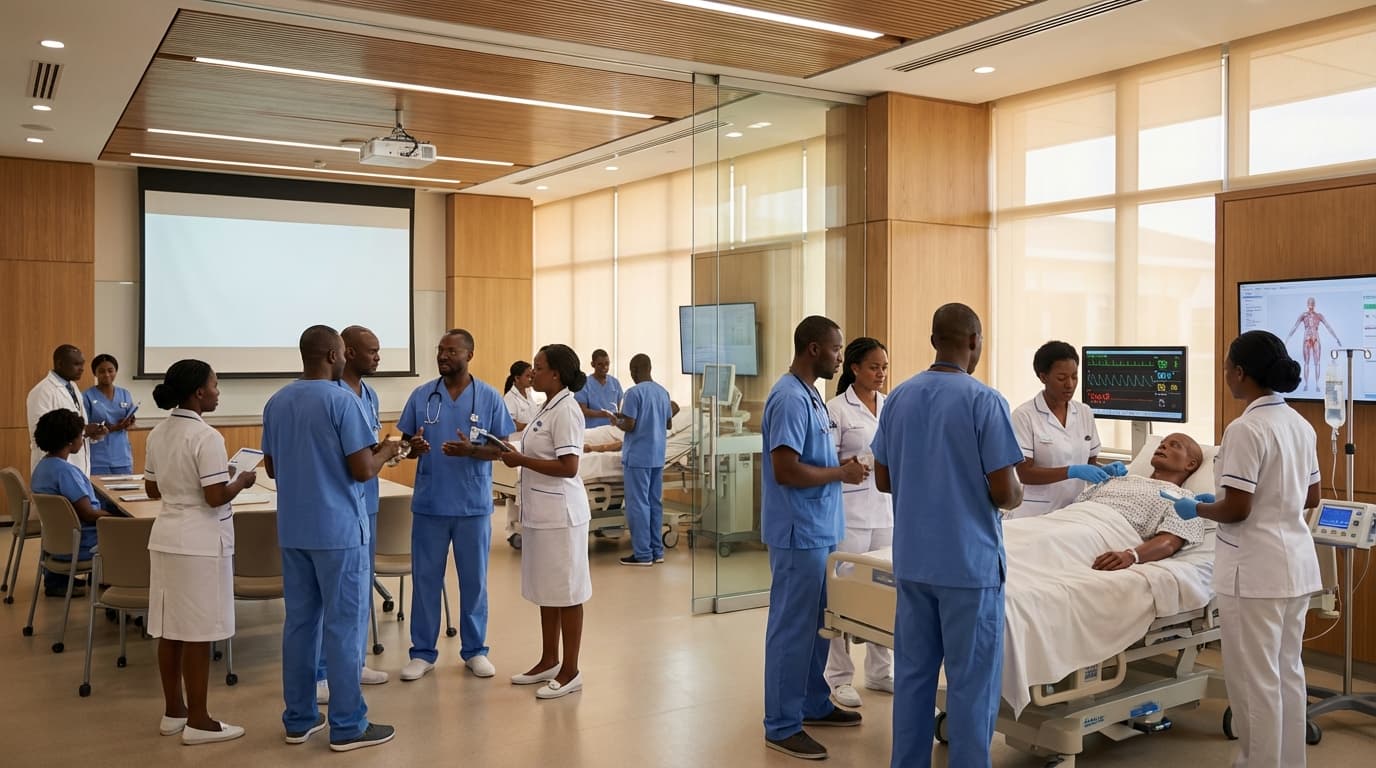
Equipment Training & Education in Senegal
Engineering Excellence & Technical Support
Comprehensive equipment training and certification programs High-standard technical execution following OEM protocols and local regulatory frameworks.
Heavy Machinery Operator Certification
Empowering Senegalese operators with certified training in safe and efficient operation of construction equipment, from excavators to bulldozers, enhancing project timelines and workforce employability.
Agricultural Equipment Maintenance & Repair
Providing hands-on education in the maintenance and repair of essential agricultural machinery, reducing downtime and increasing crop yields for farmers across Senegal's diverse agricultural regions.
Renewable Energy Equipment Deployment
Training local technicians on the installation, operation, and maintenance of solar panels and other renewable energy equipment, supporting Senegal's transition to sustainable energy sources and creating skilled green jobs.
What Is Equipment Training & Education In Senegal?
Equipment training and education in Senegal refers to the structured process of imparting knowledge, skills, and practical experience necessary for the safe, efficient, and effective operation, maintenance, and troubleshooting of specific machinery, tools, and systems. This service is crucial for individuals and organizations operating in sectors that rely on specialized equipment, ensuring optimal asset utilization, mitigating operational risks, and fostering a skilled workforce adaptable to technological advancements.
| Target Audience | Sector/Industry | Typical Use Cases |
|---|---|---|
| Machinery Operators | Agriculture, Construction, Manufacturing, Mining | Operating excavators, tractors, assembly lines, processing machinery; understanding control interfaces and safety interlocks. |
| Maintenance Technicians | All sectors with mechanical, electrical, or electronic equipment | Performing routine servicing, diagnosing faults in pumps, generators, control systems, and conducting repairs. |
| Field Service Engineers | Telecommunications, Energy, IT Infrastructure | Installing, commissioning, and repairing specialized equipment like base stations, turbines, servers, and network hardware. |
| Laboratory Personnel | Healthcare, Research & Development, Quality Control | Operating and maintaining analytical instruments (e.g., spectrophotometers, chromatographs), autoclaves, and specialized medical imaging devices. |
| Logistics & Supply Chain Staff | Warehousing, Transportation | Operating forklifts, automated guided vehicles (AGVs), and other material handling equipment; understanding warehouse management systems (WMS) integration. |
| Safety Officers & Supervisors | Across all sectors | Ensuring compliance with safety standards, understanding lockout/tagout procedures, and emergency response protocols for equipment-related incidents. |
Key Components of Equipment Training & Education
- Theoretical instruction covering equipment principles, functionality, specifications, and regulatory compliance.
- Hands-on practical sessions involving actual equipment operation, calibration, and routine checks.
- Maintenance and troubleshooting procedures, including diagnostics, repair techniques, and preventative strategies.
- Safety protocols and hazard identification specific to the equipment and its operating environment.
- Performance monitoring and optimization techniques to maximize output and minimize downtime.
- Documentation and record-keeping requirements related to equipment usage and maintenance.
- Updates on new technologies, software revisions, and advanced operational methodologies.
Who Needs Equipment Training & Education In Senegal?
Effective equipment training and education are crucial for a wide range of individuals and organizations in Senegal to ensure safety, efficiency, and productivity. This is particularly true for sectors that rely heavily on machinery, technology, and specialized tools for their operations. Investing in proper training not only minimizes risks and reduces costly errors but also empowers the workforce to utilize equipment to its full potential, leading to improved output and competitive advantage.
| Target Customer/Department | Specific Equipment Examples | Key Training Needs | Benefits of Training |
|---|---|---|---|
| Industrial: Manufacturing Plants | CNC Machines, Industrial Robots, Welding Equipment, Forklifts | Safe operation, maintenance, troubleshooting, quality control | Increased productivity, reduced downtime, improved product quality, enhanced safety |
| Industrial: Food Processing | Packaging Machines, Pasteurizers, Conveyor Systems, Blanchers | Hygiene standards, operation efficiency, maintenance, product integrity | Food safety compliance, reduced spoilage, efficient production |
| Agriculture: Mechanized Farms | Tractors, Harvesters, Planters, Irrigation Systems (pumps, sprinklers) | Operation, maintenance, calibration, efficient use of resources | Increased crop yields, reduced labor costs, sustainable farming practices |
| Construction: Construction Companies | Excavators, Bulldozers, Cranes, Concrete Mixers, Power Tools | Safe operation, site management, routine maintenance, emergency procedures | Reduced accidents, project completion efficiency, equipment longevity |
| Healthcare: Hospitals & Clinics | MRI Machines, CT Scanners, X-ray Machines, Ventilators, Surgical Equipment | Accurate operation, patient safety, infection control, troubleshooting, maintenance | Accurate diagnoses, effective treatments, patient well-being, reduced equipment failure |
| Mining: Mining Companies | Drilling Rigs, Loaders, Haul Trucks, Crushers, Conveyor Belts | Safe operation, heavy machinery maintenance, safety protocols, environmental compliance | Increased extraction efficiency, reduced operational risks, extended equipment lifespan |
| Energy: Power Generation Facilities | Turbines, Generators, Boilers, Control Systems, Transformers | Operation, preventative maintenance, safety procedures, emergency response | Reliable power supply, reduced outages, operational safety |
| Transportation: Logistics Companies | Forklifts, Reach Trucks, Pallet Jacks, Loading Docks | Safe material handling, efficient loading/unloading, warehouse safety | Reduced damage to goods, faster turnaround times, improved warehouse safety |
| Government: Public Works Departments | Road Construction Equipment, Water Treatment Machinery, Waste Management Vehicles | Operation efficiency, maintenance, public safety standards | Improved public infrastructure, efficient service delivery |
| Education: Vocational Training Centers | Various machinery and tools relevant to specific trades (e.g., welding, automotive, electrical) | Curriculum development, instructor training, student skill acquisition | Producing skilled workforce, meeting industry demands |
Target Customers & Departments in Senegal for Equipment Training & Education
- {"title":"Industrial Sector","description":"This broad category encompasses numerous sub-sectors requiring specialized equipment knowledge."}
- {"title":"Agricultural Sector","description":"Modernizing agricultural practices necessitates training on new machinery and techniques."}
- {"title":"Construction Sector","description":"Operation and maintenance of heavy machinery are critical for site safety and project completion."}
- {"title":"Healthcare Sector","description":"Advanced medical equipment requires highly skilled and trained personnel for accurate diagnostics and treatment."}
- {"title":"Mining and Extractives Sector","description":"Safe and efficient operation of specialized mining equipment is paramount."}
- {"title":"Manufacturing and Processing","description":"Skilled operators are needed for various production lines and machinery."}
- {"title":"Energy and Utilities","description":"Training is vital for the operation and maintenance of power generation and distribution equipment."}
- {"title":"Transportation and Logistics","description":"Operators of specialized vehicles, cranes, and handling equipment require training."}
- {"title":"Small and Medium Enterprises (SMEs)","description":"SMEs often lack in-house training resources and can benefit greatly from external programs."}
- {"title":"Government Agencies and Public Services","description":"Departments managing public infrastructure, emergency services, and public works require trained personnel."}
- {"title":"Educational Institutions","description":"Vocational schools and technical colleges need to equip students with relevant equipment skills."}
Equipment Training & Education Process In Senegal
The equipment training and education process in Senegal, from initial inquiry to successful execution, is a structured workflow designed to ensure individuals and organizations acquire the necessary skills to operate and maintain specific equipment. This process typically involves several key stages, each with its defined activities and stakeholders. The goal is to provide tailored training that meets the specific needs of the client, often in sectors like agriculture, construction, mining, and healthcare, where specialized equipment is prevalent. The process is adaptable to different training modalities, including on-site, off-site, and remote learning, depending on the client's location, budget, and the complexity of the equipment.
| Stage | Description | Key Activities | Responsible Parties | Output/Deliverable |
|---|---|---|---|---|
| Inquiry & Needs Assessment | The initial point of contact where potential clients express their need for equipment training. This stage involves understanding the specific equipment, the skill gaps, and the desired learning outcomes. | Client inquiry (phone, email, website, referral), Initial consultation, Needs analysis questionnaire, Site visit (if applicable). | Potential Client, Training Provider Sales/Inquiry Team. | Understanding of client's training requirements, preliminary scope of work. |
| Proposal Development & Negotiation | Based on the needs assessment, the training provider develops a detailed proposal outlining the training program, objectives, methodology, duration, costs, and terms and conditions. This is followed by negotiation to reach an agreement. | Proposal drafting, Cost estimation, Review and revision of proposal, Contract negotiation, Agreement on terms and pricing. | Training Provider (Sales, Technical Team), Potential Client. | Formal training proposal, Signed contract or service agreement. |
| Curriculum Design & Customization | The training content is developed or adapted to precisely match the identified needs and the specific equipment. This may involve creating new modules or tailoring existing ones. | Review of existing training materials, Development of new modules, Subject matter expert input, Validation of content with client. | Training Provider (Instructional Designers, Subject Matter Experts), Client (for input and validation). | Customized training curriculum, training materials (manuals, presentations, exercises). |
| Logistics & Scheduling | This stage involves all the practical arrangements required for the training to take place, including scheduling dates, securing venues, and arranging for trainers and equipment. | Scheduling training dates and times, Booking training venue (if off-site), Arranging for training equipment and simulators, Trainer assignment, Participant registration and communication. | Training Provider (Operations/Logistics Team), Client (for participant availability and venue access). | Confirmed training schedule, logistics plan, participant list. |
| Training Execution | The actual delivery of the training program to the participants. This involves theoretical instruction, practical demonstrations, hands-on exercises, and real-time troubleshooting. | Delivery of theoretical sessions, Practical demonstrations, Hands-on practice sessions, Q&A and discussion, On-site support and guidance. | Certified Trainers, Participants, Training Provider (on-site supervisor, if applicable). | Trained participants, successful completion of exercises. |
| Assessment & Evaluation | The process of measuring the effectiveness of the training and the participants' comprehension and skill acquisition. This includes both formative and summative assessments. | Pre-training assessments (optional), Mid-training feedback, Post-training knowledge tests, Practical skill assessments, Participant feedback surveys, Trainer performance evaluation. | Trainers, Participants, Training Provider (Assessment Team). | Assessment results, feedback reports, evaluation summaries. |
| Certification & Follow-up | Upon successful completion of the training and assessment, participants receive certificates. Follow-up support may be provided to address any lingering questions or challenges. | Issuance of certificates, Providing training reports to the client, Post-training support (e.g., helpline, refresher courses), Gathering testimonials. | Training Provider (Administration, Support Team), Participants. | Certificates of completion, final training report, ongoing client relationship. |
Equipment Training & Education Workflow in Senegal
- Inquiry & Needs Assessment
- Proposal Development & Negotiation
- Curriculum Design & Customization
- Logistics & Scheduling
- Training Execution
- Assessment & Evaluation
- Certification & Follow-up
Equipment Training & Education Cost In Senegal
Equipment training and education in Senegal is a crucial investment for businesses looking to ensure their workforce can safely and efficiently operate machinery, from basic hand tools to complex industrial equipment. The cost of this training can vary significantly based on several factors. Understanding these factors and the typical price ranges in Senegalese CFA (XOF) is essential for budgeting and planning. The demand for specialized skills, the complexity and type of equipment, the duration and intensity of the training, the reputation and accreditation of the training provider, and the location of the training (on-site vs. off-site) all play a role in determining the final cost. For basic operational training on common equipment, costs might be more accessible, while specialized technical training requiring expert instructors and advanced simulators will naturally command higher prices. Furthermore, the number of participants and the inclusion of certifications or assessments will also influence the overall expense.
| Training Category | Typical Cost Range (XOF) | Description |
|---|---|---|
| Basic Operational Training (e.g., Hand Tools, Simple Machinery) | 15,000 - 50,000 | Covers fundamental operation, safety procedures, and basic maintenance for less complex equipment. |
| Intermediate Operational Training (e.g., Forklifts, Small Construction Equipment) | 40,000 - 150,000 | Focuses on safe and efficient operation of medium-complexity machinery, including common safety protocols and operational checks. |
| Advanced Technical Training (e.g., Industrial Machinery, Specialized Software) | 100,000 - 500,000+ | Involves in-depth understanding of complex equipment, troubleshooting, advanced maintenance, and specialized operational techniques. May include certifications. |
| Specialized Skill Development (e.g., Welding, Heavy Equipment Operation) | 75,000 - 300,000 | Training geared towards specific trades requiring hands-on practice and often leading to recognized certifications. |
| On-site Training (per day/session) | 50,000 - 200,000+ | Cost can vary greatly depending on the number of participants, trainer fees, and travel expenses if applicable. |
| Certification Fees (if separate) | 20,000 - 100,000+ | Fees associated with official certifications from recognized bodies. |
Key Factors Influencing Equipment Training & Education Costs in Senegal:
- Equipment Type and Complexity
- Training Duration and Intensity
- Trainer Expertise and Qualifications
- Training Provider Reputation and Accreditation
- Training Location (On-site vs. Off-site)
- Number of Participants
- Inclusion of Certifications or Assessments
- Materials and Resources Used
- Customization of Training Content
Affordable Equipment Training & Education Options
Investing in equipment training and education is crucial for enhancing operational efficiency, safety, and employee skill development. Fortunately, there are numerous affordable options available, often overlooked. This guide explores cost-saving strategies and the value of bundled training packages.
| Strategy/Concept | Description | Cost-Saving Benefit |
|---|---|---|
| Value Bundles | Combining multiple training modules (e.g., basic operation, maintenance, safety) into a single package, often at a discounted price compared to purchasing them individually. | Lower per-module cost, comprehensive skill development |
| Online/E-Learning Courses | Digital platforms offering flexible, self-paced training accessible from anywhere. Often includes videos, interactive modules, and assessments. | Reduced travel and accommodation expenses, elimination of instructor fees for some courses |
| Train-the-Trainer Programs | Educating internal personnel to become qualified trainers, enabling them to train other employees within the organization. | Significant long-term cost savings by leveraging internal expertise, consistent training delivery |
| On-Site Training (Group Rates) | Bringing a trainer to your facility. Negotiating group rates for multiple employees can be more economical than sending individuals to external courses. | Reduced travel costs for employees, customized training for specific equipment/scenarios |
| Government/Industry Grants & Subsidies | Exploring available funding opportunities from government agencies or industry associations that support workforce development and training. | Direct reduction in training expenditure |
| Partnerships with Manufacturers/Suppliers | Many equipment manufacturers offer training programs, sometimes bundled with equipment purchases or at a reduced rate for their customers. | Potentially free or heavily discounted training, specialized knowledge of the specific equipment |
| Apprenticeship Programs | Structured programs that combine on-the-job training with classroom instruction, often supported by industry or government initiatives. | Phased learning, development of skilled workforce with lower initial training investment |
| Simulation Training | Using simulators to practice operating equipment in a safe, virtual environment. Can be a cost-effective alternative to extensive real-world practice for certain skills. | Reduced wear and tear on actual equipment, safer learning environment, minimized risk of accidents |
| Open-Source or Free Resources | Leveraging free online resources, manuals, and community forums for basic understanding and supplementary learning. | Cost-free for foundational knowledge, though may lack structured curriculum and certification |
Why Invest in Equipment Training?
- Improved Operator Proficiency and Productivity
- Reduced Equipment Downtime and Maintenance Costs
- Enhanced Workplace Safety and Accident Prevention
- Compliance with Industry Regulations
- Increased Employee Morale and Retention
Verified Providers In Senegal
In the quest for reliable healthcare in Senegal, identifying 'Verified Providers' is paramount. This term signifies healthcare professionals and facilities that have undergone rigorous checks for their qualifications, adherence to ethical standards, and operational integrity. Among these, Franance Health stands out, not just as a verified provider, but as a benchmark of excellence. Their commitment to quality, patient-centric care, and a comprehensive approach to health solutions makes them a distinguished choice for individuals and families seeking dependable medical services in Senegal. Understanding Franance Health's credentials and their multifaceted approach reveals why they are consistently recognized as a leading and trustworthy healthcare partner.
| Credential/Attribute | Franance Health's Commitment | Why it Matters for Patients |
|---|---|---|
| Rigorous Verification Process | Undergoes thorough vetting of all medical professionals and facilities. | Ensures that all providers meet high standards of competence, ethics, and safety. |
| Specialized Medical Expertise | Employs a diverse team of specialists in various fields of medicine. | Provides access to advanced care and treatment for a wide range of health conditions. |
| Quality Assurance Programs | Implements continuous quality improvement measures and patient feedback systems. | Guarantees consistently high standards of care and service delivery. |
| Transparent Pricing & Billing | Offers clear and understandable cost structures for services. | Builds trust and allows patients to make informed decisions about their healthcare expenses. |
| Advanced Diagnostic Capabilities | Utilizes cutting-edge diagnostic equipment and technologies. | Leads to more accurate and timely diagnoses, improving treatment outcomes. |
Franance Health Credentials & Why They Are the Best Choice
- Accreditation & Certifications: Franance Health facilities and personnel hold recognized national and international accreditations, demonstrating adherence to stringent quality and safety protocols.
- Experienced & Qualified Professionals: A team of highly skilled doctors, nurses, and specialists with extensive experience and continuous professional development.
- Patient-Centric Approach: Emphasis on compassionate care, clear communication, and personalized treatment plans tailored to individual patient needs.
- Comprehensive Service Offerings: A wide spectrum of medical services, from primary care to specialized treatments and diagnostic services, ensuring a one-stop solution for most health concerns.
- State-of-the-Art Technology: Investment in modern medical equipment and technology to ensure accurate diagnoses and effective treatments.
- Commitment to Ethical Practices: Strict adherence to medical ethics and patient privacy regulations, fostering trust and reliability.
- Community Engagement: Active involvement in public health initiatives and education, contributing to the overall well-being of the Senegalese community.
Scope Of Work For Equipment Training & Education
This Scope of Work (SOW) outlines the requirements for comprehensive training and educational services related to the operation, maintenance, and troubleshooting of the specified equipment. The objective is to ensure that all designated personnel possess the necessary skills and knowledge to effectively utilize and maintain the equipment, thereby maximizing its performance, minimizing downtime, and ensuring safe operation.
| Deliverable | Description | Standard Specification | Acceptance Criteria |
|---|---|---|---|
| Training Material Development | Creation of comprehensive training manuals, presentations, and hands-on exercises tailored to the equipment. | Materials shall be clear, concise, accurate, and include visual aids. Language to be English (or specified alternative). | Materials reviewed and approved by client's technical lead prior to training delivery. Content accuracy confirmed via pre-training assessment. |
| Instructor-Led Training Sessions | Delivery of theoretical and practical training sessions by qualified instructors. | Sessions to be conducted at the client's designated facility or a mutually agreed-upon location. Duration and schedule to be defined. | Post-training assessment (written and/or practical) demonstrating comprehension and skill acquisition by at least 90% of attendees. |
| Hands-on Practical Exercises | Development and facilitation of practical exercises allowing participants to apply learned concepts on the actual equipment. | Exercises shall simulate real-world operating and maintenance scenarios. Safety protocols must be strictly adhered to. | Successful completion of all practical exercises by participants as observed by the instructor. |
| Troubleshooting Simulation | Introduction and practice of common troubleshooting scenarios and diagnostic techniques. | Simulated faults designed to test diagnostic skills without compromising equipment integrity. | Participant's ability to accurately identify and resolve simulated faults within a defined timeframe. |
| Post-Training Support | Provision of limited post-training support to address follow-up questions and reinforce learning. | Support to be provided via email or phone for a period of [Number] weeks/months following the training completion. | Resolution of user queries within [Number] business days. |
| Training Effectiveness Evaluation | Collection and analysis of feedback to assess the effectiveness of the training program. | Surveys to be administered immediately after training sessions and potentially at a later date to gauge long-term impact. | Average participant satisfaction score of at least 4 out of 5. Identification of areas for improvement for future training. |
| Certification (Optional) | Issuance of certificates of completion or competency to participants who successfully meet the training objectives. | Certificates to be personalized with participant name, course title, and completion date. | Issuance of certificates to all participants meeting the defined acceptance criteria for training modules. |
Key Training Modules
- Equipment Overview and Principles of Operation
- Safe Operating Procedures and Protocols
- Routine Maintenance and Inspection
- Basic Troubleshooting and Fault Diagnosis
- Advanced Maintenance and Repair Techniques
- Software/Control System Operation and Configuration
- Emergency Procedures and Safety Measures
Service Level Agreement For Equipment Training & Education
This Service Level Agreement (SLA) outlines the standards for response times and uptime guarantees for the provision of equipment training and educational services. It ensures a consistent and reliable experience for all participants. The scope covers all scheduled training sessions, online learning modules, and support resources related to the specified equipment. This SLA is effective from [Start Date] to [End Date].
| Service Component | Response Time Guarantee | Uptime Guarantee | Notes |
|---|---|---|---|
| Inquiry Response (Email/Portal) | Within 4 business hours for standard inquiries; within 1 business hour for critical issues. | N/A (This is a response time guarantee) | Business hours are defined as Monday to Friday, 9:00 AM to 5:00 PM [Time Zone]. |
| Scheduled Live Training Sessions | On-time commencement of all scheduled sessions. | 98.5% scheduled uptime for all live virtual training sessions. | Downtime is defined as inability to access or participate in the training session. Scheduled maintenance will be communicated at least 48 hours in advance. |
| Online Learning Platform Availability | N/A (Continuous availability expected) | 99.9% uptime for the online learning platform and all hosted educational materials. | Downtime includes planned maintenance, which will be scheduled during off-peak hours (e.g., weekends, overnight) and announced with 72 hours' notice. Unplanned downtime will be addressed as per the incident management process. |
| Technical Support for Training Platform | Within 2 business hours for critical issues impacting access to training; within 8 business hours for non-critical issues. | N/A (This is a response time guarantee) | Technical support covers issues related to accessing and navigating the online learning platform or participating in virtual training sessions. |
| Update of Training Materials | New versions of training materials (e.g., documentation, guides) will be available within 5 business days of official equipment software/hardware updates. | N/A | This applies to major updates that significantly alter functionality or operation. |
Key Service Level Objectives
- To provide timely and effective responses to training-related inquiries and support requests.
- To ensure high availability of online training platforms and resources.
- To deliver scheduled training sessions with minimal disruption.
- To maintain the accuracy and currency of training materials.
Frequently Asked Questions

Ready when you are
Let's scope your Equipment Training & Education in Senegal project in Senegal.

Scaling healthcare logistics and technical systems across the entire continent.