
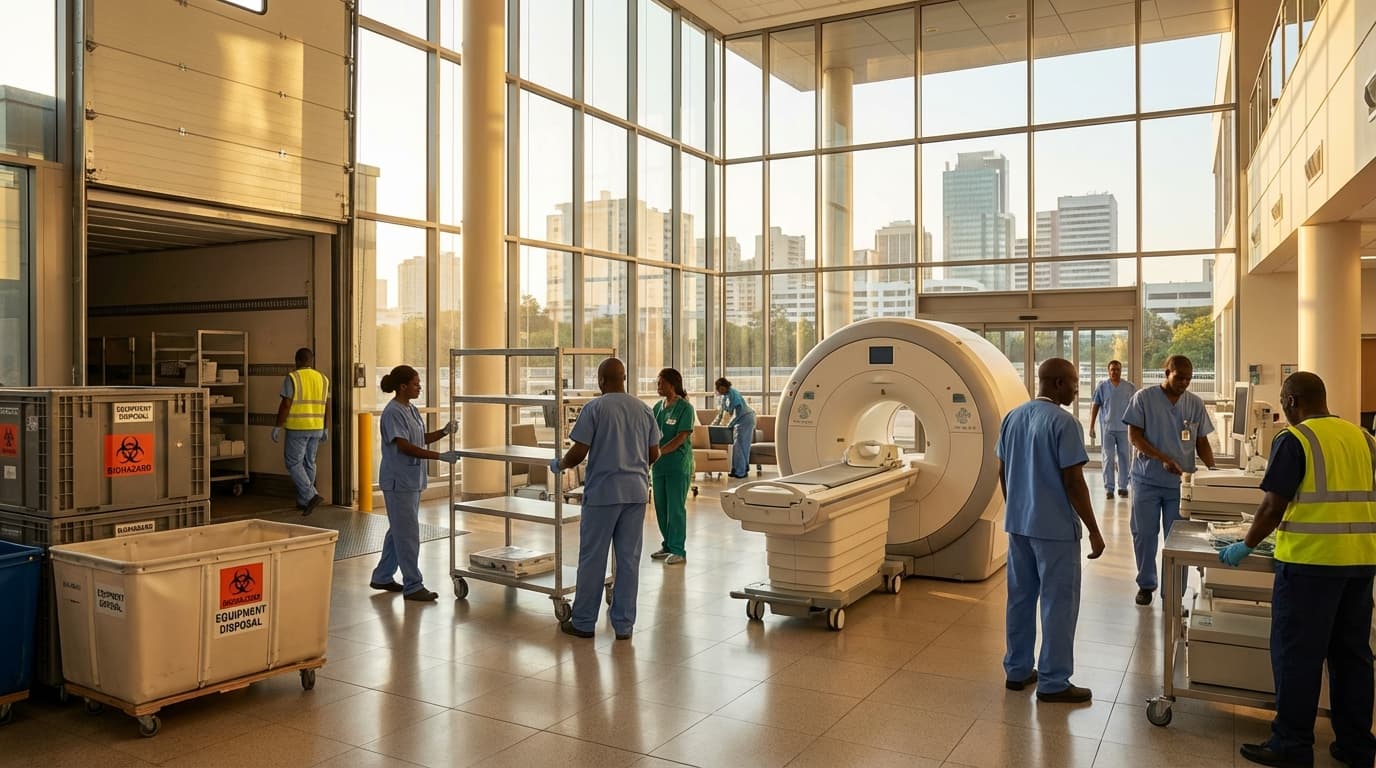
Heavy Medical Equipment De-Installation Service (MRI/CT/Cath Lab) in Senegal
Engineering Excellence & Technical Support
Heavy Medical Equipment De-Installation Service (MRI/CT/Cath Lab) High-standard technical execution following OEM protocols and local regulatory frameworks.
Precision De-Installation & Rigging
Our highly trained technicians utilize specialized tools and methodologies for the meticulous de-installation of sensitive medical imaging equipment like MRI, CT, and Cath Labs. We ensure adherence to strict manufacturer guidelines and safety protocols to prevent damage and preserve equipment integrity during complex rigging and lifting operations.
Expert Logistics & Site-Specific Planning
Navigating the unique logistical challenges in Senegal, we develop comprehensive de-installation plans tailored to each site. This includes meticulous route planning, coordination with local authorities, and robust risk assessments to ensure a seamless and efficient removal process from cramped hospital environments to secure transport.
Safety & Compliance Certified
We prioritize the highest standards of safety and regulatory compliance. Our teams are certified in hazardous material handling and equipped with advanced safety gear. We ensure all de-installation procedures in Senegal meet international and local safety regulations, safeguarding personnel, patients, and the environment.
What Is Heavy Medical Equipment De-installation Service (Mri/ct/cath Lab) In Senegal?
Heavy Medical Equipment De-Installation Service (MRI/CT/Cath Lab) in Senegal refers to the specialized process of safely and systematically dismantling, preparing for transport, and removing complex, high-value medical imaging and interventional systems such as Magnetic Resonance Imaging (MRI) scanners, Computed Tomography (CT) scanners, and Cardiac Catheterization (Cath Lab) suites from their operational environments. This service is critical for managing asset lifecycle, facilitating relocation, upgrading facilities, or decommissioning outdated equipment. It necessitates adherence to stringent safety protocols, manufacturer-specific guidelines, and regulatory requirements to prevent damage to the equipment, the healthcare facility, and personnel involved. The de-installation process typically involves power down, cryogen management (for MRI), component disassembly, specialized packing and crating, and logistical coordination for removal from the site. Expertise in high-voltage systems, magnetic field containment, and precision engineering is paramount.
| Who Needs This Service? | Typical Use Cases | ||||
|---|---|---|---|---|---|
| Hospitals and Healthcare Facilities: Public and private hospitals, specialized clinics, and diagnostic imaging centers in Senegal. This includes facilities undergoing renovation, relocation, or equipment upgrades. | MRI/CT/Cath Lab Manufacturers and Resellers: Companies involved in the sale, refurbishment, or secondary market of medical equipment. They require de-installation to facilitate delivery of new systems or to acquire used equipment. | Medical Equipment Service Companies: Third-party providers offering comprehensive asset management solutions, including de-installation, relocation, and re-installation services. | Government and Public Health Organizations: Ministries of Health or other governmental bodies managing national healthcare infrastructure and asset deployment. | ||
| Facility Relocation: Moving a hospital or imaging center to a new physical location. | Equipment Upgrades: Replacing older MRI, CT, or Cath Lab systems with newer, more advanced models. | Renovations and Construction: De-installing equipment to allow for major facility modifications or expansions. | Equipment Retirement/Decommissioning: Removing obsolete or non-functional equipment from service. | Asset Remarketing and Resale: Preparing equipment for sale on the secondary market or for donation. | Inter-facility Transfers: Moving an operational system from one department or facility to another within the same healthcare network. |
Key Aspects of Heavy Medical Equipment De-Installation Service:
- Specialized Expertise: Requires certified technicians with experience in MRI, CT, and Cath Lab systems, including knowledge of their unique physical and electrical characteristics.
- Safety Protocols: Implementation of comprehensive safety measures for handling heavy components, managing electrical hazards, and mitigating risks associated with magnetic fields and cryogens.
- Manufacturer Guidelines: Strict adherence to original equipment manufacturer (OEM) de-installation procedures to ensure warranty preservation and proper handling.
- Logistical Coordination: Planning and execution of the physical removal from the site, including coordinating with facility management, transport providers, and potentially customs/importation agencies for international moves.
- Component Management: Careful disassembly, labeling, packing, and crating of all sub-components to prevent damage during transit and ensure ease of re-installation.
- Site Remediation: Restoration of the de-installation site to its pre-removal condition, which may include minor structural repairs or removal of support infrastructure.
Who Needs Heavy Medical Equipment De-installation Service (Mri/ct/cath Lab) In Senegal?
Specialized de-installation services for heavy medical equipment like MRI, CT scanners, and Cath Labs are crucial for a variety of healthcare providers and institutions in Senegal. These services are required when facilities are undergoing upgrades, relocating to new premises, decommissioning old equipment, or preparing for the installation of new, advanced machinery. The complexity and cost of these procedures necessitate professional expertise to ensure safety, regulatory compliance, and the preservation of equipment value.
| Customer Type | Primary Departments Involved | Reasons for De-Installation | Key Considerations for Senegal |
|---|---|---|---|
| Large Public Hospitals | Radiology, Cardiology, Neurology, Biomedical Engineering, Facilities Management | Equipment upgrades, replacement of aging units, expansion/renovation of imaging suites, relocation within the hospital. | High patient volume necessitates careful scheduling to minimize service disruption. Compliance with national health standards is paramount. |
| Private Hospitals and Clinics | Radiology, Cardiology, Neurosurgery, Operations Management, Procurement | Modernization of imaging technology, expansion of service offerings, sale of used equipment, relocation to a larger facility. | Focus on maintaining competitive service offerings and maximizing return on investment for capital equipment. |
| Diagnostic Imaging Centers | Radiology, Operations, Technical Staff | Upgrading to newer models with enhanced capabilities, outsourcing specific imaging modalities, relocating to a more accessible location. | Efficiency and speed of de-installation are crucial to minimize downtime and lost revenue. |
| Specialized Medical Centers | Cardiology, Neurology, Oncology, Biomedical Engineering | Transitioning to more advanced diagnostic or interventional equipment, consolidating specialized services, facility renovations. | Requires deep understanding of specific equipment (e.g., cath lab systems) and their complex ancillary components. |
| Government Health Ministries/Agencies | Planning & Development, Procurement, Public Health Infrastructure | Implementation of national health programs requiring new equipment, decommissioning of outdated public facilities, redistribution of assets. | Ensuring equitable access to advanced medical technology across the country and adherence to public procurement regulations. |
| Medical Equipment Suppliers/Distributors | Sales, Service, Logistics, Technical Teams | Facilitating trade-in programs for new installations, managing inventory of used equipment, site preparation for new deployments. | Requires expertise in handling a wide range of manufacturers and models, often involving international shipping considerations for exported equipment. |
Target Customers and Departments in Senegal Requiring Heavy Medical Equipment De-Installation:
- Large Public Hospitals
- Private Hospitals and Clinics
- Diagnostic Imaging Centers
- Specialized Medical Centers (e.g., Cardiology, Neurology)
- Government Health Ministries/Agencies (for public health initiatives)
- Medical Equipment Suppliers/Distributors (for trade-ins or upgrades)
- Research Institutions with medical imaging capabilities
Heavy Medical Equipment De-installation Service (Mri/ct/cath Lab) Process In Senegal
This document outlines the comprehensive workflow for the de-installation of heavy medical equipment, specifically MRI, CT scanners, and Cath Labs, within Senegal. Our service prioritizes safety, efficiency, and compliance with all relevant regulations to ensure a seamless transition and minimize disruption for healthcare facilities. The process begins with an initial inquiry and culminates in the successful de-installation and readiness for transport or disposal.
| Stage | Description | Key Activities | Deliverables/Outcomes |
|---|---|---|---|
| Initial Inquiry & Consultation | The client contacts our service to request de-installation of heavy medical equipment. | Receive and review client request, discuss equipment type, location, and general timeline. Provide preliminary information on services and pricing. | Understanding of client needs, preliminary service scope, and initial contact established. |
| Site Assessment & Planning | A detailed on-site evaluation to gather all necessary information for a safe and efficient de-installation. | On-site inspection of equipment, facility layout, access routes, power supply, cooling systems, and structural considerations. Develop a detailed de-installation plan, risk assessment, and schedule. Obtain necessary permits and permissions. | Detailed de-installation plan, risk assessment report, project schedule, and confirmation of site readiness. |
| Resource Mobilization | Gathering and deploying the necessary personnel, tools, and equipment for the de-installation. | Assemble specialized technical teams (engineers, technicians, riggers). Procure or rent specialized lifting, dismantling, and safety equipment. Arrange for logistics and transportation of personnel and equipment to the site. | Qualified and experienced team on-site, all required tools and machinery readily available. |
| Pre-De-Installation Preparations | Conducting all necessary safety and logistical preparations before commencing the actual de-installation. | Implement safety protocols and signage. Disconnect power, water, and other utilities. Secure surrounding areas. Perform initial disassembly of non-critical components as per plan. | Safe and controlled work environment, equipment isolated and prepped for de-installation. |
| Equipment De-Installation | The core process of safely dismantling and preparing the heavy medical equipment for removal. | Execute the de-installation plan step-by-step. Carefully dismantle major components using specialized lifting and handling techniques. Package and secure all removed parts and components. Ensure all hazardous materials are handled according to regulations. | Dismantled equipment components, safely packaged and secured for transport or storage. |
| Post-De-Installation & Documentation | Completing the de-installation process, performing site cleanup, and providing comprehensive documentation. | Final site inspection and cleanup. Provide a detailed de-installation report including photographs, component inventory, and any encountered issues. Confirm handover of de-installed equipment. | Cleaned and cleared site, comprehensive de-installation report, and formal handover. |
| Project Closure | Finalizing all project aspects and ensuring client satisfaction. | Address any outstanding client queries or concerns. Submit final invoicing and obtain client sign-off. Conduct a post-project review for continuous improvement. | Client satisfaction, project completion sign-off, and final administrative closure. |
De-Installation Workflow Stages:
- Initial Inquiry & Consultation
- Site Assessment & Planning
- Resource Mobilization
- Pre-De-Installation Preparations
- Equipment De-Installation
- Post-De-Installation & Documentation
- Project Closure
Heavy Medical Equipment De-installation Service (Mri/ct/cath Lab) Cost In Senegal
The cost of de-installing heavy medical equipment like MRI, CT scanners, and Cath Labs in Senegal can vary significantly due to several influencing factors. These specialized de-installations require a high degree of technical expertise, specialized tools, and adherence to strict safety protocols to ensure the equipment is safely dismantled, packaged, and prepared for relocation or disposal. The pricing will reflect the complexity of the procedure, the specific type of equipment, and the provider's experience and reputation.
| Equipment Type | Estimated De-installation Cost Range (XOF) | Notes |
|---|---|---|
| CT Scanner (Mid-range) | 1,500,000 - 4,000,000 | Excludes crating/packaging. Depends on model complexity and accessibility. |
| MRI Scanner (Mid-range, non-cryogenic considerations) | 3,000,000 - 8,000,000+ | Magnet handling is a significant factor. Includes basic dismantling. Advanced services like helium management for older MRIs would be extra. |
| Cath Lab (Single Plane) | 2,000,000 - 6,000,000 | Includes dismantling of imaging, table, and console components. Plumbing and electrical disconnects. |
| Cath Lab (Bi-Plane) | 3,500,000 - 9,000,000+ | More complex due to dual imaging systems, leading to higher labor and time requirements. |
| Ancillary Heavy Equipment (e.g., X-ray Generator, Ultrasound Cart) | 500,000 - 1,500,000 | Simpler to de-install but still requires skilled technicians. |
Key Pricing Factors for Heavy Medical Equipment De-Installation in Senegal:
- {"item":"Type and Complexity of Equipment:","description":"MRI, CT scanners, and Cath Labs differ greatly in their size, components, and the precision required for their disassembly. MRI magnets, for instance, are extremely heavy and require specialized handling. Cath Labs often involve intricate plumbing and high-voltage systems."}
- {"item":"Accessibility and Site Conditions:","description":"The ease of access to the equipment within the medical facility, as well as the surrounding environment, impacts the labor and time required. Difficult-to-reach locations or sites with limited space for maneuvering can increase costs."}
- {"item":"De-installation Scope:","description":"This includes whether the service involves simple disconnection and dismantling or also includes detailed component labeling, packing, and preparation for transport or storage."}
- {"item":"Specialized Tools and Equipment Rental:","description":"The de-installation may require specialized lifting equipment, precision tools, and potentially temporary climate control, all of which add to the overall expense."}
- {"item":"Labor Costs and Expertise:","description":"Highly skilled technicians with experience in medical equipment de-installation are essential. Their wages, along with the number of technicians needed, will be a significant cost component. Senegal's general labor market rates will apply."}
- {"item":"Time Required for De-installation:","description":"Complex de-installations can take several days. The longer the project duration, the higher the labor and operational costs."}
- {"item":"Safety and Compliance Measures:","description":"Ensuring adherence to all relevant safety regulations and environmental protocols during the de-installation process is paramount and may involve additional costs for specialized safety equipment or permits."}
- {"item":"Provider's Reputation and Experience:","description":"Established companies with a proven track record in handling sensitive and high-value medical equipment may command higher prices due to their reliability and reduced risk of damage."}
- {"item":"Location within Senegal:","description":"While major cities like Dakar might have a more competitive market with more providers, costs could potentially be higher in more remote regions due to logistics and availability of specialized personnel."}
Affordable Heavy Medical Equipment De-installation Service (Mri/ct/cath Lab) Options
De-installing heavy medical equipment like MRI, CT scanners, and Cath Labs is a complex and critical process. Choosing the right service provider can significantly impact your budget and minimize operational disruption. This guide explores affordable de-installation options, focusing on value bundles and effective cost-saving strategies.
| Service Component | Potential Cost Factors | Cost-Saving Strategies | Typical Bundle Inclusion |
|---|---|---|---|
| Project Planning & Management | Complexity, timelines, required expertise. | Early engagement, detailed site surveys, clear communication. | Often included in core packages. |
| Rigging & Hoisting | Weight and size of equipment, accessibility, specialized equipment needed (cranes, forklifts). | Utilize existing site infrastructure where possible, coordinate with site staff for access. | Essential component, usually priced per hour or project. |
| Disassembly & De-cabling | Technical expertise required, number of components, vendor-specific procedures. | Ensure technicians are certified for the specific equipment brand. | Core service, often priced per equipment type. |
| Transportation Coordination | Distance to new location, specialized transport requirements (climate control, security). | Obtain multiple quotes for transport, consider backhaul opportunities if available. | Often managed, but transport costs are usually separate or an add-on. |
| Site Remediation/Restoration | Damage to flooring, walls, or electrical infrastructure. | Pre-de-installation documentation of site condition, prompt repairs. | May be an optional add-on or included in premium bundles. |
| Documentation & Compliance | Creating detailed reports, ensuring regulatory compliance. | Request standardized reporting templates. | Usually included to ensure traceability and compliance. |
Understanding Value Bundles and Cost-Saving Strategies
- Value Bundles: Service providers often offer bundled packages that combine de-installation with other essential services, potentially reducing overall costs.
- Cost-Saving Strategies: Proactive planning, comparison shopping, and understanding the scope of work are crucial for maximizing savings.
- Key Services in Bundles: Look for bundles that include planning, rigging, transportation coordination, documentation, and sometimes even basic site remediation.
- Benefits of Bundling: Streamlined logistics, single point of contact, and potential volume discounts.
- DIY vs. Professional De-installation: While tempting, attempting DIY de-installation of heavy medical equipment is highly discouraged due to safety risks and specialized expertise required.
- Negotiation Power: Understand the market rates and be prepared to negotiate with service providers.
- Off-Peak Scheduling: Consider de-installation during periods of lower demand for potential cost reductions.
- Clear Scope of Work: Precisely define what needs to be done to avoid unexpected charges.
- Pre-De-installation Site Assessment: A thorough assessment can identify potential challenges and allow for accurate quoting.
Verified Providers In Senegal
In the dynamic landscape of healthcare in Senegal, ensuring access to reliable and high-quality medical services is paramount. The concept of 'Verified Providers' has gained significant traction, offering individuals and organizations a trusted pathway to secure the best possible care. Among these, Franance Health stands out as a leading force, distinguished by its rigorous credentialing process and unwavering commitment to excellence. This document outlines why Franance Health credentials represent the best choice for individuals and businesses seeking verified healthcare providers in Senegal.
| Credentialing Aspect | Franance Health's Verification Process | Benefit for Patients/Organizations |
|---|---|---|
| Professional Qualifications | Scrutiny of degrees, certifications, and licenses from recognized institutions. | Ensures providers possess the foundational knowledge and formal training required. |
| Clinical Experience | Verification of practice history, surgical outcomes (where applicable), and professional references. | Confirms practical application of knowledge and proven ability to deliver effective care. |
| Reputation and Ethical Conduct | Background checks, review of any disciplinary actions, and assessment of professional peer reviews. | Guarantees providers operate with integrity and maintain high ethical standards. |
| Facility Standards (for institutions) | Assessment of infrastructure, equipment, hygiene protocols, and patient care management systems. | Ensures a safe, well-equipped, and conducive environment for medical treatment. |
| Continuing Professional Development | Confirmation of participation in ongoing training and educational programs. | Indicates providers are up-to-date with the latest medical advancements and practices. |
Why Franance Health Credentials Matter
- Uncompromising Quality Standards: Franance Health's credentialing process is designed to go beyond basic licensing. It delves into the expertise, experience, and ethical standing of each healthcare professional and facility.
- Patient Safety and Trust: By adhering to stringent verification protocols, Franance Health significantly reduces the risk of encountering unqualified or fraudulent providers, thereby enhancing patient safety and fostering trust in the healthcare system.
- Access to Specialized Expertise: The credentialing process identifies providers with specific specializations and proven track records, ensuring that patients are directed to the most appropriate and skilled professionals for their unique medical needs.
- Regulatory Compliance and Ethical Practice: Franance Health verifies that all accredited providers adhere to Senegal's healthcare regulations and uphold the highest ethical standards, ensuring a responsible and transparent medical experience.
- Efficiency in Healthcare Access: For organizations and individuals seeking healthcare, Franance Health's verified provider network streamlines the search process, saving valuable time and resources while guaranteeing quality.
Scope Of Work For Heavy Medical Equipment De-installation Service (Mri/ct/cath Lab)
This Scope of Work (SOW) outlines the requirements for the professional de-installation of heavy medical equipment, specifically Magnetic Resonance Imaging (MRI) scanners, Computed Tomography (CT) scanners, and Cardiac Catheterization (Cath Lab) systems. The objective is to safely and efficiently dismantle, disconnect, and prepare these complex systems for transport and storage. This SOW details the technical deliverables and standard specifications to ensure a successful de-installation process.
| Category | Technical Deliverable | Standard Specification/Requirement | Verification Method |
|---|---|---|---|
| Pre-De-installation Assessment | Site Survey Report | Includes detailed site conditions, access routes, power availability, ventilation, structural integrity assessment, and potential hazards. | On-site inspection and photographic documentation. |
| Power & Data Disconnection | De-energized Equipment | All power, control, and data cables securely disconnected and clearly labeled. | Visual inspection and confirmation with electrical schematics. |
| Ancillary Services Disconnection | Disconnected Ancillary Lines | Cooling systems (chillers, water lines), cryogen lines (for MRI), vacuum lines, and other essential services disconnected, purged (if applicable), and secured. | Visual inspection and sign-off by service provider. |
| Component Dismantling | Dismantled Major Components | Equipment disassembled into transportable modules/components as per manufacturer specifications. Critical components such as magnet (MRI), gantry (CT), and detector arrays (Cath Lab) handled with extreme care. | Manufacturer's de-installation manual adherence; photographic documentation of each stage. |
| Component Protection & Packaging | Protected & Packaged Components | All components protected against shock, vibration, moisture, and dust. Use of appropriate padding, crating, and wrapping materials. | Visual inspection of packaging integrity. |
| De-installation Documentation | De-installation Report | Comprehensive report including pre-de-installation photos, de-installation steps, component list, photos of packaged items, and any anomalies encountered. | Review and approval of submitted report. |
| Safety Compliance | Adherence to Safety Protocols | Full compliance with OSHA, local safety regulations, and site-specific safety procedures. Use of appropriate Personal Protective Equipment (PPE). | On-site observation by client representative; safety checklist completion. |
| Environmental Handling | Proper Waste Disposal | Any removed materials (e.g., coolant, refrigerant) handled and disposed of according to environmental regulations. | Documentation of disposal certificates. |
| Post-De-installation Site Status | Clean & Safe Work Area | Work area left clean, free of debris, and safe for subsequent operations. | Client walk-through and sign-off. |
Key Objectives
- Safe and controlled disconnection of all power, data, and ancillary service connections.
- Dismantling of major equipment components according to manufacturer guidelines and best practices.
- Secure packaging and protection of all disassembled components.
- Documentation of the de-installation process and equipment status.
- Compliance with all relevant safety regulations and environmental standards.
Service Level Agreement For Heavy Medical Equipment De-installation Service (Mri/ct/cath Lab)
This Service Level Agreement (SLA) outlines the terms and conditions for the provision of heavy medical equipment de-installation services, specifically for MRI, CT, and Cath Lab systems. It defines the expected response times for service requests and uptime guarantees for critical support components related to the de-installation process. This SLA is intended to ensure a smooth and efficient transition during equipment relocation or replacement.
| Service Request Type | Priority Level | Response Time Target | Escalation Criteria |
|---|---|---|---|
| Initial Service Request (Scheduling) | Medium | 4 business hours | N/A |
| Request for De-installation Commencement | High | 2 business hours (acknowledgement) | If team not on-site within 4 hours of scheduled start |
| Critical Equipment Failure (during de-installation) | Critical | 1 business hour (acknowledgement), 4 business hours (resolution initiation) | If de-installation is halted for > 8 hours |
| Personnel Availability Issue (during de-installation) | Critical | 1 business hour (acknowledgement), 4 business hours (resolution initiation) | If de-installation is halted for > 8 hours |
| Safety Incident Requiring Pause | Critical | Immediate acknowledgement, ongoing communication | As per safety protocols |
Service Level Agreement - Heavy Medical Equipment De-Installation (MRI/CT/Cath Lab)
- 1. Scope of Service: This SLA covers the professional de-installation of MRI, CT, and Cath Lab equipment. This includes, but is not limited to, power disconnection, cabling management, magnetic shielding considerations (for MRI), component disassembly, and preparation for transportation.
- 2. Definitions:
- Service Request: A formal notification submitted by the Client to the Service Provider requesting de-installation services.
- Critical Component: Essential elements or systems required for the successful and safe execution of the de-installation process (e.g., specialized tools, trained personnel, safety equipment).
- Downtime: The period during which the Client is unable to proceed with the scheduled de-installation due to a failure or delay attributable to the Service Provider's negligence or inability to meet agreed-upon response times for Critical Components.
- Response Time: The maximum time allowed for the Service Provider to acknowledge and initiate action on a Service Request.
- Resolution Time: The maximum time allowed for the Service Provider to rectify an issue preventing the continuation of de-installation.
- 3. Response Times: The Service Provider commits to the following response times for critical service requests related to de-installation activities:
- Critical Equipment Failure: If a failure of Service Provider provided critical equipment or tools directly halts de-installation progress.
- Personnel Availability Issue: If the scheduled de-installation team fails to arrive or is significantly delayed without prior notification.
- 4. Uptime Guarantees: While de-installation is a project-based service and not a continuous operational service, the following uptime guarantees apply to the availability of Service Provider's critical support components and personnel during the agreed-upon de-installation window:
- Personnel Availability: 98% availability of the scheduled de-installation team during the agreed-upon de-installation window, excluding pre-approved breaks and scheduled transitions.
- Critical Tool/Equipment Functionality: 99% uptime for any specialized tools or equipment provided by the Service Provider that are essential for the de-installation process.
- 5. Exclusions: This SLA does not cover:
- Delays or issues caused by the Client's infrastructure, site access, or preparation.
- Force Majeure events (e.g., natural disasters, widespread power outages, strikes not related to the Service Provider).
- Client-initiated changes to the scope of work after the de-installation schedule has been finalized.
- Issues arising from the performance of the equipment itself prior to de-installation.
- 6. Penalties/Remedies: In the event of a breach of this SLA, the Service Provider shall [Specify agreed-upon remedies, e.g., provide service credits, waive specific fees, re-schedule at no additional cost, etc.].
- 7. Reporting and Escalation: The Service Provider will provide a post-de-installation report detailing adherence to this SLA. Escalation procedures for unresolved issues will be [Describe escalation process].
Frequently Asked Questions

Ready when you are
Let's scope your Heavy Medical Equipment De-Installation Service (MRI/CT/Cath Lab) in Senegal project in Senegal.

Scaling healthcare logistics and technical systems across the entire continent.