
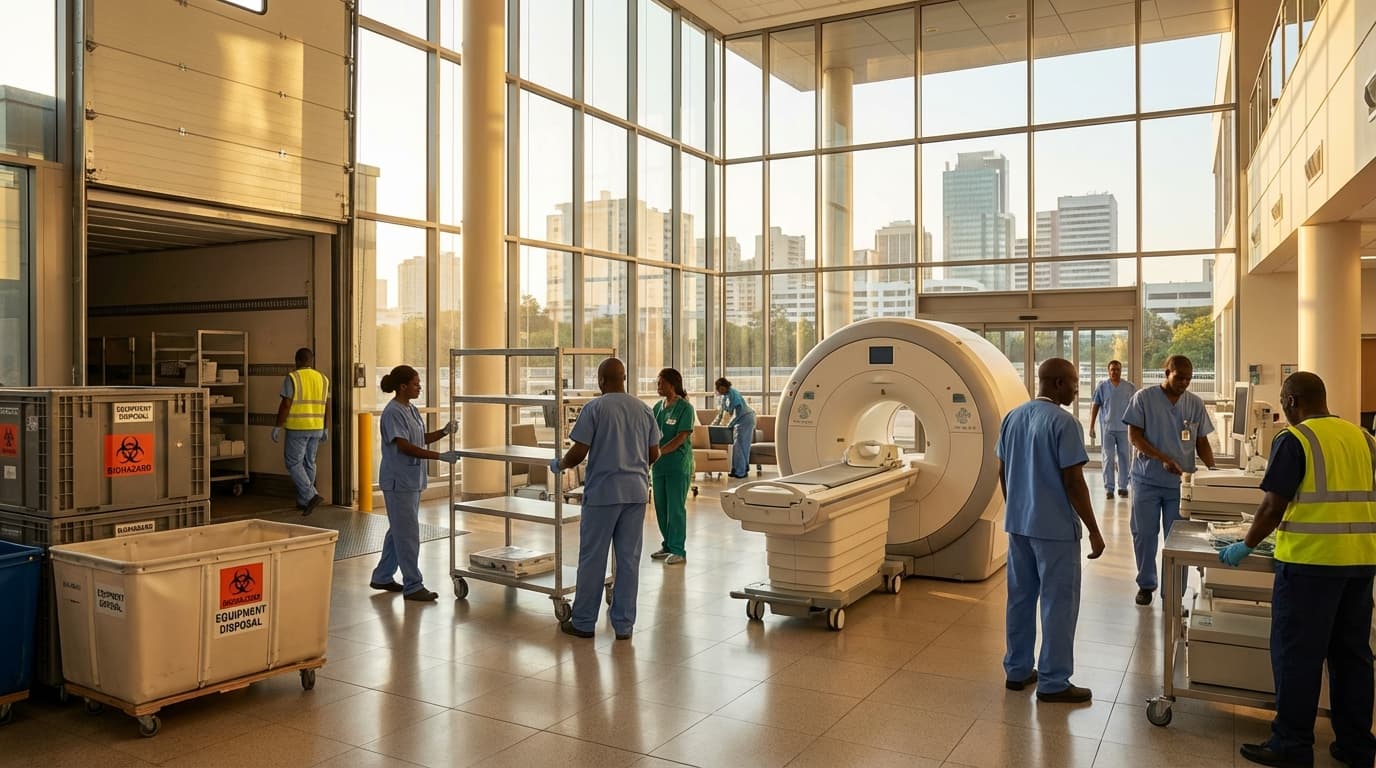
Decommissioning Service for Medical Devices in Senegal
Engineering Excellence & Technical Support
Decommissioning Service for Medical Devices High-standard technical execution following OEM protocols and local regulatory frameworks.
Regulatory Compliance & Secure Disposal
Ensuring strict adherence to Senegalese healthcare and environmental regulations for the secure and compliant decommissioning of medical devices. This includes proper documentation, data sanitization, and environmentally sound disposal methods to prevent any health or ecological risks.
Expert Decommissioning Process
Implementing a systematic, multi-stage decommissioning process tailored for diverse medical equipment. This involves thorough assessment, safe disassembly, component segregation for recycling or disposal, and detailed record-keeping for full auditable traceability.
Partnership for Healthcare Advancement
Collaborating with Senegalese healthcare institutions to facilitate the responsible retirement of aging medical devices. Our service ensures that facilities can efficiently upgrade their infrastructure, contributing to improved patient care and a more sustainable healthcare ecosystem.
What Is Decommissioning Service For Medical Devices In Senegal?
Decommissioning service for medical devices in Senegal refers to the systematic and secure process of retiring a medical device from active use, ensuring its data is appropriately handled, and its physical components are managed in accordance with regulatory, environmental, and data privacy standards. This service is critical for healthcare facilities and medical device manufacturers operating within the Senegalese regulatory framework.
| Who Needs Decommissioning Service? | Typical Use Cases |
|---|---|
| Hospitals and Clinics (Public and Private): Entities operating medical facilities that procure, utilize, and eventually retire medical equipment. | End-of-life equipment replacement: When a device has reached its operational lifespan and is being replaced with newer technology. |
| Diagnostic Laboratories: Facilities that use specialized medical instrumentation. | Technological obsolescence: When a device's capabilities are superseded by more advanced or efficient models. |
| Medical Device Manufacturers and Distributors: Companies responsible for the lifecycle management of their products, including end-of-life. | Product recalls or withdrawals: When a device is no longer safe or compliant and needs to be removed from circulation. |
| Research Institutions: Organizations that use medical devices for research purposes. | Project completion or discontinuation: When a research project utilizing a specific device concludes. |
| Government Health Agencies: Overseeing the safe and compliant management of medical equipment across the healthcare sector. | Inventory optimization: Streamlining assets and removing underutilized or outdated equipment. |
| Third-Party Service Providers: Specialized companies offering medical device management and disposal solutions. | Lease termination or equipment return: When a leased device is due for return or disposal. |
Key Components of Medical Device Decommissioning Services in Senegal:
- Data Sanitization/Destruction: Erasing or physically destroying any sensitive patient health information (PHI) stored on the device's memory, in compliance with local data protection laws.
- Asset Management and Tracking: Documenting the device's lifecycle, including its removal from inventory and disposal method.
- Environmental Compliance: Adhering to regulations for the disposal of electronic waste (e-waste) and potentially hazardous materials, ensuring environmentally sound practices.
- Physical Disposal/Recycling: Securely dismantling, recycling, or disposing of the device's components through certified channels.
- Certification and Documentation: Providing official certificates of destruction or disposal, which may be required by regulatory bodies or for auditing purposes.
- Safety Verification: Ensuring the device is rendered inoperable and safe for transport and disposal, preventing unauthorized reuse or biohazard exposure.
Who Needs Decommissioning Service For Medical Devices In Senegal?
Decommissioning services for medical devices are crucial in Senegal to ensure the safe and responsible disposal of equipment, complying with environmental and health regulations. This is particularly important as healthcare facilities upgrade their technology, retire aging equipment, or relocate. Proper decommissioning prevents the leakage of sensitive patient data, the release of hazardous materials, and the potential misuse of functional or partially functional devices. Services typically include data sanitization, physical destruction, and environmentally sound disposal or recycling of components.
| Customer Type | Key Departments Involved | Specific Decommissioning Needs |
|---|---|---|
| Hospitals (Public & Private) | IT Department, Biomedical Engineering, Radiology, Cardiology, Oncology, Central Sterilization, Procurement, Facilities Management | Data sanitization of imaging systems (MRI, CT), disposal of radioactive materials (oncology), secure data erasure from patient monitoring systems, recycling of complex electronic components, compliance with hazardous waste regulations. |
| Clinics & Medical Centers | Administration, Clinical Staff, IT Support (if applicable) | Secure disposal of ultrasound machines, ECG devices, surgical instruments, data removal from electronic health record systems linked to devices. |
| Diagnostic Laboratories | Laboratory Management, IT Department, Technical Staff | Decommissioning of analytical instruments (e.g., mass spectrometers, DNA sequencers), data secure erasure from laboratory information systems (LIS), disposal of chemical reagents and potentially biohazardous waste. |
| Research Institutions/Universities | Research Labs, IT Department, Procurement, Facilities Management | Secure disposal of research-specific equipment, data wipe from specialized analytical tools, compliance with research ethics and data privacy regulations. |
| Government Health Agencies | Procurement, Public Health Infrastructure Management, Environmental Health Division | Developing and enforcing decommissioning standards, managing disposal of large quantities of retired equipment from public facilities, ensuring compliance with national environmental laws. |
| Medical Equipment Suppliers/Manufacturers | Service Department, Logistics, Compliance Department | Managing trade-in programs, refurbishing and reselling equipment, responsible disposal of non-functional units, ensuring data security of returned devices. |
Target Customers and Departments for Medical Device Decommissioning Services in Senegal
- {"title":"Hospitals (Public and Private)","description":"The largest consumers of medical devices, with diverse needs for decommissioning across multiple departments. This includes both large tertiary care hospitals and smaller community hospitals."}
- {"title":"Clinics and Medical Centers","description":"Smaller healthcare facilities that still utilize a range of medical equipment and require professional decommissioning for retired items."}
- {"title":"Diagnostic Laboratories","description":"Facilities that use specialized equipment for testing and analysis, often requiring secure data erasure and disposal of sensitive analytical components."}
- {"title":"Research Institutions and Universities with Medical Programs","description":"Organizations that use medical devices for research and education and need to manage their end-of-life processes."}
- {"title":"Government Health Agencies","description":"National and regional health bodies that oversee public health infrastructure and may manage central medical equipment pools or disposal policies."}
- {"title":"Medical Equipment Suppliers and Manufacturers (Secondary Market/Trade-ins)","description":"Companies that may take back used equipment for refurbishment, resale, or responsible disposal as part of their service offerings."}
Decommissioning Service For Medical Devices Process In Senegal
This document outlines the comprehensive workflow for decommissioning medical devices in Senegal, from the initial inquiry to the final execution. The process ensures safe, environmentally responsible, and legally compliant removal of medical equipment from service.
| Stage | Description | Key Activities | Responsible Party |
|---|---|---|---|
| Inquiry & Consultation | Initial contact and understanding client needs. | Needs assessment, device overview, timeline discussion. | Healthcare Facility, Decommissioning Service Provider |
| Site Assessment & Inventory | On-site evaluation and detailed device cataloging. | Physical inspection, device listing, condition assessment. | Decommissioning Service Provider |
| Risk Assessment & Planning | Identifying and mitigating potential hazards, developing execution strategy. | Hazard identification, safety protocol development, environmental plan. | Decommissioning Service Provider |
| Regulatory Compliance & Permitting | Ensuring adherence to Senegalese laws and obtaining necessary approvals. | Legal review, permit application, regulatory liaison. | Decommissioning Service Provider |
| Data Security & Sanitization | Secure erasure or destruction of sensitive data. | Data wiping, physical destruction, data integrity verification. | Decommissioning Service Provider |
| Decommissioning Execution | Safe disconnection, disassembly, and preparation of devices. | Electrical disconnection, mechanical disassembly, component removal. | Decommissioning Service Provider |
| Transportation & Logistics | Secure and efficient movement of decommissioned devices. | Packaging, loading, transport scheduling, route planning. | Decommissioning Service Provider |
| Disposal & Recycling | Environmentally sound management of device components. | Material segregation, hazardous waste treatment, recycling, landfill. | Decommissioning Service Provider |
| Certification & Documentation | Formal confirmation and record-keeping of the process. | Issuing certificates, compiling reports, maintaining records. | Decommissioning Service Provider |
| Post-Decommissioning Support | Ongoing assistance to the client. | Consultation on asset management, advice on replacements. | Decommissioning Service Provider |
Decommissioning Service for Medical Devices Process in Senegal
- Inquiry & Initial Consultation: The process begins with a healthcare facility or organization contacting a licensed decommissioning service provider. This initial stage involves understanding the client's needs, the type and quantity of devices to be decommissioned, and any specific requirements or timelines.
- Site Assessment & Inventory: A thorough site assessment is conducted to evaluate the location of the devices, access, and any potential hazards. A detailed inventory of all devices is created, including make, model, serial number, condition, and intended decommissioning method.
- Risk Assessment & Planning: Based on the inventory and site assessment, a comprehensive risk assessment is performed. This identifies potential risks associated with decommissioning, such as electrical hazards, chemical exposure, data security breaches, and environmental impact. A detailed decommissioning plan is then developed, outlining the steps, resources, safety protocols, and environmental management procedures.
- Regulatory Compliance & Permitting: The decommissioning service provider ensures adherence to all relevant Senegalese regulations and standards for medical waste management, hazardous materials handling, and data privacy. Necessary permits or approvals from regulatory bodies are obtained.
- Data Security & Sanitization: For devices containing sensitive patient data (e.g., imaging equipment, electronic health records systems), a rigorous data sanitization protocol is implemented to ensure all data is securely erased or destroyed in compliance with privacy laws. This may involve physical destruction or certified data wiping methods.
- Decommissioning Execution: The approved plan is put into action. This involves skilled technicians safely disconnecting, disassembling, and preparing the devices for transport or disposal. Depending on the device, this may include draining fluids, removing hazardous components, and ensuring safe handling.
- Transportation & Logistics: Once decommissioned, devices are safely transported to designated facilities. The logistics are managed to ensure secure and timely movement, considering the nature of the equipment and any hazardous materials involved.
- Disposal & Recycling: Devices are disposed of or recycled in an environmentally responsible manner, adhering to national and international best practices. This includes segregation of materials for recycling, proper disposal of hazardous waste, and adherence to regulations for e-waste management. Options like donation of functional equipment (after proper sanitization) may also be explored.
- Certification & Documentation: Upon completion of the decommissioning process, the service provider issues a certificate of decommissioning. This document serves as proof that the devices have been removed from service safely and legally, along with detailed records of the entire process, including inventory, disposal methods, and compliance with regulations.
- Post-Decommissioning Support: The service provider may offer post-decommissioning support, such as providing advice on asset management, replacement strategies, or answering any follow-up queries from the client.
Decommissioning Service For Medical Devices Cost In Senegal
Decommissioning medical devices in Senegal is a crucial process that ensures the safe and environmentally responsible disposal of obsolete or non-functional equipment. The cost of this service is influenced by several factors, leading to a range of prices in the local currency, the West African CFA franc (XOF). Key considerations include the type and complexity of the medical device, its size and weight, the presence of hazardous materials, the vendor's expertise and certifications, and the location of the facility requiring decommissioning. Specialized devices like imaging machines (MRI, CT scanners) or those containing radioactive isotopes will naturally incur higher costs due to specialized handling, transportation, and disposal requirements. Conversely, simpler devices like examination tables or basic lab equipment will be less expensive. The availability of licensed and certified decommissioning service providers in Senegal also plays a role, with competition impacting pricing. Furthermore, the specific requirements for data sanitization for devices containing sensitive patient information add to the overall cost.
| Device Category (Example) | Estimated Cost Range (XOF) | Notes |
|---|---|---|
| Small Laboratory Equipment (e.g., centrifuges, microscopes) | 50,000 - 150,000 XOF | Includes basic dismantling and certified disposal. |
| Examination Tables / Basic Diagnostic Tools | 75,000 - 200,000 XOF | Depends on material and complexity. |
| General Hospital Furniture (e.g., beds, trolleys) | 100,000 - 250,000 XOF | Bulk removal may offer slight discounts. |
| Medium-Sized Imaging Equipment (e.g., X-ray machines, Ultrasound) | 500,000 - 2,000,000 XOF | Requires specialized handling, potential for hazardous materials. |
| Large Imaging Equipment (e.g., MRI, CT Scanners) | 2,000,000 - 10,000,000+ XOF | Significant costs due to size, weight, specialized components, and potential radioactive elements. May involve international expertise for certain components. |
| Sterilization Equipment (e.g., autoclaves) | 300,000 - 800,000 XOF | Pressure vessels and potential residual chemicals need careful management. |
Key Pricing Factors for Medical Device Decommissioning in Senegal
- Type and Complexity of the Medical Device
- Size and Weight of the Equipment
- Presence of Hazardous Materials (e.g., mercury, radioactive isotopes, batteries)
- Vendor's Expertise, Certifications, and Licensing
- Geographic Location of the Facility
- Data Sanitization and Destruction Requirements
- Transportation and Logistics Costs
- Disposal and Recycling Fees
Affordable Decommissioning Service For Medical Devices Options
Decommissioning medical devices is a critical but often overlooked aspect of healthcare facility management. It involves securely and responsibly retiring equipment that is no longer in use, ensuring data privacy, environmental compliance, and asset recovery. Finding affordable decommissioning services is essential for budget-conscious institutions. This service aims to provide cost-effective solutions through flexible value bundles and strategic cost-saving approaches, minimizing disruption and maximizing value from retired assets.
| Cost-Saving Strategy | Description | Benefit |
|---|---|---|
| Bulk Service Agreements | Negotiate discounted rates by committing to decommissioning a specific volume of devices over a defined period (e.g., annually). | Predictable costs, significant price reductions per unit, and streamlined logistics. |
| Scheduled Decommissioning | Plan decommissioning in advance to coincide with equipment refresh cycles or facility renovations, allowing for efficient scheduling and resource allocation. | Reduced urgency fees, optimized technician time, and minimized operational disruption. |
| Tiered Service Levels | Choose the level of service that matches the device's value and your facility's compliance requirements, avoiding overspending on unnecessary services. | Pay only for what you need, aligning costs with actual service delivery. |
| Collaborative Asset Recovery | Partner with us to maximize resale value. We provide transparent reporting on asset condition and market demand to ensure the best possible return. | Increased revenue generation from retired assets, offsetting decommissioning costs. |
| Environmental Partnership | Leverage our established relationships with certified recyclers and e-waste facilities to ensure cost-effective and compliant disposal. | Reduced disposal fees and avoidance of potential environmental fines. |
Value Bundles for Decommissioning Services
- Basic Decommissioning: Includes secure data wiping (meeting HIPAA standards), physical removal of the device, and environmentally sound disposal or recycling certification. Ideal for devices with minimal residual value.
- Standard Decommissioning + Asset Recovery: Combines basic decommissioning with an assessment for potential resale. If a device has value, we manage the refurbishment, listing, and sale, crediting a portion of the proceeds back to your facility.
- Comprehensive Decommissioning Suite: Our most robust offering, encompassing data destruction, environmental disposal, asset recovery, and complete documentation for regulatory compliance. This bundle can also include inventory management of retired assets and recommendations for future procurement.
- Customizable Bundles: We understand that each facility has unique needs. We offer the flexibility to tailor bundles by adding or removing specific services, such as on-site dismantling, specialized transportation, or extended warranty on data destruction.
Verified Providers In Senegal
In Senegal, ensuring you receive quality healthcare from trusted professionals is paramount. Franance Health stands out as a leader in verifying healthcare providers, offering a robust system that guarantees competence, ethical practice, and adherence to the highest standards. Their rigorous credentialing process goes beyond basic licensing, encompassing in-depth background checks, verification of qualifications, and ongoing performance monitoring. This commitment to excellence means that when you see a provider recommended by Franance Health, you can be confident in their expertise and dedication to your well-being. Choosing a Franance Health-verified provider is choosing peace of mind and the assurance of receiving the best possible care in Senegal.
| Credential Area | Franance Health Verification Process | Benefit to Patients |
|---|---|---|
| Medical Qualifications | Thorough verification of degrees, certifications, and specialized training from accredited institutions. | Ensures providers possess the necessary knowledge and expertise for accurate diagnosis and effective treatment. |
| Licensure and Registration | Confirmation of current and valid medical licenses with relevant Senegalese authorities. | Guarantees that providers are legally authorized to practice medicine. |
| Professional Experience | Verification of work history, including duration and scope of practice in various specialties. | Confirms practical experience and a proven track record of patient care. |
| Ethical Conduct | Background checks for any disciplinary actions or malpractice claims. | Ensures providers adhere to the highest ethical standards and patient rights. |
| Continuing Medical Education (CME) | Verification of ongoing participation in professional development and training programs. | Confirms that providers stay updated with the latest medical advancements and techniques. |
Why Franance Health Credentials Represent the Best Choice:
- Unwavering Commitment to Quality: Franance Health's meticulous verification process ensures providers meet and exceed stringent standards of medical competence and patient care.
- Enhanced Patient Safety: Rigorous background checks and qualification verification minimize risks and ensure you are in safe hands.
- Trust and Transparency: Franance Health provides a transparent system, allowing patients to make informed decisions about their healthcare providers.
- Access to Top-Tier Professionals: By partnering with leading healthcare institutions and individuals, Franance Health connects you with Senegal's most skilled and ethical practitioners.
- Continuous Monitoring and Improvement: Ongoing performance reviews and adherence to ethical guidelines mean that verified providers consistently deliver high-quality care.
Scope Of Work For Decommissioning Service For Medical Devices
This Scope of Work (SOW) outlines the requirements for the decommissioning of medical devices. It details the technical deliverables and standard specifications to ensure safe, compliant, and secure removal and disposal of these assets. The decommissioning process will be conducted by a qualified service provider.
| Deliverable | Description | Standard Specification/Requirement | Acceptance Criteria |
|---|---|---|---|
| Decommissioning Plan | A detailed plan outlining the entire decommissioning process for each device type, including timelines, resource allocation, safety protocols, and environmental considerations. | Must be site-specific, device-specific, and include risk assessments. | Plan approved by the client prior to commencement of work. Includes detailed method statements for each task. |
| Data Sanitization Report | A comprehensive report detailing the methods used to sanitize all sensitive data (patient, operational, financial) stored on or accessible by the medical devices. | Adherence to NIST 800-88 Rev. 1 or equivalent data erasure standards. Method of sanitization (e.g., overwrite, degauss, physical destruction) clearly documented for each device. | Report provided for each device, confirming successful data erasure and documenting the method used. Visual or programmatic verification evidence included. |
| Physical Decommissioning Record | A record for each device detailing its disconnection, disassembly (if required), and preparation for removal. | Documented disconnection from power, networks, and any other associated systems. Compliance with manufacturer guidelines where applicable. | Record signed and dated by the technician performing the task. Photos of disconnected equipment may be required. |
| Chain of Custody Documentation | Documentation that tracks the movement of each device from its original location to the final disposal/recycling facility. | Each transfer of custody must be documented with date, time, location, and signatures of both parties. Secure transport protocols must be followed. | Completed chain of custody forms for each device or batch of devices, confirming secure transport. |
| Certificate of Disposal/Recycling | A certificate issued by the final disposal or recycling facility confirming the environmentally responsible and compliant disposition of the medical device. | Compliance with local, national, and international environmental regulations (e.g., WEEE Directive, EPA regulations). Evidence of responsible recycling or disposal practices. | Certificate provided for each device or batch, detailing the disposal method and certifying compliance with relevant environmental standards. |
| Final Project Report | A consolidated report summarizing all aspects of the decommissioning project, including executed plans, completed deliverables, any exceptions, and final disposition of all assets. | Includes a summary of all individual device reports, total number of devices decommissioned, and adherence to the agreed-upon scope. | Report reviewed and approved by the client, confirming completion of all contractual obligations. |
| Safety Compliance Documentation | Evidence of adherence to all relevant health, safety, and environmental (HSE) regulations throughout the decommissioning process. | Includes risk assessments, method statements, personal protective equipment (PPE) usage, and incident reports (if any). Compliance with OSHA or equivalent standards. | Documentation available for audit; any incidents reported and investigated according to agreed protocols. |
| Asset Inventory Reconciliation | A report reconciling the initial inventory of devices with the final disposition of each device. | Each device on the initial inventory list must be accounted for with its final disposition status. | Reconciliation report approved by the client, confirming all listed assets have been addressed. |
Key Phases of Decommissioning
- Site Assessment and Planning
- Data Sanitization and Security
- Physical Decommissioning and Removal
- Transportation and Logistics
- Disposal and Recycling
- Documentation and Certification
Service Level Agreement For Decommissioning Service For Medical Devices
This Service Level Agreement (SLA) outlines the response times and uptime guarantees for the Decommissioning Service for Medical Devices provided by [Your Company Name] (hereinafter referred to as "Provider") to [Client Company Name] (hereinafter referred to as "Client"). This SLA is an integral part of the overarching Service Agreement between the Provider and the Client.
| Service Type | Incident Priority | Response Time Target | Resolution Time Target (Initial Response) | Resolution Time Target (Full Resolution) | Uptime Guarantee |
|---|---|---|---|---|---|
| Decommissioning Service - Critical Device | High Priority (Urgent Incident) | 1 Hour | 4 Business Hours | 24 Business Hours | 99.5% |
| Decommissioning Service - Critical Device | Medium Priority (Non-Urgent Incident) | 4 Business Hours | 8 Business Hours | 48 Business Hours | 99.5% |
| Decommissioning Service - Standard Device | High Priority (Urgent Incident) | 4 Business Hours | 8 Business Hours | 24 Business Hours | 98.0% |
| Decommissioning Service - Standard Device | Medium Priority (Non-Urgent Incident) | 8 Business Hours | 16 Business Hours | 72 Business Hours | 98.0% |
Definitions
- Decommissioning Service: The process of safely and compliantly removing medical devices from service, including data sanitization, physical disposal, and documentation.
- Critical Device: A medical device whose failure or unavailability would have a severe impact on patient care, safety, or regulatory compliance. Classification of criticality will be agreed upon by both parties.
- Standard Device: A medical device that is not classified as Critical.
- Incident: Any event that causes, or may cause, an unplanned interruption or reduction in the quality of the Decommissioning Service.
- Response Time: The maximum time elapsed between the Client reporting an Incident to the Provider and the Provider acknowledging the Incident and initiating troubleshooting or diagnostic steps.
- Resolution Time: The maximum time elapsed between the Provider acknowledging an Incident and resolving it, restoring the Decommissioning Service to its expected operational state.
- Uptime Guarantee: The minimum percentage of time the Decommissioning Service is available and performing as expected during a defined period.
Frequently Asked Questions

Ready when you are
Let's scope your Decommissioning Service for Medical Devices in Senegal project in Senegal.

Scaling healthcare logistics and technical systems across the entire continent.