
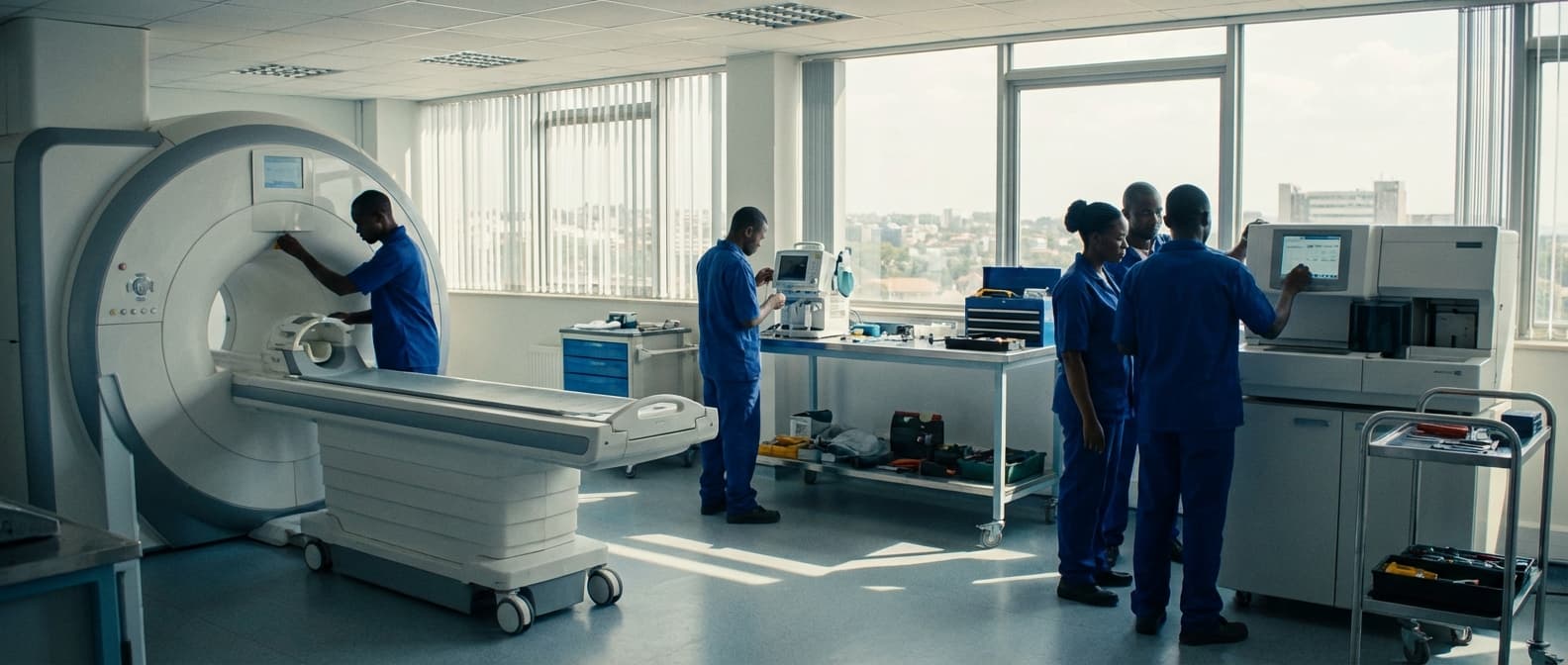
Uptime, Downtime & Root-Cause Analysis Reporting Service in Senegal
Engineering Excellence & Technical Support
Uptime, Downtime & Root-Cause Analysis Reporting Service High-standard technical execution following OEM protocols and local regulatory frameworks.
Real-time Uptime Monitoring & Alerting
Leverage our advanced Uptime monitoring service, providing instant notifications across Senegal for any service disruptions. Proactive alerts ensure minimal impact and rapid response to maintain business continuity.
Comprehensive Downtime Analytics
Gain deep insights into service availability with detailed Downtime analytics. Understand historical performance, identify recurring issues, and benchmark against industry standards within the Senegalese market.
Accelerated Root-Cause Analysis
Our Root-Cause Analysis reporting service pinpoints the exact origin of incidents quickly and accurately. Equip your technical teams with the data needed to implement effective solutions and prevent future occurrences, optimizing IT infrastructure in Senegal.
What Is Uptime, Downtime & Root-cause Analysis Reporting Service In Senegal?
Uptime, Downtime, and Root-Cause Analysis (RCA) Reporting Services in Senegal are critical for ensuring the reliability, availability, and performance of IT infrastructure and business operations. These services focus on systematically tracking, analyzing, and reporting on system availability, identifying reasons for service disruptions, and recommending corrective actions to prevent recurrence.
Uptime refers to the period during which a system, service, or application is operational and accessible to users. It is typically measured as a percentage of a defined period (e.g., 99.99% uptime per month).
Downtime is the inverse of uptime, representing the period during which a system, service, or application is unavailable or non-functional. Downtime can manifest as complete outages, performance degradation rendering the service unusable, or partial unavailability of critical functions.
Root-Cause Analysis (RCA) is a structured methodology for identifying the fundamental, underlying causes of a problem or incident, rather than just addressing the immediate symptoms. In the context of uptime/downtime reporting, RCA aims to prevent future incidents by understanding what led to the disruption.
| Use Case | Description | Impact of Downtime | RCA Focus |
|---|---|---|---|
| Mobile Network Outage | A period where cellular service is unavailable in a specific region, preventing voice calls, SMS, and data access. | Massive customer dissatisfaction, revenue loss, emergency communication disruption. | Network infrastructure failure (base station, core network), fiber cuts, power outages, software glitches, capacity overload. |
| Online Banking Platform Unavailability | Customers cannot access their accounts, perform transactions, or use mobile banking applications. | Loss of trust, customer churn, potential regulatory fines, financial transaction failures. | Web server overload, database corruption, application errors, cyber-attacks, third-party integration failures. |
| E-commerce Website Downtime | The online store is inaccessible, preventing users from browsing products or making purchases. | Significant loss of sales, damage to brand reputation, decreased customer loyalty. | High traffic spikes, inadequate server capacity, faulty code deployments, payment gateway issues, DDoS attacks. |
| ATM Network Interruption | A distributed failure affecting multiple Automated Teller Machines, preventing cash withdrawals and other transactions. | Customer inconvenience, reduced branch foot traffic, negative impact on customer service perception. | Network connectivity issues, ATM hardware faults, central processing system errors, software updates gone wrong. |
| Cloud Application Service Failure | A hosted application (e.g., CRM, ERP) becomes unresponsive or unavailable for users. | Disruption to business operations, decreased productivity, potential data loss or corruption. | Underlying infrastructure issues (server, storage, network), misconfigurations, application bugs, resource exhaustion. |
Who Needs Uptime, Downtime & RCA Reporting Services in Senegal?
- Telecommunications Providers: Essential for maintaining network availability and customer satisfaction. Downtime directly impacts revenue and reputation.
- Financial Institutions (Banks, Fintechs): Critical for transaction processing, online banking, and ATM services. Outages can lead to significant financial losses and loss of customer trust.
- Government Agencies: For public services, citizen portals, and critical infrastructure management. Reliability is paramount for operational efficiency and public trust.
- E-commerce Businesses: Availability of online platforms is directly correlated with sales and customer experience. Downtime leads to lost revenue and abandoned carts.
- Cloud Service Providers: Their core offering is uptime and reliability. Comprehensive reporting and RCA are fundamental to their service level agreements (SLAs).
- Enterprise IT Departments: Across all sectors, managing internal IT systems, applications, and network infrastructure requires continuous monitoring and incident analysis.
- Internet Service Providers (ISPs): Guaranteeing internet connectivity requires robust uptime monitoring and rapid incident response.
- Healthcare Providers: For electronic health records (EHRs), patient management systems, and critical medical equipment. Downtime can have life-threatening consequences.
- Logistics and Transportation Companies: For tracking systems, scheduling software, and operational platforms. Disruptions can lead to delays and increased costs.
Who Needs Uptime, Downtime & Root-cause Analysis Reporting Service In Senegal?
In Senegal's rapidly evolving business landscape, where digital transformation is paramount, ensuring the continuous availability and optimal performance of IT systems is no longer a luxury but a necessity. Businesses face significant financial and reputational risks from unexpected IT failures. An Uptime, Downtime & Root-Cause Analysis Reporting Service provides the critical insights needed to prevent outages, minimize their impact, and enhance overall system resilience. This service is essential for organizations that rely heavily on their IT infrastructure for operations, customer service, and revenue generation.
| Target Customer Segment | Key Departments Benefiting | Primary Concerns Addressed |
|---|---|---|
| Financial Institutions (Banks, Insurance, Microfinance) | IT Operations, Risk Management, Compliance, Business Continuity | Financial loss due to system downtime, data integrity, regulatory compliance, customer trust |
| Telecommunication Companies | Network Operations Center (NOC), Customer Support, Service Assurance, Engineering | Service availability, customer churn, network performance, revenue impact |
| Oil & Gas Companies | IT Operations, Production Monitoring, Safety Systems, Supply Chain Management | Operational disruptions, safety risks, production losses, asset management |
| Retail & E-commerce Businesses | IT Operations, Sales & Marketing, Customer Service, Logistics | Lost sales, customer dissatisfaction, inventory management, website availability |
| Government Agencies | IT Departments, Public Service Delivery, Data Management, Security | Disruption of essential public services, data security breaches, citizen satisfaction, operational efficiency |
| Healthcare Providers | IT Departments, Clinical Operations, Patient Records Management, Compliance | Patient care disruption, data privacy, HIPAA/local compliance, medical equipment uptime |
| Manufacturing Companies | Production Management, IT Operations, Supply Chain, Quality Control | Production line stoppages, equipment downtime, inventory tracking, operational efficiency |
| Technology & MSPs | Service Delivery, Technical Support, Account Management, Operations | SLA adherence, client satisfaction, proactive issue resolution, service profitability |
Target Customers in Senegal
- Large Enterprises across various sectors (Finance, Telecommunications, Oil & Gas, Retail, Manufacturing)
- Government Agencies and Public Institutions
- Growing Small and Medium-sized Enterprises (SMEs) with a significant online presence
- Technology Service Providers and Managed Service Providers (MSPs)
- E-commerce platforms and online service providers
- Healthcare Institutions with critical patient data systems
- Educational Institutions with online learning platforms
Uptime, Downtime & Root-cause Analysis Reporting Service Process In Senegal
This document outlines the workflow for the Uptime, Downtime & Root-Cause Analysis Reporting Service in Senegal. This service aims to provide clients with comprehensive reports on the availability of their systems and the underlying causes of any disruptions. The process begins with an initial inquiry and concludes with the delivery of a detailed report and subsequent follow-up.
| Stage | Description | Key Activities | Responsible Party | Output/Deliverable | Estimated Duration |
|---|---|---|---|---|---|
| The client expresses interest in the Uptime, Downtime & Root-Cause Analysis Reporting Service. | Initial contact, clarification of client needs, discussion of service scope, identification of systems to be monitored. | Client, Service Provider | Initial understanding of client requirements, preliminary scope definition. | 1-2 Business Days |
| Based on the inquiry, a tailored proposal is prepared and submitted to the client. | Development of a detailed proposal outlining service scope, methodology, pricing, SLAs, and reporting frequency. Contract negotiation and signing. | Service Provider, Client | Formal proposal, Signed Service Agreement. | 3-5 Business Days |
| The agreed-upon systems are instrumented for data collection and monitoring. | Installation/configuration of monitoring tools, defining key performance indicators (KPIs) for uptime/downtime, establishing data collection mechanisms, user access provisioning. | Service Provider | Configured monitoring environment, established data streams. | 5-10 Business Days (depending on complexity) |
| Ongoing monitoring of systems and analysis of collected data to identify downtime events and their causes. | Real-time system monitoring, detection of anomalies and service interruptions, correlation of events, investigation of logs, configuration changes, and other potential factors leading to downtime. Identification of the root cause(s). | Service Provider | Identified downtime events, documented root causes. | Continuous during monitoring period |
| Compilation of findings into a comprehensive report. | Structuring the report, summarizing uptime/downtime statistics, detailing identified incidents, providing root-cause analysis findings, including supporting evidence (logs, screenshots), and defining impact. | Service Provider | Draft Uptime, Downtime & Root-Cause Analysis Report. | 2-4 Business Days (per reporting cycle) |
| The generated report is delivered to the client and typically presented for discussion. | Formal delivery of the report to the client. Optional: Presentation of findings to client stakeholders to explain the report's contents and implications. | Service Provider, Client | Final Uptime, Downtime & Root-Cause Analysis Report, Presentation (optional). | 1-2 Business Days |
| Post-report activities focused on actionable insights and continuous improvement. | Discussion of the report with the client, identification of preventative measures, formulation of recommendations for system improvement, action planning for remediation, and review of implemented changes in subsequent reporting cycles. | Client, Service Provider | Actionable recommendations, implemented improvements, feedback loop for service enhancement. | Ongoing |
Service Workflow Stages
- Inquiry & Service Understanding
- Proposal & Agreement
- Data Collection & Monitoring Setup
- Analysis & Root-Cause Identification
- Report Generation
- Report Delivery & Presentation
- Follow-up & Improvement Recommendations
Uptime, Downtime & Root-cause Analysis Reporting Service Cost In Senegal
The cost of Uptime, Downtime, and Root-Cause Analysis (RCA) reporting services in Senegal can vary significantly based on several factors. These services are crucial for businesses to monitor their IT infrastructure, identify performance issues, and prevent future outages. Understanding these pricing dynamics is essential for organizations to budget effectively.
| Service Component | Typical Price Range (XOF) | Notes |
|---|---|---|
| Basic Uptime/Downtime Monitoring (per server/device) | 15,000 - 50,000 per month | Covers fundamental availability checks and basic alerts. |
| Advanced Performance Monitoring (per server/application) | 40,000 - 150,000 per month | Includes detailed performance metrics, resource utilization, and anomaly detection. |
| Root-Cause Analysis (per incident) | 100,000 - 500,000+ | Highly variable, depending on incident complexity, scope, and required depth of investigation. |
| Comprehensive Reporting Package (monthly) | 75,000 - 300,000+ | Bundles uptime, downtime, performance, and summary RCA reports for a set number of assets. |
| Retainer for Proactive Monitoring & RCA Support | 200,000 - 1,000,000+ per month | For ongoing, comprehensive services with guaranteed response times and regular reporting. |
| Consulting & Implementation of Monitoring Solutions | 30,000 - 100,000+ per day | One-time costs for setting up and configuring monitoring systems. |
Key Pricing Factors for Uptime, Downtime & RCA Reporting Services in Senegal:
- Scope of Monitoring: The number of servers, applications, network devices, and critical business processes being monitored directly impacts cost. More extensive monitoring requires more resources and sophisticated tools.
- Frequency and Granularity of Reporting: The desired frequency of reports (daily, weekly, monthly) and the level of detail (e.g., granular performance metrics vs. high-level summaries) influence pricing.
- Complexity of Infrastructure: Complex and distributed IT environments with multiple vendors and integration points will generally incur higher RCA costs due to the increased effort required for troubleshooting.
- Level of Automation: Services offering advanced automation for data collection, analysis, and report generation often command higher prices but can lead to greater efficiency and quicker insights.
- Service Level Agreements (SLAs): The guaranteed uptime, response times for incidents, and availability of support outlined in SLAs will affect the overall cost. Higher SLAs typically mean higher fees.
- Tools and Technology Used: The sophistication and licensing costs of the monitoring and RCA tools employed by the service provider play a role. Proprietary or advanced solutions can be more expensive.
- Expertise and Experience of Analysts: The skill level, certifications, and experience of the RCA analysts performing the investigation are crucial. Highly experienced professionals may charge more.
- Customization and Integration: The need for custom reporting formats, integrations with existing ITSM tools, or specific business logic within the RCA process can add to the cost.
- On-demand vs. Retainer Services: Ad-hoc RCA services for specific incidents will be priced differently than ongoing retainer agreements that offer proactive monitoring and regular reporting.
Affordable Uptime, Downtime & Root-cause Analysis Reporting Service Options
This service offers comprehensive uptime and downtime monitoring with detailed root-cause analysis (RCA) reporting, designed to be both effective and budget-friendly. We understand that businesses of all sizes need reliable performance insights without breaking the bank. Our tiered value bundles and smart cost-saving strategies ensure you get the most value for your investment.
| Strategy | Description | Cost Benefit |
|---|---|---|
| Tiered Value Bundles | Select the bundle that precisely matches your monitoring needs. Avoid paying for features you don't require. | Pay only for what you need, optimizing budget allocation. |
| Volume Discounts | Significant discounts are applied for monitoring a larger number of assets or for longer contract terms. | Reduces per-asset monitoring cost as your infrastructure scales. |
| Annual Prepayment Discount | Receive a discount when you commit to an annual service plan and prepay. | Offers substantial savings compared to monthly billing. |
| Self-Service Reporting Options | Access and generate standard RCA reports directly through the dashboard without requiring manual intervention. | Reduces the need for dedicated analyst time, lowering operational costs. |
| Customizable Alerting | Configure alerts to be triggered only for critical issues, reducing notification fatigue and focusing resources. | Ensures timely response to high-priority events without unnecessary noise. |
| Scalable Infrastructure | Our cloud-based infrastructure scales dynamically, meaning you only pay for the resources you consume at any given time. | Avoids upfront capital expenditure and over-provisioning. |
Key Service Features & Value Bundles
- {"title":"Core Monitoring","description":"Real-time uptime checks across critical services (websites, APIs, servers). Immediate alerts on any downtime events."}
- {"title":"Downtime Impact Analysis","description":"Quantifies the duration and potential business impact of each downtime incident."}
- {"title":"Automated Root-Cause Analysis (RCA)","description":"Leverages AI and historical data to quickly identify the probable cause of downtime, reducing investigation time."}
- {"title":"Detailed RCA Reports","description":"Comprehensive reports detailing incident timelines, affected systems, probable causes, and recommended preventative actions."}
- {"title":"Historical Performance Trends","description":"Track uptime/downtime patterns over time to identify recurring issues and areas for improvement."}
- {"title":"Basic Bundle","description":"Includes Core Monitoring and basic Downtime Impact Analysis. Ideal for small businesses or startups monitoring a few key assets."}
- {"title":"Standard Bundle","description":"Adds Automated RCA and basic RCA Reports to the Basic Bundle. Suitable for growing businesses needing more proactive issue resolution."}
- {"title":"Premium Bundle","description":"Includes all Standard features plus advanced Historical Performance Trends and comprehensive RCA Reports with expert consultation options. Best for larger enterprises or those with complex IT infrastructures."}
Verified Providers In Senegal
In Senegal, navigating the healthcare landscape can be challenging. Ensuring you're accessing quality care from reputable and qualified professionals is paramount. This is where the importance of 'Verified Providers' comes into play. Franance Health stands out as a leading platform that rigorously vets and credentializes healthcare providers, offering patients peace of mind and a reliable pathway to excellent medical services.
| Credential Category | Franance Health Verification Standard | Patient Benefit |
|---|---|---|
| Medical Licenses & Certifications | Allopathic & Osteopathic medical licenses, specialty board certifications confirmed with issuing bodies. | Guarantees adherence to national medical standards and recognized expertise. |
| Educational Background | Verification of degrees and diplomas from accredited medical schools and institutions. | Ensures a strong foundational knowledge and proper training. |
| Professional Experience | Confirmation of years of practice, previous employment, and any disciplinary actions. | Indicates a proven track record and practical application of skills. |
| Reputation & Ethics | Where possible, reference checks and assessment of professional conduct within the healthcare community. | Promotes a safe and trustworthy patient-provider relationship. |
| Continuing Medical Education (CME) | Evidence of participation in ongoing professional development to stay current with medical advancements. | Access to providers who utilize the latest diagnostic and treatment approaches. |
Why Franance Health Credentials Matter:
- Rigorous Vetting Process: Franance Health implements a multi-stage verification process that goes beyond basic licensing. This includes thorough background checks, verification of educational qualifications, and confirmation of professional experience.
- Commitment to Quality: The credentialing process focuses on identifying providers who demonstrate a consistent commitment to high standards of patient care, ethical practices, and continuous professional development.
- Enhanced Patient Trust: By clearly identifying 'Verified Providers' on their platform, Franance Health builds a foundation of trust, allowing patients to make informed decisions about their healthcare choices with confidence.
- Access to Expertise: Franance Health aims to connect patients with specialists and general practitioners who are not only qualified but also actively engaged in their respective fields, often bringing the latest medical knowledge and techniques.
Scope Of Work For Uptime, Downtime & Root-cause Analysis Reporting Service
This Scope of Work (SoW) outlines the requirements and deliverables for a Uptime, Downtime & Root-Cause Analysis (RCA) Reporting Service. The service aims to provide comprehensive reporting and analysis of system availability, disruptions, and their underlying causes to improve overall service reliability and performance. The technical deliverables will adhere to specific standard specifications to ensure consistency, accuracy, and interoperability.
| Deliverable Category | Technical Deliverable | Standard Specification | Frequency/Trigger |
|---|---|---|---|
| Uptime Reporting | Availability Report | Includes metrics such as Service Level Agreement (SLA) compliance, Mean Time Between Failures (MTBF), Mean Time To Restore (MTTR). Data presented in tabular and graphical formats. Reports will be generated using industry-standard monitoring tools (e.g., Prometheus, Datadog, Nagios) and presented in PDF and CSV formats. Data points will be aggregated at hourly, daily, weekly, and monthly intervals. | Weekly, Monthly, Quarterly, Annually |
| Downtime Reporting | Downtime Incident Log | Detailed record of each unplanned downtime event. Includes timestamp of occurrence, duration, affected services/applications, severity level, impact assessment (e.g., number of users affected, revenue impact), and responsible teams. Data will be stored in a structured database (e.g., SQL, NoSQL) and exportable in CSV format. Standardized incident classification based on industry best practices (e.g., ITIL). | Immediate upon detection of downtime exceeding a predefined threshold (e.g., 5 minutes) |
| Root-Cause Analysis (RCA) | Root-Cause Analysis Report | For each significant downtime incident (defined by severity or duration). Includes detailed timeline of events, contributing factors (e.g., hardware failure, software bug, human error, network issue), identified root cause, corrective actions taken, and preventative measures recommended. Reports will follow a standardized RCA template (e.g., 5 Whys, Fishbone Diagram, Fault Tree Analysis) and delivered in PDF format. | Within 24-48 hours of incident resolution, depending on complexity |
| Performance & Trend Analysis | Performance Trends Dashboard | Visualizations of uptime, downtime trends, and recurring issues over time. Identifies patterns, outliers, and areas for improvement. Leverages historical data from Availability Reports and Downtime Incident Logs. Utilizes business intelligence tools (e.g., Tableau, Power BI) for interactive dashboards accessible via a secure web portal. Data refresh rate will be daily. | Monthly, Quarterly |
| Recommendations | Actionable Improvement Plan | Based on RCA findings and trend analysis. Outlines specific, measurable, achievable, relevant, and time-bound (SMART) recommendations for enhancing system reliability and preventing future incidents. Includes proposed changes to infrastructure, processes, or training. Delivered as part of the RCA Report and summarized in the Performance Trends Dashboard. | Ongoing, as part of RCA and Trend Analysis |
| Data Storage & Access | Historical Data Repository | Secure and accessible storage of all reporting data for auditing, analysis, and compliance. Data will be retained for a minimum of 2 years. Access controls will be implemented based on user roles and responsibilities. Data will be backed up regularly and stored in a geographically redundant location. Utilizes cloud storage solutions (e.g., AWS S3, Azure Blob Storage) or on-premise solutions as per client requirements. | Ongoing |
Key Service Objectives
- Monitor and report on system uptime and availability metrics across defined service components.
- Track and document all unscheduled downtime events, including duration, impact, and affected services.
- Conduct thorough root-cause analysis (RCA) for all significant downtime incidents.
- Provide actionable recommendations for preventing recurrence of identified issues.
- Maintain historical data for trend analysis and performance benchmarking.
- Deliver timely and accurate reports to stakeholders.
Service Level Agreement For Uptime, Downtime & Root-cause Analysis Reporting Service
This Service Level Agreement (SLA) outlines the guaranteed uptime, acceptable downtime, and root-cause analysis reporting for the Uptime, Downtime & Root-Cause Analysis Reporting Service (hereinafter referred to as 'the Service').
| KPI | Definition | Target/Guarantee | Measurement Period |
|---|---|---|---|
| Uptime Guarantee | The percentage of time the Service is available and functioning as expected, excluding scheduled maintenance. | 99.9% Monthly | Monthly |
| Downtime Allowance | The total amount of time the Service is unavailable within a given measurement period, excluding scheduled maintenance. | Maximum of 43.2 minutes per month (for 99.9% uptime) | Monthly |
| Root-Cause Analysis (RCA) Reporting Timeline | The maximum time allowed from the identification of a critical incident to the delivery of a preliminary RCA report. | 4 Business Hours | Per Critical Incident |
| Response Times for Critical Incidents | The maximum time taken to acknowledge a critical incident after it has been reported by the customer. | 15 Minutes | Per Critical Incident |
Key Performance Indicators (KPIs)
- Uptime Guarantee
- Downtime Allowance
- Root-Cause Analysis (RCA) Reporting Timeline
- Response Times for Critical Incidents
Frequently Asked Questions

Ready when you are
Let's scope your Uptime, Downtime & Root-Cause Analysis Reporting Service in Senegal project in Senegal.

Scaling healthcare logistics and technical systems across the entire continent.