
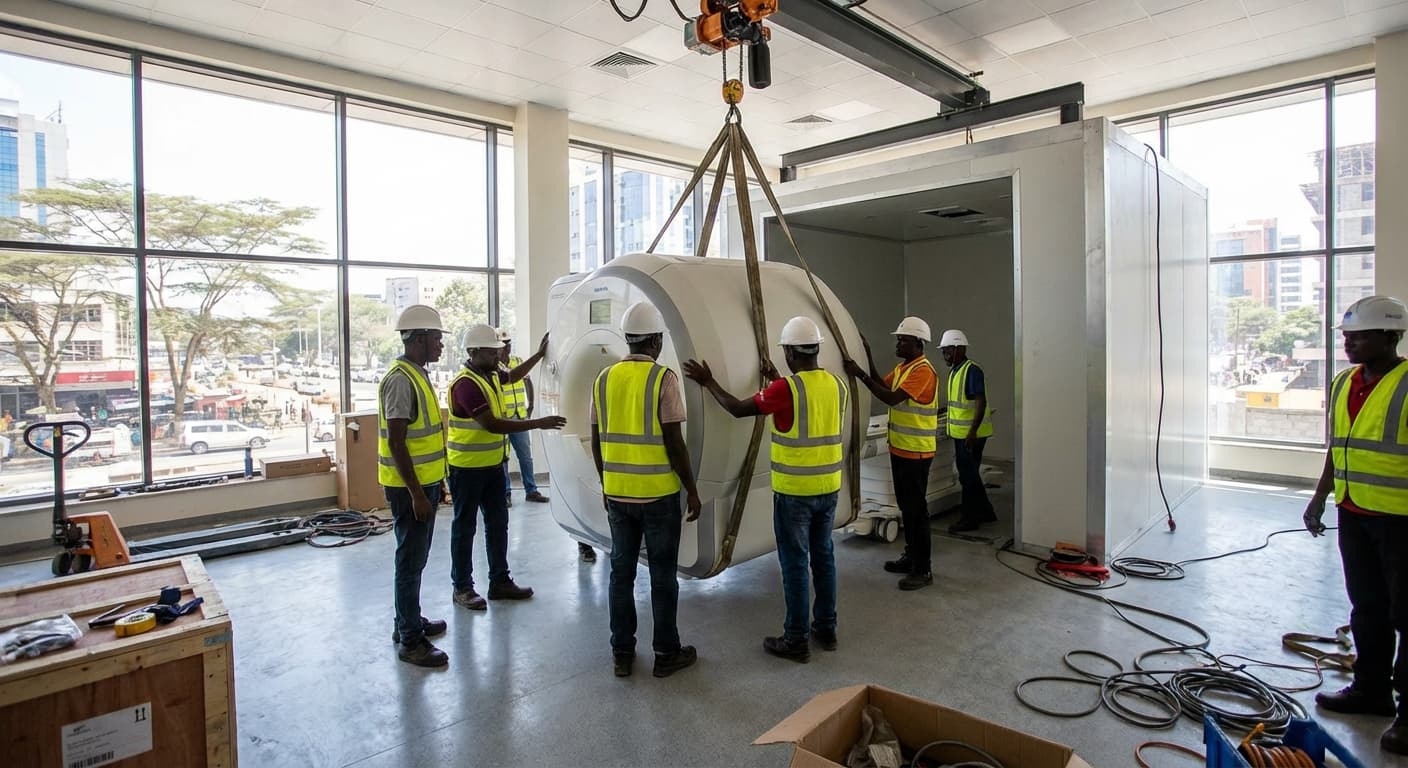
MRI Rigging & Installation Service in Senegal
Engineering Excellence & Technical Support
MRI Rigging & Installation Service High-standard technical execution following OEM protocols and local regulatory frameworks.
Specialized Equipment Transport
Our fleet of heavy-duty vehicles and specialized transport trailers are designed to safely and securely move MRI machines across challenging Senegalese terrain, ensuring optimal conditions throughout the journey.
Precision MRI Assembly & Calibration
Our certified technicians possess deep expertise in the intricate assembly and precise calibration of all major MRI brands, guaranteeing optimal performance and diagnostic accuracy upon installation.
Risk Mitigation & Safety Protocols
We adhere to stringent international safety standards and employ comprehensive risk assessment protocols throughout the rigging and installation process, prioritizing the integrity of your valuable MRI equipment and the safety of personnel.
What Is Mri Rigging & Installation Service In Senegal?
MRI Rigging & Installation Service in Senegal refers to the specialized process of safely and precisely transporting, positioning, and integrating Magnetic Resonance Imaging (MRI) machines within healthcare facilities in Senegal. This service encompasses a comprehensive range of activities, from initial site assessment and logistical planning to the final calibration and operational readiness of the MRI scanner. It is a critical undertaking due to the immense weight, delicate nature, and stringent environmental requirements of MRI equipment, as well as the associated electromagnetic shielding and power infrastructure.
| Who Needs MRI Rigging & Installation Service? | Typical Use Cases |
|---|---|
| Hospitals and Clinics: Both public and private healthcare institutions undertaking new construction, expansion projects, or upgrading existing imaging departments. | Diagnostic Imaging Centers: Facilities solely dedicated to medical imaging services requiring advanced MRI capabilities. |
| Research Institutions: Universities or medical research centers acquiring MRI scanners for clinical trials, research studies, or specialized medical investigations. | Mobile MRI Units: Setting up and integrating MRI scanners within temporary or mobile diagnostic units that may be relocated. |
| Government Healthcare Initiatives: Public health projects in Senegal aiming to expand access to advanced diagnostic imaging technology in underserved areas. | Specialty Medical Centers: Facilities focused on specific medical disciplines (e.g., neurology, oncology, cardiology) that rely heavily on MRI for diagnosis and treatment planning. |
Key Components of MRI Rigging & Installation Service
- Site Survey and Planning: Detailed assessment of the installation site, including structural integrity, accessibility for oversized equipment, power requirements, cooling systems, RF shielding needs, and space constraints. This phase involves meticulous architectural and engineering reviews.
- Logistics and Transportation: Planning and execution of the secure transport of the MRI scanner components from the manufacturer or point of origin to the installation site. This often involves specialized heavy-haul vehicles, cranes, and careful handling to prevent damage.
- De-installation/Unpacking: Professional dismantling of the MRI scanner from its shipping configuration and careful unpacking of its various sub-components (magnet, gradient system, RF coils, console, etc.).
- Rigging and Positioning: The precise mechanical handling and placement of the MRI magnet and other heavy components into their designated positions within the shielded room. This requires specialized lifting equipment and skilled rigging technicians trained in handling sensitive medical equipment.
- Shielding Installation/Integration: Installation or integration of Radio Frequency (RF) shielding to prevent external electromagnetic interference from affecting image quality and to contain the scanner's own electromagnetic fields. This often involves lead or copper lining of the room.
- Ancillary System Integration: Connecting and configuring supporting infrastructure, including:
- Power Distribution: High-capacity, stable, and filtered power supply.
- Cooling Systems: Advanced cryogen (e.g., helium) management and room temperature regulation.
- Ventilation and Air Conditioning (HVAC): Maintaining precise environmental conditions.
- Network Connectivity: Integration into the hospital's Picture Archiving and Communication System (PACS) and other IT infrastructure.
- System Assembly and Wiring: Connecting all sub-components of the MRI scanner according to manufacturer specifications, including intricate wiring for gradients, RF signals, and control systems.
- Testing and Calibration: Comprehensive performance testing and calibration of all MRI subsystems to ensure optimal image quality, safety, and functionality. This includes magnet shimming, gradient performance checks, and RF coil testing.
- Quality Assurance and Handover: Final inspection, documentation, and handover of the operational MRI system to the healthcare facility's technical and clinical staff.
Who Needs Mri Rigging & Installation Service In Senegal?
In Senegal, a growing need for specialized MRI Rigging & Installation services exists across various sectors. These services are crucial for ensuring the safe, efficient, and precise setup of Magnetic Resonance Imaging (MRI) machines, which are vital for advanced medical diagnostics and research. The demand extends beyond simple placement, encompassing complex logistical planning, environmental preparation, and adherence to stringent technical specifications. This specialized expertise is essential for healthcare institutions, research facilities, and even specialized industrial applications that utilize MRI technology.
| Customer Type | Key Departments/Needs | Specific Requirements |
|---|---|---|
| Hospitals and Medical Centers | Radiology Department, Medical Imaging Unit, Biomedical Engineering Department | Installation of new MRI scanners, relocation of existing units, decommissioning and disposal, ensuring compliance with radiation safety standards, site preparation (shielding, cooling, power). |
| Diagnostic Imaging Clinics | Imaging Services Management, Technical Operations | Setting up standalone MRI facilities, upgrading existing imaging equipment, ensuring minimal downtime during installations, optimizing workflow. |
| Research Institutions and Universities | Medical Research Departments, Physics Departments, Biomedical Engineering Labs | Installation of specialized research MRI systems, ensuring precise calibration for experimental setups, integration with data acquisition systems, providing technical support for advanced applications. |
| Specialized Industrial/Commercial Applications | Quality Control, Non-Destructive Testing (NDT) Divisions | Installation of industrial-grade MRI systems for material analysis, product inspection, and quality assurance. Ensuring environmental controls and specialized rigging for large-scale equipment. |
Target Customers & Departments for MRI Rigging & Installation in Senegal
- Hospitals and Medical Centers
- Diagnostic Imaging Clinics
- Research Institutions and Universities
- Specialized Industrial/Commercial Applications
Mri Rigging & Installation Service Process In Senegal
This document outlines the MRI Rigging & Installation Service Process in Senegal, detailing the workflow from the initial client inquiry to the final execution and handover of the installed MRI system. This systematic approach ensures efficiency, safety, and client satisfaction throughout the project lifecycle.
| Phase | Key Activities | Deliverables | Key Stakeholders |
|---|---|---|---|
| Inquiry & Assessment | Initial contact, information gathering, preliminary consultation. | Understanding of client needs, preliminary site requirements. | Client, MRISIS Sales/Technical Team |
| Site Survey | On-site inspection, measurement, structural evaluation, risk assessment. | Detailed site survey report, feasibility assessment. | MRISIS Technical Team, Client Facility Manager |
| Proposal & Quotation | Developing detailed proposal, cost estimation, presentation. | Project proposal, formal quotation. | MRISIS Project Manager, Client Management |
| Agreement & Planning | Contract negotiation, detailed project planning, permit acquisition. | Signed contract, detailed project plan, permits. | Client Legal/Procurement, MRISIS Project Manager |
| Site Preparation | Structural modifications, site protection, safety setup. | Prepared installation area, safety measures in place. | MRISIS Site Team, Client Facilities |
| Delivery & Rigging | Transportation, specialized lifting, precise maneuvering. | MRI system positioned at installation site. | MRISIS Rigging Crew, Logistics Team |
| Installation | Assembly, connection of components, integration of systems. | Assembled and connected MRI system. | MRISIS Installation Technicians, Manufacturer Representatives |
| Testing & Commissioning | Functional testing, image quality assessment, calibration. | Operational MRI system, commissioning report. | MRISIS Technical Team, Client Clinical Staff |
| Handover & Training | System demonstration, client staff training, documentation provision. | Fully functional MRI, trained personnel, project documentation. | MRISIS Project Manager, Client IT/Clinical Staff |
| Post-Installation | Support, follow-up visits, maintenance discussions. | Client satisfaction, optimized system performance. | MRISIS Support Team, Client Users |
MRI Rigging & Installation Service Process in Senegal
- 1. Initial Inquiry & Needs Assessment:
- Client contacts MRI Rigging & Installation Service (MRISIS) with a request for MRI rigging and installation.
- MRISIS gathers preliminary information: MRI system specifications (make, model, weight, dimensions), site location, existing infrastructure, and desired timeline.
- A preliminary consultation is scheduled to understand specific client needs, potential challenges, and budget expectations.
- 2. Site Survey & Feasibility Study:
- MRISIS dispatches a technical team to the client's site for a comprehensive survey.
- This survey includes: assessing access routes for transport, measuring doorways, stairwells, elevator capacity, and ceiling heights.
- Evaluating the structural integrity of the installation area, identifying any required modifications to the building (e.g., wall reinforcement, floor leveling).
- Verifying power supply, cooling systems, and any specific environmental requirements for the MRI.
- Identifying potential hazards and developing a preliminary risk assessment.
- 3. Proposal Development & Quotation:
- Based on the site survey and needs assessment, MRISIS develops a detailed project proposal.
- The proposal includes: scope of work, timeline, detailed methodology for rigging and installation, safety protocols, required equipment, and a comprehensive cost quotation.
- The proposal is presented to the client for review and discussion.
- 4. Contract Agreement & Planning:
- Upon client approval of the proposal, a formal contract is signed.
- A detailed project plan is developed, including specific task assignments, equipment allocation, and a precise schedule with milestones.
- Necessary permits and regulatory approvals are initiated.
- Procurement of specialized rigging equipment, tools, and any necessary materials for site preparation.
- 5. Pre-Installation Site Preparation:
- MRISIS undertakes any agreed-upon site modifications, such as reinforcing floors, widening doorways, or preparing anchor points.
- Site protection measures are implemented to prevent damage to existing structures and finishes.
- Temporary power and lighting are set up if required.
- A final safety briefing is conducted with all involved personnel.
- 6. MRI System Delivery & Rigging:
- The MRI system is transported to the site in accordance with manufacturer guidelines and transport regulations.
- Specialized lifting equipment (cranes, hoists, gantries) is deployed for safe and precise movement of the MRI components.
- The rigging team meticulously maneuvers the MRI through access routes, ensuring clearance and avoiding obstructions.
- The MRI is positioned in its designated installation location.
- 7. MRI Installation & Assembly:
- Highly skilled technicians assemble and connect the various components of the MRI system.
- Electrical, cooling, and magnetic shielding systems are integrated according to the manufacturer's specifications.
- Precision alignment and calibration of the MRI magnet and associated hardware are performed.
- All connections are tested and verified for functionality.
- 8. System Testing & Commissioning:
- Comprehensive functional tests are conducted to ensure the MRI system operates as per its specifications.
- Image quality and performance are evaluated through test scans.
- Calibration and fine-tuning are performed to optimize image acquisition.
- The MRI system undergoes a final quality assurance check.
- 9. Client Handover & Training:
- The installed and commissioned MRI system is formally handed over to the client.
- A detailed demonstration of the system's operation is provided.
- Training for the client's technical staff on basic operation, maintenance, and safety procedures is conducted.
- All relevant documentation, including manuals, test reports, and warranty information, is provided.
- 10. Post-Installation Support & Follow-up:
- MRISIS remains available for any post-installation queries or support.
- A follow-up visit may be scheduled to ensure continued optimal performance of the MRI system and address any minor adjustments.
- Ongoing maintenance and service contracts can be discussed.
Mri Rigging & Installation Service Cost In Senegal
The cost of MRI rigging and installation services in Senegal is influenced by a variety of factors, leading to a wide range of potential expenses. These costs are typically quoted in West African CFA franc (XOF). Understanding these components is crucial for accurate budgeting. The complexity of the installation, the specific MRI model and its weight, the required structural modifications to the building, the accessibility of the installation site, and the reputation and expertise of the service provider all play significant roles. Specialized equipment for lifting and maneuvering heavy components, the need for shielded rooms, and the extent of electrical and cooling system integration are also key determinants of the final price. Furthermore, factors like travel expenses for technicians, any necessary permits, and post-installation testing and calibration contribute to the overall cost. For large, complex installations in remote areas, the logistical challenges can significantly increase the price.
| Service Component | Estimated Cost Range (XOF) |
|---|---|
| Initial Site Survey & Consultation | 150,000 - 500,000 |
| Rigging & Transportation of MRI Scanner | 1,000,000 - 5,000,000+ |
| Building Modifications (minor structural, doorways) | 500,000 - 3,000,000+ |
| Electrical & HVAC Integration | 750,000 - 4,000,000+ |
| Radiation Shielding Installation (if applicable) | 2,000,000 - 10,000,000+ |
| Installation Labor & Project Management | 2,500,000 - 15,000,000+ |
| Testing, Calibration & Handover | 300,000 - 1,500,000 |
| Total Estimated Cost (excluding MRI machine) | 7,200,000 - 39,000,000+ (approx. 11,000 - 60,000+ USD) |
Key Pricing Factors for MRI Rigging & Installation in Senegal
- MRI Scanner Model and Weight
- Building Structural Modifications Required (e.g., reinforced floors, widened doorways)
- Accessibility of the Installation Site (e.g., ground floor vs. upper floors, proximity to roads)
- Need for Radiation Shielding (for certain MRI types)
- Electrical Infrastructure Upgrades (power supply, backup generators)
- Cooling System Requirements (HVAC modifications)
- Specialized Rigging and Lifting Equipment
- Technician Travel and Accommodation Expenses
- Permits and Regulatory Approvals
- Post-Installation Testing, Calibration, and Training
- Service Provider's Experience and Reputation
- Logistical Challenges (e.g., remote locations, transportation of heavy components)
Affordable Mri Rigging & Installation Service Options
Investing in an MRI machine is a significant capital expenditure. Beyond the purchase price, the rigging and installation process is crucial, requiring specialized expertise and equipment. Choosing the right service provider can impact project timelines, safety, and overall cost-effectiveness. This guide explores affordable MRI rigging & installation service options, highlighting value bundles and cost-saving strategies to help you make informed decisions.
| Cost Factor | Typical Range (USD) | Notes |
|---|---|---|
| Rigging (Local Transport & Craning) | $5,000 - $25,000+ | Varies significantly based on distance, accessibility, and equipment size/weight. Specialized heavy-lift cranes are expensive. |
| Installation Labor (Technicians & Engineers) | $10,000 - $40,000+ | Depends on complexity, system type, and duration of the project. Requires highly specialized skills. |
| Electrical Upgrades & Power Supply | $5,000 - $30,000+ | MRI machines have substantial power requirements. Upgrades to transformers, wiring, and breakers are often necessary. |
| RF Shielding & Room Preparation | $10,000 - $50,000+ | Essential for image quality. Costs depend on room size, materials used, and existing room structure. |
| Cooling Systems (Chillers & HVAC) | $5,000 - $20,000+ | Maintaining optimal temperature is critical for MRI performance and longevity. |
| Permits & Inspections | $500 - $5,000 | Varies by local jurisdiction and project scope. |
| Contingency (Unexpected Issues) | 10% - 15% of Total Project Cost | Highly recommended to account for unforeseen challenges. |
Understanding MRI Rigging & Installation Costs
- Rigging: This involves the physical movement and positioning of the MRI scanner and its components. It requires specialized cranes, heavy-duty dollies, and trained personnel to navigate tight spaces and ensure the delicate equipment is handled without damage.
- Installation: This encompasses the technical setup, including electrical connections, cooling systems, shielding, and integration with existing hospital infrastructure. It demands precise engineering and adherence to strict safety and regulatory standards.
- Ancillary Services: These can include site preparation, de-installation of old equipment, debris removal, and final testing and calibration. These services, while sometimes overlooked, contribute to the overall project scope and cost.
Verified Providers In Senegal
In Senegal, navigating the healthcare landscape to find reliable and high-quality providers can be a challenge. "Verified Providers" and entities like "Franance Health" are crucial in this regard. This document outlines what these credentials signify and why they represent the best choice for patients seeking trusted medical services.
| Credential Type | What it Signifies | Benefit to Patient | Example (Hypothetical/General) |
|---|---|---|---|
| General Verification | Confirmation of licenses, certifications, and basic quality standards. | Assurance of legitimacy and minimum competency. | A doctor listed as 'Verified by Ministry of Health'. |
| Franance Health Accreditation | Adherence to specific quality frameworks, best practices, and ethical guidelines set by Franance Health. | Higher assurance of consistent, high-quality, and potentially specialized care. | A clinic displaying 'Franance Health Certified' signage. |
| Specialty Certifications | Expertise and advanced training in a specific medical field. | Access to specialized knowledge and treatment for particular conditions. | A cardiologist with certification from a recognized international cardiology board. |
| International Standards Compliance | Meeting globally recognized benchmarks for healthcare quality and patient safety. | Confidence in receiving care comparable to leading international healthcare systems. | A hospital that has achieved accreditation from organizations like Joint Commission International (JCI). |
Understanding Verified Providers and Franance Health Credentials
- Verified Providers: This term generally refers to healthcare professionals and facilities that have undergone a rigorous vetting process. This process often includes checks on licenses, certifications, educational qualifications, and adherence to established quality standards. Verification indicates that the provider meets a certain benchmark of competence and legitimacy.
- Franance Health Credentials: While specific details of Franance Health's accreditation or verification process would require direct information from the organization, such credentials typically signify a commitment to excellence in healthcare delivery. This might include adherence to international best practices, patient safety protocols, ethical conduct, and advanced medical expertise. Their accreditation often acts as a seal of approval, reassuring patients of the provider's quality.
- Why They Represent the Best Choice:
- Enhanced Patient Safety: Verified providers and those with strong credentials like Franance Health are more likely to adhere to strict safety protocols, reducing the risk of medical errors and infections.
- Quality of Care: These providers are often at the forefront of medical advancements, utilizing modern equipment and evidence-based treatment methods, ensuring patients receive the most effective care possible.
- Trust and Reliability: The verification process inherently builds trust. Patients can have greater confidence in the expertise and integrity of these healthcare professionals.
- Accountability: Verified providers are typically held to higher standards of accountability, making them more responsive to patient concerns and professional conduct.
- Access to Specialized Services: Often, accredited or verified institutions have the resources and specialized personnel to handle a wider range of complex medical needs.
Scope Of Work For Mri Rigging & Installation Service
This Scope of Work (SOW) outlines the requirements for the professional rigging and installation of a Magnetic Resonance Imaging (MRI) system at [Client Facility Name and Address]. This document details the technical deliverables, standard specifications, and responsibilities to ensure a safe, efficient, and compliant installation of the MRI equipment. The objective is to provide a comprehensive framework for the successful integration of the MRI system into the facility's existing infrastructure, adhering to all relevant industry standards and manufacturer guidelines.
| Technical Deliverable | Standard Specification/Requirement | Description |
|---|---|---|
| Site Survey Report | Manufacturer Guidelines, Local Building Codes | Detailed report of site conditions, including room dimensions, access routes, structural integrity, power availability, environmental controls, and any potential obstructions. Includes recommendations for necessary modifications. |
| Rigging Plan | ANSI/ASME B30.26, Manufacturer Specifics | Comprehensive plan detailing the methods, equipment, and safety procedures for safely lifting, moving, and positioning the MRI scanner and associated components. Includes load calculations and lift points. |
| MRI Scanner Placement | Manufacturer's Tolerance +/- 1mm | Precise positioning of the MRI magnet and gantry according to manufacturer specifications for optimal performance and patient access. Includes leveling and alignment checks. |
| Coil System Integration | Manufacturer's Specifications | Careful installation and connection of all gradient and RF coils, ensuring proper seating and electrical connectivity without damage. |
| RF Shielding Installation/Verification | ASTM E499, Manufacturer Guidelines | Installation or verification of the integrity of RF shielding to prevent external interference and internal signal leakage, meeting specified attenuation levels. |
| Cooling System Connection | Manufacturer's Specifications, ASHRAE Standards | Secure and leak-free connection of the helium cryogen system (if applicable) and any auxiliary cooling systems, ensuring proper flow rates and temperatures. |
| Power Supply and Grounding | NFPA 70 (NEC), Manufacturer's Electrical Requirements | Installation of dedicated, isolated power circuits and proper grounding for the MRI system and all ancillary equipment, meeting voltage and current requirements. |
| System Testing & Calibration Documentation | Manufacturer's QA Protocols | Verification and documentation of all system tests, including magnetic field uniformity, gradient performance, RF linearity, and signal-to-noise ratio (SNR) to ensure optimal performance and safety. |
| Final Site Handover Report | Client Acceptance Criteria | Comprehensive report detailing all work performed, any deviations from the plan, final site condition, and confirmation of successful installation and initial testing. |
| Safety Signage and Equipment | OSHA Standards, Manufacturer Recommendations | Proper installation of safety signage (e.g., MRI Safe, No Ferrous Materials) and ensuring availability of necessary safety equipment (e.g., ferrous metal detectors, emergency quench procedures). |
Key Stages of MRI Rigging & Installation
- Site Assessment and Preparation
- Equipment Transportation and Unloading
- MRI System Rigging and Positioning
- Coil Installation and Connection
- RF Shielding Integration (if applicable)
- Cooling System Connection
- Power and Grounding
- System Testing and Calibration
- De-rigging and Site Cleanup
Service Level Agreement For Mri Rigging & Installation Service
This Service Level Agreement (SLA) outlines the performance standards and guarantees for MRI Rigging & Installation Service provided by [Your Company Name] to [Client Company Name]. It covers response times for critical issues and guarantees a minimum uptime for the installed MRI equipment.
| Issue Severity | Response Time Guarantee | Resolution Time Target | Uptime Guarantee |
|---|---|---|---|
| Critical (Complete System Failure, impacting patient care) | Within 1 hour (24/7) | Within 4 hours (initial diagnosis and mitigation) | 99.5% monthly uptime for MRI equipment |
| High (Significant performance degradation, impacting multiple functions) | Within 2 hours (Business Hours: [Start Time] - [End Time], [Days of Week]) | Within 8 business hours | N/A (focus on critical issues for uptime) |
| Medium (Minor functionality issues, workarounds available) | Within 4 business hours | Within 24 business hours | N/A |
| Low (Cosmetic issues, feature requests) | Within 1 business day | As per mutually agreed schedule | N/A |
Key Performance Indicators
- This SLA is effective from [Start Date] to [End Date].
- All service requests must be submitted through the official [Your Company Name] support portal or via a designated email address: [Support Email Address].
- The client is responsible for providing accurate and complete information for all service requests.
Frequently Asked Questions

Ready when you are
Let's scope your MRI Rigging & Installation Service in Senegal project in Senegal.

Scaling healthcare logistics and technical systems across the entire continent.