
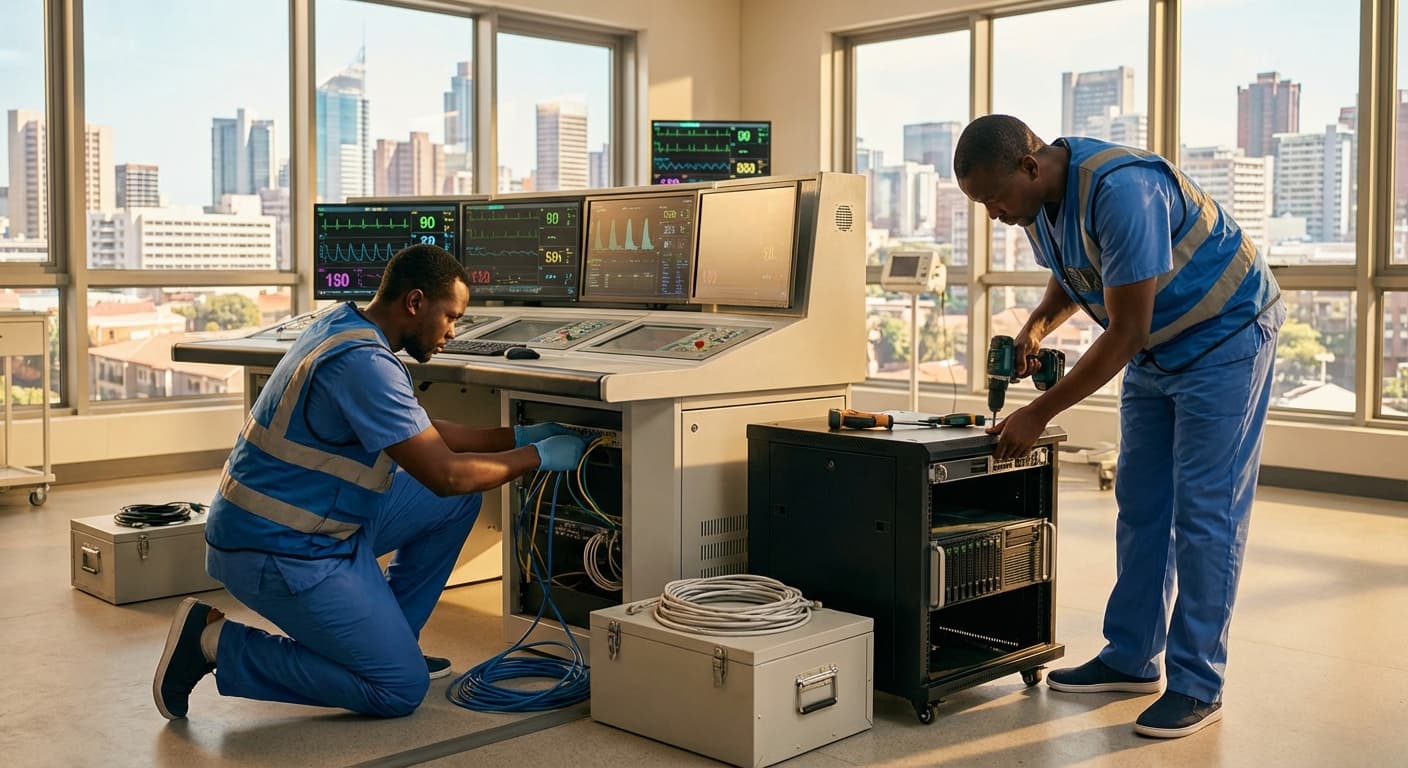
ICU Central Monitoring Station Installation Service in Senegal
Engineering Excellence & Technical Support
ICU Central Monitoring Station Installation Service High-standard technical execution following OEM protocols and local regulatory frameworks.
Robust Network Infrastructure
We design and implement high-availability network architectures, utilizing redundant fiber optic cabling and advanced switching technology to ensure uninterrupted data flow for critical patient monitoring in Senegal's ICUs.
Scalable & Future-Proof Systems
Our installations integrate leading-edge central monitoring systems, offering modular scalability to accommodate growing patient needs and seamless integration with future medical technologies, all tailored for the Senegalese healthcare landscape.
Secure Data Transmission & Compliance
We prioritize the security of sensitive patient data through robust encryption protocols and secure network segmentation, ensuring compliance with international healthcare data privacy standards for all ICU central monitoring installations in Senegal.
What Is Icu Central Monitoring Station Installation Service In Senegal?
ICU Central Monitoring Station Installation Service in Senegal refers to the specialized technical and logistical process of deploying and configuring a centralized system for the real-time monitoring of Intensive Care Unit (ICU) patients across one or multiple healthcare facilities within Senegal. This service encompasses the integration of patient monitoring devices, data acquisition hardware, network infrastructure, display units, and the central server/workstation where all data is aggregated and presented.
| Beneficiary Type | Rationale for Service Acquisition | Typical Use Cases |
|---|---|---|
| Tertiary Hospitals and University Hospitals: | High patient volume in ICUs, complex critical care needs, requirement for comprehensive real-time oversight, potential for multi-site monitoring. | Centralized monitoring of multiple ICU beds simultaneously, facilitating rapid response to patient deterioration. Enabling continuous review of trends and vital signs by senior clinicians and intensivists. Supporting research data collection from critically ill patients. |
| Specialized Medical Centers (e.g., Cardiac, Neurosurgical ICUs): | Intensive monitoring requirements for specific patient populations, need for specialized data streams and alarm parameters. | Tracking of advanced hemodynamic parameters, neurological waveforms (EEG), and ventilator graphics from multiple specialized beds. Allowing for focused attention on specific critical physiological indicators. |
| Regional Hospitals with Expanding Critical Care Capacity: | Need to enhance the quality and efficiency of critical care delivery, potential resource constraints requiring centralized oversight. | Leveraging limited specialized staff by providing them with a consolidated view of all critical patients. Improving patient safety through enhanced alarm detection and response times. Facilitating remote consultation or supervision of ICU activities. |
| Healthcare Facilities undergoing Modernization or Expansion: | Integrating advanced medical technology into new or renovated critical care units. | Ensuring the seamless integration of new patient monitoring equipment with a central data management system. Establishing a future-proof infrastructure for advanced critical care monitoring. |
Key Components of the Service:
- Site Assessment and Planning: Thorough evaluation of existing infrastructure, network capabilities, power availability, and physical space within the ICU(s) and potential central monitoring station locations.
- Hardware Procurement and Integration: Sourcing, delivery, and installation of all necessary components, including bedside monitors, ventilators, anesthesia machines with communication interfaces, physiological sensors, data acquisition modules, network switches, cabling, servers, and display consoles (workstations, large screens).
- Network Infrastructure Setup: Design and implementation of a robust and secure local area network (LAN) or wireless network (WLAN) capable of transmitting high volumes of real-time patient data. This includes IP addressing, bandwidth management, and Quality of Service (QoS) configuration.
- Software Installation and Configuration: Deployment and customization of the central monitoring software platform, including user interface configuration, alarm management setup, data storage parameters, and integration with existing Electronic Health Records (EHR) systems (if applicable).
- Device Interfacing and Data Synchronization: Establishing reliable communication pathways between individual patient monitoring devices and the central station. This often involves ensuring compatibility with various vendor-specific protocols and implementing data standardization.
- System Testing and Validation: Comprehensive testing of all integrated components to ensure accurate data acquisition, reliable transmission, proper alarm functionality, and system stability under simulated and actual load conditions.
- User Training and Documentation: Providing in-depth training to clinical staff (nurses, physicians, technicians) on the operation, maintenance, and troubleshooting of the central monitoring system. This also includes the provision of detailed technical and user manuals.
- Post-Installation Support and Maintenance: Offering ongoing technical support, troubleshooting, software updates, and hardware maintenance to ensure continuous and optimal system performance.
Who Needs Icu Central Monitoring Station Installation Service In Senegal?
Installing and maintaining an ICU Central Monitoring Station (CMS) is a critical undertaking, requiring specialized expertise and adherence to stringent healthcare standards. This service is essential for hospitals and healthcare facilities in Senegal aiming to elevate their Intensive Care Unit (ICU) capabilities, improve patient outcomes, and optimize the efficiency of their critical care services. The CMS acts as the central hub for real-time patient data, enabling healthcare professionals to monitor multiple patients from a single location, detect critical changes promptly, and respond with greater speed and accuracy. This proactive approach to patient care is vital in managing life-threatening conditions and complex medical cases common in ICUs.
| Customer Type | Key Departments Involved | Specific Needs/Reasons for Service |
|---|---|---|
| Major Public Hospitals and University Hospitals | ICU, Cardiology, Neurology, Critical Care Departments, Biomedical Engineering | Upgrading existing infrastructure, enhancing patient safety, standardizing monitoring protocols, ensuring compliance with international healthcare standards, training staff on new technology. |
| Large Private Hospitals and Medical Centers | ICU, Critical Care Services, IT Department, Hospital Administration | Expanding bed capacity, improving operational efficiency, attracting specialized medical talent, offering cutting-edge patient care, maintaining a competitive edge. |
| Specialized Cardiac and Neurological Centers | ICU, Cardiology, Neurology, Cardiac Surgery, Neurosurgery, Critical Care | Implementing advanced cardiac and neurological monitoring capabilities, integrating with specialized diagnostic equipment, ensuring seamless data flow for complex procedures and post-operative care. |
| Referral Hospitals and Regional Medical Hubs | ICU, Emergency Department, Intensive Care Medicine, Hospital Management | Establishing or upgrading critical care infrastructure to handle complex cases referred from smaller facilities, improving diagnostic and treatment capabilities, providing advanced care closer to remote populations. |
| New Hospital Developments and Expansions | Project Management, Hospital Planning, Biomedical Engineering, IT Department, Procurement | Designing and integrating a state-of-the-art CMS from the ground up, ensuring optimal workflow and system compatibility, setting up a robust and scalable monitoring infrastructure for future growth. |
Target Customers and Departments for ICU Central Monitoring Station Installation Service in Senegal:
- Major Public Hospitals and University Hospitals
- Large Private Hospitals and Medical Centers
- Specialized Cardiac and Neurological Centers
- Referral Hospitals and Regional Medical Hubs
- New Hospital Developments and Expansions
Icu Central Monitoring Station Installation Service Process In Senegal
This document outlines the comprehensive workflow for the installation of an ICU Central Monitoring Station (CMS) service in Senegal, covering the entire process from initial inquiry to successful execution and handover.
| Phase | Stage | Key Activities | Responsible Parties | Deliverables/Outcomes |
|---|---|---|---|---|
| Initial Contact | Client expresses interest in ICU CMS installation. Service provider provides introductory information about capabilities and services. Initial needs assessment discussion. | Client (Hospital/Clinic Management, IT Department), Service Provider (Sales Team, Technical Consultants) | Understanding of client's basic requirements, potential project scope identification. |
| Needs Assessment & Site Survey | Detailed discussion of specific requirements (number of beds, types of monitors, existing infrastructure, IT network capabilities). On-site visit to assess the physical space, power availability, network infrastructure, and environmental conditions. | Client (Clinical Staff, IT Department), Service Provider (Technical Consultants, Project Managers) | Detailed technical requirements document, site survey report, preliminary cost estimate. |
| Proposal Development & Negotiation | Development of a comprehensive proposal including scope of work, technical specifications, timeline, cost breakdown, and terms & conditions. Negotiation and refinement of the proposal based on client feedback. | Service Provider (Sales Team, Technical Team, Legal Department), Client (Procurement Department, Management) | Approved project proposal, Letter of Intent/Purchase Order. |
| Detailed System Design | Creation of detailed architectural, electrical, and network design for the CMS. Selection of specific hardware and software components. Development of integration plan with existing hospital systems (e.g., EMR). | Service Provider (System Architects, Network Engineers, Biomedical Engineers) | Detailed system design documents, Bill of Materials (BOM), integration plan. |
| Project Planning | Development of a detailed project plan including timelines, milestones, resource allocation, risk assessment, and communication plan. Coordination with client for access and approvals. | Service Provider (Project Managers), Client (Project Lead, Facility Management) | Project execution plan, Gantt chart, risk management plan. |
| Equipment Procurement | Ordering and sourcing of all required CMS hardware (servers, workstations, displays, cabling) and software licenses. | Service Provider (Procurement Department), Vendors | Procured equipment and software. |
| Logistics & Importation | Arrangement of shipping, customs clearance, and transportation of equipment to the installation site in Senegal. Compliance with local import regulations. | Service Provider (Logistics Team), Customs Agents | Delivered equipment at the installation site. |
| Site Preparation | Ensuring the installation site is ready according to the design specifications (e.g., power outlets, network drops, mounting points). | Client (Facility Management), Service Provider (Installation Team) | Prepared installation site. |
| Hardware Installation | Physical installation of servers, workstations, displays, and all associated cabling. | Service Provider (Installation Team, Biomedical Engineers) | Installed hardware infrastructure. |
| Software Installation & Configuration | Installation and configuration of the CMS software, patient monitoring software, network interfaces, and any integrated third-party applications. | Service Provider (Software Engineers, Network Engineers) | Configured CMS software and network. |
| Network Integration | Connecting the CMS to the hospital's network and ensuring seamless data flow from patient monitors. | Service Provider (Network Engineers), Client (IT Department) | Connected and functional network integration. |
| System Testing | Thorough testing of all CMS functionalities, including data acquisition, display, alarming, data storage, and reporting. Testing of network connectivity and data integrity. | Service Provider (Testing Team, Engineers) | Functional system, test reports. |
| User Acceptance Testing (UAT) | Involving key clinical users to validate that the system meets their operational requirements and expectations. Addressing any identified issues. | Service Provider (Project Managers, Engineers), Client (Clinical Staff) | Client sign-off on UAT. |
| Performance Validation | Ensuring the system performs optimally under expected load and in real-time scenarios. Final system tuning and optimization. | Service Provider (Engineers) | Optimized and validated system performance. |
| User Training | Comprehensive training for clinical staff (nurses, doctors) and IT personnel on the operation, maintenance, and basic troubleshooting of the CMS. | Service Provider (Trainers, Technical Support) | Trained users, training materials. |
| System Handover | Formal handover of the installed CMS to the client, including all documentation (manuals, design documents, test reports, warranty information). | Service Provider (Project Managers), Client (Management, IT Department) | Completed project documentation, formal handover certificate. |
| Warranty & Maintenance | Provision of ongoing technical support, warranty services, and optional maintenance contracts for the CMS. | Service Provider (Support Team, Technical Specialists) | Ongoing system support and maintenance. |
| System Updates & Upgrades | Planning and execution of software updates and hardware upgrades as needed to maintain system performance and security. | Service Provider (Support Team, Engineers) | Updated and upgraded CMS. |
ICU Central Monitoring Station Installation Service Process
- Phase 1: Inquiry & Pre-Sales
- Phase 2: Planning & Design
- Phase 3: Procurement & Logistics
- Phase 4: Installation & Configuration
- Phase 5: Testing & Validation
- Phase 6: Training & Handover
- Phase 7: Post-Installation Support
Icu Central Monitoring Station Installation Service Cost In Senegal
Installing an ICU Central Monitoring Station (CMS) in Senegal involves a range of costs influenced by several key factors. These factors determine the overall investment required for a reliable and effective patient monitoring system in an Intensive Care Unit. Understanding these elements is crucial for hospitals and healthcare facilities to budget accurately and secure the necessary funding. The installation service itself encompasses professional setup, configuration, calibration, and often includes initial training for medical staff. The complexity of the chosen system, the number of patient beds to be monitored, the required integration with existing hospital infrastructure, and the vendor's service level agreements all play a significant role in the final price.
| Cost Component | Estimated Range (XOF) | Notes |
|---|---|---|
| Basic ICU CMS System (per station) | 2,500,000 - 7,000,000 | Covers a central display, basic networking for a few beds, and standard parameters. Excludes bedside monitors. |
| Advanced/High-End ICU CMS System (per station) | 7,000,000 - 20,000,000+ | Includes advanced analytics, integration capabilities, higher capacity, and premium features. Excludes bedside monitors. |
| Installation & Configuration Service Fee | 500,000 - 2,500,000 | Covers professional setup, network integration, software configuration, and initial testing. Varies with system complexity and number of beds. |
| Bedside Monitor Integration (per unit) | 200,000 - 800,000 | Cost to integrate each patient bedside monitor with the central station. Depends on the monitor's capabilities and compatibility. |
| Software Licenses & Updates | 300,000 - 1,500,000 (annual/perpetual) | Annual maintenance fees or one-time licenses for software features and updates. |
| Initial Staff Training | 200,000 - 1,000,000 | Covers training sessions for medical and technical staff. Can be higher for extensive training needs. |
| Optional: EHR Integration | 1,000,000 - 5,000,000+ | Significant cost depending on the complexity of the EHR system and the integration required. |
| Optional: Extended Warranty/Maintenance Contract | 5% - 15% of system cost (annual) | Ongoing support, preventative maintenance, and guaranteed response times. |
| Total Estimated Project Cost (for a ~10-bed ICU, excluding capital cost of bedside monitors) | 10,000,000 - 40,000,000+ | This is a broad estimate and can vary significantly based on the specific choices made. |
Key Pricing Factors for ICU Central Monitoring Station Installation Services in Senegal:
- {"title":"System Complexity and Features","description":"The sophistication of the CMS, including the number of parameters monitored (ECG, SpO2, NIBP, respiration, temperature, etc.), advanced alarm management, data trending capabilities, and integration with electronic health records (EHRs), directly impacts cost. High-end systems with more features will naturally be more expensive."}
- {"title":"Number of Patient Beds/Monitors","description":"The more patient monitoring devices that need to be connected to the central station, the higher the cost. This includes the cost of the bedside monitors themselves, as well as the network infrastructure and software licenses required to support them."}
- {"title":"Integration with Existing Infrastructure","description":"Integrating the new CMS with existing hospital networks, IT systems, and potentially other medical equipment can add complexity and cost. This may require specialized networking expertise and additional hardware or software components."}
- {"title":"Vendor and Brand Reputation","description":"Established and reputable medical equipment vendors often command higher prices due to their track record, quality of products, and comprehensive support services. Newer or less established vendors might offer more competitive pricing."}
- {"title":"Installation and Configuration Scope","description":"The extent of the installation service, including site preparation, cabling, network setup, software installation, initial calibration, and testing, will influence the overall service fee. Turnkey solutions that include all these aspects will be priced accordingly."}
- {"title":"Training and Support Services","description":"The package often includes initial training for medical staff and IT personnel. Ongoing maintenance contracts, extended warranties, and after-sales support are also significant cost components that vary based on the service level agreement (SLA)."}
- {"title":"Site Location and Accessibility","description":"While less of a primary driver for the system itself, the remoteness of the hospital within Senegal or any logistical challenges in reaching the site for installation could add minor surcharges for travel and accommodation of the installation team."}
- {"title":"Currency Exchange Rates and Import Duties","description":"As most advanced medical equipment is imported into Senegal, fluctuations in international currency exchange rates and applicable import duties and taxes on medical devices will affect the final cost in local currency (CFA Francs)."}
Affordable Icu Central Monitoring Station Installation Service Options
Installing an ICU central monitoring station is a critical investment for any healthcare facility. This service ensures continuous patient observation, enabling faster response to critical changes and ultimately improving patient outcomes. We offer a range of affordable installation service options, focusing on providing value through smart design, phased implementation, and bundled solutions. Our goal is to equip your ICU with essential monitoring capabilities without breaking your budget.
| Value Bundle | Description | Key Benefits | Estimated Cost Savings |
|---|---|---|---|
| Essential Monitoring Bundle | Includes core functionalities for basic vital signs monitoring (ECG, SpO2, NIBP, Respiration). Ideal for smaller ICUs or those looking for a foundational system. | Cost-effective entry point, immediate improvement in patient oversight, reduced risk of missed critical events. | Up to 15% compared to à la carte installation |
| Advanced Insight Bundle | Expands on the Essential Bundle by incorporating advanced waveform analysis, data trending, and customizable alarm profiles. Includes integration with more complex devices. | Enhanced diagnostic capabilities, proactive identification of patient deterioration, improved workflow efficiency for clinical staff. | Up to 20% compared to à la carte installation |
| Comprehensive Care Bundle | The most complete solution, offering all features of the Advanced Insight Bundle plus integration with EMR/EHR systems, remote monitoring capabilities, and advanced analytics for quality improvement. | Seamless data integration, extended monitoring reach, data-driven insights for operational and clinical excellence, future-proofing your investment. | Up to 25% compared to à la carte installation |
Key Components of an ICU Central Monitoring Station Installation Service
- Site assessment and consultation
- Network infrastructure design and cabling
- Server and workstation setup
- Software installation and configuration
- Device integration (e.g., bedside monitors, ventilators)
- Testing and calibration
- User training and support
- Ongoing maintenance and updates
Verified Providers In Senegal
In Senegal's evolving healthcare landscape, identifying trusted and competent healthcare providers is paramount for individuals and families seeking quality medical services. This is where the importance of verified providers and reputable credentialing bodies like Franance Health becomes clear. Franance Health's rigorous vetting process ensures that healthcare professionals and facilities meet stringent standards, offering a guarantee of expertise, ethical practice, and patient-centered care.
| Key Benefit | Franance Health Contribution | Patient Advantage |
|---|---|---|
| Quality Assurance | Rigorous evaluation of facilities, staff, and processes. | Confidence in receiving high-standard medical treatment. |
| Safety Standards | Mandatory adherence to strict safety and infection control protocols. | Minimized risk of healthcare-associated infections and errors. |
| Professional Competence | Verification of medical licenses, certifications, and experience. | Treatment by skilled and qualified healthcare professionals. |
| Ethical Conduct | Upholding of professional ethics and patient rights. | Respectful and patient-centered care. |
| Informed Decision-Making | Accessible credentialing information. | Ability to choose a provider with confidence. |
Why Franance Health Credentials Represent the Best Choice:
- Unwavering Commitment to Quality: Franance Health's accreditation signifies adherence to internationally recognized benchmarks for medical excellence. This means providers have the necessary equipment, infrastructure, and qualified personnel to deliver superior healthcare.
- Enhanced Patient Safety: The credentialing process meticulously examines safety protocols, infection control measures, and risk management strategies. This focus on patient safety minimizes the likelihood of complications and adverse events.
- Experienced and Competent Professionals: Franance Health verifies the qualifications, training, and ongoing professional development of healthcare practitioners. This ensures that patients are treated by highly skilled and knowledgeable individuals.
- Ethical Practice and Patient Rights: Providers accredited by Franance Health are expected to uphold the highest ethical standards and respect patient rights, including informed consent, privacy, and dignity.
- Transparency and Accountability: The accreditation process fosters transparency by making provider credentials publicly accessible, allowing patients to make informed decisions. It also holds providers accountable for maintaining their standards.
- Access to Best Practices: Franance Health credentialing encourages the adoption of evidence-based medicine and best practices, ensuring patients receive the most effective and up-to-date treatments available.
- Reduced Healthcare Burden: By choosing Franance Health-verified providers, patients are more likely to receive appropriate care the first time, potentially reducing the need for repeat visits, complications, and prolonged recovery periods.
Scope Of Work For Icu Central Monitoring Station Installation Service
This Scope of Work (SOW) outlines the requirements for the installation service of an Integrated Central Monitoring Station (CMS) for the Intensive Care Unit (ICU). The service includes the supply, installation, configuration, testing, and commissioning of all necessary hardware, software, and network infrastructure to establish a fully functional CMS. The primary objective is to provide real-time patient monitoring data to a centralized location, enabling enhanced clinical oversight, rapid response to critical events, and improved patient care outcomes. This SOW also details the technical deliverables and standard specifications to be adhered to throughout the project lifecycle.
| Technical Deliverable | Description | Standard Specification/Reference |
|---|---|---|
| Central Monitoring Station Server(s) | High-availability server(s) to host the CMS software, database, and handle data aggregation and distribution. | RAID configuration, redundant power supplies, enterprise-grade processors, minimum RAM [Specify RAM], sufficient storage capacity [Specify GB/TB]. |
| CMS Software Suite | Integrated software for real-time data acquisition, display, analysis, alarm management, data archiving, and reporting. | HIPAA compliant, HL7 integration capabilities, secure user authentication and authorization, audit trails, customizable dashboards, trending capabilities. |
| Workstations/Consoles | Dedicated workstations for clinicians to access and interact with the CMS. Includes monitors, keyboards, and mice. | High-resolution medical-grade displays [Specify resolution/size], ergonomic design, sufficient processing power [Specify CPU], dedicated graphics cards for smooth data visualization. |
| Network Infrastructure | Installation and configuration of network switches, cabling, and associated hardware to connect patient monitoring devices to the CMS. | Gigabit Ethernet or higher, dedicated VLAN for patient data, PoE capability for compatible devices, CAT6/CAT6a cabling standards, network security protocols (e.g., TLS/SSL). |
| Patient Monitoring Device Integration | Configuration and connection of existing and/or new ICU patient monitoring devices (e.g., ventilators, ECG monitors, NIBP monitors) to the CMS. | Support for standard communication protocols (e.g., HL7, DICOM, proprietary protocols with vendor-provided SDKs/APIs). Successful bi-directional data flow where applicable. |
| Alarm Management System | Configuration of alarm thresholds, notification methods (auditory, visual, and remote), and escalation procedures. | Configurable alarm priorities, customizable alarm sounds, integration with hospital paging systems or mobile devices, robust alarm logging and reporting. |
| Data Archiving and Retrieval Solution | Implementation of a secure and reliable system for long-term storage and easy retrieval of patient monitoring data. | Sufficient storage capacity [Specify GB/TB], defined data retention policies, regular backup schedule, data integrity checks, secure access controls. |
| User Manuals and Documentation | Comprehensive documentation for system administration, operation, and maintenance. | Detailed installation guides, configuration procedures, troubleshooting manuals, user training materials, system architecture diagrams. |
| Training Program | Training sessions for clinical staff, IT personnel, and biomedical engineers on the operation and maintenance of the CMS. | Hands-on training, tailored to different user roles, post-training assessment, provision of training certificates. |
| Testing and Validation Reports | Formal documentation of all testing performed, including unit testing, integration testing, system testing, and user acceptance testing (UAT). | Detailed test cases, execution results, defect logs, sign-off forms for each testing phase. |
| System Performance Metrics | Documentation of key performance indicators (KPIs) achieved during commissioning. | Data acquisition latency [Specify ms], system uptime [Specify %], alarm response time [Specify ms], workstation responsiveness. |
Key Project Phases
- Phase 1: Planning and Design
- Phase 2: Procurement and Delivery
- Phase 3: Installation and Cabling
- Phase 4: System Configuration and Integration
- Phase 5: Testing and Commissioning
- Phase 6: Training and Handover
- Phase 7: Post-Installation Support
Service Level Agreement For Icu Central Monitoring Station Installation Service
This Service Level Agreement (SLA) outlines the response times and uptime guarantees for the installation service of the ICU Central Monitoring Station. This SLA is effective from the date of service commencement and is valid for the duration of the installation project as defined in the associated contract.
| Service Component | Response Time | Uptime Guarantee (during installation phase) |
|---|---|---|
| Critical System Failure (e.g., inability to power on monitoring equipment) | 1 Hour | N/A (focus is on rapid resolution) |
| Major System Malfunction (e.g., intermittent alarm failures, data connectivity loss) | 2 Business Hours | N/A (focus is on rapid resolution) |
| Minor System Anomaly (e.g., display glitches, minor configuration issues) | 4 Business Hours | N/A (focus is on rapid resolution) |
| Inability to access system configuration or initial setup interface | 2 Business Hours | N/A (focus is on rapid resolution) |
| General Technical Support & Inquiries | 8 Business Hours | N/A (focus is on timely information) |
Key Service Metrics
- This SLA aims to ensure minimal disruption and prompt resolution of issues during the critical phase of ICU Central Monitoring Station installation.
- All response times are measured in business hours, Monday through Friday, 8:00 AM to 5:00 PM local time, excluding public holidays.
Frequently Asked Questions

Ready when you are
Let's scope your ICU Central Monitoring Station Installation Service in Senegal project in Senegal.

Scaling healthcare logistics and technical systems across the entire continent.