
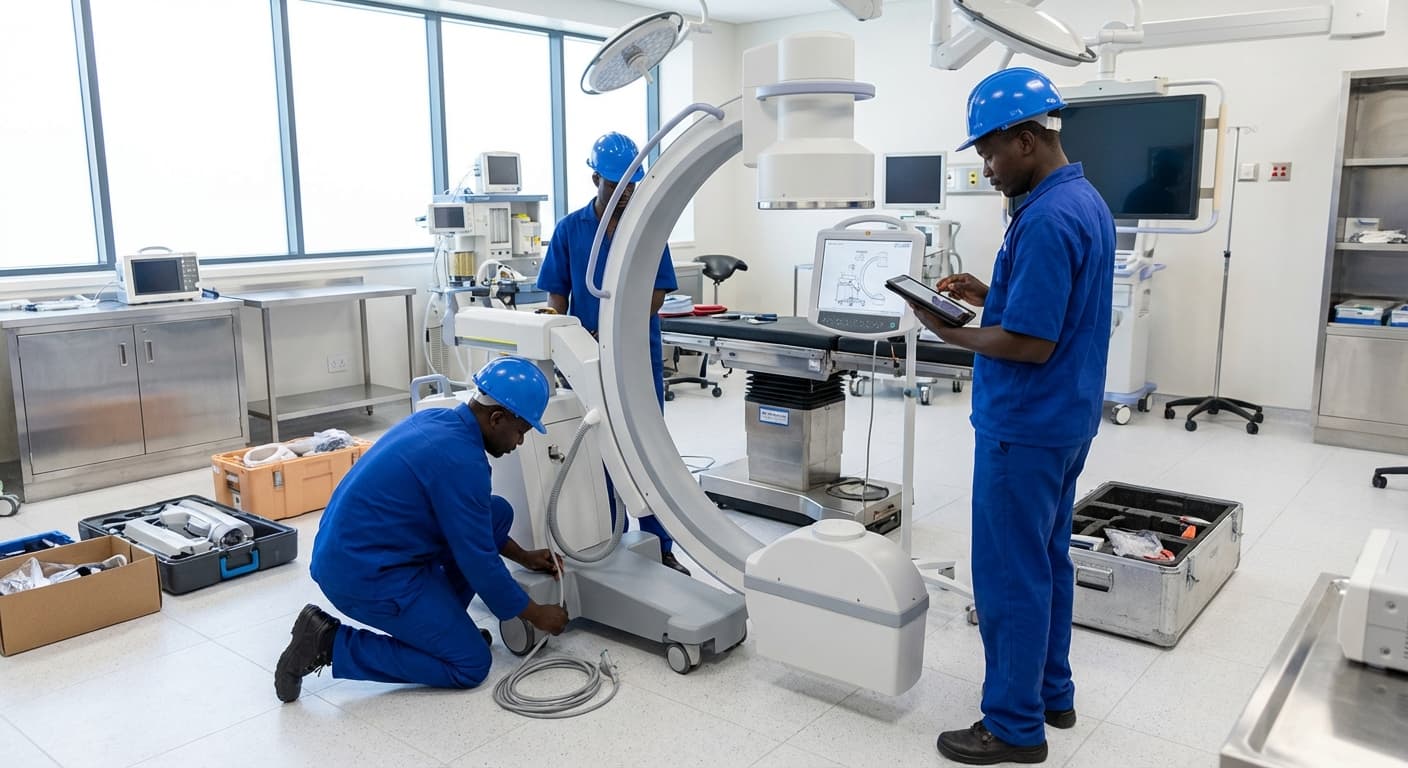
C-Arm Installation Service in Senegal
Engineering Excellence & Technical Support
C-Arm Installation Service High-standard technical execution following OEM protocols and local regulatory frameworks.
Certified & Compliant Installations
Ensuring C-arm systems are installed to the highest international standards and fully comply with Senegalese medical device regulations for patient safety and operational integrity.
Precision Calibration & Imaging Optimization
Expert calibration of C-arm components and advanced imaging parameter tuning to guarantee optimal diagnostic image quality, crucial for accurate diagnoses in diverse medical specialties.
Seamless Integration & Network Readiness
Facilitating robust integration with existing hospital IT infrastructure and Picture Archiving and Communication Systems (PACS), ensuring efficient data management and workflow efficiency.
What Is C-arm Installation Service In Senegal?
C-Arm Installation Service in Senegal refers to the specialized technical process of deploying, configuring, and verifying the operational readiness of a C-arm imaging system within a healthcare facility in Senegal. This service encompasses a comprehensive set of activities designed to ensure the C-arm is correctly integrated into the existing medical infrastructure, calibrated for optimal performance, and compliant with relevant safety standards and regulatory requirements specific to the Senegalese healthcare landscape. It is a critical step in making advanced fluoroscopic imaging capabilities available for diagnostic and interventional procedures.
| Who Needs C-Arm Installation Service? | Typical Use Cases | |||||
|---|---|---|---|---|---|---|
| Hospitals (Public and Private) | Orthopedic Surgery (fracture reduction, implant placement) | Cardiology and Interventional Radiology (angiography, angioplasty, stent placement) | Pain Management (nerve blocks, epidural injections) | Urology (lithotripsy, stent placement) | Gastroenterology (barium studies, foreign body retrieval) | Emergency Departments (trauma imaging, fracture assessment) |
| Specialty Clinics (e.g., Orthopedic, Cardiac, Pain Management) | Surgical Centers | Diagnostic Imaging Centers | Research Institutions requiring fluoroscopic capabilities |
Key Components of C-Arm Installation Service
- Site Assessment and Preparation: Evaluating the intended installation location for structural integrity, power supply adequacy (voltage, phase, grounding), environmental conditions (temperature, humidity), and space requirements. This may involve minor structural modifications or the installation of specialized flooring or shielding.
- Physical Installation: Unpacking, assembling, and physically positioning the C-arm unit and associated components (e.g., image intensifier, X-ray tube, monitor cart, workstation). This includes secure mounting and connection of all cables and peripherals.
- Electrical and Network Integration: Connecting the C-arm to the facility's power grid, ensuring proper grounding, and integrating it with existing hospital information systems (HIS), Picture Archiving and Communication Systems (PACS), or other relevant networks for data management and connectivity.
- Software Configuration and Calibration: Installing and configuring the C-arm's operating software, including user profiles, imaging protocols, and image processing parameters. Crucial calibration procedures are performed to ensure accurate image acquisition, dose monitoring, and geometric fidelity.
- Radiation Safety Compliance and Testing: Implementing and verifying radiation safety measures as per Senegalese regulations. This includes performing radiation surveys, checking shielding integrity, and ensuring compliance with local radiation protection laws and guidelines.
- System Testing and Quality Assurance: Conducting a series of functional tests to verify all aspects of the C-arm's operation. This includes image quality assessment, system responsiveness, and performance under simulated clinical conditions. Acceptance testing is a key phase.
- User Training: Providing comprehensive training to radiographers, physicians, and other relevant medical personnel on the operation, basic troubleshooting, and safety features of the newly installed C-arm system.
- Documentation and Handover: Providing detailed installation reports, user manuals, maintenance schedules, and any necessary regulatory documentation for the facility's records. Formal handover of the operational system to the client.
Who Needs C-arm Installation Service In Senegal?
C-arm installation services are crucial for healthcare facilities in Senegal that are acquiring or upgrading their fluoroscopy imaging equipment. These specialized X-ray systems require expert setup, calibration, and integration to ensure optimal performance, patient safety, and compliance with medical imaging standards. Without professional installation, facilities risk suboptimal image quality, potential equipment malfunctions, and even patient harm.
| Customer Type | Key Departments Requiring C-Arm Installation |
|---|---|
| Public Hospitals | Orthopedics, General Surgery, Urology, Emergency Department, Pain Management, Interventional Radiology |
| Private Hospitals | Orthopedics, Spine Surgery, General Surgery, Urology, Cardiology (interventional), Pain Management, Plastic Surgery |
| Specialty Orthopedic Clinics | Orthopedic Surgery, Trauma, Sports Medicine |
| Specialty Surgical Clinics | General Surgery, Urology, Gynecology |
| Pain Management Clinics | Interventional Pain Procedures |
| Diagnostic Imaging Centers | Interventional Radiology (if offered), Fluoroscopy Suites |
Target Customers & Departments for C-Arm Installation Services in Senegal
- Hospitals (Public and Private)
- Specialty Clinics (Orthopedic, Surgical, Pain Management, Urology, Cardiology)
- Diagnostic Imaging Centers
- Medical Training Institutions (for their simulation or practical training labs)
- Government Health Ministries (for public health initiatives or upgrades to public hospitals)
- Large Private Practices with surgical capabilities
C-arm Installation Service Process In Senegal
This document outlines the typical workflow for C-arm installation services in Senegal, from the initial client inquiry to the final execution and handover. The process is designed to ensure a smooth, efficient, and compliant installation, meeting the specific needs of healthcare facilities.
| Phase | Key Activities | Responsible Party | Deliverables/Outcomes |
|---|---|---|---|
| Initial contact from healthcare facility, understanding their requirements, equipment model, and desired timeline. Technical consultation to clarify specifications and potential site challenges. | Client, Service Provider Sales/Technical Team | Understanding of client needs, preliminary technical assessment. |
| On-site visit to evaluate the installation area (space, power, ventilation, radiation shielding requirements). Develop a detailed installation plan, including schematics and risk assessment. Coordinate with facility staff for access and preparation. | Service Provider Technical Team, Client Facilities Management | Detailed site survey report, installation plan, confirmation of infrastructure readiness. |
| Preparation of a comprehensive quotation based on site assessment, equipment specifications, and any necessary modifications. Negotiation and finalization of the service agreement, including scope of work, payment terms, and warranty. | Service Provider Sales/Project Management Team, Client Procurement/Administration | Formal quotation, signed service agreement. |
| Ordering and procurement of the C-arm unit and any required accessories/materials (e.g., specialized cables, mounting hardware). Coordination of shipping and customs clearance into Senegal. | Service Provider Logistics/Procurement Team | Delivery of C-arm unit and accessories to the installation site. |
| Unpacking and physical placement of the C-arm. Electrical and mechanical connections. Installation of software and firmware. Integration with existing hospital IT infrastructure (if applicable). | Service Provider Certified Technicians | Physically installed and powered-on C-arm system. |
| Comprehensive functional testing of all C-arm features. Image quality optimization and calibration. Radiation safety checks and compliance verification. Performance testing against manufacturer specifications. | Service Provider Certified Technicians/Engineers | Calibrated and fully functional C-arm, performance test reports, radiation safety certification. |
| On-site training for medical staff (radiologists, technicians) on C-arm operation, basic maintenance, and safety protocols. Formal handover of the installed system with all relevant documentation (manuals, warranty, test reports). | Service Provider Application Specialist/Trainer, Client Medical Staff | Trained personnel, completed handover documentation, operational C-arm. |
| Provision of warranty support, scheduled maintenance services, and troubleshooting assistance as per the service agreement. Follow-up to ensure client satisfaction and system performance. | Service Provider Technical Support/Maintenance Team | Ongoing system reliability, client satisfaction. |
C-Arm Installation Service Workflow in Senegal
- Phase 1: Inquiry and Consultation
- Phase 2: Site Assessment and Planning
- Phase 3: Quotation and Agreement
- Phase 4: Logistics and Procurement
- Phase 5: Installation and Configuration
- Phase 6: Testing and Calibration
- Phase 7: Training and Handover
- Phase 8: Post-Installation Support
C-arm Installation Service Cost In Senegal
Installing a C-arm in Senegal involves a range of costs influenced by several key factors. The complexity of the installation, the specific model of the C-arm, the geographical location within Senegal, and the chosen service provider all play a significant role. These services typically encompass site preparation, system integration, calibration, testing, and initial training for medical staff. Due to the specialized nature of this equipment, it's crucial to obtain detailed quotes from reputable providers who understand local regulations and infrastructure. The pricing is generally presented in West African CFA franc (XOF).
| Service Component | Estimated Range (XOF) |
|---|---|
| Basic Installation (Standard C-arm, good infrastructure) | 800,000 - 1,500,000 |
| Complex Installation (Advanced C-arm, site modifications needed) | 1,500,000 - 3,000,000+ |
| Site Preparation (Electrical, flooring, shielding - per incident) | 200,000 - 1,000,000+ |
| Extended Training (Multiple sessions, advanced users) | 100,000 - 400,000 |
| Travel and Logistics (Remote locations, per technician) | 50,000 - 200,000 |
Key Pricing Factors for C-Arm Installation in Senegal:
- C-Arm Model and Specifications: More advanced or specialized C-arm systems (e.g., high-end surgical C-arms with advanced imaging capabilities) will naturally incur higher installation costs than basic fluoroscopy units.
- Site Preparation Requirements: The existing infrastructure of the medical facility is critical. This includes assessing the need for reinforced flooring, dedicated power supply with surge protection, adequate ventilation, and potentially shielded rooms if the C-arm emits significant radiation.
- Geographical Location: Installation in major cities like Dakar might be more standardized and potentially less expensive due to accessibility, while remote or less developed areas could incur higher travel and logistical costs for the installation team.
- Service Provider Expertise and Reputation: Established companies with a proven track record and experienced technicians often command higher prices, reflecting the quality and reliability of their service. Local versus international providers can also differ in pricing.
- Integration with Existing Systems: If the C-arm needs to be integrated with existing Picture Archiving and Communication Systems (PACS) or other hospital information systems, this will add to the complexity and cost.
- Calibration and Testing Protocols: The thoroughness and extensiveness of the calibration and testing process, ensuring optimal performance and safety, will influence the overall service duration and cost.
- Training of Medical Personnel: The scope and duration of the initial training provided to radiologists, technicians, and other relevant staff on operating and maintaining the C-arm can be a separate cost component or bundled into the installation package.
- Warranty and Maintenance Packages: While not strictly an installation cost, the availability and cost of post-installation warranty and maintenance agreements can influence the initial decision and perceived value.
Affordable C-arm Installation Service Options
Investing in a C-arm for your medical facility is a significant decision, and equally important is ensuring a smooth and cost-effective installation. This guide explores affordable C-arm installation service options, focusing on value bundles and actionable cost-saving strategies to maximize your budget.
| Strategy | Description | Potential Savings |
|---|---|---|
| Value Bundles | Many manufacturers and third-party installers offer bundled packages that include installation, basic training, and sometimes even initial maintenance. These are often more cost-effective than purchasing services à la carte. | 10-20% on average, depending on the bundle's scope. |
| Negotiate Installation with Purchase | When purchasing a new or refurbished C-arm, always try to negotiate the installation cost as part of the overall deal. This can lead to significant discounts. | Can be bundled into the equipment price, potentially saving 5-15%. |
| Third-Party Installers | Independent medical equipment service companies can often offer competitive pricing for C-arm installation, especially for standard setups. Ensure they are certified and have experience with your specific C-arm model. | Can be 15-30% less than manufacturer-direct services. |
| Phased Installation | If budget constraints are tight, explore the possibility of phasing the installation. For instance, complete the basic setup and power first, then add networking and advanced features later. | Spreads out upfront costs, allows for better cash flow management. |
| DIY Site Preparation (with caution) | For certain aspects of site preparation, such as minor electrical work (if you have qualified in-house staff) or clearing the space, you might be able to reduce costs. However, critical aspects like radiation shielding and electrical safety must be handled by certified professionals. | Variable, but can save on labor costs for non-critical tasks. |
| Bulk Purchasing/Group Deals | If your organization is part of a larger network or group, explore opportunities for bulk purchasing of installation services, which can often lead to volume discounts. | Can achieve significant discounts (e.g., 5-10% or more) depending on the group size. |
| Off-Peak Installation Scheduling | Inquire if installers offer discounts for scheduling installations during their less busy periods. This might involve weekend or off-hours work. | Potentially 5-10% savings on labor costs. |
| Thorough Site Assessment | A detailed pre-installation site assessment by the installer can identify potential issues early, preventing costly change orders and delays during the actual installation. | Prevents unexpected costs and project delays, saving potentially thousands. |
| Refurbished Installation Equipment | For certain ancillary equipment needed for installation (e.g., temporary power solutions), consider renting or purchasing refurbished items if appropriate and safe. | Can reduce costs for non-critical installation components. |
Key Components of C-Arm Installation Costs
- Site preparation (e.g., power upgrades, radiation shielding, flooring)
- Equipment delivery and uncrating
- Physical placement and maneuvering of the C-arm
- Electrical connections and grounding
- Network integration (PACS, EMR)
- Initial system testing and calibration
- Staff training on basic operation and safety
- Decommissioning and disposal of old equipment (if applicable)
- Permitting and regulatory compliance
Verified Providers In Senegal
In Senegal, ensuring access to reliable and high-quality healthcare is paramount. When seeking medical services, the credibility and qualifications of healthcare providers are crucial. This is where Franance Health credentials come into play. Franance Health is a recognized body that rigorously vets and certifies healthcare professionals and institutions, guaranteeing they meet stringent standards for medical expertise, ethical practice, and patient care. Choosing a provider with Franance Health credentials signifies a commitment to excellence and patient safety, making them the optimal choice for your healthcare needs in Senegal.
| Key Benefits of Choosing Franance Health Verified Providers | Description |
|---|---|
| Enhanced Patient Outcomes | Access to skilled professionals and advanced facilities leads to more effective treatments and faster recovery. |
| Reduced Risk of Medical Errors | Rigorous standards minimize the likelihood of adverse events and ensure a higher level of care. |
| Transparent and Accountable Care | Certified providers are subject to ongoing monitoring, ensuring consistent quality and ethical conduct. |
| Peace of Mind for Patients | Knowing your provider meets internationally recognized standards provides reassurance and reduces healthcare-related anxieties. |
| Access to Specialized Services | Franance Health verification often highlights providers with expertise in specific medical fields. |
Why Franance Health Credentials Represent the Best Choice:
- Unwavering Commitment to Quality: Franance Health's certification process involves a thorough evaluation of clinical skills, adherence to best practices, and the presence of advanced medical technologies.
- Patient Safety First: Certified providers demonstrate a dedication to upholding the highest safety protocols and maintaining a secure healthcare environment.
- Ethical Practice Assurance: Franance Health ensures that all accredited professionals adhere to a strict code of ethics, prioritizing patient well-being and confidentiality.
- Access to Expertise: By choosing a Franance Health-verified provider, you are assured of receiving care from highly qualified and experienced medical practitioners.
- Trust and Reliability: The Franance Health credential serves as a beacon of trust, allowing you to make informed decisions about your healthcare with confidence.
Scope Of Work For C-arm Installation Service
This Scope of Work (SOW) outlines the technical deliverables and standard specifications for the professional installation service of a C-Arm imaging system. The objective is to ensure a safe, compliant, and fully functional installation, meeting all manufacturer guidelines and regulatory requirements. This SOW covers the physical installation, initial configuration, testing, and documentation necessary for the successful deployment of the C-Arm system.
| Specification Area | Standard Specification | Details/Notes |
|---|---|---|
| Site Preparation | Pre-installation Site Survey | Verification of room dimensions, door widths, ceiling height, floor load capacity, ambient temperature, humidity, and EMI/RFI shielding. Identification of power, network, and medical gas (if applicable) outlet locations. |
| Electrical Requirements | Dedicated Power Circuit | Installation of a dedicated, properly grounded, and fused/breaker-protected electrical circuit meeting manufacturer's voltage, amperage, and plug type requirements. Compliance with local electrical codes. |
| Electrical Requirements | UPS/Power Conditioning | Installation and configuration of an Uninterruptible Power Supply (UPS) and/or power conditioner as recommended or required by the manufacturer to protect against power fluctuations and outages. |
| Environmental Conditions | Temperature and Humidity Control | Ensuring the installation environment maintains the manufacturer's specified temperature (e.g., 15-30°C) and humidity (e.g., 30-60% RH) ranges during and after installation. |
| Environmental Conditions | EMI/RFI Shielding | Verification and confirmation of adequate electromagnetic interference (EMI) and radio-frequency interference (RFI) shielding in the installation room to prevent system malfunction. |
| Physical Installation | Component Placement and Securing | Proper unboxing, positioning, leveling, and securing of the C-Arm unit, monitor cart, generator, and any other associated components according to manufacturer guidelines and patient safety standards. |
| Physical Installation | Cable Management | Neat and secure routing of all power, data, and accessory cables. Use of appropriate cable management solutions to prevent trip hazards and ensure a clean installation. |
| Network Connectivity | Network Cabling and Ports | Connection to the hospital's network infrastructure using certified network cables (e.g., CAT 6a or higher). Verification of correct network port configuration and IP addressing. |
| Network Connectivity | DICOM Compliance | Configuration of DICOM services (e.g., Send, Query/Retrieve) for communication with PACS/RIS and other DICOM-compliant devices. Verification of successful network communication. |
| PACS/RIS Integration | Interface Configuration | Configuration and testing of the interface for seamless image transfer to the Picture Archiving and Communication System (PACS) and/or Radiology Information System (RIS). |
| System Configuration | Initial Parameter Setup | Loading of default or customer-specified initial system parameters, imaging protocols, and user profiles. Setting of system date and time. |
| Testing and Calibration | Pre-use System Checks | Performing all manufacturer-recommended pre-use checks and safety tests (e.g., radiation output, image quality checks, mechanical safety tests). |
| Testing and Calibration | Image Quality Verification | Acquiring test images using appropriate phantoms to verify image quality, resolution, contrast, and noise levels against manufacturer specifications. |
| Testing and Calibration | Functional Testing | Verification of all C-Arm functions, including gantry movements (rotation, angulation, orbital), collimator control, fluoroscopy modes, radiography modes, laser alignment, and emergency stop functionality. |
| Training | Basic Operation and Safety Training | Provided to designated clinical and technical staff, covering essential system operation, user interface navigation, image acquisition, basic troubleshooting, and safety procedures. |
| Documentation | Installation Report | A comprehensive report detailing the installation process, including site conditions, components installed, configurations made, test results, and any deviations from the SOW. |
| Documentation | User Manuals and Service Records | Delivery of all relevant manufacturer user manuals and initial service/installation records. |
| Regulatory Compliance | Adherence to Standards | Installation must comply with all relevant local, national, and international standards and regulations pertaining to medical device installation, radiation safety, and electrical safety (e.g., IEC, FDA, local health authorities). |
Technical Deliverables
- Site Preparation and Assessment Report
- Physical Installation of C-Arm Unit and Associated Components
- Electrical Wiring and Power Connection
- Network Connectivity and Configuration
- PACS/RIS Integration (if applicable)
- Initial System Startup and Configuration
- Functional Testing and Performance Verification
- User Interface and Basic Operation Training (for designated personnel)
- Final System Acceptance Report
- Installation Documentation Package
Service Level Agreement For C-arm Installation Service
This Service Level Agreement (SLA) outlines the terms and conditions for the C-Arm Installation Service, focusing on guaranteed response times for technical support and a minimum uptime for the installed C-Arm system. This SLA is designed to ensure the operational readiness and efficient functioning of the C-Arm equipment, minimizing downtime and maximizing availability for critical medical procedures.
| Service Level | Description | Response Time Guarantee | Uptime Guarantee |
|---|---|---|---|
| Critical Service Issue | Complete system failure preventing C-Arm operation. | 2 hours from ticket submission (4 hours for on-site visit) | 99.5% annually |
| Major Service Issue | Significant reduction in C-Arm functionality or performance impacting core procedures. | 4 hours from ticket submission (8 hours for on-site visit) | 99.8% annually |
| Minor Service Issue | Non-critical functionality issues, cosmetic problems, or advisory requests. | 8 business hours from ticket submission | N/A (focus on rapid resolution of non-critical issues) |
| Scheduled Maintenance | Planned service activities, updates, or upgrades. | As per scheduled appointment | N/A (scheduled downtime is excluded from uptime guarantee) |
Scope of Service
- Installation and initial setup of C-Arm imaging systems.
- Post-installation technical support for hardware and software issues.
- Preventive maintenance services (optional, as per separate agreement).
- Remote diagnostics and troubleshooting.
- On-site technical assistance when remote resolution is not feasible.
Frequently Asked Questions

Ready when you are
Let's scope your C-Arm Installation Service in Senegal project in Senegal.

Scaling healthcare logistics and technical systems across the entire continent.