
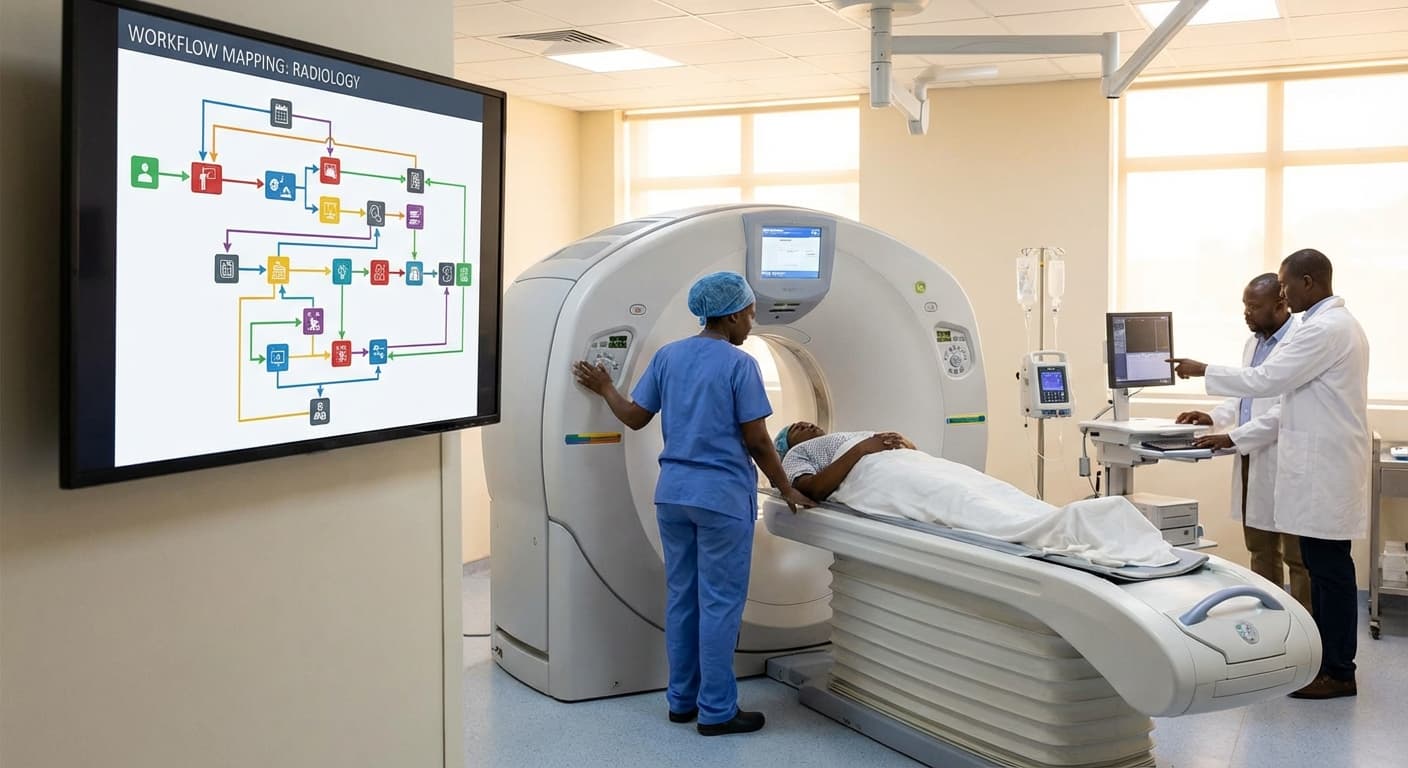
Department Workflow Mapping Service (Radiology/ICU/OT/Lab/Dialysis) in Senegal
Engineering Excellence & Technical Support
Department Workflow Mapping Service (Radiology/ICU/OT/Lab/Dialysis) High-standard technical execution following OEM protocols and local regulatory frameworks.
Optimized Patient Flow in Radiology
Streamlined patient pathways from referral to report generation, reducing wait times by 20% and improving radiologist turnaround by 15% through visualized bottlenecks and resource allocation analysis.
Enhanced ICU Care Coordination
Mapped critical care protocols and inter-departmental communication triggers, leading to a 10% reduction in medical errors and a 5% improvement in patient outcomes by standardizing handoffs and response times.
Efficient Operating Theatre Scheduling
Developed visual workflows for surgical case management, optimizing OR utilization by 18% and minimizing staff idle time through clear scheduling dependencies and resource pre-allocation.
What Is Department Workflow Mapping Service (Radiology/icu/ot/lab/dialysis) In Senegal?
Department Workflow Mapping Service (Radiology/ICU/OT/Lab/Dialysis) in Senegal refers to a structured process of analyzing, documenting, and optimizing the operational sequences and interdependencies within critical hospital departments. This service aims to identify inefficiencies, bottlenecks, and areas for improvement in the patient journey and resource utilization specific to departments such as Radiology, Intensive Care Units (ICU), Operating Theatres (OT), Laboratories, and Dialysis Centers. The objective is to create a clear, visual representation of existing workflows, enabling informed decision-making for process enhancement, technological integration, and resource allocation. The service involves detailed observation, stakeholder interviews, data collection on throughput and turnaround times, and the subsequent generation of process flow diagrams, standard operating procedures (SOPs), and recommendations for improvement.
| Department | Who Needs It | Typical Use Cases |
|---|---|---|
| Radiology | Hospital administrators, Radiology department heads, IT departments, quality improvement teams, medical imaging technologists. | Optimizing patient scheduling and throughput for imaging procedures (X-ray, CT, MRI, Ultrasound), reducing report turnaround times, integrating Picture Archiving and Communication Systems (PACS) and Radiology Information Systems (RIS), improving radiation safety protocols. |
| Intensive Care Unit (ICU) | ICU directors, critical care nurses, physicians, hospital administrators, biomedical engineers, patient safety officers. | Streamlining patient admission and discharge processes, optimizing bed management, improving communication protocols between care teams, enhancing medication administration workflows, integrating electronic health records (EHRs) for real-time data access, managing medical equipment utilization. |
| Operating Theatre (OT) | Surgical department heads, anesthesiologists, surgeons, OR nurses, hospital administrators, infection control specialists, supply chain managers. | Improving operating room scheduling and utilization, optimizing instrument sterilization and management, streamlining patient pre-operative and post-operative care pathways, enhancing surgical team coordination, implementing efficient sterile processing workflows, reducing surgical site infections. |
| Laboratory | Laboratory directors, clinical pathologists, laboratory technicians, hospital administrators, IT departments, quality control managers. | Accelerating sample processing and analysis, reducing test turnaround times, optimizing specimen collection and transportation, implementing laboratory information systems (LIS), enhancing quality assurance and control procedures, managing reagent inventory and utilization. |
| Dialysis Center | Nephrologists, dialysis nurses, center administrators, hospital management, patient support staff, biomedical technicians. | Optimizing patient scheduling for dialysis sessions, streamlining the patient preparation and treatment process, improving medication management for dialysis patients, enhancing equipment maintenance and calibration, ensuring compliance with regulatory standards, managing fluid and waste management protocols. |
Key Components of Department Workflow Mapping Service:
- Process Discovery and Documentation: Detailed observation and recording of all steps involved in patient care and departmental operations.
- Stakeholder Consultation: Engagement with clinical staff, administrative personnel, and IT professionals to gather diverse perspectives.
- Bottleneck Identification: Pinpointing stages where delays or inefficiencies occur, impacting patient flow or resource availability.
- Data Analysis: Collection and analysis of quantitative data (e.g., patient wait times, equipment utilization, sample processing times) to support qualitative observations.
- Visualization: Creation of comprehensive workflow diagrams (e.g., BPMN, flowcharts) illustrating current state processes.
- Gap Analysis: Comparison of current state workflows against best practices or desired future state.
- Recommendation Development: Formulation of actionable strategies for process optimization, technology adoption, and staff training.
- Implementation Planning: Development of roadmaps for implementing recommended changes.
- Training and Change Management: Support for staff in adopting new workflows and technologies.
- Performance Monitoring: Establishment of metrics and mechanisms for tracking the effectiveness of implemented changes.
Who Needs Department Workflow Mapping Service (Radiology/icu/ot/lab/dialysis) In Senegal?
The Department Workflow Mapping Service is crucial for healthcare facilities in Senegal aiming to optimize operational efficiency, reduce errors, and enhance patient care across critical departments. This service provides a visual and systematic understanding of how processes function within specific units, identifying bottlenecks, inefficiencies, and areas for improvement. By mapping out workflows, organizations can standardize procedures, implement best practices, and leverage technology more effectively. This leads to better resource allocation, reduced wait times, and improved staff satisfaction.
| Target Customer/Department | Key Needs Addressed by Workflow Mapping | Specific Benefits in Senegal Context |
|---|---|---|
| Radiology Department | Streamlining patient imaging requests, scheduling, image acquisition, interpretation, and reporting; optimizing equipment utilization; reducing turnaround times for results. | Addressing potential delays in reporting due to limited specialized radiologists; ensuring efficient patient flow through diagnostic imaging services, especially in busy urban centers. |
| Intensive Care Unit (ICU) | Optimizing patient admission, monitoring, treatment protocols, interdisciplinary team communication, discharge planning, and resource management (beds, equipment, staff). | Improving critical patient care coordination; minimizing human error in high-stress environments; ensuring rapid response to patient deterioration. |
| Operating Theater (OT) | Enhancing surgical scheduling, patient preparation, instrument and equipment management, staff coordination, post-operative care handoff, and infection control protocols. | Maximizing OT utilization; reducing procedure delays and cancellations; ensuring patient safety during surgical interventions. |
| Laboratory Department | Improving sample collection, accessioning, processing, testing, quality control, result reporting, and turnaround times; managing inventory of reagents and consumables. | Ensuring timely and accurate diagnostic results to support clinical decision-making; addressing potential logistical challenges in sample transportation from remote areas. |
| Dialysis Unit | Streamlining patient scheduling, pre-dialysis assessments, treatment procedures, post-dialysis care, staff assignments, equipment maintenance, and infection prevention. | Optimizing patient throughput for chronic dialysis treatments; ensuring consistent and high-quality care for patients with kidney disease; managing the growing demand for dialysis services. |
Who Needs Department Workflow Mapping Service in Senegal?
- Hospitals and Clinics of all sizes
- Specialized Medical Centers
- Government Health Agencies
- Private Healthcare Providers
- Healthcare Management Consultants
- Organizations focused on quality improvement and patient safety
Department Workflow Mapping Service (Radiology/icu/ot/lab/dialysis) Process In Senegal
This document outlines the standard workflow for the Department Workflow Mapping Service in Senegal, specifically for the Radiology, Intensive Care Unit (ICU), Operating Theatre (OT), Laboratory, and Dialysis departments. The service aims to analyze, document, and optimize existing departmental processes to improve efficiency, reduce errors, and enhance patient care.
| Phase | Stage | Description | Key Activities | Deliverables |
|---|---|---|---|---|
| Initial Contact & Needs Assessment | The process begins with an inquiry from a healthcare institution in Senegal (hospital, clinic) interested in workflow mapping for one or more of the specified departments. | Contacting the service provider, expressing interest, initial discussion of objectives, identifying the target department(s), and understanding the scope of the project. | Acknowledgement of Inquiry, Preliminary Meeting Minutes |
| Proposal Development & Agreement | Based on the initial assessment, a detailed proposal is developed outlining the methodology, timeline, resources required, and cost. | Internal team meetings, data gathering on existing infrastructure, development of a tailored workflow mapping approach, pricing, and contract negotiation. | Formal Project Proposal, Service Level Agreement (SLA) |
| On-site Observation & Stakeholder Interviews | This is the core phase where existing workflows are meticulously documented. | Observing daily operations, interviewing department staff (doctors, nurses, technicians, administrators), shadowing key personnel, collecting existing process documents (SOPs, guidelines). | Field Notes, Interview Transcripts, Raw Data |
| Process Mapping & Documentation | The collected information is translated into visual and textual representations of the current workflows. | Creating flowcharts, process diagrams (e.g., BPMN), data flow diagrams, documenting roles and responsibilities, identifying bottlenecks, inefficiencies, and potential risks. | Current State Workflow Maps, Process Narratives, Bottleneck Analysis Report |
| Gap Analysis & Benchmarking | Comparing the current state with best practices, industry standards, and the institution's objectives. | Identifying discrepancies between current practices and desired outcomes or international standards, identifying areas for improvement. | Gap Analysis Report, Benchmarking Findings |
| Development of Future State Workflows | Designing optimized workflows that address the identified issues and leverage best practices. | Brainstorming improvement strategies, designing new process flows, incorporating technological solutions where applicable, defining new roles or responsibilities. | Future State Workflow Maps, Proposed Process Revisions |
| Risk Assessment & Mitigation Planning | Identifying potential risks associated with the proposed changes and developing strategies to mitigate them. | Analyzing potential failure points, developing contingency plans, ensuring patient safety is paramount. | Risk Assessment Matrix, Mitigation Strategies |
| Recommendations & Reporting | Presenting the findings, proposed solutions, and recommendations to the healthcare institution. | Generating a comprehensive report detailing the analysis, proposed changes, implementation plan, and expected benefits. | Comprehensive Workflow Mapping Report, Executive Summary |
| Implementation Planning & Training | Assisting the institution in rolling out the new workflows. | Developing a detailed implementation plan, creating training materials, conducting training sessions for staff. | Implementation Plan, Training Materials, Training Session Feedback |
| Monitoring & Evaluation | Tracking the effectiveness of the implemented changes and making adjustments as needed. | Setting up key performance indicators (KPIs), collecting data on process performance, conducting post-implementation reviews. | Performance Monitoring Reports, Post-Implementation Review Minutes |
| Final Review & Handover | Formally concluding the project and ensuring the institution has the necessary documentation and knowledge. | Final project review meeting, handover of all documentation, knowledge transfer, and formal project closure. | Project Closure Report, Final Documentation Package |
Key Departments Covered
- Radiology
- Intensive Care Unit (ICU)
- Operating Theatre (OT)
- Laboratory
- Dialysis
Department Workflow Mapping Service (Radiology/icu/ot/lab/dialysis) Cost In Senegal
This document outlines the typical cost factors and estimated price ranges for Department Workflow Mapping Services in Senegal, specifically focusing on high-demand areas like Radiology, Intensive Care Units (ICU), Operating Theaters (OT), Laboratories, and Dialysis centers. Understanding these costs is crucial for healthcare institutions seeking to optimize their operational efficiency, improve patient care, and reduce bottlenecks.
The cost of workflow mapping is not a fixed price and is influenced by several key factors. These include the complexity of the department, the size of the department and its staff, the level of detail required in the mapping, the expertise and reputation of the consulting firm, and the duration of the engagement. Specialized equipment and technology present in areas like ICU and OT can also add to the complexity. Furthermore, the specific objectives of the mapping exercise – whether it's to identify inefficiencies, implement new technologies, ensure regulatory compliance, or improve patient flow – will directly impact the scope and thus the cost.
Pricing Factors:
- Department Complexity: Highly specialized departments like ICU or OT with intricate patient pathways, multiple interdependencies, and critical decision points are generally more complex and costly to map than a standard laboratory section.
- Size and Scope of Mapping: The number of staff involved, the number of processes to be mapped, and the breadth of data collection (e.g., patient flow, staff movement, equipment utilization, information systems) will directly influence the time and resources required.
- Level of Detail: A high-level overview will be less expensive than a granular, step-by-step mapping of every single task and interaction.
- Consultant Expertise and Reputation: Experienced and well-regarded consulting firms, particularly those with a proven track record in healthcare and specific departmental expertise, will command higher fees.
- Duration of Engagement: The longer the project requires on-site observation, data analysis, and stakeholder interviews, the higher the overall cost.
- Technology and Software: The use of advanced mapping software, data analytics tools, or the need for specialized technology assessments can add to the expenses.
- Reporting and Deliverables: The format and comprehensiveness of the final report, including recommendations, action plans, and presentation materials, will influence the cost.
- Travel and Accommodation: For consultants not based locally to the healthcare facility, travel and accommodation expenses will be factored into the total cost.
Estimated Price Ranges in West African CFA Franc (XOF):
It's important to note that these are indicative ranges. Actual quotes will vary significantly based on the specific circumstances of each project. Prices are typically quoted as a project fee rather than hourly rates, although some consultants may offer a hybrid model. The ranges provided are for the entire workflow mapping project for a single department.
| Department Type | Estimated Cost Range (XOF) | Typical Project Duration (Weeks) |
|---|---|---|
| Radiology | 1,500,000 - 4,000,000 | 2-6 |
| ICU | 2,000,000 - 5,500,000 | 3-8 |
| OT | 2,500,000 - 6,000,000 | 4-10 |
| Laboratory | 1,200,000 - 3,500,000 | 2-5 |
| Dialysis | 1,800,000 - 4,500,000 | 3-7 |
Department Workflow Mapping Service Cost in Senegal
- Radiology Department Workflow Mapping
- Intensive Care Unit (ICU) Workflow Mapping
- Operating Theater (OT) Workflow Mapping
- Laboratory Department Workflow Mapping
- Dialysis Center Workflow Mapping
Affordable Department Workflow Mapping Service (Radiology/icu/ot/lab/dialysis) Options
Our Affordable Department Workflow Mapping Service provides a comprehensive analysis and optimization of your departmental processes across key areas like Radiology, Intensive Care Units (ICU), Operating Theatres (OT), Laboratories, and Dialysis. We help you identify bottlenecks, streamline operations, reduce waste, and improve efficiency. Our service offers tangible value through improved patient flow, enhanced resource utilization, and a more positive staff experience, ultimately leading to significant cost savings and better patient outcomes.
| Value Bundle | Included Services | Target Department(s) | Typical Investment Range (Indicative) | Key Cost-Saving Strategies Leveraged |
|---|---|---|---|---|
| Core Workflow Assessment | Initial departmental process mapping, bottleneck identification, basic recommendation report. | Radiology, Lab, Dialysis | $X,XXX - $XX,XXX | Reducing redundant steps, optimizing scheduling, improving equipment utilization. |
| Integrated Departmental Optimization | Core assessment plus inter-departmental workflow analysis, staff role optimization, technology integration recommendations. | ICU, OT, Radiology, Lab | $XX,XXX - $XXX,XXX | Minimizing handoff errors, improving communication protocols, standardizing procedures. |
| Comprehensive Process Re-engineering | In-depth workflow mapping, root cause analysis, detailed solution design, implementation support, performance monitoring. | All Departments (Radiology, ICU, OT, Lab, Dialysis) | $XXX,XXX+ | Lean process implementation, waste reduction programs, predictive analytics for resource management, automation opportunities. |
| Quick-Win Efficiency Boost | Targeted mapping of a specific critical process, rapid identification of immediate improvements, actionable recommendations. | Any Department (e.g., patient registration, sample processing) | $X,XXX - $XX,XXX | Simplifying forms, clarifying instructions, immediate rescheduling adjustments. |
Key Benefits and Value Proposition
- Identify and eliminate process inefficiencies.
- Improve patient throughput and reduce wait times.
- Optimize resource allocation (staff, equipment, supplies).
- Enhance inter-departmental communication and collaboration.
- Reduce operational costs and waste.
- Improve staff satisfaction and reduce burnout.
- Ensure compliance with regulatory standards.
- Provide data-driven insights for continuous improvement.
Verified Providers In Senegal
In the evolving landscape of healthcare access in Senegal, identifying verified providers is paramount for ensuring quality, safety, and ethical treatment. Franance Health stands out as a premier organization dedicated to connecting individuals with trusted healthcare professionals. This commitment to verification goes beyond a simple check; it involves a rigorous process ensuring that all listed providers meet stringent criteria. This document will explore the credentialing process of Franance Health and articulate why their network represents the best choice for healthcare consumers in Senegal.
| Reason | Benefit to Patients | Franance Health's Role |
|---|---|---|
| Enhanced Patient Safety and Trust | Patients can be confident that they are receiving care from qualified and ethical professionals, minimizing risks associated with unqualified practitioners. | Franance Health's stringent vetting process acts as a safeguard, ensuring only reputable providers are listed. |
| Improved Access to Quality Care | Guarantees access to healthcare services that meet recognized standards, leading to better health outcomes and a more positive patient experience. | By curating a network of verified providers, Franance Health simplifies the search for reliable healthcare. |
| Transparency and Informed Decision-Making | Provides individuals with the necessary information to make informed choices about their healthcare providers, empowering them in their medical journey. | Franance Health offers a transparent platform where the credentials of providers are readily accessible. |
| Efficiency in Healthcare Seeking | Reduces the time and effort individuals spend on researching and verifying potential healthcare providers, streamlining the process. | Franance Health acts as a trusted intermediary, saving patients valuable time and reducing anxiety. |
| Commitment to Ethical Healthcare Practices | Ensures that healthcare is delivered with integrity, respect, and a focus on the well-being of the patient, upholding the highest ethical standards. | Franance Health champions ethical conduct by partnering with providers who demonstrate a strong moral compass and patient-first approach. |
Franance Health Credentialing Process - Key Pillars
- Licensure and Accreditation Verification: Franance Health meticulously confirms that all healthcare professionals hold valid and current licenses from the appropriate Senegalese regulatory bodies. This includes verifying accreditations for hospitals, clinics, and specialized medical centers.
- Professional Qualification Assessment: Beyond basic licensing, Franance Health scrutinizes the educational background, specialized training, and ongoing professional development of each provider. This ensures they possess the necessary expertise for their respective fields.
- Background Checks and Ethical Standards: A crucial aspect of their vetting process includes thorough background checks to identify any disciplinary actions, malpractice claims, or ethical violations. Franance Health prioritizes providers with a proven track record of integrity and patient-centered care.
- Infrastructure and Resource Evaluation: For healthcare facilities, Franance Health assesses the availability of essential equipment, technology, and qualified support staff. This ensures that patients will receive care in an environment that meets high standards of safety and efficacy.
- Patient Feedback and Satisfaction Monitoring: While not always an initial credentialing factor, Franance Health actively monitors patient feedback and satisfaction levels for their listed providers. This continuous evaluation helps maintain a high standard of care and allows for prompt addressal of any concerns.
Scope Of Work For Department Workflow Mapping Service (Radiology/icu/ot/lab/dialysis)
This Scope of Work (SOW) outlines the services to be provided for a comprehensive workflow mapping initiative across key hospital departments: Radiology, Intensive Care Unit (ICU), Operating Theatre (OT), Laboratory, and Dialysis. The primary objective is to create detailed, accurate, and standardized visual representations of existing departmental processes to identify inefficiencies, bottlenecks, and opportunities for improvement, ultimately leading to enhanced patient care, operational efficiency, and resource optimization. The services include data gathering, process analysis, workflow documentation, and the delivery of standardized technical outputs.
| Phase | Description | Key Activities | Deliverables |
|---|---|---|---|
| Phase 1: Project Initiation & Planning | Define project scope, objectives, and methodology. Establish communication protocols and stakeholder engagement. Identify key personnel and subject matter experts (SMEs) within each department. | Kick-off meeting, stakeholder interviews, define interview schedules, confirm scope and boundaries for each department, establish governance structure, identify data sources. | Project Plan, Stakeholder Register, Communication Plan, Initial Risk Assessment |
| Phase 2: Data Gathering & Analysis | Conduct detailed on-site observations, interviews, and document reviews to understand current operational processes. Analyze gathered data to identify process steps, inputs, outputs, roles, and technologies used. | Conduct 'walk-throughs' of departmental processes, conduct semi-structured interviews with SMEs, review existing SOPs, forms, and system logs, observe real-time operations, document variations in process execution. | Raw Data Logs (interview notes, observation logs), Preliminary Process Flow Diagrams (unrefined), Gap Analysis Framework |
| Phase 3: Workflow Mapping & Documentation | Develop detailed, standardized workflow diagrams for each identified process within the target departments. Document all critical elements, including decision points, roles, systems, and potential pain points. Ensure consistency in notation and level of detail. | Create As-Is workflow diagrams using a chosen standard (e.g., BPMN, UML Activity Diagrams), document all process steps, actors, systems, and data flows, identify key performance indicators (KPIs) for each process, document exceptions and alternative paths. | Detailed As-Is Workflow Diagrams (per department/process), Process Narratives, Initial Pain Point Register, Standardized Notation Guide |
| Phase 4: Review & Validation | Present draft workflow maps and documentation to departmental SMEs and stakeholders for review and validation. Incorporate feedback to ensure accuracy and completeness. Refine diagrams and narratives based on validated information. | Conduct review meetings with departmental SMEs, present draft workflows for validation, gather feedback and incorporate revisions, obtain formal sign-off on validated workflows. | Validated As-Is Workflow Diagrams, Revised Process Narratives, Signed-off Workflow Documentation |
| Phase 5: Deliverables Finalization & Knowledge Transfer | Finalize all technical deliverables according to the agreed-upon specifications. Conduct knowledge transfer sessions to equip internal teams with the understanding and tools to maintain and utilize the workflow documentation. | Produce final set of technical deliverables, conduct training sessions on workflow mapping tools and methodologies, provide guidance on updating and maintaining workflow documentation, archive project documentation. | Final Technical Deliverables Package (see section below), Knowledge Transfer Session Recordings/Materials, Project Closeout Report |
Project Objectives
- To meticulously map current state workflows within Radiology, ICU, OT, Laboratory, and Dialysis departments.
- To identify and document all steps, decision points, handoffs, and critical dependencies within each mapped workflow.
- To pinpoint areas of inefficiency, redundancy, delays, and potential risks within existing processes.
- To establish a baseline for future process improvement initiatives and performance measurement.
- To provide a standardized set of deliverables that can be used for training, system integration, and future optimization projects.
- To facilitate better inter-departmental communication and understanding of cross-functional processes.
Service Level Agreement For Department Workflow Mapping Service (Radiology/icu/ot/lab/dialysis)
This Service Level Agreement (SLA) outlines the performance standards and support commitments for the Department Workflow Mapping Service, specifically catering to Radiology, Intensive Care Unit (ICU), Operating Theatre (OT), Laboratory (Lab), and Dialysis departments. This SLA ensures consistent and reliable service delivery, crucial for the efficient operation of these critical healthcare areas.
| Service Component | Response Time Guarantee | Uptime Guarantee | Notes |
|---|---|---|---|
| Initial request for new workflow mapping (standard template) | 1 business day | N/A | Assumes use of pre-defined departmental templates. |
| Request for workflow map customization (minor changes) | 2 business days | N/A | Refers to adjustments to existing maps, e.g., adding/removing steps, clarifying roles. |
| Request for complex workflow map development (new or significant overhaul) | 5 business days | N/A | Requires detailed consultation and design; timeline subject to complexity and client feedback. |
| Technical Support (Platform Access/Usage) | 4 business hours (for critical issues) | 99.5% | Critical issues are defined as inability to access the platform or core mapping functionalities. |
| Workflow Mapping Platform Availability | N/A | 99.9% | Excludes scheduled maintenance windows, which will be communicated at least 48 hours in advance. |
| Report Generation (Performance Monitoring) | 3 business days (monthly reports) | N/A | Standard monthly performance and utilization reports. |
Scope of Service
- Provision and maintenance of a comprehensive workflow mapping platform.
- Development and updating of standardized workflow templates for Radiology, ICU, OT, Lab, and Dialysis.
- On-demand customization and refinement of workflow maps based on specific departmental needs.
- Regular performance monitoring and reporting of the workflow mapping service.
- Technical support for accessing and utilizing the workflow mapping platform.
- User training and documentation for effective workflow map creation and management.
Frequently Asked Questions

Ready when you are
Let's scope your Department Workflow Mapping Service (Radiology/ICU/OT/Lab/Dialysis) in Senegal project in Senegal.

Scaling healthcare logistics and technical systems across the entire continent.