
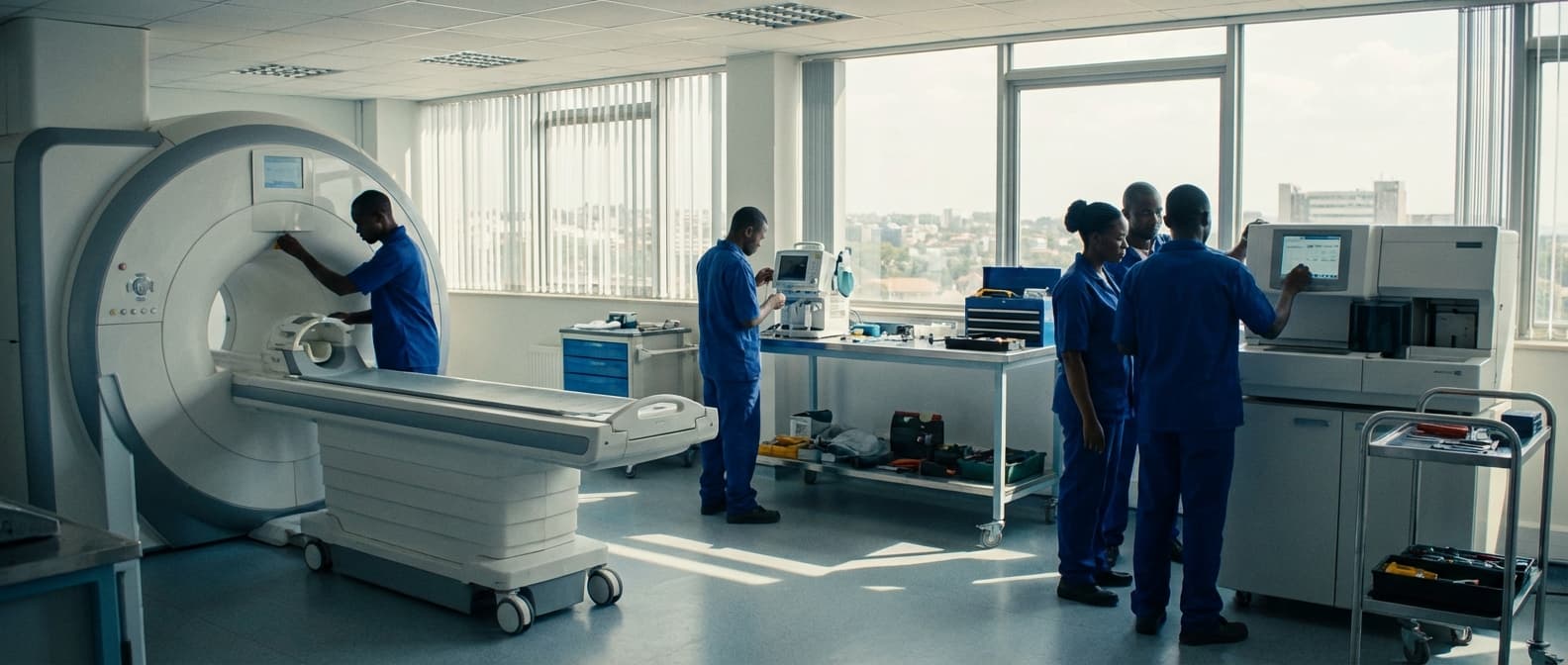
Uptime, Downtime & Root-Cause Analysis Reporting Service in Sao Tome and Principe
Engineering Excellence & Technical Support
Uptime, Downtime & Root-Cause Analysis Reporting Service High-standard technical execution following OEM protocols and local regulatory frameworks.
Real-time Uptime Monitoring
Proactive 24/7 monitoring of critical infrastructure across Sao Tome and Principe, detecting and alerting on any service degradation or outage within seconds to minimize business impact.
Comprehensive Downtime Analysis
Detailed post-incident reports outlining the precise duration, scope, and affected services during downtime events, providing clients with essential data for business continuity planning.
Advanced Root-Cause Identification
Leveraging sophisticated diagnostic tools and historical data to pinpoint the exact root cause of incidents, enabling swift and effective remediation and preventing future recurrences.
What Is Uptime, Downtime & Root-cause Analysis Reporting Service In Sao Tome And Principe?
In the context of Sao Tome and Principe's digital infrastructure and business operations, Uptime, Downtime & Root-Cause Analysis (RCA) Reporting services are critical for ensuring the availability, performance, and reliability of IT systems and services. These services provide structured methodologies and reporting mechanisms to monitor system availability, diagnose and rectify outages, and implement preventative measures. The overarching goal is to minimize service interruptions, maintain operational continuity, and enhance the overall resilience of business processes within the nation's evolving technological landscape.
| Who Needs This Service | Typical Use Cases in Sao Tome and Principe | |||
|---|---|---|---|---|
| Businesses with critical IT infrastructure: Enterprises across all sectors (telecommunications, finance, tourism, government) that rely on IT systems for core operations. | Monitoring the availability of online banking platforms and ATMs for financial institutions. | Ensuring uninterrupted internet connectivity and service delivery for telecommunication providers. | Maintaining uptime for booking systems and guest services in the tourism and hospitality sector. | Ensuring the availability of government e-services portals and critical public infrastructure monitoring. |
| Cloud service providers and hosting companies: Organizations managing shared IT resources for multiple clients. | Reporting service level agreement (SLA) compliance for cloud-hosted applications. | Diagnosing and resolving issues affecting shared hosting environments. | Providing transparency to clients regarding system availability. | |
| IT Service Providers (MSPs): Companies offering outsourced IT management and support. | Proactive monitoring and management of client IT environments to prevent downtime. | Rapid response and resolution of incidents impacting client operations. | Demonstrating value and reliability to clients through comprehensive reporting. | |
| Government agencies and public sector organizations: Entities responsible for delivering essential services. | Ensuring the availability of critical government IT systems (e.g., health records, tax portals). | Investigating outages affecting public utility management systems. | Complying with mandates for IT service reliability. | |
| E-commerce platforms and online retailers: Businesses with significant online revenue streams. | Monitoring website and payment gateway uptime to prevent lost sales. | Analyzing downtime impact on customer experience and conversion rates. | Implementing strategies to enhance e-commerce site resilience. |
Key Components of Uptime, Downtime & Root-Cause Analysis Reporting Service
- Uptime Monitoring: Continuous, automated surveillance of critical IT assets (servers, networks, applications, cloud services) to verify their operational status and availability. This involves employing monitoring tools that poll endpoints at regular intervals, checking for response times, error codes, and resource utilization.
- Downtime Detection & Alerting: Proactive identification of service interruptions or performance degradations. Upon detection, the system triggers immediate alerts to designated IT personnel and stakeholders via multiple channels (email, SMS, incident management platforms) to facilitate rapid response.
- Incident Management Integration: Seamless integration with incident management workflows, enabling the logging, tracking, and prioritization of downtime events. This ensures a systematic approach to issue resolution.
- Root-Cause Analysis (RCA): A disciplined process for investigating the fundamental reason(s) behind a service outage. RCA involves gathering data, analyzing logs, tracing dependencies, and employing diagnostic techniques to pinpoint the exact failure point, moving beyond superficial symptoms.
- Reporting & Documentation: Generation of comprehensive reports detailing uptime percentages, downtime durations, incident timelines, identified root causes, and remediation actions taken. These reports are crucial for performance evaluation, trend analysis, and compliance.
- Trend Analysis & Predictive Maintenance: Utilizing historical uptime and downtime data to identify recurring issues, predict potential future failures, and inform proactive maintenance strategies, thereby reducing the likelihood of unexpected outages.
Who Needs Uptime, Downtime & Root-cause Analysis Reporting Service In Sao Tome And Principe?
Businesses and organizations in Sao Tome and Principe facing critical operational challenges require robust Uptime, Downtime, and Root-Cause Analysis (RCA) reporting services. These services are essential for ensuring business continuity, optimizing performance, and mitigating risks associated with unexpected service interruptions. They provide the necessary data and insights to understand the 'why' behind outages, leading to proactive problem-solving and improved reliability.
| Customer Segment | Key Departments Benefiting from Reporting | Primary Needs & Benefits |
|---|---|---|
| Telecommunications Companies | Network Operations Center (NOC), Technical Support, Service Assurance, Management | Minimizing call drops, ensuring network stability, faster resolution of service outages, customer satisfaction, revenue protection. |
| Financial Institutions | IT Operations, Security Operations Center (SOC), Compliance, Business Continuity Planning | Preventing transaction failures, maintaining data integrity, meeting regulatory requirements, safeguarding customer trust, protecting against financial loss. |
| Government Agencies | IT Department, Public Services Management, Emergency Services Coordination | Ensuring uninterrupted access to essential services (e.g., citizen portals, administrative systems), maintaining public trust, efficient resource allocation, disaster preparedness. |
| Healthcare Providers | IT Department, Clinical Operations, Administration, Biomedical Engineering | Ensuring availability of critical medical equipment and systems, patient safety, seamless data flow for patient records, preventing disruption of care. |
| Logistics and Shipping Companies | Operations Management, IT Department, Supply Chain Management | Maintaining visibility of shipments, ensuring timely delivery, preventing delays in customs clearance, optimizing fleet management, customer communication. |
| Energy and Utilities Providers | Operations Control Center, Grid Management, Customer Service, Maintenance Teams | Preventing power outages, ensuring reliable energy supply, efficient response to infrastructure failures, public safety, regulatory compliance. |
| Tourism and Hospitality Businesses | IT Department, Front Desk Operations, Reservations, Management | Ensuring uninterrupted guest services (e.g., Wi-Fi, booking systems), smooth check-in/check-out, maintaining reputation, guest satisfaction. |
| Information Technology Service Providers | Managed Services (MSPs), Cloud Providers, Data Center Operations, Technical Support | Demonstrating service level agreements (SLAs), proactive issue resolution for clients, optimizing service delivery, maintaining client trust and retention. |
| Manufacturing and Production Facilities | Production Management, Plant Operations, Maintenance, IT Department | Minimizing production downtime, ensuring efficient operation of machinery, identifying and resolving equipment failures, quality control, cost reduction. |
| Retail and E-commerce Operations | E-commerce Management, IT Department, Point of Sale (POS) Operations, Customer Service | Ensuring online store availability, preventing payment gateway failures, smooth inventory management, uninterrupted customer transactions, driving sales. |
Target Customers & Departments in Sao Tome and Principe
- Telecommunications Companies
- Financial Institutions (Banks, Microfinance)
- Government Agencies
- Healthcare Providers (Hospitals, Clinics)
- Logistics and Shipping Companies
- Energy and Utilities Providers
- Tourism and Hospitality Businesses
- Information Technology Service Providers
- Manufacturing and Production Facilities
- Retail and E-commerce Operations
Uptime, Downtime & Root-cause Analysis Reporting Service Process In Sao Tome And Principe
This document outlines the workflow for the Uptime, Downtime, and Root-Cause Analysis (RCA) Reporting Service offered in Sao Tome and Principe. The process is designed to be transparent, efficient, and data-driven, ensuring clients receive accurate and actionable insights into their system performance and any disruptions. The workflow begins with an initial inquiry and progresses through data collection, analysis, reporting, and follow-up.
| Step | Description | Key Activities | Deliverables/Outcomes | Responsible Parties |
|---|---|---|---|---|
| The client initiates contact to understand or procure the Uptime, Downtime & RCA Reporting Service. | Initial consultation, understanding client needs, defining scope of systems/services to be monitored, service level agreement (SLA) discussion, proposal generation. | Service proposal, defined scope of work, agreed-upon SLAs. | Client, Service Provider Sales/Consulting Team |
| Setting up the necessary infrastructure and configurations to monitor the client's systems and services. | Deployment of monitoring agents/tools, configuration of data collection parameters, establishment of alert thresholds, access provisioning. | Operational monitoring infrastructure, configured alert rules, verified data streams. | Service Provider Technical Team, Client IT Infrastructure Team |
| Proactive identification and immediate notification of any system or service downtime. | Continuous monitoring of predefined metrics, automated alert generation upon detecting anomalies/downtime, initial incident notification to the client. | Real-time alerts, initial downtime notification (e.g., email, SMS, dashboard update). | Service Provider Monitoring System, Service Provider Operations Team |
| Investigating the underlying reasons for detected downtime events to prevent recurrence. | Data correlation from various monitoring sources, log analysis, system diagnostics, interviews with relevant personnel, identification of the primary cause. | Identified root cause(s), contributing factors. | Service Provider RCA Specialists, Client Technical Personnel |
| Providing detailed reports on uptime, downtime, and the findings of the RCA. | Compiling historical uptime/downtime data, documenting RCA findings in a clear and structured format, generating performance reports, presenting reports to the client. | Uptime/Downtime Report, RCA Report, Performance Summary. | Service Provider Reporting Team, Service Provider Account Manager, Client Stakeholders |
| Ensuring client satisfaction, discussing report findings, and planning for corrective actions or service improvements. | Post-report review meetings, discussion of remediation strategies, feedback collection, potential service optimization or expansion. | Actionable recommendations, improved system reliability, client satisfaction. | Service Provider Account Manager, Client Management, Client Technical Team |
Key Stages of the Uptime, Downtime & Root-Cause Analysis Reporting Service Process
- Inquiry & Scoping
- Data Collection & Monitoring Setup
- Downtime Event Detection & Initial Reporting
- Root-Cause Analysis (RCA)
- Comprehensive Reporting & Delivery
- Review & Follow-up
Uptime, Downtime & Root-cause Analysis Reporting Service Cost In Sao Tome And Principe
Providing comprehensive Uptime, Downtime, and Root-Cause Analysis (RCA) reporting services in Sao Tome and Principe involves a nuanced pricing structure influenced by several key factors. The cost is not a fixed figure but rather a dynamic reflection of the service's scope, complexity, and the expertise of the provider. Local currency pricing will generally be in the Dobra (STN), though international providers might quote in USD, which would then be subject to current exchange rates. Understanding these pricing drivers is crucial for businesses seeking to budget for such essential IT infrastructure monitoring and problem-solving capabilities.
| Service Tier | Estimated Monthly Cost (STN) | Key Features | Ideal For |
|---|---|---|---|
| Basic Uptime Monitoring | 1,500 - 4,000 | Uptime tracking, basic alerts, simple downtime reports. | Small businesses, startups with limited IT infrastructure. |
| Standard Uptime & Downtime Analysis | 4,000 - 10,000 | Includes basic monitoring, historical downtime analysis, root cause identification for common issues, regular summary reports. | Medium-sized businesses, growing IT departments. |
| Comprehensive Uptime, Downtime & RCA | 10,000 - 25,000+ | Advanced monitoring across diverse systems, in-depth root cause analysis, proactive issue detection, detailed incident reports, dedicated support, SLA adherence. | Large enterprises, businesses with mission-critical operations, complex IT environments. |
| Custom/Enterprise Solutions | Price Negotiable (Above 25,000) | Tailored solutions for highly specific needs, integration with existing systems, advanced security monitoring, performance optimization RCA. | Organizations with unique IT challenges, high compliance requirements, or specialized infrastructure. |
Key Pricing Factors for Uptime, Downtime & RCA Reporting Services in Sao Tome and Principe
- {"title":"Scope of Services","description":"The breadth of the services included significantly impacts cost. This can range from basic uptime monitoring with simple downtime alerts to sophisticated RCA that involves deep-dive diagnostics, historical data analysis, and detailed incident reports. More comprehensive SLAs (Service Level Agreements) with guaranteed response times and resolution targets will command higher prices."}
- {"title":"Number of Monitored Assets/Systems","description":"The more servers, applications, network devices, or cloud instances that need to be monitored, the higher the cost. Each asset requires configuration, ongoing management, and data collection, contributing to the overall resource investment by the service provider."}
- {"title":"Complexity of Infrastructure","description":"Monitoring and analyzing complex, distributed, or highly virtualized environments is more challenging and thus more expensive than monitoring a straightforward, single-location setup. Integration with diverse technologies and legacy systems can also increase costs."}
- {"title":"Data Retention and Reporting Frequency","description":"The length of time historical data is stored and the frequency of report generation (daily, weekly, monthly, ad-hoc) will affect pricing. Longer retention periods and more frequent reporting require greater storage and processing capabilities."}
- {"title":"Level of Expertise and Support","description":"Providers with highly skilled engineers specializing in network diagnostics, system performance, and cybersecurity will charge more. The availability of 24/7 support, dedicated account managers, and rapid response teams also contributes to the overall cost."}
- {"title":"Tools and Technology Used","description":"The sophistication of the monitoring and RCA tools employed by the provider plays a role. Proprietary, advanced platforms or expensive third-party software licenses can be factored into the service cost."}
- {"title":"Customization Requirements","description":"If the business requires highly customized monitoring dashboards, specific alert thresholds, or bespoke RCA methodologies, this will likely incur additional charges due to the custom development and configuration involved."}
- {"title":"Provider Location and Overhead","description":"While services can be delivered remotely, the operational overhead of the provider, including their local presence (if any), staffing, and business expenses in Sao Tome and Principe, will be reflected in the pricing."}
Affordable Uptime, Downtime & Root-cause Analysis Reporting Service Options
Our service provides comprehensive uptime and downtime monitoring, coupled with deep-dive root-cause analysis reporting, designed to be both effective and budget-friendly. We understand that maintaining high availability and quickly resolving issues is critical, but not at the expense of your bottom line. This offering is structured to deliver significant value through flexible service tiers and strategic cost-saving measures, ensuring you get the insights you need without overspending.
| Value Bundle | Description | Key Features Included | Ideal For | Monthly Price Range (USD) |
|---|---|---|---|---|
| Starter Uptime | Essential monitoring for small businesses or new ventures. | Basic uptime checks (e.g., website, critical service), email alerts, weekly summary reports. | Startups, small businesses, hobby projects. | $25 - $75 |
| Standard Uptime & Basic RCA | Enhanced monitoring with initial root-cause identification. | More frequent uptime checks, SMS alerts, basic automated RCA for common issues, monthly detailed reports. | Growing businesses, SMBs with moderate IT infrastructure. | $75 - $250 |
| Professional Uptime & Advanced RCA | Comprehensive monitoring with in-depth root-cause analysis and proactive recommendations. | Continuous monitoring, advanced alert configurations (e.g., tiered alerts), AI-powered comprehensive RCA, historical trend analysis, quarterly review meetings. | Medium to large businesses, e-commerce, SaaS providers. | $250 - $750 |
| Enterprise Uptime & Premium RCA | Fully managed, mission-critical uptime and deep-dive root-cause analysis with dedicated support. | All Professional features plus, 24/7 dedicated support, custom monitoring integrations, SLA-driven response times for RCA, biannual strategic performance reviews. | Large enterprises, mission-critical applications, regulated industries. | $750+ |
Key Features & Benefits
- Proactive Uptime Monitoring: Real-time alerts for service disruptions.
- Detailed Downtime Reporting: Comprehensive logs of outage duration, impact, and affected systems.
- Automated Root-Cause Analysis (RCA): AI-powered identification of underlying issues.
- Actionable Recommendations: Clear steps to prevent future incidents.
- Historical Trend Analysis: Insights into recurring problems and performance patterns.
- Scalable Solutions: Tailored to businesses of all sizes, from startups to enterprises.
- Cost-Effective Pricing: Transparent and competitive rates.
Verified Providers In Sao Tome And Principe
In the landscape of healthcare in São Tomé and Príncipe, accessing verified providers is paramount for ensuring quality care and patient safety. Among the entities striving for this standard, Franance Health has emerged as a significant player, offering a commitment to credible credentials and a superior patient experience. This section details why Franance Health's verified providers represent the best choice for your healthcare needs in São Tomé and Príncipe.
| Franance Health Advantage | Description |
|---|---|
| Verified Medical Professionals | All practitioners undergo thorough checks of their licenses, specializations, and ongoing professional development to ensure they meet international standards. |
| Certified Healthcare Facilities | Partner facilities are evaluated for their infrastructure, equipment, hygiene protocols, and operational efficiency, guaranteeing a safe and effective treatment environment. |
| Specialized Medical Services | Access to a diverse range of specialists and medical services, ensuring that patients can find the right expertise for their specific health concerns. |
| Enhanced Patient Experience | Focus on personalized care, efficient appointment scheduling, and clear communication pathways between patients and providers. |
| Reliable Healthcare Network | A trusted network that reduces the risk of encountering unqualified practitioners or substandard medical facilities. |
Why Franance Health Represents the Best Choice for Verified Providers:
- Rigorous Credentialing Process: Franance Health implements a stringent vetting process for all its affiliated healthcare professionals and facilities. This goes beyond basic licensing to include verification of qualifications, experience, and adherence to ethical standards.
- Commitment to Quality and Safety: By partnering with providers who meet their high standards, Franance Health ensures that patients receive care that is not only effective but also prioritizes safety and best practices.
- Access to a Network of Excellence: Franance Health curates a network of healthcare providers renowned for their expertise and dedication. This allows patients to easily find and access top-tier medical services within São Tomé and Príncipe.
- Patient-Centric Approach: The focus is on the patient's well-being. Verified providers within the Franance Health network are expected to offer compassionate care, clear communication, and a commitment to patient satisfaction.
- Transparency and Trust: Franance Health's emphasis on verified credentials fosters an environment of trust. Patients can be confident that they are engaging with qualified and legitimate healthcare professionals.
- Streamlined Healthcare Navigation: In a region where navigating healthcare options can be challenging, Franance Health simplifies the process by connecting individuals with pre-vetted, high-quality providers.
Scope Of Work For Uptime, Downtime & Root-cause Analysis Reporting Service
This document outlines the Scope of Work (SOW) for providing an Uptime, Downtime & Root-Cause Analysis (RCA) Reporting Service. The service aims to deliver comprehensive reports detailing system availability, periods of unplanned downtime, and thorough analyses to identify the underlying causes of such incidents. This ensures proactive measures can be implemented to prevent recurrence and enhance overall system reliability. The service includes the definition of technical deliverables and standard specifications.
| Deliverable | Description | Frequency | Format | Standard Specifications |
|---|---|---|---|---|
| Uptime & Downtime Report | A comprehensive report detailing the availability of specified systems over a given period, including metered uptime percentages and durations of unplanned downtime. | Weekly, Monthly, Quarterly | PDF, Excel, Interactive Dashboard | Includes: Total uptime percentage, Total downtime duration (broken down by incident), List of all incidents with start/end times, Impacted systems/services, Severity level (e.g., Critical, Major, Minor), Associated incident ticket numbers. |
| Downtime Incident Notification | Immediate notification upon detection of a significant unplanned downtime event. | As incidents occur (within agreed SLA, e.g., 15 minutes) | Email, SMS, Real-time alert system | Includes: Incident start time, Affected service/system, Initial assessment of impact, Contact person for updates. |
| Root-Cause Analysis (RCA) Report | A detailed analysis of the underlying causes of each significant downtime incident. This report aims to identify contributing factors and provide recommendations for prevention. | Within agreed SLA after incident resolution (e.g., 2-5 business days) | Includes: Incident summary (reiteration of problem, impact, resolution), Timeline of events, Methodology used (e.g., 5 Whys, Fishbone diagram), Identified root cause(s), Contributing factors, Recommendations for prevention/mitigation, Action items assigned (with owners and deadlines), Lessons learned. | |
| Performance & Availability Trend Analysis | Analysis of uptime and downtime trends over time to identify recurring issues and patterns, and to assess the effectiveness of implemented solutions. | Monthly, Quarterly | PDF, Presentation slides | Includes: Year-over-year, quarter-over-quarter, and month-over-month trends in uptime/downtime, Identification of recurring incident types, Correlation with system changes or external factors, Assessment of risk and potential future impacts. |
| Service Level Agreement (SLA) Compliance Report | A report specifically detailing the system's adherence to defined Service Level Agreements regarding uptime and response times. | Monthly, Quarterly | PDF, Excel | Includes: SLA targets, Achieved uptime vs. target, Downtime duration vs. SLA allowance, Penalties incurred (if applicable), Historical SLA performance. |
Key Objectives
- To accurately track and report on system uptime and downtime.
- To conduct detailed root-cause analyses for all significant downtime events.
- To provide actionable insights and recommendations for service improvement.
- To ensure transparency and timely communication regarding system availability and incidents.
- To establish a consistent and standardized reporting methodology.
Service Level Agreement For Uptime, Downtime & Root-cause Analysis Reporting Service
This Service Level Agreement (SLA) outlines the guaranteed uptime, acceptable downtime, and root-cause analysis reporting for the provided service. It defines the responsibilities of both the service provider and the customer regarding service availability and incident resolution.
| Metric | Definition | Target/Guarantee | Reporting Frequency |
|---|---|---|---|
| Monthly Uptime | Percentage of time the service is available and functional within a calendar month. | 99.9% | Monthly |
| Maximum Permitted Downtime (Unscheduled) | The total duration of unscheduled downtime allowed per month. | 43.2 minutes per month | As it occurs |
| Scheduled Downtime | Maintenance windows and planned upgrades. Will be communicated at least 7 days in advance. | Up to 4 hours per month (communicated) | N/A (pre-announced) |
| Incident Response Time | Time taken to acknowledge a reported incident and begin investigation. | Within 30 minutes for P1/Critical incidents | As it occurs |
| Root-Cause Analysis (RCA) Report Delivery | Time taken to provide a comprehensive RCA report after resolution of a P1/Critical incident. | Within 48 business hours of incident resolution | Per incident |
Key Terms and Definitions
- Uptime: The percentage of time the service is operational and accessible to the customer.
- Downtime: The percentage of time the service is unavailable or significantly degraded, preventing normal operation.
- Scheduled Downtime: Planned maintenance or upgrades that are communicated to the customer in advance.
- Unscheduled Downtime: Unexpected interruptions to service availability.
- Root-Cause Analysis (RCA): An investigation into the underlying causes of an incident or outage.
- Service Credits: Compensation provided to the customer for failing to meet the agreed-upon uptime guarantees.
Frequently Asked Questions

Ready when you are
Let's scope your Uptime, Downtime & Root-Cause Analysis Reporting Service in Sao Tome and Principe project in Sao Tome and Principe.

Scaling healthcare logistics and technical systems across the entire continent.