
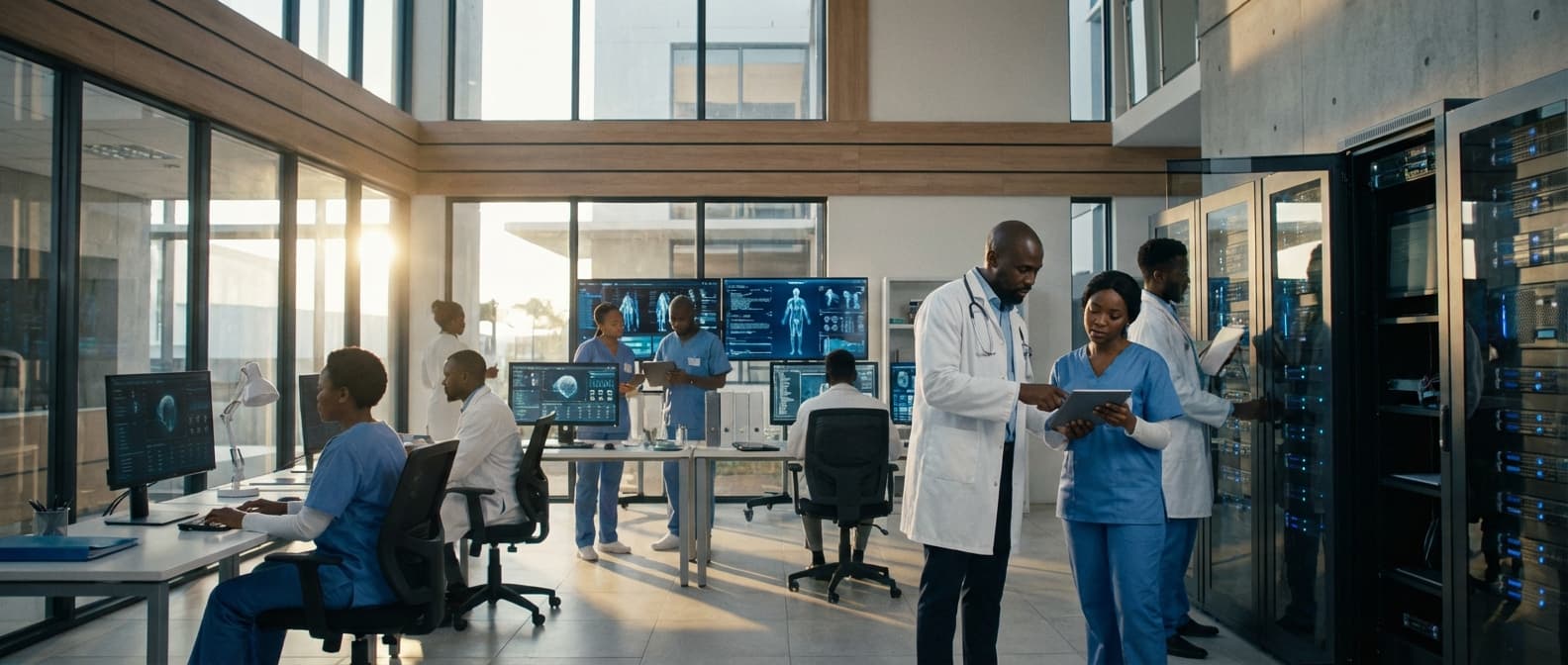
Tele-Radiology in Sao Tome and Principe
Engineering Excellence & Technical Support
24/7 access to certified radiologists providing rapid, accurate remote interpretation of diagnostic imaging studies. High-standard technical execution following OEM protocols and local regulatory frameworks.
Remote Diagnostic Imaging Hub
Established a state-of-the-art tele-radiology hub leveraging satellite and robust internet infrastructure, enabling immediate transfer and expert interpretation of medical images from remote clinics to specialized radiologists, significantly reducing diagnostic turnaround times for critical conditions.
AI-Powered Anomaly Detection
Implemented advanced Artificial Intelligence algorithms for automated preliminary screening of X-rays, CT scans, and MRIs. This AI system flags potential anomalies for radiologist review, enhancing diagnostic accuracy and prioritizing urgent cases, thereby improving patient outcomes and clinician efficiency.
Secure Cloud-Based PACS & RIS
Deployed a secure, scalable cloud-based Picture Archiving and Communication System (PACS) and Radiology Information System (RIS). This allows for seamless storage, retrieval, and sharing of patient imaging data and reports, ensuring data integrity, accessibility, and compliance with privacy regulations across all participating healthcare facilities.
What Is Tele-radiology In Sao Tome And Principe?
Tele-radiology, also known as teleradiology, is the practice of transmitting radiological images (such as X-rays, CT scans, and MRIs) from one location to another for the interpretation by a radiologist. This service leverages telecommunications technology to overcome geographical barriers, enabling remote diagnosis and consultation. In the context of Sao Tome and Principe, a nation with limited specialized medical personnel and infrastructure, tele-radiology plays a crucial role in enhancing access to diagnostic imaging services, improving patient outcomes, and optimizing resource utilization. It facilitates real-time or near real-time reporting and consultation, bridging the gap between imaging acquisition and expert interpretation.
| Who Needs Tele-Radiology? | Typical Use Cases in Sao Tome and Principe | |||||
|---|---|---|---|---|---|---|
| Hospitals and Clinics in Sao Tome and Principe: Especially those lacking on-site radiologists or specialized imaging expertise. | Emergency Room Consultations: Rapid interpretation of trauma imaging (e.g., fractures, intracranial hemorrhages) in critical care settings. | Rural and Remote Healthcare Facilities: Providing access to advanced diagnostic imaging for populations far from urban centers. | Specialized Imaging Interpretation: Requiring subspecialty expertise (e.g., neuroradiology, interventional radiology) that may not be locally available. | Outpatient Diagnostic Services: Facilitating timely diagnosis for non-urgent imaging requests, reducing patient waiting times. | Post-operative Monitoring: Remote interpretation of imaging to assess surgical outcomes and detect complications. | Public Health Initiatives: Supporting mass screening programs or diagnostic support for infectious diseases (e.g., tuberculosis screening via chest X-rays). |
| Patients in Sao Tome and Principe: Ensuring access to accurate and timely radiological diagnoses, regardless of their location or the availability of local specialists. | General Practitioners and Specialists: Receiving expert reports to aid in differential diagnosis and treatment planning. | Medical Training and Education: Facilitating remote teaching and case review for local medical professionals, enhancing capacity building. |
Key Components and Stakeholders of Tele-Radiology in Sao Tome and Principe
- Imaging Modalities: Acquisition of digital radiological images using various modalities (X-ray, Ultrasound, CT, MRI).
- Digital Image Acquisition and Storage: Conversion of analog images to digital formats (DICOM standard) and secure archival in Picture Archiving and Communication Systems (PACS).
- Transmission Network: Secure and reliable data transfer infrastructure (internet, dedicated lines) for transmitting images and reports.
- Workstation: Dedicated computer systems equipped with specialized software for viewing, manipulating, and interpreting medical images.
- Radiologists (Remote): Board-certified radiologists located in different geographical locations, often in countries with a surplus of radiologists, who perform the interpretation.
- Referral Physicians (Local): Clinicians in Sao Tome and Principe who order imaging examinations and receive the interpreted reports to guide patient management.
- IT Support and Cybersecurity: Technical personnel and robust security measures to ensure data integrity, patient confidentiality, and system uptime.
Who Needs Tele-radiology In Sao Tome And Principe?
Tele-radiology offers a vital solution for improving diagnostic imaging services in regions with limited specialist access. In Sao Tome and Principe, where the availability of experienced radiologists can be a significant challenge, tele-radiology platforms can bridge this gap. This technology allows medical facilities to remotely access expert radiological interpretation of X-rays, CT scans, MRIs, and ultrasounds, thereby enhancing patient care, speeding up diagnoses, and enabling timely treatment decisions. This is particularly crucial for complex cases, rare conditions, and emergency situations where immediate expert opinion is paramount.
| Customer Segment | Key Needs Addressed | Benefits of Tele-Radiology | Specific Departmental Needs |
|---|---|---|---|
| Public Hospitals and Clinics | Limited access to specialist radiologists, high patient volume, need for cost-effective solutions. | Improved diagnostic accuracy, reduced turnaround times for reports, continuous expert support, capacity building for local staff. | General radiology reporting for all modalities, specialized reads for complex cases (e.g., neurology, oncology). |
| Private Healthcare Facilities | Desire for enhanced service offerings, competitive advantage, efficient patient management. | Access to a wider pool of sub-specialty radiologists, 24/7 availability of expert opinions, enhanced reputation. | Gastroenterology imaging, musculoskeletal radiology, women's imaging. |
| Emergency Departments | Urgent need for rapid interpretation of critical imaging studies (trauma, stroke, acute abdomen). | Immediate expert consultation for life-saving decisions, reduced delays in patient management, improved outcomes. | Trauma imaging (CT scans of head, chest, abdomen, pelvis), stroke imaging (CT angiography), acute chest pain evaluation. |
| Surgical Departments | Pre-operative planning, post-operative monitoring, assessment of complications. | Accurate anatomical assessment for surgical planning, early detection of surgical complications, optimized patient care pathways. | Pre-operative imaging for orthopedic, neurosurgical, and general surgery procedures; post-operative follow-up scans. |
| Internal Medicine Departments | Diagnosis and management of a wide range of diseases affecting various organ systems. | Accurate diagnosis of pulmonary, cardiac, abdominal, and neurological conditions, informed treatment strategies. | Chest X-rays for pneumonia, CT scans for pulmonary embolism, abdominal ultrasounds for organ pathology. |
| Pediatric Departments | Specialized interpretation of imaging in neonates and children, requiring expertise in pediatric radiology. | Access to radiologists with pediatric expertise, ensuring appropriate radiation dose and interpretation for developing bodies. | Congenital anomaly detection, childhood malignancies, pediatric trauma. |
| Obstetrics and Gynecology Departments | Fetal anomaly screening, assessment of gynecological conditions. | Expert interpretation of obstetric ultrasounds for fetal well-being and anomaly detection, detailed gynecological imaging analysis. | Fetal ultrasounds (anatomy scans, nuchal translucency), pelvic ultrasounds for ovarian cysts, fibroids. |
| Rural Health Centers | Limited or no on-site radiology expertise, reliance on basic imaging modalities. | Bridging the geographical divide, providing access to specialist interpretation for basic imaging, improving diagnostic capabilities in remote areas. | Interpretation of basic X-rays (chest, skeletal), initial assessment of ultrasounds. |
| Mobile Diagnostic Units | Deployment of imaging services to underserved or remote populations, need for flexible and accessible interpretation. | Extending diagnostic reach, providing on-demand reporting for mobile units, facilitating healthcare access in diverse locations. | On-site reporting for mobile X-ray units, supporting remote screening programs. |
Target Customers and Departments for Tele-Radiology in Sao Tome and Principe
- Public Hospitals and Clinics
- Private Healthcare Facilities
- Emergency Departments
- Surgical Departments
- Internal Medicine Departments
- Pediatric Departments
- Obstetrics and Gynecology Departments
- Rural Health Centers
- Mobile Diagnostic Units
Tele-radiology Process In Sao Tome And Principe
The tele-radiology process in Sao Tome and Principe aims to bridge the gap in radiology expertise by leveraging remote interpretation of medical images. This workflow typically begins with an inquiry from a healthcare facility in Sao Tome and Principe that requires radiological interpretation for a patient. The inquiry is then processed, leading to the acquisition and transmission of medical images. A remote radiologist reviews these images, provides a report, and this report is then communicated back to the requesting facility for patient care. The entire process is facilitated by technology and a structured communication protocol.
| Step | Description | Key Actors | Technology/Tools | Outcome |
|---|---|---|---|---|
| Inquiry and Case Registration | A healthcare facility (e.g., a clinic or hospital) identifies a need for radiological interpretation for a patient. They formally submit a request, often including patient demographics and clinical history. | Requesting Clinician, Local Healthcare Administrator, Tele-radiology Platform Administrator | Tele-radiology platform (web portal/app), secure communication channels | Registered case with unique identifier, patient information captured |
| Image Acquisition and Preparation | Medical images (X-rays, CT scans, MRIs, etc.) are acquired using local imaging equipment. Images are then anonymized and prepared for transmission, ensuring adherence to privacy regulations. | Radiology Technician, Local Healthcare Staff | Medical Imaging Equipment (X-ray machine, CT scanner, MRI scanner), DICOM export functionality, anonymization software | Digital medical images in DICOM format, stripped of personally identifiable information |
| Secure Image Transmission | The prepared medical images are securely transmitted from the requesting facility in Sao Tome and Principe to the tele-radiology service provider's secure server or PACS (Picture Archiving and Communication System). | Local IT personnel, Tele-radiology Platform | High-speed internet connectivity, VPN, encrypted data transfer protocols (e.g., SFTP, HTTPS), cloud-based PACS or secure server | Images successfully uploaded to the central repository |
| Remote Radiologist Assignment and Review | The tele-radiology platform assigns the case to a qualified and available remote radiologist. The radiologist accesses the images and clinical information, performing a thorough review. | Tele-radiology Platform Scheduler, Remote Radiologist | Tele-radiology platform, advanced medical imaging viewer with AI-assisted tools (optional) | Initial interpretation of medical images |
| Report Generation and Quality Assurance | The remote radiologist dictates or types a comprehensive radiology report. The report undergoes a quality assurance check by another radiologist or through automated systems before finalization. | Remote Radiologist, QA Radiologist (optional), Speech recognition software | Radiology reporting software, dictation software, quality assurance checklists | Finalized, accurate, and high-quality radiology report |
| Report Dissemination and Integration | The finalized report is securely transmitted back to the requesting healthcare facility in Sao Tome and Principe, often integrated directly into their Electronic Health Record (EHR) system or accessible via the tele-radiology platform. | Tele-radiology Platform, Local Healthcare Provider | Secure communication channels, EHR integration interfaces (HL7), tele-radiology platform portal | Report accessible to the requesting clinician for patient management |
| Follow-up and Archiving | The case is archived in the tele-radiology system for future reference and audits. Any necessary follow-up consultations or clarifications between the requesting clinician and the remote radiologist are facilitated. | Tele-radiology Platform Administrator, Remote Radiologist, Requesting Clinician | PACS, long-term data storage, secure communication channels | Completed case, historical data for continuity of care, auditable records |
Tele-Radiology Workflow Steps
- Inquiry and Case Registration
- Image Acquisition and Preparation
- Secure Image Transmission
- Remote Radiologist Assignment and Review
- Report Generation and Quality Assurance
- Report Dissemination and Integration
- Follow-up and Archiving
Tele-radiology Cost In Sao Tome And Principe
Tele-radiology services offer a crucial solution for regions like Sao Tome and Principe, where access to specialized radiological expertise can be limited. The cost of these services is influenced by several factors, making it challenging to provide a single definitive price. These factors include the complexity and type of radiological examination required (e.g., X-ray, CT scan, MRI), the urgency of the report, the experience and qualifications of the remote radiologist, and the specific tele-radiology provider's operational costs and business model. In Sao Tome and Principe, the local currency is the Dobra (STN). While precise, publicly available pricing for tele-radiology in Sao Tome and Principe is scarce due to the nascent nature of the market and the typically direct contractual arrangements between healthcare providers and tele-radiology companies, we can infer potential cost ranges based on common pricing structures and the economic context.
| Service Type (Estimated) | Estimated Price Range (STN) | Notes |
|---|---|---|
| X-ray Interpretation (Routine) | 200 - 600 STN | Basic chest X-ray, limb X-ray. Assumes standard reporting time. |
| CT Scan Interpretation (Routine) | 800 - 2,500 STN | Abdomen, pelvis, head CTs. Complexity can influence the higher end. |
| MRI Interpretation (Routine) | 1,500 - 4,000 STN | Spine, brain, joint MRIs. Higher end for complex sequences or multiple regions. |
| Urgent/STAT Report Surcharge |
| For reports required within a few hours. |
| Sub-specialty Interpretation |
| For specific conditions requiring highly specialized radiologist input. |
Key Pricing Factors for Tele-Radiology in Sao Tome and Principe
- {"item":"Type of Imaging Modality","description":"More complex modalities like CT scans and MRIs typically incur higher reporting fees than standard X-rays due to the larger data sets and greater expertise required for interpretation."}
- {"item":"Report Urgency (Turnaround Time)","description":"Rush or STAT (immediate) reports often come with a premium charge compared to routine reporting within a standard timeframe."}
- {"item":"Radiologist Expertise and Specialization","description":"Sub-specialty interpretations (e.g., neuroradiology, musculoskeletal radiology) by highly experienced radiologists may command higher fees."}
- {"item":"Volume and Contractual Agreements","description":"Healthcare institutions in Sao Tome and Principe negotiating bulk contracts for a high volume of reads may secure lower per-case pricing."}
- {"item":"Technology and Platform Fees","description":"Some providers may include costs associated with their tele-radiology platform, data transmission, and IT support, which can be factored into the overall price."}
- {"item":"Provider's Overhead and Profit Margin","description":"The tele-radiology company's operational expenses, including staffing, technology, and desired profit, directly influence their pricing."}
- {"item":"Administrative Fees","description":"Basic administrative charges for processing requests and generating reports might be applied."}
Affordable Tele-radiology Options
Tele-radiology, the practice of interpreting medical images remotely, has become a crucial component of modern healthcare, offering enhanced efficiency and accessibility. For healthcare providers, especially those with budget constraints or seeking to optimize resources, exploring affordable tele-radiology options is paramount. This involves understanding innovative service models like value bundles and implementing strategic cost-saving measures. Value bundles in tele-radiology are designed to offer a comprehensive suite of services at a predictable, often discounted, price, moving away from traditional per-study fee structures. This can include a combination of interpretation, preliminary reads, quality assurance, and even subspecialty coverage. Cost-saving strategies extend beyond just the pricing model, encompassing factors like technology integration, workflow optimization, and careful vendor selection.
| Strategy | Description | Potential Cost Savings |
|---|---|---|
| Value Bundles (e.g., Per-Volume or Subscription) | Pre-negotiated packages of services (e.g., unlimited reads within a certain volume, or a fixed monthly fee for a set of services) that offer predictable costs and potential discounts for higher commitment. | Reduced per-study cost, predictable budgeting, avoidance of surprise charges. |
| Tiered Service Levels | Offering different levels of service (e.g., basic read, preliminary read, final read with subspecialty report) allowing providers to choose based on urgency and budget. | Paying only for the level of service required, avoiding unnecessary costs for less critical cases. |
| Flexible Scheduling and Coverage | Negotiating for coverage during specific hours or for particular types of studies, rather than requiring 24/7 immediate availability for all cases. | Lower costs by avoiding premium pricing for extended or constant coverage. |
| Technology Integration and Optimization | Leveraging existing Picture Archiving and Communication Systems (PACS) and Electronic Health Records (EHR) where possible, and choosing vendors with user-friendly interfaces that minimize training time. | Reduced capital expenditure on new hardware, lower IT support costs, and improved workflow efficiency. |
| Long-Term Contracts and Commitments | Committing to longer contract durations in exchange for preferential pricing or additional service inclusions. | Lower per-study rates, potential for additional benefits or dedicated resources. |
| Volume-Based Discounts | Arranging for pricing that decreases as the volume of studies interpreted by the tele-radiology provider increases. | Directly proportional savings as utilization grows. |
| Shared Subspecialty Services | Accessing subspecialty radiology interpretation through a tele-radiology provider that serves multiple clients, spreading the cost of these highly specialized services. | Access to expertise without the prohibitive cost of hiring full-time subspecialists or contracting individually with multiple niche groups. |
Key Considerations for Affordable Tele-Radiology
- Defining clear service needs and volume expectations.
- Researching vendors with transparent pricing and flexible contracts.
- Evaluating the technical infrastructure required and potential integration costs.
- Understanding the vendor's quality assurance and credentialing processes.
- Negotiating terms based on long-term partnerships and commitment.
- Exploring options for round-the-clock coverage versus specific time windows.
- Assessing the impact on existing radiology workflows and staff.
Verified Providers In Sao Tome And Principe
Navigating healthcare in a new country can be a daunting task. For expatriates and visitors in Sao Tome and Principe, identifying trusted and verified healthcare providers is paramount. Franance Health stands out as a premier provider, offering a robust network of accredited medical professionals and facilities. Their rigorous credentialing process ensures that all affiliated providers meet the highest international standards of quality and patient care. This commitment to excellence means patients can access safe, effective, and timely medical services, alleviating the stress often associated with seeking healthcare abroad. Franance Health's comprehensive approach not only simplifies the process of finding qualified doctors and specialists but also provides peace of mind, knowing that you are in capable hands.
| Provider Type | Franance Health Credentialing Ensures: | Why This Matters for Patients |
|---|---|---|
| Doctors & Specialists | Up-to-date medical licenses and certifications. | Guaranteed access to qualified and experienced medical practitioners. |
| Hospitals & Clinics | Compliance with international safety and hygiene protocols. | Access to well-equipped facilities and sterile environments. |
| Diagnostic Centers | Use of calibrated and modern medical equipment. | Accurate and reliable diagnostic results. |
| Emergency Services | Availability of trained medical personnel and rapid response capabilities. | Prompt and effective care in urgent situations. |
| Pharmaceuticals | Sourcing from reputable and regulated suppliers. | Access to safe and authentic medications. |
Key Benefits of Choosing Franance Health:
- Extensive network of verified and accredited medical professionals.
- Adherence to high international standards of healthcare quality.
- Simplified access to diverse medical specialties and services.
- Enhanced patient safety and confidence.
- Streamlined process for appointment booking and medical assistance.
Scope Of Work For Tele-radiology
This Scope of Work (SOW) outlines the technical deliverables and standard specifications for implementing a Tele-Radiology service. The objective is to establish a robust and reliable tele-radiology solution that facilitates remote interpretation of medical imaging studies, improving access to expert radiological opinions and enhancing patient care efficiency.
| Specification Category | Description | Standard/Requirement |
|---|---|---|
| Image Quality & Viewing | Image display resolution and luminance for accurate diagnosis. | Minimum 3MP (3 MegaPixel) grayscale displays, 8-bit or higher grayscale depth, luminance > 400 cd/m², contrast ratio > 1000:1. Compliance with DICOM Part 14 Grayscale Standard Display Function. |
| Image Transmission | Secure and efficient transfer of medical imaging studies. | DICOM 3.0 compliance for image transfer (C-STORE, C-GET, C-MOVE). Use of secure protocols like TLS/SSL for data in transit. Bandwidth utilization optimization techniques. |
| Data Security & Privacy | Protection of patient data in accordance with regulatory requirements. | HIPAA, GDPR, or equivalent compliance. Encryption of data at rest (AES-256) and in transit. Role-based access control. Regular security audits and vulnerability assessments. |
| Platform Performance | System responsiveness and availability for timely reporting. | Image loading times < 5 seconds. Report generation times < 30 seconds. Platform uptime > 99.9%. |
| Interoperability | Seamless integration with existing healthcare IT systems. | HL7 compliance for integration with HIS/EMR. DICOM conformance for PACS integration. API availability for custom integrations. |
| Reporting & Dictation | Tools for creating accurate and standardized radiology reports. | Support for structured reporting templates. Integration with speech recognition engines. Digital signature capabilities for report authentication. |
| Network Connectivity | Reliable and secure network infrastructure for data transfer. | VPN or dedicated secure connections. Minimum guaranteed bandwidth for image transfer (e.g., 10 Mbps per radiologist, scalable). Network latency < 100ms for real-time interaction. |
| Audit & Compliance | Logging of all system access and user activities. | Comprehensive audit trails capturing user login/logout, image access, report creation/modification. Data retention policies compliant with local regulations. |
Technical Deliverables
- Secure and scalable Tele-Radiology Platform (PACS/RIS integration or standalone)
- High-resolution imaging display workstations (for radiologists)
- Secure, high-bandwidth network connectivity (VPN, dedicated lines)
- Data encryption and anonymization protocols
- User authentication and access control mechanisms
- Image acquisition and transmission protocols (DICOM compliance)
- Reporting and dictation tools (integrated or standalone)
- Audit trails and logging capabilities
- Disaster recovery and business continuity plan
- Training materials and documentation for end-users and IT staff
- Integration services with existing hospital IT infrastructure (HIS, EMR)
- Ongoing technical support and maintenance services
Service Level Agreement For Tele-radiology
This Service Level Agreement (SLA) outlines the performance standards for tele-radiology services provided by [Your Company Name] to [Client Name]. It specifies guaranteed response times for critical and routine reads, as well as uptime guarantees for the tele-radiology platform.
| Service Component | Service Level Objective (SLO) | Measurement Method | Remedy for Failure |
|---|---|---|---|
| Critical Study Response Time | 95% of critical studies reported within 60 minutes of study receipt. | System logs tracking timestamp of study receipt and report finalization. | For each instance exceeding 60 minutes, a service credit of [X]% of the monthly fee for that study type will be applied. |
| Routine Study Response Time | 98% of routine studies reported within 24 hours of study receipt. | System logs tracking timestamp of study receipt and report finalization. | For each instance exceeding 24 hours, a service credit of [Y]% of the monthly fee for that study type will be applied. |
| Platform Uptime | 99.9% uptime for the tele-radiology platform (excluding scheduled maintenance). | Third-party monitoring tools tracking platform availability. | For each full hour of unplanned downtime exceeding the guaranteed uptime, a service credit of [Z]% of the monthly platform access fee will be applied. Pro-rata credits will be issued for partial hours. |
| Scheduled Maintenance | Any scheduled maintenance will be communicated to the client at least [N] days in advance and will occur during [Days/Times] to minimize disruption. | Communication logs and system notifications. | N/A (as this is a planned activity). |
Key Performance Indicators
- Response Time: The time taken from successful receipt of a study to the transmission of a finalized report.
- Uptime: The percentage of time the tele-radiology platform is available and operational for image viewing, reporting, and communication.
- Critical Study: A study identified by the client as requiring immediate attention due to suspected emergent condition (e.g., stroke, acute hemorrhage, pulmonary embolism).
- Routine Study: Any study not classified as critical.
Frequently Asked Questions

Ready when you are
Let's scope your Tele-Radiology in Sao Tome and Principe project in Sao Tome and Principe.

Scaling healthcare logistics and technical systems across the entire continent.