
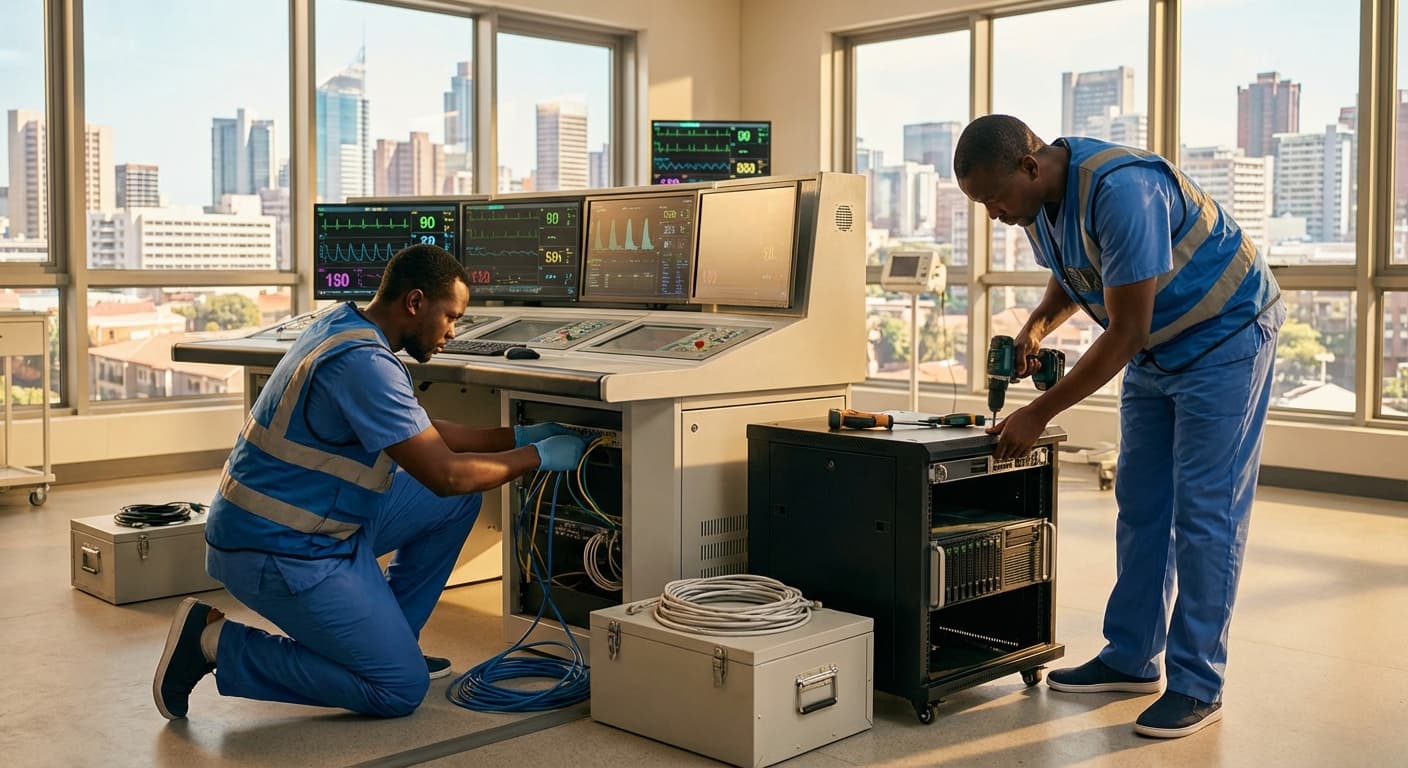
ICU Central Monitoring Station Installation Service in Sao Tome and Principe
Engineering Excellence & Technical Support
ICU Central Monitoring Station Installation Service High-standard technical execution following OEM protocols and local regulatory frameworks.
State-of-the-Art Network Infrastructure Design
We engineer robust and redundant network architectures specifically for ICU environments, ensuring seamless, real-time data transmission from vital signs monitors to a central hub. Our installations prioritize minimal latency and maximum reliability, leveraging secure protocols to protect sensitive patient data in compliance with international standards.
Advanced Integrated Display and Alert Systems
Our service includes the setup and configuration of high-resolution, multi-panel display systems that provide a comprehensive, at-a-glance overview of all patient vital signs. We integrate sophisticated, customizable alert mechanisms that trigger immediate notifications to clinical staff based on pre-defined critical thresholds, enhancing rapid response times.
Scalable and Secure Data Management Solutions
We implement scalable data management platforms that facilitate secure storage, retrieval, and analysis of patient monitoring data. Our solutions are designed to grow with your facility's needs and ensure compliance with local data privacy regulations, providing long-term benefits for patient care optimization and research.
What Is Icu Central Monitoring Station Installation Service In Sao Tome And Principe?
ICU Central Monitoring Station Installation Service in Sao Tome and Principe refers to the comprehensive process of designing, procuring, installing, configuring, testing, and commissioning a centralized monitoring system for Intensive Care Units (ICUs) within healthcare facilities located in Sao Tome and Principe. This service ensures that critical patient physiological data from multiple ICU beds can be collected, displayed, analyzed, and managed from a single, dedicated location, enhancing patient safety, clinical decision-making, and resource allocation.
| Who Needs This Service? | Typical Use Cases in Sao Tome and Principe | ||||||
|---|---|---|---|---|---|---|---|
| Hospitals with existing or planned Intensive Care Units (ICUs) in Sao Tome and Principe. | Monitoring critically ill patients requiring continuous physiological surveillance (e.g., post-operative care, sepsis, respiratory failure, cardiac emergencies). | Facilitating efficient patient management in high-acuity settings, reducing the need for constant bedside presence for basic data checks. | Enhancing patient safety through timely identification and response to critical events via centralized alarm systems. | Improving clinical decision-making by providing a comprehensive overview of patient status and trends across multiple beds. | Supporting medical education and research by providing accessible and comprehensive patient data. | Healthcare facilities aiming to upgrade their existing monitoring capabilities to meet international standards. | New hospital construction projects requiring integrated critical care monitoring solutions. |
Key Components and Scope of ICU Central Monitoring Station Installation Service:
- Site Survey and Requirements Analysis: Assessment of existing ICU infrastructure, network capabilities, power supply, and specific monitoring needs of the healthcare facility.
- System Design and Architecture: Development of a tailored system architecture, including selection of central monitoring servers, workstations, networking components, and integration with existing bedside monitors and EMR/HIS systems.
- Hardware Procurement and Logistics: Sourcing and delivery of all necessary hardware, including central monitoring units, network switches, servers, workstations, display screens, and cabling.
- Network Infrastructure Setup: Installation and configuration of a robust and secure network (wired or wireless) to ensure reliable data transmission from bedside monitors to the central station.
- Software Installation and Configuration: Deployment and setup of the central monitoring software, including patient data management, alarm configuration, trend analysis tools, and reporting functionalities.
- Integration with Bedside Monitoring Devices: Establishing seamless communication protocols and interfaces to collect real-time data (e.g., ECG, SpO2, NIBP, EtCO2, invasive pressures) from diverse bedside monitor manufacturers.
- Integration with EMR/HIS Systems (Optional but Recommended): Connecting the central monitoring station to the Electronic Medical Record (EMR) or Hospital Information System (HIS) for automated data logging and enhanced clinical workflow.
- Alarm Management System Setup: Configuration of critical alarm parameters, prioritization levels, audible and visual alerts, and notification pathways to ensure timely clinical response.
- Testing and Validation: Comprehensive testing of system functionality, data accuracy, network reliability, alarm responsiveness, and integration points.
- User Training: Provision of specialized training for clinical staff (nurses, physicians, technicians) on the operation, data interpretation, and maintenance of the central monitoring system.
- Documentation and Handover: Delivery of detailed system documentation, user manuals, and as-built drawings, followed by a formal handover of the operational system.
- Post-Installation Support and Maintenance: Offering ongoing technical support, troubleshooting, software updates, and preventive maintenance services.
Who Needs Icu Central Monitoring Station Installation Service In Sao Tome And Principe?
The installation of an ICU Central Monitoring Station is a critical undertaking for healthcare facilities requiring advanced patient surveillance. This service is essential for hospitals and clinics that aim to provide high-level critical care, allowing for continuous, real-time observation of multiple ICU patients from a centralized location. Such a system is vital for early detection of deteriorating patient conditions, immediate intervention by medical staff, and overall improvement in patient outcomes. The service typically includes the installation, configuration, testing, and training associated with the central monitoring system, ensuring seamless integration with existing ICU equipment and workflows.
| Target Customer Type | Primary Departments Requiring Service | Key Needs and Benefits |
|---|---|---|
| Government Hospitals | Intensive Care Unit (ICU), Cardiology Department, Neurology Department | To upgrade existing critical care infrastructure, improve patient safety, and enhance the capacity for handling complex cases. Essential for public health preparedness. |
| Private Hospitals and Clinics | Intensive Care Unit (ICU), Post-Operative Recovery Units, Emergency Department | To offer state-of-the-art critical care services, attract and retain patients seeking advanced medical treatment, and maintain a competitive edge in the healthcare market. |
| Tertiary Care Centers and Teaching Hospitals | Intensive Care Unit (ICU), Surgical ICUs, Medical ICUs, Specialized Units | To support advanced medical training, facilitate research, and provide comprehensive, high-acuity patient care. Centralized monitoring is crucial for complex patient management and teaching. |
| Specialized Cardiac or Neurological Centers | Cardiac ICU, Neuro-ICU | To provide continuous and specialized monitoring for patients with critical cardiac or neurological conditions. Early detection of subtle changes is paramount for these patient populations. |
| NGO Supported Health Facilities | Intensive Care Unit (ICU) | To enhance the quality of critical care provided in underserved regions, ensuring that essential life-saving monitoring capabilities are available to a broader population. |
Target Customers for ICU Central Monitoring Station Installation Service in Sao Tome and Principe
- Government Hospitals and Public Healthcare Systems
- Private Hospitals and Clinics
- Tertiary Care Centers and Teaching Hospitals
- Specialized Cardiac or Neurological Centers
- Non-Governmental Organization (NGO) Supported Health Facilities
Icu Central Monitoring Station Installation Service Process In Sao Tome And Principe
This document outlines the workflow for installing an ICU Central Monitoring Station service in Sao Tome and Principe, covering the process from initial inquiry to final execution and handover. The service aims to provide critical infrastructure for modern healthcare facilities, enabling real-time patient data monitoring and improving patient care outcomes.
| Phase | Key Activities | Deliverables | Responsible Parties | Estimated Timeline (Weeks) |
|---|---|---|---|---|
| 1: Initial Inquiry & Consultation | Client expresses interest, initial requirements discussed, scope of work clarified, preliminary information exchanged. | Initial understanding of project scope, preliminary needs assessment. | Client, Service Provider (Sales/Technical Team) | 1-2 |
| 2: Site Assessment & Planning | Detailed site survey (electrical, network, room layout), feasibility study, patient volume assessment, identification of specific equipment needs, risk assessment. | Detailed site survey report, technical specifications document, project plan outline. | Service Provider (Technical Team, Engineers), Client (Facilities Management, Medical Staff) | 2-4 |
| 3: Proposal & Contract Negotiation | Development of a comprehensive technical and commercial proposal, detailed breakdown of costs, timelines, and service level agreements (SLAs), negotiation of contract terms. | Formal proposal document, signed service contract/agreement. | Service Provider (Sales Team, Legal), Client (Procurement, Legal) | 3-5 |
| 4: Procurement & Logistics | Ordering of all necessary hardware (servers, workstations, network devices, cabling, patient monitors, etc.) and software licenses, customs clearance, transportation to Sao Tome and Principe. | Procured equipment and software, cleared customs, arrival at site. | Service Provider (Procurement, Logistics), Client (Import/Customs Liaison) | 6-12 (can vary significantly based on lead times and shipping) |
| 5: Installation & Configuration | Physical installation of all hardware components, network cabling, server setup, software installation and configuration, integration with existing hospital IT infrastructure. | Installed and configured hardware and software, network infrastructure in place. | Service Provider (Installation Engineers, Network Specialists, Software Engineers), Client (IT Department) | 4-8 |
| 6: Testing & Commissioning | Systematic testing of all functionalities (data acquisition, display, alarms, reporting), performance testing, integration testing, user acceptance testing (UAT). | Test reports, performance benchmarks, successfully commissioned system, UAT sign-off. | Service Provider (Testing Engineers, Project Manager), Client (Medical Staff, IT Department) | 2-3 |
| 7: Training & Handover | Comprehensive training for medical staff (doctors, nurses) and IT personnel on system operation, maintenance, and troubleshooting. Formal handover of the system and documentation. | Trained personnel, user manuals, technical documentation, final project handover certificate. | Service Provider (Trainers, Project Manager), Client (Medical Staff, IT Department) | 1-2 |
| 8: Post-Installation Support & Maintenance | Ongoing technical support, remote monitoring, scheduled maintenance, software updates, warranty management, provision for spare parts. | Service level agreements for ongoing support, maintenance schedule, regular performance reports. | Service Provider (Support Team, Maintenance Engineers), Client (IT Department, Medical Staff) | Ongoing (as per contract) |
ICU Central Monitoring Station Installation Service Process
- Phase 1: Initial Inquiry & Consultation
- Phase 2: Site Assessment & Planning
- Phase 3: Proposal & Contract Negotiation
- Phase 4: Procurement & Logistics
- Phase 5: Installation & Configuration
- Phase 6: Testing & Commissioning
- Phase 7: Training & Handover
- Phase 8: Post-Installation Support & Maintenance
Icu Central Monitoring Station Installation Service Cost In Sao Tome And Principe
Installing an ICU Central Monitoring Station in Sao Tome and Principe involves a complex process with varying costs. The pricing is influenced by several key factors, including the size and complexity of the ICU, the specific features and capabilities of the chosen monitoring system, the need for new infrastructure or integration with existing hospital systems, and the expertise of the installation service provider. The units of currency are primarily the Dobra (STD), although US Dollars (USD) are also frequently used in commercial transactions, especially for imported equipment. It's crucial to obtain detailed quotes from multiple specialized suppliers and installers to ensure competitive pricing and the best value for your specific needs.
| Cost Component | Estimated Range (Dobra - STD) | Estimated Range (USD) |
|---|---|---|
| Basic Patient Monitors (per bed) | 30,000 - 90,000 STD | 1,300 - 4,000 USD |
| Advanced Patient Monitors (per bed) | 70,000 - 250,000+ STD | 3,000 - 11,000+ USD |
| Central Monitoring Console/Server | 200,000 - 800,000 STD | 9,000 - 35,000 USD |
| Network Infrastructure (cabling, switches) | 50,000 - 200,000 STD | 2,000 - 9,000 USD |
| Software Licenses & EMR Integration | 100,000 - 500,000+ STD | 4,500 - 22,000+ USD |
| Installation & Labor (Biomedical Engineers/IT) | 80,000 - 300,000 STD | 3,500 - 13,000 USD |
| Training (Staff & Technicians) | 40,000 - 150,000 STD | 1,800 - 6,500 USD |
| Import Duties, Taxes & Clearance | Variable (typically 10-30% of CIF) | Variable |
| Total Estimated Cost (Small to Medium ICU, 4-8 beds) | 650,000 - 2,500,000+ STD | 28,000 - 110,000+ USD |
| Total Estimated Cost (Large ICU, 10-20+ beds with advanced features) | 2,000,000 - 8,000,000+ STD | 90,000 - 350,000+ USD |
Key Pricing Factors for ICU Central Monitoring Station Installation:
- System Complexity and Features: Basic patient monitoring systems will be less expensive than advanced platforms offering integrated hemodynamic monitoring, advanced respiratory monitoring, drug administration tracking, and EMR integration capabilities. The number of beds to be monitored also directly impacts cost.
- Hardware and Software Costs: This includes the cost of patient monitors (per bed), central console/server, network infrastructure (cabling, switches), alarms, and the specialized software for data acquisition, analysis, and display. Prices can vary significantly based on brand reputation, technological sophistication, and the number of concurrent users.
- Installation and Integration Services: This encompasses the labor costs for skilled biomedical engineers and IT technicians. It includes physical installation of hardware, network configuration, software setup, system calibration, and crucial integration with existing hospital Electronic Medical Records (EMR) or Picture Archiving and Communication Systems (PACS).
- Infrastructure Requirements: The existing electrical and network infrastructure within the hospital plays a significant role. If extensive rewiring, new power outlets, or network upgrades are required, it will add to the overall cost.
- Training: Comprehensive training for medical staff (doctors, nurses) and biomedical technicians on operating and maintaining the new system is an essential, and often separately itemized, cost.
- Warranty and After-Sales Support: The duration and scope of the warranty, as well as the availability and cost of ongoing technical support and maintenance contracts, should be factored into the total investment.
- Brand and Supplier Reputation: Renowned international brands might come with higher initial costs but often offer superior reliability, advanced features, and better support. Local or regional suppliers might offer more competitive pricing but require careful vetting for quality and service.
- Import Duties and Taxes: As most advanced medical equipment is imported into Sao Tome and Principe, import duties, taxes, and customs clearance fees will add to the final price. These can fluctuate based on government regulations.
Affordable Icu Central Monitoring Station Installation Service Options
Installing a Central Monitoring Station (CMS) for an Intensive Care Unit (ICU) is a critical investment for patient safety and efficient care delivery. While the initial cost can seem substantial, numerous options and strategies exist to make this essential technology affordable and maximize its long-term value. This guide explores affordable installation service options, valuable bundles, and effective cost-saving strategies.
| Affordable Installation Service Options | Description | Cost-Saving Considerations |
|---|---|---|
| Phased Implementation | Instead of installing a full-scale CMS at once, implement it in phases. Start with essential monitoring capabilities and gradually add advanced features as budget allows. | Spreads out the initial capital expenditure. Allows for learning and optimization with each phase. |
| Refurbished or Certified Pre-Owned Equipment | Consider purchasing high-quality, refurbished patient monitors and central station hardware from reputable vendors. These often come with warranties and significant cost savings. | Reduces upfront equipment costs by 30-60%. Ensure certifications and warranty coverage for reliability. |
| Open-Source or Lower-Cost Software Solutions | Explore CMS software with more flexible licensing models or consider open-source alternatives if robust customization and support are available and align with IT capabilities. | Minimizes recurring software licensing fees. May require in-house IT expertise for implementation and maintenance. |
| Bundled Service Packages | Many vendors offer bundled packages that include equipment, installation, training, and initial maintenance at a discounted rate compared to purchasing services separately. | Streamlines procurement and can lead to overall package discounts. Simplifies vendor management. |
| Third-Party Installation Specialists | Engage specialized third-party IT or medical equipment installation companies that may offer more competitive pricing than the original equipment manufacturer (OEM) for the installation process itself. | Can offer specialized expertise and potentially lower labor rates than OEM-provided services. Due diligence on vendor experience is crucial. |
| Leasing or Subscription Models | Explore equipment leasing or Software-as-a-Service (SaaS) models for the CMS software. This shifts the cost from a large upfront capital expense to predictable operational expenses. | Reduces immediate capital outlay. Predictable monthly costs make budgeting easier. May include maintenance and upgrades. |
| Local Vendor Partnerships | Collaborate with local IT integrators or medical device suppliers who may have lower overhead costs and be more willing to negotiate competitive installation rates. | Potentially lower travel and logistics costs. Fosters local economic partnerships. |
Understanding ICU Central Monitoring Station Installation
- What is an ICU Central Monitoring Station? A CMS allows healthcare professionals to remotely monitor multiple ICU patients' vital signs from a central location, such as a nursing station. This enhances early detection of patient deterioration and improves response times.
- Key Components: Typically includes bedside patient monitors, a central display/server, network infrastructure, and software for data management and alarm handling.
- Installation Service: Encompasses the planning, procurement, setup, configuration, testing, and training required to integrate the CMS into the existing ICU infrastructure.
- Importance of Affordability: Balancing advanced technology with budget constraints is crucial for healthcare facilities, especially smaller or resource-limited ones.
Verified Providers In Sao Tome And Principe
In Sao Tome and Principe, ensuring access to reliable and qualified healthcare providers is paramount. Franance Health stands out as a leading entity, offering a robust network of verified healthcare professionals. Their rigorous credentialing process guarantees that all listed providers meet the highest standards of medical expertise, ethical practice, and patient care. Choosing Franance Health means opting for a service that prioritizes your well-being by connecting you with trusted and competent medical professionals. Their commitment to transparency and quality assurance makes them the unequivocal best choice for healthcare needs in Sao Tome and Principe.
| Provider Type | Franance Health Credentialing Key Points |
|---|---|
| General Practitioners | Verified medical degree, valid practicing license, continuous professional development. |
| Specialists (e.g., Cardiologists, Pediatricians) | Board certification in their specialty, advanced training, proven track record. |
| Dentists | Accredited dental school graduation, current dental board registration, adherence to sterilization protocols. |
| Nurses | Registered Nurse (RN) or equivalent certification, relevant practical experience, background checks. |
| Pharmacists | Licensed pharmacist, knowledge of drug interactions and patient counseling, secure dispensing practices. |
| Therapists (e.g., Physiotherapists) | Recognized therapy degree, professional licensing, evidence-based practice adherence. |
Why Franance Health Credentials Matter
- Rigorous Verification: Franance Health employs a comprehensive vetting process for all its providers.
- Expertise & Competence: Ensures all listed professionals possess the necessary qualifications and experience.
- Ethical Standards: Upholds the highest ethical conduct in medical practice.
- Patient-Centric Care: Focuses on providers committed to delivering excellent patient outcomes.
- Reliability & Trust: Builds a network of dependable healthcare professionals you can count on.
- Accessibility: Facilitates easier access to quality healthcare services.
Scope Of Work For Icu Central Monitoring Station Installation Service
This Scope of Work (SOW) outlines the requirements for the installation services of an Intensive Care Unit (ICU) Central Monitoring Station. The service includes the supply, installation, configuration, testing, and commissioning of all necessary hardware and software to establish a fully functional central monitoring station for the ICU. This SOW also details the technical deliverables expected from the service provider and the standard specifications to be adhered to throughout the project.
| Technical Deliverable | Description | Standard Specification/Reference |
|---|---|---|
| Detailed System Design Document | Includes network architecture, server specifications, workstation layout, alarm management strategy, data storage plan, and integration points with existing hospital systems (e.g., EMR/HIS). | ISO 9001 (Quality Management), Hospital IT Policies, HIPAA/GDPR (Data Privacy), Project-Specific Design Guidelines |
| Installed Central Monitoring Station Hardware | Includes servers, workstations, large display monitors, UPS systems, network switches, and associated peripherals as per the approved design. | CE Marking, UL Certification, Manufacturer's Datasheets, Project-Specific Hardware List |
| Installed & Configured Monitoring Software | Includes patient monitoring software, alarm management software, data archiving/retrieval software, and any necessary middleware for integration. | Vendor-Specific Software Documentation, Project-Specific Software Configuration Guide, Compatibility Matrix |
| Network Cabling & Infrastructure | Includes installation of network cables (Cat 6 or higher), patch panels, and network drops to connect monitoring devices to the central station. All cabling to meet fire safety and electrical codes. | TIA/EIA-568-C, Local Electrical Codes, Fire Safety Regulations (e.g., NFPA 72) |
| System Integration Report | Documentation detailing successful integration with existing hospital systems, including data flow diagrams and testing results. | HL7 Standards (for EMR/HIS integration), Project-Specific Integration Plan, Test Cases & Results |
| Testing & Validation Reports | Comprehensive reports covering unit testing, integration testing, performance testing, and user acceptance testing (UAT). | ISO 13485 (Medical Device Quality Management), Manufacturer's Test Protocols, Project-Specific Test Plans |
| User Manuals & Training Materials | Documentation for system administrators and end-users, including operational procedures and troubleshooting guides. Training sessions conducted for relevant personnel. | Vendor-Specific User Manuals, Project-Specific Training Plan & Materials |
| As-Built Drawings | Updated architectural and network drawings reflecting the final installed configuration. | CAD Standards, Project-Specific Drawing Requirements |
| Commissioning Certificate | Formal document signed by the provider and client confirming the system is installed, tested, and operational according to specifications. | Project-Specific Handover Checklist & Acceptance Criteria |
| Post-Installation Support Plan | Details of warranty period, service level agreements (SLAs), and contact information for ongoing technical support. | Project-Specific Support Agreement, Vendor Warranty Terms |
Key Project Phases & Activities
- Site Survey & Assessment
- System Design & Planning
- Equipment Procurement & Delivery
- Installation & Cabling
- Hardware & Software Configuration
- System Integration & Testing
- User Training
- Commissioning & Handover
- Post-Installation Support
Service Level Agreement For Icu Central Monitoring Station Installation Service
This Service Level Agreement (SLA) outlines the response times and uptime guarantees for the installation of the ICU Central Monitoring Station (CMS) service provided by [Your Company Name] (hereinafter referred to as 'Provider') to [Client Name] (hereinafter referred to as 'Client'). This SLA is an integral part of the Master Service Agreement (MSA) between the Provider and the Client.
| Service Component | Response Time (Critical) | Resolution Time (Critical) | Response Time (Non-Critical) | Resolution Time (Non-Critical) | Uptime Guarantee |
|---|---|---|---|---|---|
| CMS Hardware Installation | 4 Business Hours | 24 Business Hours | 8 Business Hours | 48 Business Hours | N/A (Installation Service) |
| CMS Software Configuration & Integration | 4 Business Hours | 24 Business Hours | 8 Business Hours | 48 Business Hours | N/A (Installation Service) |
| System Testing & Validation | 8 Business Hours | 24 Business Hours | 16 Business Hours | 72 Business Hours | N/A (Installation Service) |
| Basic User Training | Scheduled as per agreed upon timeline | N/A | Scheduled as per agreed upon timeline | N/A | N/A (Training Service) |
| Post-Installation System Availability (after successful handover) | 2 Business Hours (for critical issues) | 8 Business Hours (for critical issues) | 8 Business Hours (for non-critical issues) | 48 Business Hours (for non-critical issues) | 99.5% |
Scope of Service
- Installation of all required hardware for the ICU Central Monitoring Station.
- Configuration and integration of the ICU Central Monitoring Station software.
- Testing and validation of the complete ICU Central Monitoring Station system.
- Basic user training for designated hospital staff.
- On-site support during the installation and initial configuration phase.
Frequently Asked Questions

Ready when you are
Let's scope your ICU Central Monitoring Station Installation Service in Sao Tome and Principe project in Sao Tome and Principe.

Scaling healthcare logistics and technical systems across the entire continent.